
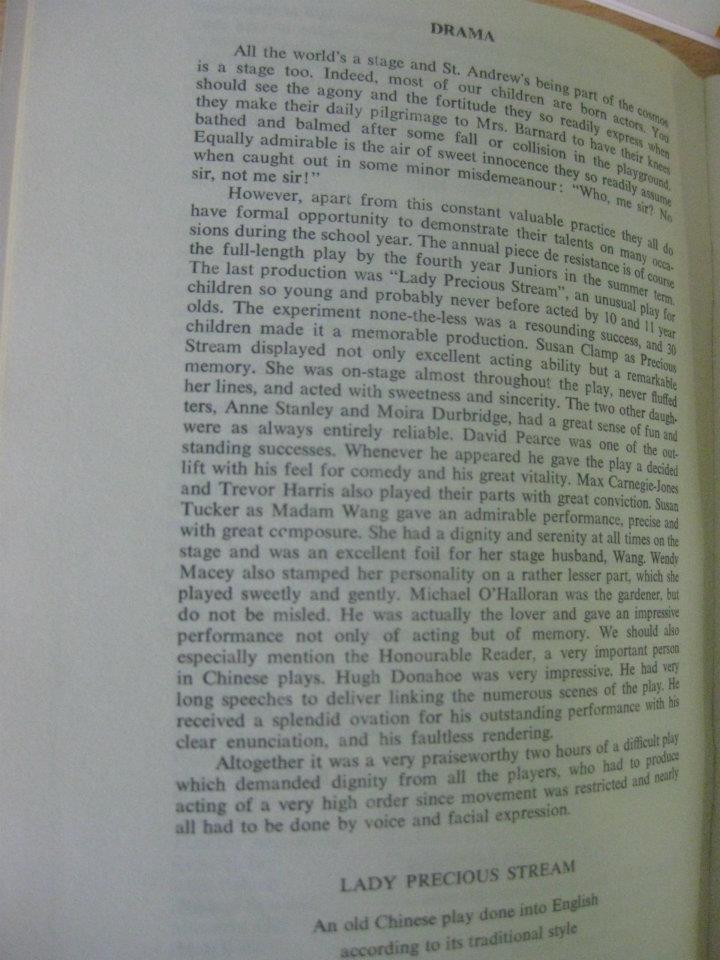
I first got into amateur dramatics in Junior School when our fourth year play took place and I decided to audition for one of the parts in a play called Lady Precious Stream. I got the part of the Prime Minister, one of the main roles, but almost lost it before I got on stage! At the first read through, I hadn’t done more than glance through my part, so not only was I hazy on the speeches, I didn’t know where my cues were! The headmaster Commander Starkie was very angry and said that there would be another read through the following day and anyone who was similarly clueless then would be removed from their role. I was not about to become Spear Carrier Number 1 so I spent the evening poring over the script and practicing for hours until I was happy that I had got it memorised. The following day I was word perfect, and I never put myself into that situation again whenever there was a script to learn. When I got to the two performances I was flying as this review, which I never saw until I revisited the school 35 years later, attests.
It was to be over a decade before I ventured onto stage again as my hated secondary school, Maths School Rochester, made it clear that if I did step out in front of an audience I would be ridiculed and bullied by pupils and staff alike. The local church, which I was involved in around my teens and twenties, had a drama group called ASCAF and my best friend Gavin was one of the regular performers. He persuaded me that I should go along and for the first production, a pantomime called Hickory Dickory Dock, and I was the prompt for the production. On the second night I appeared on stage, or at least my arm did! The characters were supposed to find a note on the stage but the crew hadn’t put it there to find. Thinking quickly I decided that as it was a pantomime I could give them the note and have some fun at the same time. So, I stretched my arm out from the wings with the note in my hand causing laughter on and off stage and in the audience. It made me think that perhaps the next production I could take a chance and audition.
The next play was Grease. I hadn’t become as obsessed with the musical as most back in 1978 and when we started in late 1986 I wouldn’t have listened to the songs in 7 or 8 years. I was not sure what part I wanted, if any, but as I had promised myself I would give it a go I auditioned. I got given the part of Johnny Casino, the lead singer of the band, Johnny Casino and the Gamblers, at the high school dance. The prospect terrified me, especially when I found out that I would be backed by a live band. How could someone like me live up to singing in front of musicians who were well trained and highly talented? I had such a case of Imposter Syndrome that I tried to pull out. Luckily, the director who had seen everything before talked me round and gave me the opportunity to give my best. I decided to get into character so I went to the barber’s in town and asked for a fifties style DA cut. The teasing I got from the other cast members was incredible, but it really made me feel like I belonged. I had a huge wobble on the morning of the opening performance, but I had come too far to back out now, and the first night was such a great experience – well at least once I got on stage it was! Having a band behind me was a massive help and I just went into a zone that allowed me to relax and heightened my senses at the same time. It was an experience that money couldn’t buy and I wanted more!
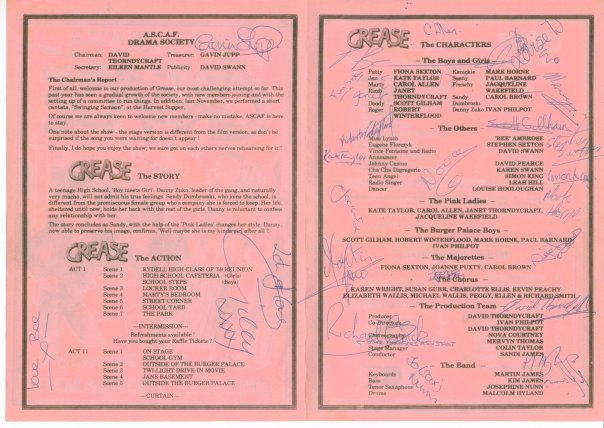

I am on the far right with the white shirt and red cummerbund!
My final role on stage came a year later where I was the compere for ASCAF’s Greatest Hits. I linked the pieces, gave a few details and anecdotes, having quizzed the actors who were in the productions at the time, and I wrote the whole thing out as a script. By the second night I was so confident I started ad libbing in the middle, but never at the end, because a prompt is a prompt and, in my opinion, should never be messed with. It was definitely in my comfort zone and, unbeknown to me at the time, was perfect practice for getting up in front of a class. My decision to be a teacher was three years away, but all teachers are actors so it makes sense! Some of my colleagues when I was teaching EFL were genuinely actors or performers during the evening and used teaching as a regular if small income.

That was the end of my stage acting career, but it left many lovely memories of time spent with friends who have all vanished from my life over the last few decades but whose presence in my formative years was so important.

What was 2019 like?
As I write, I am going back six years, but so much has happened in that time, especially politically, that it feels like sixty! It was the last year of daily life having a feel of normality before the Covid lockdowns, so let’s see what the main events and interesting asides were.
Queen Elizabeth was in the 67th year of her reign, but any thoughts of a peaceful winding down in her role were dashed by one of the most fractious political years on record. During the year she had two Prime Ministers, Theresa May and ‘Boris’ Johnson. Brexit negotiations and infighting had removed the former from power and his role in railroading (or perhaps bus driving) the country to the vote to leave saw him given the keys to No 10. Within months he had illegally prorogued parliament and, when he didn’t get his way over a no deal Brexit called a General Election in December and won an 80 seat majority over Jeremy Corbyn’s Labour Party. At the time, Covid was only just starting with the first recorded case in China on December 1, but until January the following year there was no real indication as to how much impact it would have. Looking back on the politics of that year, and those since, it is clear that the more measured approaches I observed in the 20th Century have gone, never to return.
With such an awful year, politically speaking, around the world it is surprising to find out that the New York Times called it the ‘Best year in human history’! They cited decreased child mortality, literacy rates reaching 90% worldwide, a decline in diseases like polio and increased digital connectivity. They may have had a point at the time, but the 2020s are going the right way to reversing all of the above apart from the last, which now means more people than ever have their world view controlled by a small number of powerful people. So, what did Country Life make of Christmas 2019?
Country Life Christmas Special 2019


After the somewhat sour and decidedly unfestive fare served up 12 years early, I had a feeling of trepidation when starting this particular issue. The jolly looking Father Christmas on the front once again doubles up as an Advent Calendar, and although this one remains unopened, the contents page informs the reader that the windows hide a cast of Christmas characters drawn by Alan Baker of Look and Learn. Maybe I will open it during Advent 2026! The editorial for 2019 is firmly back in the world of Christmas with a reflection on songs that have messages relevant to modern life. The connection between hope for the future and the hope engendered by a new born baby, the sorrow at the state of the world and the everlasting light promised in a Bethlehem that was in 2019, and still is in 2025, riven by conflict. It is thought provoking and hopeful. The following page is an article about my favourite carol, ‘Hark the Herald Angels Sing’ tracing its sometimes confusing history. Finally, in the early pages of the magazine is a lovely article about a camel farm whose residents are in great demand for Nativity Plays. It’s a marvellous peek behind the curtain of some very British eccentricity.
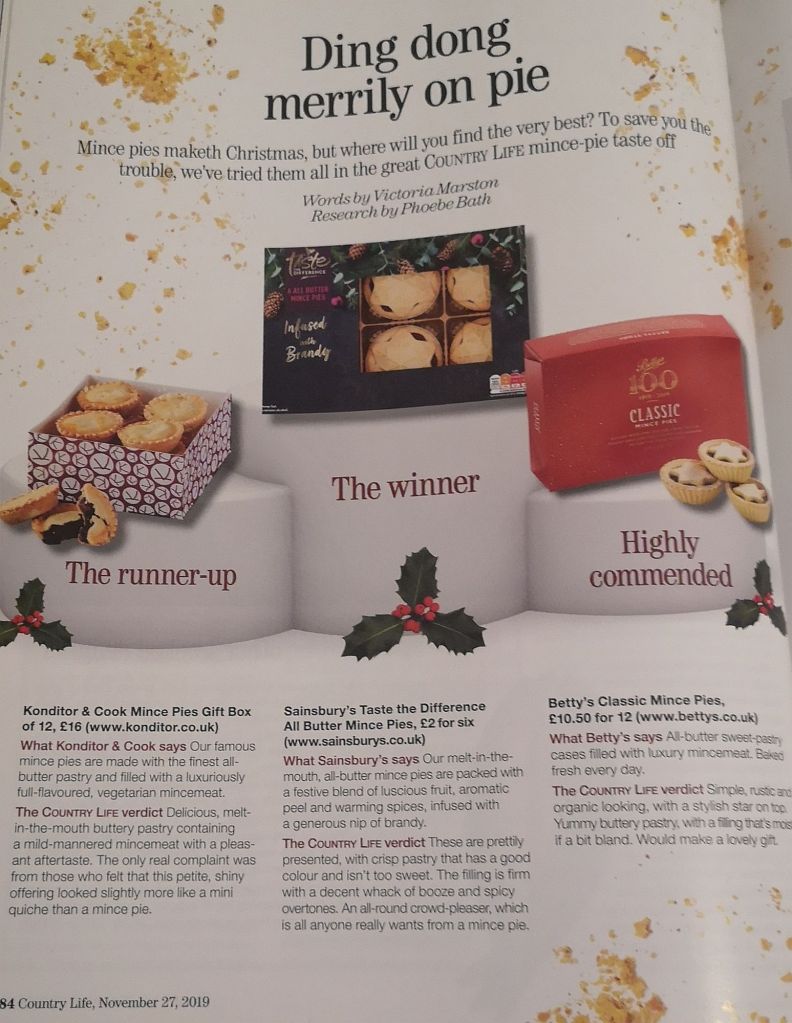

The best mince pies are put to the test because, as Country Life states and I agree wholeheartedly, ‘Mince pies maketh Christmas …’! Of course, homemade is the best but if you aren’t going to make them from scratch then this was a guide to the best options. Interestingly, Sainsbury’s beat Konditor and Cook and Fortnum and Mason whose mince pies were four and six times the price respectively! In many magazines, you would be told how best to cook a turkey. In this magazine there are some interesting ideas for red cabbage instead. There is also a recipe for venison burgers but they’re too deer for me!
There are present ideas for The Host, The Hostess, Tricky Teen, Little Ones, Bachelor Uncle (!) and Made Personal. If you wanted to buy the most expensive items, the suggestions for each category were, a travel bag for £1295, fire opal and diamond earrings for £3500, a leather belt bag for £395, an alphabet chest of drawers for £1350, a Green stag head decanter for £3950 and finally a personalised backgammon set for £12000 totalling nearly £25000! They may be expensive, but some of the ideas are simply marvellous and I will look into them if I win the lottery!
There is an article called Doorways to Heaven where Ysenda Maxtone Graham, with tongue firmly in cheek for some of it, counts down the 25 musical moments she is looking forward to most as a kind of advent calendar. My favourite is Day 21 which reflects the joy of hitting the top note of Hark the Herald without squawking! The final page of the magazine is an interesting call for more superstition, or perhaps a willingness to believe, in a world that is becoming more materialist.

At the bottom of the final page the cartoon cannot resist political commentary. The three wise men following the star are told there is a change of plan and they need to sort out the UK instead!
Final Reflections
This set of articles have been something of a labour of love, and in many ways a real eye opener. The past definitely has been a different country, so it has been a lovely finish to read a magazine so full of Christmas spirit. Yes, the audience is quite specific, but in many ways their likes, dislikes and preoccupations are not so different from ours. They have more money to indulge in their tastes, but they look forward to certain aspects of Christmas and suffer others like we all do. It left me with a feeling that at Christmas there is still more that unites us than divides us, and it is a message I needed to hear.
My final magazine tomorrow brings us right up to date with a Christmas issue from 2025, but which one? You’ll have to visit this site to find out!
What are your favorite physical activities or exercises?
When I look back on my journey through exercise, I realise that there has never been a type of activity that has been consistent apart from walking.
As a child, I found physical activities like sports very challenging due to my dyspraxia. I was forced to think about every movement and for that reason nothing was natural and easy. Once I learnt how to run and ride a bike I still found myself having to think about every movement. Football was a game I loved playing but I couldn’t get my movements sorted out so I played just one half of one game for my junior school, mainly, I think, because I was a trier. I played in defence and when I was substituted we were 3-0 down but in the second half the defence shipped another 7 goals and we lost 10-0. I felt like it indicated that I was a better defender than my replacement, but the football coach didn’t seem to agree!
I played a variety of games at senior school but if you weren’t a natural player you were not given any opportunity to improve. You were put in the lowest group and given up on. This happened with rugby and cricket in my first two years and I proved to be very bad at the time at cross country running. Basically, those seven years were a real trial but, looking back, the 90 minutes of games plus the 90 minutes of PE gave me a baseline fitness level that stood me in really good stead. Along with the hiking it gave me a strong core of activity throughout my teens.
As I have recounted before I ended up becoming extremely fit when I was in the Royal Air Force. I had to rebuild that fitness after my injury and in Polytechnic I tried Kendo, which I thoroughly enjoyed but which, with its prescribed foot movements was a trial for my dyspraxic brain. I played badminton at various points but was enthusiastic rather than able. I played friendly 5 a sides in Hong Kong with my fellow teachers and enjoyed it but looked like I was completely out of my depth, which I was!
I did some weight training for a couple of years along with cycling, rowing and running machines so by the time I finished at INTO St George’s I was very fit. We have equipment at home which was bought for me to restart this training but which I haven’t used for a few years! I know I must start again and I will in 2026. Along with that I will definitely be walking more as I look to move to another level of fitness at this point in my life. Please wish me luck, as I could need it!
What was 2007 like?
Queen Elizabeth saw in the 55th year of her reign in a much stronger position than she had been in 10 years previously. She was seen as a valued stateswoman by the majority of the UK public and was very much the favourite member of ‘The Firm’. In politics, however, the previously very popular Labour Party was split at the very top with Gordon Brown insisting that Tony Blair should make good on his promise, apparently made at the time of the Labour leadership election that took place after the tragic death of John Smith, that Brown step aside to avoid splitting the vote and Blair would hand the leadership over after 10 years. Whether the promise was made in those very definite terms, only the two protagonists would know, but after years of acrimony Blair resigned as Prime Minister in June and handed over the poisoned chalice to Brown. Then came one of those ‘Sliding Doors’ moments, where Brown had the opportunity to go to the country in October, buoyed by a 20% poll lead. Rumours were so strong within the party and the press that it was considered a foregone conclusion. Brown never wanted to go, because it was not in the national interest as he saw it, but when he announced that there would be no election, the press jumped all over the story and accused him of bottling it. The following year, the Banking Crisis sank the World economy, and although he used all his economic judgement to navigate a path through it, he was fatally compromised by it in political terms. Brown himself admits that Labour would have won the election and he would have had extra time to recover politically from the 2008 Crash.
Away from politics, it was a year that saw the new Wembley Stadium open, but the England team that graced the new stadium were less a new era and more a throwback to the 1970s with their failure to qualify for the 2008 European Championships. Their lack of success was matched by the England Cricket Team who were whitewashed in the 2006/7 Ashes series by an Australian team looking for revenge after England had regained the Ashes in 2005. A sporting icon made its last appearance on BBC1 after nearly half a century of bringing the best of sport to TV viewers. Sadly, it was a shadow of its former self as the BBC lost sport left right and centre to Sky and Channel 4.
Television was in the grip of reality shows and one of them, Celebrity Big Brother became highly controversial when Jade Goody, Danielle Lloyd and Jo O’Meara were accused of directing racial abuse at Shilpa Shetty, a Bollywood actress. Leon Jackson won X Factor and became the third show winner in a row to achieve the once coveted Christmas Number 1 slot. In more positive news, The Sarah Jane Adventures starring Elisabeth Sladen as former Doctor Who companion Sarah Jane Smith, debuted on New Year’s Day and at times was even better than the parent series. However, David Tennant had a notable success in the role of the Doctor, as the Doctor Who Christmas Special, Voyage of the Damned, co-starring Kylie Minogue achieved a 13 million audience, the programme’s highest on Christmas Day.
The music charts in the summer were dominated by the juggernaut of Umbrella by Rihanna and the latter part of the year by the highest selling single of the year, Bleeding Love by the previous year’s X Factor winner Leona Lewis. Now that downloads as well as physical sales counted, the opportunity for records to stay in the upper reaches of the chart for longer meant less movement up and down. Whether that was a good or bad thing depended upon your age and view as to the importance of chart positions, but for now the charts were still to some extent the true measure of success.
Two films released this year used books that had been a massive success with a young audience. Harry Potter and the Order of the Phoenix was the fifth book in the series and a guaranteed blockbuster. The other was The Golden Compass, the first book of the His Dark Materials trilogy. It had a top cast with Daniel Craig and Nicole Kidman and a fantastic central performance by Dakota Blue Richards as Lyra. However, the source material with its anti religious storyline was diluted, too much for supporters and not enough for detractors. The result was that the second book, The Subtle Knife was left unfilmed until a much more faithful BBC adaptation many years later.
Country Life Christmas Special 2007
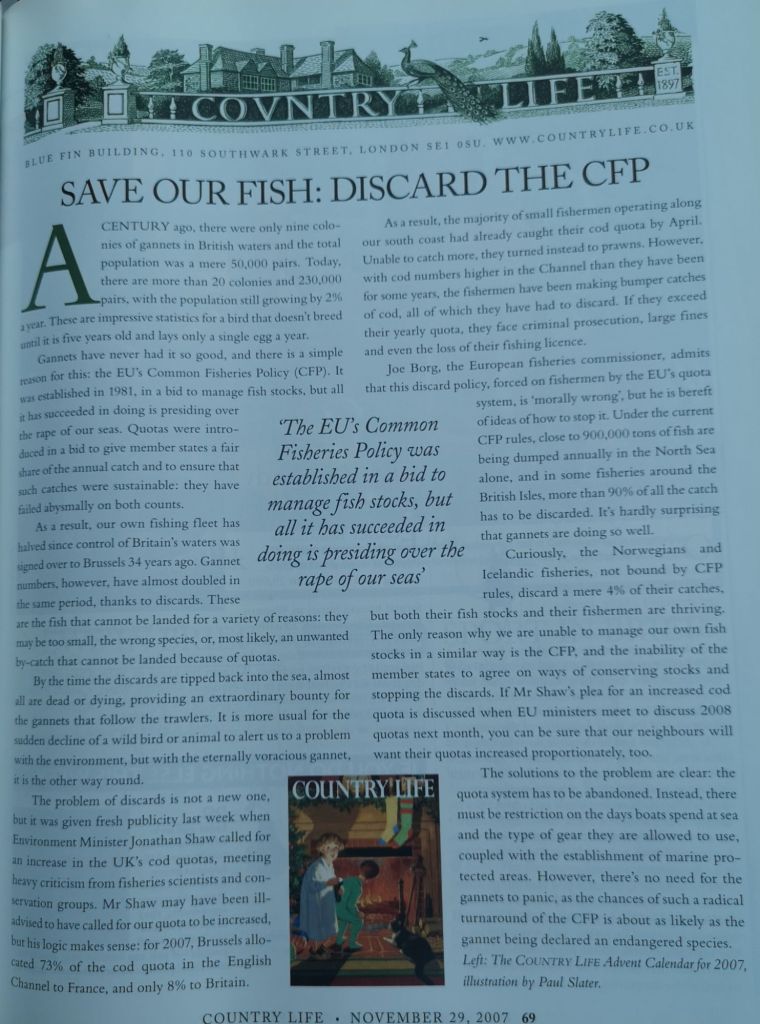

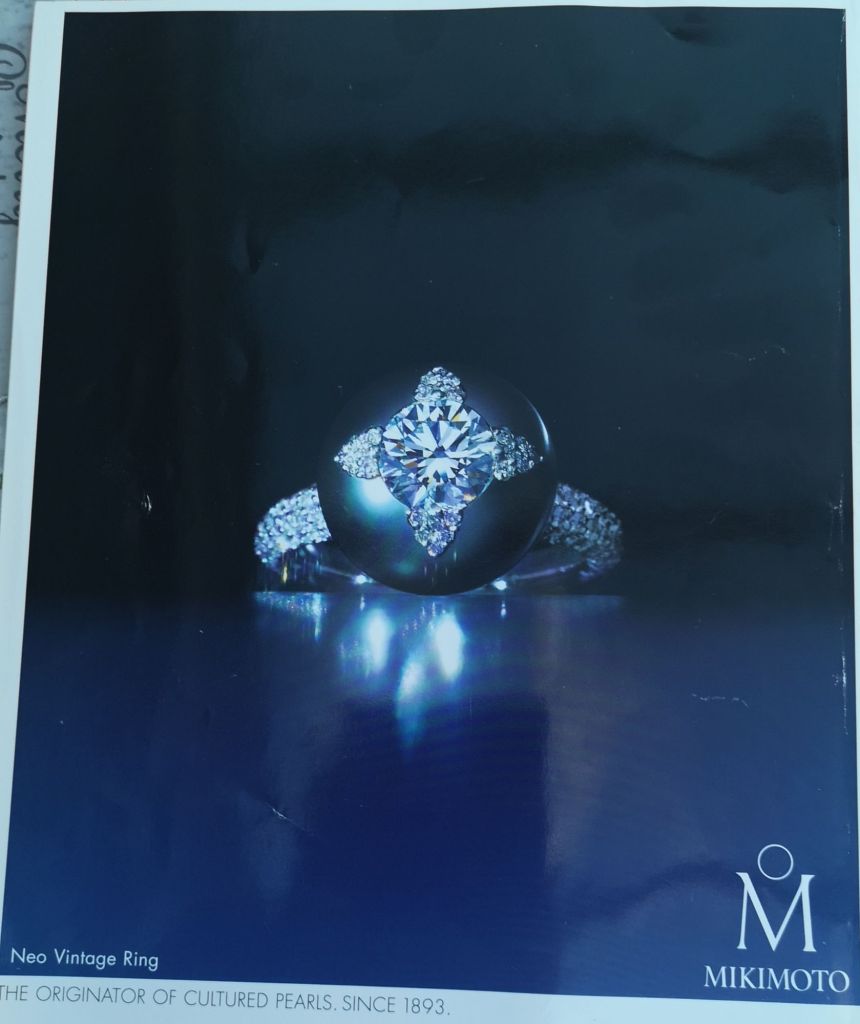
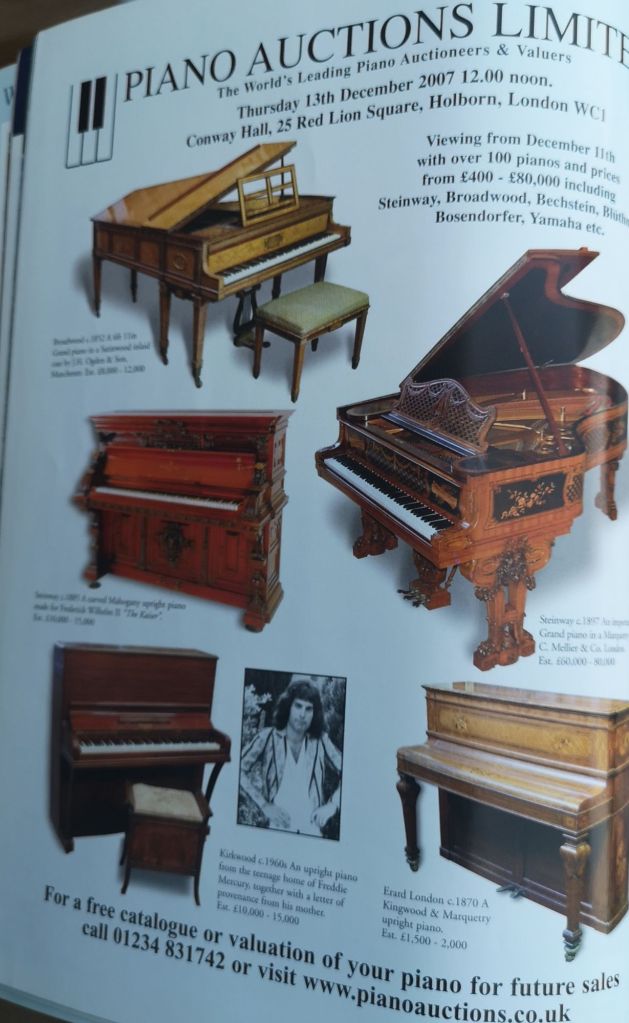
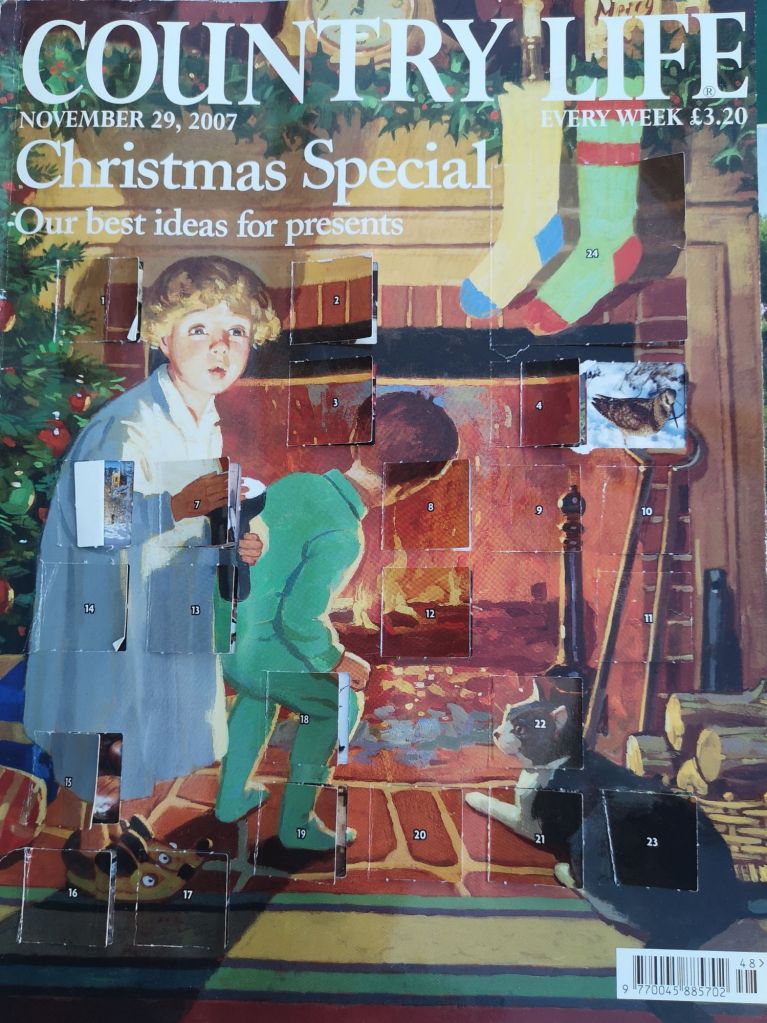
The cover promises magic and reflection, but it turns out to be a very misleading one. In 11 years, this magazine had undergone a massive change in tone. Gone were 1996’s reflections on the social and religious meaning of Christmas. In its place there is a political activism that sits very uneasily with a festival of peace and love. The editorial is nothing to do with Christmas and instead concentrates on a campaign to get rid of the European Union’s Common Fisheries Policy. No peace and love there, that’s for sure! This sour tone continues into the letters page with no one seeming to wish anyone else the compliments of the season. I found it very disappointing, and I can only imagine that at least a readers at the time found it left a similarly sour taste. Looking at the advertisements the readership hadn’t changed in social and financial status, but they were clearly more militant having a Labour Party in power that they saw as antagonistic to their way of life. With Avian Flu being an immediate threat to their birds, things were bad enough, but when the smoking ban in enclosed places including pubs was brought in, the landowners must have felt like they were living through the end days!
Final Reflections
I suppose there is no golden rule that you can run to decide whether a Christmas issue is meeting the needs of its audience. It has become clear that the magazines throughout the years are meeting the needs of the audience at the time and in a way that the audience appreciate. However, the lack of Christmas spirit in evidence has made this the least enjoyable read so far. My next magazine is a Country Life from the following decade so did the Christmas spirit so absent here reappear? You will have to find out tomorrow!
What is something others do that sparks your admiration?
I have always been envious of people with a clear sense of purpose and destiny. That becomes admiration when these people use that sense to make the lives of others better. Philanthropy in its Victorian incarnation has all but disappeared in our modern world where people in power, political or financial, only wish to make their own lives better. Only a few of those with influence use that influence for good. Nowadays it is much more common for powerful people to deliberately make the world worse for the vast majority in order to make it better for themselves. We are in the age I have seen described as the ‘Broligarchy’ where those who have made countless billions through their ability to use technology for their own ends now bow down to the very worst leaders humanity has to offer.
What a contrast to the Victorian philanthropists who were extremely well off and who lived in luxury that was unimaginable to their workforce, but who did what they could to make life better for them. The Cadbury company built the Bournville Village for their employees in the late 18th century, with relatively spacious houses to alleviate the many problems caused by overcrowded accommodation. They also built schools, parks and facilities for further education of the workers. George and Richard Cadbury were Quakers so they refused to have pubs in the village, removing a source of both social and personal problems that they saw as inhibiting effective work in their factories. Were they completely altruistic? Of course not, because the village tied the workers to the company in perpetuity as their home was utterly dependent on remaining employed by the company. In that sense it worked as a kind of benevolent dictatorship because what the Cadburys expected of you was socially enforced in all areas of life, not just work. However, they realised something that nearly all modern employers have completely forgotten, namely that a workforce that is valued will produce much better work than a workforce that is threatened and overworked, the situation for so many people today. It is very sad to think that employers are worse now than they were 200 years ago, but it’s the truth and I can only see them doubling down on their poor treatment as it is profitable for them and keeps them in the manner to which they have become accustomed. It is unimportant to them that they have more money than they can spend in a hundred lifetimes. All they care about is power to do bad things to people below them.

