
What skills or lessons have you learned recently?
When I finished working in London in June I went pretty much straight into the online teaching environment for another two months. This meant some changes to my morning routine based around my commute. It wasn’t that much of an issue because I had to get used to a whole new routine and this kept me fully focused.
Since finishing in September, the aim has been to find a new routine. This has become a much more difficult task than I expected. One of my issues, I think, is that I have tried to introduce a new routine very quickly rather than letting it develop organically. The fact that I have tried to introduce so many different things to work on at once is undoubtedly my main problem. Some of the things I have introduced like the daily blog writing and doing my Duolingo during the day when my mind is theoretically sharper have taken a hold. One of the things I have lost along the way is the regular waking up time. When I was working full time I was waking up at about 5.50 to 6 every day including weekends. This, I think, has had a bigger effect than I expected. With later waking up times I don’t have the same opportunity to start my day with reading. I had an hour of reading time in the morning on the train to work and another hour in the late afternoon or early evening on the way home. In the last month I have completed two books, an unheard of lull by my standards! Why has it been reading that has gone from my routine? To be honest I don’t know. Perhaps it was a situational as well as a time bound routine. So, I have decided to let my reading find it’s own natural place within my routine, wherever that may be and at whatever level it may be. Perhaps in reading as well as other aspects I have been making perfect the enemy of good. Where I can’t find a regular place in my schedule I am often finding no place in my schedule.
What should I have I learnt from this? That it takes longer than a few months to completely shift your life from one basis to another. That trying to control the mindset is good at some level, but that trying to go beyond that leads to the wheels coming off a bit. That I should take the small wins and build around them. That I should be open to change and work with it rather than against it.
What will I learn from this? Who knows! I am already looking at 2026 and thinking about what I want to introduce or reintroduce into my life. Perhaps I can take a more considered approach and allow things to develop more naturally. Perhaps I can learn to be happy with the small wins I mentioned and build around them. Perhaps I will get to February exhausted by the mental effort of trying to introduce a whole raft of changes! The human mind, particularly my human mind, is a very funny thing. Watch this space!!
What cities do you want to visit?
I have been incredibly lucky in my life to have visited and lived in some amazing cities. Some of my favourites are Sydney, which I have mentioned more than once, Nara in Japan with the breath taking Giant Buddha and very recently Salzburg with its magical Christmas Market. My wife has a wish list of about 20 places that she wants to visit (!) but I have just a few and they are up in the Scandinavian region.
Tromsø in Norway and Reykjavik in Iceland are apparently the best places to base yourself if you want to see the Northern Lights. That would count as one of my biggest remaining ambitions as I have wanted to see them for as long as I can remember. Having the chance to visit a city I know nothing about would definitely be a bonus.
Sweden is a country I want to visit, and I have two places on my list there. First is Stockholm, because I just ABBA visit a particular museum! Once I have finished exploring that city I would move on to Malmo to see the location of one of my favourite ever series, the Swedish/Danish border police thriller Bron (The Bridge). From Malmo, you can cross the titular bridge to Copenhagen, another city that is high on my list and has been since I heard the song ‘Wonderful Copenhagen’ by Danny Kaye on Junior Choice!
Finally, I would love to visit Torshavn in the Faroe Islands, which is a place I have wanted to visit since I met someone from the Faroe Islands about four decades ago! To say it’s a bit out of the way is putting it mildly. It’s perhaps one of the most exposed and rugged cities anywhere, but it would be an incredible adventure.
The title of this post comes from the Billy Joel song from the amazing ‘The Nylon Curtain’ album. Check it out.
Tell us one thing you hope people say about you.
One thing I have learnt over the years is that other people’s opinions of you are likely to be restricted by the context in which they meet you. If they meet you professionally they will see the professional side of you. If they meet you socially they will see the social side of you, assuming you have one! If they read something you have written they will see a curated version of you. So, in many ways you are controlling what they might say about you, and therefore their comments are actually a reflection of what you have chosen to share with them.
Why do I say it’s a strange question? Well, what would you do with that opinion? Agree with it, disagree with it or ignore it are your three options. In any of those cases the impact of what they think is simply going to be short term. It doesn’t matter at any deep level what people say about you. Years ago I had a number of friends, as nearly all of us do in our younger days. Now, very few of them probably give me a single thought. Their opinions were very important to me at the time, but the fact that they have no interest in me now shows that those opinions were irrelevant in the greater scheme of things. I have had students who really enjoyed my teaching and students who hated it, more the latter than the former in my last couple of years of full time teaching. They saw me in lessons and made their judgement on me based on two hours a week. They may have made some valid points, but that would have been more by accident than insight. Even my colleagues only saw a curated part of my personality, however long they worked with me. Their opinions would carry more weight, but I would be either unwilling or unable to change anything based on that.
People’s views of you are simply that, their views, and I feel that only my wife sees the full me, so hers is the only view that really counts. I don’t have to ask what she thinks, because she will tell me, and I know that she will do so out of love. If you listen to anyone else’s view other than those closest to you, you are barking up the wrong tree.
Tell us about your first day at something — school, work, as a parent, etc.
One thing that your memory does is play tricks on you. It takes odd scenes from particular days and builds a narrative around them. I can remember odd things about first times in a variety of situations but I can’t guarantee that those things actually happened in that way or whether they were remotely important at the time. The memories almost certainly reflect what I ended up thinking about the situation. So, I think I remember standing in the playground on my first day at Secondary school and being incredibly nervous. Was I? Who knows? I am almost certainly fixing my memory based on the fact that I ended up hating the place. If I had ended up enjoying it I would no doubt have remembered a much more positive moment from that morning.
We develop a narrative around situations that make sense to us, but if we talk to people who were with us we may find out that either events did not happen in those ways or that no one else even vaguely remembers them. The film Inside Out perfectly reflects this view of memories and was based on what is known about the way that the brain stores memories and how those memories are analysed. I am not saying that the events other bloggers are recounting didn’t happen, but I can guarantee that if there were 10 other people there they would remember 10 other ways that it played out. The way that someone reacts to the event is almost certainly after the fact rather than contemporaneous. So, be careful what you think you remember as it almost certainly very personal and very selective.
What was 2025 like?
Actually, as Fred says in the first stave of A Christmas Carol, ‘I will keep my Christmas spirit to the last’! So, let’s just agree that globally it’s been perhaps the worst year in living memory and leave it at that!!
Woman & Home 2025
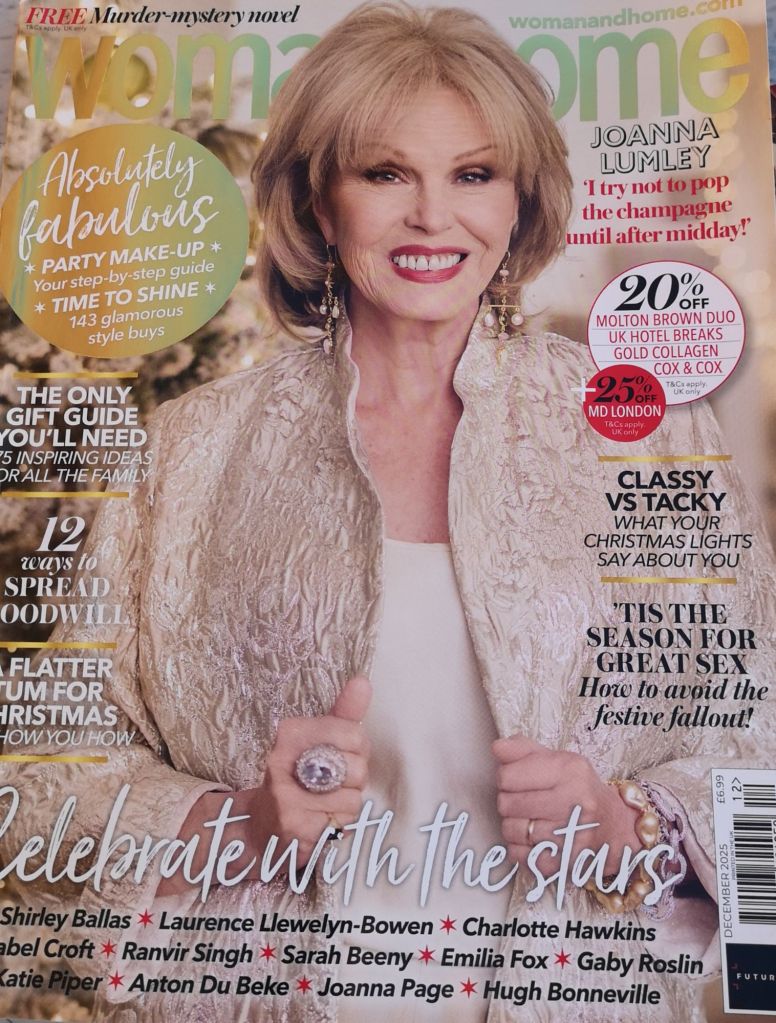
The Front Cover

The first thing you notice is the difference in the front cover. In the middle you have the marvellous Joanna Lumley. None of the old magazines I looked at had celebrities on the cover, although some that I didn’t look at may well have done, but then we didn’t have a real celebrity culture until quite recently. Christmas was the main selling point so various Christmas themed covers were the order of the day. Now, most of the magazines on the supermarket shelves feature a famous person to try to entice the casual reader to part with their money. Now, looking at the bottom of the front cover you see a list of twelve further celebrities in a section called ‘Celebrate with the stars’. When you see the names, it is quite clear that the magazine’s demographic is skewed towards the older female reader as the average 25 year old is unlikely to see the names Laurence Llewelyn-Bowen, Annabel Croft, Katie Piper and Hugh Bonneville and think that they have to read on. As well as the list at the bottom, there are seven ‘cover stories’ and a quote from Joanna Lumley. Why is there so much going on here? Well, as I will mention more than once, magazines are fighting a desperate rear guard action against the Internet, and on there we are used to a blizzard of information before deciding what to click on. Woman & Home, like pretty much all other magazines nowadays, has a digital version and this magazine cover is clearly designed to be seen digitally.
Let’s look at the subjects of the front cover, going from top left. The big gold highlight is Absolutely Fabulous, an obvious nod to Lumley’s most famous role, and covers make up and no less than 143 style buys. Just below that there is a gift guide of 175 ideas for all the family. 12 ways to spread goodwill brings the magazine back to the ‘meaning of Christmas’ but the bottom left is the much more superficial ‘A Flatter Tum for Christmas’! On the right, we start with a quote from the interview with Lumley about trying not to drink champagne before midday. This is a clear nod, once again, to Patsy, her constantly drinking alter ego in Absolutely Fabulous and you can imagine her eyes twinkling as she delivers that line. It’s a very clever quote placed in the part of the cover that your eye is drawn to first, namely right next to her smiling face. Just below are money saving deals that are, once again, aimed at the demographic which is, broadly speaking, ‘middle class’ and in their 40s or older, because the magazine buyer definitely seems to be incredibly rare in the younger generation. Keeping the idea of class you have ‘Classy v Tacky. What your Christmas lights say about you’. This preoccupation with not appearing tacky is not a new one, but it definitely has extra force now that someone could take pictures of your display, put it on social media and judge it. Finally, there is advice on sex around Christmas! I can guarantee that any mention of that before the 2000s would have had the readers of this magazine up in arms. It is part of a greater openness about subjects that used to be taboo that is either refreshing or intrusive depending upon your viewpoint.
The Contents
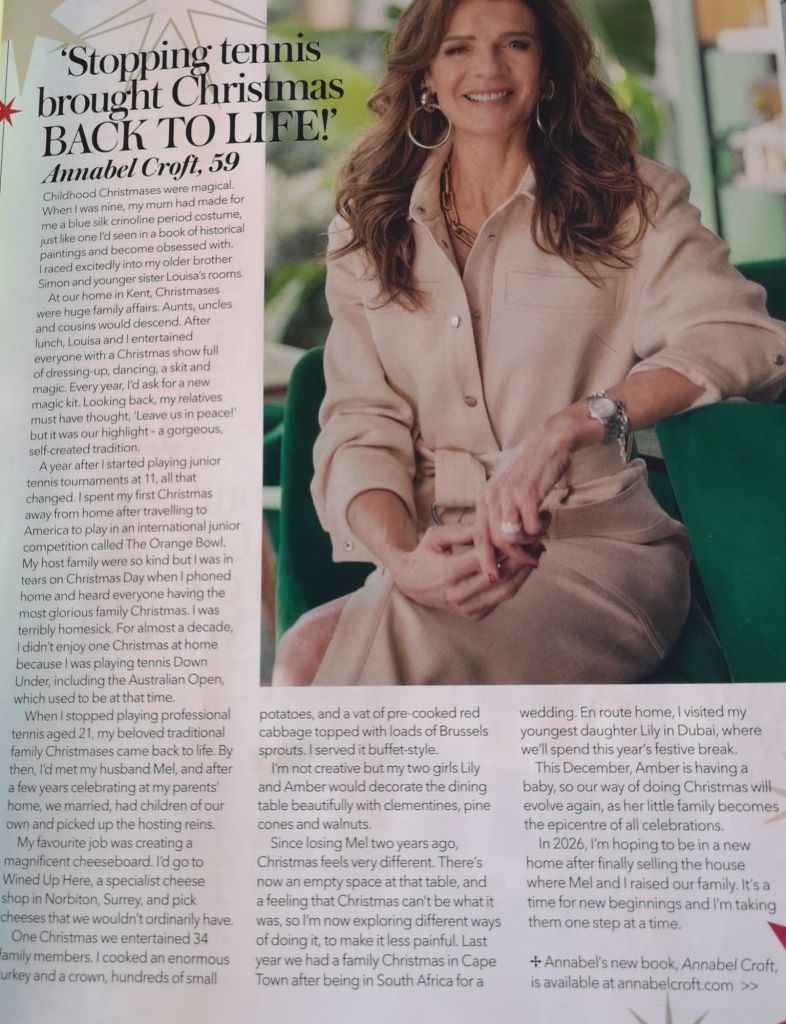

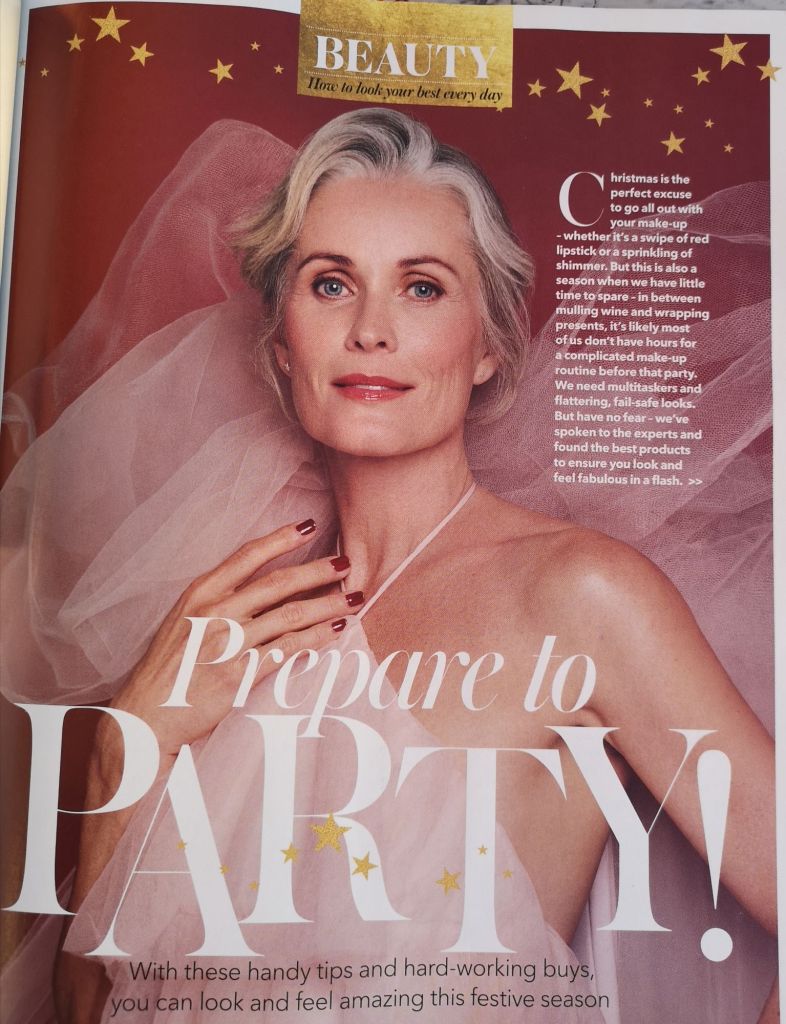

With over 230 pages to fill, there are obviously a number of articles, but what becomes clear immediately is how short those articles are compared to the magazines of the past. In the magazines up to the turn of the 21st Century, you tended to have longer interviews dotted throughout and specially written Christmas stories, often about the trials of the season. In the ‘Great Reads’ section, Joanna Lumley gets 6 pages, the 12 celebrities on Celebrate with the stars get 12 pages between them. Everything else is dispensed with in a few pages. These articles are designed to be read quickly before moving on to something else that is perhaps more interesting. It reflects our cultural reduction in attention span. We then have five articles on fashion and four on beauty that are aimed at the person with Christmas occasions to attend and to host. The Health section starts with the article about sex and finishes its list of seven vaguely health related subjects with the promised flatter tum for Christmas. Just as an aside, the magazines of the 50s, 60s & 70s would not have dreamed of using a slang phrase like tum, as that would just have been too common. The Food section is perhaps the one that a 1950s reader would recognise most from their own reading, although the recipes, as we will see, have definitely become more complex and are now as much about appearance as taste. Home and Travel are dealt with very quickly with two articles in each section. Time for you is a mixed bag of articles, mainly focused on books but also encompassing entertainment and puzzles. Finally, there are the offers for a range of products. This contents page is set up like the main page of a website, and you can imagine the online reader clicking on an article, skimming it and then hitting the back arrow. Even reading it in print you find your brain defaulting to a skimming approach, because you just want to see if it is worth saving or highlighting. As a society we tend not to read magazines or individual articles deeply anymore, and the dreaded acronym ‘TLDR’ is increasingly common. This contents page is the visual representation of that.
The Headline Articles
The Joanna Lumley interview is the first main article and covers six pages of observations, clearly in response to questions, that cover a range of subjects. Given Joanna Lumley’s age you would expect, and indeed get, a very traditional approach to Christmas, talking, for example, about how cards keep you connected as the tradition in society as a whole is almost vanishing due to digital communication and incredibly high postage costs. She also talks about mortality and health in a marvellously matter of fact way. An interesting box at the top of the final page of the interview is entitled ‘Give us hope, Joanna’ which reflects, once again the expected age group of the reader. It references a song by Eddy Grant released in 1988, so that pretty much rules out anyone under 50 without an encyclopaedic knowledge of pop music, from understanding the reference to what was a relatively minor hit! Actually, her three tips to end the year on a high are very good.
The Christmas with the stars is the ultimate in fluffy articles, with no content beyond ‘this is what I like to do at Christmas’. It is largely superficial but occasionally there are some interesting insights. The trouble is that you have to search very hard for those few nuggets as you flick past celebrities you don’t know or aren’t interested in and only skim the ones you are interested in. There, in a nutshell, is the problem with this magazine and so many others. You drown in information and end up not really being able to sift through it effectively, however much you intend to. The old magazines were clearly designed to be read cover to cover and to hold your attention whilst having a sit down and a cup of tea, whereas this magazine is designed to be clicked on in the digital version or mentally scrolled through in the physical version as you look for articles to hold your attention. Other than the Joanna Lumley article, I would recommend ’12 ways to spread goodwill’ looking at how you can be charitable at Christmas time, ‘My worst ever Christmas’ which is great fun and the food section, another skimming exercise, but one that has a huge number of recipes, at least of few of which will pique your interest. Finally, there is a nod to Christmas Past with an article about Christmas styles through the decades that I wish could have been longer and more in depth as there was a very interesting premise that was dashed through too quickly.

Final Reflections
Everyone will get different things from this magazine, depending upon their age, income and individual situation. Gone are the days of Woman’s Realm or Woman’s Own where one size fitted all and, in most practical ways, people other than the very rich and the very poor led broadly similar lives. Now, rather than a main meal to be partaken of together, it is a buffet spread out in front of you inviting you to load up on certain small treats and ignore others completely. I must confess that I miss the days of shared experiences in our increasingly atomised existences. In the 1970s, Morecambe and Wise and Mike Yarwood would attract over 20 million viewers with ease. Even in the 1980s, Only Fools and Horses and Eastenders would regularly top the 20 million mark. Now, the most watched Christmas programmes struggle to reach 10 million. Children used to get annuals like Shoot, Blue Peter, The Beano, Victor Book for Boys and Jackie which would keep them quiet for ages. Now, annuals are ignored in favour of the endless scroll of Tik Tok or WhatsApp messages. We can’t go back, and in many ways I wouldn’t want to, but I feel that Christmas is the last remaining shred of a shared tradition and I genuinely hope that the magazines of the future, in whatever format they may exist, will always reflect this special time of the year.

