
What do you enjoy doing most in your leisure time?
These prompts do tend towards repetition from time to time and I have been answering them for the best part of seven months now. I actually like that because it gives me the challenge of thinking of a new way of answering similar questions. So today I am going back over four decades to look at the way that I spent my leisure time before computers and smartphones took over our lives.
As a child, teenager and young adult I was used to activities that involved friends. Whether that be Scouting, parties or drinking (sometimes all three were very much linked especially in Venture Scouts!!) we were focused on having fun and deepening our ties as people. Conversations flowed, different groups of people talked together and we discussed pretty much everything under the sun. Now, I know that this still happens with my children and their friends, but if you drift out of the conversation you can immediately focus on the screen in your hands. When I was younger, if you drifted out of a conversation you often carried on listening to it in case there was a chance for you to rejoin. If you were tired of conversation or, in your teenage years, a bit worse for drink you could have a proper break sitting on your own or walking outside for some fresh air until someone came to look for you.
When reading, you would be completely focused on the book in your hand. You wouldn’t be wondering how many people had read your latest blog post or Instagram post because those things only existed in science fiction. Instead of going to the phone if the book became hard going you would plough on. That didn’t mean that you finished every book, or that you didn’t get distracted, far from it. What it did mean was that you allowed your mind to drift to other things or to reflect on why the book wasn’t really grabbing you. I would often have three or four books on the go at the same time, which probably reflected my butterfly mind, and as a result I would find something to interest me. Should all of the books fall short it would be on to music.
Music in the pre Spotify age was a much deeper experience. You only had the records or tapes in your collection to work with, so you would listen to certain singles and certain albums time after time until you knew them perfectly. With a choice of a few hundred songs you would find them become an integral part of your life. They are songs you can listen to now and they bring back memories of people and places in a way few other things can. It’s inconceivable to me that you would be able to bring those visual memories to mind nowadays. No way could you remember and picture your surroundings the first time you heard a song on Spotify! Music has never been more accessible or more disposable because it doesn’t cost anything. Back in the days when you spent your pocket money on your records they meant so much more and you connected with them so much more readily. Obviously, artists become an integral part of young people’s lives, as the passionate crowds at recent concerts I have been to prove. Taylor Swift, Sabrina Carpenter and The Last Dinner Party all have absolutely passionate fan bases but I think that passion is far harder to come by.
Television was the central technology of my childhood and it was a live experience only. If you missed it, you missed it for ever (at least until video tapes and DVDs) so you concentrated on each programme more if you really liked it. If you didn’t enjoy it you had, at most, two other channels to choose from but with closedowns being common on the BBC and with few programmes, if any, starting before 9am, it was often a case of one channel or switching off. With no phone to double screen on your focus was only on the programme or the people you were with so you knew much more quickly whether you wanted to carry on with the programme or turn it off.
The most important part of your leisure time back in my younger days was boredom. That was what encouraged you to try something else or just sit quietly and allow your mind to wander. It was essential for you to experience boredom and Sundays were the perfect time to do that until the early 1990s when the shops were allowed to open. Sundays just stretched out endlessly unless you dreaded going back to school on the Monday, in which case they sped by. I credit my boring Sundays with giving me an imagination that I still value and use.
So, will I occasionally go back to a 70s and 80s style Sunday? Well, I often think I should and I intend to a bit more this year. My phone will go onto airplane mode and I will see if I can rediscover the joys and drawbacks of analogue life once again. Will that be possible? Who knows, but I will try it and write about it, so watch this space!
Name an attraction or town close to home that you still haven’t got around to visiting.
For those of you who have read Great Expectations you will remember that a fair amount of the story takes place in Satis House, the home of Miss Havisham where she lives in constant despair after she was jilted at the altar on her wedding day. It is actually based on a real house in Rochester called Restoration House. With Great Expectations being such a favourite of mine and with Rochester being so close it seems incredible that I have never been there. I have always wanted to, but it is one of those attractions that is only open occasionally, and it’s not easy to remember to check when. What I will do is to find the official website, work out when it is open and when I can go and finally make the booking. When I do I will definitely write about it on here.
List five things you do for fun.
I am trying to find out what I do for fun as that has become more important as I have stepped back from full time year round teaching. It’s not actually a case of doing something new, but appreciating what I already do more than I have in the past.
- Writing my blog every day is a good discipline to get into but it’s also a lot of fun. I wouldn’t do it otherwise. The fact that it is nearly always early on in the morning means that I have to engage my brain and it’s really good for me.
- Janet and I love doing jigsaw puzzles together and it’s something we need to do more of this year. Yes, there is the occasional frustration of getting stuck but even that’s fun because it’s followed by the inspiration that means you are full steam ahead for the next part of the puzzle. It’s great as a mental challenge and also as an opportunity to work on something together.
- Walking is something I have always enjoyed doing and Janet and I love walking down by the Kent coast in particular. It is great exercise of course but it is also great fun to see the views and to feel the fresh air. Over the years I have undertaken a number of charity walks for a number of different causes and our walks are a very important part of my training. I am not sure if I am going to do a charity walk this year but if I don’t then I’ll definitely do one next year.
- One of the pastimes I let slip after finishing my commuting days was reading. My hour long journeys there and back were completely focused on books rather than a screen. I would read over 100 books a year as a result and I would concentrate on anything I liked. Romantic comedies, detective novels, books about music, books about popular culture and social history. You name it, I read it. To restrict myself to fiction or non fiction, or to read a specific genre is anathema to me. Variety is the spice of my reading life.
- Finally we come to my favourite TV programme of the moment. My youngest daughter and I started watching Celebrity Traitors together last year and I got completely hooked. Tonight, as I write is the final programme of the normal version and I am absolutely loving it. The game is great, the players are a fantastic mix and the sheer enjoyment I get from it is amazing. A lot of that enjoyment comes from sharing it with my daughter and discussing the programmes and what might happen next. The programme we share as a family is Home and Away. It’s a blast of sunshine from our favourite country and we have been to Palm Beach where it is filmed a couple of times so we recognise the places where the filming takes place. Individual watching is OK but nothing like as much fun as watching something with other people. My Dad and I shared three programmes, MASH, Yes Minister/Prime Minister and The Wonder Years. The last of those we shared despite not living in the same house. We used to watch each episode then chat about it on the phone and I really treasure the memories of those conversations as I grew to understand him more and more.
So, there you have it. That’s what is fun for me, and long may it continue.
If you could make your pet understand one thing, what would it be?
I have posted before about the ill founded exceptionalism of the human race. Let’s start with one thing I want people to understand. We are simply members of the animal kingdom ourselves, not some kind of master species. Our pets are generally far more intuitive than we are and we ignore their instincts to our detriment. So, what can we learn from our pets?
First of all, unconditional affection. We are extremely bad at loving other living things with no agenda. We want to know what we can get from them. Well, pets stay with us for food, you might argue. Evidence shows that you are wrong. Pets will stay in houses where they are underfed or mistreated because of that unconditional love they have. When they are abandoned they shut down because they lose so much whereas many of those who abandon their pets do so without feeling the least bit guilty. However much pets go through, they want to love and trust again.
Second, your pet will be able to sense a ‘wrongun’ very quickly. If someone visits the house, they size up the unconscious cues that we all give off and decide whether to approach, to observe or to avoid. If they avoid the person, that is an excellent indication that they are not particularly pleasant.
Third, we have a lot of difficulties in ascertaining the emotional state of our pets. They have to be exhibiting extremely unusual behaviour for us to notice. We on the other hand only need to be showing small signs, imperceptible to other people and perhaps even to ourselves, and our pets will pay closer attention to us, be more affectionate and will do that until we feel better at least temporarily.
Finally, our pets learn what we are like and what our routines are far more quickly than we realise. They are often ready to greet us as soon as we come home. I remember reading that they can identify the sound of your footsteps long before you come into view because of their excellent hearing. If we go away on holiday, particularly a long holiday, they will get agitated even if someone they know is taking care of them during your absence. Our cat Albus had my daughter looking after him for nearly three weeks during Christmas 2024 and her schedule was very different to ours. He was absolutely fine, being fed, played with and cared for, but when we got back and he had forgiven us, he spent a good few days reintroducing us to his correct schedule!
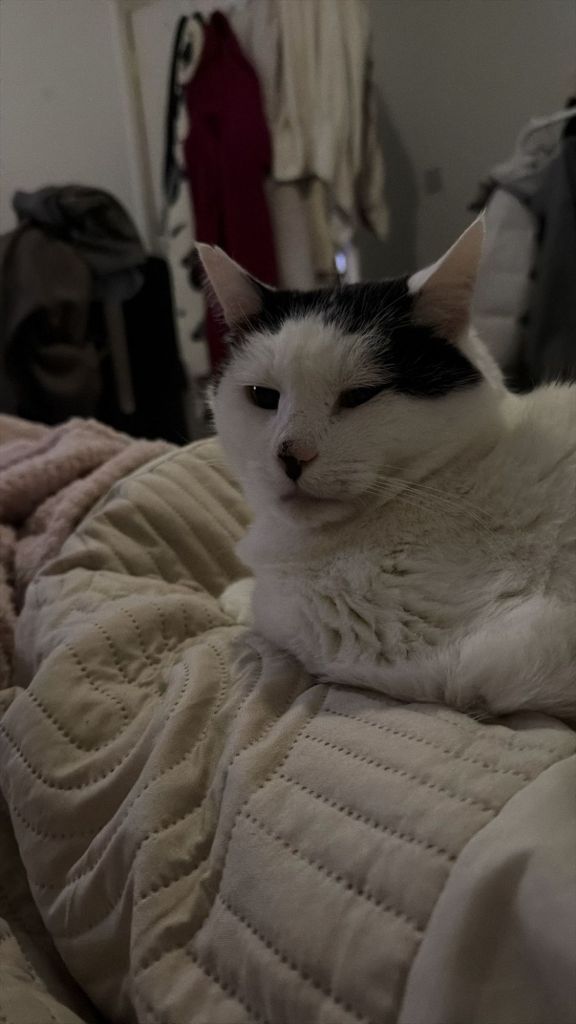
Our pets are intuitive, loving and loyal. In return they deserve the best care and attention we can give them. We are the true dumb animals in this relationship and the sooner we realise that the better. That said, there is one thing I do want Albus to understand. If it’s raining outside one door, it will be raining outside all of them so there’s no need to try all three! ☔☔🤣🤣
Write about your first name: its meaning, significance, etymology, etc.
I was given the name David when I was born. In 1965 it was the third most popular boy’s name in the UK, behind Michael and John. In the decade as a whole it was the top baby name in the UK. As a result there were a good sprinkling of Davids everywhere I went. It is a ‘classless’ name in that you can’t tell where a David might come from in the social hierarchy. There would have been as many Davids in the comprehensives as there were in the Public schools. Interestingly, if I had been a girl I would have been given the name Jane, the 7th most popular name for girls during the decade.
David is a Hebrew name meaning Beloved although I never really lived up to that! I am interested to find out that it also means ‘to boil’ more appropriately as I often found myself boiling over! I think it’s interesting how having a common name makes you one of the masses. Now, obviously there have been famous people called David throughout history, but its ubiquity means that you are much more likely to fade into the background of life. In the Scout movement and in Polytechnic I was almost always called Dave but I am not a fan of the shortened version. To me, Dave sounds quite common – in the class context rather than its ubiquity – and indicates a person who is in some way trying too hard to fit in. I never went as far as telling people not to call me that, but I never really took to it.
Funnily enough, it was my middle name that attracted the most attention, generally negative, because I was given my Dad’s name for my middle one, as was common at the time, so I was David Gerald. Unlike me, he disliked the full version of his name and called himself Gerry from very early on. That suited him far more than Gerald would have done because he was always at the centre of everything in social terms.
As a name, David is OK and I have just accepted it over the years without question, but I wonder what would have happened if I had been given a more unusual name. Would I have been a different person? It’s an interesting thought experiment but how would you go about pursuing it?

