
How has technology changed your job?
I genuinely can’t think of any job that has been changed by technology more than teaching. Partly, of course, because society has been changed by technology and any societal changes invariably hit hardest and earliest in education.
I first walked into a classroom in 1991, so let me take you back to what it was like. Well, for a start, there was no technology except for the purpose built but already out of date computer room. Students sat at desks with pens, pencils and lined paper pads, in the sixth form, or notebooks given to them by the school in the lower years. The teacher stood at the front with a cardboard box full of chalk and blackboards behind them. There were two in most classrooms, the ones on the wall that were filled and then rubbed off and the more portable version which included four boards on a rotating drum. I used to move between the two, partly to leave the main elements of the lesson on the big blackboard and partly because I was of the opinion it is always harder to hit a moving target 🤣🤣. In all seriousness it is always beneficial to direct student attention to more than one place as staring at one board quickly becomes very boring. It was at that point I developed my teaching style of constant movement, which I was to keep for the rest of my classroom career.
The first real change in the look of the classroom came in the arrival of the whiteboard and pens, although they didn’t really change teaching in any meaningful way. They simply replaced blackboards, but, in my opinion, did so ineffectively. They were smaller, they did not offer the flexibility of the rotating blackboards and the pen marks became notoriously difficult to rub off after a while. It was a very clear example of ‘progress’ actually taking things backwards. At that point, however, the front of the classroom was still the only focal point and that gave the teacher more control. One bit of ‘technology’ that did make a difference was the overhead projector or OHP. It had actually been around for ages, but when you had one in your classroom it could really help, especially in my area of Economics and Business Studies. I say it could help, but that was only when you got it the right way up and the right way round, on the whiteboard rather than the wall and magnified properly! Let’s just say I wasn’t a natural so I often gave up and went back to the drawing board as it were!
In the early 2000s computers were slowly making their way into the classroom and I found myself in the early adoption phase. My M Ed TESOL at the University of Wollongong in 2004 included a module on technology in the classroom and I made my own lesson using an Apple Mac which I then saved on a floppy disc! Believe me when I say it was groundbreaking at the time. It did, however, teach me a lesson that I never forgot, namely that technology should only be used if it makes things better. The amount of time I poured into developing the lesson on computer was astonishing. I could very easily have done the same lesson on a whiteboard in a tenth of the time, probably less. When I taught it to a class I also realised that it made no discernible difference to understanding or retention. It may or may not be the reason why I have avoided Apple products ever since!
When I got back to the UK after the degree I was back in classrooms where the only technology was a cassette recorder to go with the book I was teaching. It was a couple of years teaching young adults EFL that I think I saw the sweet spot of technology where we actually had DVDs that could be projected onto the whiteboard. This satisfied the students because it allowed them to look at something else and it satisfied me as a teacher because there was a demonstrable increase in engagement for very little extra effort on my part. Our relationship was still front and centre of the learning process but we had technology that complemented rather than conflicted with the learning experience.
That was the starting point of the real technological revolution in the classroom. By the early 2010s things had progressed quickly to using the Internet in the classroom. I used it to teach students to search effectively, to introduce them to recent TV documentaries and to give them access to the library in a whole new way. The students couldn’t get AI to write their essays, but they knew far better than I did where to find ‘extra help’ and I realised that for the first time they were ahead of me in some aspects of the technology. When it first happened I was teaching medical students so I wasn’t too worried, because the process of getting into medical school was so difficult that there were no worthwhile short cuts as any that you had used would trip you up in the extremely searching interview process.
Now, I want to fast forward to the pandemic and the years that have changed teaching, teachers and students irrevocably. When I first started teaching online I didn’t like anything about it, because I couldn’t connect with the students in the way I was used to and even if they had their cameras on they were often very poor quality or they were not focused on the students themselves, something that was particularly common at exam time! However, I started teaching according to the technology available, changing lessons to be more engaging, allowing students to use chat if they didn’t want to speak out loud and making use of votes or yes and no questions. Within a few weeks I was a total convert and I became a very enthusiastic proponent of the new technology. Last summer I went back to online only teaching and it was an absolute joy. OK I did have a brilliant class, but I also slipped straight back into the rhythm I enjoyed so much during the pandemic, but one thing had changed out of all recognition.
AI is an area of teaching that has caused more controversy inside and outside of the profession than any other in my teaching life. It can, and has, lead to widespread cheating and the invalidation of certain forms of assessment. Teachers largely detest it, while students can run rings round the educational system if they so choose. However, it is simply another form of technology and we can use it to make our lessons and their learning better. You need to be proactive as a teacher, learning everything you can about the various AI tools, working out how to avoid most of the obvious pitfalls and how to harness it. I was very lucky in my final couple of years to have two colleagues, John and Clara, who blazed the trail for me to follow, a trail they had to fight to get most of the staff to even engage with. This stereotype of ‘AI bad, all previous technology good’ leads to classrooms with no effective student guidance. As I put it, we can either be King Canute ordering the water to retreat or we can be Isambard Kingdom Brunel and build a defence to reduce its effect. (By the way, Canute may have been misunderstood by history. From what I have read, he ordered the tide to go back to show that there was a limit to a King’s power not because he thought he could do it.) There are amazing tools like Chat PDF that you can use to pinpoint the most useful elements of a journal article, but you as a teacher can show students how that only works if they read the article itself, because otherwise they won’t have a clear understanding of the content. Chat GPT is an AI system that produces poor arguments, poor structure and even uses made up sources. Once you make it clear to the students that you have noticed that you then give them the tools to use it properly.
My decision to leave full time teaching came about in part due to technology. We now teach almost entirely using online resources and we have encouraged students to have full access to these resources. The result is a classroom where everyone has a screen and you have the choice between trying to stop students from using the Internet on their devices or you make it worth their while to pay attention. You can walk backwards and forwards keeping an eye on every screen, but that is just a game of Whack a Mole because the students just flick back to the lesson screen when you get to them and back to the other screen when you walk away. Some teachers were fans of teaching from the back of the classroom, but that only works in lessons where you use the board very infrequently. Once you move to the front, you are back to Whack a Mole. The way I got the engaged students to pay attention was to put the basic information on to a PowerPoint and then using a whiteboard to add extra information, without which they would not be able to complete their tasks effectively. In my last two years I noticed even ideas like that lose their impact as students felt increasingly as though they could blag their way to university which, unfortunately, they could.
In my new teaching job of being a volunteer reading helper, which I will start very soon, I will be coming full circle and rediscovering my analogue past. No screen, just printed books, no phone, just a watch on my wrist to tell the time and no distraction, just me and one pupil learning the joy of reading. Funny how things happen isn’t it?
How often do you say “no” to things that would interfere with your goals?
I think that over my life I have said ‘yes’ to opportunity on a number of occasions when ‘no’ would have been the easier answer. It started very early on in my working life. After just over 6 months I realised that my first job at Lloyds Insurance didn’t suit me at all so I went to the RAF Careers office and spent two hours one lunchtime doing the tests. 6 months later I was going to RAF Swinderby to start basic training. When I was invalided out due to the ankle injury picked up in basic training I took the first opportunity I saw to get myself completely away from the UK and my problems and spent a summer over in America. After that I worked in the civil service for nearly two years before a phone call at work asked me if I wanted to take a place at Staffordshire Polytechnic the following week!! I gave myself a whole 10 seconds before saying yes, a decision that wasn’t very popular with my fiancée! We’re still together 38 years later so you could say she ended up accepting it! My decision to take a PGCE in Economics and Business Studies and start my teaching career was another quick pivot which required a quick decision to move and led to 4 very happy years at Kidderminster. I left there to move to Japan, and from there things just snowballed!!
Have all these decisions worked? No! However I suppose even the ones that didn’t led me to something that did. From 1988, certainly after I made my decision to go to Stoke for my degree, my decisions were made with Janet who gave me the courage to take them even when I was really reluctant to do so. Interestingly when I started to write this I thought I might end up by saying that I needed to say ‘yes’ more often but looking back I said it far more than I thought I had.
What’s a secret skill or ability you have or wish you had?
I have always wanted to be able to play a musical instrument. As someone whose entire life has revolved around music, to be able to reproduce the sound of a guitar, drums or saxophone is the dream. Sadly, my brain won’t play ball as my dyspraxia makes it impossible to develop the coordination to seamlessly and naturally move my hands with the speed and accuracy required. One year in my 20s I remember learning guitar at an adult education class and I was the only person who made no discernible progress in 10 weeks. I couldn’t change the hand position for chord changes so I was unable to play the simplest song all the way through. Each verse was taking about 3 times as long for me as it was for everyone else. At the end of the term I gave up to save myself further embarrassment and never picked up another instrument.
My youngest daughter played clarinet for 4 years and she made huge strides as she inherited my wife’s coordination. My youngest son was similarly able to play the guitar at a reasonable level, but he never really carried it on. I really enjoyed hearing both of them make progress and I was pleased that I had been able to give them the interest in music that encouraged them to do so.
I would now have the time to develop my playing abilities but as they are non existent there seems to be little point. As a teacher I know when someone is a lost cause, and believe me lost causes are vanishingly rare, and I am one such lost cause when it comes to musical instruments!
What is your favorite type of weather?
Various types of weather can elicit emotional responses. Mist and fog can be atmospheric and make you think of ghosts or dark deeds. Sun can be very pleasant as long as it’s not too hot. Rain can be refreshing in the summer and disheartening in the winter. However, there is only one kind of weather that is magical and that, of course, is snow.
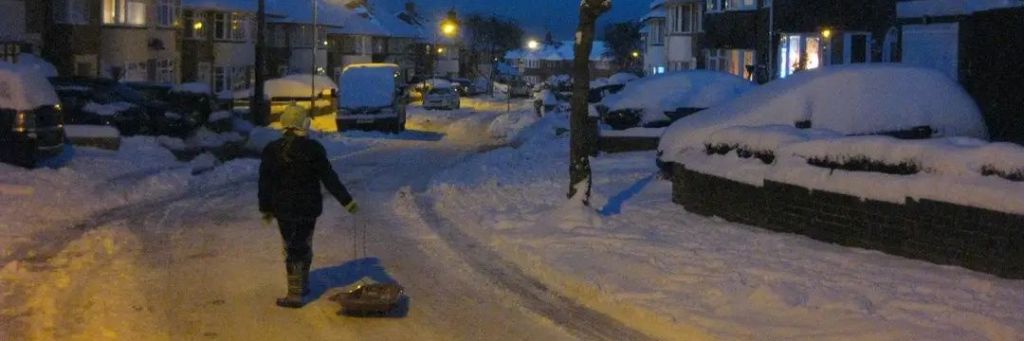
The picture above shows my 9 year old daughter taking her toboggan home after a day where we entered into the joys of snow as never before. In 2010 we had well over a foot of snow in South East England, something that has never been repeated in the 15 years since. School was cancelled across the county and the day stretched before us full of possibilities. After breakfast we went into the back garden and built a snowman, which ended up staying there for over a week, with both my daughters joining in the fun. We had a snowball fight which was great and we had races in the snow which was about 18 inches deep which were very tiring. After that we went inside for some hot chocolate and decided how we were going to spend the afternoon. The previous day, my wife, who works at the local hospital in an admin role, walked in and walked back in the days before working from home was widely possible. When she walked back she was dragging a toboggan behind her, much to my daughter’s delight! That was what would provide the entertainment for the afternoon. We walked to the local park and I spent the whole afternoon watching the children toboggan down the slope and never tiring of it. Although the park was crowded there was an air of friendliness and happiness that never exists in any other weather. As a community we were brought together in each other’s company and we knew it was something special, unique and magical. When walking home I saw the scene above and thought it might make a good picture. I was absolutely overjoyed when I saw it because it was pretty much perfect and the lighting made it magical as it reflected off the snow. You can’t see my daughter’s face but you know it has a look of wonder at the magical scene. It’s my favourite picture of all the thousands I have taken and would never have been possible in any other weather conditions.
If I have one wish it is that I could experience a huge amount of snow one more time in my life.
Who was your most influential teacher? Why?
It is impossible to pick one teacher from your lifetime that was the most influential. I think that if you do, you are almost certainly picking your favourite teacher, and that is often a very different thing. It is relatively easy to be a popular teacher but far more difficult to be a truly influential teacher. Also, we are often guilty of making it all about the positive influence only.
When I look back at the unpleasant, bullying teachers at the Maths school where I had my awful secondary school experience they ended up being very influential as I remembered the misery they put me through and resolved to be a completely opposite teacher to them. They came from a different age so to some extent they only reflected teacher training at the time which seems to have been ruling through fear. There were a few decent human beings on the other side of the teacher’s desk but they appeared to be few and far between! That said, I know how I was in my last couple of years of teaching and I was as short tempered as they were and could be prone to letting loose my negative thoughts. It gave me an insight into some of the pressure that teachers are under when they feel like their classes are getting away from them. The difference was that where we were terrified into submission in the 1970s, my classes, especially in the last few years, just looked at me with undisguised contempt whether I was being nice or hard line. I may have been an influence on some students but the balance between those who were receptive and those who were genuinely antagonistic had pretty much tipped by the time I left. To be honest even my few successes were not enough to keep me going given the waves of dislike from ever more entitled students who had neither the interest nor the concentration span to listen.
Teaching is an increasingly difficult career as we try to compete with the short term gratification of modern life which children and young adults expect after their formative years being a succession of dopamine hits engineered by immoral tech giants whose only care is for profit and who don’t give a damn about the damage to society. Sadly we in teaching now have to gamify lessons, teach in short bursts and watch as disinterested students either cheat or produce the bare minimum to pass. The days of influential teaching are at an end I’m afraid. From now on keeping a lid on things and trying to get a small amount of original thought from our students is the best we can hope for.

