
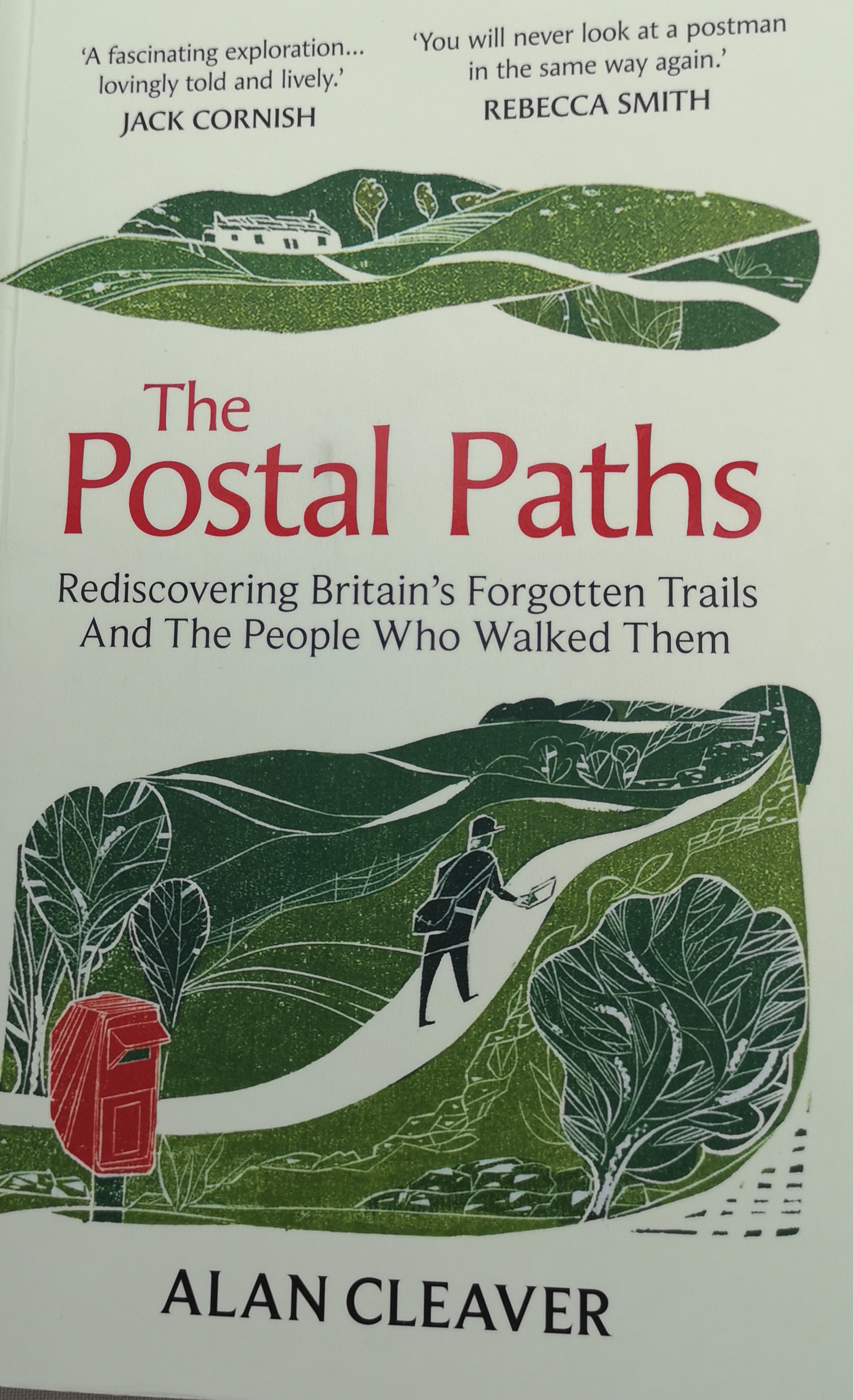
If you are a devotee of social history, as I am, this book will fascinate you. If you are a rambler or hiker looking for ideas of new and interesting routes to tackle, this book will inspire you. If you have an abiding interest in the Post Office, this book is right up your street. If you are none of these, but you appreciate a well written book with anecdotes, reflections and fascinating characters on every page, give it a go anyway!
I had never come across the term postman’s paths before picking up this book, and author Alan Cleaver himself only heard it for the first time in 2015. In the decade from a chance remark in a conversation he researched, walked and interviewed along the length and breadth of Great Britain. He was already a collector of arcane information about footpaths that were not officially acknowledged by the Ordnance Survey or were acknowledged under a different official name. The postal paths were often known by the name of the postman who first codified the route to enable the mail to be delivered as quickly as possible in rural areas where remote farms could be miles from where the post office was situated. In those days walking was the only way to get around so the quicker and easier the route, the better. Each route had its own instruction card, but the Royal Mail archives were not interested in these fascinating pieces of social history and threw away all but a few. Looking at it through the lens of this book, it seems like an act of cultural vandalism on a par with the mass wiping of TV programmes. However, it is difficult to know what may become culturally or historically significant in the future, so we should try not to look at the decisions with the benefit of a hindsight they did not have. So, Cleaver had to rely on Twitter, Web searches and chance comments to guide him as he made his way through the country looking for these paths.
The book starts in the centre of Great Britain, a town called Haltwhistle in Northumberland. Why the centre of Great Britain? Well, it is 290 miles from Portland in Dorset, 290 miles from North Orkney, 36.5 miles from Wallsend on the East coast and 36.5 miles from Bowness-on-Solway on the West coast, That sounds like a very good candidate for the centre of Britain to me. Cleaver had heard of a postal path starting from the town and taking in the sights of the South Tyne valley. From there the book meanders as a good path should, picking up snippets of local history here and there, interviewing the posties themselves or their descendants where that was possible and walking the route as far as possible in the footsteps of the posties of the 19th and 20th centuries.
We go to places like the Eskdale Valley where Hannah Knowles started delivering the mail at the age of 15 in 1912 and retired 61 years later having walked an estimated 87,000 miles delivering and collecting the mail! She was awarded the British Empire Medal but decided not to have it presented by the Queen as she had no wish to visit London! Matt Bendelow lost his left leg in WWI but came back from the front to become the postman for Bowes in Northumbria for 40 years. Jack Rukin had perhaps Britain’s most remote round ending at the Tan Hill Inn, Britain’s highest pub. Charles Macintosh was a naturalist and postie who was friendly with Beatrix Potter whose family holidayed in Dalguise in Scotland. She immortalised him for generations of children as Peter Rabbit’s nemesis Mr Macgregor.The one thing these posties had in common were that they were all of a very firm frame of mind to the point of stubbornness at times, but to walk all those miles over so many years you had to be out of the ordinary.
This book is no rose coloured look at a ‘better past’. Cleaver is admirably clear eyed when reflecting upon the difficulties that the posties faced and the occasionally appalling treatment they received from an apparently uncaring management. Their rounds were walked in all weather with little support in terms of clothing which was often unsuitable or basic amenities which were considered an unnecessary expense. He outlines the poor conditions they lived in, the pitiful wages and expenses they received and the often unsuitable clothing they were given. This was a hard life but one that they were proud of and revelled in in a way that modern workers simply wouldn’t.
I get the impression that originally this was going to be a minor offshoot of a bigger project, but it took on a life of its own and this marvellous book is the culmination of all that hard work. It is a glimpse into a Britain forgotten in all but fragments and the determination of Alan Cleaver to piece at least some of those fragments together.
How do you use social media?
If you had asked me this question six months ago I would have given you a very different answer. At that point I was scrolling on auto pilot through Instagram, Facebook, Twitter, BluSky and Threads, sometimes for 4 or 5 hours a day. Now, the picture could hardly be more different. I have mothballed the last two, cut Facebook and Instagram down to a few visits a week rather than multiple visits a day and use Twitter for music challenges almost exclusively. I have been helped by ScreenZen no end. By putting strict limits on my social media use I have reduced my overall phone use by about 60% and the times I am using it, I have a clear purpose. I am not at the stage where I am fully content with the level of my social media use, but I am now very much closer to where I want to be. It’s very freeing and I don’t want to go back to the days of constant scrolling. Like any addiction, though, you have to be careful not to slide back into old habits. So the ScreenZen stays on and the ways of distracting me from social media stay in place and my life is much better and fuller for it.
Jot down the first thing that comes to your mind.
I don’t have just one thing in my mind at any time. My brain is a buzz of activity from the moment I wake up until the moment I go to sleep. I can concentrate, but I need to be utterly engrossed in something for that to happen. Jigsaw puzzles will often still my mind to the extent that I am thinking of nothing else. Meditation last thing at night will often do it. Watching my daughter play football when she was younger would keep me concentrating, but that was helped by me writing reports on every game I watched for seven seasons, so in a sense I was still thinking of two things at once. Just to give you an insight into my mind, here’s the things that have flitted in and out of it in the first few hours of wakefulness.
What’s the time? My phone needs charging. I let Albus out at midnight. Where is he? Now he’s in I can sort out his breakfast. He’s gone into Hana’s room but I will do it anyway. I need a drink – breakfast tea or Earl Grey? Let’s look at my new library book. It’s good, at least for the first two chapters. I wonder what’s going on in the world? Why do I want to know?! Let’s look at sport. Nothing interesting there. I have my twitter challenges to do. Let me look at my Spotify for the playlists for them. Why do I build up all these playlists and then never listen to them? How can I choose a favourite album? Surely that’s impossible for any normal human being! Ah, Janet’s up. Must do her drink. Let’s look at the prize crossword for today. It’s a hard one. I wish my general knowledge was better. Why do my legs feel so tired? I should be able to walk more than I do. Maybe it’s because I have been doing less walking than usual. I must build it up. I don’t need to go shopping today. I got everything yesterday. Maybe we can have a walk this afternoon. I really must get on with my exercises because I can’t have breakfast until I do. The dumbbell work is definitely improving. I can go up to 3kg tomorrow. My form is better and I have noticed that I am reshaping my physique slowly. That’s good. I need breakfast but I don’t feel like getting it yet! What’s the prompt for today’s blog?!
It’s a really interesting insight into my brain and why it can be quite exhausting at times having a continuous internal monologue. I wonder if it’s anything to do with Asperger’s? Oh well, here I go again!!
Describe a random encounter with a stranger that stuck out positively to you.
I avoid random encounters with strangers as much as possible. If one happens I use the approach outlined in the title. When I was younger there was the ‘nutter on the bus’ fear. That was where the person who was most likely to talk to you was the one you were well advised to avoid! They were people who were often lonely, but sometimes they were unsettling and you would get off the bus early in order to avoid the encounter. This has been the basis of my approach ever since. I can’t imagine wanting to talk to someone I don’t know and I don’t want someone I don’t know talking to me.
I am sure many people will say that I am missing out by taking this approach to life, and I may very well be doing so. However, I am not going to change now as my avoidance tactic has ensured that my life is easier and more predictable. Remember, a stranger is someone who you probably wouldn’t choose to talk to in normal situations. I will always be polite but I will definitely not encourage any interaction.
Describe a decision you made in the past that helped you learn or grow.
I think it’s impossible to single out one specific decision. If you hadn’t done A then you wouldn’t be in a position to do B and for that reason C would never enter the equation and so on. As human beings we are constantly trying to find patterns, reasons and starting points. This is because we want to make sense of life and to imagine that there is a guiding hand, either of God, whoever you perceive that entity to be, or fate. The greatest likelihood, however, is that we are random organisms living random lives in a random universe. Pretty much the only element that is fixed is the human factor, which is that we are imperfect creatures making decisions with very little information and giving power to those who do not deserve to have it.
We love a story and we constantly tell narratives that we pretend to ourselves are true or logical. In fact the stories we tell are just as made up as the fiction we read. So, if you find a decision for today to talk about, the decision will be interesting and no doubt seem important, but it will be part of a random series of events that you are retrospectively putting a structure to.

