
Radio Times (London Edition) 16 – 22 December 2000
Let’s go back to just before the start of the current millennium. Wait a minute, you might say, it’s the year 2000, it says so in the title. Well, I was one of those people who would tell anyone who would listen that there was no Year Zero when Anno Domini was codified, so the first millennium was from Year 1 to Year 1000, so the second must be Year 1001 to Year 2000. When people were talking about celebrating the millennium in late 1999 I could be guaranteed to trot out that argument every time! Did people agree with me? No. Did it make people like me? Again, no! However, I was right and that was all that mattered 🤣🤣! Now we have mathematical correctness established, let’s get on with this deep dive into the pre-Christmas week according to the Radio Times.
What was 2000 like?
The year 2000 started on January 1st and, irrespective of the arguments above, people, especially in IT circles, were extremely worried about the Y2K computer problem. This arose because of the early coders using two digits for the date, so 84 was 1984, for example. The concern was that as soon as the date clicked over to 2000 or 00 in coding language, the programs would assume that this meant 1900. Various theories were shared in the public realm, such as planes falling out of the sky, the entire world wide web malfunctioning and banks losing track of all their accounts. Behind the scenes, luckily, the coders and programmers across the world were working tirelessly and, often, together to mitigate the situation as completely as they could. January 1 2000 saw very few problems, causing some to claim that there was never a issue in the first place, but experts across the industry knew better. It was a huge potential problem averted by long term planning. Perhaps not coincidentally, the all new Windows 2000 appeared the following month with Microsoft’s new operating system making access to the Internet much more straightforward for the time although it was only the new system until October 2001 when it was replaced by Windows XP.
The UK ‘celebrated’ the Millennium with a masterclass in awkwardness with Queen Elizabeth II very reluctantly linking hands with Prime Minister Tony Blair on one side and an equally unimpressed Duke of Edinburgh on the other! She steadfastly refused to cross her arms, making it look even more awkward, but I for one applauded her decision to keep to her principles! The national celebration included the River of Fire which didn’t work and the Millennium Dome which was expensive, baffling, disappointing and very time consuming to get to for the bulk of the country. I had been in Sydney for NYE 1999 and I was very surprised that no lessons had been taken from there as to how to set up a fireworks display properly. (Disclaimer – all views are those of the writer and are almost certainly different to many other people!)
In January the Pyrenean Ibex became extinct, a largely ignored story at the time which, sadly, pointed the way ahead in a world progressively spoilt by human beings. The Scimitar Oryx was declared extinct, but a small colony was bred in captivity and in 2016 it was reintroduced into the wild in Chad. As of now, it remains critically endangered.
The biggest film of the year worldwide was Mission Impossible 2 with Gladiator close behind. In music, Steps, S Club 7, Tom Jones and Robbie Williams were among the winners at the Brit Awards while the Mercury Prize was won by Badly Drawn Boy with The Hour of the Bewilderbeast. When this Radio Times magazine came out, Stan by Eminem featuring Dido was Number 1, but it only stayed at the top for a week as Can We Fix It by Bob the Builder scooped Christmas Number 1! The year ended with tragedy as music fans around the world were plunged into mourning by the death of Kirsty McColl in a collision with a speedboat that was being driven far too fast. Television saw Castaway on BBC1 start the year in a blaze of publicity before fizzling out as the public switched to other channels. It was an early reality show that gave Ben Fogle his big break. A far more successful reality show, Big Brother, debuted later in the year and became water cooler TV thanks to the showdown between Craig and ‘Nasty’ Nick. It benefitted from the contestants playing the game for itself and not for the opportunity to get a TV presenting role. Sadly, later series were overrun with the ‘look at me’ contestants and (for me at least) the show turned into a tedious parody of itself.
So, that’s the very brief background to this year. Let’s take a look at the magazine.
Radio Times 16 – 22 December 2000
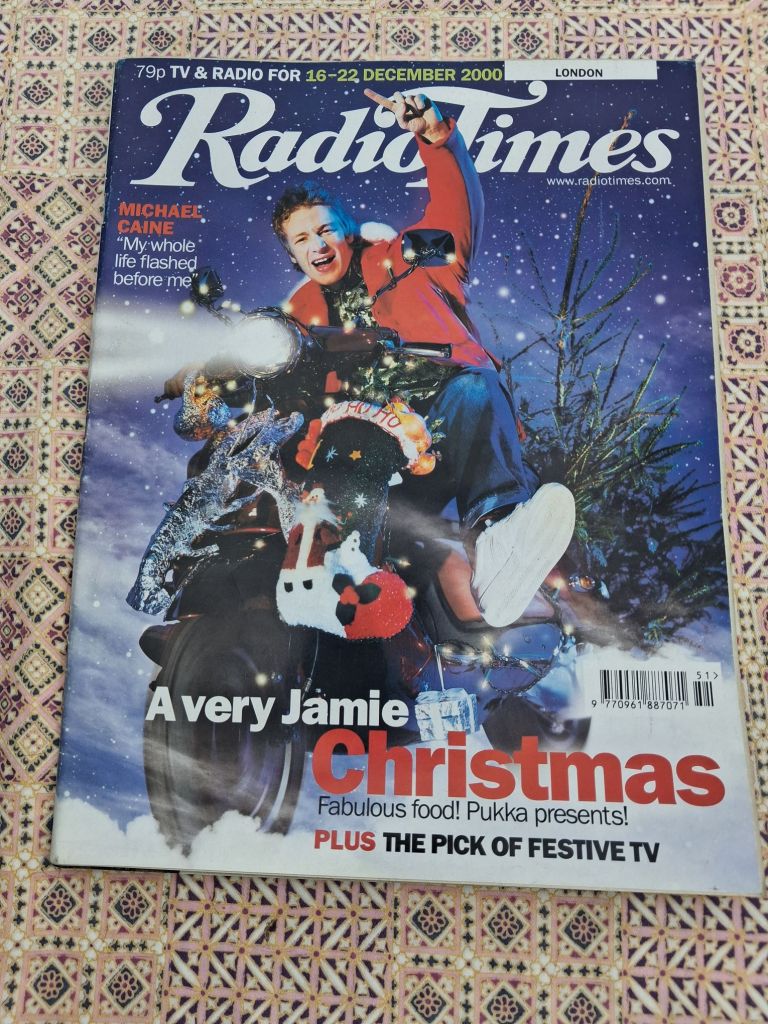
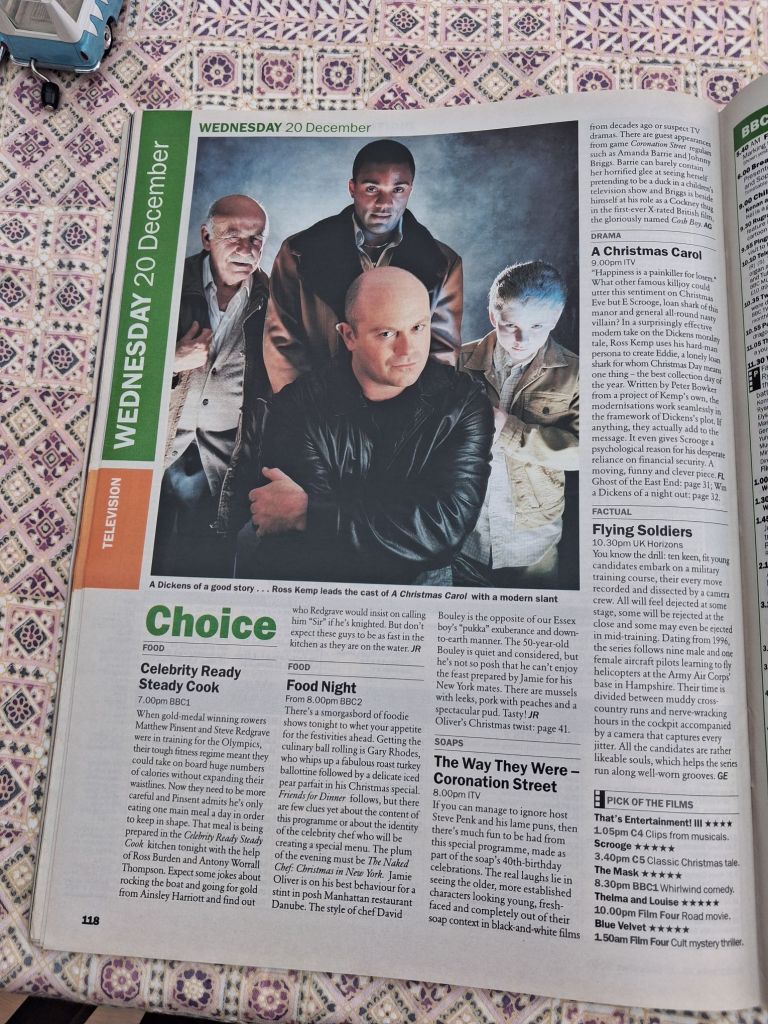
The cover is really interesting, because it reminds you of how long Jamie Oliver has been around and for how much of that time he’s been a huge star. The Naked Chef, his first series, had only started the year before when he was just 24 years old, but the combination of his patter and his platter immediately endeared him to a large part of the British TV audience, although it alienated almost as many people who took an instant dislike to him. There was clearly a class element to much of the dislike, but his manner was so different from previous TV chefs that he was never going to be one for the traditionalists. The first of many Christmas programmes aired in 2000, The Naked Chef – Christmas in New York, which showed him working in the kitchens of a very exclusive Manhattan hotel before putting together a non-traditional Christmas menu. It aired on Wednesday 20 December, the same night as an extremely effective modern take on my favourite story.
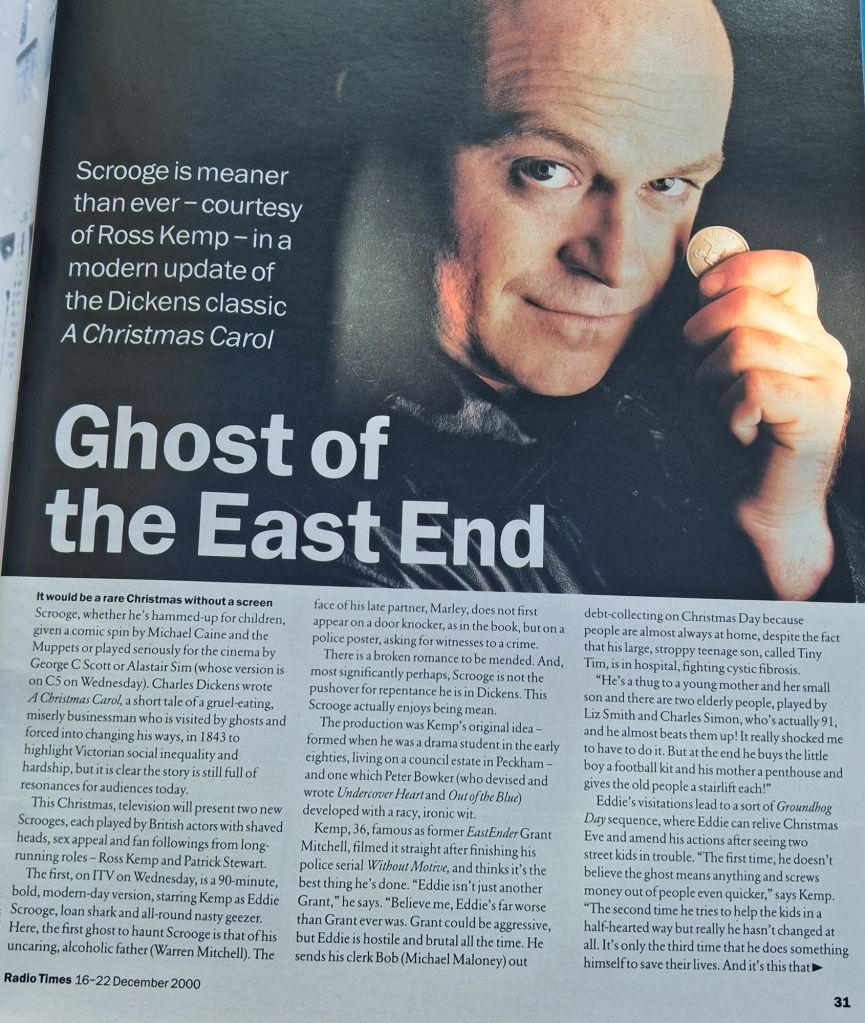
Ross Kemp is still a big star, but like Jamie Oliver he took a long time to be treated seriously due to his onscreen persona. He had started in Eastenders as hard man Grant Mitchell in 1990, and over those ten years had been the centre of many explosive storylines. Not only was he in a soap, which has always been a type of programming dismissed by the higher social classes, but his character was thuggish and unlikeable leading those who dealt in appearances to see Kemp himself as an extension of that character. His amazing documentary work was a few years in the future but for the week before Christmas he appeared in a gritty, faithful but entirely different take on A Christmas Carol. He played Eddie Scrooge, a loan shark, who terrorises his little corner of London. He is every bit a modern equivalent of Ebenezer who is cruel and delights in that cruelty. It’s well and truly worth searching out, because it’s an excellent version of the story and one that Charles Dickens himself would, I’m sure, have nodded his approval to. Put it this way, Eddie wouldn’t have been worried about someone putting a sailor’s hat on his head!
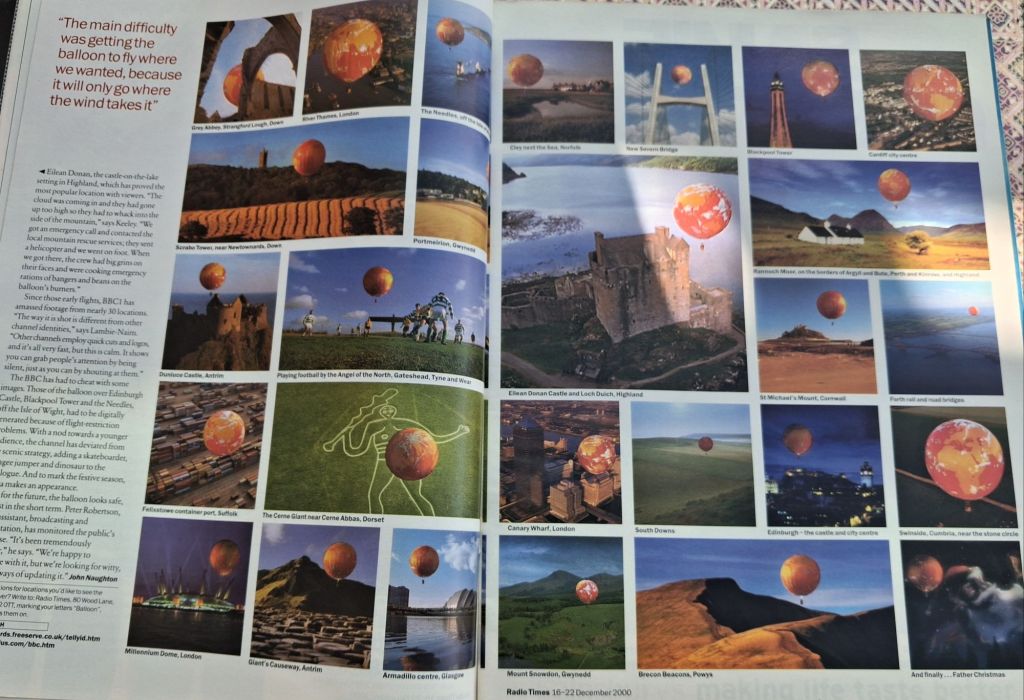
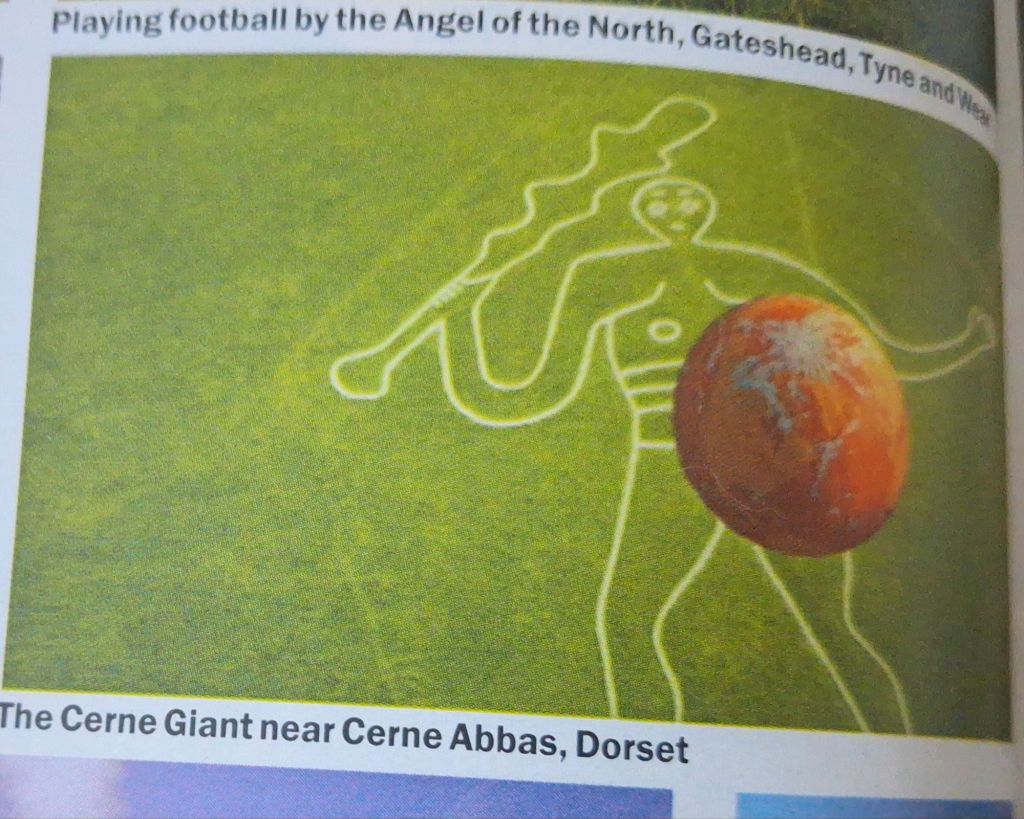
For five years the BBC1 programmes were frequently introduced by the wonderful balloon idents. I was only in the UK for around two and a half years during this time but they are an integral part of my memories of British TV in that time. In essence, the idea of a balloon floating past scenes and landmarks of the UK was a simple one, but the visual impact in those days before Digitally Enhanced photographs was incredible. An AI generated version of the famous BBC globe balloon, which would undoubtedly be the choice nowadays, would have looked uninspiring. The article does admit to tinkering with the pictures of Edinburgh Castle and Blackpool Tower because they couldn’t fly close enough, but the balloon was real in every picture. My favourite picture is of the Cerne Giant because of the strategic positioning of the balloon! It was a piece of creative brilliance that the BBC has never matched since as the YouTube video below testifies.
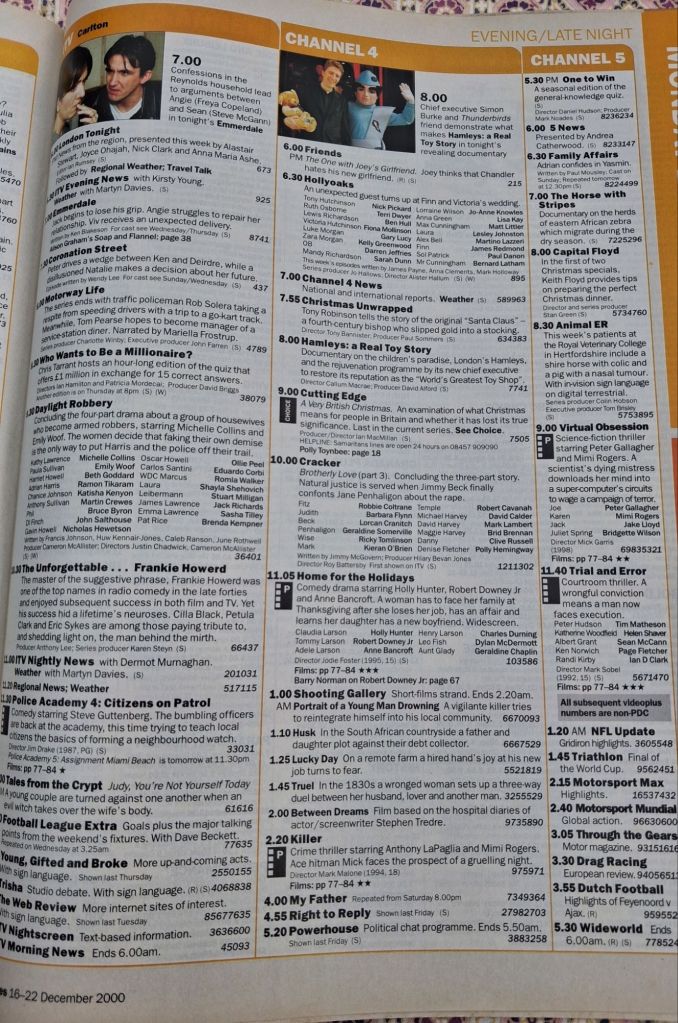
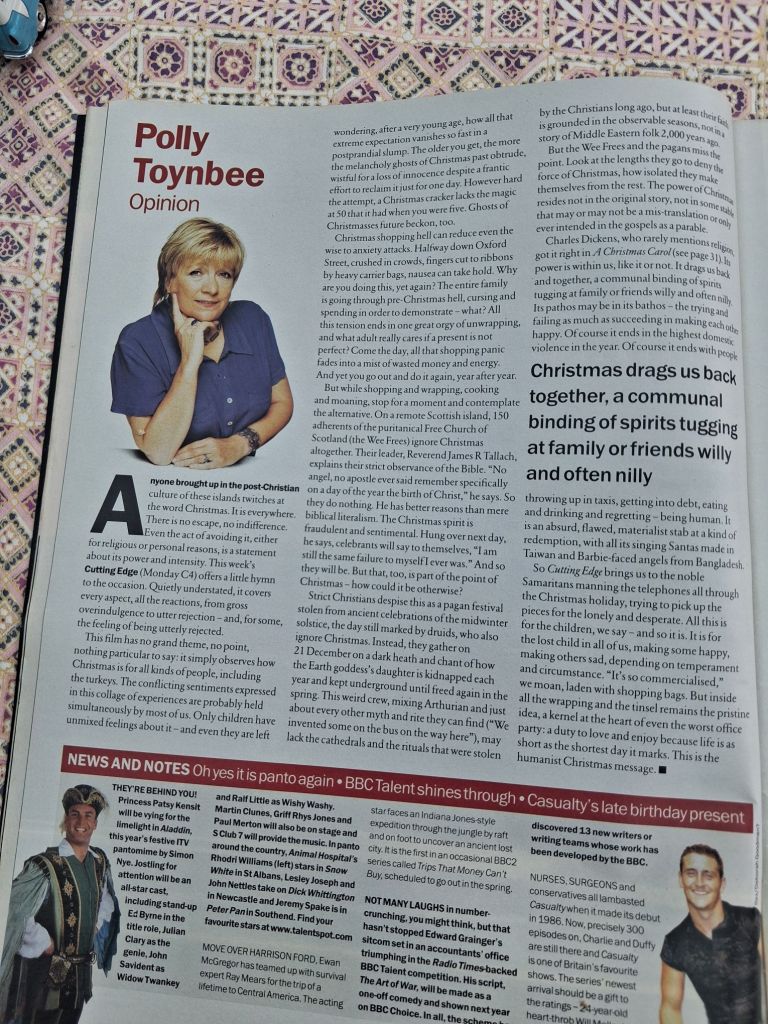
Polly Toynbee’s thoughtful article takes as its inspiration A Very British Christmas, a Cutting Edge documentary. Cutting Edge was a programme that was the Channel 4 equivalent of Panorama, Man Alive and World in Action. It covered a whole range of subjects in a way that served to illuminate facets of society both good and bad. As Toynbee observes, ‘It is an absurd, flawed, materialist stab at a kind of redemption’, and even as a huge lover of Christmas I can say that she really gets to the heart of what the season evokes in all its messiness. Sadly, the programme appears to have vanished from both Channel 4 and YouTube, so I won’t be able to see it from the look of things. It’s a shame as the range of situations and viewpoints would have made it social history par excellence.
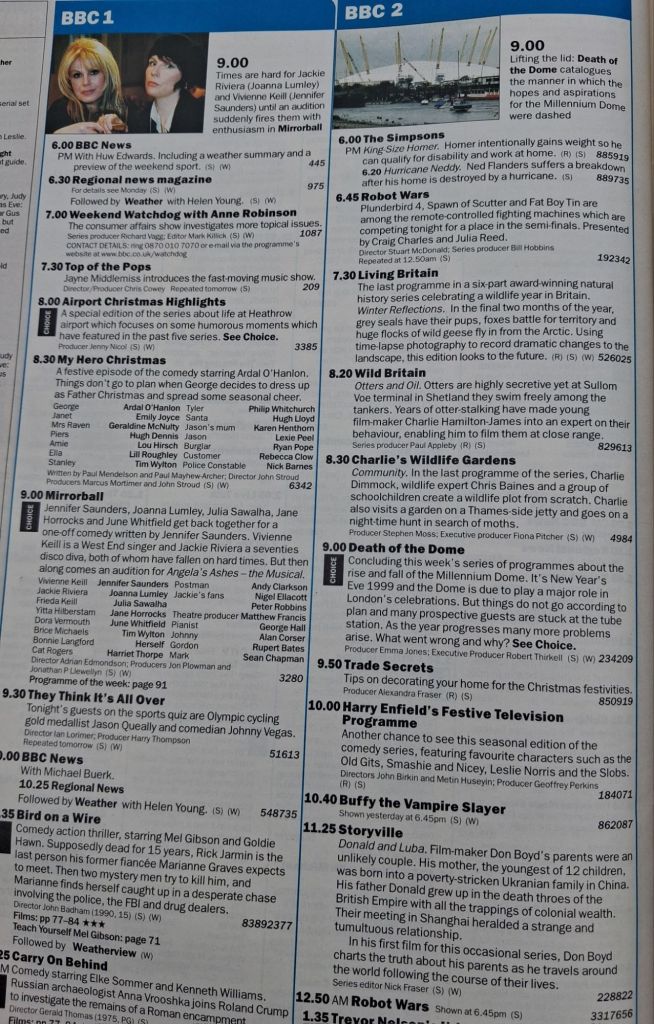
Given my dislike of the dome in it’s new guise as the O2, the place where sound goes to die, I am really intrigued to see the documentary Death of the Dome, dealing with all the problems with the Millennium Dome exhibition, both practical and political. From what I can glean from the Radio Times, not just the title, it isn’t going to be anything other than a warts and all treatment. Ironically, after a 7 year self imposed hiatus I am going back to the O2 in October 2027 to see one of my musical favourites, Jean Michel Jarre, the man who introduced me to electronic music. I am much lower in the auditorium and I have it on good authority that the sound is that much better than in the top tier where the sound was flat and distorted as well as hugely expensive. If you are also interested, click on the YouTube link above.
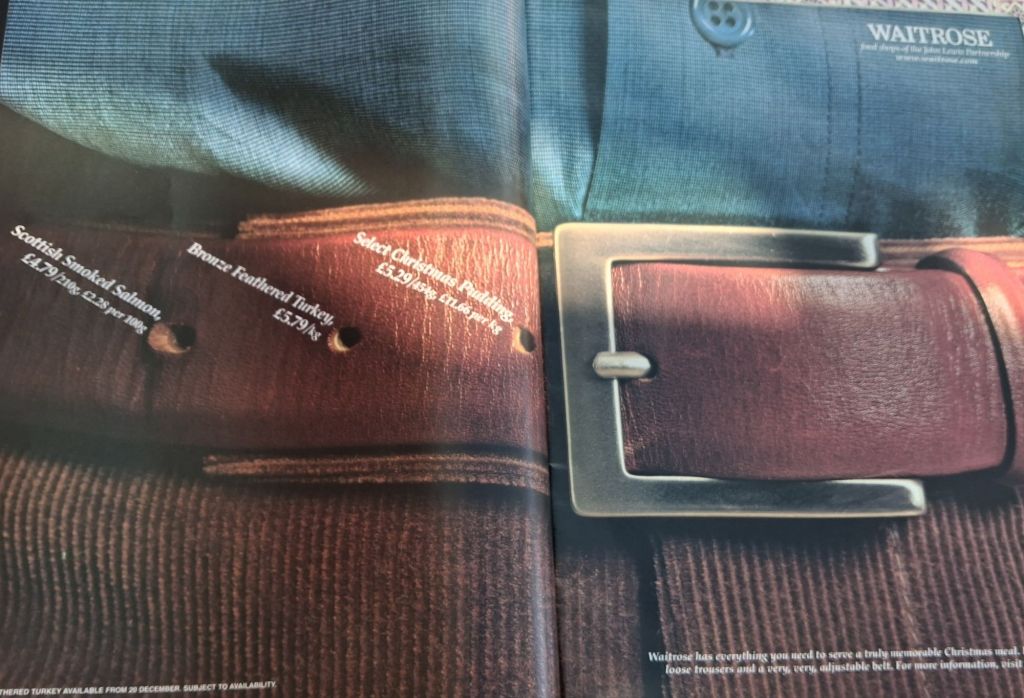
Finally, it’s on to the adverts, and you would have thought that a magazine at the beginning of the 2000s would carry similar adverts to today. Well, that turns out not to be the case. Look at the subtle, humorous and effective Waitrose advert below. It’s not the all singing all dancing advert you see today is it? The idea of wearing a belt at the dinner table and then gradually loosening it as you get further into the meal is not one that you hear much nowadays, but it is testament to the fact that the beginning of the 2000s had much more in common with the 1980s than the 2020s. It was something of a gradual change that accelerated and completely changed our world 10 – 15 years later.
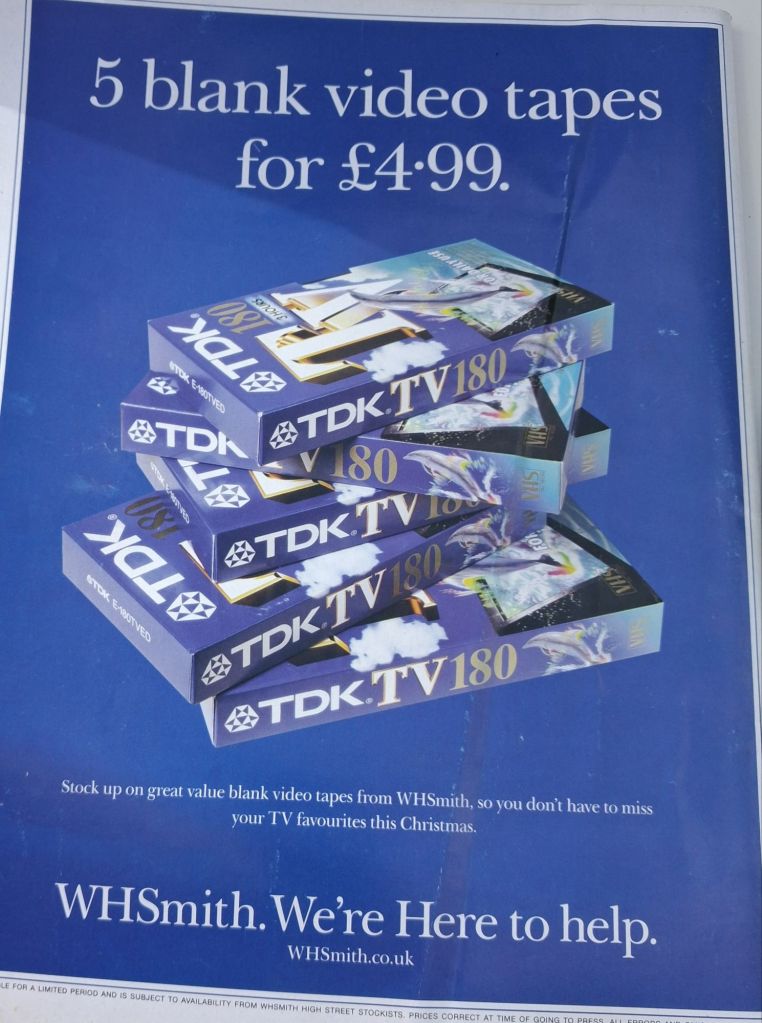
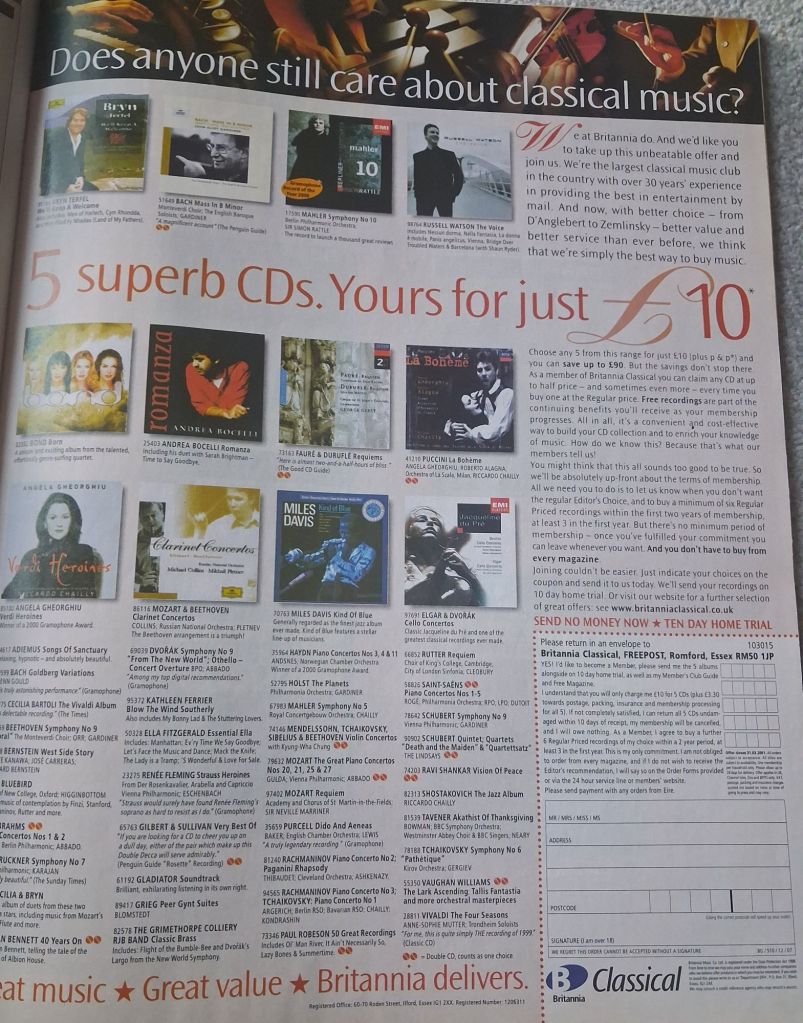
The next two adverts reinforce the fact in their presentation of items that are now social museum pieces. I was actually very surprised to see the WH Smith advert on the back cover with blank video tapes, but I thought back to those days and remembered that I was still using video tapes. Five years later they were no longer part of the entertainment landscape, but nothing had come along to replace them for recording programmes. On demand viewing was still in the future and it was only the technically minded who recorded TV programmes on DVD. In that sense, it was probably a liminal space where one technology was largely obsolete and nothing had yet effectively replaced it. Then there is the Britannia Music Club, a fixture of the 80s and 90s when they sold cassettes and took advantage of people like me who were hopelessly disorganised and forgot to send the form back in the post saying we didn’t want the selection of the month! As CDs replaced cassettes, the same business model applied and no doubt many people continued to receive albums they’d forgotten to cancel and couldn’t return. The other aspect of the advert that is interesting is the fact that it’s a classical music section of the club. I remember people bemoaning the musical tastes of the day and predicting the death of classical music, hence the tagline ‘Does anyone still care about classical music?’ As ever, the demographic that did had far more purchasing power and influence than those who didn’t and it kept its place as high culture appreciated by the most discerning people in society. The advert was an invitation to join their ranks in terms of the music if not in terms of the power, influence and affluence.
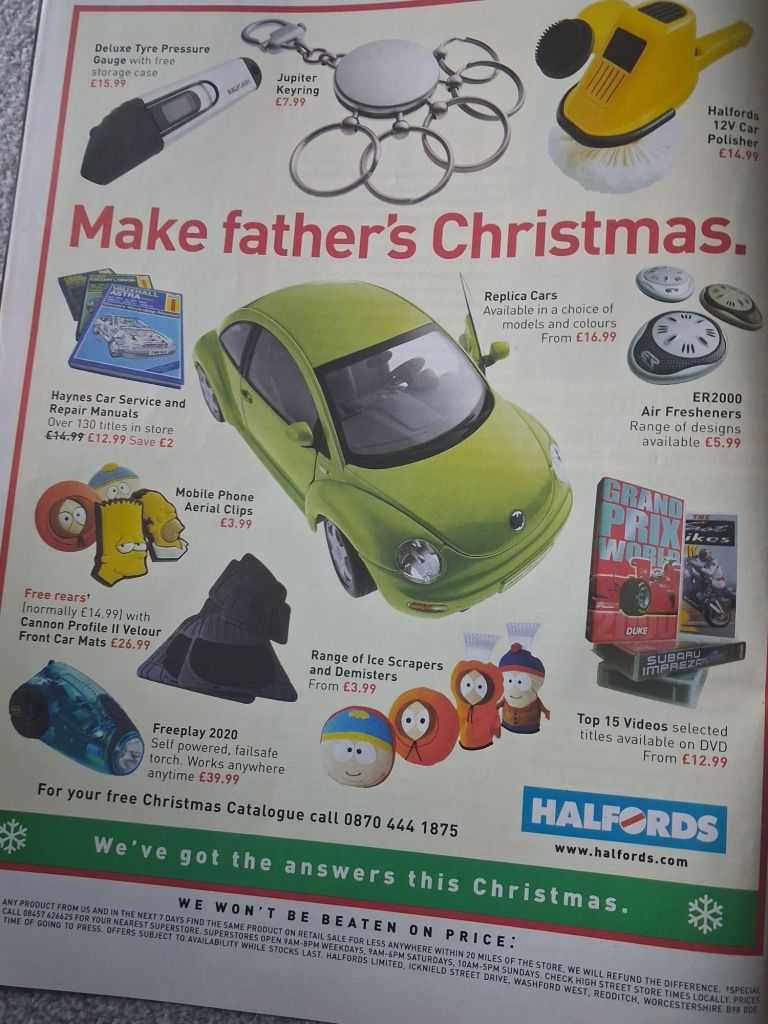
The final two adverts see the old and the new of Christmas gifts. Debenhams were to some extent ahead of the curve with their offerings below. Aromatherapy and scented candles are still popular gifts now as people try to find ways to hold the noise of the modern world at bay. There was far less noise in 2000 but the progress towards our modern online world had begun and ways to switch off needed to be found by many. The only item on that page that you would no longer see in the majority of homes would be the Stone Temple Water Fountain, an offshoot of the packaging of Oriental culture that would have been far more familiar to me having spent three years in Japan than it would to most people in the UK. Finally, an advert that could have sat in the pages of any magazine from the 1970s onwards, the Halfords gifts for ‘Dads’! Yes, the technology, if you can call it that, had progressed, but the basic premise that men liked cars was still very much an accepted cultural touchstone. Like the Fathers Day cards that show football, rugby and fishing, the idea that men and cars are almost symbiotically linked is an enduring one. Fortunately for me, geek culture is much more of a thing nowadays when it comes to men so even the non hunting, shooting and fishing types are well catered for!

I hope you enjoyed this look back at the Radio Times of nearly 26 years ago. The next one in this occasional series will take us back to 1997, nearly 30 years ago. You might be surprised at some of the things I unearth from a Radio Times from January of that year.
Discover more from David Pearce - Popular Culture and Personal Passions
Subscribe to get the latest posts sent to your email.

