

In 1970, arguably at the end of the heyday of movie musicals, the story of A Christmas Carol got a musical treatment from the pen of Leslie Bricusse who went on to write songs for the following year’s Willy Wonka and the Chocolate Factory another of my all time favourite movies. The fact that neither movie really set the box office alight hinted at changes in the tastes of the cinema going public. However, both have their die hard fans and both have remained cultural touchstones for the generation that first saw them and the succeeding generations. So, what is special about Scrooge?
The Cast
Rather like the George C Scott version I blogged about yesterday this version of Scrooge has household names sprinkled throughout the cast. Albert Finney is a marvellously bitter Scrooge who plays him as an unrepentant miser at the start. You could argue that his redemption arc is perhaps a little extreme, but what would you expect in a musical? He inhabits the role with gusto and his speak singing enables him to overcome the limitations of his musical abilities as he delivers the songs with a depth of emotion especially in I’ll Begin Again. The first three ghosts he meets with are played by British acting legends Alec Guinness as Jacob Marley, Dame Edith Evans as The Ghost of Christmas Past and Kenneth More as The Ghost of Christmas Present. All three enjoy themselves tremendously with Guinness in particular chewing the scenery with relish! However, of the three, it’s perhaps Edith Evans who leaves the biggest impression of acting excellence as the faintly disapproving and gently acerbic spirit looking on with a mixture of disappointment and interest at Scrooge’s past. She plays it completely straight and it’s all the more effective for that. Laurence Naismith is a magnificent Mr Fezziwig, embodying the spirit of the character more than in any other filmed version, and in my fantasy Christmas Carol with my favourite actors in the roles, he would definitely be my Fezziwig of choice. Try to avoid singing along with December the 25th if you can as his infectious joy lights up the screen. Alongside these names one other actor stands out for his bravura performance of the film’s most famous song. Anton Rodgers as Tom Jenkins was given the opportunity to sing the Oscar nominated song Thank You Very Much and he absolutely knocked it out of the park. When he is singing a song filled with sharp, occasionally bitter humour, he brings out the underlying hatred of the mean moneylender whilst still singing and dancing with infectious good humour.
The Songs
I have already mentioned two of the songs, but the soundtrack is packed with the superb song writing of Leslie Bricusse at every turn. From the riotous Father Christmas to the misanthropic I Hate People to the sweet and sentimental Christmas Children this film has every mood catered for. Almost every song is a singalong classic that would really suit a singalong version at the cinema. However, it doesn’t seem to have been revived in the wider public affection in the way that Willy Wonka has, to the extent that the prequel, Wonka, released on Friday (8 December), which uses some of Bricusse’s original music, in the UK has become one of the most anticipated and critically lauded films of the year. The songs in Scrooge are arguably much more effective as a score and the theatre revival of the early 90s with some well judged additions proved to be one of the best stage shows of the decade.
The Secret of its Success
For me, Scrooge has become a Christmas classic for a few reasons. I have already mentioned the cast and the songs, but the other main ingredient is more intangible. Bricusse loved A Christmas Carol and he wanted to share his affection for this marvellous story. He does so by investing each role, large or small, with a rich characterisation and an actor that embodies that role perfectly within the film. Look at Fred’s friend Harry, with just a few lines, played by the legendary Gordon Jackson, the toyshop owner with only a couple of scenes played by Catweazle and Magic Grandpa (depending on your age or the age of your children) star Geoffrey Bayldon or one of the two charity collectors, played by Roy Kinnear. Each of these minor roles is brought to life with care and with a seriousness that shows actors who were committed to the character and the film. Yes, Scrooge doesn’t really reflect the grittiness of Dickens’ novel, but it’s not supposed to. It is there to reflect the redemption arc, almost from the very beginning. I can also see that the addition of scenes in Hell aren’t really the film’s finest moments as they don’t really make sense, but Guinness saves the scenes with his playful acknowledgement of their absurdity. In the final reckoning, though, this film is simply great fun and what’s wrong with that at Christmas? It will almost certainly be on a TV channel at least once during Christmas, so even if you don’t have it on Blu Ray like I do, why not settle down in front of it for two hours of total enjoyment?

There are many versions of A Christmas Carol – I have more than a dozen myself! – and I am sure each one is someone’s favourite. I don’t have a specific favourite overall, but I have favourite scenes and favourite actors. In my opinion, the version that has the finest portrayal of Scrooge comes from 1984 when acting legend George C Scott had his turn at the role. In addition, the portrayals of Bob Cratchit, by David Warner and Ghost of Christmas Present by Edward Woodward, in particular, are absolutely fantastic. There is a huge array of talent in front of the camera, and all of them play their parts, large or small, with aplomb. Director Clive Donner was usually found behind the camera on TV shows but although this film was billed as a TV movie, he clearly had a much larger canvas to paint on. That canvas was Shrewsbury which stood in for Victorian London very well and became one of the characters in the film in its own right.
The Setting
For me, the main element that sets this film apart from all the others is the way that this version’s London is dark, grimy and claustrophobic. It is also very real and totally convincing. This setting is far closer to the way in which Scrooge, Bob Cratchit and Scrooge’s clients would have lived. There is squalor, there is danger, there is despair and Scrooge builds his business on all three. Even Scrooge himself lives in one room of a large but dilapidated house, that looks like a place that hasn’t seen any maintenance in decades, having walked home through streets that are dark and threatening, where beggars and thieves could be waiting around any corner. Scrooge’s first workplace, Fezziwig’s, does not resemble a ballroom ready for a dance, it resembles a warehouse which has been swept and cleared. The Cratchit house is clearly not warm or even particularly comfortable, although they make the best of it. This is all at variance with the other more genteel versions of Scrooge that show a sanitised London within which even the Cratchit family look fairly content. When Scrooge is led through the streets on Christmas Morning by the Ghost of Christmas Present, the people look happier but the streets look as dark and grimy as ever. This is a real world within which we see a real Scrooge.
Ebenezer Scrooge played by George C Scott
George C Scott plays Ebenezer Scrooge not as a pantomime villain but a real person. Gone is the ogre growling at children, counting his money into piles of gold or licking his pencil to put another name in his book. In his place is a businessman with his eye on the earning potential of his company, to whom his debtors are simply entries in a ledger. He is not immoral but amoral, not evil but uncaring and not angry but baffled by those who don’t think like him. He would fit perfectly into modern Britain and would no doubt recognise it straight away – although I mustn’t stray into politics here! Scrooge in this version is self contained, as Dickens imagined him, and, as a businessman should, very ready to negotiate with the ghosts in order to make things easier for himself. Scott was always a powerful actor, and he could have made it the Scrooge show by dialling up the pantomime villainy or by chewing the scenery, but he doesn’t. His Scrooge is a product of his time, his upbringing and his choices and he remains entirely true to that. His reaction to the visions reflects a tendency towards sober consideration rather than emotional outbursts and logical questions rather than flights of fancy. Throughout the film he doesn’t struck the wrong note once, even in the final scenes when he could have been forgiven for throwing caution to the wind. He is the definitive Scrooge for me, the one all others are judged by and the one they should aspire to be.
Bob Cratchit played by David Warner
I would put David Warner’s portrayal of Scrooge’s long suffering clerk on a par with that of Mervyn Johns in the 1951 Scrooge, and there is no higher praise from me! The Bob Cratchits of both films are perfect foils for their Scrooges so Warner’s Cratchit is downtrodden but occasionally defiant and constantly struggling by a weight that is emotional rather than physical. When he meets Tiny Tim outside his office after closing up you can tell he is happy to see him, but far too tired to run to the end of a queue to slide down Cornhill. At home, he is very much the family man, but he isn’t the focal point until he proposes the toast to Scrooge, at which point his wife slaps him down, showing who is the real boss at home! With limited screen time Bob Cratchit can fail to make much of an impression, but in David Warner’s capable hands he becomes a vital element of the storyline.
The Ghost of Christmas Present played by Edward Woodward
This Ghost of Christmas Present is hands down the best of any of the films. He is sarcastic, angry, acerbic and clearly despises Scrooge and all of his ilk. He is also endlessly compassionate to those who are forced into poverty, pain and fear by a system that is completely weighted towards the Scrooges of this world. Edward Woodward delivers both sides to perfection. He, more than any other Ghost of Christmas Present, makes you remember that A Christmas Carol was going to be a pamphlet called On Behalf of the Poor Man’s Child. Dickens was appalled at the conditions he saw about him in London and wanted to speak out about it, and the original pamphlet he wrote ended up almost verbatim in the mouth of the Ghost of Christmas Present. Given the angry nature of the contents, why wouldn’t the character be angry? Woodward delivers that anger better than any other iteration of this character in any other film. He is simply magnetic.
If you haven’t seen this version before then give it a chance if it comes on TV or, better still have it available whenever you want to watch it by buying it from the usual outlets. It’s worth every penny, and maybe even Ebenezer himself would agree!

One of the great things about Christmas is that every so often a new song, album, TV show or film comes along to become part of your own personal Christmas. This has happened with Lost at Christmas which I first came across on BBC Scotland two years ago. I watched it again last year and thoroughly enjoyed it once again, so this year I took the plunge and bought the DVD. So what is so special about this film as far as I am concerned? Why should you ignore the ridiculously low rating on IMDB? Well, read on.
The Story
In a small Scottish town, two people are making big decisions that will be life changing. Jen is heading there to surprise her boyfriend and Rob is about to propose to his long term girlfriend. Suffice it to say, things do not go to plan and the two find themselves on a station platform, only to find that there is no chance of getting home that way. Jen takes her former boyfriend’s car and the two of them head into some typical Scottish (Christmas movie) weather. Having to stop at a remote inn when their car grinds to a halt, the two, who don’t really understand each other, having to share a room. So far, so predictable, but there’s some twists that really make the film different from a traditional Hallmark style movie.
The Cast
One of the main reasons I first gave this a chance is because of its very strong Doctor Who connection. We have the Seventh Doctor himself, Sylvester McCoy, 60s companion Jamie McCrimmon, Fraser Hines and young Amelia Pond from the new series, Caitlin Blackwood. Add the star power of Gregory’s Girl alumnus and Altered Images lead singer Clare Grogan, and you have a central supporting cast packed with talent. The two main characters, Natalie Clark’s Jen and Kenny Boyle’s Rob are, on the surface a typical rom-com couple with one being a free spirit, or at least trying to be, and the other being an initially taciturn and unhappy man at a crossroads. The way they introduce you to the hidden depths in the characters is part of the charm of this film for me.
My reflections
I have always enjoyed my trips to Scotland and I feel at home in Edinburgh whenever I visit. The Scots seem to have a kindness mixed with a no nonsense attitude and a sense of not suffering fools at all, let alone gladly. As a result, I have always enjoyed films, TV, music and sport from there. To me, Lost at Christmas captures the irreverence and warmth of the people who are often very happy to poke fun at themselves as well as others. It is a film that is a very welcome contrast to the syrupy Christmas movies common at this time of year – not that I am averse to them either! The characters all have their own charm but they are not instantly appealing. You have to get to know them and appreciate them, just as you do people in real life. It makes the film more true to life than most and gives it a welcome edge especially early on. This film will no doubt be on the BBC sometime this month and if you spot it, I really urge you to give it a chance. If you’ve had too much sweetness you will appreciate the occasional tartness of Lost at Christmas.
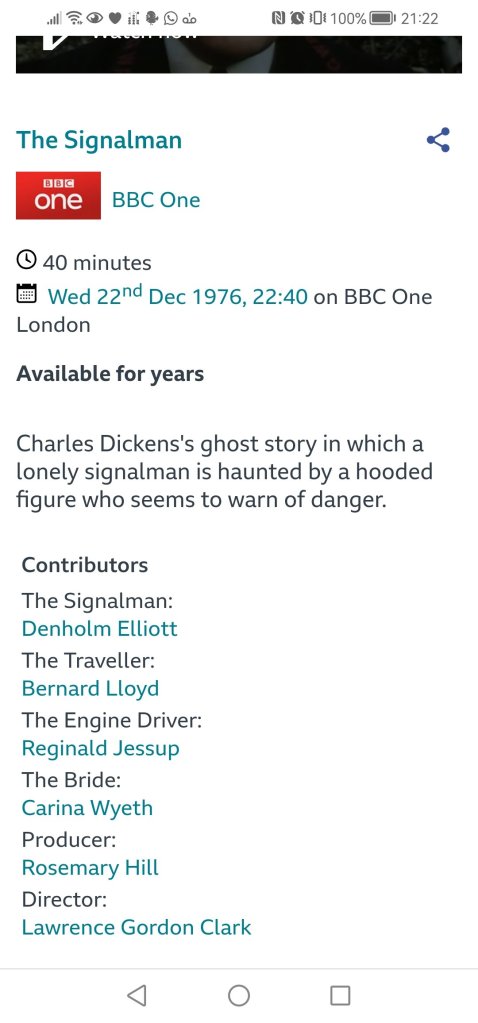
In 1976 I was up late on a night three days before Christmas. My parents may well have been out because I wasn’t being told to go to bed even though I was just 11 years old. At the time I was a big fan of ghost stories and horror stories. When I saw The Signalman in the Christmas Radio Times listing I was determined to stay up for it. Well, I soon realised I had chosen to watch a programme that would leave me very unsettled both then and now.
The story
A traveller is walking in the countryside and comes across a signal box and he calls down to the signalman below. He is beckoned down to the track by a clearly disturbed man who looks like he has seen a ghost. It turns out that his cry of ‘Look out below there’ is the very same cry that an apparition, who has appeared to him twice, greeted him with. As The Signalman tells the traveller his story he is met with scepticism as the traveller tries to find a logical explanation. However, it seems that it may not be a situation where logic applies.
The adaptation
This story was the 6th in the Ghost Stories at Christmas strand, and the only one featuring a tale from Charles Dickens, who wrote this in the year after he was involved in a terrible train crash. The Signalman was played by acting legend Denholm Elliot and he carries the adaptation with his suppressed terror that occasionally leaves its mark on his expression. It is a tour de force of subtle power that unsettles the viewer far more than screams and an exaggerated response to the situation. Bernard Lloyd who plays the traveller is an excellent foil, reacting to the increasingly scared signalman with compassion and support. For 35 minutes they hold the audience in the palms of their hands as they come to terms with the true nature of the otherworldly apparition. In keeping with the other stories in this collection there is little overt horror, although two glimpses of the face of the apparition have been burned into my mind for nearly 50 years.
My reactions
47 years ago I was deeply unsettled by the programme and tonight on re-watching The Signalman the same reaction came to the fore. This is a genuinely scary piece of television of the type they struggle to make these days. Why is that? Well, I think it is to do with the restraint of the actors, directors and film makers. They allow the minimum of overt horror and reap the reward of genuinely unsettling and scaring the audience. The atmosphere is one of quiet dread from about 30 seconds in right up to the shocking ending. At no point is this played anything but straight and there is no attempt to explain what is happening. It is left to the audience to decide and that exerts a greater pull on the imagination than any of the jump scares and other tricks of the horror genre these days. If you want to see a classy and creative piece of storytelling, look no further than The Signalman, but don’t blame me if you are given an unsettled night!
The bedtime story is a cherished part of many children’s nightly routines and then a cherished part of their memories ever after. The same is true for many parents. I read to my children throughout their formative years, and given the 7 year gap between our oldest and youngest children I was lucky enough to do so for more years than many parents have the opportunity to. It was a marvellous time for both reader and listeners and Christmas meant a chance to revisit books that became perennial favourites. In our house that meant Merry Christmas Sleepover Club, Old Bear, Paddington and the Night Before Christmas amongst many others. They provided fun, laughter and the comfort of earlier childhood and every Christmas we revisited them, knowing the stories and losing ourselves in the spirit of the season. Even as older children they reconnected with that part of themselves which still believed in magic. (I can see an entry for Blogmas 2024 right there!) I read A Christmas Carol in its Ladybird Book form, but it wasn’t one that I returned to quite as often, perhaps because they were played many different versions of the story on video, and later DVD, in my attempt to bring that same magic that I felt from the story.
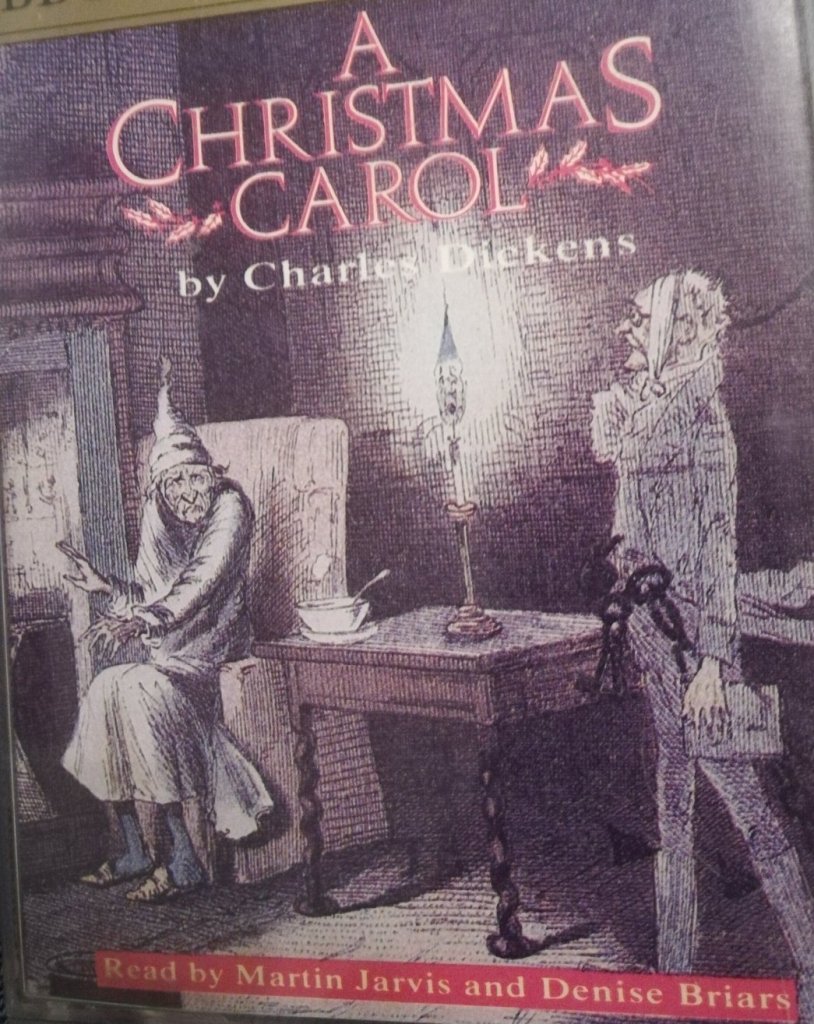
As adults we don’t necessarily settle down for stories as our busy lives take precedence, although I do try to read before going to sleep most nights. For many, Book at Bedtime, the long running Radio 4 series takes on the role of storyteller, and the recording of A Christmas Carol by Martin Jarvis and Denise Bryer was a 1988 release on cassette that I bought very eagerly despite not having heard the original programme. It was a chance to immerse myself in my own visions of the book and the characterisations of the readers. So, without further ado I will look at the qualities that makes this particular version my favourite reading.
The first thing that appealed to me when I first heard this on cassette was the lovely opening theme. At the time, I had never watched Box of Delights or listened to the Hely-Hutchinson Carol Symphony so the beauty of the theme just entranced me and it still has exactly the same effect. When the story starts with the pronouncement ‘Marley was dead! To begin with’ read by Martin Jarvis you just know you are in safe hands. However, the addition of the lovely voice of Denise Bryer adds the touch that all other readings miss, the voice that can deliver all the female roles written in the book without resorting to caricature. I can pick out two of her many roles for particular praise, Mrs Cratchit and Mrs Dilber. The former has a real strength and an anger when denouncing Scrooge that is really powerful whilst the latter has the requisite cockney accent but Bryer steers clear of making her a music hall style foil. Martin Jarvis is, as ever, simply marvellous with a superbly caustic Scrooge and an open hearted and kind Bob Cratchit standing out. One of the other real strengths of this production is the perfect timing of the end of each episode. My favourite is the appearance of Marley where the flame leaps up. It is just perfect.
The beauty of the best audiobooks is that it takes you back to your time as both the person being read to as a child and the person reading to your children. This book definitely does that in every respect. Sadly it is not available on the BBC Sounds site or indeed on CD, and it deserves to be heard by a much bigger audience. Should you still have a cassette player and should my love and affection for this version has encouraged you to seek it out you can occasionally see it on Discogs or on eBay, but, sadly, it is incredibly difficult to find otherwise. I just count myself lucky that I was able to get a copy and to be able to play it to this day.
‘May it haunt your house pleasantly and no one wish to lay it’
 David Pearce - Popular Culture and Personal Passions