
One of the guarantees on a Christmas morning in the 1970s was that somewhere among my presents would be an annual or two. The Beano, The Victor Book for Boys and from the age of 8 a Blue Peter annual were regular treats. The Eleventh Blue Peter book was my first one and I received them every year until my teens. What was so special about them, and how would I react when reading my first annual again? I got the chance to find out when I found it in a charity bookshop earlier this year, so let’s go.
The Year 1973
1973 was the year of strikes and industrial unrest with the unions and the government at loggerheads. It was the year that the three day week started and we did our homework by candlelight. It was the year of the first battle for the Christmas Number One won by Slade with their iconic Merry Xmas Everybody. It was, for me, the year I joined St Andrew’s and finally fitted in somewhere. For all those reasons it was a year I remember with great affection.
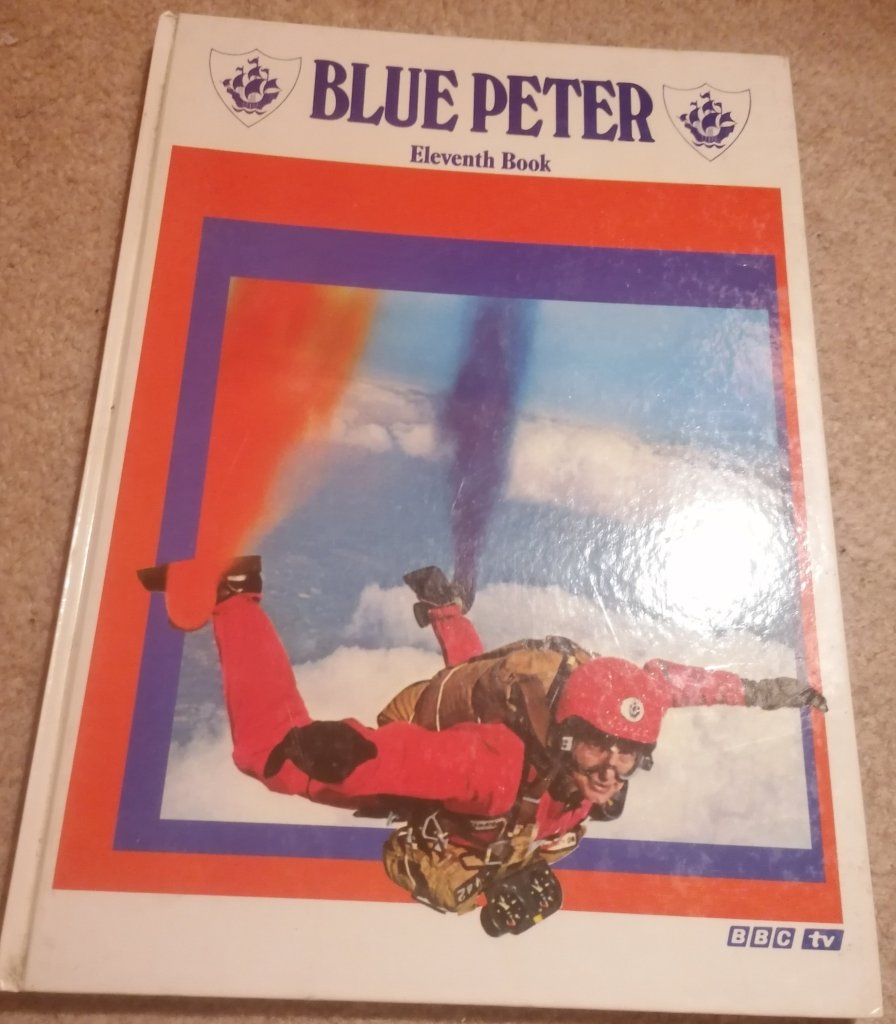
The Cover
On the front, instead of the year, the title was Blue Peter Eleventh Book, rather than the Blue Peter Annual 1974. I think this gave it an air of an ongoing series and perhaps made it less likely that it would be put to one side before New Year’s Eve as some of the other annuals were. The picture on both the front and back cover is of the daredevil presenter John Noakes skydiving as part of one of the most clearly remembered segments of the show from 1973. I was a massive fan of John Noakes, as were many others, and his picture on the front cover probably attracted many parents, family, friends or Father Christmas himself to buy it!


The Contents
On the two contents pages inside the front cover there are 20 passport style pictures of John Noakes and 20 of Lesley Judd, who joined the team in 1972. They were the presenters who were perhaps seen as more relatable to the audience and, in Judd’s case she was now the third presenter of a trio with Noakes and Peter Purves, having initially presented the programme alongside Valerie Singleton and then taken over from her as Singleton branched out into a series of programmes like Val Meets the VIPs and became a guest presenter for Blue Peter Special Assignments rather than a regular presenter. So, 1973 was Judd’s first full year and the book reflected this in the prominence it gave her. Looking at the bottom of the two pages, the 70p price tag raised a smile! Looking at the contents themselves, three sections jump out straight away. First of all, A Spoonful of Paddington, one of a series of Michael Bond penned stories featuring the famous bear. I got the Armada Lion collection of stories pretty much as soon as it was released in 1978, but this was my opportunity to read a new Michael Bond and I remember it being the first page I turned to. Second was Tolpuddle Martyrs which I remember incredibly well both on screen and in this book. Finally, The Ugly Sisters was a pantomime themed section of the show with Peter Purves and John Noakes gleefully hamming it up aided by Arthur Askey!

A Spoonful of Paddington
One of the elements of the Paddington books that kept them fresh was that there were no references to people or events that could pin the books to a specific time period. After decimalisation, for example, people still referred to coins using their pre-decimal names, and everyone knew what they meant. So, when a character in Paddington referred to sixpence or a shilling it didn’t seem out of place. I read Paddington as a child and was quite convinced that the books were set in the modern day. That was turned on its head in A Spoonful of Paddington which was a story based on Uri Geller. Now, immediately, I have to explain to readers who weren’t around in the 1970s who Uri Geller was. He was an ‘illusionist’ (charlatan) whose stock in trade was bending spoons through ‘the power of the mind’ and he became a sensation in the more credulous days of 1973. Michael Bond incorporated this trick of Geller’s in the story and tied it in to Paddington’s efforts to replicate the feat, his first go at babysitting and the Blue Peter team in a typically funny and well plotted tale. By the end of the story, with it’s knowing pay off, it is clear which side he is on in the Geller debate!

The Tolpuddle Martyrs
This was a story I remember from television and one that had a real impact on me at the time. In the studio, and in this book, Peter Purves introduced this historical tale with union banners behind him to explain the reasons behind unions. Nowadays, of course, the government would be screaming about indoctrination and trying to get Blue Peter banned, but in those days we were trusted to be given that type of historical information. The historical stories were always accompanied by beautifully drawn cartoons, which are reproduced faithfully in this book. The story of the poor workers in Tolpuddle being exploited by their employers resonated with me and the time because of the way it was done. They complained that 8 shillings a week was impossible to live on and asked for 10 shillings. In retaliation for their attempt to feed their families properly, the employers reduced their wages to 6 shillings a week, leaving whole families at the risk of starvation. A group of men got together to form the first union and swore an oath to support each other. Sadly, one of the men was a traitor and he went straight to the employers. I remember being appalled by his actions at the age of 8, and not much has changed in the intervening 50 years. Along with the cartoon version of A Christmas Carol it informed my sympathy for the underdog that has stayed with me all my life.

The Ugliest Sisters
This was an article based on a Blue Peter pantomime that took a scene from Cinderella as its inspiration. Val was Cinderella, Lesley was the Prince, John and Pete were The Ugly Sisters and Arthur Askey was Baron Hardup. It was Askey with his huge experience of the art form who guided them through their rehearsals and gave them the tips they needed to put together a scene that was broadcast. I still remember the ‘somewhere else’ gag that amused me hugely then and still makes me grin now. It is the details of the preparation that give this article a real interest to me, explaining some of the history and conventions behind pantomimes.
Reflections on the book
There is a huge amount to read in this book, even for an avid devourer of the written word as I was at the time. There are behind the scenes stories including the cover story of John’s 25,000 feet freefall with the Flying Falcons which goes into great detail about the training required and the way the actual jump felt. There are historical articles and one of the famous ‘makes’ giving you the instructions to make your own ‘Red Indian’ village! I’m not sure that one would get past the planning stage now! There is a recipe for cooking a Scone Pizza, which sounds intriguing at the very least, and would be easy for any reasonably capable child to do. In those days of latchkey kids, of which I was one, it was useful to be able to put a snack together when you got home from school. Of course, you first needed to remember your key if you were to try out these recipes, something I was not always good at! The overall tone was what might be called didactic today, and it is a tone some people might frown upon. This book shows why they would be completely wrong to do so. All the facts and ideas are presented in an engaging and effective way that is as good as the most technologically advanced of lessons these days. The quality of this book just doesn’t dip from cover to cover, and revisiting it has been an absolute treat.
Moving on 2 years from yesterday’s blog I come to the Christmas before I turned 13. It was the year that one of the crown jewels in the BBC’s Christmas viewing was watched by an audience of 21.4 million! I wonder if you can guess which one? As well as that show, there were a number of programmes both familiar and forgotten. So, join me on a trip through the Christmas of 1977 from Christmas Eve to Boxing Day.
Christmas Eve 1977
The Christmas Eve morning line up was very appealing to me at the time and, quite honestly, would be appealing to me now! We start off with Bagpuss at 8.55, which was a total comfort blanket of a programme. For a complete contrast you had that followed by Buster Crabbe in Flash Gordon Conquers the Universe from 1940, which was still exciting to watch given the amount of battles and the cliff-hangers that would take you into the next episode. Regardless of the slightly hammy quality of the acting, it definitely stood the test of time in those days. It would, perhaps, be less appealing to the majority of today’s 12 year olds, but even 80 years on, it’s relatively fast pace might keep some of them interested. The next 90 minutes would have been an absolute must see for me as it contained much of the music I would have bought as I started to collect singles. I was a Swap Shop fan through and through, never once switching channels to the anarchy of Tiswas, whose casual, if humorous, cruelty reminded me far too much of my days at school at the time, minus the humour of course. One of the main areas for the other children at school to target were my musical likes which I was occasionally unguarded enough to admit to. This programme gave me 90 minutes to ignore all the bullying and ridicule and just enjoy pop music in Swap of the Pops.
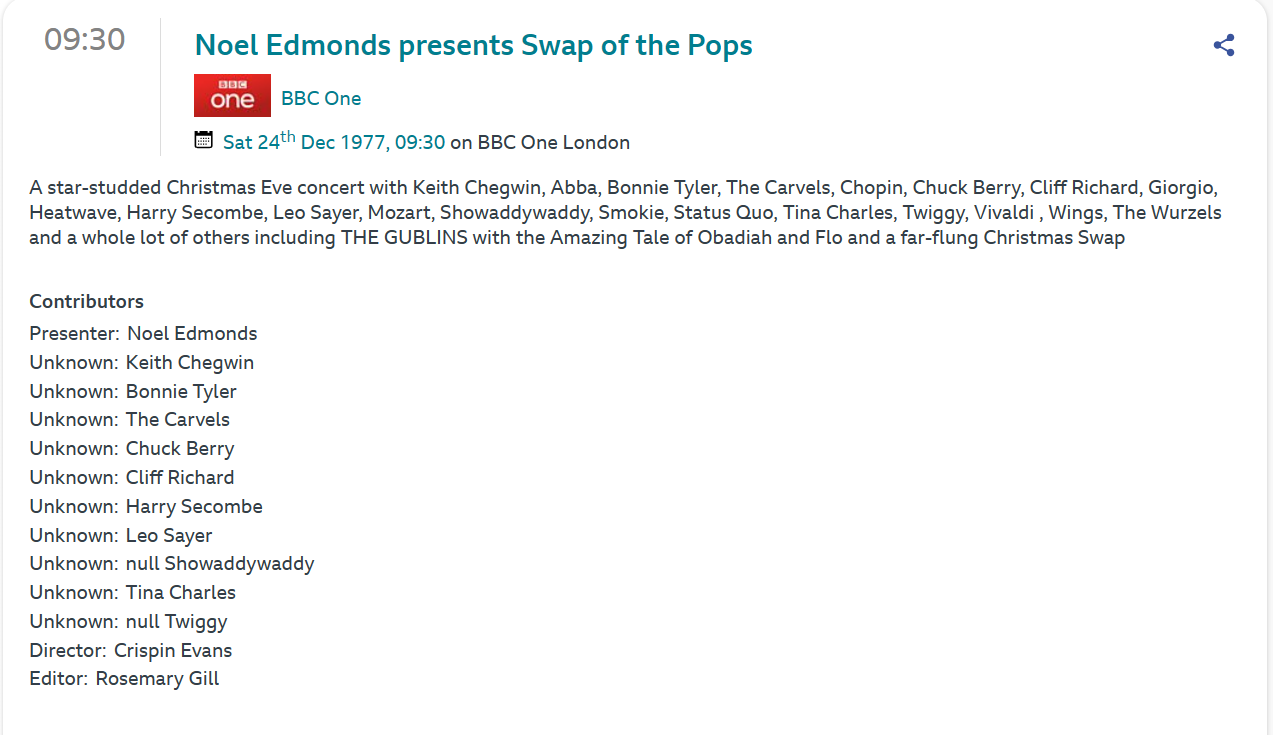
Two things come to mind when looking at the list of artists. Firstly, I can guess what songs they will have been singing in most cases, and could quite conceivably have a number of them on vinyl. Secondly, what were Harry Secombe and Chuck Berry doing on the programme? I’m not saying they weren’t excellent singers in their own right, but they seem a little out of place on this list. Mind you, the music that we were introduced to particularly on the BBC covered all bases at the time, so it is perhaps less surprising than it would be these days. Having another look at the list, I’m even more impressed to note that they resurrected both Chopin and Beethoven for this show!
One of the biggest news stories of 1977 was the death of Elvis Presley on August 16. It is one of those news stories where I can remember exactly where I was when I heard it. In my case I was watching the ITV lunchtime news sitting in my dad’s chair as he was at work. I remember my heart literally skipping a beat through shock. Although I hadn’t really discovered much of his music before he died, the release of Way Down, giving him a posthumous Number 1 in August/September 1977 and the subsequent airplay his old hits got put him firmly on my radar. I clearly wasn’t the only one, as Christmas saw a season of Elvis films in the mornings.
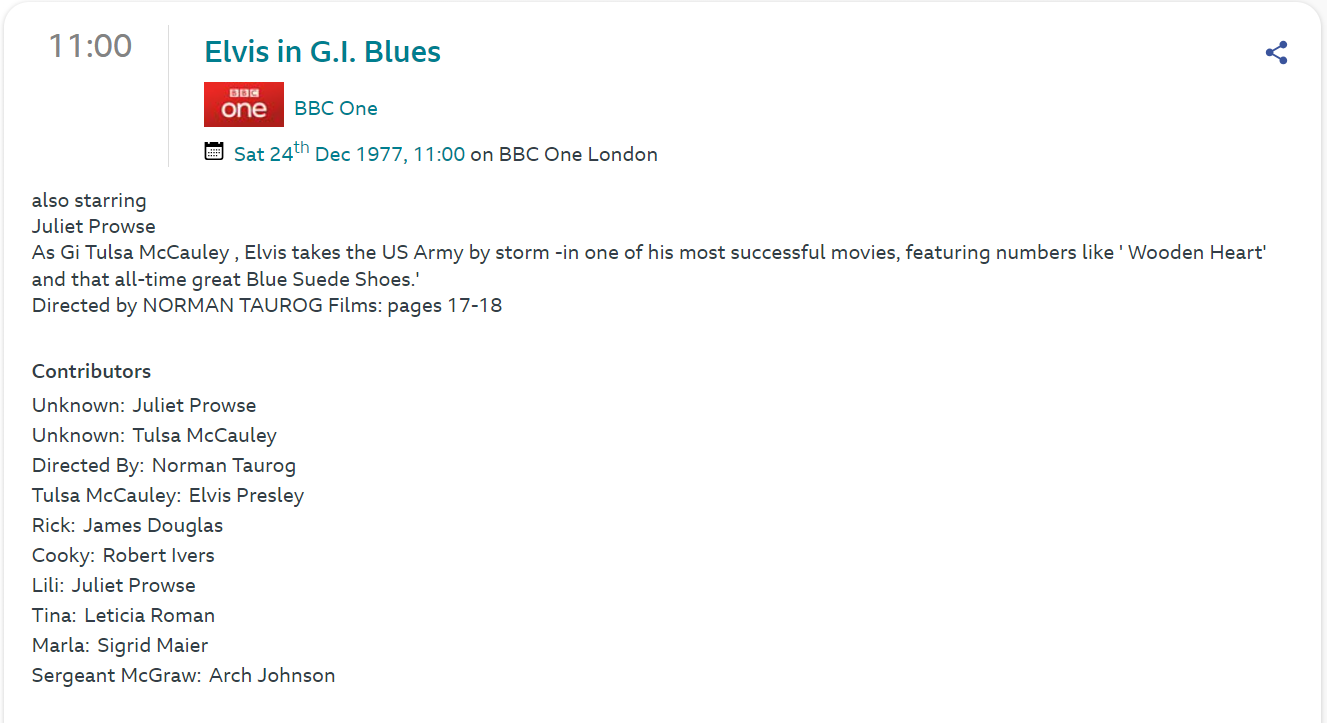
I have to admit that I was never a great fan of his 60s films despite preferring his 60s music output. They were fairly pedestrian and pretty much all had the same plot, a bit like a prototype Hallmark movie set up! As a 12 year old, the constant romantic entanglements were of no interest to me, so it was really a case of waiting for the songs or, more probably, drifting away from the TV and concentrating on something else. They may have been commercially successful in their time, but they were definitely not great works of cinema!
Following G.I. Blues your BBC1 viewing was eclectic to say the very least. At 12:40 there was the Soviet Gymnastics Spectacular, at 1:30 the film White Christmas and at 3:25 Jubilee 77 which looked back at the Queen’s Silver Jubilee celebrations that June. The two hours watching this review may, I would suggest, have stretched my 12 year old patience too far!
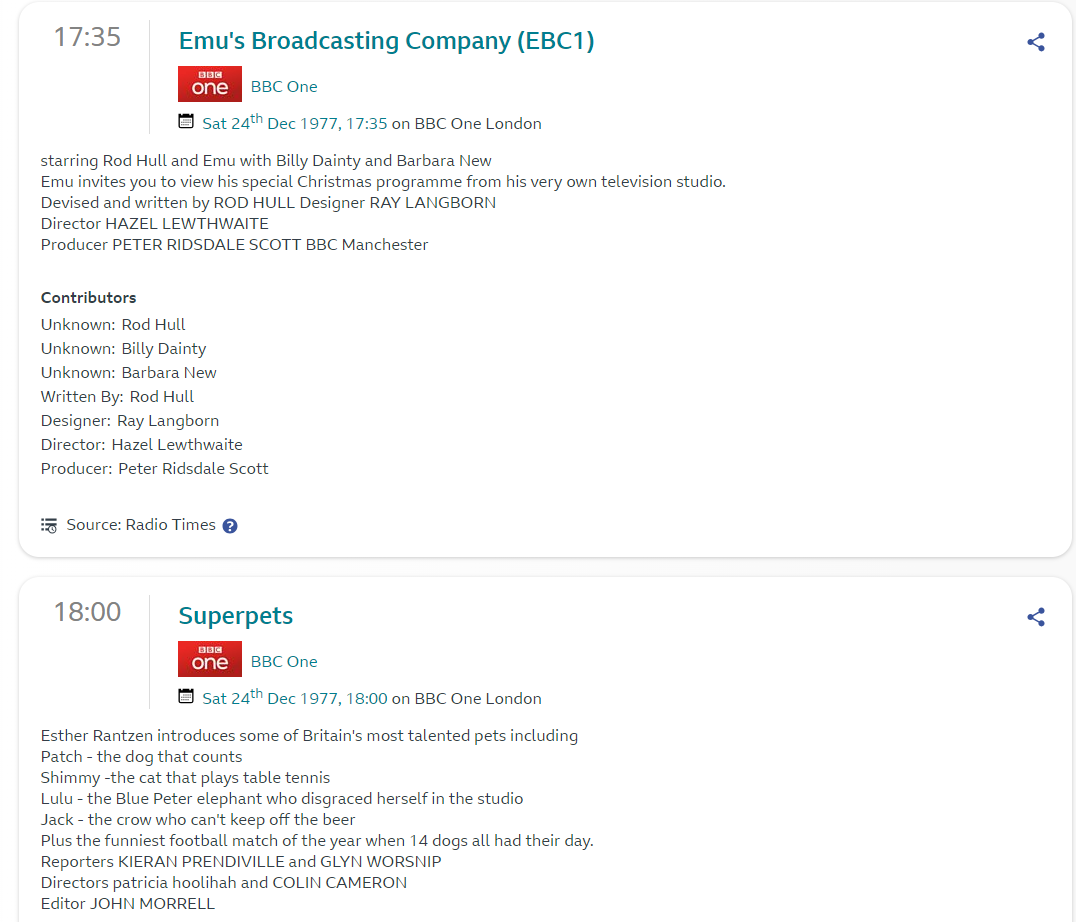
As you can see, things definitely looked up for me from 5.35 when Rod Hull and his feathered friend started off Christmas Eve evening with, almost certainly, complete chaos. The Superpets programme was a That’s Life spin off that looked at some of the animals featured on BBC TV over the years. It would certainly be popular today and would no doubt launch a huge number of Tik Tok posts or GIFs! I actually remember all of these segments believe it or not! The evening took another dip, from my perspective, with a film called Third Man on the Mountain which included a few famous names like Michael Rennie (who was ill the Day the Earth Stood Still!), Herbert Lom from the Pink Panther films and James MacArthur who was Danny in Hawaii Five-O (Book him Dano, Murder One!). My childhood was filled with action and adventure films which I generally found boring, and seemingly endless numbers of Westerns which I grew to detest. My favourite part of the evening was probably atypical for a 12 year old boy. It was this classic drama.
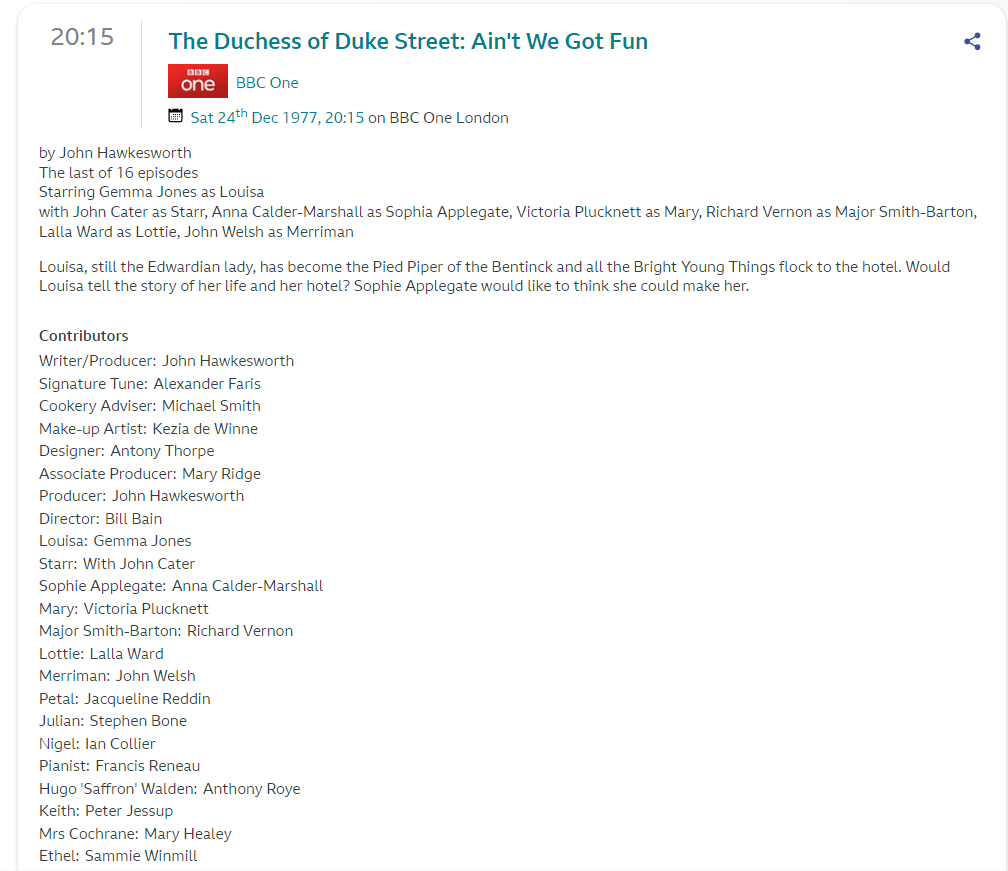
As you can see, it was the last of 16 episodes, and it was a programme that gripped me from the start as I watched Louisa’s journey from poverty to her position as the Duchess of Duke Street. Further down the cast list you can see Lalla Ward who was the Second Romana in Doctor Who and something of a crush of mine at the time. Let’s say that her appearances on screen were greatly anticipated! We then go from the sublime to the cor blimey with The Dick Emery Christmas Show, which I remember raising an awful lot of laughs in our house with his collection of broad characters and instantly familiar catchphrases. Finally, it was back to a favourite show of mine at 9.50, the ever brilliant Starsky and Hutch. The late finish of 10.40 wasn’t a big problem as I was not full of excitement for the following day in the way I had been two years earlier. Where was The Polar Express when I needed it!
Christmas Day 1977
Looking at the line up on BBC1 for Christmas Day a couple of things come to mind. First is a real sense of deja vu, of which more later, and second is the realisation that the ‘golden age’ of Christmas TV wasn’t necessarily as good as it is made out to be all these years later. Like the music from the era, we remember the gold and forget the iron pyrite!
The morning offerings were similar to two years earlier with two programmes focused on the religious element of the season. Star over Bethlehem featured a service from the Church of the Nativity in Bethlehem, and after a programme called Playboard, which I have no recollection of at all, the traditional showing of a church service, this time from Kingston upon Thames in Surrey. The sole Christmas themed children’s programme was The Bear who Slept through Christmas.
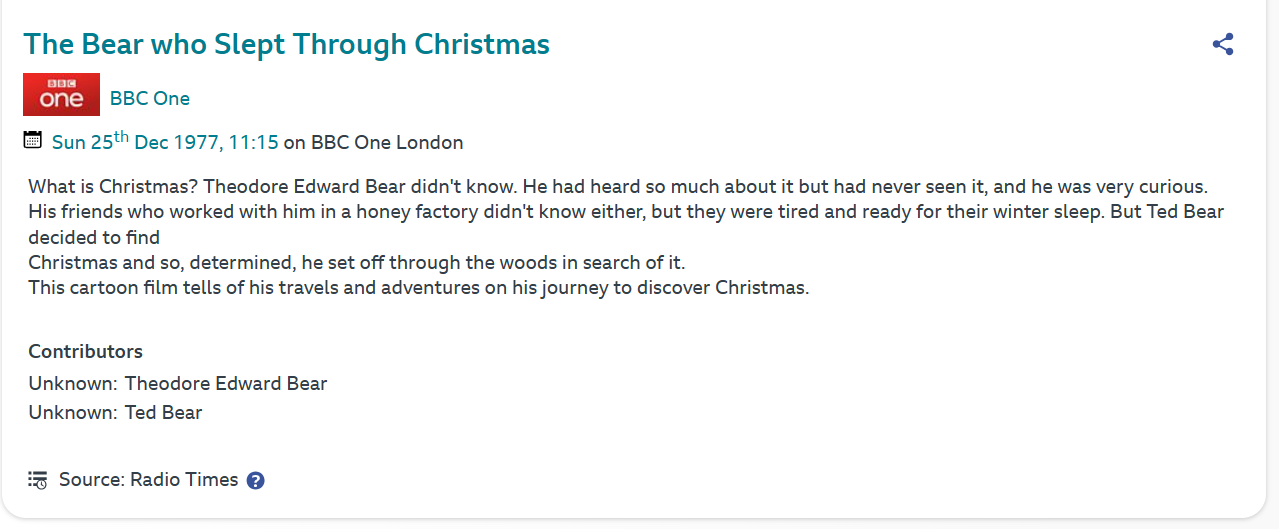
Another programme lost in time, at least to me, and one that has a fairly sketchy write up with no idea from Radio Times who contributed to it. Well, IMDB came to my rescue this time with their page although with the exception of Johnny Mathis none of the names are familiar. The morning film, National Velvet from 1944, is famous for being the first starring role for the then 12 year old Elizabeth Taylor. It’s a film I have never watched, but given the cast I might look out for when it appears on TV again. At 1.40, there was the Are You Being Served? Christmas Special which would probably have had me in fits of laughter at the time, but from there until early evening, the deja vu I wrote about earlier set in! Top of the Pops, Queen’s Speech, Billy Smart’s Christmas Circus, The Wizard of Oz, all in exactly the same position in the schedules as they had been two years earlier. It was perhaps this type of relatively quick repeat of the ratings winner that has those of us of a certain age associating certain films with the holidays. The Great Escape always seemed to be on at Easter or the August Bank Holiday and Christmas was The Wizard of Oz or Oliver (Christmas Day 1976) or The Sound of Music (Christmas Day 1978)! Interestingly, it turns out that The Great Escape was first broadcast on August Bank Holiday Monday in 1979, May Bank Holiday 1981 then around Christmas in 1983, 1985 and 1987, while Oliver! was only repeated once more at Christmas in the 1978 and The Sound of Music was repeated in 1980, 1981 and 1982, but never at Christmas. Amazing how your memory plays tricks on you.
Anyway, back to the programmes which introduced everyone’s favourite vulpine celebrity into Christmas 1977.
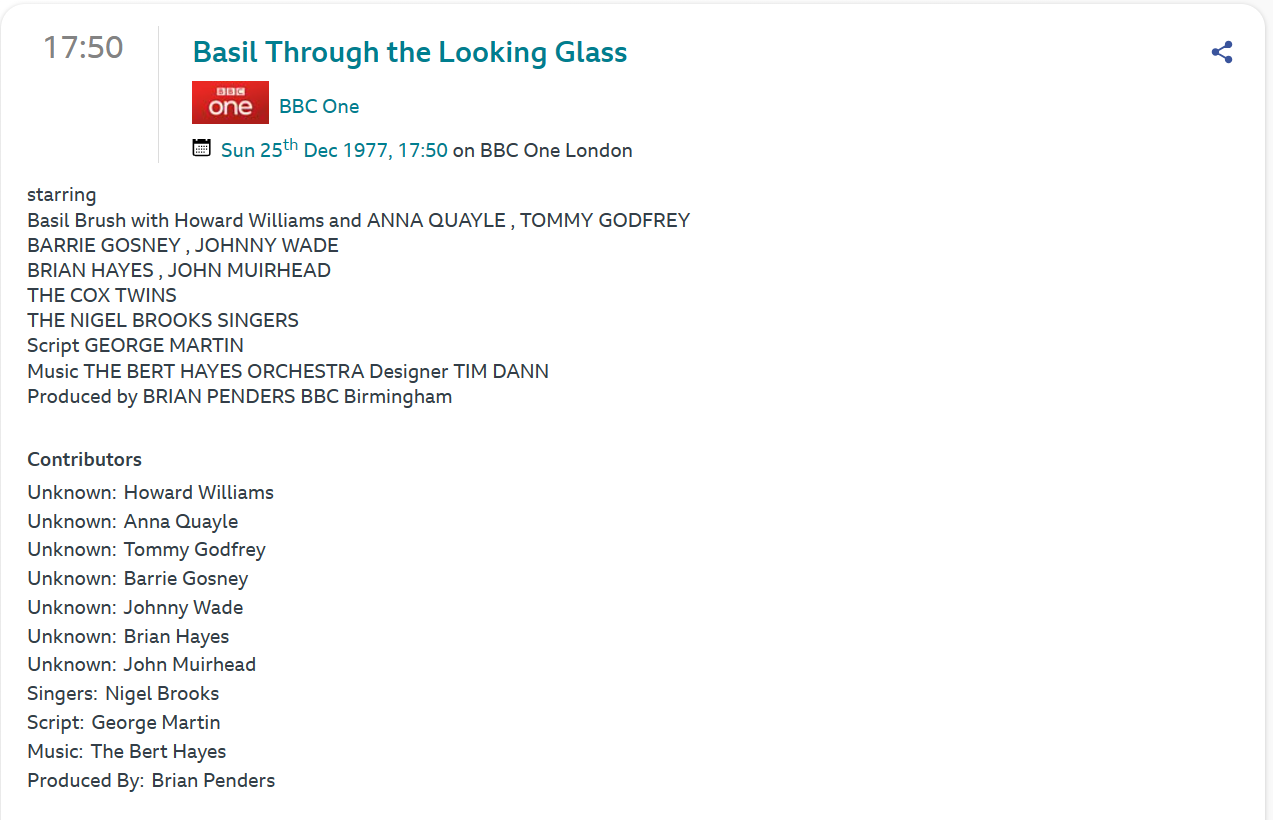
Basil Brush’s infectious laugh and dreadful jokes thoroughly endeared him to me and to generations of children and it was no surprise to see him and Mr Howard in the Christmas schedules. It would definitely have been a programme I would have watched, and all of us would have settled down for the rest of the evening as BBC1 brought out the big guns after Songs of Praise, as Christmas Day was on a Sunday that year, starting with Bruce Forsyth’s Generation Game at 7.15. Following that, were the two biggest shows of 1977, each attracting over 20 million viewers.
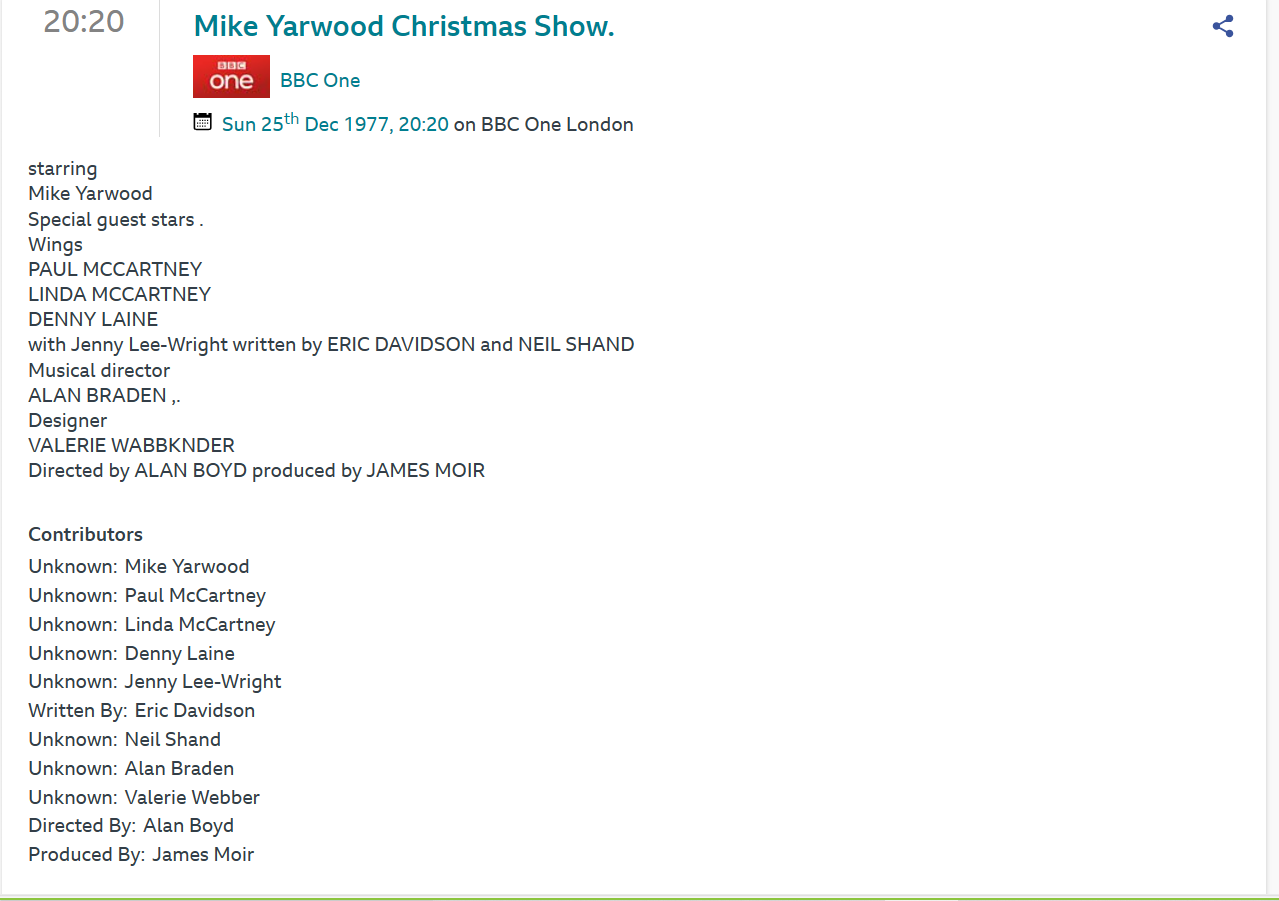
I discussed the relative unfamiliarity of Mike Yarwood to current audiences, but it was his show that won the ratings battle in 1977 with over 21 million viewers. It reflects his amazing popularity at the time, built on the excellent impersonations and the very funny writing that gave life to his characters. Can I remember anything about his 1977 show? No, I can’t. In contrast, the cast list itself for the following show which also attracted around 20 million viewers will bring back memories of two particular sketches.

Yes, this was the show where Angela Rippon showed off her dancing skills over 40 years before Strictly, and where Messrs Aspel, Baker, Bough, Kendall, Norman, Waring, Whitmore and Woods joined Eric and Ernie for the famous rendition of Nothing Like a Dame! When you remember that this was 46 years ago, it’s ability to conjure up memories is just incredible.
Boxing Day 1977
The Boxing Day fare was again very similar in nature to 1975, with Grandstand, It’s a Christmas Knockout, Top of the Pops, including a certain tracksuit clad presenter who also headlined a programme that fixed it for children making a reappearance, and such staples as Holiday on Ice getting a prime slot on Boxing Day afternoon. However, there were a couple of programmes that definitely deserve a mention. First of all, the Elvis film that morning proved beyond doubt that he could act and that he could handle the grittier character work that his overbearing manager, Colonel Tom Parker, refused to allow him to do in the 1960s.
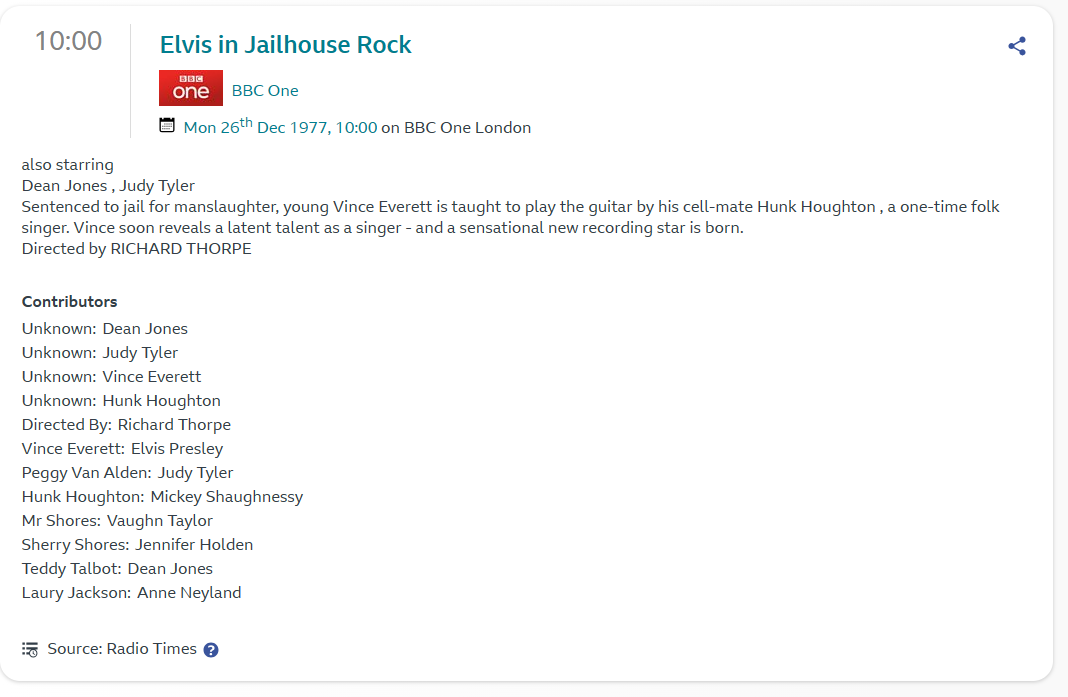
Jailhouse Rock was arguably Elvis’ high point as an actor, and you can see in this film the way he could have rivalled Frank Sinatra who turned himself in to a movie star by proving that he could cut it as a serious actor. Elvis here is raw, angry, vulnerable and utterly charismatic as the young man who took the wrong decision, but whose talent may yet save him. He was followed on Boxing Day by another singer turned actor, the brilliant David Soul. His musical showcase might have had him reviewing his situation at one point!
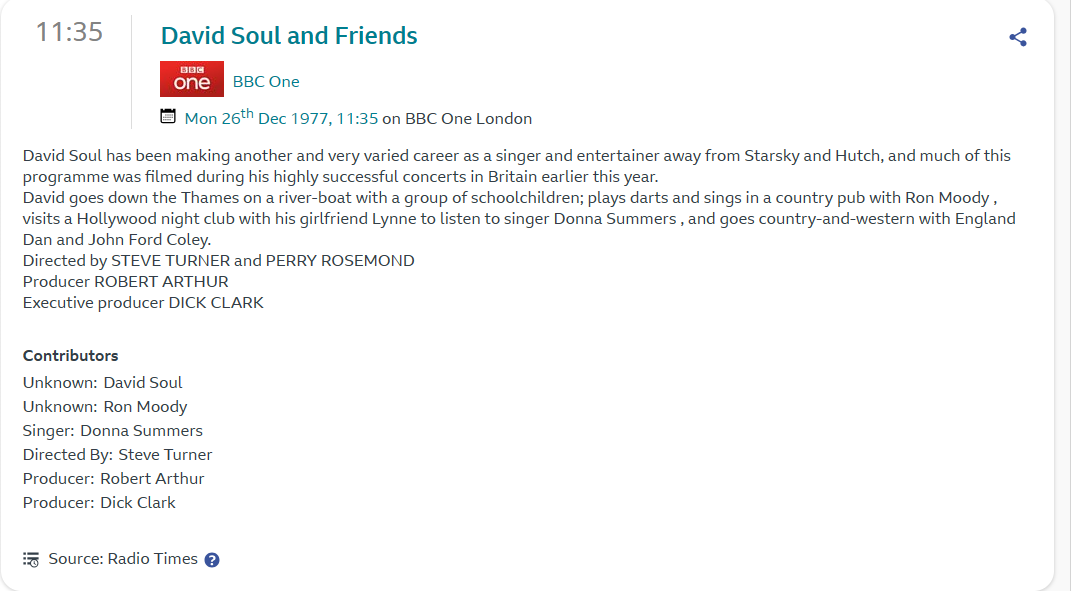
The double act of Fagin and Hutch takes some getting your head round, especially them taking part in a darts match! However, both were very adept at comedy as well as drama and they both had a background in music so perhaps it isn’t quite as surprising as it seems. Soul’s appearance in the Christmas schedules reflects what a huge star he had become on this side of the Atlantic due to Starsky and Hutch and his massively successful year in the upper reaches of the charts.
The final programme to pick out is one of my favourite ever Christmas specials and one that I will give a full review to during #Blogmas. It’s this one.

Still hilariously funny, I will take a deep dive into this comedy classic in a couple of days time. I hope you have enjoyed my second look at Christmas TV of the 70s. Was it as good as everyone remembers? Probably not. The appearance of the same programmes is perhaps understandable as you don’t change a winning formula, but looking back it seems as though most of the festive content reflected a time where audiences were given safe and undemanding Christmas fare rather than the line up of absolute classics that our selective memories tell us we were watching. Did it hit heights that arguably haven’t been matched since? It definitely did. Morecambe and Wise and Mike Yarwood were gifted performers who brought perfect comic timing and excellent writing into the mainstream. The talent in front of and behind the camera was amazing and both programmes still stand up today as examples of the best of British TV.
Christmas 1970s style and the heyday of British Christmas TV. The big hitters of the BBC out in force. Wall to wall comedy, variety and new films. What bliss it was in those days to be watching the telly … or was it? As with music from ages past we tend to remember the good bits and forget the rubbish. I wonder to what extent we are fooling ourselves as to its quality? Well, thanks to the Radio Times Genome Project, I am able to take a look at Christmas TV from Christmas Eve to Boxing Day 1975 on the BBC. Why have I chosen that particular year? Partly because I was 10 and therefore in the sweet spot of my childhood where memories are more solid and I can remember specific programmes and events. Also, partly because I see so many reflections on the quality of mid 1970s TV and I thought it would be fun to investigate how good it really was. Be prepared to have your memories jogged and perceptions challenged if you were around at the time. For the rest of you, ‘The past is another country, they do things differently there.’
Christmas Eve 1975
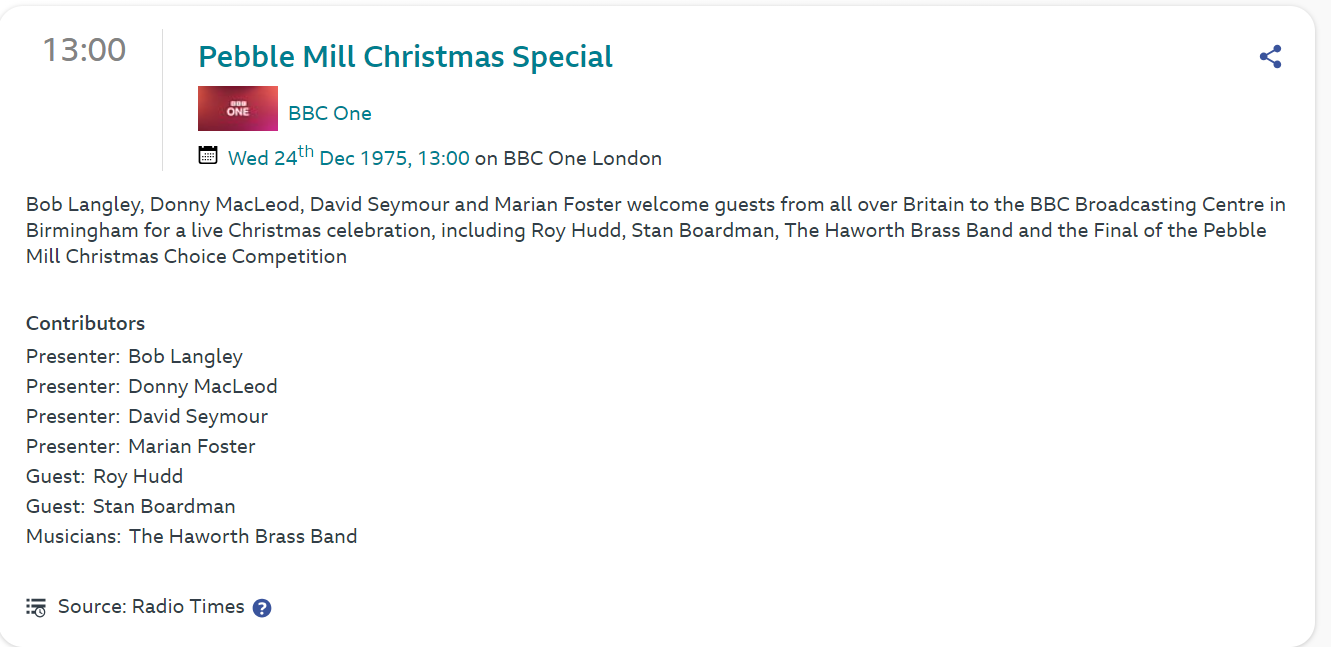
On BBC1, the main focus of Christmas Eve was very clearly the younger viewer. In those days it was quite accepted that TV would keep the children out from under your feet, in the same way as it is accepted now that various screens will serve the same purpose. In a 3 channel world, this meant children being entertained in the morning and later afternoon whilst the parents – well in the 70s almost invariably the mother – got on with last minute preparations for the big day. So what was on in the morning, and was it Christmas themed? Well, for the most part, no. There were episodes of Mr Men, Banana Splits (tra la la la la la la!), Star Trek, Laurel and Hardy and the very unfunny (in my opinion at least) Foghorn Leghorn! There were two programmes with a Christmas connection, the Royal Society Christmas Lectures which I loved watching and something called Away in a Village which I have absolutely no recollection of.
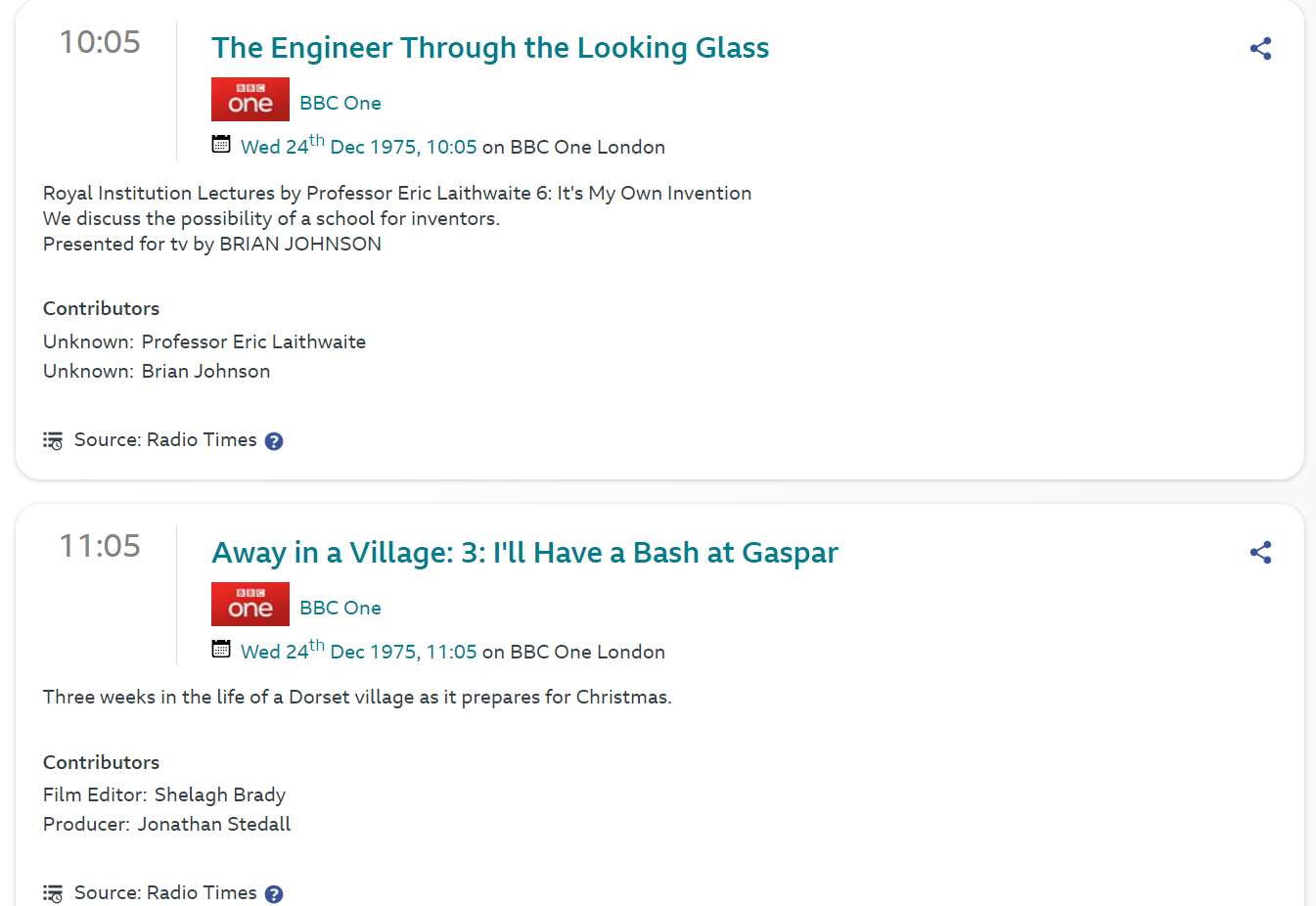
In to the afternoon and we had the Pebble Mill Christmas Special followed by a Doris Day film called Jumbo, set in a circus. I would have watched Pebble Mill which I always enjoyed and not the film for reasons that will become clear later. For a 70s time capsule, take a look at the Pebble Mill guests!
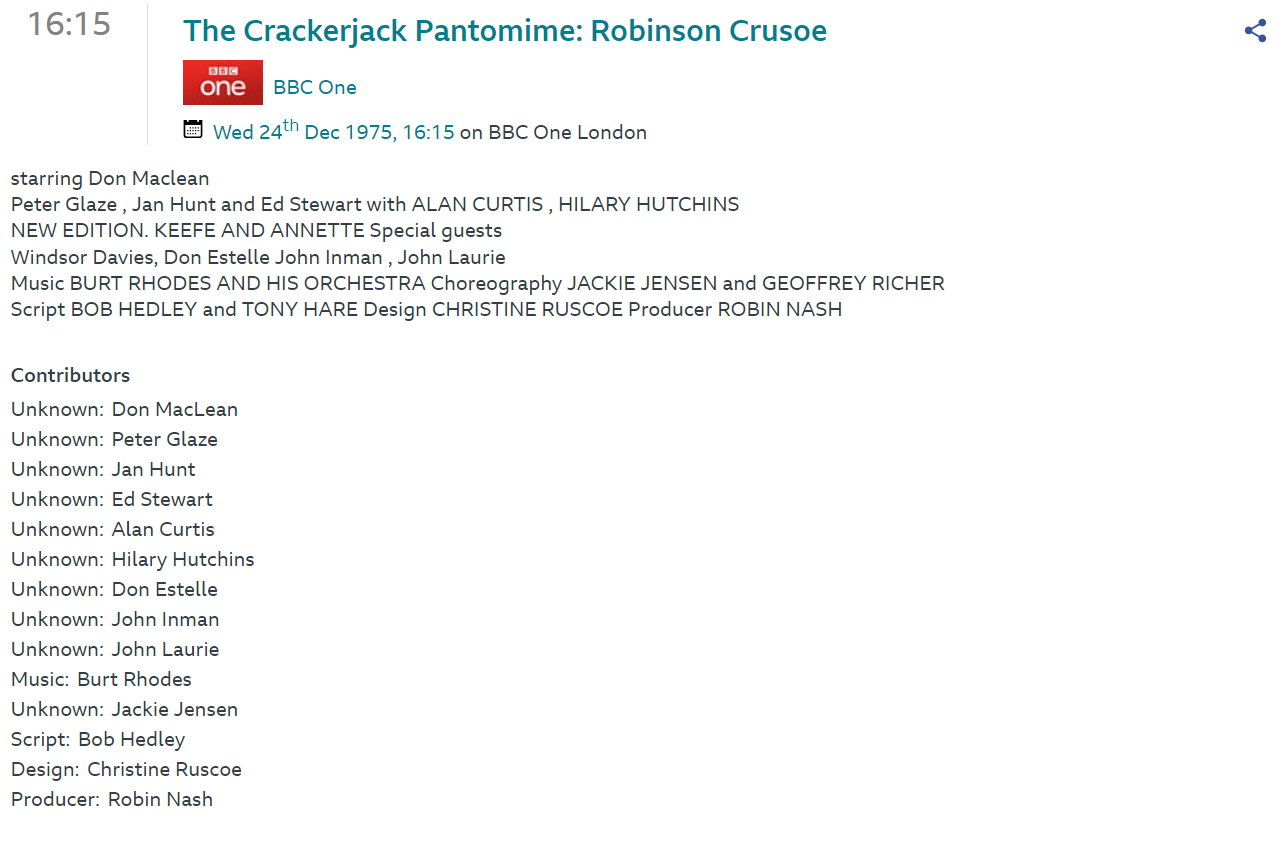
It’s Wednesday, it’s 4.15 and it’s Crackerjack! One of the highlights of the Christmas programming for me, and I’m sure many other children, was the Crackerjack Christmas Pantomime. 1975 saw the classic Crackerjack team of Ed Stewart, Jan Hunt, Peter Glaze and Don Maclean. The double act of Glaze and Maclean was a total joy with their slapstick and their silly jokes, so they were perfectly suited to the pantomime season. The guests in 1975 were a very good guide to the comedies the average family and therefore the average 10 year old were watching. You had Don Estelle and Windsor Davies from It Ain’t Half Hot, Mum along with John Laurie from Dad’s Army and John Inman from Are You Being Served? A real roll call of 70s classic characters there. The fact that I still remember them so clearly when characters from latter years have made little impression is interesting. I wonder if it’s because they are associated so strongly with my formative years? Given my reaction to music from a similar vintage I would say so.
The rest of the day saw a certain tracksuit clad presenter making dreams come true, a Walt Disney film in the early evening based on the American Civil War, the sketches of Dick Emery and the Porridge Christmas Special No Way Out, which still holds up incredibly well nearly 50 years on. Then, it was time for bed to prepare for the arrival of Father Christmas!
Christmas Day 1975
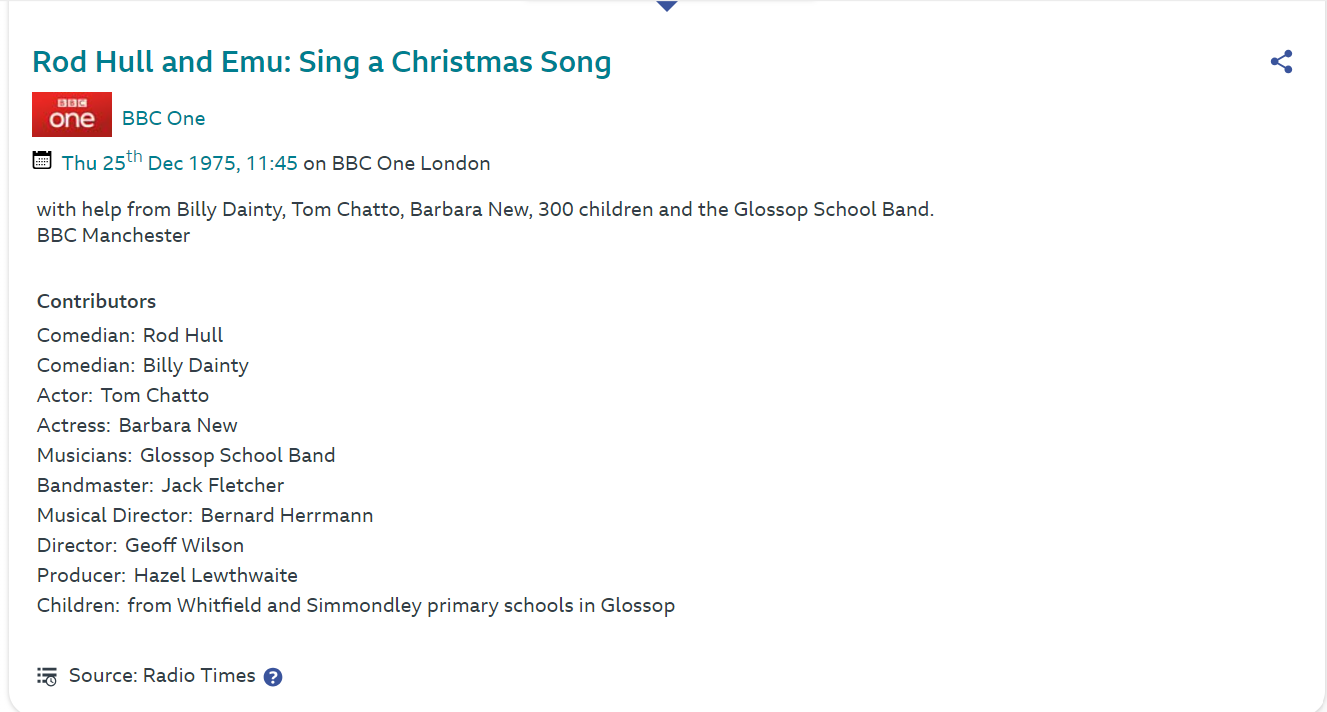
It’s highly likely that I was more interested in present opening than TV viewing on Christmas Day, as most 10 year olds would have been. However, what I could have watched in the morning may not have had me switching on even if presents were removed from the equation. There was a programme featuring schoolchildren from Leicestershire, a cartoon version of The Happy Prince, never a favourite story of mine, and finally a Christmas Morning service from St George’s Chapel, Windsor with the Queen and other members of the royal family in attendance. At 11:45 one of my Christmas presents that year appeared on the TV. Along with probably a few others I had a toy Emu! Rod Hull had created his act based around a silent but very angry bird that he carried with him and used to attack people. Michael Parkinson was probably the most famous victim of Emu’s rages and it was this incident that, probably more than any other, catapulted him into the public eye. I can’t remember if I saw this, but I can imagine that if I did, I would have had my toy Emu on my arm copying any mayhem that may have arisen! Given the subject matter though, I can imagine that it was generally a more restrained Rod Hull and Emu that day.
I would definitely have watched the Christmas Top of the Pops with Noel Edmonds and Tony Blackburn at 2.10, after Christmas Dinner, followed by the Queen’s Speech at it’s traditional time of 3pm. What I wouldn’t have done is watched Billy Smart’s Christmas Circus. I can say that for certain, because that was the year when a circus set up on the rec opposite our house. Along with most of the children from the immediate neighbourhood, I went along to watch it and, probably at the time I enjoyed it. However, after the circus was over we were told we could pay our 5p and go to where the animals were to see them up close. I suppose I expected something like London Zoo. What is burned into my memory is a lion in a cage that was probably a few feet longer than she was. It broke my heart, made me angry and gave me a lifelong hatred of circuses. I never took my own children to a circus even after they reluctantly gave up their cruelty to animals, because any circus that had made money from that in the past was tainted in my view. It is one Christmas TV tradition I was pleased to see ended.
Following the circus, there was the TV premiere of a film that was 36 years old!
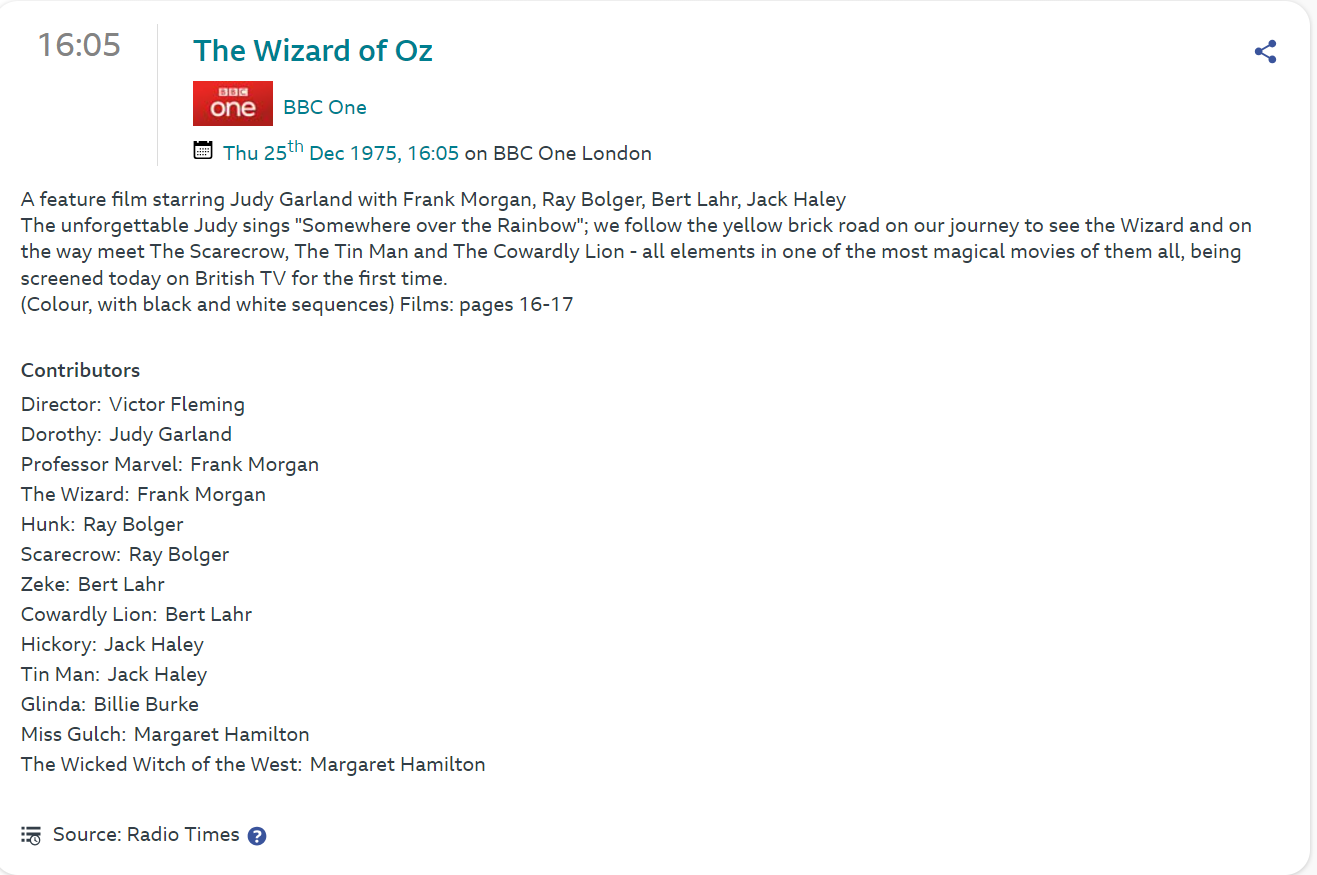
Remember, that back in those days there were no VCRs for the vast majority of homes, no videotapes on sale, although you could buy cine films if you had the large reel cameras. I remember going to a party of one of my classmates and her parents had a cine film camera to play old cartoons and Laurel and Hardy shorts, which was incredibly exciting at the time! You had probably never seen the Wizard of Oz if you were under 30, even if you had heard Over the Rainbow, so you had no idea what the film would look like. The technicolour was amazing and the whole film was just amazing to my ten year old eyes. Given all our special effects nowadays, it is easy to be blasé but at the time it was awe inspiring. Following Wizard of Oz, you had Bruce Forsyth’s Generation Game and the Christmas Special of Some Mothers Do ‘Ave ‘Em followed by Morecambe and Wise, so it was probably four hours in front of the screen followed by bedtime at the end of a day which would have had me overdosed on excitement and wanting to play with or read all my presents!
Boxing Day 1975
Boxing Day, rather like Christmas Eve seemed to be a case of keeping the children out of mischief, but perhaps this time to ensure that they didn’t wake up hungover and/or tired parents! To that end, there were cartoons like Boss Cat (as Top Cat was inexplicably called in the UK) and Hong Kong Phooey and an episode of Holiday Star Trek – not Christmas themed, just Star Trek shown during the holidays! Just after midday it was time for sport, and in those days sport meant only one thing – Grandstand!
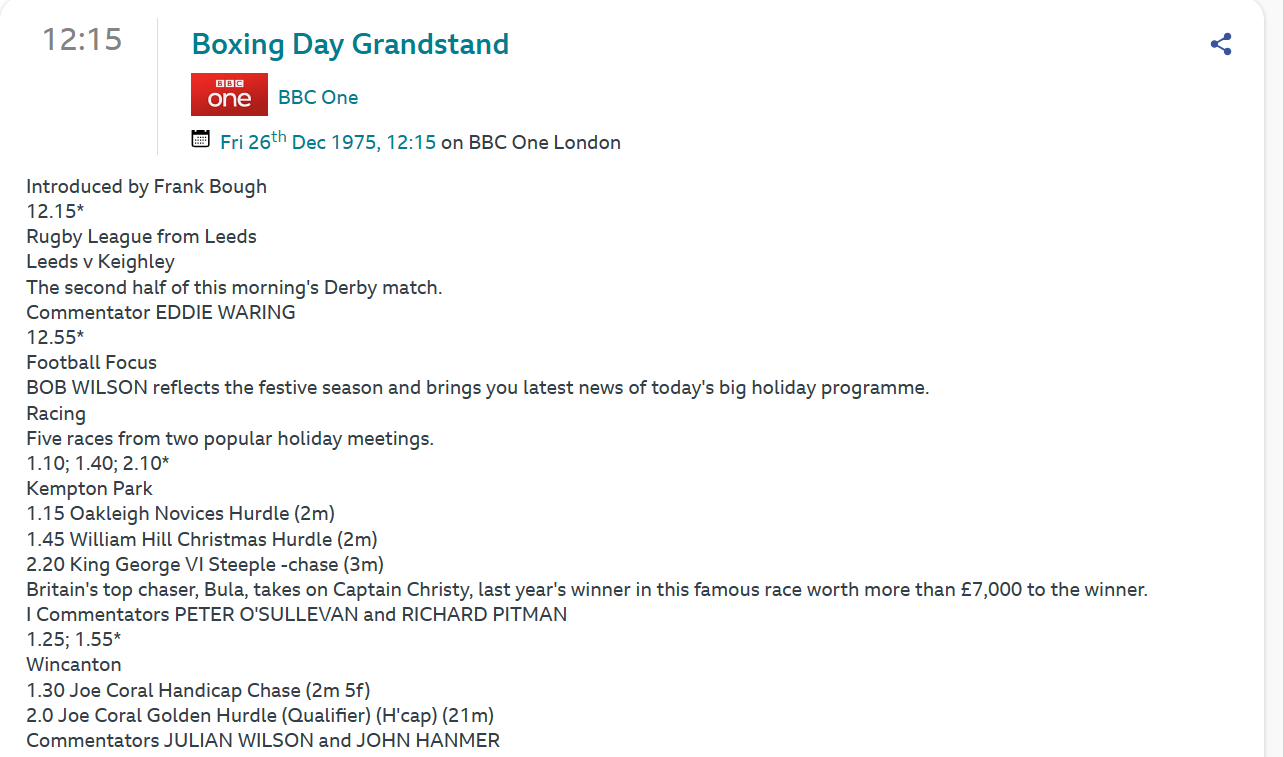
Look at that role call of 70s icons! Frank Bough, Eddie Waring, Bob Wilson, Peter O’Sullevan and Julian Wilson, all instantly recognisable to those of us of a certain age. I would definitely have drifted away from the screen during the racing but Eddie Waring’s commentary made this sport an absolute must watch. It wasn’t the last I’d see of sporting competition either, as after the lacklustre feature film Tom Thumb, it was time for It’s a Christmas Knockout! No Eddie this time for some reason, but the games never failed to make me laugh and cheer. It was pure fun and pure theatre and I loved it.
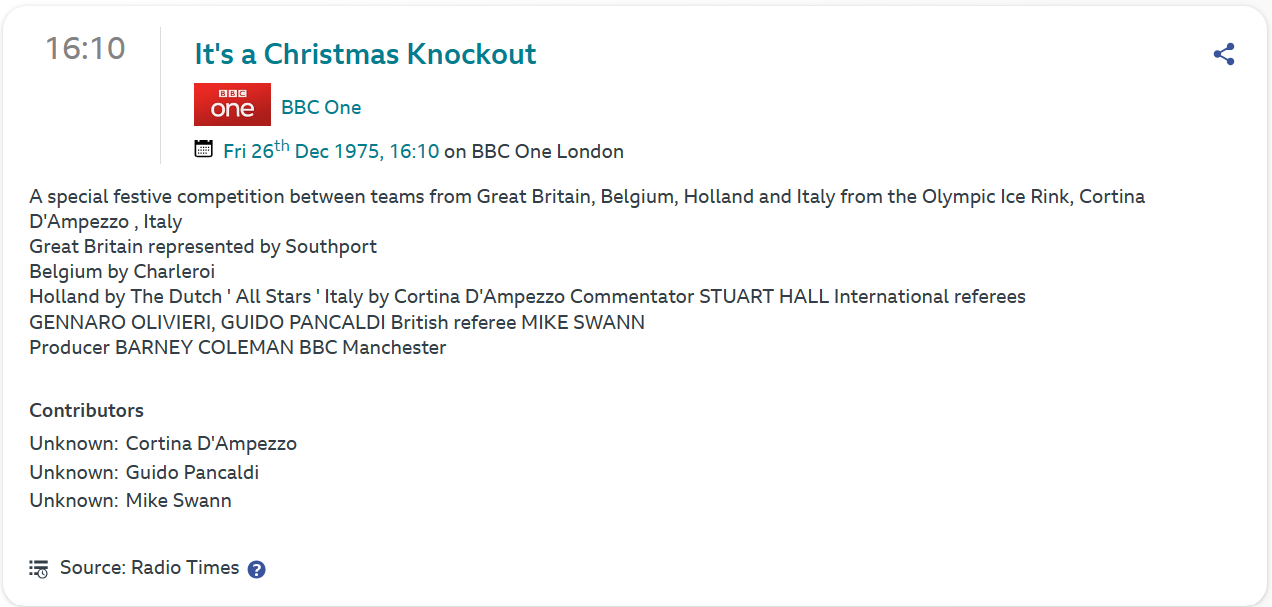
Bing Crosby introduced Disney Time, a seasonal staple that thrived in the days when we only saw clips of the films on the television. Dad’s Army followed hot on its heels and the evening film was The Railway Children. Confession time, it was never a film I ever really liked despite its classic status, and even now I can’t see its appeal. Finally, there was the other main highlight of Christmas 1975 in terms of big audience entertainment, the Boxing Day appearance of Mike Yarwood who was a rival to Morecambe and Wise in terms of popularity at the time. His impersonations were often very funny and he brought a particular skill to humanising politicians of the time, especially Harold Wilson, Ted Heath and Denis Healey. The reason we don’t see his shows now is because many of his characters would mean little or nothing nowadays, which is a shame, whereas the sketches of Morecambe and Wise are quite simply timeless.
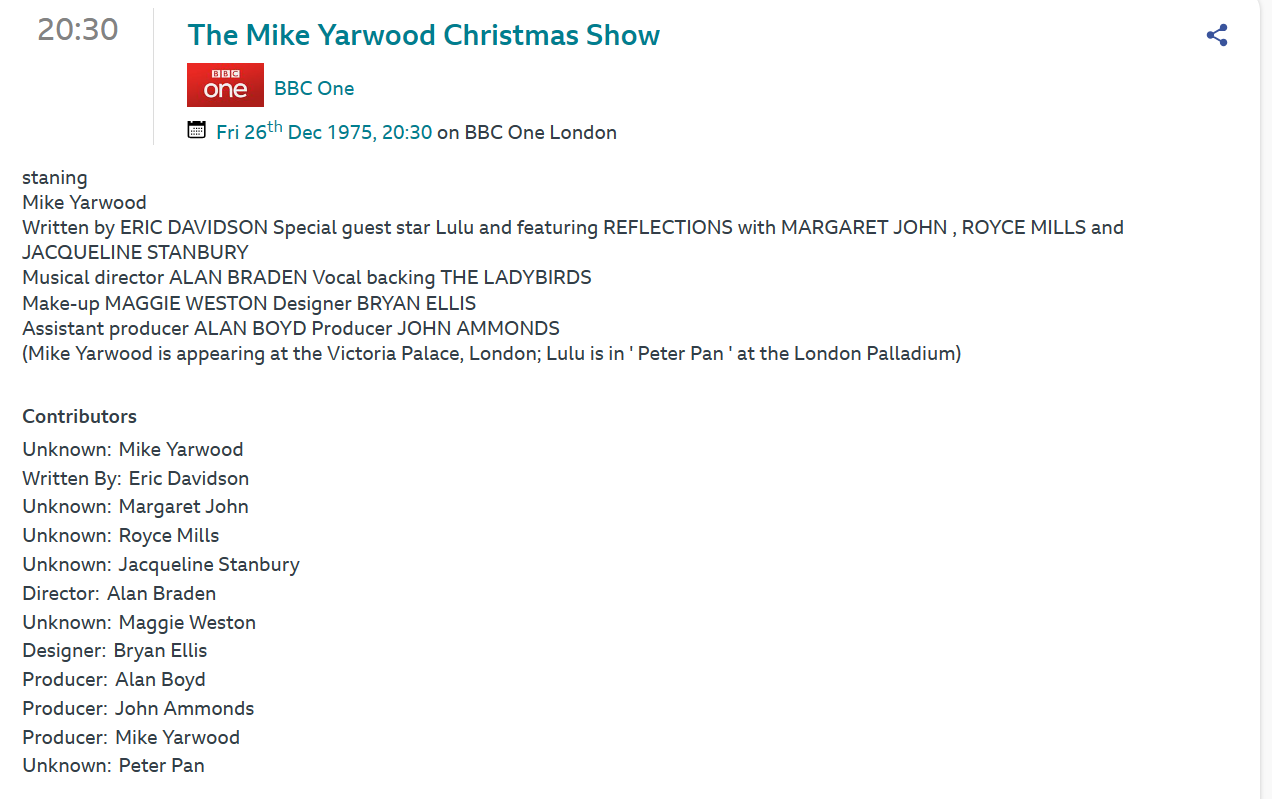
So there you have it. The good, the bad and the average of the BBC1 offerings for the three days of the festive season in 1975. I really enjoyed wandering down memory lane thanks to the Radio Times Genome Project so join me tomorrow when we will look at Christmas TV for 1977.
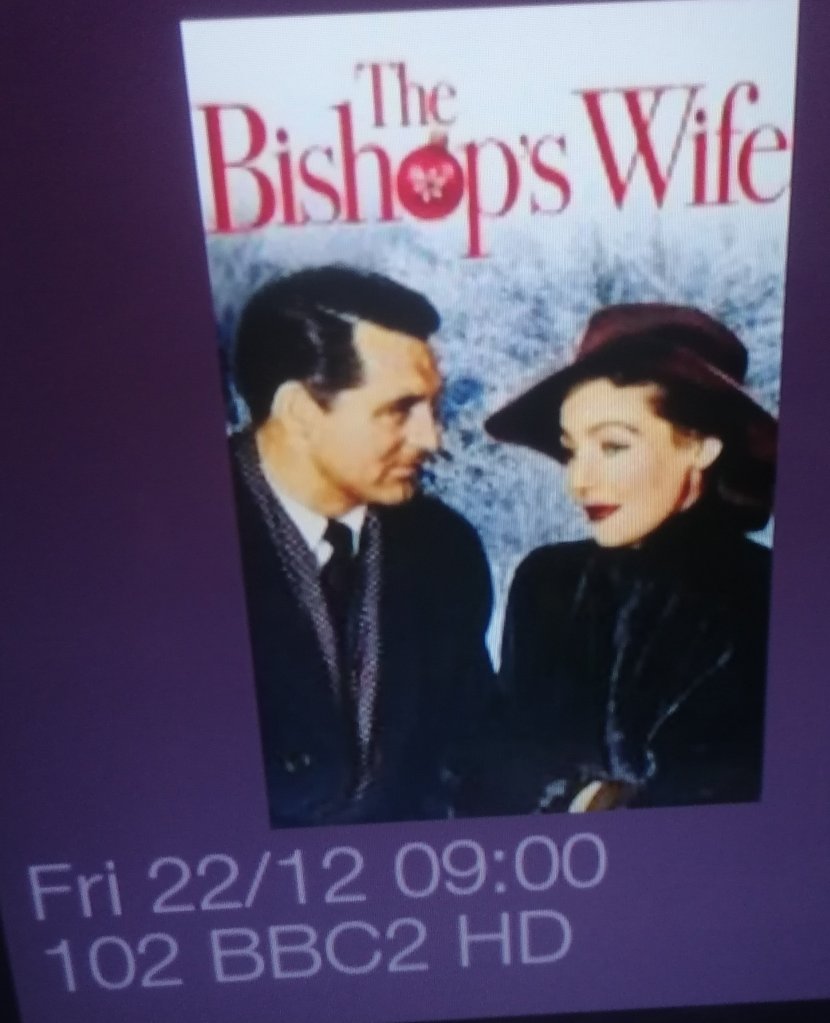
After going against the prevailing wisdom in nominating George C Scott as the best Scrooge, I am now going to challenge orthodoxy once more. It’s a Wonderful Life is a marvellous film, and well deserving of its status as a Christmas classic, but it isn’t the best film in the immediate post war years. For me, that accolade lies with the largely forgotten The Bishop’s Wife, made one year later, which has the Christmas spirit and generous nature of the season that the other doesn’t have in my opinion. It’s a Wonderful Life is dark and has a lovely ending, but it definitely isn’t a feelgood movie! So, what does The Bishop’s Wife have that it’s more famous contemporary doesn’t?
The Story
Henry Brougham (David Niven), the Bishop of the title, is trying to raise money for a brand new cathedral to replace his congregation’s current dilapidated home. The main sticking point is that Mrs. Hamilton (Gladys Cooper), the wealthy widow who is proposing to provide most of the money, wants the cathedral built as a tribute to the memory of her late husband. Henry is conflicted so he prays for guidance. That guidance comes in the form of Dudley (Cary Grant), an angel, who is about to answer Henry’s prayer, but definitely not in the way he expected. It turns out that Henry has been so preoccupied with the new cathedral that he has been neglecting his beautiful wife Julia (Loretta Young). Dudley notices this and pays attention to her in an attempt to help their relationship. However, will he overstep both earthly and heavenly bounds when his thoughts for her start to look like they may be developing into more than friendship?
The Production and Box Office
David Niven was originally attached to this film as the angel Dudley, opposite Dana Andrews as Henry. When Andrews pulled out, Cary Grant replaced him. When, in a troubled production, the director William A Seiter left the film, he was replaced by Henry Koster who looked at the scenes that had already been shot. He very quickly came to the conclusion that the two lead actors were in the wrong roles, so he told Niven and Grant to change places. This didn’t go down well with Grant, who took a lot of persuading to go along with a decision he disagreed with. However, when he finally agreed to the switch, the role of Dudley would become one of the most widely acclaimed of his career. Interestingly, I could imagine Niven as Dudley, but I could not imagine Grant as Henry. That would definitely be a case of muscular Christianity!
The film had a very successful premiere, but it was unsuccessful at the box office because the perception was that it was a film fairly and squarely aimed at a religious audience. The studio, RKO, got round this by retitling the film Cary and The Bishop’s Wife in parts of the US, an unusual move given that the actor’s name was not the name of his character, In other parts of the US the tagline was in the form of a question, ‘Have you heard about Cary and the Bishop’s wife?’ In the final analysis, the studio put the figure of 25% on the increase in cinema attendance as a result of this changed approach to the publicity. It was a film that, at the time, was far more successful than the previous year’s It’s A Wonderful Life. The latter won out in terms of longevity, however, as a result of a mistake made when drawing up the copyright. That copyright expired in 1974 so the US TV stations could show it for free. As a result, the film became a Christmas tradition and quickly became associated with the Christmas season in a way that The Bishop’s Wife never did. In the younger cast, there were a couple of actors who connected the two films. Karolyn Grimes who played Debby Brougham, the daughter of the Bishop and his wife, had been Zuzu in It’s a Wonderful Life. Robert J Anderson who played a choirboy in a church scene was the young George Bailey in that film just a year earlier.
The Film
So, what makes this film so special to me? Well, at the centre of this film are two actors playing off of each other perfectly. Niven’s uptight Bishop and Grant’s laconic angel are the original odd couple and they have a chemistry that makes it work superbly. With Dudley clearly having great fun needling Henry the humour fizzes back and forth with perfect timing. No less important is the role of Julia, and here Loretta Young plays her with an air of innocence. She really likes Dudley but she doesn’t see him as any more than a friend even if he might see her in a more romantic light. Young makes Julia smart and funny, but she is oblivious because she only sees the best in human nature. Her performance is so effective that you completely believe that she is this contradictory person. If she was knowing or arch it simply wouldn’t work. The look and feel of the film are quite modern in a sense, despite being in black and white. For the time, the special effects are very good, and the decorating of the tree in particular is still marvellously effective. Some of the scenes with the conflicted Mrs Hamilton are quite contemporary as Dudley uncovers the psychology of a very lonely woman. Overall, the film is the entire package of comedy and romantic drama as well as some quite intriguing elements of psychology and theology. If you are intrigued after reading this review you can watch it on BBC2 on Friday December 22 at 9am, so maybe set it to record and see what all the fuss is about.
Welcome to the seasonal offshoot of my record by record trawl through my huge singles collection. I have separated my Christmas singles from the rest and it’s these I am going to look at here. My definition of a Christmas single is quite simply a record with an A Side that explicitly mentions Christmas or is based on a carol. So, here goes, it’s time to get festive!

The Barron Knights had a run of success in the late 70s and early 80s with their parody tracks. Never Mind the Presents is a typical set of three songs being parodied, together with a linking tune and lyrics. The three songs in their sights at Christmas 1980 were Another Brick in the Wall Part 2, about a drunk Father Christmas, Day Trip to Bangor, about the office Christmas party and The Sparrow, about a fairy at the top of a tree. It was great fun at the time and still raises a grin all these years later. White Christmas by Bing Crosby was re-released in 1977 after his death and I had to get it. Yes, it’s old fashioned, yes it sounds a bit corny in places, but for sheer Christmas spirit it perhaps encapsulates the traditional feelings of the season better than any other. It’s always interesting for me to look at why certain records don’t stand the test of time in the way others do. With Dana’s gorgeous I’s Gonna be a Cold Cold Christmas it’s definitely not about the quality. It’s arguably a better seasonal ballad than pretty much any other from the era, and it’s beautifully sung by Dana. However, Dana has slipped from the collective musical consciousness, due I think to the unfair perception of her music as old fashioned and I think this explains why one of the superior Christmas singles, which got to Number 4 in 1975 has been unjustly forgotten. If you find it on YouTube I think you will agree with me. I said from the start of this series that I would include every single and I have. Another Rock n Roll Christmas has fallen foul of the singer’s crimes, quite understandably, but I bought it, I loved listening to it and although I have obscured his name to avoid offending sensibilities, it stays in my collection. Jethro Tull’s Solstice Bells is a very classy piece of folk/pop and is, as far as I know the only festive record to reference December 21st! Given the fact that so many of our Christmas traditions were taken from Yuletide, it counts as Christmas for me. Finally, we have Aled Jones A Winter Story from the cartoon of the same name. It was clearly designed to repeat the success of his version of Walking in the Air from The Snowman cartoon (originally sung in the cartoon itself by Peter Auty in case you get that question in a pub quiz!) the previous Christmas. It was sung by Aled Jones who was on the crest of a wave, was from the soundtrack of a Channel 4 cartoon shown at Christmas and had a similar sound. It looked all set to hit similar heights. However, A Winter Story released in 1986, didn’t get much airplay simply because it wasn’t as memorable, and crawled to Number 51 in the charts.

I know I said it based on whether the A Side was a Christmas record, but as I only picked up the single from Johnny Mathis and Henry Mancini because of When A Child is Born I have decided to count it! Even if Dave Bartram of Showaddywaddy hasn’t forgiven Johnny Mathis for stealing the Christmas Number One from under their noses in 1976, it’s still a gorgeous song beautifully sung and when I saw it in a charity shop I thought ‘Why not?’ Stop the Cavalry is simply a seasonal must listen and has been every year since 1980. Jona Lewie may not have intended it to be a Christmas single, but it has been a welcome returnee to my playlists every Christmas and will always be a cherished song of my mid teens at a time when the Christmas record arguably seemed to be in decline. Mud were Number One in 1974, following the previous year’s Christmas themed monster, of which more later. An Elvis pastiche, it was performed by Les Gray on Top of the Pops with his trademark lack of seriousness. He had a ventriloquist’s dummy that ‘delivered’ the spoken section to camera on a set which was covered by snow by a very enthusiastic stage crew! Listening to it devoid of the memories of the time, it probably sounds a little pedestrian, but it’s a song that caught the imagination of the record buying public in no uncertain terms. Shakin’ Stevens was one of those artists whose singles I bought without hearing them in virtually every case, so sure I was that I would like them. As a result I bought three of his Christmas singles as soon as they were released. His Elvis impression is even better than Les Gray’s on Blue Christmas. Not surprising really as his big break was appearing as the Young Elvis in the West End. The star on the top of the Christmas tree from Shaky is of course Merry Christmas Everyone, a seasonal classic in the top tier of the genre. It is so good that it was always going to be a Number One, except of course it wasn’t. He recorded it in 1984 but as soon as he saw the competition, Band Aid and Wham, he postponed its release until the following year when it stormed to Number One! For anyone else, The Best Christmas of All would have been a signature Christmas tune, but so good were both predecessors that, good though it is, it has the air of an also ran. I still enjoy listening to it though.

As already mentioned, Showaddywaddy missed out on the Christmas Number One by a whisker in 1976. Two years earlier they released their self-penned festive song, Hey Mister Christmas, a catchy rock n roll number that is better than a lot of people give it credit for. Sentimental verses and a singalong/shoutalong chorus makes it proper Christmas fare and it is definitely due a reappraisal so just give it a chance. I think it may just surprise you. Next, it’s Slade, it’s Noddy, it’s Christmaaaaaaaaas!! Arguably, without them and Wizzard in 1973 the Christmas chart battle and perhaps the whole genre of Christmas songs may never have been developed in the same way. It’s brilliant and I can listen to it time after time every December and never get remotely bored of it. Given the number of novelty records that hit the charts in December it’s perhaps surprising that I don’t have more of them in my collection and that so few of them are directly Christmas themed. One that is, is a very funny record from Dennis Waterman and George Cole in their characters of Terry McCann and Arthur Daley from the hit TV series Minder, What Are We Gonna Get for ‘Er Indoors? It’s a genuinely good record in its own right and on its own terms. In the song, Arthur is agonising over which of his knock off goods to give to his wife at Christmas! The comic timing displayed and the singing of Waterman are both top notch and they combine to produce an excellent Christmas single. As I am putting this entry together, the Number One is Last Christmas by Wham. My single is from the original release in 1984, pretty much on the day it came out. Again, no introduction is necessary. The only thing that I cannot understand is why people want to play Whamaggedon every year. I can’t wait to hear it as soon as possible. The final original single is the fantastic, timeless Wombling Merry Christmas with the ultimate sax solo, gorgeous lyrics and the typically multi-layered Mike Batt lyrics. Pure magic that takes me right back to 1974

As a bonus, I end up with two modern day Christmas classics from Cats in Space, a group who hark back to the 70s and 80s with their sound and also in terms of their release of vinyl singles. My Kind of Christmas is simply fantastic and the sound is a throwback to every classic Christmas track you’ve ever heard. Tongue in cheek lyrics with the 70s flowing through them and I only wish it could have been given a chance to get a wider audience. As you can see I have two copies, one a single disc, the other one a double disc pack. Finally, I have their version of I Believe in Father Christmas, which loses nothing in comparison with the original. The voice of Damien Edwards is one of the best in modern rock music and he really shows it on this track.
So there you have it. My Christmas singles collection of the good and the not so good. I hope you enjoyed the journey through Christmas past and that some of these will get you singing along in your head and going on to Spotify to relive your youth.
 David Pearce - Popular Culture and Personal Passions