
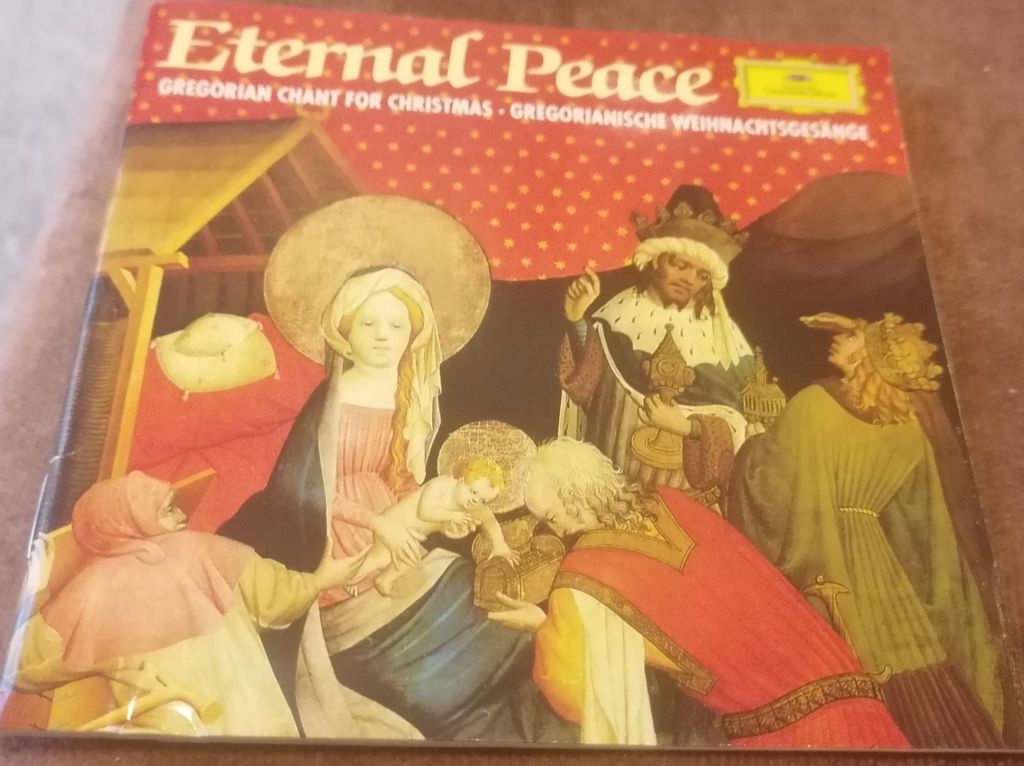
Gregorian Chant can split music lovers down the middle. For some, it is restful, profound music, for others it is anything but restful. To quote Ruby from the Butterflies Christmas Special in 1979 when she finds Ben listening to it while she is on her cleaning round,
I’ve switched them moaning fellas off while I’m working!
(Lane, 1979)
Whether you are a Ben Parkinson, who loves it, or a Ruby who can’t stand it, a little bit of background will probably be useful.
Gregorian Chant
Gregorian Chant is named after Pope Gregory I who became the Pontiff in 590 and oversaw the Catholic church until 604. He was the first person to codify it and make it an integral part of worship. However, the music we would recognise as Gregorian Chant nowadays probably dates from a few centuries later when Charlemagne, the King of the Franks, a Germanic people, combined existing Gregorian Chant with Gallican Chant to create a new style of worship. Even allowing for this, which has the recognised version of Gregorian Chant dating from the very start of the 9th Century, it is perhaps remarkable that this style has endured for over 1200 years and, in its original form, for 1500 years.
It is sometimes referred to as plainsong and it consisted of Latin worship set to very simple music and sung in monophonic style. This simply means that there is only a single line of melody which is sung in unison. It is at its most effective in churches and large halls, where the acoustics bring out its full power. There were different chants for different times of day, as they followed the cycle of the eight prayer services, Matins, Lauds, Prime, Terce, Sext, None, Vespers and Compline. In addition the chants varied across the year according to the seasons. As you might expect, then, there are chants which are only heard during Advent and Christmas. They were obviously not Christmas carols as we know them today. Incidentally, the word carol actually referred to a dance performed in a circle in Roman times, and celebrated all kinds of festivals. They only became inextricably linked with the Christmas season much later on, particularly after their revival in Victorian times.
Gregorian Chant has been used in a number of films, especially the ‘Dies Irae’ chant used for funerals, which pops up in films as diverse as Star Wars, The Lion King, The Shining and It’s A Wonderful Life. This is extremely well covered in this YouTube video from Vox if you want to go into more depth. Gregorian Chant even reached the UK Number 1 slot the week before Christmas in 1990 when Sadeness by Enigma used a Gregorian Chant by The Kapelle Antiqua Choir as the background to the track. Unfortunately, Enigma didn’t ask permission to feature the track, so the choir sued the group (!) who settled very swiftly out of court.
So, how does Gregorian Christmas music sound to my modern ears? Let’s find out!
The Music
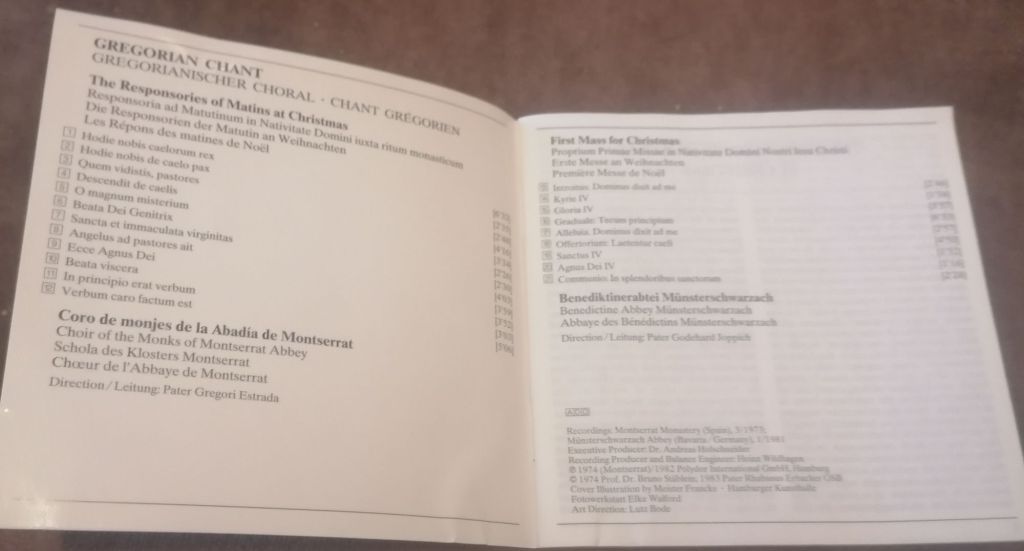
The Responsories of Matins at Christmas
The first 12 tracks on this disc are titled The Responsories of Matins at Christmas. Matins is the canonical hour sung at midnight and this group of songs are generally used following the reading of lessons, in the same way as King’s College Cambridge have the famous Nine Lessons and Carols, alternating between the two. These are responsories that vary with the seasons but which, by virtue of coming at midnight, must have been incredibly significant in marking Christmas. The haunting refrain is, quite naturally, an acquired taste purely because we are no longer used to hearing music like this any more. However, if you can learn to appreciate as I have been able to, after some effort I must admit, it is uniquely atmospheric. These twelve tracks are sung by the Choir of the Monks of Montserrat Abbey, and the sound of many voices coming together as one is powerful, and the quality of their voices makes the limited musical palette bright and colourful. Though there is nothing, to modern ears, particularly festive, the sleeve notes for the CD includes the full responsories in four languages including English. It includes the familiar bible story of the Virgin Birth and the Angels’ tidings to the shepherds together with the meaning of the birth in spiritual terms. Whether you believe in the story or not, you can sense the importance of these words to the monks in the way they are sung.
I find it to be a piece of social and musical history that is incredibly interesting. These songs whisk you back a millennium or more to times when only the monks themselves and the wealthy, whose family could afford and wanted to give their children an education, could read the words. The rest of the population would have been reliant on listening to the words in songs like these to follow and understand the story of the birth of Jesus. In an oral tradition, they would have been incredibly significant as a way that the clergy could communicate with those outside. Although I am a teacher now, I realise that I would certainly not have been one in those days because I am not from the ruling and monied classes. I too would have been reliant on these responsories to understand what happened that first Christmas. I can picture myself in a monastery in the 12th or 13th Century listening to these words and committing to memory as far as possible. Perhaps I would have been inspired to join the monastery in those days where it was seen as a step up the social ladder that allowed you to access the world of education. These voices and words of the past carry me back to my ancestors and their much harder, more uncertain, and shorter lives, lives that were enriched by a simple belief that, in some ways at least, is still central to the season.
First Mass of Christmas
The tunes and words in this section, sung by the Benedictine Abbey, Munsterschwarzach in Bavaria, are believed to date from around the 9th Century, right at the start of the Gregorian Chant we know today. You can hear differences in this mass, with the words being sung, not by all the monks all the time, but in different sections and perhaps combinations. These songs are also structurally different with longer chants like the Gloria having a very similar purpose to the Collect in the modern church as far as I can tell. In both cases, the congregation are encouraged to reflect on the central message of the religion. There is also a more musical flavour to them, in modern tones, with more variety in the tones you can hear. In its understated way, this is a more expressive piece of choral singing.
It is interesting that the chant seemed more modern and accessible, given its very early derivation, mentioned above, but it is clearly recognisable as the forerunner of choral and religious singing in more modern times. Again, as with the responsories, there is nothing recognisably festive in these tunes, but their overall effect is to invite contemplation that can move in religious or more personal directions. If you are not inclined to think about the former, you can, perhaps, consider your own life and relationships and listen to that still small voice of calm that the reflective music may help you to hear.
Final Reflection
This was a really interesting experience for someone who is fascinated by the development of music through the ages. Did I feel as though I really understood it? No, I didn’t. Quite apart from the content, I couldn’t pick up the variations and intricacies that I am always listening for in modern music. Did I find it an easy listen? Actually, yes, because it is so relaxing and so different from anything else I have ever listened to that I lost myself in it. My thoughts turned to my ancestors, as I remarked above, and by weaving a narrative I was able to immerse myself in the music.
Should you be interested in trying this new field for yourself, you will be able to find this CD from your usual stockists. Read the sleeve notes, because they will help to put things in context, but have an open mind. Who knows, you may find a new appreciation for something incredibly different as I have started to through this aural experiment.

After John Esmonde and Bob Larbey wrote The Good Life, they teamed up with Richard Briers once again in a series called The Other One. I must confess that it is a series that has left no impression on me at all. Briers was playing opposite Michael Gambon in what sounds like a riff on The Odd Couple if the synopsis is anything to go by. However, nothing comes to mind where that series is concerned. Whilst successful enough to stretch to two series, from 1977 – 1979, it is one of those comedy series that has sunk without trace in the wider public consciousness. Apparently, Briers was playing a fairly obnoxious character, but his role in The Good Life perhaps made it very difficult for the public to accept him as anything other than the bumbling but affable Tom Good. A similar fate befell Felicity Kendal when she tried to move away from Barbara Good into portraying more flawed and arguably more interesting characters. Five years later, however, Esmonde and Larbey once again struck gold with a vehicle for Richard Briers entitled Ever Decreasing Circles.
The Programme
Ever Decreasing Circles was probably designed to be a Richard Briers centred comedy, but what Esmonde and Larbey ended up with was a comedy with three actors at the centre giving sublime performances and playing off of each other superbly. Briers was Martin Bryce, a very organised man, and that’s putting it mildly! He would no doubt be diagnosed as being on the autistic spectrum today, but in those days he would have just been seen as weirdly obsessed. Martin organises everything in his close, from the extremely unsuccessful football team for boys to the residents committee and, from there, the social events for everyone. When we see him at the start of the series, he is the unquestioned leader of the close. His wife, Ann, played by Penelope Wilton was alternately irritated and amused by his hyper organised approach to everything, but she gave him her wholehearted support because she saw that what he was doing came from a place of goodness. She is sometimes frustrated that her wishes take second place to whatever Martin is organising, but she accepts that it is just the way things are.
This situation is turned on its head by the arrival of Paul Ryman, who moves in next door to him. Paul Egan played Paul, the ultra confident, effortlessly charming, utterly charismatic businessman in a performance that is amongst the best in the history of sitcoms. Paul from the start was seen to be sending up Martin’s role as close leader, but it was never done unpleasantly. You could tell that he actually liked Martin, and the fun Paul had at his expense was always tempered by an admiration for someone who was putting himself out for others. However, all Martin could see was someone who was trying to replace him in the affections of all his friends. Often, when Martin had problems, the incredibly well connected Paul was able to call in a favour from someone who he knew from his business, his school, his university or the army. You didn’t always know if Paul was teasing him with the sheer range of his connections, but he was clearly very well ensconced in the upper echelons of society. He was also supernaturally talented at just about anything he turned his hand to, most memorably in the cricket match where Paul, a Cambridge Blue who played at Lords manages to lead the team to a miraculous win. The only thing that Martin didn’t realise, luckily enough, was the growing attraction that Paul was developing for Ann, one that was very much reciprocated. Their flirting was an absolute joy to watch, particularly when you realised that the affection of both of them for Martin would always stop them from taking it any further.

Along with the three central characters, there were two supporting roles that became just as well remembered. Howard Hughes and his wife Hilda were a couple so in tune with each other that they always wore identical jumpers! Even now, when my wife and I inadvertently dress in very similar colours, we refer to it as a ‘Howard and Hilda’! Stanley Lebor played Howard, initially as comic relief, but increasingly, as the series progressed, became a more complex character who was given the confidence by Paul to come out of Martin’s shadow and show steel and occasional anger. This was brilliantly showcased in Snooker, the episode that really introduced Howard as a different man to the one we were used to. He was often irritated by Martin’s brusque nature, but he had never directly challenged him until the final of the snooker tournament, where Martin’s certainty that he was better than Howard riled him like nothing else had done previously. Geraldine Newman’s Hilda was an uncomplicated character, driven totally by love and admiration for her husband. When Martin dismissed Howard’s abilities and contributions she was tigerish in his defence, calling out Martin’s unkindness in a way that no one else would do. With their closeness and their growth during the four series, and the superb comic timing of Lebor and Newman, Howard and Hilda became very important elements of the show.
The Party
From the start this is a classic episode. Martin comes in from work with a scarf wrapped tightly around his head. Ann sees him in the hall and immediately asks why. Eventually, Martin removes his scarf to show ‘confidential’ stamped twice on his forehead and ‘urgent’ stamped on each cheek! This was retaliation for him trying to stop the Christmas party at work from starting before the designated time of 4 o’clock! When he is washing off the stamps, Paul rings up and invites them to his party. Martin, naturally declines and suggests a night in for Ann and himself. She agrees until he tells her he’ll only be two hours servicing his minibus! At that point she heads round to Paul’s on her own. The following morning, a very disgruntled Martin sees a shape in the bed next to him and he proceeds to make his displeasure known to Ann, except it isn’t Ann! The reveal and the subsequent exchange are an absolute delight and a comic highpoint in an episode full of them. When Martin gets down to his lounge he finds Howard and Hilda on the sofa bed! It turns out that there were so many people at Paul’s party that they spent ages working out where everyone could fit and Howard and Hilda let 8 people have their house and ended up in his front room. Later on, Paul arranges a girls v boys football match with about 20 a side. Martin refuses to consider joining in, making a very 80s comment about Women’s Football along the way. Paul comes in to see Martin, saying how sorry he is for the situation and how he wishes he had organised things more effectively. Martin steps straight into the trap and spends the next three hours arranging sleeping quarters, meals and bathroom rotors. Ann comes back after the game to inform him that the girls won 83 – 69! With everyone staying until the day after Boxing Day, Ann admits that she is missing Martin and Martin has a brainwave.
This is pretty much the perfect episode of Ever Decreasing Circles with Briers, Wilton and Egan on top form, and clearly having a marvellous time filming it. It is, in my opinion, Richard Briers’ crowning comedic role, making a character that would be simply annoying in any other hands, into a very flawed hero whose reaction to life brings pathos to the mix as well as humour. Peter Egan is just as good as Paul, mining laughs with every scene and often making himself and his co-stars laugh in the process. I get the impression that some of the lines may have been ad-libbed, but I can’t be sure. All I know is that both actors are at the top of their game, scripted or otherwise. Wilton is the mostly calm centre of the piece. She loves Martin but she also loves the flirtatious relationship she has with Paul, and as a, mostly, straight woman she is peerless.
Ever Decreasing Circles is one of the jewels in the comedy crown and bears comparison with any other comedy before or since. If you haven’t seen this yet, then do yourself a favour and find it on Gold, because every single episode is a gem.

In 1988, a programme made its debut on US Television just after the Super Bowl. It wasn’t widely trailed and it didn’t contain any household names in the cast, but with a huge audience still sitting in front of their televisions it made a huge impact. It featured the Arnold family specifically Kevin, whose adult reflections on the process of growing up was by turns funny and sad. Although The Wonder Years was a programme whose backdrop was the many US social and political upheavals of 1968 to 1974, it’s themes were universal, friendship, family and first love. If you want a comprehensive look at the programme, here is an article I wrote for h2g2.
The Wonder Years was an incredibly important programme for me, developing a significance that went beyond my love for the programme itself. For the vast majority of its run, my Dad and I would ring each other on the Sunday night after it was shown on Channel 4 in the UK, and discuss the episode. It was one of three programmes we really bonded over, the other two being M*A*S*H and Yes Minister/ Yes Prime Minister. I credit the show with giving me insight into my Dad’s character, thoughts and motivations that I would never otherwise have got.
The Programme
The Wonder Years was, in essence, the story of one abiding relationship, that of Kevin Arnold played by Fred Savage and Winnie Cooper played by Danica McKellar, and it is this relationship that takes centre stage in the episode I am going to reflect upon. Kevin and Winnie were childhood friends who grew up together, and when we first see Winnie, she has glasses and pigtails, seems shy, and is very much the girl next door. When the first day of Junior High School arrives, Winnie has contact lenses, long hair and is very much the object of any 12 year old’s dreams. That first episode takes the Vietnam War as its background and brings it front and centre in an incredibly shocking way. We learn that Winnie’s brother, Brian, has been killed in action. At the Cooper’s house after the funeral, Winnie feels overwhelmed by grief and the amount of people there and she and Kevin slip away to Harper’s Woods where they used to play as young children. It’s there that Kevin and Winnie share their first kiss as Kevin tries to comfort her. It’s a moment of innocence and tenderness which is one of the most beautiful in any series. The way that the programme confidently trod that line between humour and drama hooked huge numbers of viewers who were watching straight after the Super Bowl. It certainly hooked me a few months later when I first tuned in, and I watched every single episode from then on.
The Arnold Family were familiar to most of us who grew up in the 70s and 80s, even those of us who weren’t from the US, with the lower middle class nature of the family’s situation making it universal in a time that still saw many trying to bridge that divide between the working class background they came from and the middle class lifestyle they craved. Jack Arnold, played by Dan Lauria, worked for Norcom where he became a middle manager through hard work and making the most of his abilities, traits he tried to pass on to his children. His wife Norma, played by Alley Mills, was a housewife when we first meet the family, but she was, like many women at the time, trapped by social expectations and wanted much more out of life. Karen, the oldest of their children, played by Olivia D’Abo, represents the counter culture of the time. Her generation are pushing against social expectations, in a way Norma cannot, and she is destined to clash with Jack who has doted on her since she was born. Wayne, played by Jason Hervey, is, initially at least, spiteful and bullying to Kevin who has to share a room with him until Wayne is about 16. I can imagine that many brothers would react badly to that kind of enforced closeness, and lashing out at Kevin is probably the only way he can express himself. Winnie comes from a much more well off family, who are able to give Winnie the type of lifestyle that the Arnolds are unable to give their children. However, the death of Brian makes her family situation more pressurised as she is carrying all the hopes and dreams of her parents, and they clearly expect an awful lot from her in terms of school and life achievements. Kevin’s best friend, Paul Pfeiffer, played by Josh Saviano, is initially Kevin’s geeky sidekick, but over the course of the series he develops in ways that surprise both Kevin and the audience. The final piece in the puzzle is the voiceover of Kevin’s adult self, played by Daniel Stern, who comments on the events in front of us with the benefit of experience and more understanding of those involved. In a sense, nearly all of us have that tendency towards reflection when looking back, with our own internal monologue filling in the gaps and giving us new insight. It is, almost certainly, that voiceover which turned a nice but potentially unremarkable story of growing up in small town America into a phenomenon. It spoke to that person inside many of us who constantly tries to understand their upbringing and how it led to their place in the world.

Christmas
This episode starts off in an electrical shop where colour televisions are starting to be advertised as must have items for any family. Kevin, Wayne, Karen and Norma are entranced by the sight and the salesman moves towards them scenting a sale. Norma, who wants one as much as her children, informs the salesman that she will have to ask her husband, at which point the possibility of getting one for Christmas recedes very quickly! Jack shows off his apparently Scrooge like tendencies, in the next scene, by complaining about the cost of a Christmas Tree which is $8 for an 8 foot tree or, as Jack disbelievingly puts it, ‘a buck a foot’! Kevin wants to butter his Dad up by helping him carry the tree to the car, favouring a subtle approach. Wayne characteristically spoils this approach by asking his Dad directly if he is going to buy a colour TV or not! Throughout the episode, his tendency to complain or demand at inopportune moments derails the family’s charm offensive, a fact remarked upon by Kevin’s older self. We see Jack and Norma at the kitchen table after the kids have gone to bed, and Norma is clearly trying everything she can to persuade Jack to buy the television, but it looks ever more unlikely.
Kevin’s last day of school provides a very agreeable surprise when Winnie comes up to him in the corridor and gives him a Christmas present. He immediately says that he has got a present for her, even though he hasn’t, and must now decide what the perfect gift will be to show Winnie how much he loves her. The trouble is that 50 cents a week in allowance doesn’t stretch very far and he only has $6 left to spend on perfection! He is given a hint by the perfume that Winnie is wearing. Kevin and Paul go to the store to buy that perfume, but there’s a problem, namely that Kevin doesn’t have a clue what it’s called! Paul, ever practical, suggests a skater in a snow globe, but Kevin is determined to find that perfume if he has to stand at the perfume counter all day.
By the time Christmas Eve night arrives, the family are at loggerheads due to Wayne’s constant moaning and Karen’s determination to go out with her boyfriend rather than go carol singing with them. Kevin wraps up his present for Winnie and goes to her house to give it to her, dreaming of her reaction when she sees him. The evening doesn’t quite go to plan, on either front, but it isn’t disastrous either. Why? You’ll have to find out by watching it. The full episode doesn’t appear to be on YouTube, but there are a number of clips including the ending if you want to search for it.
Final Reflection
This episode encapsulates, for me, the appeal of the show, from its reflections on the social and economic realities of a family like the Arnolds, to its beautiful portrayal of Kevin and Winnie’s developing relationship, still in that area between friendship and romance, and the difficult task in getting those early presents just right. The reveal of Winnie’s present is beautifully done, and the gift itself is absolutely perfect.
One thing I haven’t mentioned so far is the music, which played such a central role in fixing time and place. It is this music that meant The Wonder Years would remain unreleased on DVD for about three decades, as copyright permission had to be sought for each piece of music for the release. However, it had to be like that, because without that music The Wonder Years would not have worked. The music in this episode was, interestingly, much less of a focus than usual but the use of River by Joni Mitchell is beautifully done. She is not an artist I really know very much about, but the lyrics and tune fit perfectly with Kevin’s situation, as indeed it pretty much always did. Yesterday was the first time I had seen this episode since the original UK broadcast, and it is simply magical, which makes me wonder two things. One, why have no reruns of The Wonder Years been shown since it finished? Two, why, when I have the DVD of the entire series have I waited until now to watch any of it?! I have decided to watch the entire six seasons next year, so watch this space as I am certain to be blogging about it!

My second Christmas TV special of the four I am revisiting, and this year I am going back to the 1970s, the heyday of the Christmas special where seemingly every comedy and variety show had a specific Christmas episode. Up until 1977, interestingly enough, The Good Life bucked the trend as they kept to the main series only. When they did decide to schedule one for Season 4, writers Esmonde and Larbey gave us an episode that ranks with the absolute classics of the sitcom form.
The Programme
In 1975, John Esmonde and Bob Larbey pitched an idea that took self sufficiency as its subject. The idea of living off of the land had been gaining a fair amount of attention in the 1970s. Now, this was, perhaps, not as progressive as we might think. Even though The Good Life has been seen by some as a ‘green’ comedy, in the 70s far more of the country grew their own fruit and vegetables than they do now. Allotments were far more common with the land being available for these social amenities, and many more men in particular having the time after work and at the weekends to tend to their plots. Self sufficiency took the idea one step further with the people involved trying to escape from, not only the ‘rat race’, but the whole economic system, swapping items using barter rather than paying for goods using currency. Esmonde and Larbey’s stroke of genius was to set their comedy in the heart of the commuter belt, Surbiton in Surrey. This made the lifestyle far more disruptive than it would otherwise have been, given the social strictures of the time. The comedy was built around four characters, Tom and Barbara Good, played by Richard Briers and Felicity Kendal and their neighbours Jerry and Margo Leadbetter, played by Paul Eddington and Penelope Keith. In the first episode, Tom Good is a commuter alongside Jerry Leadbetter, but as he faces his 40th birthday he realises that he is unfulfilled and he is looking for something to inspire him. His decision, to become completely self sufficient is fully supported by Barbara, treated with sardonic amusement by Jerry, who cannot understand why anyone would want to give up security, and viewed with horror by Margo whose life revolves around social climbing. In the 1970s, both households could be supported by their husband’s wages, so the idea of Barbara and Margo looking after the house was not as unusual as it perhaps appears today in a society where even two wages are not enough to get a mortgage. The interesting point here is that Barbara becomes every bit Tom’s equal partner in self sufficiency, giving her a key role in both the decision making and the physical labour. Now, that was progressive for the time.
The Good Life took the situation and got 4 seasons of top class comedy out of the clash of cultures and characters aided by four of the most gifted comic actors of the time. Richard Briers was the most well known of the quartet at the time, and his was clearly the central role, at least initially. However, it didn’t take long for the writers to make it a real ensemble piece. It was in the comedy writing tradition of its time, in that very few supporting actors appeared for more than one episode. The idea of creating an extended network of family and friends who we would become equally familiar with was perhaps a decade away and the Christmas episode had just one other actor in the half hour.
Silly, But It’s Fun
This episode was the penultimate episode of the entire series, and was much needed as far as I was concerned. The final regular episode of Season 4, The Anniversary, was extremely downbeat and actually quite shocking. For the second anniversary of their adoption of self sufficiency, and therefore Tom’s 42nd birthday, they go out for dinner with the Leadbetters as Tom wrestles with the increasing financial problems his lifestyle is causing. While they are out, a gang of burglars who have been targeting homes in Surbiton break into the Goods’ house, and, finding nothing to steal, vandalise the house. It was an episode I didn’t like as a kid, and still don’t like now, although at the time it was praised for injecting a note of realism into the series, and the Christmas episode can arguably be seen as a corrective which returns to the qualities that made it so loved by the public.
The episode starts with Barbara making paper chains out of newspapers. She is going for Christmas robins, although Tom says they look more like Christmas vultures! Tom has also been busy, scavenging at the local golf course for holly and mistletoe, and getting the top of a Christmas tree from the local greengrocer after it had snapped off. In total their Christmas ends up costing 15p, for the balloons which Tom insists are a necessity! On the other side of the fence, Margo has ordered the Leadbetters’ entire Christmas from a high end store. However, upon delivery she immediately spots a problem. The delivery includes a Christmas tree that is supposed to be nine feet tall, but is only eight feet five and three quarters. According to Margo, that six and a quarter inches is a measure of how much standards have fallen! She refuses to accept any of the order as the tree is not up to standard, and insists that the delivery man returns to the store with everything including the food and drink. The cameo by David Battley as the delivery man is a masterpiece of scene stealing. He is laconic, long suffering, and, when he observes something, very funny. He tells Barbara she has the type of eyes men would kill for! He is one of those actors instantly recognisable to regular viewers of 70s film and television, most notably for me as Charlie Bucket’s teacher in the iconic Willy Wonka movie from 1971.
The following morning, having found out that redelivery on Christmas Day is impossible, she rings round her entire social circle with the news that Jerry has chicken pox! Jerry is quite delighted with his ‘diplomatic’ chicken pox as he hates the social whirl of Christmas visits demanded of him by Margo every year. However, reality sets in when Margo reminds him that they now have no Christmas food or drink. Luckily, Tom and Barbara are on hand to save the day by inviting Jerry and Margo to share Christmas with them. When Christmas dinner is over, Tom brings out his home made Christmas crackers and informs the assembled company that all they lack is something that makes them go bang, so they have to shout bang when they pull them! They all do, apart from Margo who says crack as it is the root of the word cracker! When the crackers are opened there are paper hats made of newspaper. Margo, a natural Tory, is less than impressed by the fact that her hat is made from the Daily Mirror, so Tom swaps his Daily Telegraph hat with her! Then, there are the jokes, which Tom has written, which are not entirely suitable as far as Barbara is concerned. Margo reads hers out in one of the funniest moments in the whole episode.
“The Ooh-Aah Bird is so-called because it lays square eggs.”
“I don’t understand that.”
The Good Life Series 4 Episode 8 (Esmonde & Larbey, 1977)
One thing was hinted at during the series was that Barbara was attracted to Jerry and Tom to Margo. In this episode it is out in the open with Barbara and Jerry flirting with each other and Barbara using the excuse of mistletoe to plant a couple of kisses on Jerry and then giggled naughtily as Tom was walking out of the room! Mind you, Tom then cornered Margo and threatened to kiss her if she didn’t start joining in more enthusiastically! Let’s just say that it was the 70s and leave it at that!
The party games are a delight with balloons allowing the two couples to get up close and personal, and giving us the rare sight of a thoroughly enthusiastic Margo letting her hair down. The final scene of an exchange of presents, I will leave for you to see for yourselves if you haven’t already.
Final Reflection
A bit like Only Fools and Horses after Time On Our Hands, The Good Life came back for a further adventure, and, as with Only Fools, it was a let down, and I choose to ignore it and not treat it as canon! That’s my decision and my opinion but don’t let me influence you on that. Anyway, after The Good Life, Richard Briers went on to the fantastic Ever Decreasing Circles, Paul Eddington the timeless Yes Minister/ Yes Prime Minister and Penelope Keith to the comedy juggernaut To The Manor Born. Arguably all three programmes played to the strengths of the actors and showed them in a similar vein to their Good Life characters. Felicity Kendal, however, never had the same success with Solo, even though it was written by Carla Lane. Like The Mistress, four years later, it asked the TV audience to see her as more unsympathetic and flawed, but sadly for her The Good Life’s fan base didn’t take to it.
For four years The Good Life went from strength to strength, becoming one of the best loved comedies of the entire decade. The original showing of this episode drew in over 20 million viewers on Boxing Day 1977, and is still shown most years. Indeed, this year (2023) you can find it on BBC4 at 8:30 pm on 21 December and Christmas Day itself on Gold at 5:25 pm. Do yourself a favour and track it down if you haven’t seen it, and watch it again if you have!
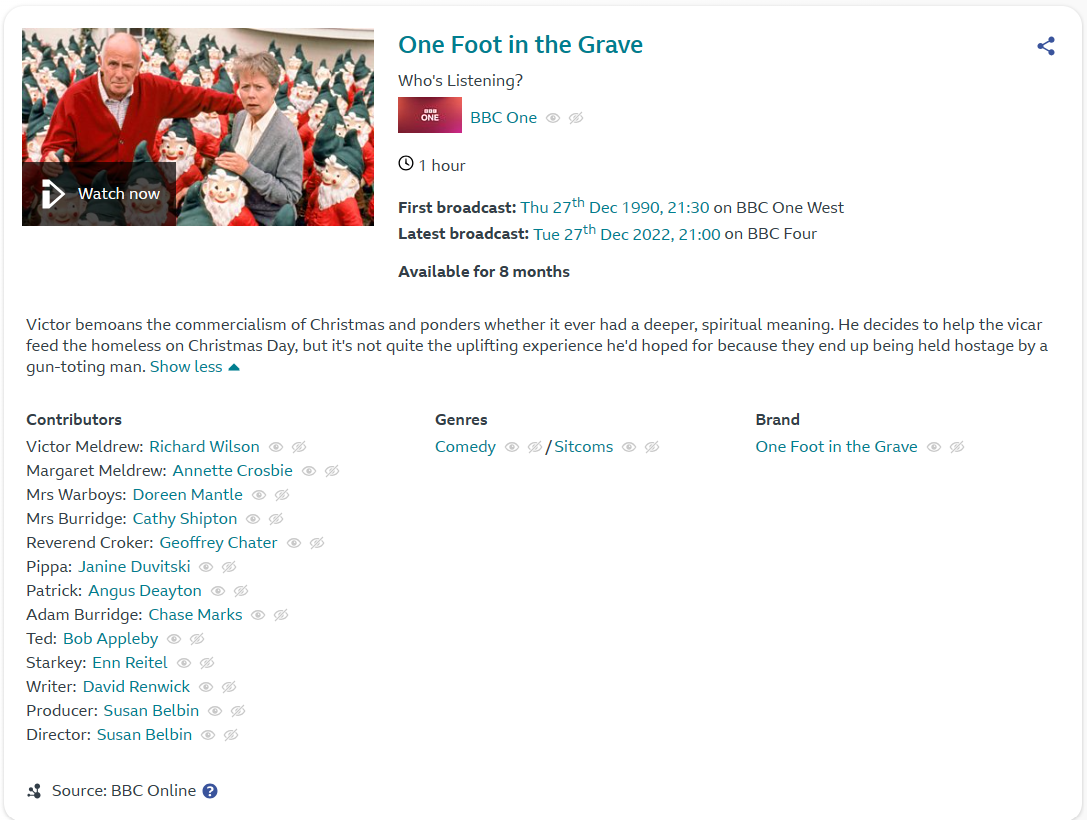
For the first in a series of four posts covering favourite Christmas specials, I have chosen an hour of comedy from 1990, which made me laugh more than anything else in that decade. Despite excellent specials from Only Fools and Horses, The Royle Family and 2.4 Children, this is the one for me that just shades it on the strength of one particular scene. What is it about ‘Who’s Listening?’ that sets it apart? Let’s find out.
The Programme
It’s easy to forget that One Foot in The Grave was very much a slow burner, much like Only Fools and Horses. The first series gained an enthusiastic core audience including Janet who introduced me to it, but viewing figures were quite low. However, the second series benefitted from very good reviews and word of mouth, building up very good numbers and making a Christmas special a viable option. The fact that this first Christmas special was shown on December 27, 1990 rather than in a prime slot on Christmas Day or Boxing Day perhaps indicated a certain hedging of the bets. Future Christmas specials including One Foot in the Algarve would become Christmas Day staples.
For those of you who are unfamiliar with the show, it is the story of the misadventures of Victor Meldrew played by Richard Wilson. In the very first episode he is forced into early retirement from his job as a security guard after 26 years and replaced by a box! This leaves him with too much time on his hands to contemplate the irritations of life, of which there are many, and his railing against the world provides the catalyst for the frequently bizarre twists that fate has in store for him. His wife Margaret played by Annette Crosbie is driven to distraction by Victor’s antics, frequently getting annoyed with him as he allows problems to get under his skin and spiral out of control. Despite their rows and frustration, theirs is not an antagonistic relationship, merely one that is prone to storms, and their deep love for each other is frequently shown throughout the series. It’s perhaps best summed up by Margaret’s quote
He’s the most sensitive person I’ve ever met and that’s why I love him and why I constantly want to ram his head through a television screen
Warm Champagne Series 4 Episode 4 (Renwick, 1993)
There are a number of recurring characters who help to give the series its texture. Jean Warboys played by Doreen Mantle is Margaret’s friend who drives Victor to distraction with her muddled thinking, but she has a heart of gold and puts up with Victor’s temper when others would have had enough. Patrick Trench (Angus Deayton) and his wife Pippa (Janine Duvitski) are the Meldrew’s next door neighbours. Although Victor and Patrick are constantly fighting, Margaret and Pippa are very good friends who share their mutual frustration at the juvenile behaviour of their warring husbands. Finally Nick Swainey played by Owen Brenman is the constantly cheerful arranger of old people’s activities in the area, activities he keeps trying to get Victor involved in despite constant abuse.
Who’s Listening
This episode features three threads that are woven through the story. First of all, a woman who works in a video shop gets on Victor’s wrong side and is treated to one of his trademark rants. He talks to the vicar of their local church, who has lost his faith because of what has happened to her, and finds out that one of his comments struck far too close to home. Victor has a problem with a mail order for a gnome to put into his garden, because he has put the catalogue number, 263, into the column for the amount! Finally, Patrick and Pippa order an £800 bottle of wine for her father which gets delivered to the Meldrews as they are out. David Renwick has great fun with the storylines for the latter two stories as he dovetails them with consummate skill. The story of Mrs Burridge, the video shop worker, and her son Adam showcases his skill at incorporating very sad and serious threads into his stories without missing a beat. He even dabbles in philosophy with Reverend Croker who has lost his faith as a result of Mrs Burridge’s experience. The whole episode is as tightly plotted as a farce, but it never loses sight of the humanity that makes this show so good.
The scene that always has me in fits, and had me struggling to take a breath when I first saw it was the gnomes scene. It starts with Victor ranting at someone at the other end of the telephone because he can’t believe they haven’t used enough common sense to realise that no one could possibly want 263 garden gnomes! As the wind gets up and gnomes start breaking, gnomes that need to be returned to the firm before he can get a refund, Margaret and Victor have to take drastic measures.
I still think this is the funniest scene of any Christmas special and indeed any comedy in the last 50 years. It’s so beautifully played, superbly structured and the reveal is timed to perfection as it unfolds. In 1991 Janet and I formed a quiz team with my best friend and his Dad. We called ourselves the 263 Gnomes in honour of this scene!
Final Reflection
It seems amazing that this is nearly 33 years ago, as the memory of first watching it still brings back such clear memories of our first Christmas together. It is a Christmas special for the ages, a perfect mix of pathos, philosophy and farce. If you have never seen it, hunt it down on Brit Box or maybe iPlayer, or buy it on DVD if you feel inclined to treat yourself to one of the most consistently brilliant comedies in British TV history.
 David Pearce - Popular Culture and Personal Passions