
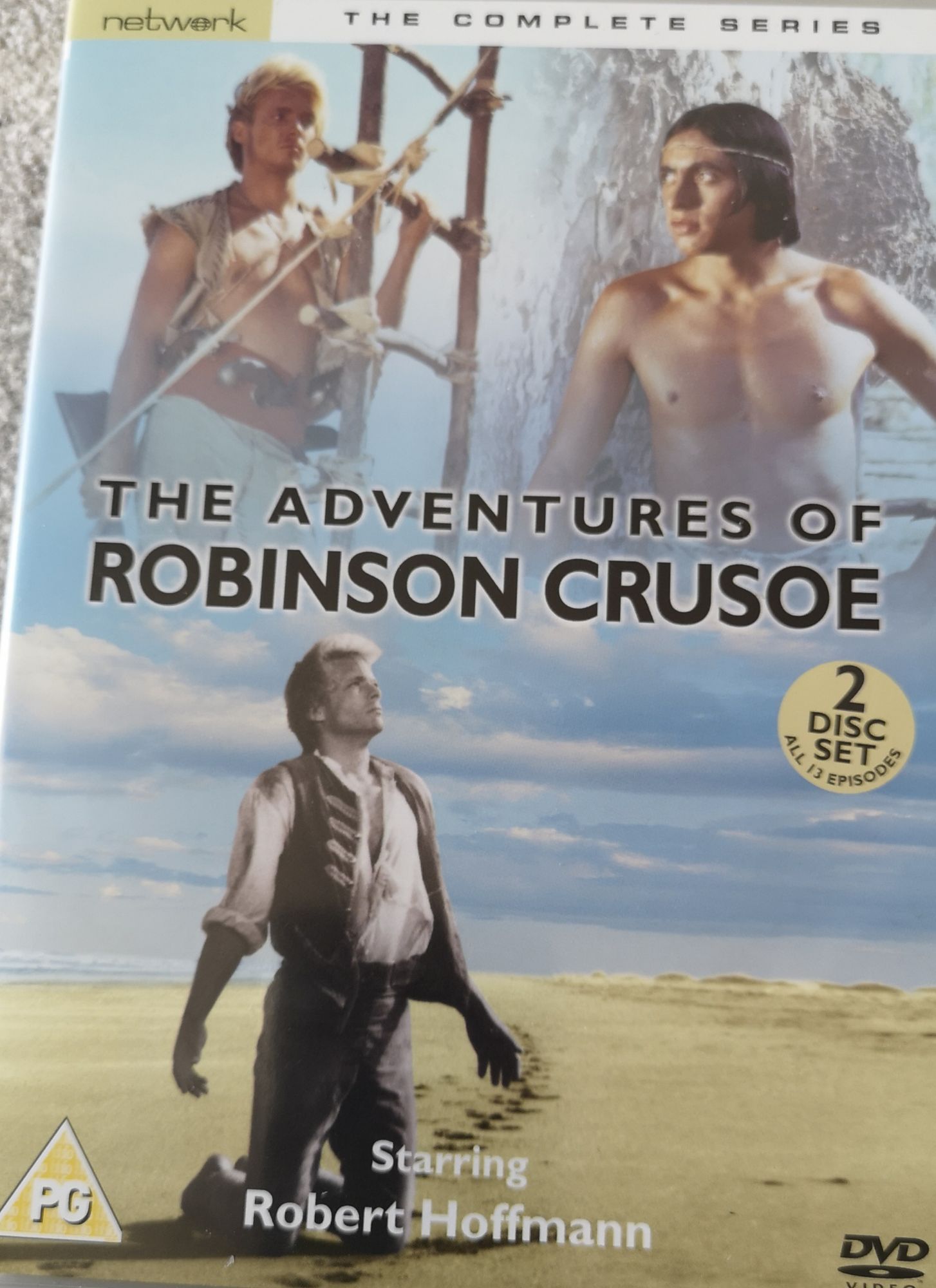
So here are the final five parts but I will start this final section with my favourite Robinson Crusoe joke.
Why did Robinson Crusoe have every weekend off? Because his work was always done by Friday!
Now, you may have noticed that this particular character has not appeared yet. It turns out that he was very much a latecomer to the scene. I can guarantee he plays a significant part in the rest of the story.
Episode Nine opens up with the aftermath of the shipwreck of what turned out to be a pirate ship as Robinson Crusoe has brought a lot of the supplies onto the island. Suddenly, it’s three years since he was shipwrecked and he has a party for himself and his companions after thanking God for his blessings. It’s really interesting to hear that being a central plot point, but with it being so faithful to the original early 18th Century novel, that probably shouldn’t be surprising. I love the different animals and the parrot sitting around the table all being on their best behaviour! After having finished off two flasks of rum, Crusoe bemoans the fact that they left him so little, so he runs down to the beach and sets off for the pirate ship in search of more. He is drunk and the voiceover makes this very clear! Back on the pirate ship he falls asleep in a drunken stupor, waking up to the sound of singing sea shanties, which he presumes is in his imagination, before finding more rum and having a hair of the dog! He playfully spins the wheel of the ship and then falls asleep again. When he comes to he realises that he is drifting out to sea and he can no longer see the island. The ship’s wheel is now stuck and there is nothing left on board the ship as he has taken it all off and transported it to the island. Is he ever going to get back? What will happen to the dog, the parrot and the goats? I can imagine being really worried as a child, as I am concerned as an adult! It’s a measure of how well the story and the adaptation have drawn me in. His ship runs aground on an unfamiliar stretch of coastline and he decides to take his chances with the land. The first living thing he sees is his dog! He turns out to be back on his island much to his, and my, relief. However, he finds unfamiliar footprints which tempers his joy at being back. Who is the intruder? Is he still on the island? It has taken a very unsettling turn as Crusoe starts to fear his own shadow. To keep the parrot quiet, because he is afraid that the bird will bring the intruder to his cave, he throws a sheet over it which seems to work. He finds himself nursing his first illness in three years and decides that inhaling the fumes from a bowl of tobacco will be the perfect cure! His goats are bleating with pain from not being milked and he has succumbed to exhaustion. When he wakes up he has got rid of the fever, no doubt because of the tobacco. Suddenly he sees a skull and realises that there are cannibals on his island!
The next episode sees Crusoe on guard and he sees the cannibals leaving, whereupon he makes plans to frighten them so much that they will never come back. So, he invents a weapon that means a number of muskets can be fired at once and booby traps the place where he has seen the fire they have lit with a barrel of gunpowder. The cannibals will believe that there are supernatural forces at play because, of course, all non English races are superstitious. When they do return it is surprisingly tense. The cannibals see a lone prisoner escape and two follow them. Crusoe kills one, terrifies the other and then the fire explodes accompanied by a volley of gunfire. The savages turn tail and run to their boats apart from two cannibals, including the one who he terrified earlier. One is shot but the other attacks Crusoe and starts to strangle him. Luckily, the grateful prisoner kills the assailant and Crusoe uses the knife to cut the binds around his wrist. The two then set about burying them. Robinson Crusoe calls his new companion Friday, and calls himself Master, because of course he would having been born an Englishman! His dog does not like Friday initially, but is calmed somewhat with food. Crusoe makes Friday sleep outside the cave and binds his wrists once again in case he ‘wakes up feeling hungry’ as he is a cannibal! There is a real feel of the slavery storyline coming back with Crusoe as the slave owner this time, with his added role of civilising this savage, which to modern audiences may be somewhat troubling, but which to 60s and 70s kids was quite natural. The story has suddenly gone into overdrive in Episode Ten after meandering through nine episodes!
Episode 11, and it isn’t clear where the story is going to go yet in these last three instalments. So lets settle in for the ride during this last hour of the story. Now, it’s clear that Friday has to be civilised to enable Crusoe to feel like he has done his job, but how is he going to do this? Well, Friday learns to bring him his breakfast on his first morning, although it’s not explained how. Crusoe tells us that he is showing Friday how the gun works so he can be impressed by how powerful and superior his Master is. He then starts to teach Friday to count and how to say specific words like milk. It’s a fascinating glimpse into the way that people thought about those from different countries, especially those with different skin tones, as people with no sense or intelligence. The whole section dealing with his education makes it clear what was at the heart of slavery, as the trade in people could not be acceptable unless those being traded were inferior. He teaches Friday to use a gun as that is civilised and a bow and arrow are not! Naturally, the use of birds as target practice is a clear indicator of civilisation. Friday then runs amok with the rifle and proves very civilised! Friday suddenly seems to learn the intricacies of English to the extent that they can have philosophical discussions. Robinson Crusoe then introduces Friday to God. It is quite a leap from where they started the episode, that’s for sure!
The penultimate episode starts with Crusoe searching for Friday who he fears has left him after an argument. Apparently he has been living on the island for five years, four years on his own and one year with Friday. Friday has gone to ground but not left the island, as a series of gifts for Crusoe proves, but why is he continuing to hide? Then we find out that his faithful dog is dying in scenes that will have upset even the most hardy of 60s and 70s children. It’s upsetting even now. Friday returns and the two men simply look at each other, and they go together to bury his faithful canine companion. Now, Crusoe sees him as an equal rather than a slave although the reason isn’t exactly made clear. Later in this episode Crusoe has lost track of time, grown a beard and become a joint ruler of his domain. He doesn’t ever want to leave. Suddenly he sees a ship and he is ready to leave with Friday, but when the men come ashore in a small boat he keeps out of sight just in case. It turns out that the men are murderers and pirates, so it’s just as well. Then, his parrot starts talking and the pirate draws his gun. Is the parrot about to squawk his last? Crusoe rescues his bird by tripping up the head pirate, but he and Friday’s days seem to be numbered. Another boat comes ashore. Surely this is it for our heroes?
The final episode opens with a game of hunter and hunted, but which is which? The pirate captain creeps up behind Robinson Crusoe and knocks him out with the butt of his pistol. Friday finds the canoe the latest set of pirates came ashore in and hides in it. Crusoe is a captive at the whim of the pirate captain but he tries to lead him on a wild goose chase in search of water. Friday is found by a pirate but pretends not to understand him so that he can find out what is happening with the pirates. It’s all very confusing! Then, all seems lost as the pirates find his cave and his treasure. Luckily, greed makes them fight and under cover of the confusion Friday escapes. Crusoe tells the captain that he knows of a native village on the other side of the island with even more treasure and luckily the captain is foolish enough to fall for it. Friday then picks the pirates off one by one from hiding. When the captain is killed things become more confusing still for the pirates as they have no leader, no plan and no sense of companionship. Robinson Crusoe and Friday now have the upper hand. It’s quite the body count in this last episode! Crusoe captures a pirate who agrees to help in return for his life. The last two pirates try to escape with the treasure chest in their canoe but Friday sinks the canoe by making holes in the bottom with his knife. The treasure has gone but so have the pirates. Friday makes his way to the pirate ship, ambushes those left on board and raises the White Ensign! They are on their way back to freedom, but Robinson Crusoe reflects on his luck at being changed for the better by his captivity on the island. We now see the two of them back in England with Friday now speaking RP and writing the story in front of a roaring fire.
Well there you go. They certainly don’t make them like that anymore. Yes, there were elements that are jarring to modern eyes, but the way that the story gripped me proves that good television is good television from whatever era it comes. Tales of shipwrecks and desert islands have been replaced for now, but if you ever want to go back to them they will always be there. I hope you enjoyed this revisit and that you will join me for more blasts from the past in the months ahead.
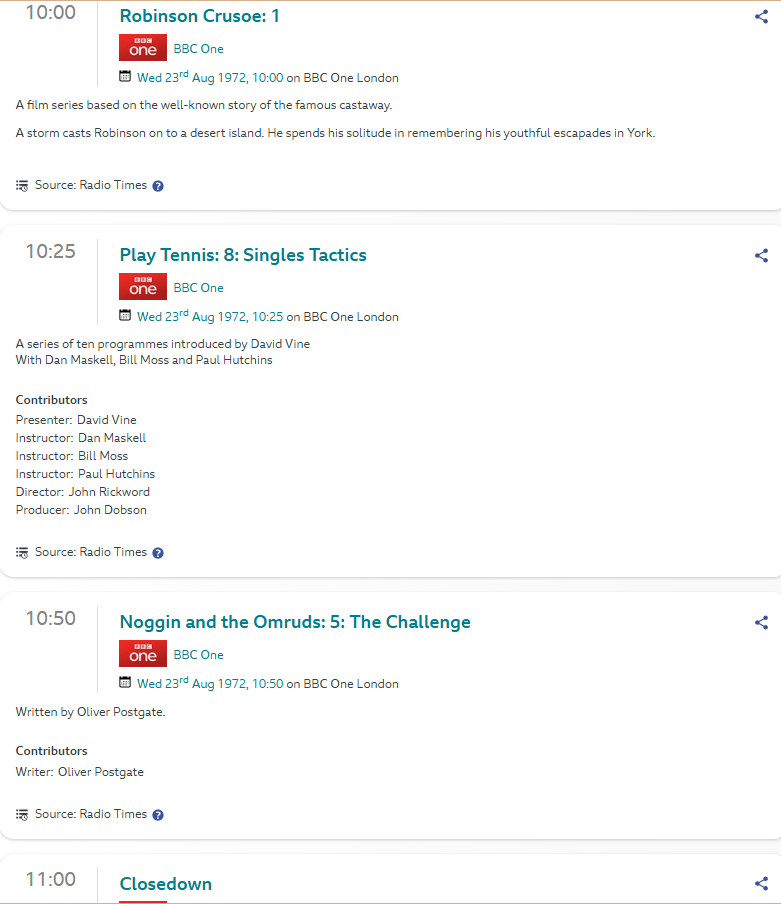
So, after the first four episodes saw our hero settle in to life on his desert island, we see what the next four have in store from him. Here is the TV listing for the morning of Tuesday August 19, 1975 when Episode 5 was broadcast.

I don’t think I would have moved from 10:00 – 1:45!
Episodes 5 – 8
The fifth episode opens up with Crusoe having been on the island for over a month, and now constructing a wall and a terrace for his cave. He even makes his own furniture, though not with great success as he reflects. Yet again, the slow pace and regular silences show how different programmes for children were all those years ago. There is a very interesting insight into his thoughts at his enforced isolation, and the viewer is invited to empathise with his situation without it being made into a big emotional set piece. I wonder how that would go with younger generations. The scenes when he is at sea are fascinating as you watch an old sailing ship being made ready to sail and then his increasing fascination with the way that the sextant and other navigational aids. He has several run ins with the second mate, Blake who dislikes him on sight and revels in his ability to bully him. When Crusoe and some of the sailors row ashore for fresh water they find slave traders in wait and he and another sailor are captured. He tries to escape but his efforts are in vain. There is a large scale action sequence as the slavers rush to try to capture more sailors. The others escape and decide to tell the others on board that Crusoe had been killed. Blake can’t hide his satisfaction at the ‘death’ of his disliked crewmate, and Crusoe has to endure the cruelty of the ‘barbarians’ who act in a way that they are expected to at least in terms of the storytelling of the time. There are Bedouin tents, Emirs with evil expressions, concubines and camels! Back on the island he constructs a goat trap to ensure a regular supply of milk and he keeps a fire going to advertise his existence on the island.
At the start of episode six our castaway is starting to find life ever more difficult as a result of the isolation. He is certain he sees a ship, but it turns out to be an hallucination. He wonders if he is succumbing to madness, and sets about yet more work to try to keep it at bay. He is determined to keep a track of the days by carving a notch for each day on a post (and a cross for Sunday) and wonders how many posts he will have by the end. Then, disaster strikes as his cave catches fire and all his furniture destroyed. Fortunately his dog and his parrot are both safe so he resolves to start again, reflecting how much worse the situation was when he was in slavery. He finds himself being exchanged by the Emir for a camel due to being so useless as a slave, then his second owner gets rid of him in exchange for a donkey and so on until after half a dozen trades he is worth just two baskets of fish! He finds himself working for a fishmonger and he plans his escape. He throws his latest cruel master into the sea and makes his escape in a small boat with very little food but a lot of his master’s gold! However, he has very little food and water and finds himself heading out to sea praying for a ship to find him. Luckily for Robinson Crusoe, and the story, he is finally discovered by a ship, who rescue him. A Portuguese ship finds him in his little rowing boat in a state of complete exhaustion and he is finally rescued. Once again attired as an Englishman should be, he uses the gold to buy a small plot of gold in Brazil, which he then exchanges for a banana plantation, and finds himself making money hand over fist. Back on the island he is rebuilding his cave and constructing a canoe to escape in.
We reach the halfway point and it’s interesting how little has actually happened to take the story forward. There has been a lot of backstory, but he has not really done anything to move on with his plans to get off of the island. Well, in this episode he has finished his massive canoe and he is preparing to leave his island. The trouble is that it is far too big and far too heavy. He cannot even get it to the water and when he realises this he despairs. He reflects once again on Brazil and his good fortune that he never really appreciated properly. He has become bored in Brazil so when he is told that there is a voyage to the coast of Guinea needed to obtain more slaves ‘at source’ he is tempted by the new adventure and accepts, leaving his plantation in the hands of three other businessmen. It is there that he first boards the Esmerelda, the boat that he would eventually be shipwrecked in. The Captain of the ship disappears without trace and there are no rats on board, a sure sign of bad luck in maritime superstition. Hit by a storm very soon after Crusoe must rally the crew to ensure their survival. Men plunge overboard or are crushed by huge spars of wood in yet another seaborne disaster. You are left wondering why he won’t take the hint! It turns out that this is the very voyage that has brought him to his island and left him a castaway. From now on the story can only move forward. However, he ensures that all the adventures are written down in the Esmerelda’s log book which has mysteriously appeared at this point in the story! He is bored and decides to get rid of a piece of rock that he keeps banging his head on. The parrot seems to realise it’s a bad idea and warns him loudly, but it’s no use, Robinson Crusoe is buried under tons of rubble.
The final episode of this quartet opens on a cliff hanger with a Doctor Who style reprise. Crusoe is buried but his dog tries to dig him out. Soon enough he is safe and he has even created a second door for the cave, so that’s fine. He discovers previously unsuspected skills for pottery, cheese making, farming and bread making. This is something of a holding episode of the types that longer series of this style used to have but none the worse for all that. By bringing the focus back completely onto the island and his increasing confidence in his own skills to thrive, not just survive. He even starts to catch fish and as a slave he learnt how to salt them, so he can build up a store of food. He has a day of rest on Sunday to respect the day of the lord, something that would have been completely understood by the children of the day. They would also, no doubt, have been expected to have understood words like idiosyncrasy from primary school onwards. What different times they were. Suddenly he hears a cannon, sees a boat, and realises that possible rescue is close at hand. He can hear a bell but no longer see the boat. Suddenly he remembers that the cannon and the bell means a ship that has the plague aboard. Undaunted, he decides to take his chances with the ship.
Next time, it’s the final five episodes, so join me to see what happens next.
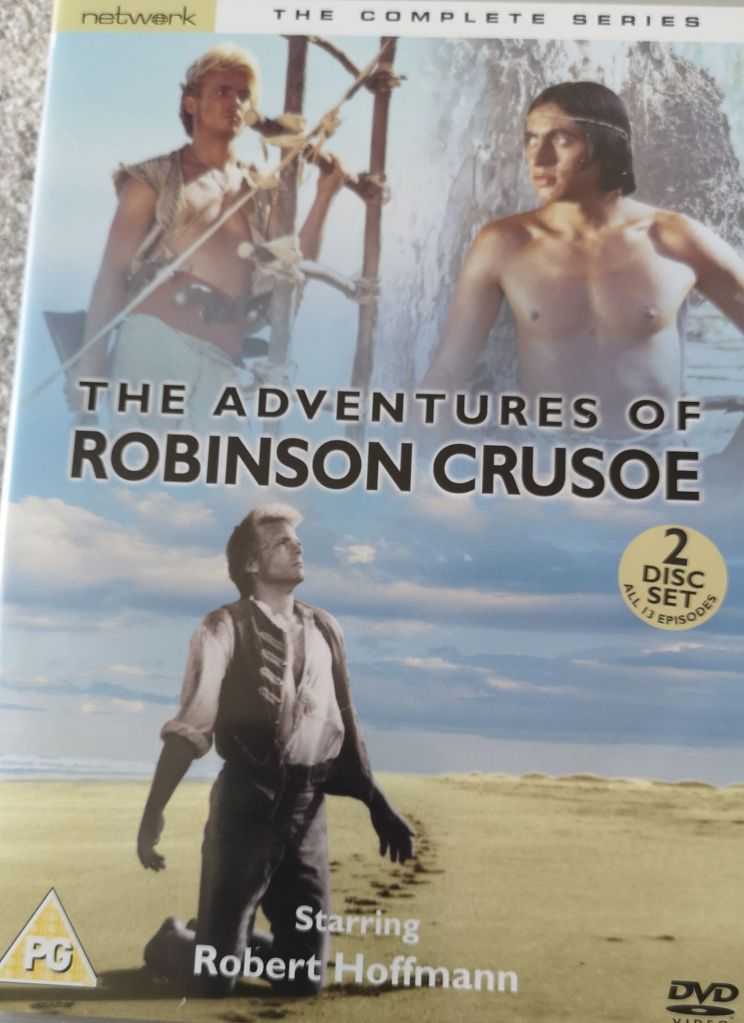
In this ongoing series of posts I will be reflecting on the TV programmes of my childhood in alphabetical order, broadly speaking, and rewatching them to see how much of their original magic remains.
Pretty much every year during my childhood one programme seemed to reappear during the Easter, Summer or Christmas holidays. In my memory, it was like the first bluebell in Spring, the first butterflies of summer (at least back in the 70s) or the first sight of the new Woolworths advert in November. You knew that school had finished and that you could just relax. That unmistakable theme tune, and some instantly recognisable incidental music meant that once again you were going to sit through all thirteen episodes of The Adventures of Robinson Crusoe!

Note that I said it seemed to be the case. In fact, the first broadcast was weekly on a Tuesday from October 12 1965 to January 4 1966. This format continued through its first three showings before August 1972 introduced the daily episodes that we knew and loved. This would have been the first time I had seen it, and I know that it was when I was staying at my Grandparents’ cottage for two weeks that summer.
Episodes 1 – 4
The first episode shows the storm and shipwreck that led to Crusoe’s stranding on the desert island that would become his home. Given its studio bound filming, the initial scenes are extremely effective, giving a feeling of danger and disaster with very limited resources. However, when he comes ashore you can see that the studio has been left behind and even now there is a real magic to the exploration of the island. That magic would have been even stronger when I was a child given that we hardly ever saw nature documentaries in the early 1970s. It turns out that it was Gran Canaria apparently. The voiceover is very effective from the beginning as Lee Payant gives Crusoe a real character. We see his younger days as a very immature and headstrong man with a despairing father. Robert Hoffman, the actor on screen makes Crusoe a very dashing hero with all too human failings. I appreciate the background more now than I probably did then.
The second episode is a very interesting time capsule with Crusoe praying to God, looking through his tobacco pouch, reflecting on his civilised nature and calling other races ‘savages’! Well, it was very much a product of its time and, given how faithful it is to the original novel, that time was the end of the 17th Century! As he climbs rocks and tries to find ways to survive the veneer of civilisation starts to be rubbed off. He realises that he must become a different person. I only realised rewatching it today how much silence there was in the episodes. We were very different then with no smartphones, regular closedowns on TV and Sundays that went on for ever, and, consequently, a much higher threshold for silence and reflection than we do nowadays! It’s interesting that it doesn’t shy away from the unpleasant nature of the battle for survival with the killing of a goat being shown in some detail, and the orphaned baby of the goat he killed becoming his responsibility due to his feeling of guilt.
Episode three sees the building of a shelter plus a mother goat who has clearly, and conveniently, been nursing her own kid and is quite happy to nurse the offspring of another goat. We return once again to Robinson’s years as a feckless young man with an increasingly offhand attitude to the law. He decides to go to sea and become the master of many slaves to make his father proud – another sign of very different times! The wreck of the Esmerelda appears on the horizon, and he swims out to see what he can scavenge. Viewers had seen a frightened dog during the storm, and almost certainly assumed that he had died in the wreck, but he has survived! I remember being very happy then, and it turns out I am still happy now!
Episode four continues the slow building nature of this programme which starts with that unmistakable theme tune and develops the story by using flashbacks interspersed with the reality of everyday life on the island. It concentrates on practicality rather than daring adventures and it turns out to be a good guide to survival if you ever find yourself on a desert island. His early attempts to get himself a place on a ship lead to seasickness and attempted robbery respectively. It’s a wonder he didn’t give up and go back to his boring law office – I would! Captain Darrick takes him on board after saving him from the robbers and his adventures begin in earnest. Back on the island, he and his dog discover a cave that will become his shelter for the rest of his time on the island. By the way, it turns out that rum soaked materials set on fire are a very good fuse for gunpowder – in case you ever need to use that nugget of information! You even get rudimentary physics when Crusoe tells you that the explosion has the greatest force where the resistance is greatest!
Well, that’s the first third of the series over and it is just as fascinating as a piece of archive television and a reflection of prevailing ideas and attitudes as it is in terms of drama. It is curiously grown up in content, requiring the young viewer of yesteryear and the older viewer of now to concentrate and be content to see a story taking its time to develop both the backstory and the drama of life on the island. Next time, it will be Episodes 5 – 8. See you then.
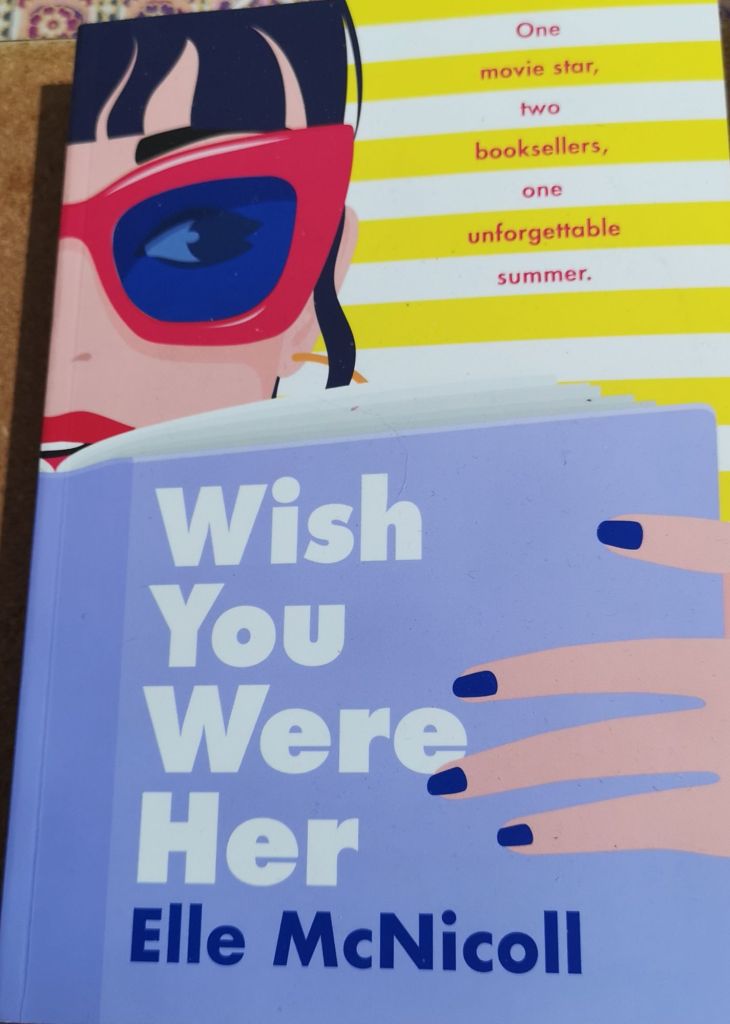
Elle McNicoll has become one of those rare authors whose books I will pre-order without knowing anything about them, because I know I will enjoy them immensely. As with Keedie and Some Like It Cold I went straight to West End Lane Books to buy a personalised, signed copy. Even if you aren’t in the market for signed copies, go to the website at the link and support one of the best independent bookshops around.
Wish You Were Her is the second of her books set in Lake Pristine, but it is not a direct sequel. That proves to be an inspired choice on her part, as she reintroduces characters from that book, two of whom become very important in the story. This story is set five years after the events surrounding Jasper’s return to Lake Pristine, but she does not dwell on what the characters have been doing in the meantime. The original book is referred to, but you don’t need to have read the first book to thoroughly enjoy this one. That said, for readers of Some Like It Cold the situation we find Grace and Jasper in fulfils the promise of that first book, but more of that later.
The Story
Allegra Brooks is one of the biggest movie stars in the world. She is 18 with the world seemingly at her feet, but she needs somewhere to disappear to for the summer. Lake Pristine has a book festival each summer, and for Allegra, the daughter of the local bookseller, that seems like the perfect place to hide out. Even before she arrives, she is getting on very well with one of the employees through a series of anonymous and occasionally mischievous emails. She meets the two employees who work for her Dad, Simon, the confident, quick witted and charming alpha male and Jonah, who is permanently defensive, often rude and socially inept. Jonah is autistic, which makes him great with the organisation and the prehistoric computer, but Simon is the one who deals with people. Allegra and Jonah get off to the worst possible start when he is extremely rude to her, but Simon is charm personified. It has to be Simon who is her mystery emailer doesn’t it? Initially, Lake Pristine closes ranks around her. She is the daughter of George Brooks, not the one of the biggest movie stars on the planet so she can relax safe in the knowledge that she won’t be the target of gossip, photos or reporters, as long as she doesn’t leave the town. Is Lake Pristine big enough for her, though? What should she do about her continuing email chats? How will she react when she finds out who it is? More to the point, how will they react? Finally, how can she keep the secret of her autism diagnosis when it could negatively affect her life and career if anyone finds out about it? When it turns out that she is not as safe as she thought, the answers to those questions take her to very surprising and difficult places.
My thoughts
Every book I read from Elle McNicoll, and I’ve now read four, is a delight and a reflection of my own experiences as someone on the autistic spectrum. As ever, I have learnt about myself along with the characters as McNicoll once again builds up world that is viewed from a very specific viewpoint. Very early on, the book made me laugh when Allegra muses about revealing her autistic diagnosis and says, ‘Maybe I should, I don’t know, come out of the library’! Later on it caused a very different reaction when one of the other characters talks about a whale whose song is at a completely different frequency from all the others, meaning it is always alone. The occasional humour that is found in the ways that autistic people navigate the neurotypical world is often overshadowed by the darker moments of never really fitting in. The idea that Allegra is such a good actress because she has spent a lifetime trying to read people and fit in is very interesting. It’s a similar dynamic to her other Lake Pristine book and in fact the main protagonist from Some Like it Cold, Jasper Montgomery reappears to take a pivotal role. You look at two outwardly brilliant, successful and popular characters and realise that there is more than one way of being autistic in an allistic world. The appearance of Grace, my favourite character from the first book is a delight. She has blossomed in the five years since the first book, and the belief that Jasper showed in her has proved to be completely justified. An indication of how much McNicoll’s books get you to care about the characters is that I was delighted for her because she deserved it and I actually found myself smiling when reading about her successes. You don’t need to have read the first book, but if you have it adds the depth that only the best storytellers can achieve.
Once again, Elle McNicoll has written an irresistible romance that makes autism a central part of the story without it feeling preachy or forced. She is doing more to bring understanding and empathy to readers young and old than any other novelist writing today. If you haven’t read A Kind of Spark or Keedie check out my reviews and put those two and the two Lake Pristine books right at the top of your TBR pile.
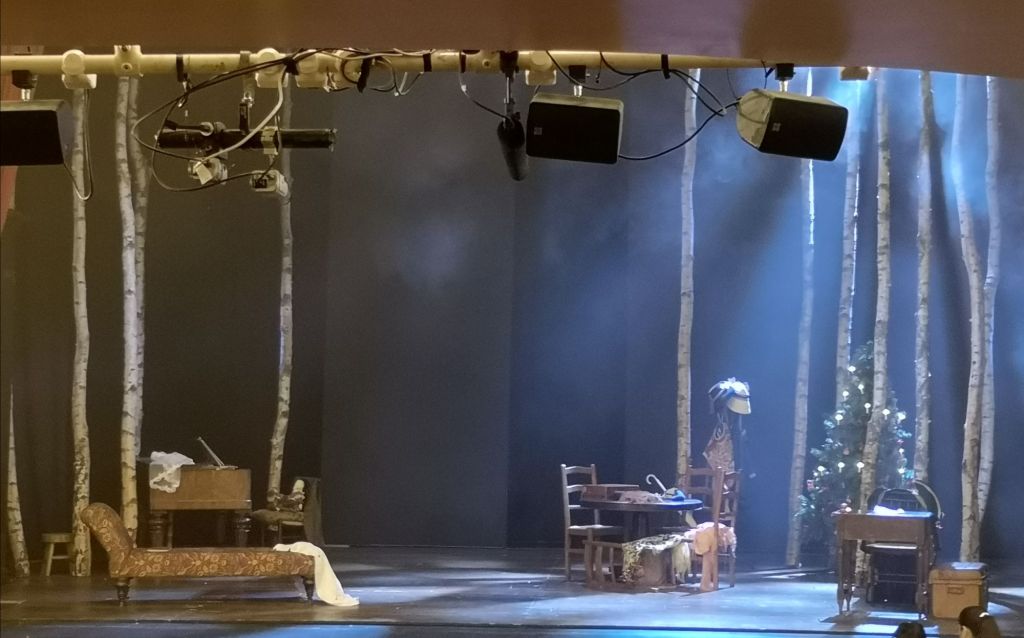
This is a story that was a hugely successful book, one that has been filmed on a number of occasions, most recently directed by Greta Gerwig and starring Saorsie Ronan, Timothee Chalamet and Emma Watson. However, I don’t think that any other version has quite as much charm as this stage play.
It starts with the singing of a hymn by the assembled company, a motif that occurs at various times and is always a delight as the harmonies are gorgeous. They sing Christmas carols at various points in the play which was actually quite marvellous on a balmy June night. Once that has finished we are plunged straight into one of the plays that the talented and driven Jo has written for her and her sisters to perform. It’s a really inspired opening as it takes us straight onto the stage as the natural home of the action. There are four sisters, Jo, Meg, Beth and Amy, and they embody passion, romance, service and ambition respectively. Their mother, Marmee and Aunt March are the only adult influences in their lives as the play starts since their father has volunteered in the American Civil War as a chaplain. Marmee is focused on their spiritual development while Aunt March, exasperated by their resultant lack of worldliness wants to see them in good marriages. Jo is completely disinterested in marriage until a young man called Laurie moves in nearby setting in train a series of events that none of the sisters are prepared for and which will change their lives completely both for good and for bad.
The Cast

The actresses who played the four sisters were uniformly excellent and right from the start they were an absolutely convincing family unit. Having seen some of the stories and posts on Instagram this closeness is one that is both on and off stage and it rooted the whole performance in their affectionate and loving relationships with each other.
Grace Molony played Jo with vigour, humour and passion. The character can be played as something akin to a paragon, but the writing and the performance showed both the good and bad sides of her character. She is generous, open and affectionate throughout, but she can also be self centred, quick to anger and oblivious to the needs of those she cares about. The skill of Molony was in making sure that both sides were utterly consistent with the person we saw on the stage. You felt the ambition burning from the first scene as writer and central character of the sisters’ plays but that ambition turns out to be a complicating factor in both her personal relationships and professional goals.
Jade Kennedy played Meg, the eternal romantic who dreams of getting married and starting a family but is worried that their genteel poverty may spoil her chances. She is amusing, wholehearted and loyal to those who love her. She is a character that you wanted to see end up happy because she is instantly appealing. Again, this is a character who can be something of a type rather than a person, but Kennedy brought out her frustrations at the lack of money and the uncertainty she feels about herself and her position in both society and in the heart of her would be suitor.
Catherine Chalk as Beth had probably the most difficult character to bring to life. Her self sacrificing nature and her health battles make her, in some versions, more of a cypher than a character. In this play, however, she is every bit the main driver in keeping the contrasting natures of her siblings in balance. She is not afraid to tell them when they are wrong, firmly but affectionately, and she sticks to her principles throughout. For her, charity is not just a way of helping others, but a way of making yourself a stronger person. Her musical talent gives her a focus and a belief that the future will be better for all of them. In Chalk’s capable hands I felt for the first time that Beth was a living breathing person.
Imogen Elliott was Amy, the youngest of the sisters. She is utterly determined to be rich and to surround herself with the finest things in life. That determination brings her into conflict with Jo and sees her put herself first on every occasion. Her flash of real anger and spite early on when she is unable to go to a dance is genuinely shocking. She balances this out with her feisty nature and her humour along with her growing self awareness. When you first see the family, Amy is about 12 or 13 years old, a challenge for any actor on stage as the portrayal of a young person can easily tip over into caricature. To be honest, I thought that Elliott herself was perhaps 16 or so herself, so convincing was she as a soon to be teenager. She was able to change her portrayal of Beth with alterations in her physical approach, seemingly growing up before our eyes before finally becoming a young lady of poise and beauty. It was incredibly subtly done and marks her out as a real rising star.
On the night we went, Ellie Pawsey played Marmee. She is the moral centre of the family and the play with a firm religious conviction in the role of goodness and charity. Her acceptance of their straitened circumstances occasionally frustrates the sisters and constantly irritates Aunt March. However, her strength and determination in the face of all the challenges give her a steel that gives her a real presence. To balance this out she is a cheerleader when things are difficult, humorous in a subtle way and able to admit that this is something she has had to learn to accept over the years. Pawsey was able to show both sides of her character with warmth, humour and affection.
Cillian Lenaghan played Laurie, the young man who moves into the big house opposite the sisters. He instantly slots into the role of playmate for Jo, who starts to blossom as a result of the friendship. When it turns out that his feelings for her tend in a different direction, it leads to a fracture in their relationship that drives the second half of the play. Laurie is adept at puncturing Jo’s occasional self importance with some affectionate teasing and he is open and honest with all the sisters. He treads a fine line between the romantic and the filial and Lenaghan makes him an instantly appealing character who gives the play a focus away from the relationship at its heart.
Jack Ashton played both John Brooke and Professor Bhaer. I can give no better compliment than to say I genuinely didn’t realise that they were one and the same person until I read the cast list again at the end! His portrayals of the soft spoken tutor of Laurie and the excitable and passionate German academic were completely different physically as well as in terms of character. Brooke is slow and deliberate with a physical demeanour that anchors him to the stage, whereas Bhaer is constantly moving and almost bouncing with passion and excitement. The two of them are such contrasting characters and Ashton showed real skill in bringing out the authenticity of both.
Last and definitely not least we have Aunt March played by the amazing Belinda Lang. It was her presence in the cast that made me so eager to see the play as she has long been one of my favourite actresses. She was a total delight every time she appeared on stage. Her humour and exasperation were perfectly pitched as she played the Southern matriarch with clear delight. I wanted to see more of her, the sign of a great character and a marvellous actress, but it was the occasional and brief nature of her scenes that made her appearances all the more effective. It was every bit the treat I expected to see one of my favourites on stage and I am so glad I was able to get the opportunity.
Final thoughts
I had only seen one version of this story before, the Greta Gerwig film from 2019, and despite trying very hard I was completely unable to get into the book, so I was not familiar with the events that unfolded. This meant that the twists and turns were often a surprise and they kept me gripped throughout. Having not really thought of this as a story that I could really become engaged with, the play proved me completely wrong. The cast made me care about each character and I was absolutely captivated from the first minute to the last. I know that this tour is coming to an end at Richmond, but if and when the play reappears I can absolutely recommend it to anyone who wants two enchanting hours in the company of the March sisters.
 David Pearce - Popular Culture and Personal Passions