
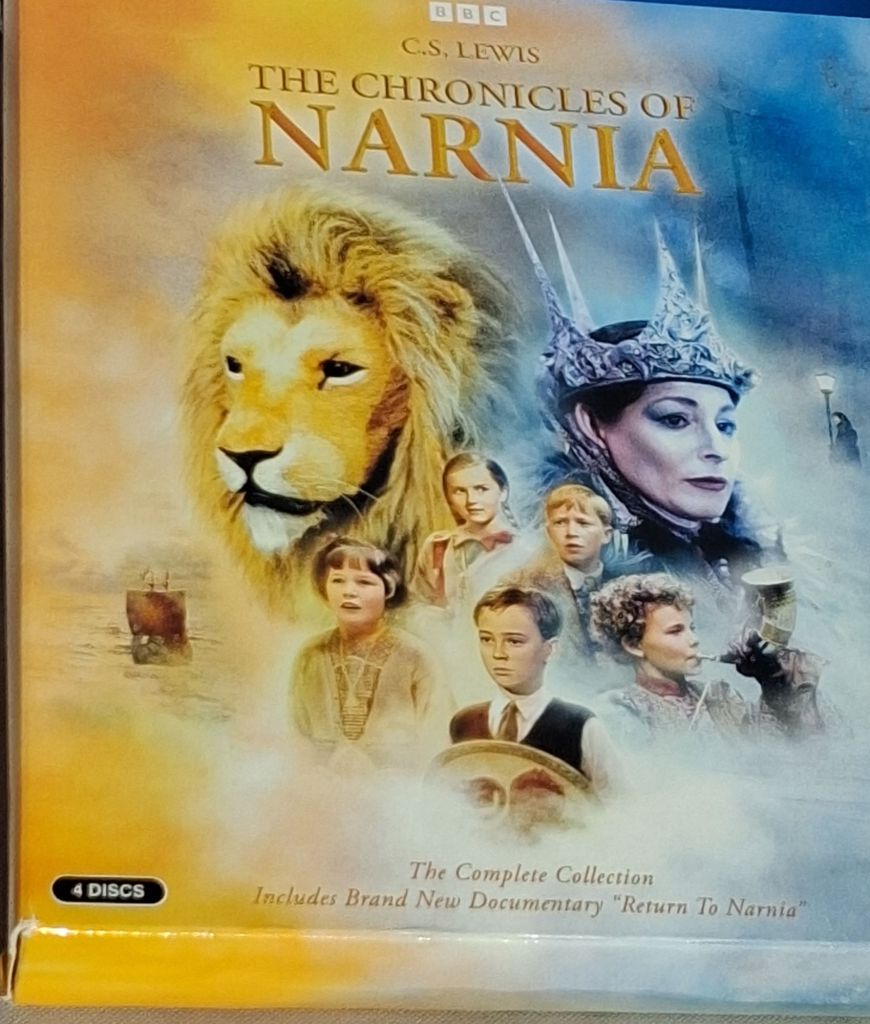
You may have noticed that there is some degree of disquiet about Greta Gerwig’s forthcoming production of The Magician’s Nephew, and that’s putting it mildly! I am definitely prepared to wait until I see it to pass judgement – always the best approach but sadly less and less common – and, as it’s never been filmed before I’m actively looking forward to it. It made me want to revisit the BBC productions from 1988 and buying the Blu Ray box set gave me the perfect excuse to do so. As with the Walden films of the 2000s this series bypassed The Magician’s Nephew and went straight to the first Narnia book that C.S. Lewis wrote. So, let’s start there.
Plot
It is 1940 and the four Pevensie children Peter, Susan, Edmund and Lucy, have been evacuated to the house of Professor Kirke in the country for safety. As Edmund observes, it’s only safe because nothing ever happens in the country. This appears to be the case until Lucy, playing hide and seek, decides to hide in a wardrobe in one of the many spare rooms in the Kirke house. Instead of the back of the wardrobe she finds herself in a strange land of snow which for some reason features a lamppost. While she is exploring she meets a faun called Mr Tumnus who seems strangely perturbed that she is a ‘Daughter of Eve’ and he makes her fall asleep by playing a magical tune on his pipes. He admits that he has been told by The White Witch to bring any human straight to her, but he decides to keep it a secret and lets her go. When Edmund gets into the land of Narnia he meets The Witch who calls herself Jadis, Queen of Narnia. She is alternately friendly and threatening, giving him hot chocolate and Turkish delight and then telling him he must bring his brother and sisters to Narnia to meet her and telling him there will be serious consequences if he doesn’t do so. When he gets back, Edmund tells the others he never saw Narnia and starts teasing Lucy. Peter and Susan go to Professor Kirke to ask what to do and whether she is mad or just a liar. Professor Kirke says that they should ask themselves instead if the story is true, something he considers to be the most likely explanation. When the wardrobe next opens all four of the children are inside and they find out that things have moved on with Mr Tumnus having been captured.
Production
This particular version is seemingly ingrained in the mind of lovers of Narnia as the perfect comfort show, and in many ways it is. From the sweeping music to the old fashioned look it is every Sunday tea time programme produced by the BBC writ large, and while so many were watched and forgotten about this has stayed fresh in the cultural memory banks. From the first scene in the railway station as the Pevensies are evacuated there is a real sense of time and place, evoked by the scenery, the clothes and the speech patterns of children and adults alike. When we first see Narnia, it is the Narnia of C S Lewis with the lamppost standing tall amid snow covered fir trees. The map that the viewer sweeps over in time with the music is brought to life very well indeed. It is a very post war Narnia, even though it is always winter, because food that the young Pevensies will not taste until perhaps a decade after the war is available, at least to Edmund! The overall look is very much helped by the sets and the, at the time, ground breaking special effects, which are overlaid on the real world giving Narnia an allegorical feel. Mr Tumnus, Mr & Mrs Beaver, Maugrim and Aslan are all clearly human beings in costume, but they inhabit their parts so well that the viewer looks past that and instead concentrates on the unfolding story. The Blu Ray helps the world building element by cleaning up the visuals and the soundtrack but the action continues to stand on its own merits.
The Cast
The four children are front and centre throughout the six episodes and, despite the perception that child actors are more polished these days, they turn in four very strong performances. It is, of course, true that styles of acting have developed over the years but they inhabit their parts fully and convincingly. Richard Dempsey plays Peter with a mix of uncertainty and bravery that is absolutely correct for a boy of 13 or 14 plunged into a situation that he has never been prepared for and knowing that he needs to protect his younger siblings. His battles with Edmund played by Jonathan R Scott are familiar to anyone who has been a sibling or seen them in action. Scott has the most unsympathetic part but he brings Edmund to life as a conflicted and lost boy rather than a total brat, and it is clear that there is room for redemption. The production cleverly reflects this when he his interrogated by his conscience and you see the bad side beginning to crumble. Sophie Cook plays Susan and does very well with an underwritten part, but that is in a sense because of Lewis’ original series of books where he made Susan a two dimensional character compared to her siblings. Finally, Sophie Wilcox plays the central character of Lucy, through whose eyes the new world is seen and understood. She is absolutely perfect for the role with her air of wonder and gratitude and a positive belief that things will turn out well.
Barbara Kellerman is the standard by which all other White Witches will be judged, and in my view no one has yet matched her air of danger. She is absolutely volcanic in her rages and vindictive in her actions, whether that be everyday cruelty to slaves and enemies or turning those who anger her to stone. When she leads the forces of evil to the Stone Table she takes the Sunday teatime story into the realms of folk horror. Ronald Pickup is the voice of Aslan and he brings a power to it that often belies its softness. Mr & Mrs Beaver played by Kerry Shale and Lesley Nicol are great fun with their bickering relationship. Jeffrey Perry is an ambivalent Mr Tumnus who makes it clear from the start that there is something untrustworthy about him that is fighting with his inner goodness. Finally, the marvellous Michael Aldridge makes a winning and amusing Professor Kirke and his views about ‘modern education’ definitely struck a few chords!
Reflection
This is a marvellous trip down memory lane and a huge pleasure to watch once again, particularly in its cleaned up format. I don’t remember the three further adaptations with anything like the same clarity but I am really looking forward to refreshing what memories I have as I work through the discs.
Do you believe in karma?
View all responses
You only have to look at the world to know that karma does not exist. Good people very rarely succeed and bad people are in positions of power everywhere you look. The planet is being destroyed by malign people in business, politics and the media, but none of those people see anything bad happening to them at any point. I don’t believe in any type of cosmic goodness that sets things to rights. The easiest and quickest way to get on in life is to not care about other people or the effect you have on them, and if you do that you will be congratulated and honoured.
Terry Pratchett had it right in his most brilliantly angry exchange between Susan Sto Helit and Death in The Hogfather. If you could encapsulate my attitude to karma it’s here.
“All right,” said Susan. “I’m not stupid. You’re saying humans need… fantasies to make life bearable.”
REALLY? AS IF IT WAS SOME KIND OF PINK PILL? NO. HUMANS NEED FANTASY TO BE HUMAN. TO BE THE PLACE WHERE THE FALLING ANGEL MEETS THE RISING APE.
“Tooth fairies? Hogfathers? Little—
” YES. AS PRACTICE. YOU HAVE TO START OUT LEARNING TO BELIEVE THE LITTLE LIES.
“So we can believe the big ones?”
YES. JUSTICE. MERCY. DUTY. THAT SORT OF THING.
“They’re not the same at all!”
YOU THINK SO? THEN TAKE THE UNIVERSE AND GRIND IT DOWN TO THE FINEST POWDER AND SIEVE IT THROUGH THE FINEST SIEVE AND THEN SHOW ME ONE ATOM OF JUSTICE, ONE MOLECULE OF MERCY. AND YET—Death waved a hand. AND YET YOU ACT AS IF THERE IS SOME IDEAL ORDER IN THE WORLD, AS IF THERE IS SOME…SOME RIGHTNESS IN THE UNIVERSE BY WHICH IT MAY BE JUDGED.
“Yes, but people have got to believe that, or what’s the point—
” MY POINT EXACTLY.” —
Hogfather, Terry Pratchett
How do you write what people actually want to read?
I have been writing this blog for the past six years or so. In that time I have refined my approach to writing my posts through experience and by reacting to what seems to cut through to a larger audience. However, I haven’t tried to write to chase a big audience. I have tried to write to keep a core audience who come back day after day. Most of my posts have a solid 30 or 40 reads on the day they are published and about two thirds of those reads become likes. In this sense I think I am writing what people actually want to read. So what is it I am actually writing?
My style is personal opinion, personal experiences and an approach that prioritises one or the other depending on the prompt. Writing every day in response to the daily prompt has been central to both building and keeping an audience. This year, so far, I have had over 13000 views. A couple of years ago I had less than 3000 and that was mainly due to a few posts that became popular for some reason. The problem is that you are never really sure what that reason is!
My most popular post ever is Memories of Singing Together. It has had over 1200 views in the three years since I wrote it. I have no idea why that particular post is 24 times as popular as my usual posts, and I don’t suppose I will ever find out. On the surface it is very similar to my usual style but it has never stopped gaining a readership. The vast majority of my posts do not have any sort of afterlife at all. It isn’t the style so what about the subject? Well, I wrote two connected posts about the Christmas songs featured in Singing Together. The first one, featuring the years 1970 to 1972, has received 71 views and 2 likes. The second one, featuring the years 1973 to 1975 has received 174 views and zero likes!
So, for me anyway, it’s very difficult to write what more people want to read so all I can do is be authentic and carry on writing as well as I can and perhaps the audience will take care of itself and grow organically.
What’s the most spontaneous thing you’ve ever done?
Spontaneity isn’t really my approach to anything. It’s not that I can’t make quick decisions, it’s that I distrust doing something without at least some time weighing up the pros and cons. Often, the decisions that seem spontaneous to others have been considered at length as thought exercises as I have seen the unfolding situation previously for someone else and wondered how I would react.
Spontaneity has most often been the province of those I am with. My best friend in my teens and twenties was ridiculously spontaneous and I just went along with him 90% of the time. More than once that led to some unexpected consequences!My wife is also very spontaneous and has never been wrong even if it’s made things complicated! I have learnt to trust her judgement when she is being spontaneous and follow her.
I don’t trust spontaneity in myself but I know how to trust it in others.
How do you make time for self-care?
Self-care has become an industry with products, advice and influencers that, like pretty much everything else in modern life, is looked at in terms of how much money can be made out of it by the providers. At it’s heart, however, it is very simple. It is about keeping yourself fit and doing things to provide relaxation for body and mind. We are persuaded to give it a kind of mystical aura by the overblown language around the subject, chief of which is the term used here, self-care. It is a buzz word and, like so many buzz words it is invented by commerce.
Let’s break it down to it’s simple components. First of all, mental health. This does not mean being permanently happy or permanently relaxed. It means having resilience so when things get tough you are able to deal with them without causing yourself too many long or short term problems. For many people these reserves of resilience are there naturally but for others they are not and here is where the concept of self-care can be useful. I have often mentioned that I use a Calm App and have done for about two years. I listen to the Daily Jay almost every night and even if I don’t find Jay Shetty’s ideas persuasive, the deep mindful breaths at the beginning and the meditation at the end have made a huge difference to my sleep quality. Before, I used to have episodes of broken sleep and I often felt like I hadn’t slept at all. Now, I know that a lot of my problems were caused by the stress of work and now I don’t work full time a lot of my mental resilience has recovered but whilst I was working Calm made a demonstrable positive impact on my mental wellbeing.
One interesting area of mental and physical health is where they come together as they do in Yoga. I have been practicing Yoga on and off for about 20 years but it is only since I have semi-retired that I have been able to focus on building it into my routine four or five days a week. It has helped my flexibility enormously and it has had a similar effect on my mental health. As with any other area of self-care it has been monetised but it is so easy to do at home by yourself and as long as you can find a book in a charity shop or guidance online you can put it into practice at whatever level you want. One thing you must do is listen to your body. I have had intermittent problems with my shoulder so I have changed one of the suggested exercises for another that has less impact on the joint.
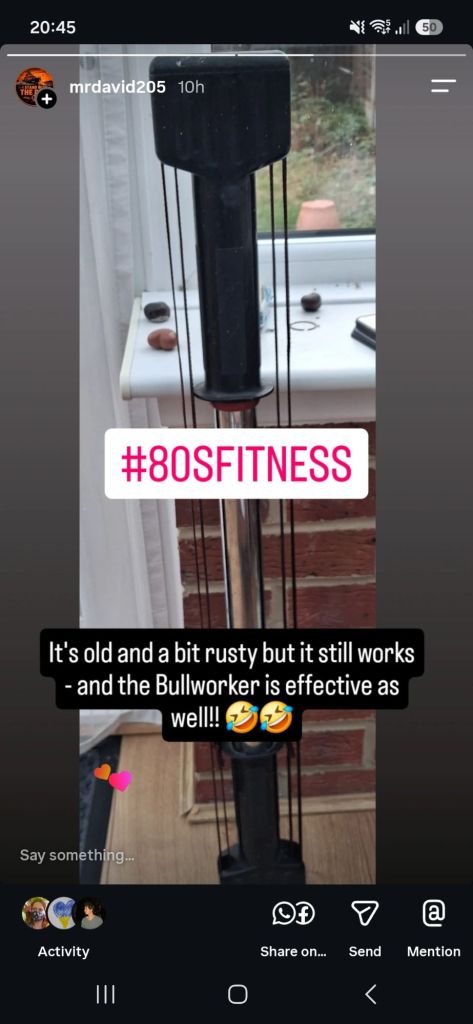
In terms of physical health I have recently taken my old Bullworker out of retirement and I am finding it really useful in terms of building up my muscles steadily and carefully. Doing it slowly is absolutely essential because it is a huge temptation to go too fast and you end up having to stop. Once that happens it is the devil’s own job to start once again.
Good luck with your mental and physical fitness journey. Just ignore the self-care industry and you will be fine.

