

What was the hardest personal goal you’ve set for yourself?
I have written about my time in the Royal Air Force in a previous blog post and mentioned my preparation. Looking back on the three or four months before I travelled to RAF Swinderby my determination to be as prepared as possible was completely at odds with my previous approach to life. It was part of my somewhat late growing up process – which I still feel like I am continuing! The issue was whether I could match my famously poor self discipline with the task I had set myself.
Starting was definitely the hardest part, because I hadn’t done any real exercise since leaving school the previous year and I had already developed a very regular pub going habit which played havoc with my concentration and sleeping patterns. I was at home with no real incentive to go out apart from getting away from the atmosphere of disappointment that still pervaded the house after my spectacular crash and burn of my first full time job.
The first ‘run’ was an absolute nightmare. I chose a 2 mile course which was twice round the block and then up to the end of the road and back. Yes, I was out of practice, yes there was a fairly steep hill on the route, but 20 minutes was a pathetic time to take, particularly given how exhausting it was! As I stood in the shower I realised I had two choices. Give up and hope for the best or redouble my efforts. The person I was then should have taken the first option, but something clicked in my mind at that point. I realised that I was going to be pushed to my limit and probably beyond in basic training – although I had no idea how bad it would get at times – and I would have no say in how bad it got. My training, on the other hand, was totally within my control and I owed it to myself to make the best of it.
The whole of that first week was dreadful. I got my time down by about a couple of minutes but I was still nowhere near the 11 minutes for one and a half miles which would see me pass the BFT. The one thing I did, was to get myself into a proper routine. I would get out of bed, get into my tracksuit and trainers and go straight out of the house without even a cup of tea. It’s not something I would recommend, but I knew that if I waited until after breakfast, or even a cuppa, I would have given it a miss. That might not sound like a big challenge to most, but at the time it was huge.
As the weeks and months went by I devised my own approach to the training. I decided that once I had got down to 16 minutes for two miles I would add an extra two miles to my run. I did this and I realised something very quickly. However far I was running I was a metronome! My first mile would take exactly the same amount of time as my fourth mile, and later my sixth mile. I was not capable of speeding up but I was not capable of slowing down either!! 🤣🤣 Timing wise I only needed to concentrate on my first mile and the other three or five would take care of themselves. By the time I went into the RAF I was running 6 minute miles across the 6 mile run. Not a bad rate of improvement I’m sure you would agree.
Those morning runs showed me that I was capable of so much more than I realised but that getting started was my main challenge. I would love to say that I never looked back but that would be utterly untrue, but meeting that personal goal was the start of completely changing myself as a person.
I wonder if I could get back to 6 minute miles with some training?!

An image generated with AI
Who are your favorite artists?
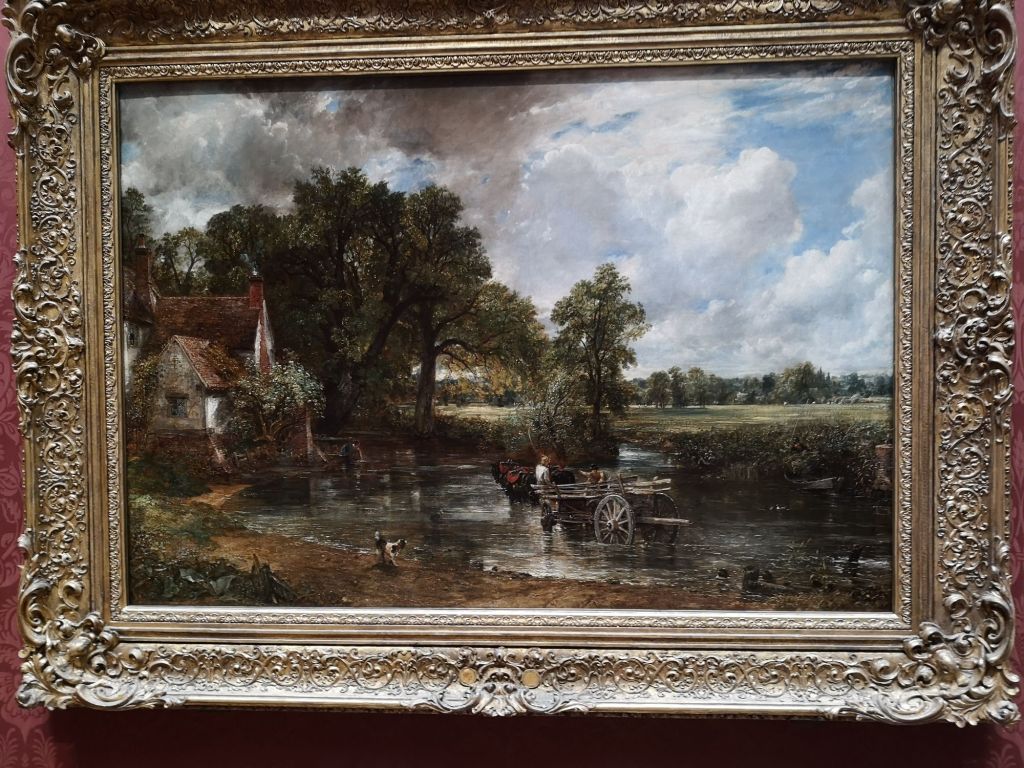
It’s quite difficult to choose a favourite artist but I can definitely choose a favourite painting. That painting is The Haywain by John Constable. I saw it recently in the National Gallery in London and it brought the memories flooding back.
A print of the picture was a permanent fixture in my grandparents cottage in the village of Felsted in Essex. Hanging in the dining room, the print was framed and it caught my eye the first time I visited. When I had holidays there I was able to look at it in detail and truly appreciate it. Yes, my appreciation was artistically basic, if not primitive, but I realised that it was telling me a story about the two men in the Haywain and the figure next to the mill. I could decide for myself what that story was and it allowed me to take the early steps towards the creativity that I exhibited as a child. In order to make the stories my own I never asked my grandparents what the picture was about or what they thought. In my own unformed way I was being an art critic and I loved the feeling of interacting with that painting.
Seeing it again decades later I was able to pick up more details due to its size, but the feeling I got was one of security and affection which was the atmosphere in that cottage. We often talk about music taking us back to our earlier years, but art can definitely have the same effect if the connection is strong enough.

This was the first time I had ever been to the Old Vic and I have to say that I was expecting a traditional West End theatre given the name. From the outside it looked like a new state of the art venue and that impression was confirmed when I got into the theatre itself. It’s a venue I will be hoping to visit more often in the future.
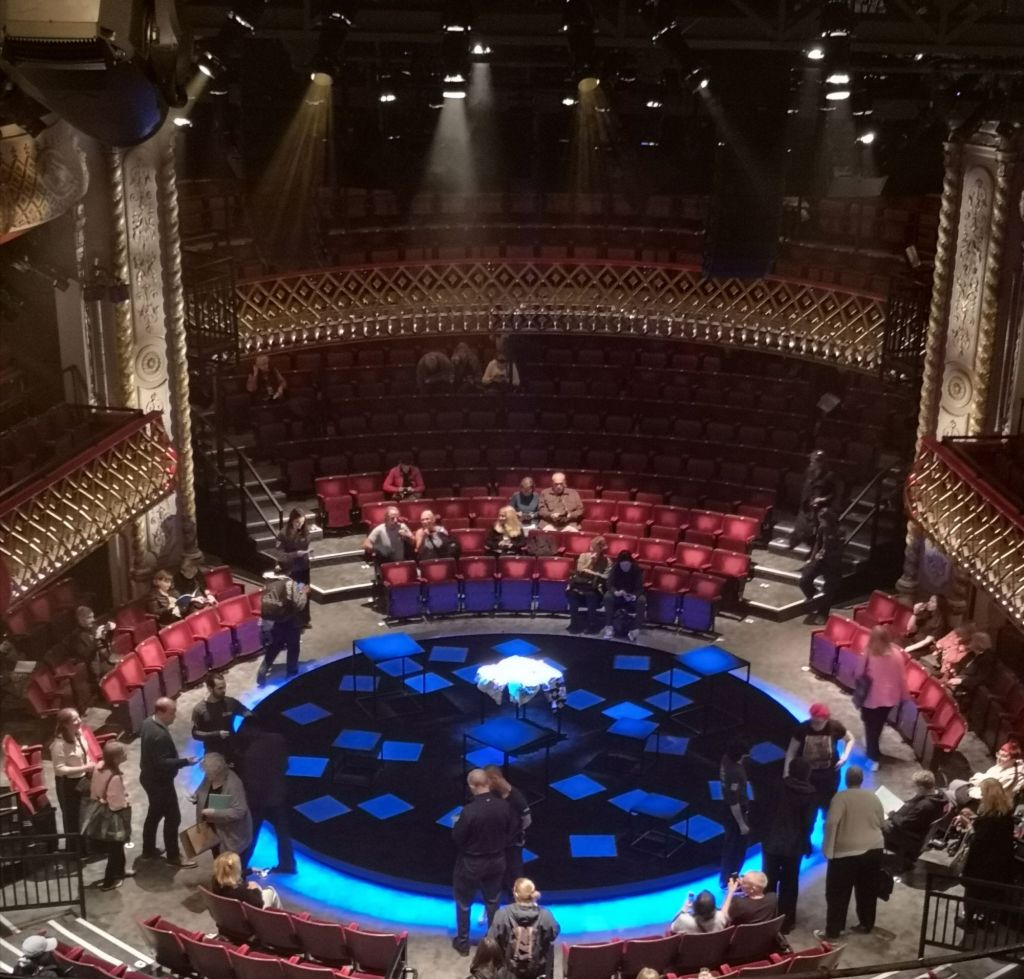
When we got inside the seats had generous legroom when compared to the older theatres, and you could see the stage with no problem. As you can see, the stage was in the round, something that will continue throughout the next year, another innovation for me as I have not seen a play in the round before. Having such a clear focal point really suited this play as it drew your entire attention to one life ‘in the round’.
The Play
I don’t want to give too much away about the play itself, partly because I think it needs to be enjoyed with as little prior knowledge as possible, and partly because it would take too long to explain the different aspects! Suffice it to say that the eleven different scenes are not in chronological order, and that you have to put two and two together to fully understand the story. Even then you probably won’t get the full story, because, as in all our memories, some of the events are almost certainly remembered differently by different people and what we see is the reflections of Mary Page Marlowe herself. Some things are hinted at, some are deduced and some almost certainly exist in my own mind differently from the way they exist in the minds of the other audience members. It reflects hope, fear, love, hate, grief and acceptance in a way that is dizzying in its brilliance. Tracy Letts has created a tour de force of theatre that will have the audience in its spell long after the show has finished.
The Cast
There are five Mary Page Marlowes on stage at various times and I will go from youngest to oldest. Alisha Weir plays Mary at the age of 12. Her scene reflects the path not taken, mostly due to a mother who is using alcohol to numb her psychological pain, sowing the seed for Mary’s own battle with sobriety. Weir very subtly plays the conflict between wanting to be a child and having to look after her parent, and it makes the heart sink to watch it, because by then you have seen the bulk of her future and you want to protect her. It is a performance of sensitivity and skill that shows a young actress who will not only be a fine screen actor, but also an excellent stage actor in the years to come.
Eleanor Worthington Cox is a young actress who I recognised from The Enfield Haunting where she played a teenage girl affected by a poltergeist. She was brilliant in that, but on stage she is even more well known, having been one of the original Matildas in the stage musical, the same part Alisha Weir played in the film version, and having returned to the stage regularly thereafter. She plays the 19 year old Mary Page Marlowe, and she has a brittleness and wariness that sets the scene for the more complicated woman that she becomes. However, at this point she is still able to look forward with a certain amount of positivity to a future that may include creativity and travel. In her portrayal, Mary is still allowing herself to hope for something better while half expecting something worse. It is a very nuanced and clever piece of acting that unbalances the audience because they pick up an undercurrent, the specifics of which only become clear later.
Rosy McEwen is Mary at 27 and 36. Her scenes are powerful and surprising, particularly the one where we find out that she is having affairs outside of her rocky marriage and is sleeping with her boss! Her Mary is still trying to find a way out of her descent into unhappiness and is allowing herself to hope for the best whilst preparing for the worst. We see a Mary who is capable of volcanic anger, a trait that becomes increasingly obvious in her future, but also of vulnerability and a sexuality that allows her to express a different side of herself as she charms and excites her boss. The sadness that hangs over this scene comes from the fact that both of them know that this is doomed to be a fling even though to each of them it clearly means much more. Andrea Riseborough has three scenes, playing Mary at 40, 44 and 50. Her scenes show a series of awful events that littered the decade, a decade that shapes the rest of her life for the worse and which puts Mary and the audience through the emotional wringer. Sometimes pleading for help, often vicious and unkind, occasionally showing a complete disassociation with everything going on around her, Riseborough’s Mary constantly wrongfoots those around her and imposes her faults and issues on everyone else’s lives. However, you retain a sympathy for her because of Riseborough’s incredible ability to make you care for this damaged, self-obsessed person. How she does it, I’m not sure, but it’s the type of alchemy that very few actors are capable of. In many ways her Mary is the central character of the play because it is in her ten years that you see all her chickens come home to roost. It is these chickens that her oldest self will spend the rest of her life trying to deal with.
The oldest Mary, at the ages of 59, 63 and 69 is played by the legendary Susan Sarandon. It’s a really interesting decision for this great actress because it is very much an ensemble piece and she doesn’t try to overpower the other four. She is every inch the older woman with regrets and the reasons for those regrets become clear at various points in the play. The pain of those regrets is palpable at times, but mixed in with the pain is acceptance and flashes of optimism particularly in the company of her final, and best, husband. The idea that she has found a person who makes life better for her is far too superficial for a play of this complexity, but she has clearly been able to accept things that have happened more readily and the support, finally, of someone who she can rely on definitely plays a part in this healing. Sarandon skilfully brings the conflicting emotions and experiences of a life not so well lived together to create a character who we understand by the end, at least on her terms. The final scene, in the play but not chronologically, is sweet and positive and beautifully played by a consummate and generous actress.
The play is introduced and played out by Hymn for Her by The Pretenders, one of my favourite ever songs. The lyrics refer to ‘the maiden, the mother and the crone that’s grown old.’ I think in this play we see the connection between all three stages more completely than in any other piece of work. I really urge you to go to this play if you can, and I wouldn’t be surprised if this will be revived with a new set of Marys every few years. However, this marvellous collection of actresses will be very hard to improve on as they were simply outstanding.
What is your favorite hobby or pastime?
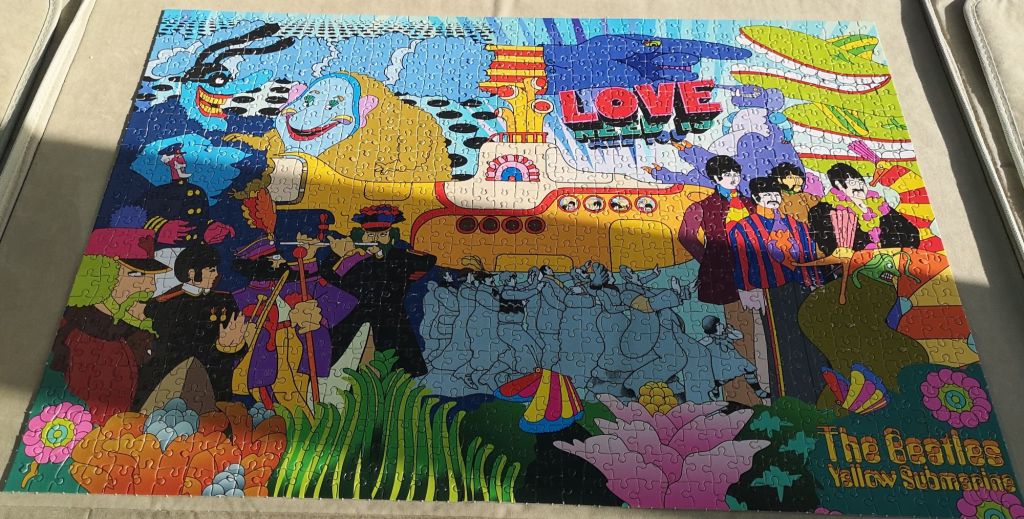
At least in terms of hobbies I am the proverbial person of the title. Depending on my mood and the availability of time and inclination, I can be found dabbling in a number of hobbies. Now that I am no longer working full time I have tried to find a hobby to start anew or pick up for the first time.
It’s not easy because I have more time. Why is that? Well, I now have to decide whether to concentrate on a particular pastime or branch out in a number of directions. I also have to decide how seriously I am going to take any particular hobby and whether I want to find a way to monetise it. For example, I was walking through my home town and I saw an advert for a craft and food fair. I found myself wondering if I could make my cucumber relish on a bigger scale and sell it. I then wondered if I really wanted to, because it would probably be a lot of effort for very little return once you had paid for ingredients, jars and a stall at the fair.
I decided that on balance it’s probably better to keep the hobbies as hobbies and then take advantage of any opportunities that may arise. In the last month or so I have increased the focus on my blog, looked for new recipes to try out, focused on trying to increase my creativity and considered a couple of areas I can look at that may yield more tangible dividends in the future. So, all this time is weighing, if not heavily, confusingly on my mind. I daresay I will find something to really focus on in the future, but for now I will continue to adjust to my new normal. Come back to me in 2026 and I might have a definitive answer, but then again I could still be trying to work out what I really want to do. Either will be OK I think, because I will be guided by ideas and opportunities rather than trying to force them. That way I hope I will get the right answer.
What would you do if you lost all your possessions?
I know it’s unfashionable, but I value possessions. Not in an acquisitive sense, but in the way they tell the story of who you are.
Photos are not always replaceable, for example our wedding album. That would be one of the first things we would grab in a fire. My wife has kept her diaries from every year since we first started going out together so we could completely reconstruct our relationship if we needed to.
We have loads of programmes from concerts and theatre productions, which would remind us of the acts we saw and the plays we enjoyed. That is one thing that I really miss when I go to concerts nowadays. Add on to that brochures from places we have visited over the years and once again you are able to return to the time and place.
Physical media like Dvds and CDs are time capsules. You can put them on and you are right back in the time and place where you first remember seeing or hearing them. I wrote a blog post about the fact that so much media has disappeared from streaming services and the Internet or never made it there in the first place. If you don’t have the physical copies you can very easily use access to them.
Why is this all so important? Well, in an age where increasing numbers of people are living longer and living with the effects of dementia in different forms, you need to be able to reach those memories and moments that bring them back to you and to themselves. Tell them about a memory and it may not make it through the misfiring neurons, but show them a memory or play them a memory and you can get a glimpse of that person once again. Possessions are vital elements of who we are, and I would rather have too many than too few. If I lost all of them I could be completely untethered from my very identity in years to come.
 David Pearce - Popular Culture and Personal Passions