
What is your mission?
Ever since I got married, my mission has never changed. I have always wanted to do the best for my family. They are central to my life and my purpose. I am always thinking about them first and I know I am not alone. When I have a decision to make I instantly think about how it will affect them. If I feel like I am putting myself first I feel guilty about that. I should always think about what they need first.
When I was in Australia back in 2003 we had left Hong Kong ahead of schedule and whilst I knew that we were making the correct decision I also knew that financially it was going to be difficult. I was lucky enough to be able to get 3 or 4 days teaching a week alongside the University work and Janet was also able to find some part time work along the way. Despite this, we were very tight for cash so I gave up alcohol and pretty much all non essential spending in order to ensure that my children could get the most of the opportunities available in Australia for sport and dance. The self imposed ban lasted about 8 years and I still barely touch alcohol and I always consider every bit of spending to make sure I am not being selfish. It’s a really good thing because I know I am always doing my best for my family at whatever stages of their lives they are.
Mission Statement
Family First, Last and Always
What are your thoughts on the concept of living a very long life?
So many of us want to live as long as possible because we can’t deal with the alternative. It’s a natural human instinct. However, there is little point in a long life if you do nothing with it. The most impactful life can be a short one. Let me tell you about my best friend whose short life had an impact that lasts to this day.
Gavin Jupp was a force of nature who lived on the principle of doing whatever he felt like whenever he felt like. He was outrageous in his behaviour on many occasions but he was never deliberately unpleasant. If his behaviour negatively affected someone he would shrug his shoulders on the outside but he would reflect on it on the inside. It was never deliberate and it was never something he took lightly, however much it may have seemed. He was a Scout Leader, a leading light in ASCAF the amateur dramatic society he encouraged me to join and he was the absolute centre of our group of friends. His charisma was off the scale and he used that charisma to entertain, encourage and perform. Some of the statements he made and some of the ways he behaved were jaw dropping but the twinkle in his eye when he did those things always made him practically immune from criticism and consequences. I remember when he and two of my other friends visited me at Staffordshire Polytechnic. We had a good night at the Place, the nightclub in Stoke on Trent. We were walking past a car sales business and one of my friends mentioned that the hub caps on one of the cars would look brilliant on his car which was the same make. Before we knew it, we were following Gavin and watching as he started to lever off the hub caps! I stood back as I tended to whenever something happened that I was concerned would be a problem for me! That said, when the hub caps were removed I was happy to carry one back to my room!
However, when you were in trouble he was in your corner more effectively than anyone else and he had an awful lot of insight into the way that people’s minds worked. He had a huge heart and huge reserves of compassion and where he led so many others followed without question.
Gavin Jupp was killed in a car crash 30 years ago this month at the age of 29. The bare facts of his lifespan were 14 December 1966 to 28 January 1996, but in between the two dates he was more adored and more influential than people who lived three times as long. That is what we should all try to emulate, however long we are given.
What could you do differently?
What couldn’t I do differently? There are very few elements of my life that I feel like I couldn’t improve, and I am sure that’s the case for so many of us. The decision to make once you have identified areas of your life that you could improve is to ask three questions. What are the most important areas to improve? What are those areas that would make the biggest difference to the quality of my life? What changes can I implement now?
So many of us love making New Year’s Resolutions. No, let me rephrase that. So many of us feel like we should be making New Year’s Resolutions! So many of these resolutions fail because we are making them for the wrong reasons. We are making them on a particular day because we feel under social pressure and we set our sights too high. We are not focusing on the process, we are focusing on the result. We do not have a plan for what to do if things go wrong, so when they do we can’t react effectively.
Now, I have made resolutions in seven areas. Do I expect to succeed in all of them? No. Do I have a plan for what to do when things don’t work? Yes. If you look at the first resolution below, you will see that it’s a weekly fitness regime. Now, as I write, it is the end of the first week of January and I have been ill throughout the week. Does that mean my resolution has already failed? No it doesn’t. I know that it’s about developing a new routine so I am focusing on the long term. I have written off Week 1 and will start when I feel much better, because trying to force myself to do this when I am ill is a guarantee that I will fail both short term and long term.
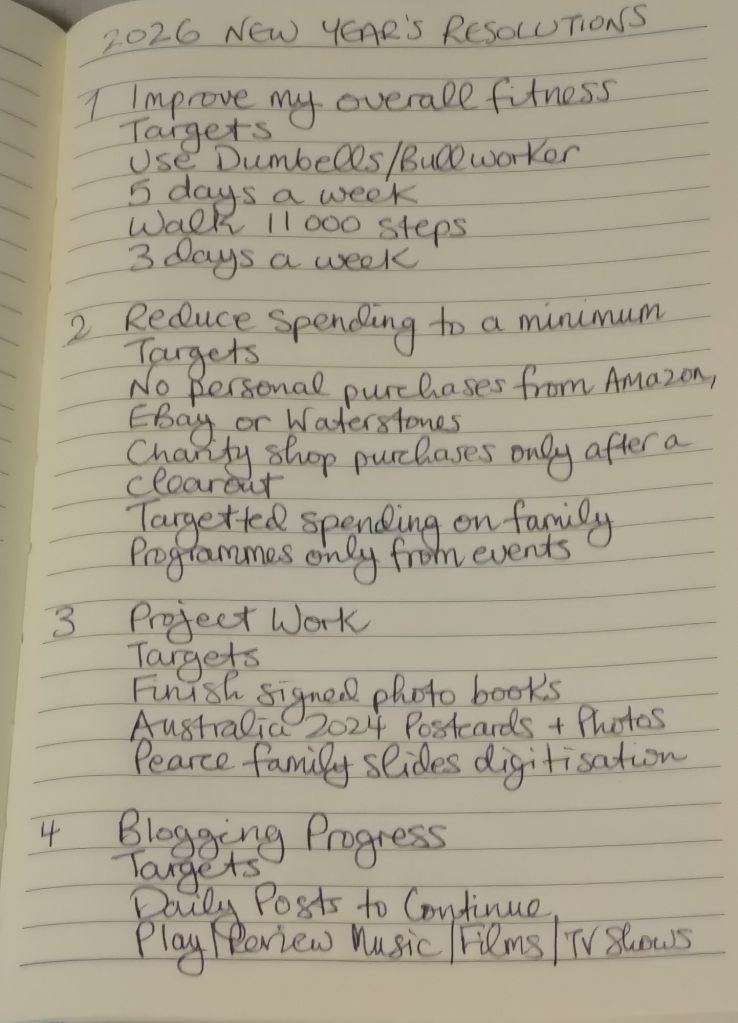
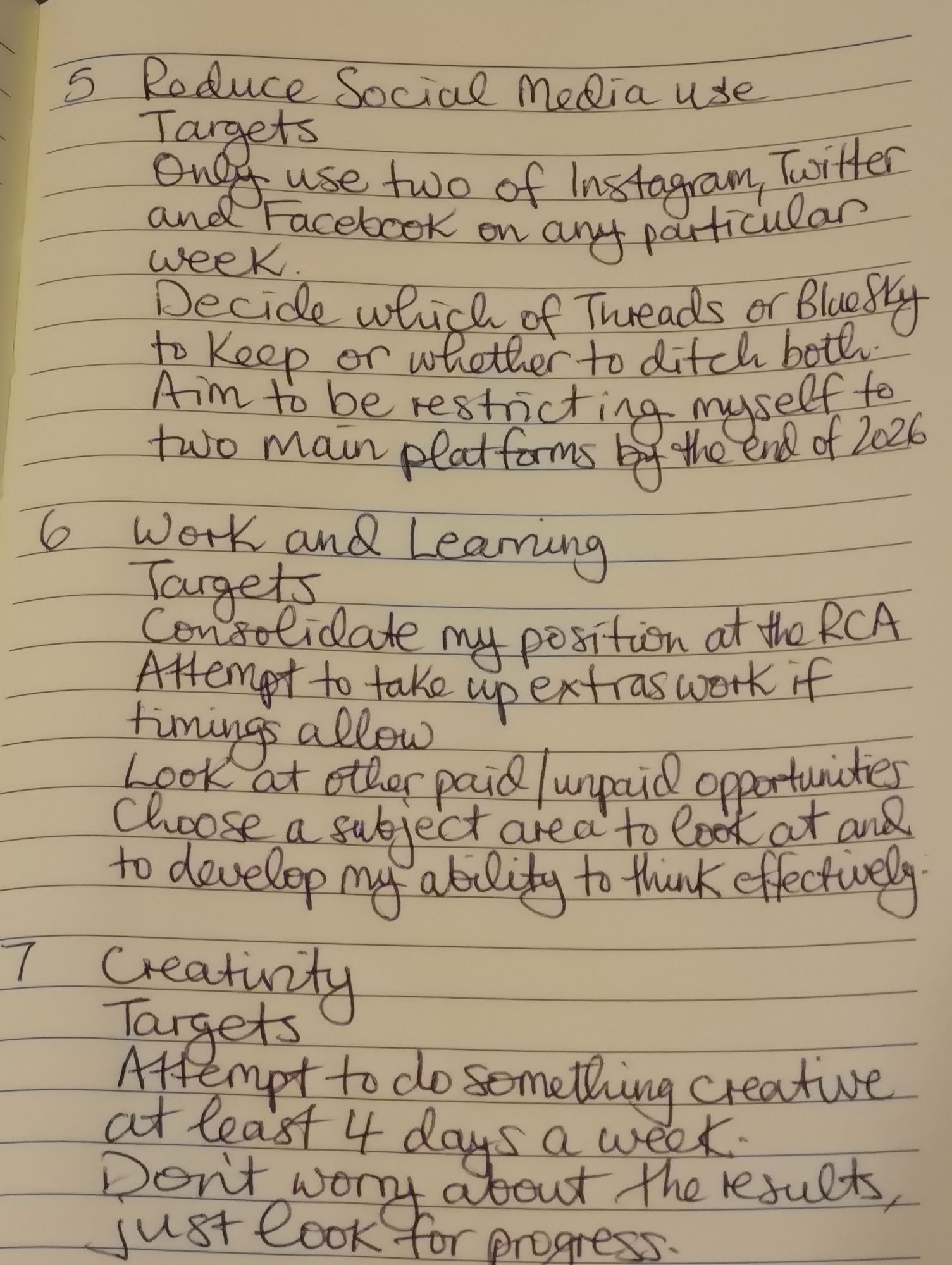
I have aimed very high this year deliberately because I know that with luck three or four of these resolutions will stick for the whole year and maybe one or two will start to succeed as the year progresses. I am happy that my approach is the one best designed to help me do things differently. Wish me luck especially when I get better!
If you had a freeway billboard, what would it say?
I would not want to have anything as ostentatious as a billboard. It certainly wouldn’t be on a freeway unless I moved country as we have motorways in the UK! Also, how could you guarantee that the advertisement would reach the correct people? If it did, would it have the correct style?
A famous, though perhaps apocryphal quote, attributed to both John Wanamaker and William Hesketh Lever states, ‘I am convinced that one half the money I spend for advertising is wasted, but I have never been able to decide which half.’ There in a nutshell is the problem with traditional advertising. In practice, way more than half is wasted, whatever medium you choose. Surely, then, the ability to specifically target your advertisements to each individual on the Internet based on their searches and site visits has dealt with that problem? In all likelihood it has simply made it easier for some adverts to succeed while making others less likely to do so. I recently bought a shaver and for two weeks my feed was inundated with more adverts with links for shavers. Now, if it was a human being rather than an algorithm, the adverts would be for something like trimmers or haircare or skincare because a consumer is much more likely to buy a complementary item rather than the same item. I mean, how many people would buy multiple shavers?!
Over the last few months of 2025 I threw myself into a project based around Christmas Magazines Through The Years and I found the development of advertising absolutely fascinating. In the 1890s the advertisements were factual in the main and concentrated on giving the necessary information only, namely product specifications and price. There were two interesting exceptions, however, which both pointed the way forward. Cadbury, back in the day when the company was owned by a Quaker family and produced decent chocolate at a decent price, focused on the provenance of the chocolate and the way that the company followed its values through from the countries that supplied the cocoa to the way that the bars were made in Birmingham. Nowadays, of course, they have no guiding principles apart from profit above all else, and the chocolate is becoming more expensive and of worse quality. Still, at least they are not producing American standard chocolate which is unquestionably the worst in the world!

The other advert was Bird’s Custard Powder which used a humorous advert featuring a playful cook. It set in place the innovative humour that characterised British adverts for at least a century on from that 1896 magazine.
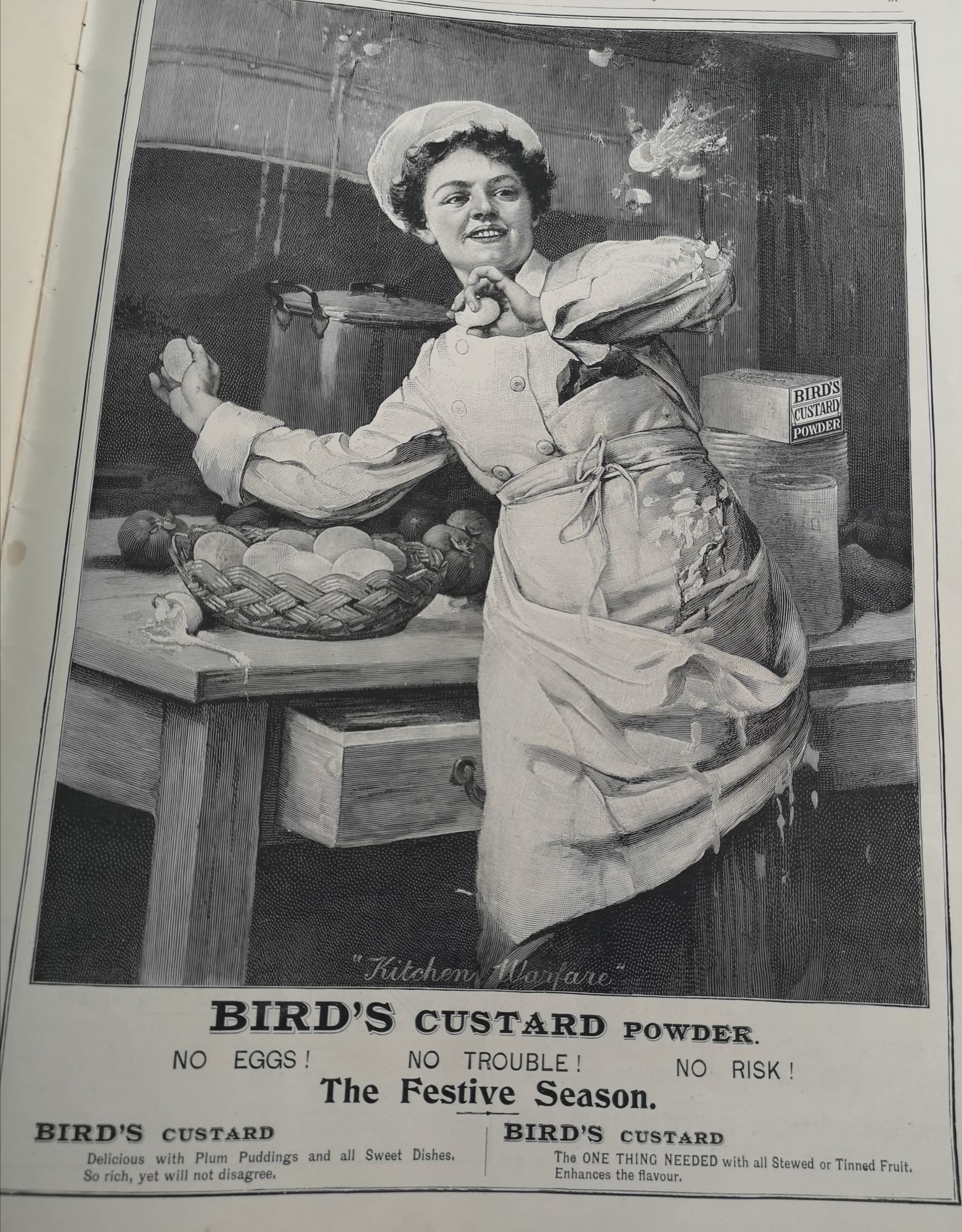
Nowadays, the humour has been largely lost with a few exceptions and replaced by a cynical ’emotion’ that is designed as if by computer to wring tears out of consumers. The problem is that consumers are wiser to the manipulation of their feelings than they were and those advertisements are suffering diminishing returns or being parodied.
The heyday of the UK TV advert was probably the 70s and 80s where humour and innovation were at the forefront of the industry. You had adverts that used chimpanzees, robots, straws and classical music! It was aimed at making the customer remember the brand when they were shopping. It worked with the Smash Robots which advertised a particularly awful powdered mashed potato which tasted entirely of powder and never of potato! Without the robots I doubt it would ever have become a favourite with households up and down the country.
So, although the advertising industry has evolved in terms of the technology it is using, it has significantly regressed in terms of the content it is producing. The only time you might see innovation, humour and true emotion is at Christmas where so many adverts are now events. However, even they are simply becoming repetitive and the innovations are starting to get fewer and further between as AI and algorithms take over. Will we see another golden age? Never say never, but it completely depends on the advertising agencies taking human control of the products and not outsourcing it to computer systems. It certainly seems unlikely at least in the next few years.
Do you spend more time thinking about the future or the past? Why?
I spend the bulk of my time in the past, both on this blog and away from it. There are a few reasons for this and this post is an opportunity to look at them in an attempt to organise my thoughts on this matter.
First of all, I don’t look at the past simply because it was a time that I enjoyed. Often, at Secondary school especially, I had a miserable time. However, as I get older I want to understand how and why my experience there, and during other times, have impacted my personality and approach to life for better and for worse.
Second, as I get older I find myself not only wanting to return to things I enjoyed when I was younger but also to gauge the effect those things have on me now. I tend to remember events in my childhood with more clarity than most people in any case so the anecdotes and events are seen with far more accurate recall than the majority of people. However, there is one of the interesting aspects of Memory. Someone else with the same level of recall could either have forgotten the event or they remember it in an entirely different way. So that recall is only accurate for me and as such is heavily edited by my mind over the years.
Third, I love enveloping myself in old music, movies and TV because it makes me feel younger when I am doing it. There is a lot of evidence that people with dementia can access old memories and also evidence that people who have aged, even without dementia, can reverse the physical effects of age by being immersed in the past. I remember watching a documentary where a group of older and infirm men were given a physical test before entering a house, then taken back to the 1950s and completely immersed in the decade. When the physical tests were repeated at the end of the experiment they had all reversed many of their previous signs of ageing.
Finally, as I will never be asked to write my autobiography this is a way of capturing my life in all its aspects and maybe leave something of myself for my loved ones to read so that they might understand me more.
 David Pearce - Popular Culture and Personal Passions