
Radio Times (Medway Edition) 2 – 8 August 1980
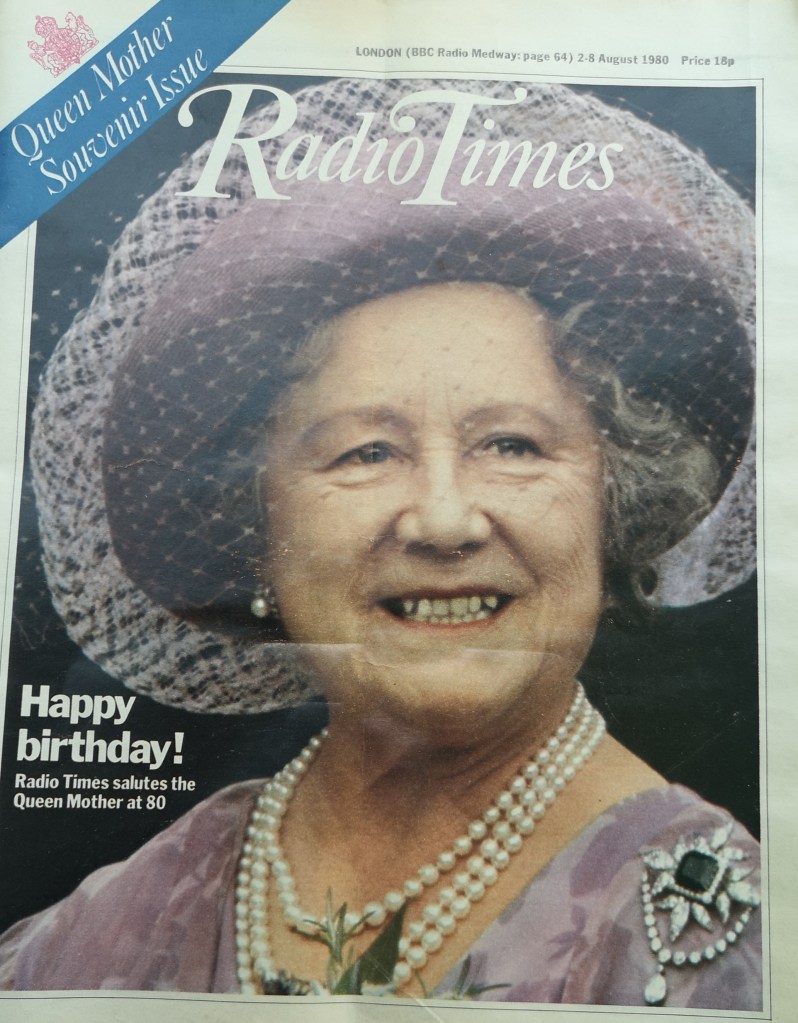
When I was having a look through some items that belonged to my Mother in Law, I found a copy of the Radio Times Queen Mother Souvenir Issue which marked her 80th birthday. As with the Christmas magazines that I featured in December, it struck me as a fascinating relic that warranted a similar treatment. As well as looking at adverts, of course, I will also reflect on the programmes so if that sounds like your idea of fun, let us begin!
What was 1980 like?
Queen Elizabeth marked the 28th anniversary of her accession to the throne on February 6 and had weekly meetings with her still relatively new Prime Minister Margaret Thatcher. Whether she enjoyed them or not has been the subject of some speculation in the years since, but I think we can be sure that whatever her personal thoughts she kept them to herself! The British public were much less inscrutable as a poll in March found that 6 out of 10 voters were dissatisfied with her government. Some things never change do they? Parties go through peaks and troughs, Prime Ministers are the lightning rod for those who are against the government. The only thing that has changed is that in those days we had three news bulletins a day and no Breakfast TV, so the reporters were able to report the news objectively as they only had 90 minutes of TV to fill, rather than try to make it up or even lead it with their gossip in this era of 24 hour news. Also, there was a feeling of respect for institutions that no longer exists. Make no mistake, Margaret Thatcher was in real political strife by August 1980 but she was allowed to carry on without fictitious coups being turned into reality by correspondents who want to make the news and be the news rather than report the news! Later in the year, at the Conservative Party Conference, with a backdrop of concern inside the party over the 1.5 million unemployed and rising, she gave her ‘lady’s not for turning’ speech.
Outside of politics there were two Olympic games, back in the days when the Winter and Summer Olympics took place in the same year. The Winter Olympics were held in Lake Placid, New York, so they were acceptable to the UK Government. The Summer Olympics were held in Moscow so they were not acceptable to the UK Government. Robin Cousins won Figure Skating gold and was well on his way to becoming a professional skater, celebrity and, in the mid 90s Frank N Furter in the Rocky Horror Show! Yes, really, and very good he was too! The Olympics Committee was instructed to boycott the summer games, but decided to send a team anyway. Thatcher was extremely angry but she couldn’t do anything about it. The team won five gold medals but the government conspicuously failed to congratulate them and the honours committee were instructed to withhold the customary OBEs or MBEs from those athletes. The FA Cup was won by West Ham with the only goal of the game being scored by the legend that is Trevor Brooking with a very rare header. In beating Arsenal, West Ham became the last club to date from outside the top division to win the cup. As an interesting aside, Paul Allen became the youngest player ever in an FA Cup final when he came on as a substitute. He was through on goal when he was cynically hauled down by Willie Young who received a yellow card. As a result of this challenge the professional foul rule was instituted allowing for a red to be shown instead.
The Yorkshire Ripper was still at large and during 1980 he murdered Marguerite Walls and Jacqueline Hill, who was his final victim. He also attacked Upadhya Bandara, Maureen Lee and Theresa Sykes but all three survived, albeit with significant injuries. He was arrested on January 2, 1981 and confessed to the murders, but it was the tenth separate occasion on which he had been questioned in connection with the investigation.
In music, Kate Bush, astonishingly, became the first woman to top the UK album charts. The Pretenders achieved the first Number 1 single of the 80s when Brass in Pocket took over from Another Brick in the Wall at the top of the charts. ABBA reached Number 1 twice in the singles charts with The Winner Takes It All and Super Trouper and twice in the album charts with Greatest Hits Volume 2 and Super Trouper. The end of the year saw John Lennon’s shocking murder on December 8 and the appearance of three of his songs in the Top 5 over Christmas. However, with typical British contrariness, the Christmas Number 1 was St Winifred’s School Choir with There’s No One Quite Like Grandma!!
Radio Times 2 – 8 August 1980
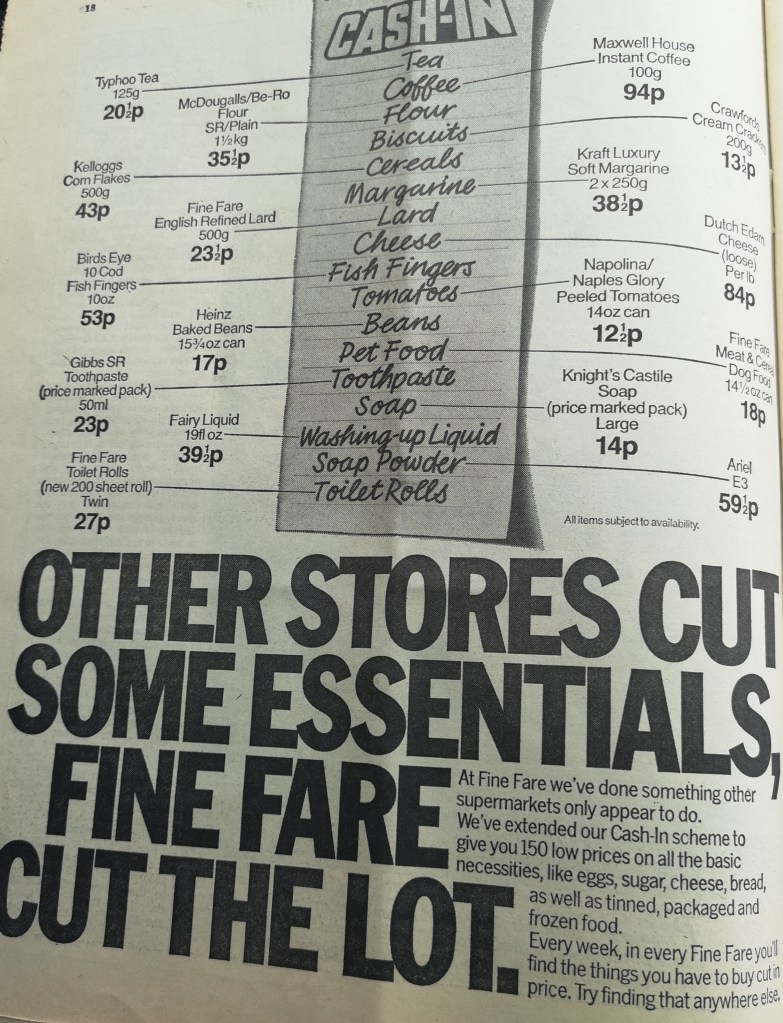
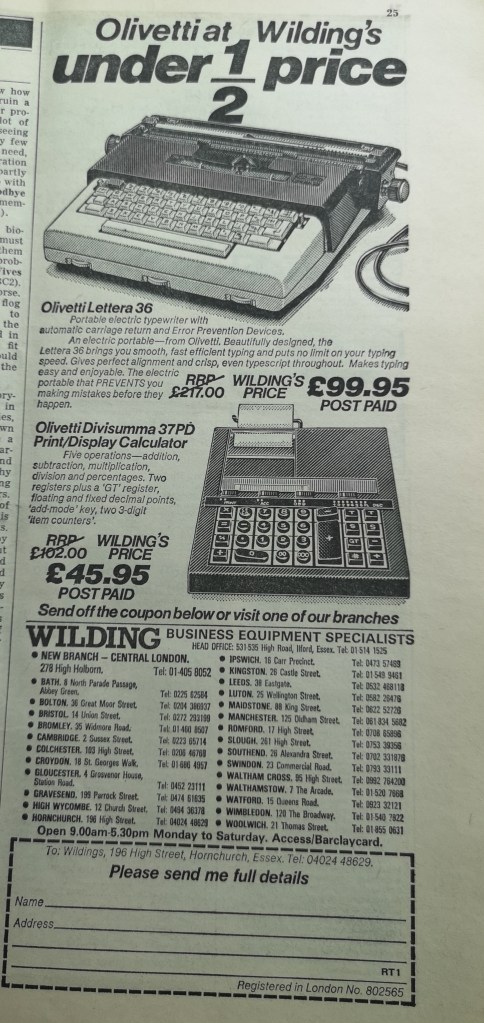
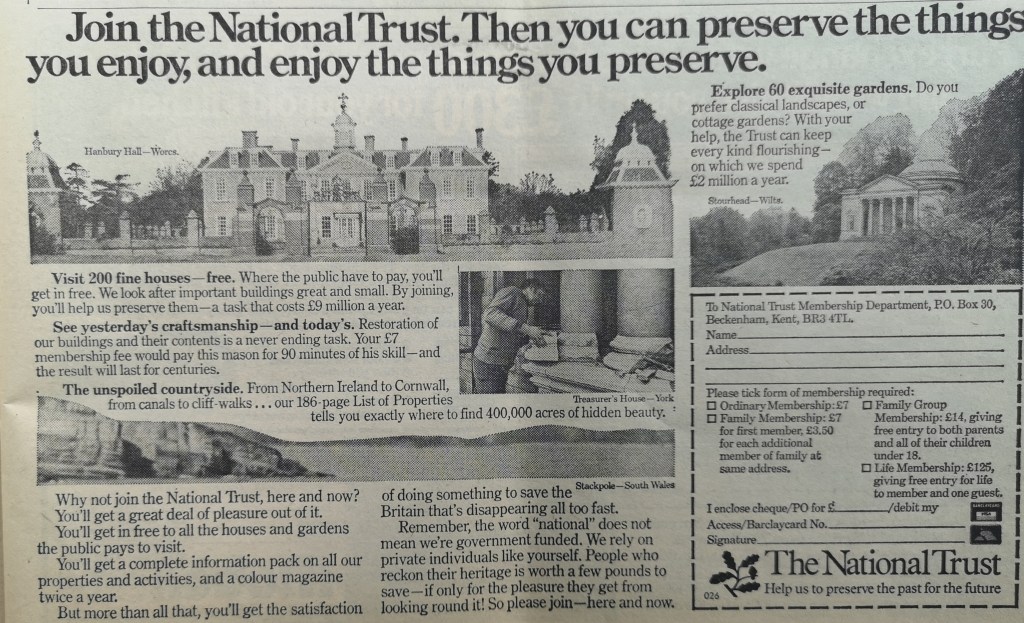
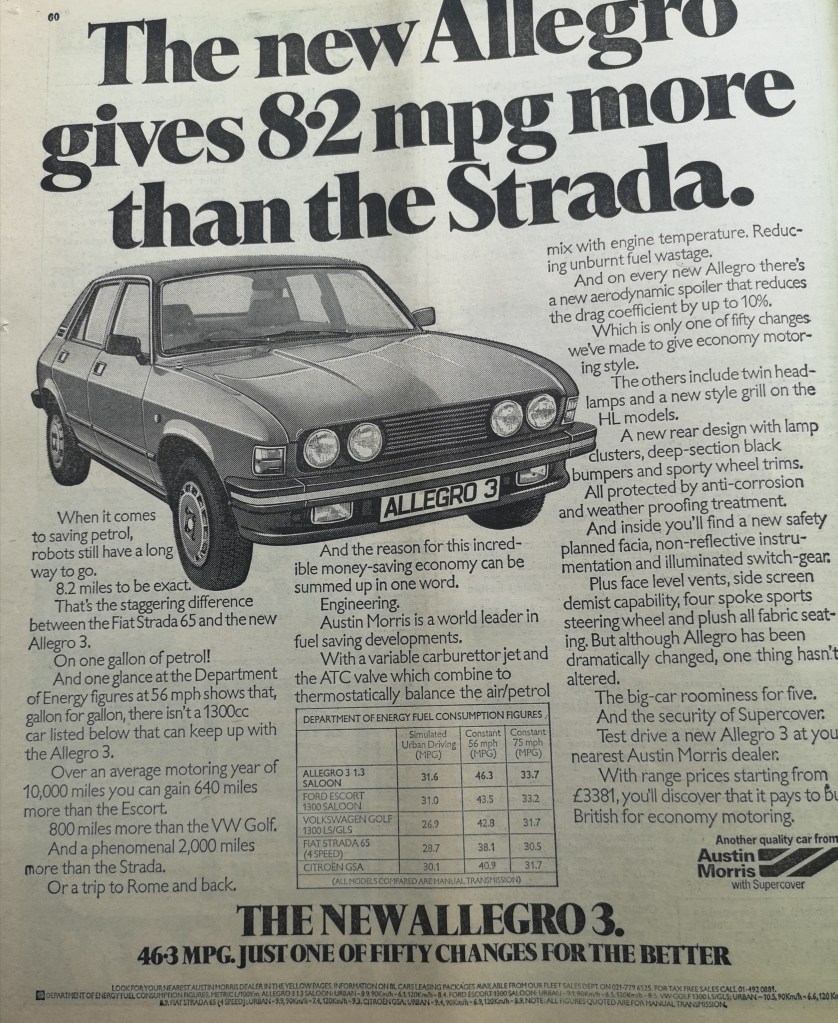
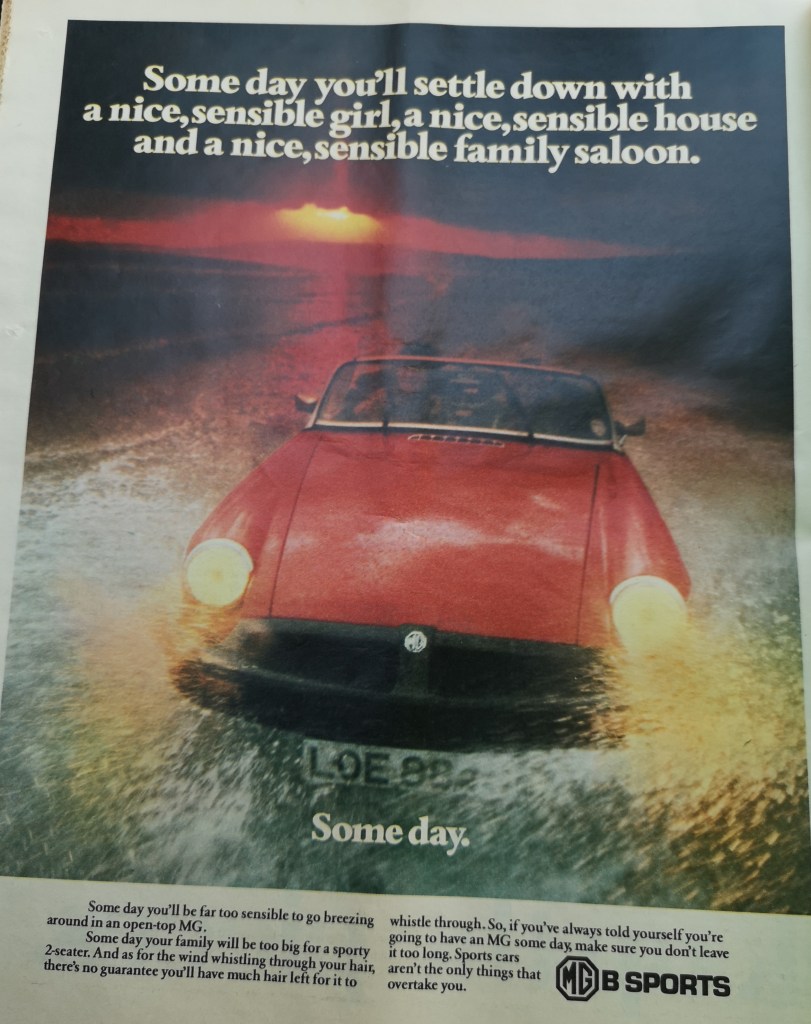
Anyone who read any of my Christmas Magazine pieces will know how interesting I found the adverts. They give a fascinating insight into the surrounding culture of the times. As this is a magazine with readers from every social group, it’s no surprise to find the adverts covering a number of different price points.
Starting with the Fine Fare advert, it was very interesting to see how much some things have increased in price and how little others have. For example, 125g of Typhoo Tea, which was loose tea in a time when teapots were much more common, was 20½p, far lower than it would be today. Maxwell House Coffee was 94p whereas a price of £3 or so is more likely for a branded version. On the other hand, 1½ kg of flour was 35½p which is more in line with the price nowadays where it can still be under 60p. The biggest price hike comes in the area of margarine where even on special offer the cost of 2 250g tubs of margarine is more than ten times as much as the 38½p of 1980. The shopping list shown here is actually fairly similar to the one that a family might use as the basis for a cupboard, fridge or freezer today although refined lard has pretty much vanished from the shelves. What you might notice, as I did is the complete absence of ready meals, pizzas, and sugary cereals and desserts. They were around of course, but they weren’t part of everyday life as they are now.
The Olivetti Electric typewriter and calculator were part of our gradual movement towards the eventual digital future, but they were both still rooted in the analogue world. The typewriter still required paper not a screen and the calculator, despite its very high cost was incredibly basic. (I remember that we were not allowed to use calculators in maths or science as they were considered tantamount to cheating!) Both of the items were perhaps more useful than they had been in years gone by as some workers were becoming less chained to the desk. That said, today’s working from home was still in the realms of fantasy in 1980, and perhaps not even there. In a time when one computer literally filled an entire room, the thought of being fully connected at home was ridiculous!
The National Trust advert could come from any of today’s magazines or newspapers. It’s quite reassuring in a way that our interest in visiting stately homes and gardens has not waned over the last 46 years, and has arguably increased. There is of course a competitor to the National Trust in the form of English Heritage, but that tends to be aimed at a different market, demographically speaking. The prices, however, are somewhat different from those you would see today. Lifetime Membership in 1980 was £125, whilst yearly membership was a mere £7. So, you were paying for a shade under 18 years membership at 1980 prices. In 2026, Lifetime Membership is £2430, nearly 20 times higher whilst yearly membership is £100.80, just over 14 times higher. Now your lifetime membership requires you to fork out just over 24 years of membership at 2026 prices, so by any measure our houses and gardens are significantly more expensive and require you to be confident of living over 6 years longer than before to justify the amount you were forking out!
Finally we come to two car adverts that couldn’t be more different in tone. In the blue corner we have the Austin Allegro, a proper workhorse of a car that made great play of its economic running costs and hinted, by mentioning that the car seated 5, at the fact that it was a family car for the ‘average’ family. At £3881 it was significantly more of an investment that a lifetime of National Trust visits, but how else would you get to the countryside?! In the red corner we have the MG, solely marketed towards the single carefree man because, obviously, women wouldn’t be able to make the most of it! It’s a fascinating insight into a country that 10 years earlier had voted for the Equal Pay Act but in which men were still the ones to have fun and be carefree while women were marking time until their marriages. It is an aspirational, single gender car to such an extent that you could imagine League of Gentlemen style two car salesmen telling a woman that it’s ‘a male car for male people’ 🤣🤣! Notice it doesn’t mention the cost, because, as with stores catering to the more affluent in society, if you need to ask the price you obviously can’t afford it.
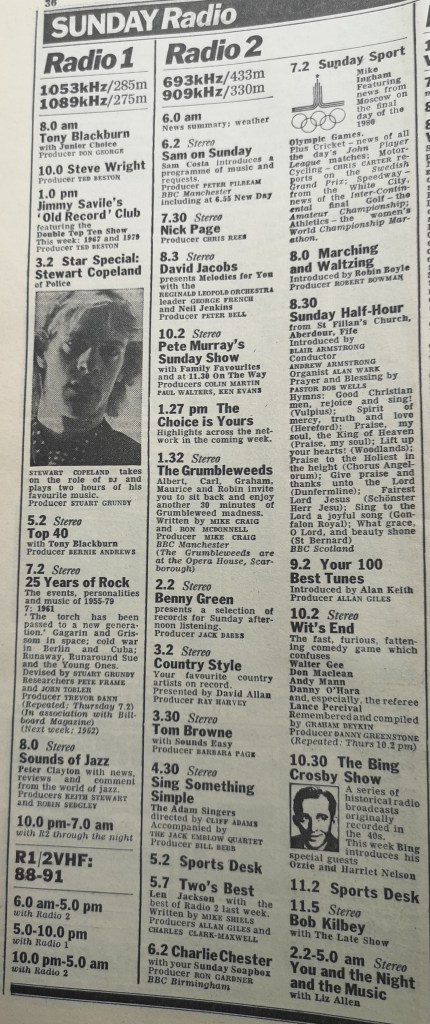
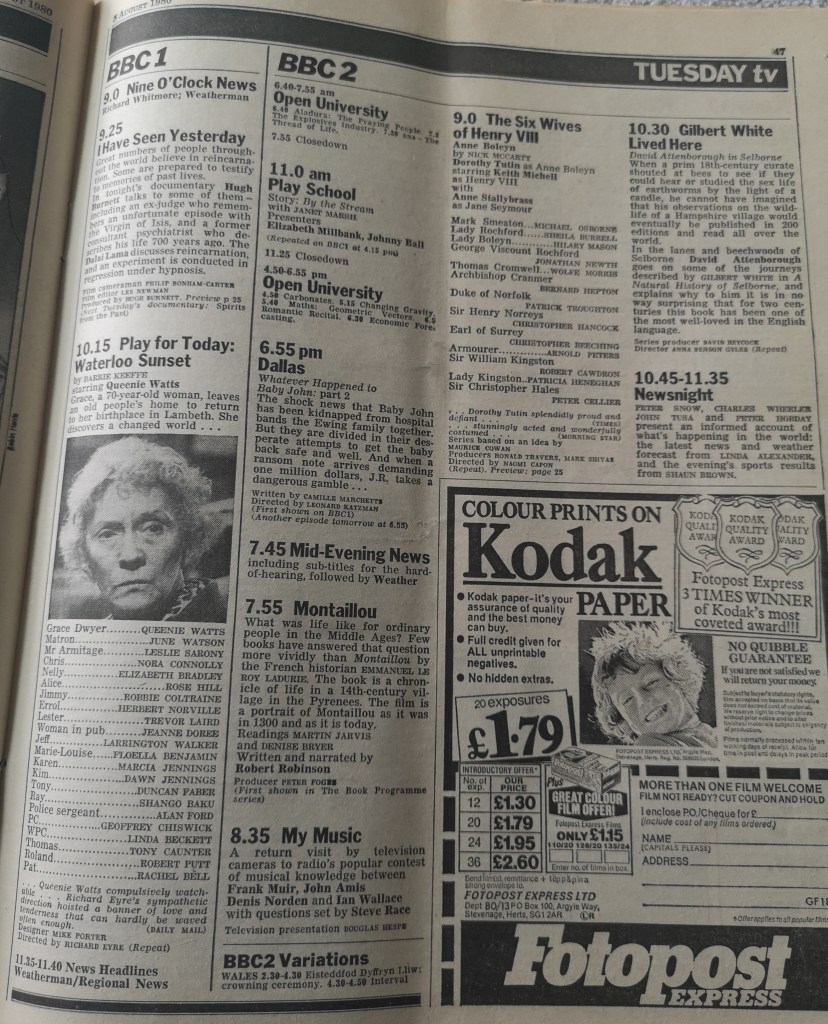
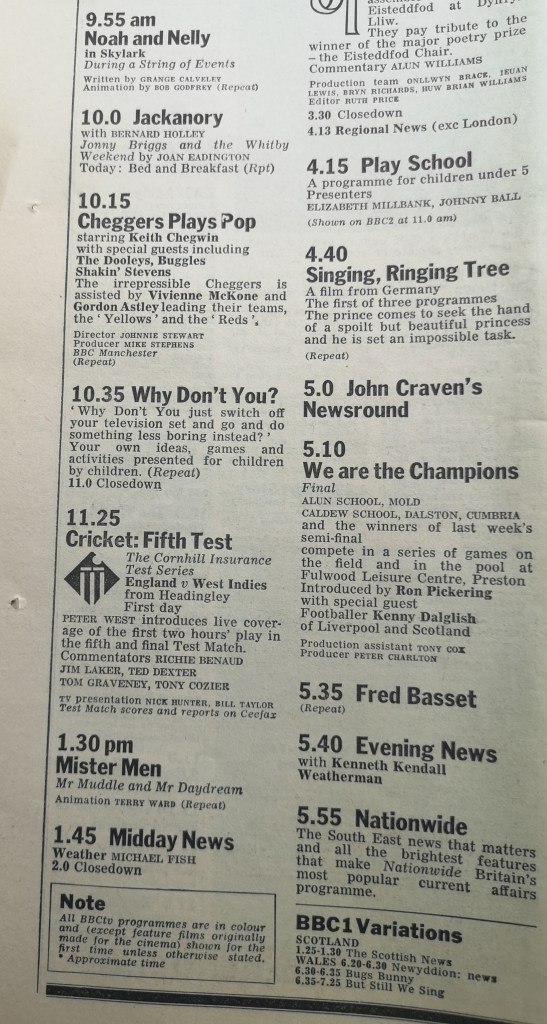
In previous blog posts I have looked at programmes on the BBC in Christmas TV 1975 and Christmas TV 1977 but they, of course, were full of specials and big films. What about a week in the summer in 1980? Well, the first thing that became clear is that there were precious few new programmes, and those that were broadcast tended to be low key and not readily remembered over the years to come. The second was that the complaint about BBC repeats during the summer was, in fact, quite justified. However, I want to start with radio programmes on Sunday 3 August on Radio 1 & 2.
Radio 1 started at 8am with Junior Choice, presented at that time by Tony Blackburn. Even in my mid teens I enjoyed listening to it because of its mix of childhood favourites, Tony Blackburn’s good natured humour and the occasional ‘Woof, woof’ from Arnold! It was a difficult time in my life in terms of what I was going through at school, so for two hours on a weekend morning it was nice to escape from that and become the much happier child I had been 5 or 6 years earlier. Obviously, this particular episode was on during the summer holidays, but the thoughts of my impending O Level year had already started to cloud my mood as I knew the exams were going to be difficult after four years of bullying had wrecked my learning and my confidence. Perhaps I would have turned back to the TV after that, or perhaps I would have been out playing if it was a decent day. However, if I was home I would probably have listened to the Stewart Copeland show at 3.02 – very precise but there had to be two minutes of news even if most of the audience weren’t interested – as he was the fantastic drummer of my favourite band of the time, The Police. One show I would definitely have tuned into was the Top 40, once again with Tony Blackburn. Wherever I was on a Sunday I always wanted to listen to the ups and downs of the charts as I was building my record collection on it! As it turns out, the Number 1 announced that Sunday was one of my favourite songs ever and one I had already played time and time again until I was word perfect, ABBA’s The Winner Takes it All. If you’re interested here are those charts in all their glory Radio 2 on a Sunday was oldies only! The only show I might have listened to occasionally would have been Sunday Sport, an offshoot of my favourite radio show of all, Saturday afternoon’s Sport on 2.
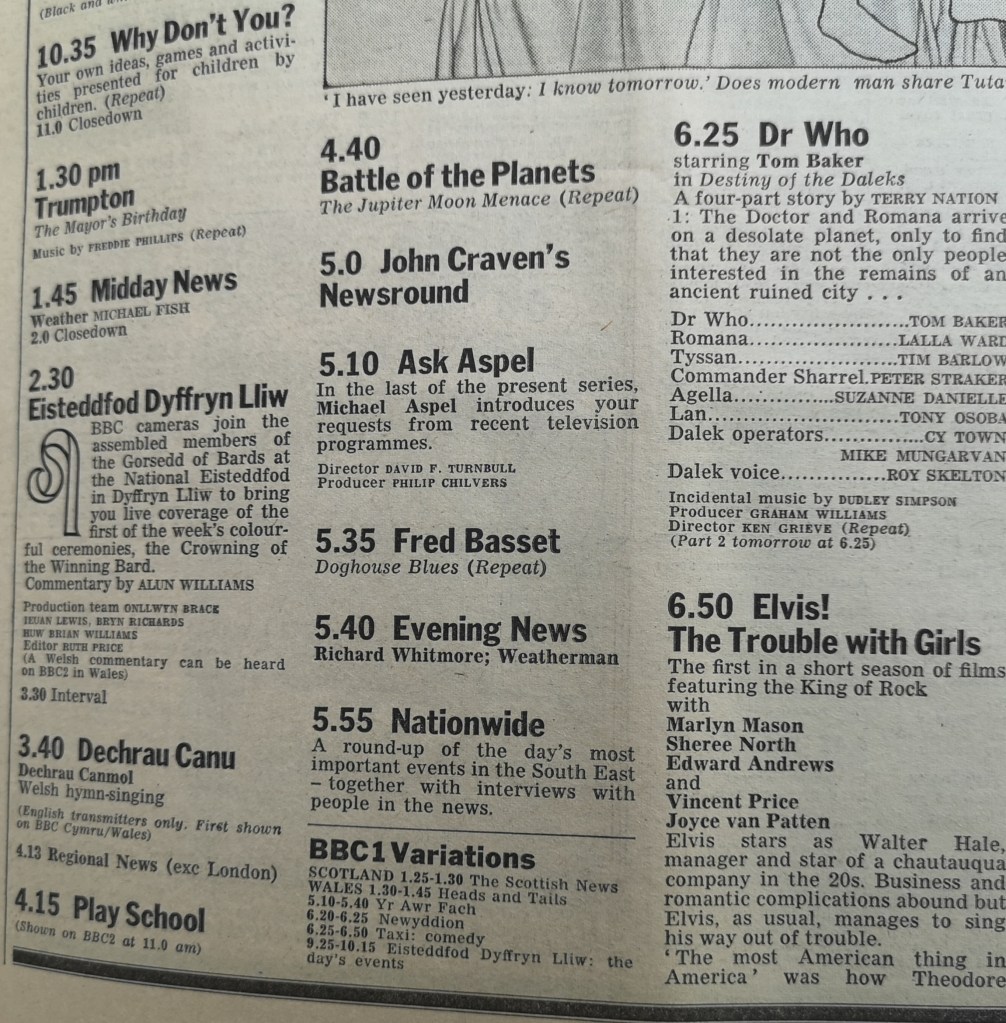
On Tuesday 5 August the repeat of Why Don’t You?, a programme that divides opinion to this day, was followed by a Closedown which lasted for two and a half hours. For any readers who are much younger, closedowns were a regular occurrence on BBC1 & BBC2, particularly during the 70s and 80s. The famous Test Card F with the noughts and crosses game was the most shown image of TV during those years. The Test Card had colours on which allowed TV engineers to tune and calibrate the colour TV sets that were by now in most homes. In those days it was pretty much unheard of to set up a TV yourself and in any case, most people in 1980 still had TVs from Radio Rentals or a similar company so set up was part of the service. The Test Card was backed by light music that sometimes featured new versions of familiar songs or other stock music. Following the closedown was Trumpton on its umpteenth repeat, but always welcome to kids of all ages. If you were a Welsh speaker you hit the jackpot on this day with the Eisteddfod Dyffryn Lliw and Dechrau Canu. Strangely enough I used to be fascinated by shows such as these because of the different sound of unfamiliar languages. Play School was still going and this episode was presented by Elizabeth Millbank and the legend that is Johnny Ball. I may be in the minority but I never liked Battle of the Planets so I might have flicked to ITV, but at 5pm for forty minutes we had the triple bill of children’s favourites John Craven’s Newsround Ask Aspel with it’s brilliant theme tune and Fred Basset, an excellent cartoon version of the Daily Mail comic strip with Lionel Jeffries marvellous narration. After the Evening News and Nationwide there was a Doctor Who repeat and the first in a season of Elvis films that started with perhaps the worst of the lot and would almost certainly have had viewers getting up to change channels!
On BBC2 five minutes after the Elvis film started there was a repeat of Dallas, which was an absolutely iconic soap opera of the time with a marvellous central performance by Larry Hagman as J.R. Ewing, one of the nastiest villains of the time. These days where violent scenes are more explicit (and consequently dull) than ever, he would be quite cuddly, but he had a charisma that none of today’s equivalents could hold a candle to. After this we have one of those programmes that BBC2 did so well in the 70s and 80s. Montaillou reflected French lives in the 14th century, and I wouldn’t be surprised if it was a fascinating 40 minutes. As an aside, the readings are by Martin Jarvis and Denise Bryer who narrated the marvellous Book at Bedtime version of A Christmas Carol for Radio 4. My Music is currently being repeated on BBC4 and I know I enjoyed it first time round, but then I was an odd 15 year old! The Six Wives of Henry VIII was a repeat but I think by then I had decided that I wanted nothing to do with that awful human being so I would have probably have gone upstairs to watch something on my portable TV! The BBC2 evening rounded off with a David Attenborough documentary and Newsnight. Both channels had finished broadcasting by 11:45pm in an era when the appalling spectre of 24 hour TV was not even thought about. There was something extremely comforting about closedowns because they said to the viewer in the afternoon, it’s time to either play outside or read, and at night, it’s time to go to sleep. A final note on this page is the Fotopost Express advert. You took the film out of the camera, posted it off in the envelope provided, and in a week or so you had the excitement, or disappointment, of the printed pictures! It is a reminder of an age when people did not insist on instant gratification and, in my opinion, life was all the better for it.
My final page comes from Thursday 7 August and includes a number of well remembered childhood staples. Children’s programmes for one hour and five minutes included Noah and Nelly, from the creators of Roobarb and Custard, Jackanory with the very popular, at the time, Jonny Briggs stories, Cheggers Plays Pop with Keith Chegwin and pop stars The Dooleys, The Buggles and Shakin’ Stevens and another episode of Why Don’t You? The 25 minute closedown would have given cricket lovers amongst us the time to prepare for the long haul of the Fifth Test Match. Well, actually, no it wouldn’t. The 1980 summer was one of the wettest in my memory and the whole of Days 1 and 4 of this five day match were rained off. I used to enjoy seeing highlights of past series, so I would probably have switched on anyway! The afternoon saw more from the Eisteddfod and children’s programmes included the very strange Singing, Ringing Tree from Germany and the We Are the Champions final. This inter school competition featured the type of children who ran rings round the rest of us during sports days, but with a great theme tune and the no nonsense Ron Pickering in charge it was a great watch from the first game to the kids from all the teams jumping into the swimming pool at the end.
This was a fascinating trip down memory lane for me. It reminded me of one thing in particular. For every classic programme there were half a dozen ranging from forgettable to appalling, and in the summer when ‘everyone’ was on holiday, the BBC was chock full of repeats that often weren’t that good in the first place. Christmas programmes are often what we reflect on when we talk or write about how good TV was in the 70s and 80s, but outside of that week, it’s very much a reflection of what TV was really like.
Discover more from David Pearce - Popular Culture and Personal Passions
Subscribe to get the latest posts sent to your email.


A real pleasure to read, thank you! I was born the year after this but I do feel as if I sort of remember it and it has a gentle nostalgia which is just ouy of reach. I do remember some of the same things being around as a small child, so I suppose that might be it.
LikeLiked by 1 person
Thank you youngun! 🤣🤣 It was an interesting one to look at with the very different feel. The programme line up was very ordinary though!
LikeLiked by 1 person
Not sure how young I am if I remember Michael Aspel, but I’ll take it. 😄
LikeLiked by 1 person