

Background
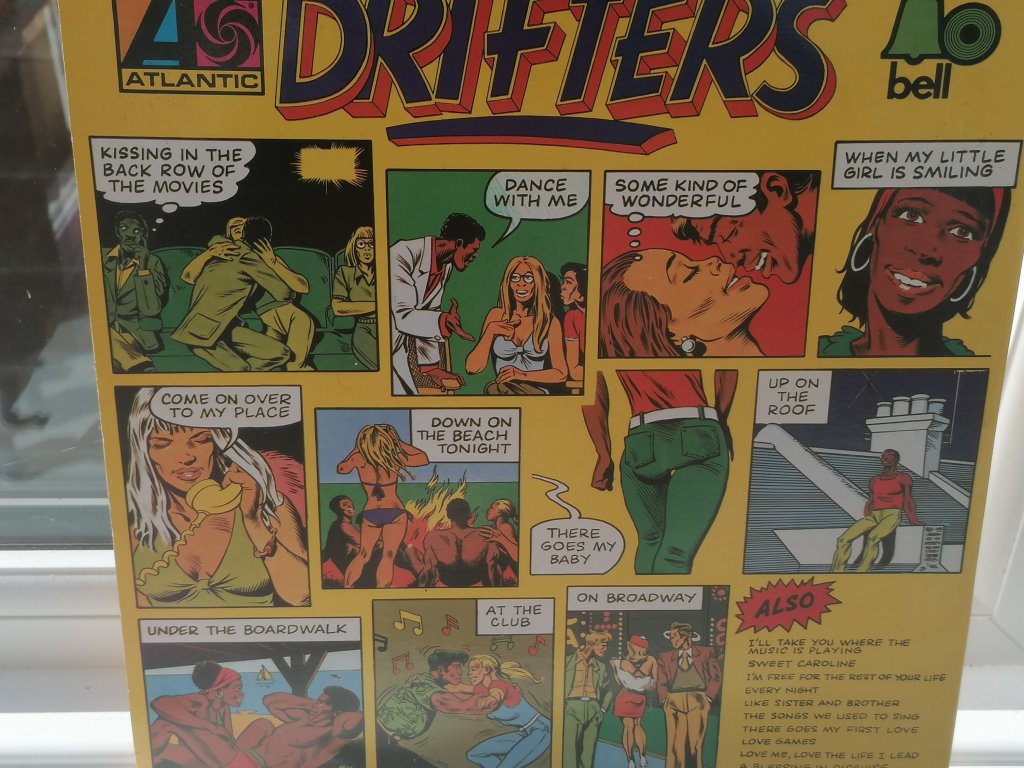
Yesterday, I went right back to the 70s with one of my favourite childhood groups. Soul legends The Drifters are perhaps an odd choice for a 9- or 10-year-old, but there was something irresistible about their music, their singing style and their lyrics. I remember the original compilation album being advertised on television and the cartoon cover and font immediately appealed to me. At the time, it never occurred to me to put it on a wish list for Father Christmas, but 47 years after it’s original release I tracked down a really good copy at a great price and here we are. As it isn’t an album I originally owned, how does it count as a Re-play? Good question. My justification is simply that I loved the singles at the time and its an album that brought my early music listening days flooding back.
The Drifters 24 Original Hits – The Tracks
The double album is split into their early Atlantic tracks on Sides 1 & 2, and their later Bell tracks, which made me a fan, on Sides 3 & 4. I am going to pick out my personal highlights of a collection that had me smiling, singing and reminiscing from the first track on Side 1 to the last track on Side 4. We start off with an absolute classic for Track 1 Side 1 that even non-fans of the group will know. Saturday Night at the Movies just encapsulates their sound from the early 60s. It was a track recorded in 1962 and the opening riff is just as recognisable now as it was 60 years ago! The smooth singing and the unmistakeable tune make this a song that never gets old. The fifth track on this first side is Come on over to my place, which was used for a fondly remembered Wimpy advert where the word ‘party’ was cleverly replaced by the word ‘Wimpy’! That advert dates from 1987 but when I listened to this I still kept replacing the word ‘party’ in my head! The final track on Side 1 is Save the Last Dance for Me. It is an interesting treatment of the social rules of the time, where the singer tells his girlfriend that she can dance and flirt with anyone she likes all night as long as he has the final dance with her because he’s the one taking her home. It’s another early 60s track that shows off the quality of the legendary Ben E King during his year as their lead singer. Far from being resigned to his girlfriend flirting with everyone he sings with the confidence of someone who feels he has nothing whatsoever to fear.
Ruby Lewis was King’s replacement and the standout track from that era has to be the gorgeous Up on the Roof, Track 2 on Side 2, a song delivered with a serenity that tells you he really has found his escape on the roof. It was one of the early classics from Goffin and King and it stands comparison with anything they ever wrote together. The sixth and final track on the second side is perhaps the definitive version of Under the Boardwalk. What a performance this is, with the irresistible tune and those harmonies, unmatched by any other version. The only other version that stands alongside this is the early 80s remake by the Tom Tom Club which I urge you to check out.
Side 3, which is the Bell years starts off with a very interesting version of Sweet Caroline. The Drifters give it their own inimitable style, and whilst not as immediate as the Neil Diamond version, and pure Drifters class. The third track on Side 3 is my all time favourite track by The Drifters, a track that I adored as a 9 year old and one I still adore now, because it is one of those tracks that brings back a time and place as only music can. Kissing in the Back Row of the Movies was a Number 2 hit in 1974 and I loved hearing it on radio or on Top of the Pops. Now, the lyrics might be a little bit of their time (!) but they have the essential innocence of the Johnny Moore delivery to offset the more modern sensibilities of the listener. It starts with a gorgeous solo verse from Moore before the group joins in with one of their very best performances. I was in the throes of first love at the time and this really reminds me of that very special young lady. As we were both 9 years old the lyrics
Every night, I pick you up from school
‘Cause you’re my steady date
But from Monday through to the Friday night
I leave you at the gate, yeah
You know, we can’t have too much fun
‘Til all your homework’s done
But when the weekend comes
She knows where we will be, yeah
Were about two teenagers at school, but the fact that the singer was picking her up from school indicates that he himself may have been slightly older! Whatever it might seem like to modern ears, it was a record I fell in love with, and to.
Side 4 begins with the marvellous There Goes My First Love, which coincided with my own first love leaving to go to another school. As a song that reflects my feelings at the time it is perhaps perfect for my 10-year-old self and still speaks to my somewhat older self! The final track on a classic double album is the lovely Down on the Beach Tonight which just oozes quality and reinforces the picture of the US as a beach lovers paradise.
Reflection
What can I add about an album that made me feel so happy and which brought back so many lovely memories, personal and musical? Perhaps all I can add is that if you were there in the 70s this will be a trip down memory lane that will simply delight you and which will remind you of tracks long forgotten. If you weren’t, and you want an introduction to one of the great soul groups of all time, this is an album and group you will really want to track down.
The second book in the series is, of course
Harry Potter and the Chamber of Secrets

It takes up the story in the summer before Year 2 in Hogwarts School of Witchcraft and Wizardry. All of the main characters were introduced in the Philosopher’s Stone so there is a refreshing lack of time spent in reintroducing characters at length. The basic storyline of the previous year is revisited, but as with the original, plot wise it is full steam ahead.
The Opening Chapters
Harry is back at the Dursley’s for the summer, and they are behaving just as vindictively as they were in the first book, to the extent that Uncle Vernon has locked away all of Harry’s magic equipment and forbidden Harry from flying Hedwig in case the owl delivers messages to his friends. These friends have been very quiet during the summer and Harry is very unhappy because he feels that they have just forgotten him. The first set piece revolves around a very important business meeting where Vernon hopes to make a huge sale to some rich builders. When Harry is told to keep out of the way, he gladly returns to his bedroom, but there he is met by an elf called Dobby. OK, let’s get this out of the way. I can’t stand the character in either the books or the films! I know that puts me in the minority, but there you go. The slapstick nature of Dobby’s behaviour and the way he talks about and to Harry just get on my nerves, but I promise I won’t go on about it. Anyway, Dobby manages to wreck Vernon’s meeting and gets Harry into trouble with the Ministry of Magic when he performs a hover charm. Vernon locks him in his room and threatens to stop him going back to Hogwarts ever again. Things look hopeless until the younger Weasley brothers, Ron, Fred and George arrive in a Ford Anglia which just happens to be able to fly!
The danger at Hogwarts
In the Chamber of Secrets, a series of events leave staff and students fearing for their safety. Harry becomes the object of suspicion after it transpires that he is able to speak to snakes. Parseltongue is the province of dark wizardry and was an ability famously possessed by He Who Must Not Be Named. It is part of the plotting of the series that something that seems relatively unimportant becomes significant later. In the first book Harry speaks to a snake in London Zoo, which seems like a short scene designed to make the reader smile. When it happens again, the reader is unsurprised, but the other students are horrified. The first time it was funny, subsequent times in the series it is anything but. Something similar happens with Ginny Weasley’s role in the story. Her character, such as it is, was set up very early on as a very shy Harry Potter groupie! This becomes very significant, although the reader only finds this out later, in bringing Harry Potter and Tom Riddle together. The final set piece makes the connection clear as a certain amount of ‘monologuing’ takes place!
Defence against the Dark Arts – the impossible post
In the first book Professor Quirrell was the Defence against the Dark Arts teacher. When it turned out that his turban was hiding more than a bad haircut his days were numbered. This book sees the flamboyant and fraudulent Gilderoy Lockhart taking over the post. Far from the brave vanquisher of dark magic he portrays in his books, he is a vain coward who is skilled at memory charms. He is desperate for fame and assumes that Harry wants the same thing. I won’t spoil things for anyone who hasn’t read it, but his lack of expertise soon makes him the object of derision amongst the staff and students, a situation that bodes ill for his job prospects.
Overall
The second book in the series moves at a cracking pace. You are plunged into the adventure and, rather cleverly, the world building is integral to the plot. I never felt that the pace slackened for the purposes of an information dump, and I raced through the book. There are a number of differences between the book and the film, but the most glaring was that in the book, Hermione has to be told what a ‘Mudblood’ is, which is much more logical for someone who only entered the Wizarding World a year earlier. The characterisation remains functional rather than rounded, but the story is so good that it’s easy to ignore that. Once again, I thoroughly enjoyed it and was reminded of bedtime reading for my children with them hanging on my every word.
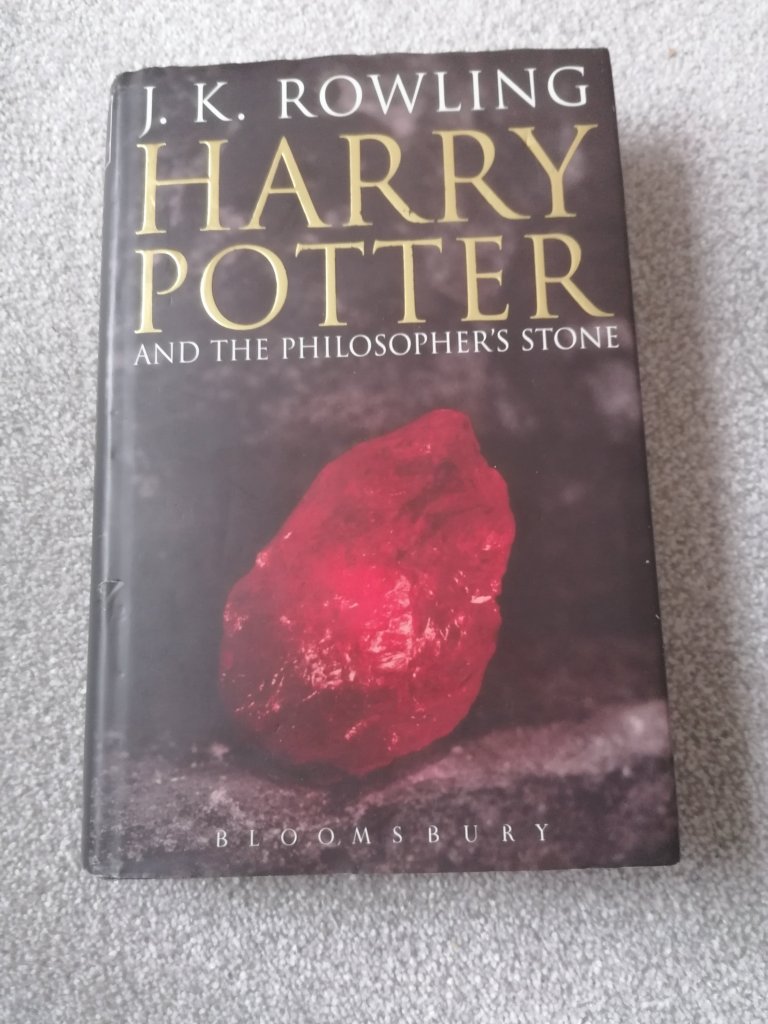
Like many parents, especially those with children in their 20s now, I spent many happy hours reading the Harry Potter series to a rapt audience. I would use all the tricks I could to keep my children engaged, making liberal use of accents, volume, tone of voice and of course cliff hangers that made them beg for one more chapter – which they often got! I didn’t read the final two as bedtime stories, because my children had reached the age where they read them for themselves. Those two came out two years apart, in 2005 and 2007, and had become very long books that really didn’t lend themselves to bedtime reading due to the very dark nature of the stories. Our family interaction with the series after that was based on the films to a large extent and I went with the children to each one, which they and I enjoyed immensely.
Recently, I came across the books again whilst clearing out as we were preparing to have a carpet fitted. I wondered how the books would come across to me now as a set of stories that I could read back-to-back without the two-year gaps. Would they still transport me? Would they still give me the same enjoyment? Were they, when removed from the context of reading to my children, any good? Well, there was only one way to find out wasn’t there? Join me as I embark upon a re-reading of the entire series 25 years on from the publication of the very first book in the series.
First up …
Harry Potter and the Philosopher’s (Sorcerer’s) Stone
The Philosopher’s Stone was a low-key release in 1997, but it quickly received a lot of word-of-mouth support and I remember getting paperback versions of this and the sequel from a newspaper offer in 1999, just a few months before The Prisoner of Azkaban was released.Things were very different in those pre-internet days!
The opening chapters
I suppose the first thing that occurred to me when I started re-reading it was how much of the books I had forgotten. The films have, quite naturally, become our vision of Hogwarts and the Wizarding World, but they have also become the default storylines and the default versions of the characters. The starting point of the whole series is Vernon Dursley, not Harry Potter. In the films he is the butt of a lot of humour, being portrayed in a somewhat buffoonish style, but in the books, he is a staid, narrow-minded and spiteful character who tries to impose his views on everyone around him. This makes him more understandable when he treats Harry so badly, and it grounds the story much more in the real (Muggle) world. The importance of this becomes clear to the reader when he starts seeing things around him that he cannot explain, and we share his sense of confusion as his ordered world refuses to conform to what it should be. The opening chapters do an incredibly effective job of building up the background to the story and preparing us for what happens next. Plotting is very much the strength of the whole series, and it makes you turn the pages briskly and read on for ‘one more chapter’! Petunia and Dudley Dursley stay very much in the background in this first book as Vernon is brought front and centre.
The Wizarding World
When Hagrid turns up, he brings the whole of the Wizarding World with him. This is not the Hagrid of the films, however, but a shrewder more calculating character who shows clearly why Dumbledore trusts him. He is our key to the back story and our key to understanding Harry’s position in the world he has been kept from for 10 years. It is a master stroke to go to Gringott’s first, because the characters of the goblins are opaque and their demeanour unsettling. Yes, we marvel at Diagon Alley with Ollivander’s and the Owl Emporium, but the goblins put us off kilter from the start. It’s very interesting that the first Hogwarts student that Harry meets in the book is Draco. Again, we notice an undercurrent, but we’re not sure what it means just yet or what has caused it. The wand that chooses Harry comes with its own story which Ollivander is only too eager to divulge. The journey on the Hogwarts’ Express introduces us to the Weasley clan, Hermione and Neville and the Sorting Hat gives us a pen portrait of the four houses in the school. Within a hundred pages the foundation of both worlds has been built. It’s a very impressive piece of writing for an inexperienced author.
The Characters
This is perhaps the aspect of the book that is the patchiest. Although the characters arrived on screen fully formed, having benefitted from three completed books to find their feet, in the novel they are functional at best. Generally speaking, their job is just to move the plot along, so they tend to have a stereotypical air. You have the hero, finding out that he is special, the best friend providing support and someone to impress and the third side of the triangle that is being set up for 6 books hence. It surprised me how peripheral Hermione was in this book, even after the troll at Halloween. Yes, she became part of the trio, but she remained resolutely on the outside in terms of the friendship. She is the know-all who can be insufferable but is OK once she has had a couple of rough edges knocked off. In some ways, her role could have been split between the other two with a minimum of fuss. Neville is intended to be comic relief with his haplessness, but we only see him being clumsy or forgetful so his act of defiance towards the end of the book doesn’t ring true. Draco is a one note villain, and his henchmen are simply there. At this stage, the staff barely have a character of real interest amongst them. Dumbledore is unknowable, which makes complete sense, McGonagall is the harsh but fair one and Snape is simply the nasty metalwork teacher we’ve all had!
This tendency towards two dimensional characters is obviously a product of the inexperience I mentioned before, but the great plus is that it doesn’t matter. The plot is the thing that keeps you reading the book and that just works from page 1 onwards. The characters will develop as the series progresses, but for now they do not clutter up the narrative and slow everything down.
Overall
It was something of a strange experience re-reading this first book so many years on, but it was an experience that reminded me of the reasons why I held this set of books in such high esteem despite its occasional weaknesses. As the opening novel in the series, it ticks all the boxes.
Background
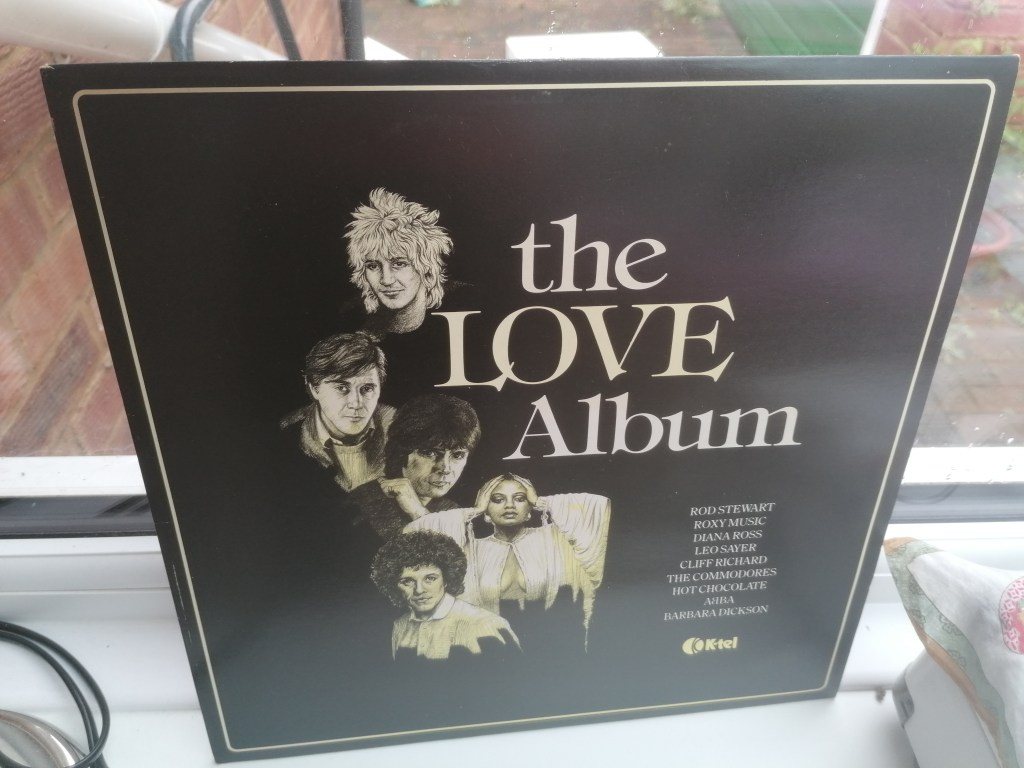
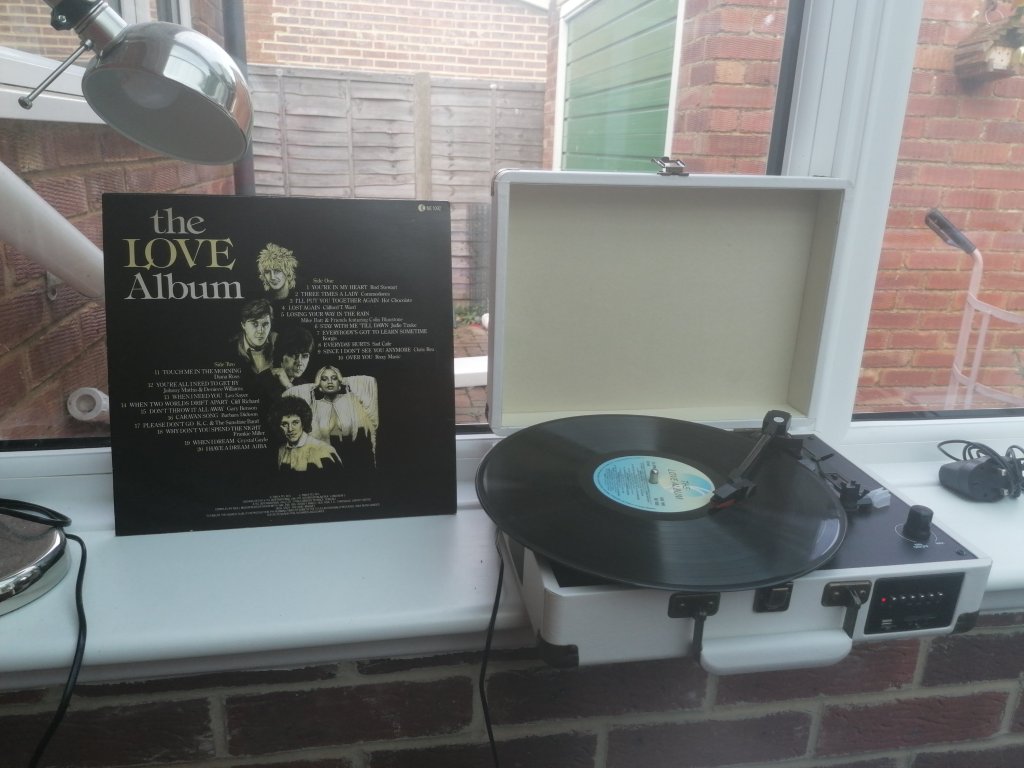
The compilation album was, for a number of years, a market cornered by K-Tel. Their albums were familiar sights during advert breaks in the late 70s and early 80s. Although the adverts helped, the main reason why K-Tel were the gold standard for compilations was simple, they were extremely good at putting them together. The Love Album is a great example of the genre. It was a record that belonged to my parents but it ended up in my collection after the house was sold, along with a few other favourites. It’s 42 years since the compilation was released and not far off 40 years since I last listened to it, so it’s overdue another spin.
The Love Album – The tracks
Side 1 starts with Rod Stewart and his classic track, You’re in my Heart. Vocally, he is on good form, but what really makes the track stand out are the one liners, occasionally biting always funny, like ‘Her ad-lib lines were so well rehearsed’! It’s a superb put down and reflects a supremely well written song. Following that is Three Times a Lady which is simply one of the best love songs ever written. A lesser played Hot Chocolate tune, I’ll put you together again, is a real pleasure to hear again. It’s one of those tracks that really demonstrated the quality of Errol Brown’s voice to the full and it still sounds gorgeous.
We then have two very unfamiliar songs of the type that these K-Tel compilations specialised in. The first, Lost Again by Clifford T Ward is the type of song that is OK to listen to, but one you have completely forgotten by the time the final note is played. The second is the great Mike Batt who penned the track Losing your way in the rain. This stands out because it features Batt’s marvellous ear for a tune and because it had Colin Blunstone on lead vocals. It has a charm to it that makes it a song worth listening to and returning to.
Three stone cold classics follow, starting with the largely forgotten classic Stay with me till Dawn by Judie Tzuke. She has such a superb voice that her relative obscurity will always be a mystery. The sultry but brittle vocals are fantastic, but when you combine them with a tune that burrows it way into your head and the beautiful lyrics like ‘I’ll show you a sunrise if you stay with me until dawn’ to finish the chorus, it was bound to be a huge hit. Number 16? What were you thinking UK record buying public? This is followed by two big hits from Korgis and Sad Café with Everybody’s got to learn sometime and Everyday hurts respectively. These songs really stand the test of time and are familiar from the classic music stations that proliferate these days, and yet the first of the trio is, in my opinion at least, head and shoulders above those two other extremely good tracks.
The final two tracks on Side 1 are an interesting pair. A pre-Road to Hell Chris Rea trying to channel Roy Orbison on Since I don’t see you anymore is certainly interesting. The closing number is the lounge lizard extraordinaire Bryan Ferry with the stunning Roxy Music track Over You. As with the Hot Chocolate track, you don’t hear it as often these days, but it is my favourite Roxy Music single, and Ferry himself never sounded better.
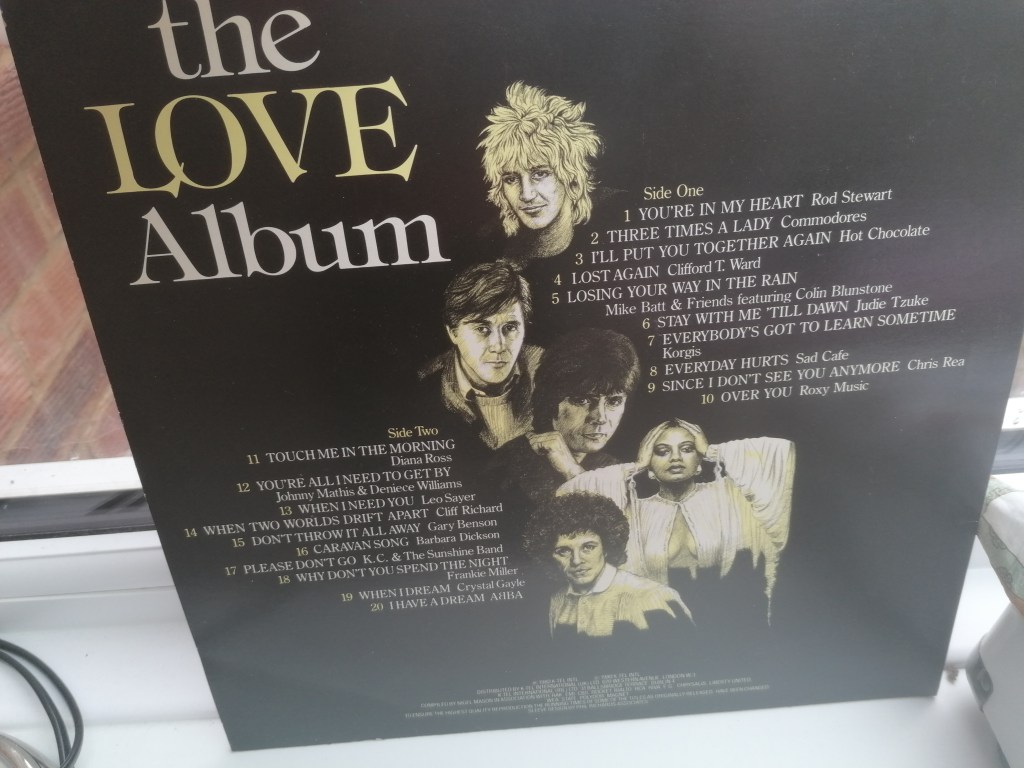
Side 2, like Side 1 starts with a legend, in this case Diana Ross, and her greatest ballad, Touch me in the morning. It is one of those songs that never gets old, although it was released fifty years ago, and you just know it will sound as fantastic in another fifty years. The Johnny Mathis and Deniece Williams track You’re all I need to get by is very much after the Lord Mayor’s show, not that it’s an awful track by any means, because it isn’t a song that really suits Mathis in particular. It’s a situation compounded by the following track, When I need you, by the brilliant Leo Sayer. It’s probably the best encapsulation of a long-distance relationship that you could ever hear and when I was working abroad, the line ‘A telephone can’t take the place of your smile’ resonated with me like no other. With the whole of Cliff Richard’s releases to choose from, it seems very odd that K-Tel chose When two worlds drift away was their pick. The song isn’t bad, but it doesn’t really showcase Cliff to the best effect. It sounds like an attempt to write Miss You Nights that didn’t quite hit the spot.
The up and down nature of Side 2 continues with Don’t throw it all away by Gary Benson, a name that is as unfamiliar as Clifford T Ward on Side 1. The song, however, is very familiar and it brought back memories with the chorus. Now, we have the best track on the entire album, Caravan Song by Barbara Dickson written by Mike Batt. One of the finest songs ever recorded, and I stand by that description, record company machinations stopped it from being the massive hit it deserved. Even on an album like this it overshadows every other track with its brilliance. If you have never heard it, head to Spotify or YouTube to fill that hole in your musical knowledge before you continue with this article!
Now you’re back, we’ll carry on with the final four tracks! The first is what sounds like the curiously restrained original version of Please Don’t Go by KC and the Sunshine Band. I suppose I have just got used to the more upbeat KWS cover, but it’s an interesting track because it reminds you that sometimes your musical memories can deceive you.. Frankie Miller, another unfamiliar name, contributes the Rod Stewart style Why don’t you spend the night which doesn’t hold up too badly at all. It’s a good singalong and it sounds like a track that should have been a bigger hit. The gorgeous voice of Crystal Gayle is featured in the penultimate track on this album and what a track it is. When I Dream sounds like a showtune in places and it showcases her vocals superbly. The final track is I have a dream by ABBA. No more needs to be said!
Reflection
This is a wonderful album whose occasional misses are not ones you’d necessarily skip, but whose standout tracks are all time classics. The only slightly jarring thing about the album is the fade out of tracks which habitually cuts them short. If you know the originals as well as I do, it can be slightly irritating, but if you don’t you may not notice it as much. It has been an album I have really enjoyed getting to know again and, in Stay with me till Dawn and Caravan song it has two tracks that you simply have to search out.
Background
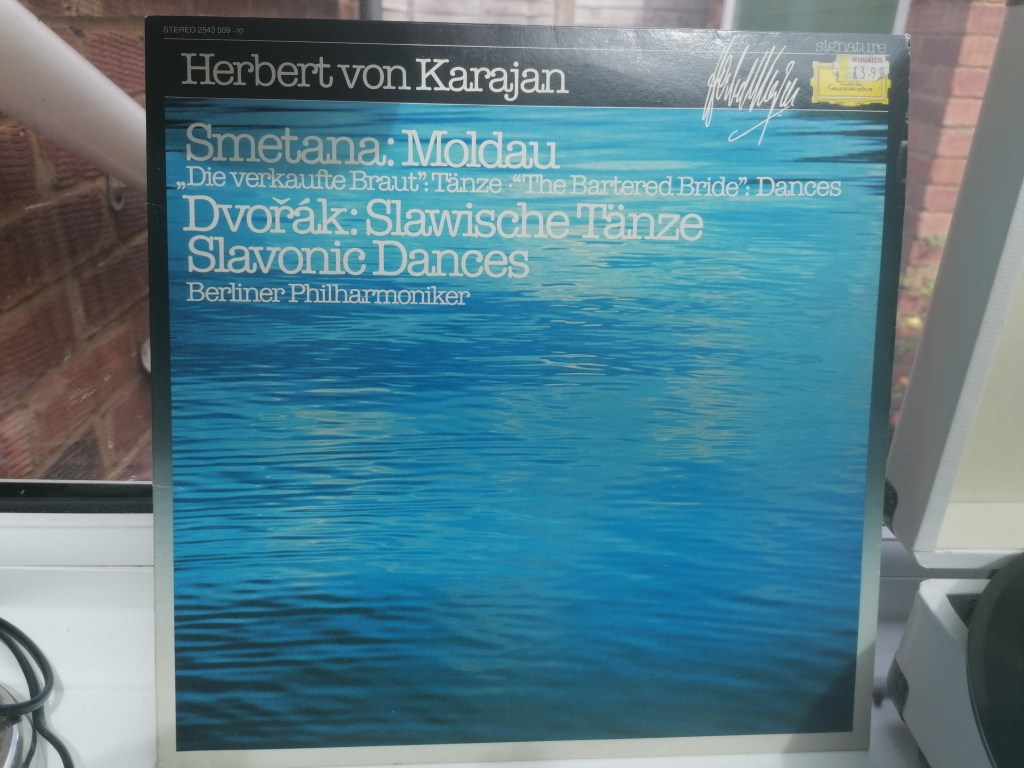
As many people on my Twitter feed may know (because I tell them often enough!), there is one piece of classical music I love above all others. In 1874 Bedrich Smetana completed the second of the six pieces of music that make up the Ma Vlast, (My Country) cycle that pay tribute to his homeland of Bohemia, part of the modern-day Czech Republic. That second piece, Die Moldau or as it is more familiarly known Vltava, became his most famous and completely eclipsed the rest of his music. The Vltava is the river that flows through Prague on its way to the sea and the course of its journey from its origin to its eventual destination is told as a symphonic poem. It was a piece of music I was introduced to in a school music lesson and formed the only useful 45 minutes of music teaching in my secondary school career! Since I first heard it, it has been the orchestral piece I have gone back to when I wanted to relax or to think about things. It has that indefinable air of magic for me, and I can get quite evangelical about introducing it to others!
Smetana Moldau and other tracks
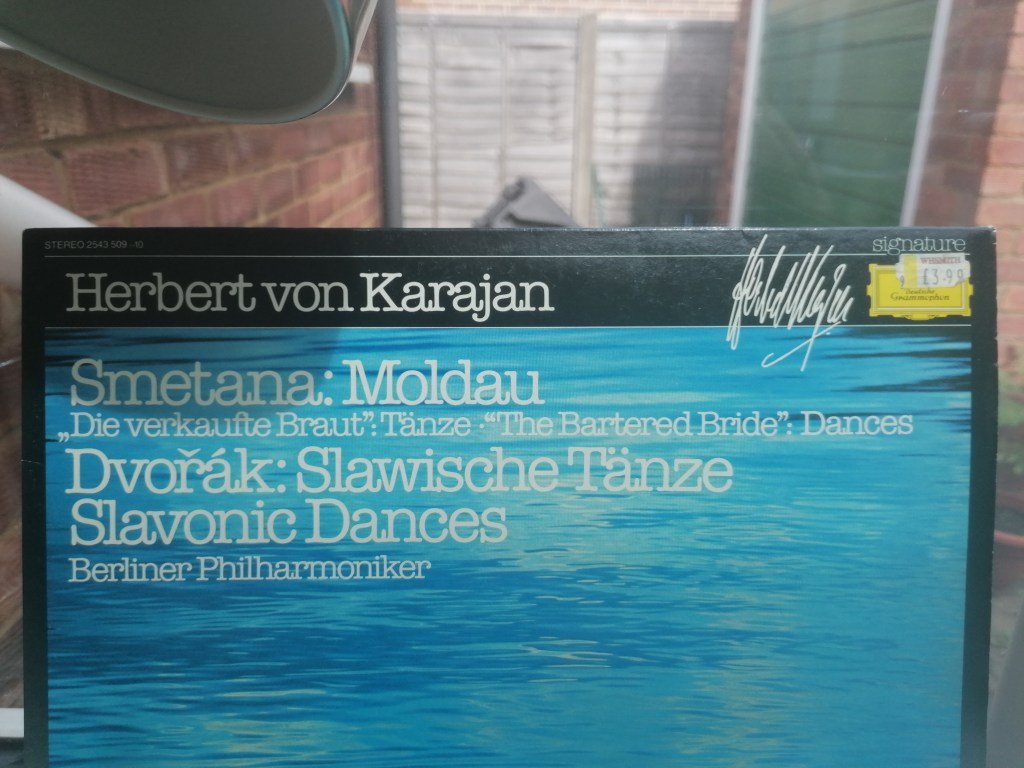
This recording, bought for the princely sum of £3.99 from W.H. Smith back in the 80s, is from the Deutsche Grammophon signature collection featuring the conducting of the legendary Herbert Von Karajan. As soon as you hear that familiar opening you know that with Karajan and the Berliner Philharmoniker you are in very safe hands indeed. It is the version I first heard and still, to my mind, the best. There is, appropriately, a real flow to the music and it just carries you along the river, dropping in on each scene and then moving on until the Vltava reaches the sea in an exhilarating finish. Straight after the main piece of music there are a series of dances from Smetana’s opera The Bartered Bride which, although unfamiliar and written in a very different style, complements Vltava beautifully. Although this is the first time in probably 30 years that I have listened to the dances I definitely recognised some of the movements. The ‘B side’ is devoted to the music of Dvorak who is of course most famous for the New World Symphony aka the Hovis advert theme! His symphonic dances are, to my relatively untutored ear, very similar to the Bartered Bride dances on the ‘A Side’ but not as immediately engaging. This is not to say that they are not worth flipping the record over for, because they are very well performed and definitely have their moments, but I can see why I tended to play the Smetana pieces and put the album back in its sleeve. It was very good to be able to listen to these somewhat neglected pieces from the standpoint of somewhat greater exposure to classical music over the years, and I can wholeheartedly recommend the second track on this side No. 10 e-moll Op 72 No 2: Allegretto grazioso which, in parts, reminded me of the theme from The Godfather.
Reflection
Many years on from my first listen to Vltava it still holds that incredible magic for me, and even now I think that this version from Karajan and the Berliner Philharmoniker reigns supreme. If you get a chance the vinyl has a depth and richness that I still don’t think CDs match and definitely more depth than streaming will make apparent.
 David Pearce - Popular Culture and Personal Passions