
The Blue and The Green

In the early 70s, ITV was responsible for two fondly remembered science fiction series. The first, from 1970, was the excellent Timeslip which only lasted for one series on TV, but which covered a huge amount of dramatic and scientific ground. The second series, which started in 1973, was The Tomorrow People. Both series were overseen by Ruth Boswell, a leading figure in children’s drama whose approach was never to talk down to her audience, but rather encourage them to stretch themselves. Alongside her two most famous series, she was responsible for Escape into Night in 1972 and the anthology series Shadows in 1976. All four were high quality productions where the ideas were central to their appeal. If you have seen them, you’ll know what I mean, and if you haven’t I urge you to track them down.
The Story
The Blue and The Green is perhaps the best regarded, and certainly the best remembered, story in the series, and it is the story that introduced Series 2. The episode starts with two Tomorrow People in their hidden lab, John (Nicholas Young) and Stephen (Peter Vaughan Clarke). Stephen is attending school, where his art class is being taught by Elizabeth M’Bondo (Elizabeth Adare), a new student teacher. He quickly realises that she is a Tomorrow Person, although she is quite a bit older than the others who had ‘broken out’. John tells Stephen to tread carefully, but soon the new potential Tomorrow Person is a minor problem compared to Stephen’s new classmate. Robert (Jason Kemp) produces a painting he calls ‘The change of weather on Rexil 4’, a name he insists he made up. However, Stephen knows that not only is there a planet called Rexil 4, but that he has painted it entirely accurately. The situation gets much worse when Robert brings a box of badges to school, in two shades, blue and green. When the whole world takes sides, there seems to be little even the Tomorrow People can do. What is Robert’s story? How will Elizabeth cope with becoming a Tomorrow Person? These two questions drive the five episode story as it becomes progressively darker.
Reactions
My first reflection when re-watching a programme I’d last seen when it was first broadcast in 1974, was how well the central concepts still stand up. The way that human nature tends towards inexplicable violence is just as pertinent now as it was then, perhaps even more so. It is one of the programme’s strengths, at least in the first three series which were overseen by Ruth Boswell, not to sugar coat the more controversial elements of the programme. The ongoing conflict in Northern Ireland is referenced, as is racism. Cleverly, the points are not laboured, but they are unsettling and left firmly in the viewer’s minds. The apparently random introduction of the Blue and Green badges is extremely clever, because their effect is immediate and occasionally shocking, but the explanation for that effect is deliberately left until Episode 5. The viewer is left wondering what is going on and even Tim (voiced by Philip Gilbert), the Tomorrow People’s powerful computer is at a loss to explain what is going on. He does, however, mention that the Roman Empire fell after the citizens split themselves into Blue and Green factions. This occurred in the 6th Century and initially took place within the Byzantine Empire, which was centred around Constantinople. This proves to be an important plot point. The denouement is interesting and brings the best story, in my opinion, to a satisfying close.
The weaker points are few, but one of them centres around the uncomfortable marriage between high concept science fiction and children’s television at the time. Robert has a ‘grandfather’ (Nigel Pegram) looking after him who has been brainwashed into thinking that Robert is his flesh and blood. He looks, and acts, like Dick Van Dyke in his role as the manager of the bank in Mary Poppins! It’s a clowning performance that seems to have wondered in from a completely different programme, perhaps Rentaghost. The fight scenes are badly choreographed, but then again they couldn’t be too realistic for a programme shown before 5pm, so some allowances are needed when judging them. That said, there is significant footage from conflicts around the world and that gives a more unsettling feel to the programme which offsets it. Finally, there is a non Tomorrow Person who helps out called Chris (Christopher Chittell). His role is providing the muscle, given the Tomorrow People’s prime barrier which largely stops them from acts of violence. In this episode, Chris gets involved in breaking and entering as well as seemingly random car chases that, once again, seem out of place in the show. Finally, the way the solution is enacted can seem quite amusing in places, but if you suspend disbelief I think it’s actually quite effective.
Things to look out for include early appearances by those Birds of a Feather Pauline Quirke and Linda Robson, the former immediately recognisable, and their castmate from ‘You Must Be Joking’ Ray Burdis. An interesting aside from Tim introducing himself to Elizabeth is his description of himself as Artificial Intelligence. This reflects the fact that The Tomorrow People, like Timeslip, had a scientific advisor.
Final Thoughts
So there you have it. The Blue and The Green definitely stands up extremely well all these years later. It is thoughtful, intelligent science fiction that is the perfect showcase for this 70s classic. Even if the story hadn’t been as effective I could watch the opening titles on a loop! The combination of music and images still sends shivers down my spine in the same way as it did when I was just 8 years old.
As I have just got back from the capital of Ireland I thought I’d share a few thoughts and recommendations to give you a head start if you’re planning your own trip to Dublin’s fair city.
Getting there
Unless you have lots of time, or you live very much closer to Holyhead than I do, the flight is perhaps the only option. With the usual caveats of it being something of a game you are playing with the airline to keep your costs as low as possible, the budget carriers were our best option. We ended up with Ryanair, and for me the huge plus was the amount of legroom. To be able to actually stretch your legs out on a plane was a real surprise and an element that made the flight far more comfortable than expected. As more experienced travel blogs would tell you, exhaustive internet research is the key so head to the usual suspects and do your comparisons.
Accommodation
We went across as a family for my wife’s birthday so with ourselves, children and partners there were eight of us. This meant that we could look at the self catering options provided by Yugo, whose term time student accommodation is available for the summer months. Now, if you are used to hotels, the accommodation can seem a little basic, but if you are used to hostels it’s pretty good. The kitchen has fridge, freezer, oven, toaster, microwave and hob. It doubles as the lounge and there is a flat screen on the wall which has the terrestrial channels plus Netflix access. All cups, plates and utensils are present and correct, and all in all it’s perfect for breakfasts and your evening meal if you are cooking for yourself at any point as we were. There was a dishwasher but no tablets so if you want to use it you have to buy your own. The rooms are basic in nature, but comfortable, although the beds were three quarter sized doubles which may be rather cosy for two! All in all it was pretty good and a perfect base for 3 nights.
Getting around
From the airport, the best option by far, to my mind, is the Dublin Express Bus, which takes you into the centre of the city within an hour for 5 euros. Once you are in the city itself, most things were in walking distance for us, but there are buses that cover most of the city as well. As someone who never takes taxis I’m afraid I can’t comment on those!
Eating and Drinking
As with any city there are a huge number of options, but as with any city the meals are not especially cheap. However, I want to suggest a couple of pubs and a small but excellent café. The pub that we went to for a couple of meals was O’ Shea’s, and even as a non pub goer I was bowled over by the atmosphere there and the quality of the food and drink. Between the eight of us we tried most of what was on the menu over two visits and all the meals were of the highest quality. On the Sunday night the live music was superb and not at the level where you couldn’t hear each other speak. The pub is situated near Merchant’s Quay and is definitely worth a visit. The other bar, Dillon’s Bar, is a great place for lunch with an excellent sandwich menu and an excellent atmosphere. It is just down the road from Phoenix Park, so it makes a handy stopping off point on your way back in to the city. Finally, for breakfast on my wife’s birthday we went to a little place called The Cheeky Piglet which had a fantastic breakfast menu which was tasty and perfect to set us up for our day of sightseeing.
Places to see in Dublin
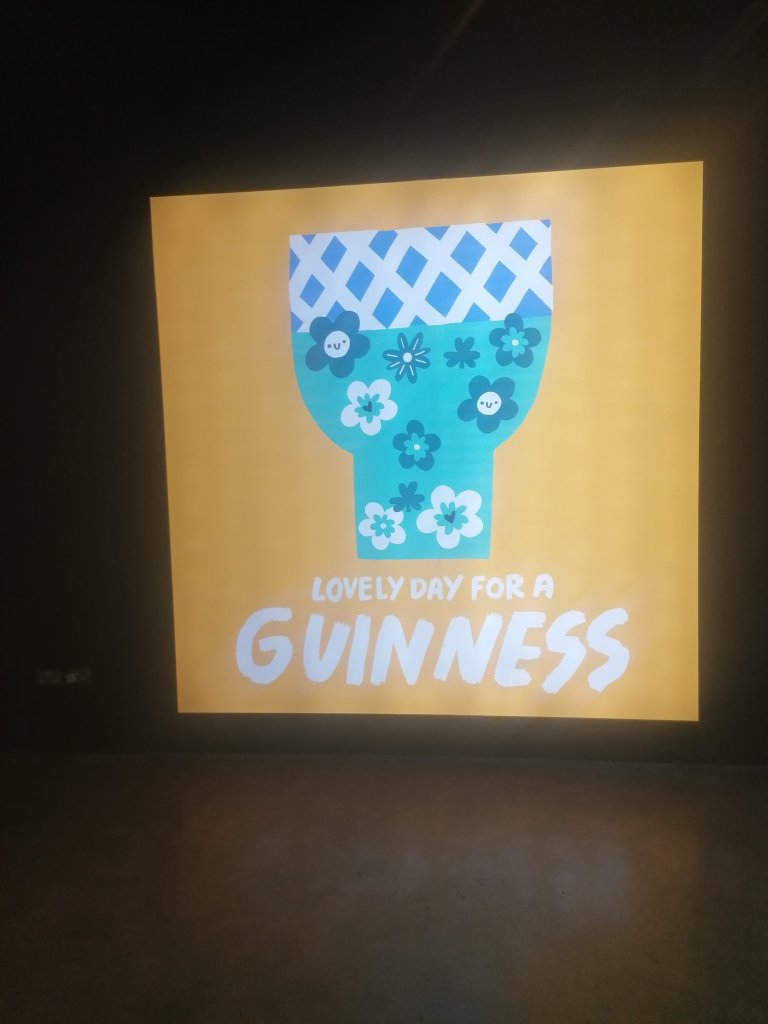
I don’t want to make this an exhaustive list, so I will just pick three places that I really enjoyed. The main reason for our visit was to take my wife to the Guinness Storehouse. Across five floors and a rooftop bar, you are introduced to the story of Guinness and then invited to sample your own pint. We upgraded our visit to the Stoutly which gives you the rather intriguing option of your picture on the head of a pint of Guinness. It’s definitely worth the extra money in my opinion, because it’s a real talking point and you won’t get it anywhere else! We ended up spending 4 hours there, but you can probably see and do most things in 3.
Dublinia is a fascinating introduction to the Viking and Medieval history of Dublin. The idea is similar to Jorvik in York although there is no ride through a Viking village. It’s a good place to while away 90 minutes, particularly when waiting for the rain to stop!
On our final afternoon, we visited the Irish Whiskey Museum, because we had an hour or so to kill before the end of our visit, and we were so glad we did! You get a tour from a knowledgeable guide. Donal was our guide and he was by common consent absolutely brilliant. His genuinely hilarious asides were cheeky, quick witted and entirely good natured even, or especially, when he skirted the edge of insulting very skilfully. In our final couple of hours in Dublin we saw, heard and tasted the essence of the Irish experience.
Final thoughts
The weather when we went was pretty bad, in common with most of the rest of Britain and Ireland.
Tip Number One – Never go out without a jacket thinking it looks OK! The weather changes insanely quickly and the next belt of rain could be far closer than you think.
Tip Number Two – Layer up so you don’t end up perspiring profusely if you don’t get rained upon.
Tip Number Three – The atmosphere of Dublin is best experienced on a summer’s evening by simply walking around. We went to Grafton Street one evening and Temple Bar area on another, and had a fantastic time. It is a European City in every respect and the café and pub culture comes into its own on a walk around the areas where the locals congregate.
Tip Number Four – It’s expensive but so is any city, and with careful budgeting you can spend a small amount and get a huge amount of value from it.
Tip Number Five – Slow down and let Dublin seep into your soul. My family say I am incapable of slowing down (!) but by my standards I was more relaxed here than on pretty much any other short break I’ve ever taken.
Thank you Dublin, I will be back.

When I first read about the Booker Prize this year and looked at the shortlist, one book stood out. Time Shelter, the eventual winner, was instantly appealing in its central idea of whole countries having referenda to decide which decade of the 20th century they wanted to return to. As you will have noticed on this blog, I would probably quite like to return to the 70s! When I started reading it, however, it was clear that the ideas driving this book were far more wide ranging. It was a reflection, ageing, mortality, nostalgia, dementia, national characteristics and a feeling of wanting safety in an unsafe world. Georgi Gospodinov juggled all these ideas with verve, wit, humour and occasional tragedy in a densely plotted, but never overwhelming, book. He was aided in this by the excellent translation by Angela Rodel which helped the book’s momentum and appeal. At times, it was as if the author was speaking directly to me and reading my thoughts. As I read, I considered all the ideas that were coming at me thick and fast, and every time I put the book down, those ideas stayed with me, forcing me to consider ‘What if?’ as I reflected on what my own approach may be in the situation the protagonist found himself in.
The Plot
As far as the plot is concerned, and as ever no spoilers, the narrator sets up dementia clinics with the mysterious, enigmatic Gaustine. In these clinics, each floor is designed to perfectly reflect a particular decade complete with items from the time, music, newspapers, entertainment, food and even smells. The idea is to give sufferers a safe space in which to immerse themselves in a decade that allows themselves to connect with part of the person the disease has taken away. The details are correct in every respect, and the staff and visitors all dress and act appropriately within that decade, allowing the patients to retain that sense of their own time shelter. These time shelters become ever more popular as the idea is replicated in countries across the world, and younger people who are not suffering from dementia start to visit these clinics to escape from the stresses of modern life. (Doesn’t that sound absolutely amazing in these awful times?) Eventually, the decision is made that across Europe there will be referenda to decide which decade each country will return to. One very short chapter that made me laugh reflected the situation of the UK, but I will leave you to read that for yourself! Anyway, it turns out that returning to these decades may not be the panacea that everyone hoped.
My reflections
When you read a book like this, you can’t help but think where you might want to go back to and why. One very minor character, when asked where she would return to, replies that she would just like to be 12 in whichever decade she was living, reflecting on that age as one without responsibility and open to new experiences day after day. It reminded me of the marvellous BBC series, Back in Time for the Weekend, featuring the Ashby-Hawkins family where it was twelve year old Seth who had a fantastic time in every decade whilst his parents Rob and Steph found the social requirements of the time more restrictive, especially Steph who was pretty much chained to the kitchen, and his sixteen year old sister Daisy found the restrictions of the 1950s gradually loosen throughout subsequent decades. The idea that twelve is the age to be in every decade seemed to hold true if that programme was anything to go by. I wondered where the Ashby-Hawkins might vote to live, and decided that like me it would be a toss-up between the 70s and 80s. For my part, I would want to be nine or ten in every decade with secondary school always in the future and never in the present.
For the story the referenda are reflected through the prism of the national situations that existed in each decade, and it’s a very interesting whistle-stop tour through 20th century history. A large section of this middle part of the book quite naturally takes place in Gospodinov’s own Bulgaria, but the way that he brings the country to life means that you are captivated and immersed within the borders of a place that I have never visited and know very little about. The research for the time zones and the individual nations felt integral to the book but at no point did it feel like a historical or cultural lesson to me, merely an unfolding of the narrative. I have never read a book like this, and it is definitely one I will return to in the future – or perhaps in the past!
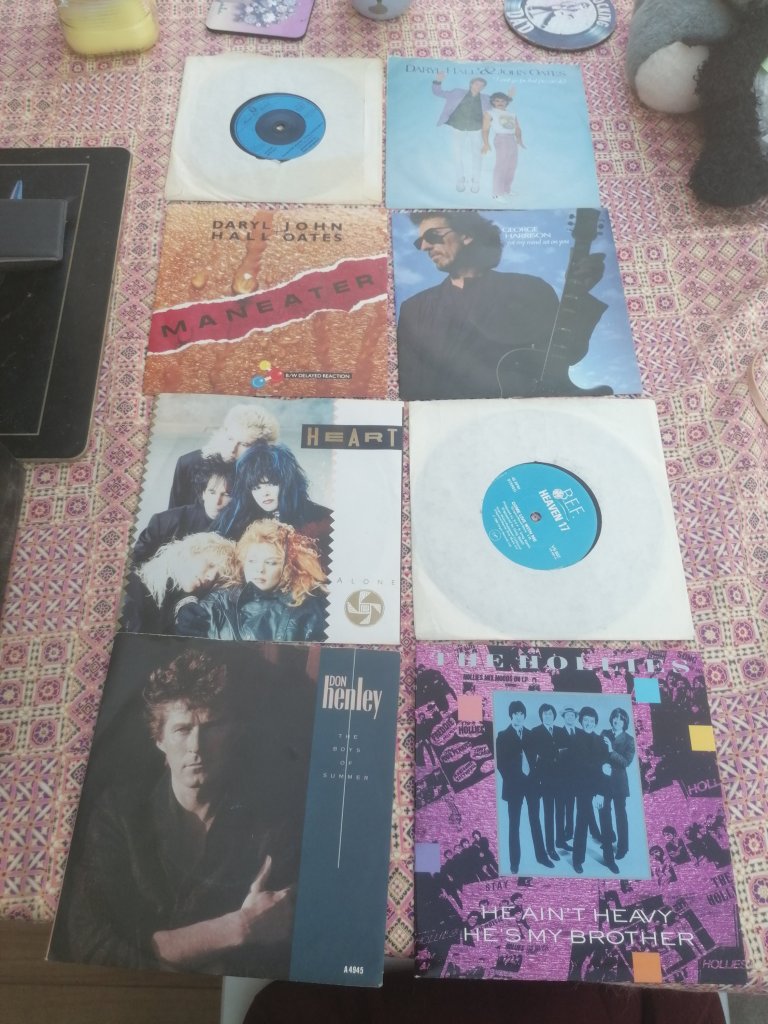
So, let’s start Part 7 with a set of classic tracks from a whole range of genres. Haircut 100 were a short-lived but very good band fronted by Nick Heyward. His excellent song writing and fresh faced appeal made them irresistible to female record buyers in particular. Over the years I have grown to appreciate their records more and more, but at the time I only picked up Favourite Shirts (Boy meets Girl), a typically catchy and sunny track. Hall and Oates were an American duo who had a Top 10 single with I Can’t Go for That followed by a Top 5 smash in the UK with the brilliant Maneater. They had a real feel for a chorus, and could inject attitude into the simplest phrases. They had more success in their native land but their 80s singles definitely bring memories flooding back. The quiet Beatle George Harrison had a massive hit with Got My Mind Set on You, a brilliant track accompanied by an equally brilliant video. It was a track produced by Jeff Lynne, and this collaboration led a year later to my favourite supergroup of all time, The Travelling Wilburys. As with a lot of Jeff Lynne’s productions, the kitchen sink is thrown in, followed by the bathtub but it all works somehow! Heart had their biggest hit with Alone, a record that reached Number 3 in May 1987. It is an archetypal power ballad, and I was, and remain a huge fan of power ballads. You will spot a good few of them in the singles collection! Much as I enjoyed Temptation by Heaven 17, it was Come Live With Me that really captured my imagination. Glenn Gregory sounded excellent on both tracks, but his world weary delivery just took this song to another level. With memorable lines like ‘I was 37, you were 17’ and ‘If half the things they say are quarter true of me’ it got me dancing and it fascinated me as a piece of storytelling, the perfect combination. Is there a more perfect American summer song than Boys of Summer? As soon as you play it, your imagination puts you in a car travelling down a long straight American road with the top down. It is atmospheric and simply exudes cool as befits Don Henley, perhaps the most effortlessly cool member of The Eagles. It is an incredible piece of music. Finally, we go from 80s cool to 60s cool with the classic ballad from The Hollies, He Ain’t Heavy (He’s My Brother). It finally reached the top of the charts in September 1988, 19 years after its first release, when this song featured in an advert.
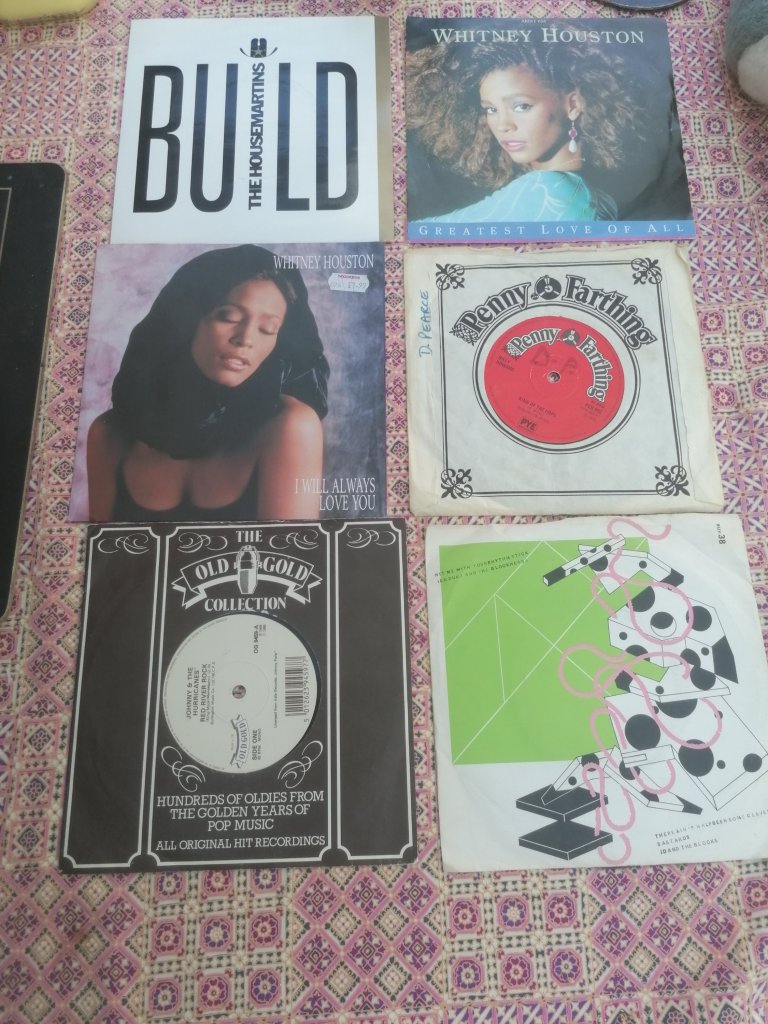
Well, this was a massive surprise! How have I only got one Housemartins single? It is my favourite track of theirs, a fantastically melancholy look at the price of ‘progress’. Build is the cry of the people not so much left behind by progress, but treated as collateral damage. Next time you listen have the lyrics or lyric video to hand. Whitney Houston is simply an icon and I have two of her singles, along with both of her albums on cassette – now sadly unplayable as I no longer have a cassette player! Anyway, The Greatest Love of All and I will Always Love You are the tracks that to me epitomise her brilliance. Neither require any further introduction, but I always feel that the former is perhaps unjustly overshadowed by her other tracks.
We now come to a piece of my personal history, the first single I ever bought. I am sure that some people did strike gold with the first single purchased with their own money, but I bet most people actually bought a record with a cringe factor like Billy Howard’s King of the Cops and try not to admit it. I loved it at the time, or I wouldn’t have bought it, but looking back now, it is a gimmicky song that is objectively awful with Howard performing poor impersonations of American cops from TV shows of the era. As it is, there are two things very much in its favour. The B Side, Bond is a Four Letter Word is very funny even now with a very good Sean Connery impersonation. More to the point though, it introduced me to the thrill of deciding which single to buy, taking it out of its cover and watching it spin on that turn table for the very first time. That still lives with me every time I get a new single or album.
Red River Rock by Johnny and the Hurricanes was a permanent fixture on the jukebox at the Crispin, my local pub, and when I saw it on the trusted Old Gold label I snapped it up. It’s a Rock n Roll instrumental with virtuoso guitar work that is extremely infectious. It got played pretty much every night my friends and I were at the pub and we all loved singing along to the tune. Take a listen and you’ll see what I mean. Hit Me With Your Rhythm Stick was probably my gateway into punk with its funny lyrics, the utterly unique Ian Drury and the fantastic work by his band The Blockheads. During their career they produced song after song steeped in the London experience as their predecessors The Kinks did and their successors Madness would do.
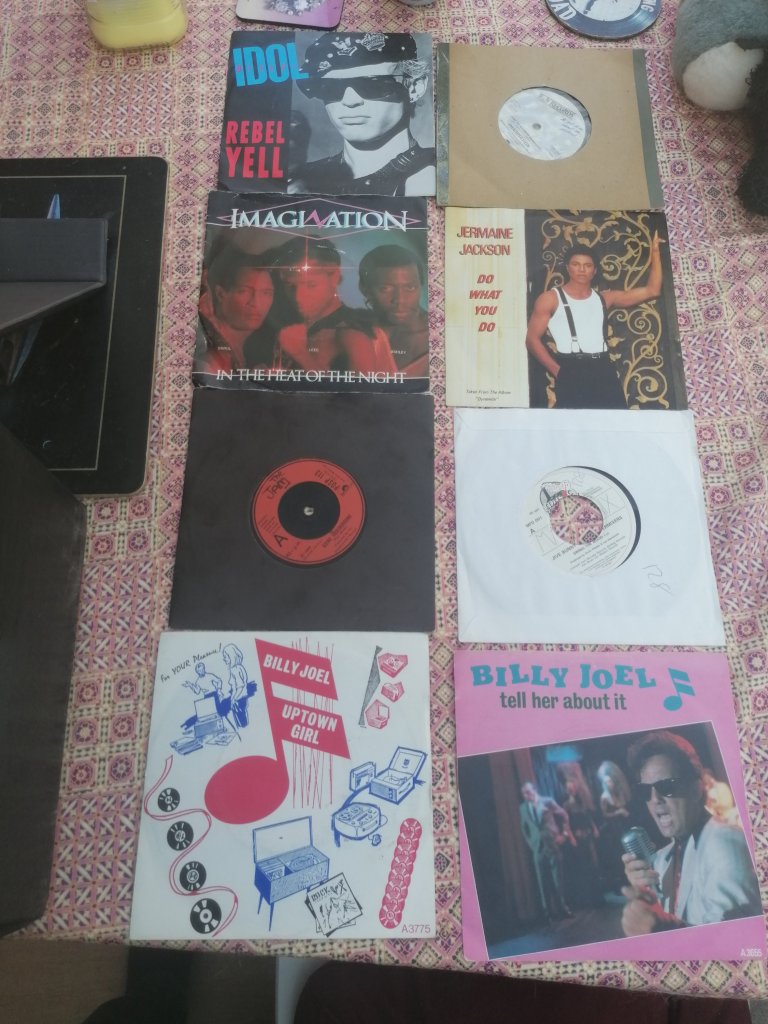
Rebel Yell was Billy Idol’s biggest hit along with White Wedding, both of which made Number 6 in the charts. The chorus was a proper singalong and it’s still a song that makes me smile. Imagination were one of my favourite funk bands of the 80s and their biggest hit Just an Illusion was a Number 2 hit which was kept off the top spot by the Goombay Dance Band! Shades of Vienna and Joe Dolce there! It was a song that had a brilliant tune and a superb performance from Leee John (yes there were three ‘e’s in his first name!) which made it one of the most instantly recognisable dance tracks of the time. In the Heat of the Night was released 6 months after their biggest record, and although it stalled outside the Top 20 it was another excellent track from a band that really deserves to be better regarded. Jermaine Jackson, like the rest of the family was very much in the shadow of his younger brother MIchael, but Do What You Do is smooth, beautifully sung and a song that Michael himself would have been happy to put his name to I would think. Only one single from 80s Mods The Jam, but what a single. Going Underground is an absolute belter of a track with a thumping bassline, excellent drumming and socially conscious lyrics delivered with real passion. Swing the Mood has none of those attributes, but it was definitely interesting to hear big band jazz in the charts!
Now we come on to Billy Joel, the Piano Man himself. All five of the singles released from his Innocent Man album were Top 30 hits, and the album itself reached Number 2 in the album charts. To say I was obsessed with the album was something of an understatement. I had all five of the 7 inch singles as you can see, the first three Uptown Girl, Tell Her About It and An Innocent Man on 12 inch singles and the cassette version of the album itself! If we had had different coloured versions of any of the above I would have bought those as well. When CD came along I collected all of his studio albums on that format, and I would almost certainly pick up the vinyl of Innocent Man for a reasonable price nowadays! He is quite simply up there with The Boss in the pantheon of American artists of the 70s and 80s for me, and up there with Elton John as the best piano player of his era.
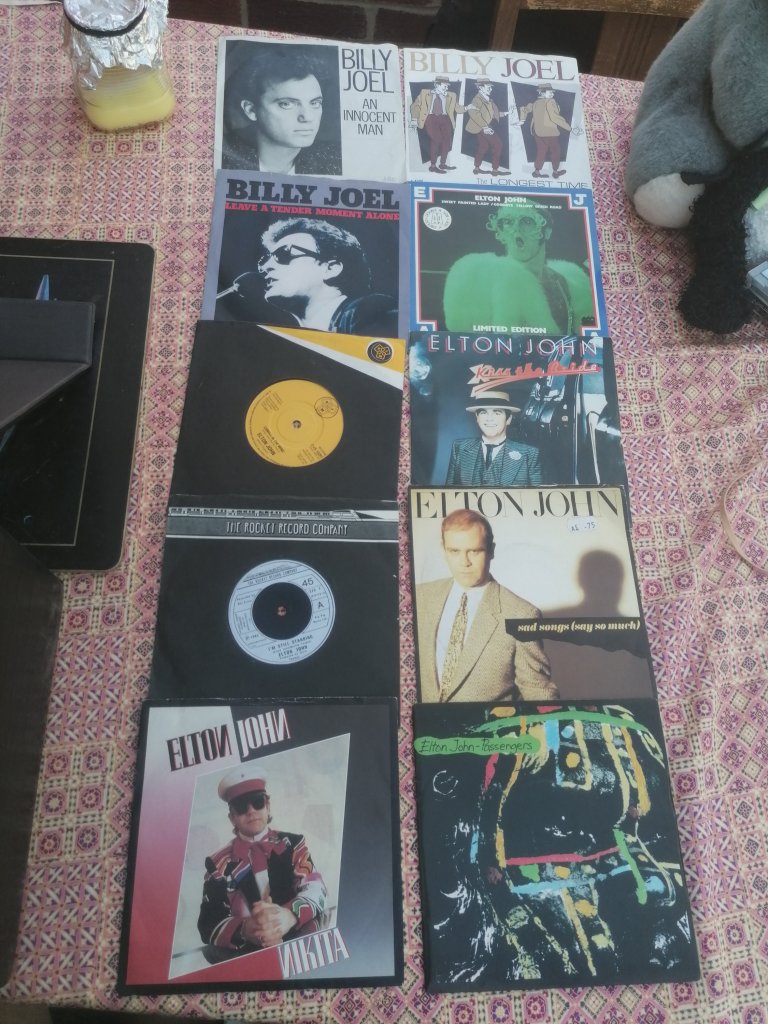
Speaking of Elton John, I have a number of his singles as you can see. My two favourite tracks of his in the 70s are there, in the shape of Goodbye Yellow Brick Road and the original version of Candle in the Wind. (As an aside I do wish he hadn’t rewritten it, let alone released the 1997 version which was frankly mawkish in the extreme.) From his excellent 1983 album Too Low For Zero perennial favourite I’m Still Standing and the rather overlooked Kiss the Bride which only reached Number 20 in the charts, believe it or not. It was the start of a run of tracks that sent Elton John back to the charts on a regular basis. The three other singles here include perhaps my favourite song of his, the gorgeous Nikita. Sad Songs and Passengers were also very good, but Nikita just stands out for me as one of the pinnacles of his career as a balladeer.
See you next time for Part 8!

For those of us of a certain age, one of the landmarks of primary school was sitting in the classroom just before 11am on a Monday waiting for the radio to be switched on for Singing Together. Although the programme ran for over 60 years, starting in 1939 and ending in 2001, I am often met with blank looks by anyone who went to primary school after the early 80s. So, if you have never heard of it, or experienced its gentle charms let me introduce you to a programme that literally provided the soundtrack to my primary school years.
Rediscovering Singing Together
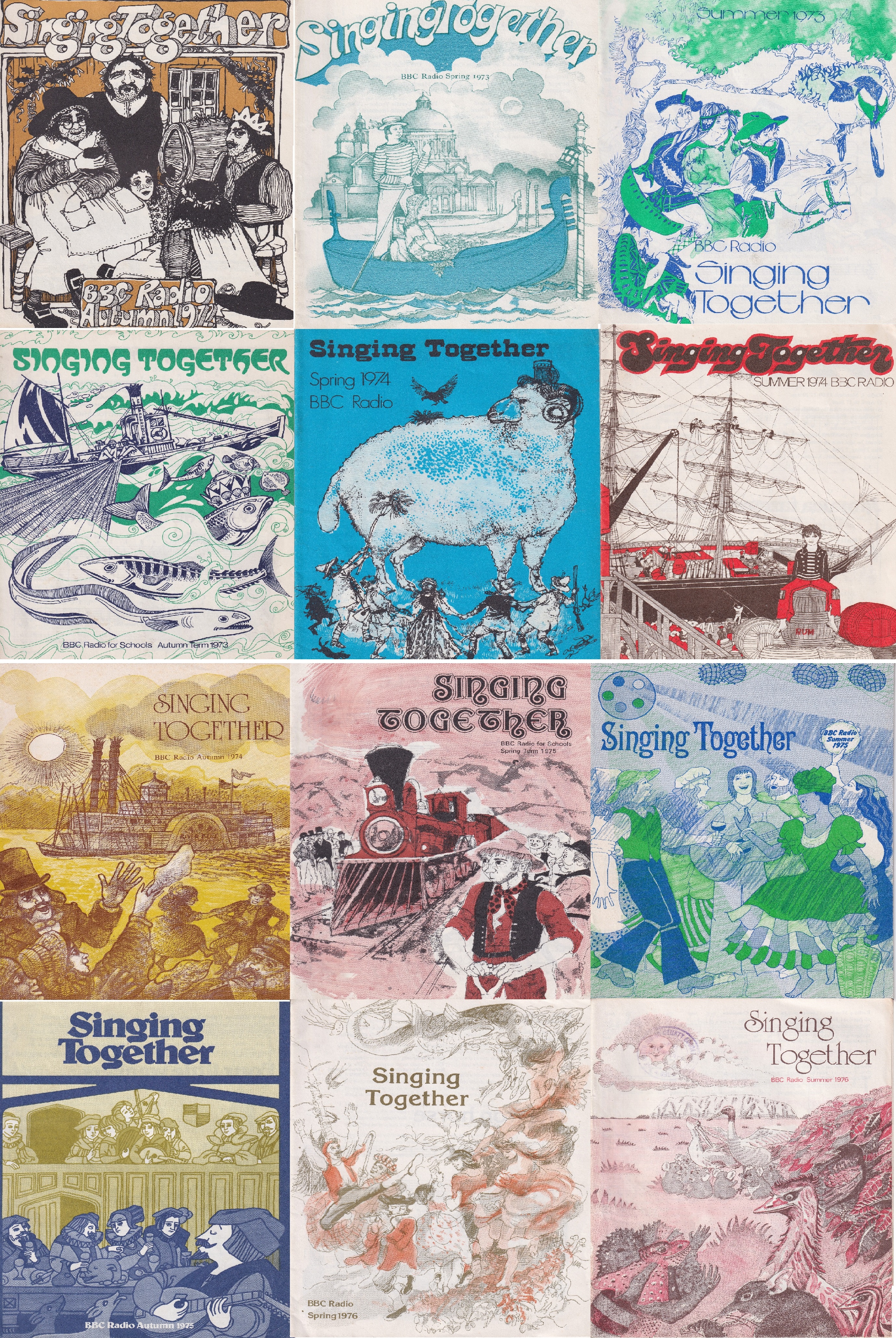
When I did a twitter challenge called #Marchthroughtime I reflected on two songs I remembered from Singing Together. It made me wonder if there were any records of the show anywhere, so I went to eBay and found the marvellous Nigel42folk who had digitised decades of Singing Together books including the entire run from my primary school years. So, what did I remember about one of my favourite parts of the week? More than I realised as it turned out.
A potted history
Singing Together was part of the Reithian tradition of the BBC, to inform, educate and entertain. It started on 25 September 1939, just over three weeks after the Second World War started. That is no mere historical detail, it is central to the reason it came into being. With children being evacuated and sent to new communities away from the expected bombing targets, thoughts turned to how these new arrivals might integrate. Community singing was considered to be a very effective vehicle for this integration and so Singing Together was born. For much of the first couple of decades, the song list consisted almost entirely of British folk songs, but gradually songs from cultures around the world began to appear. By the 1970s there were a number of songs from Europe, the US and the Caribbean amongst other areas, making the list more varied and interesting. The Autumn Term saw a range of Christmas songs from a variety of cultures along with the more traditional entries. Some songs were forgettable, but some stayed with those who sang them for decades afterwards.
Singing Together 1970 – 1976
I spent the first five years of my life abroad in India, Pakistan and Singapore as my Dad worked for the Diplomatic Wireless Service. However, in 1970 we returned to the UK and our first port of call was a small village called Potterspury in Northamptonshire where I went to Potterspury Primary School (now renamed John Hellins Primary School) for a year. From the first term of songs, one stands out. See Amid the Winter’s Snow is a lovely carol, but it isn’t one you hear very often. When Annie Lennox sang it on her Christmas Album many years later I knew it from somewhere, but I didn’t know where. As it turned out, it had triggered one of my earliest memories of this country in the Autumn 1970 Singing Together songbook. The other song from that year that came back to me was when I read the list of songs for the Summer 1971 songbook. It was a song called Donkey Riding and I remembered how much I loved singing the chorus! Here it is sung by Fisherman’s Friends
The first few years back in England were quite nomadic, and September 1971 saw me at Bligh Way Primary School in Kent which I remember as the first time I realised I was an outsider. I wasn’t liked by students or staff and I just remember wondering why we had to move there. Monday mornings were one of the few times I could really enjoy and it was nice to know that even in the face of the comments about my lack of coordination (dyspraxia) and general ‘weirdness’ (Asperger’s) I received from everyone including the headmistress there were some positive memories. Two songs immediately stood out from Autumn 1971, and I started singing them in my head as soon as I saw the titles. One was Land of the Silver Birch, a Canadian folk song about the Native culture with a chanted chorus that I found irresistible and the other was the carol from Saint Helena called Mary had a Baby which, once again had a chorus that has stayed with me for over 50 years. I loved the type of song you could ‘belt out’, a musical preference that has stayed with me ever since as my ongoing trawl through my singles collection is testament to! Neither of the other songbooks from that year had any songs that stood out, so onto the next school! My choice from the two mentioned is Land of the Silver Birch.
Cobham Primary School was one of those in the vanguard of the progressive teaching movement, where projects that saw each student ‘playing to their strengths’ made that school more to my liking. Once again, however, it was a one year stopping off point from September 1972 to July 1973! The progressive teaching meant that I could devote myself to reading and finding information for group projects, leaving other people to the writing and the art. There were a couple of obvious highlights in the Autumn 1972 book. The song Four Sisters again had a chorus that I enjoyed and amongst the carols there was Deck the Hall that I’m pretty sure I hadn’t come across before, which, according to the book, is a Welsh carol. There was a Spanish carol in this book called Fum, fum, fum, but it rings absolutely no bells whatsoever! The Spring 1973 book contained the most well remembered tune of all, the wonderful Song of the Western Men, a song of Cornish origin, that is thought to tell the story of either Sir John Trelawny, jailed by King James II in 1688 or his grandfather, of the same name, imprisoned by King Charles I in 1628. As with many folk songs the derivation is a matter of debate, but even if I had been aware of that debate I wouldn’t have cared, because the song is just fantastic. Here are The Fishermen’s Friends once again to show you how it should be sung.
Once again, the Summer Term had no songs I remember, but looking at the lyrics of Here Come the Navies, an Irish song, actually references the potato famine and the prejudice they faced when coming to England. It’s a fascinating insight into history, and quite advanced in a sense for primary school pupils.
It was off to another school in the September of 1973 (!) as my parents were unimpressed with progressive teaching and wanted something more traditional for me. I passed the entrance exam to get into St Andrew’s in Rochester and it became the only school which holds any fond memories for me at all. The three years there were safe because a lot of my fellow pupils seemed to be similar to be in many ways so I no longer really stood out. It was a lovely school and one I wish I could have been at for longer. The Autumn Term 1973 songbook contained more carols including the marvellous Gabriel’s Message which was the B Side of Sting’s single Russians. As with See Amid the Winter’s Snow, I knew it was familiar from somewhere when I first listened to Sting’s version, but it was only when I looked at that term’s Singing Together that I understood why. Perhaps he too heard it in Singing Together when he was training to be a Primary School teacher at the time. It’s an interesting thought isn’t it?

Spring Term 1974 is the cover I remember most clearly. It is based on the Derby Ram which I very dimly recall. It was The Lincolnshire Poacher that I really enjoyed at the time. As with all my other clearer memories, it was one that benefitted from an excellent chorus. The theme that is coming across when I look at these songs is that of folk songs that were pieces of social history, reflecting lives that never made the pages of the history books in a time when all that mattered was Kings, Queens and battles. Summer Term 1974 featured the West Indian song Jamaica Farewell which I loved, although I do remember in those less politically correct days that we were encouraged to sing the song in a Caribbean accent!
Autumn Term 1974 saw me in 3rd Year Juniors and thoroughly settled into the life of the school. The carols that term were not familiar then and not familiar now, but there was the bonus of Cockles and Mussels, a song I remember singing outside of Monday morning’s Singing Together broadcasts, because I enjoyed it so much. Spring Term 1975 had no real highlights for me, although I do remember Kalinka, the Russian song. Summer Term 1975 featured Scarborough Fair, made famous by Simon and Garfunkel, not that I knew it then.
My final year of Singing Together started with the Autumn Term 1975 songbook. The carols this year included the Carol of the Drum. Ringing any Christmas bells? Possibly not, but if I called it The Little Drummer Boy you would probably recognise it instantly. Even the children who didn’t like Singing Together could not help but enjoy that tune. Here’s my favourite version of that song from Charlotte Church
1975 – 6 was my last year of Primary School and Spring Term 1976 had two songs that I actually recognised already. A-Roving was a song sung by The Spinners, a folk group whose album was one of the few my parents owned. As a result I played it quite a lot at home and was very familiar with it already. The chorus of Casey Jones was the theme tune of a black and white TV programme of the same name, that appeared during school holidays if Champion the Wonder Horse wasn’t on (!), which I hadn’t thought about in ages before looking at the songbook. Here it is in all its ‘glory’!
So to my final Singing Together songbook from Summer Term 1976. It was a very low key finish for the series, in terms of the songs, although I am sure that I joined in with my final opportunity to sing at 11am every Monday with my usual enthusiasm. That term saw me concentrating on Lady Precious Stream, the 4th year Juniors leaving play, in which I took one of the main parts, that of the Prime Minister! I loved it and thoroughly enjoyed getting most of the laughs. It is, however, somewhat bittersweet reading the review of the play which I never saw until returning to the school for its 60th anniversary. It reminds me that before the Maths School knocked it out of me I did have some self confidence.
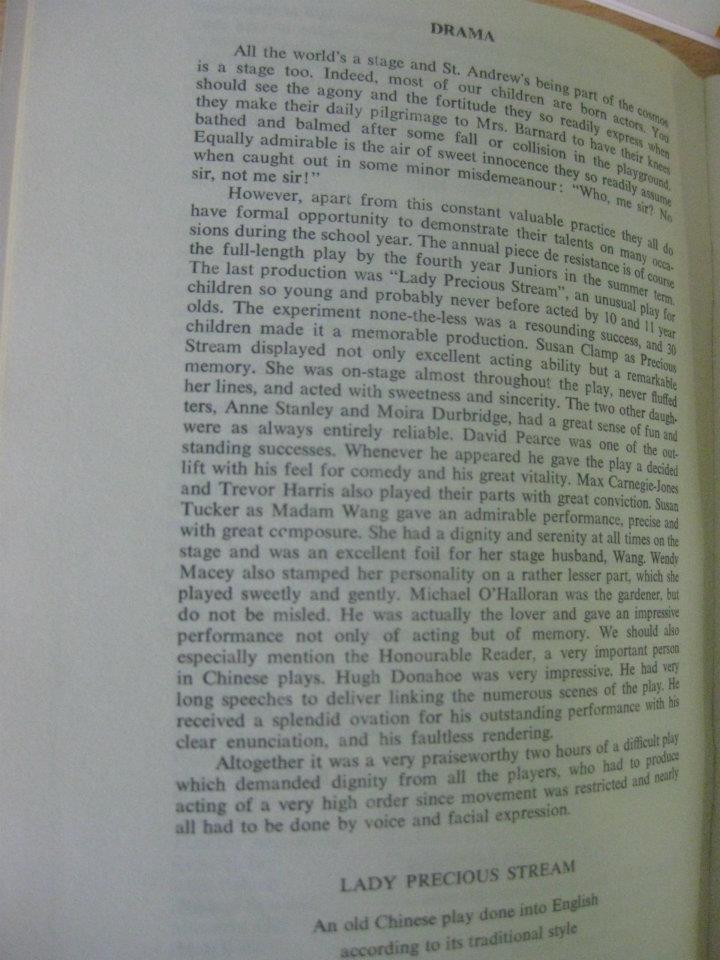
So, there you have it. The part that Singing Together played in my formative years was low key but definitely not unimportant. It gave me a love for music, an appreciation of a good chorus, an early introduction to the music of the world and a smattering of social history. I feel that those of us who grew up in the Singing Together era were very lucky and I wish something similar had been around for my own children.
 David Pearce - Popular Culture and Personal Passions