
Here is a Box, a Musical Box
Wound up and ready to play
But this box can hide a secret inside
Can you guess what is in it today?
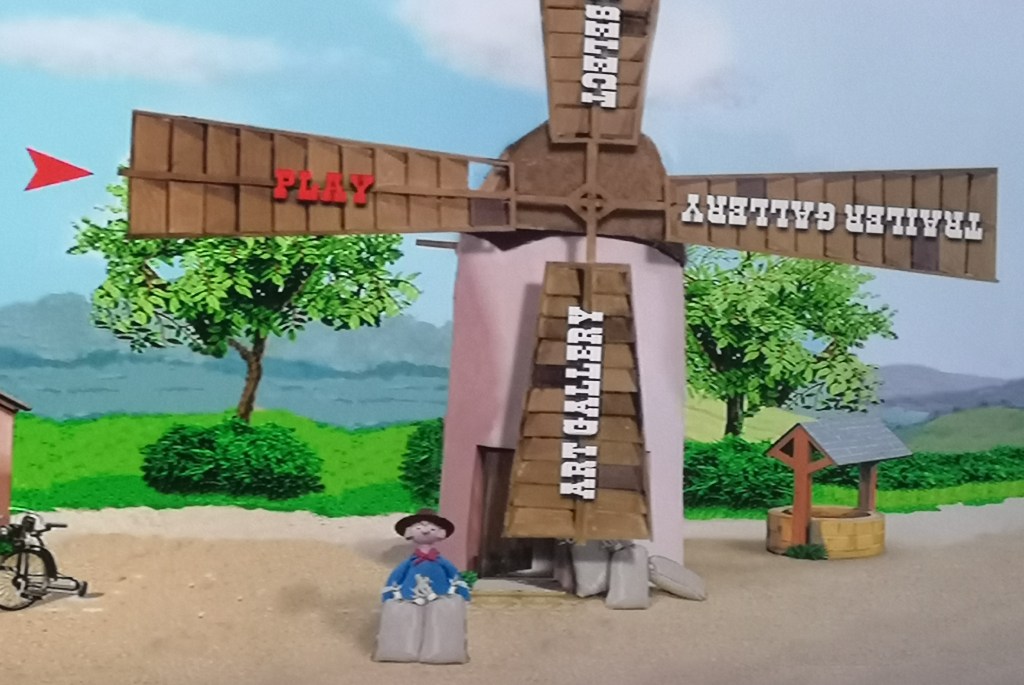
Camberwick Green was made in 1966 and was the first of the Trumptonshire Trilogy, followed by Trumpton in 1967 and Chigley in 1969. To my mind, it is the children’s TV equivalent of the first three albums by The Police. Outlandos D’Amour was a great start, Regatta De Blanc was the standout and Zenyatta Mondatta had great moments but did not hit the height of the first two. That is why you will see Trumpton in this series of posts but not Chigley. Why not put them together as a trilogy? Well, I did think of that, but all three series were self contained and very different from each other in tone and characters. Also, it would have made the blogpost too long. So, what makes Camberwick Green so special? Well, the elements I remember most vividly, before rewatching some of the episodes, are the opening and closing credits and Windy Miller.
If I may digress for a minute, I was interested by a poll I saw in my research for this post. Neither Camberwick Green nor Chigley were able to earn a place in the Channel 4 100 Greatest Kid’s TV Shows poll from 2001, which saw Trumpton at Number 22, and it would be unlikely to be remembered at all by many voters if they re-ran the poll now. It is a fascinating list, but the top spot was taken by The Simpsons showing that the voters had no clear idea what a Kid’s TV show really was. The Simpsons definitely isn’t my idea of a kids show, and I think it was only the fact that it was a cartoon that led voters to that conclusion.
Getting back to Camberwick Green, the programme was, like almost all Watch With Mother programmes, a series of 13 episodes, allowing for 4 different programmes in each daily slot throughout the year, first shown between January 3 and March 28 1966. It was repeated until 1985 and has been released in a number of versions on VHS, DVD and Blu-Ray. The latest, and presumably last, of these releases includes the original master tapes found in writer and producer Gordon Murray’s attic. It is however for the purists given it is over £40 for the DVD and £50 for the Blu-Ray at full price!
Episode 1 Peter Hazell The Postman
The lovely tune, the clown that rotates the opening credits, the music box that opens to reveal the central character of the story, and the unmistakable voice of Brian Cant are instant nostalgia for any child brought up in the UK in the 60s, 70s or 80s. The first story centres around Peter Hazell, the postman for Camberwick Green. Like all the characters, Peter has a song of his own which starts with a strong whistle, a sound that you used to hear from many postmen or milkmen on their rounds, and indeed many men in a range of jobs. He has a song for emptying the post boxes and a variation of the song to tell him who to deliver the letters to. Once he has got the letters sorted he starts dancing with Mrs Dingle, for no adequately explored reason! He goes first to Mickey Murphy the baker, then to Dr Mopp whose beard and top hat made him instantly recognisable to many children of the era. Poor Dr Mopp finds himself being talked at by Mrs Honeyman the village busybody. Then it’s on to Windy Miller with that iconic windmill, the sails turning making a sound I recognised instantly. Windy has the smock and hat that mill workers probably stopped wearing over a century ago. Then, it’s off to Pippin Fort under the command of Captain Snort. Peter gets into trouble for calling the men to collect their letters while they are on parade. As Brian Cant observes, ‘You must never do that’! That is it for the story in Episode 1. Back goes Peter Hazell into the music box and the closing credits are turned by the clown. The lack of action or storyline would almost certainly baffle children these days, but the appeal to those of us of a certain age is more about the characters and the village, which was very similar to the villages you could see in the UK in the 60s and 70s in particular. My grandparents lived in one such village, Felsted in Essex, with many characters who were identifiable chiefly by their professions. It is a throwback to quieter and more socially structured times that is now so far away from our modern lives as to be unfathomable to many.
Episode 2 Windy Miller
We meet Windy at his mill, preparing to grind some corn. We learn that many farmers now take their corn to the large modern mills rather than to the old windmill. Farmer Jonathan Bell brings his corn to Windy and suggests that he get himself a modern mill so he can increase his business. Windy is adamant, saying that the mill was good enough for his father and grandfather and is therefore good enough for him. In any case, as Windy points out, the modern mills don’t make such a nice sound! In a very interesting detail, given that this was made in 1965 before it became socially unacceptable, Jonathan refuses Windy’s offer of home brewed cider as he is driving. Maybe the subtle message influenced a generation of drivers without them knowing it, as I remember that in my generation drinking and driving was definitely frowned upon, whereas for my parents’ generation it was not really a big deal even when it became illegal. Windy, however, has a drink as he likes cider but as it is very strong it sends him to sleep! While he is sleeping the sails stop turning. Mickey Murphy, whose tune is an Irish jig, requires a lot of flour for a flood of orders from Captain Snort and Mrs Honeyman. So, Mickey and his children drive to Colley’s Mill to pick up some flour. They wake Windy up, but there is no wind to power the sails. Windy says that all you need to do is whistle for the wind so he, Mickey and the children try to do this. We then go to Pippin Fort where the soldiers are off to Camberwick Common to play tracking games! They are all roped in by Windy to whistle for the wind and this time it works! Mickey Murphy gets his flour and we wave goodbye to Windy.
Episode 4 Dr Mopp
The family Doctor who visited patients is very much a thing of the past, but Dr Mopp is one such Doctor in his car that requires a handle to start it. This would have been old fashioned even in the 60s, so he is very much a throwback. First of all, Dr Mopp visits the bakery to tend to Mickey Murphy’s children who have bad colds. Luckily Dr Mopp has pink medicine for that, so that’s a relief! Mrs Honeyman sees him go into the bakery and sees the chance for a good gossip. She leaves her baby under the watchful eye of Peter Hazell, but when she looks at her baby in the pram she sees that there are red spots all over its face. What she doesn’t see is one of the soldiers from Pippin Fort on a ladder right above the baby using red paint! Dr Mopp goes to Windy Miller’s mill in a hurry, because, it turns out, he is a keen photographer and Windy has spotted two thrushes building a nest. The doctor remembers that he needs to be at Pippin Fort for a medical inspection of the men, helped by Sgt Major Grout who gives the order to the men to stick their tongues out! Then it’s off to Jonathan Bell whose wife is unwell. He hears a very deep cough which Farmer Bell tells him has been going on for two days. It turns out not to be his wife who has the cough. As Farmer Bell says, ‘Oh no, it’s not my wife, it’s the old cow’!! Definitely a joke for the adults watching 🤣🤣 His final job of a busy episode is to tell Mrs Honeyman that the baby’s red spots are paint.
Final Thoughts
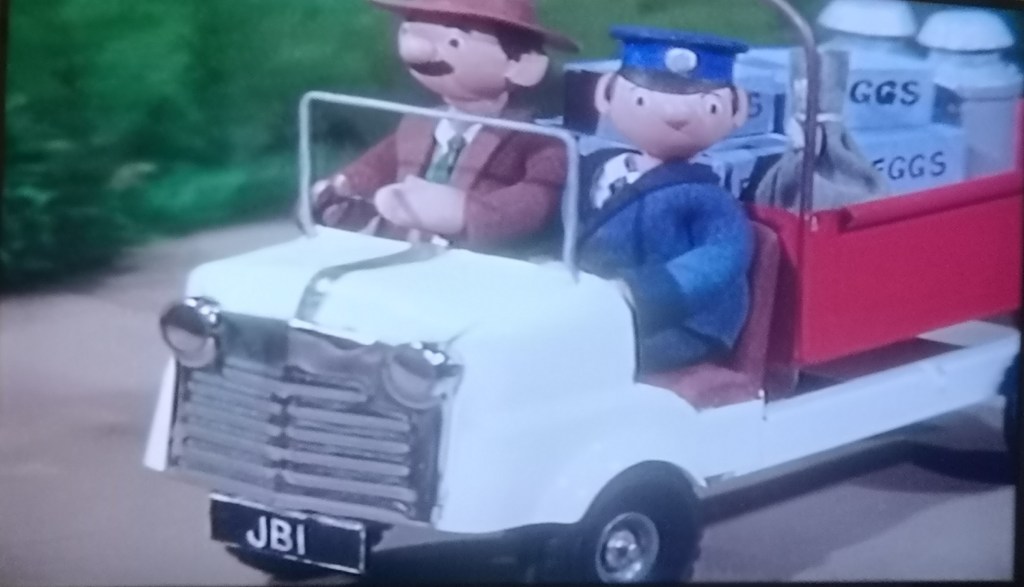
This is an absolute joy of a programme, that looks at old fashioned ways with a wry humour, while indicating that more modern approaches may not always be an improvement. There is real care taken with the stop motion animation and the detailed buildings and backgrounds. People are kind to each other, help each other out whenever needed and are even patient with the gossipy Mrs Honeyman. This vision of a Britain that might only have existed in Trumptonshire is still one that has a power to draw us in. It is an analogue world with community life at its centre and a clear expectation of each person according to their position and profession. Tolerance is the watchword in Camberwick Green, and although very little of any real importance seems to happen, you know that everything is helping to keep their small village in perfect equilibrium. You are safe in Camberwick Green, safe with Brian Cant’s gentle and humorous narration and safe in the little music box which only gives you pleasant secrets.
It’s abiding cultural impact can be shown most clearly by TV series Life On Mars and the rock band Radiohead. Enjoy the two links below, which are dangerous in a way Camberwick Green could never be, but dangerous in a way that would certainly have given Brian Cant a chuckle.
Which animal would you compare yourself to and why?
I would compare myself to a cat, because I think I share some characteristics with my own cat Albus. First of all I am a home lover and I am never happier than when I can be safely inside my four walls. Yes, I do go out, but I always look forward to getting back to what is familiar. Second, I am loyal to, and comfortable with, a small number of people. Albus is incredibly affectionate with people he knows and trusts but he steers clear of those he doesn’t. There are occasions when I think that diving for cover or heading to the foot of the garden is far preferable to being sociable 🤣🤣! Third, I am always looking out for those I care about, checking in from time to time and making sure all is as it should be.
I am aware that Albus is not your typical cat but if I channel any animal it’s definitely him. We are very similar in personality and approach to life and I can’t imagine anyone else from the animal kingdom I would rather be. After all, humans, animals themselves with no spiritual characteristics lifting above any other life form, would be so much better if they actually learned from other animals rather than believing they were better than them! This is why I like the approach of Buddhists who live in harmony with animals and see themselves as part of the same world.
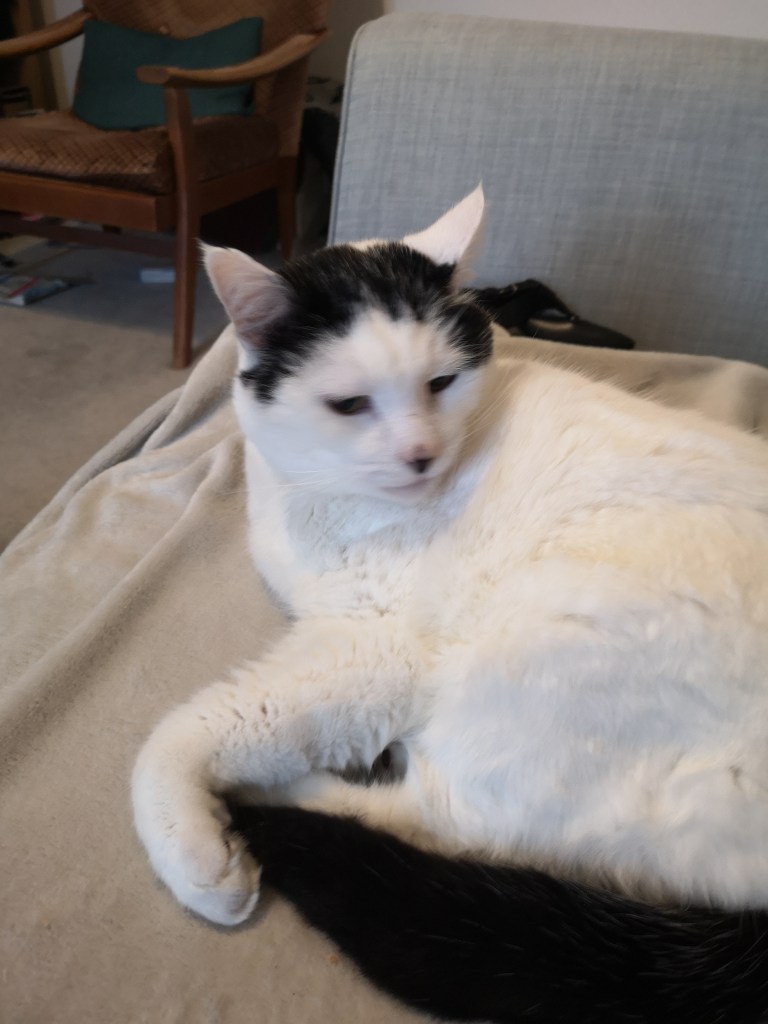
My Spiritual Guru, Albus
Write a letter to your 100-year-old self.
Statistically there is little chance of me, or anyone else, getting to three figures. As in cricket, though, it’s a target that seems to obsess people. Why is 100 so much better than 99 or 96? Why is it something to aim for? The truth is that it’s pointless unless you reach three figures in good health. There is no point in getting a telegram from the monarch if you are a wreck in a chair. Like most people I want to live as long as possible, but it needs to be on the basis of a high level of QALY. This is the concept of Quality Adjusted Life Years which I first came across in my teaching of prospective medical students at St George’s. In essence, it looks at your overall health and gives you a score. Let’s say you can expect 20 years of life but your health is only half as good as it was. That gives you a QALY of 10 years of life. If you can get your coefficient above 0.75 I would say that every year is worth it. If it slips below 0.50, what’s the point? It’s just sitting in the house probably in pain and not able to get anything out of your life, and that’s just existing. So, if I reach 100, which I won’t, it had better be with a QALY of at least 0.6! The century is as irrelevant in life as it is in cricket because an effective 89 will carry more weight than hanging on for an ineffective 100.
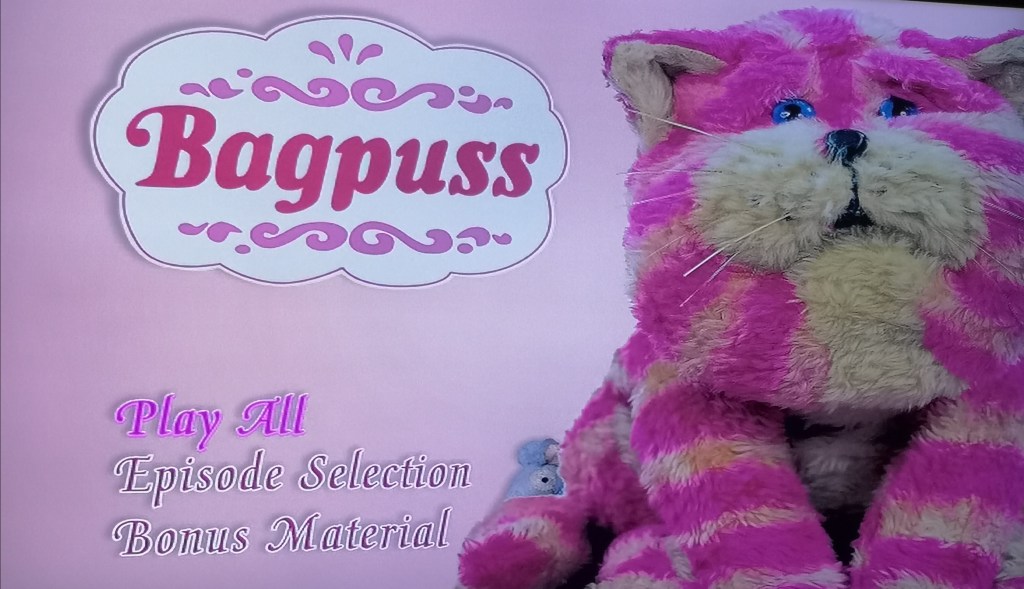
If there is one programme that instantly transports me back to my childhood, Bagpuss would be it. It was first broadcast on 12 February 1974, with the final one of the 13 episodes being transmitted on 7 May 1974. The first episode would almost certainly have been shown during the half term in my first year at St Andrew’s, so my clear memories of seeing it are probably not a trick that my mind is playing on me. I was just over a month away from my ninth birthday and I was still a big fan of Watch with Mother. Watching it now, I think it’s quite clear that, although it appeared in a slot for pre-school children, it was aimed at primary school children in general. The language and the ideas were quite advanced for five year olds, although the repeated introduction and ending would have appealed to the youngest viewers who could learn from the repetition and start to identify words and pictures. Occasionally, I would mention IT at school if I was talking to someone I knew wouldn’t say anything, but I tended to steer clear of anything that could be used against me. It’s not that this happened at St Andrew’s, but after two years of bad treatment from classmates and teachers I definitely played safe.
The opening of each episode was the same. Emily, a Victorian girl in a long dress with long dark hair, played by Emily Firmin, daughter of Peter Firmin who made the series along with Oliver Postgate, would be introduced as Bagpuss’ owner. I remember being absolutely enchanted by Emily who was about the same age as me and looked really pretty, and I doubt I was the only one! Let’s just say that even if I hadn’t enjoyed the programme, I would have tuned in at 1.45 just to see Emily!
The narrator, as he was for so many of the series they made together was Oliver Postgate, whose voice just exuded comfort and security to the young viewer. He created all the voices, except for the singing duo, Madeleine and Gabriel, whose folk songs are sung by Sandra Kerr and Peter Faulkner. Their songs became a very important part of the memories I have of the programme.
Episode 1 Ship in a Bottle
We are introduced to Bagpuss, The MIce on the Mouse Organ, Madeline the Rag Doll, Gabriel the Toad and Professor Yaffle, a bookend in the shape of a distinguished old woodpecker. The item turns out to be a ship in a bottle. Gabriel sings a folk song about mice who sail a very small ship, which the Mice enjoy very much, but which Professor Yaffle describes as very silly. The mice disagree with him and find a music roll to put into the ‘Marvellous, Mechanical, Mouse Organ’! This enables them to hear the song again accompanied by pictures that appear on the screen of the mouse organ. Professor Yaffle decides that Bagpuss needs to tell a magical story to reassemble the pieces of the broken ship. He puts on his Captain’s Thinking Cap from when he was a Sea Captain and tells a story of a voyage that he took. The ship is becalmed so he goes fishing and catches a topless mermaid! Now, that was one bit that I really thought my memory was misleading me on, but no! Let’s just say that the 70s were a different time shall we? If your parents read The Sun, then you will have seen your fair share of topless females before you got to the age where you might appreciate them, so perhaps this was considered completely innocuous. It certainly wouldn’t be these days! However, the fact that there ended up being at least a dozen, similarly unclad mermaids putting the ship back together was something I hadn’t remembered! Anyway, the story works and the mouse under the instructions of Professor Yaffle put the ship looking like new in the bottle and push it to the front of the shop window.
Episode 5 The Hamish
This is the episode I remember most fondly from the series. It is a piece of tartan material that Professor Yaffle says is a soggy bag with legs. They realise it is from Scotland so Bagpuss is given a Tam O’Shanter and then proceeds to weave the beautiful tale of a Small Soft Hamish. It was a creature that lived alone because it was very shy and frightened of people. It didn’t even have a name because it was completely unknown to mankind. Then Tavish McTavish (!) who played the bagpipes so badly that he was forced to live far away from other people (!) hears the call of the creature which sounds like someone else playing the bagpipes very badly. He decides it can only be his long lost brother Hamish McTavish as Hamish is the only other person in Scotland who plays the bagpipes as badly as he does. He introduces himself to Hamish and takes him into the small house he lives in. As it is very dark outside, it is only when he sees Hamish in the light that he realises it isn’t his brother. They decide that they like each other and they live together for many years until the Hamish hears the sound of many other Hamishes and Tavish tells him he must go to his own family. They are both very sad that they have to part and over 50 years on, so was I all over again. Tavish does not want to live on his own without the company of the Hamish, so he goes to live with his sister Mavis McTavish who hates the sound of bagpipes and he never plays them again.
Professor Yaffle is totally unimpressed by the Hamish explanation and decides it is a porcupine. Madeleine and Gabriel sing a song about a porcupine who travels around the world in a hot air balloon which is eventually brought down to earth by an errant spike. Finally Madeleine realises it is a porcupine pin cushion, so the mice find lots of pins to stick into the porcupin cushion, as Professor Yaffle calls it, and it is restored to its former glory. I beg leave to differ here as, to nine year old me it was a Hamish and all these years later, a Hamish it remains!
Episode 11 The Fiddle
My final choice takes me to Ireland, or rather the Bagpuss version of Ireland, which bears as much resemblance to the real Emerald Isle as the Hamish episode represented Scotland! Professor Yaffle says the old bucket that Emily has brought in is Irish. Gabriel hears a fiddle playing from inside the bucket and he and and Bagpuss recognise the playing as coming from a Leprechaun called Seamus O’ Hoolihan! Bagpuss met O’ Hoolihan in a peat bog in the far West of Ireland and he refuses the option of getting a pot of gold from him, much to the leprechaun’s delight. The leprechaun and Bagpuss then tell the story of when O’ Hoolihan was last caught by a cabbage farmer called Michael O’ Sullivan, and it’s a confusing tale of fiddle playing, dancing spades and axes and 40 acres of cabbages all cut in half! The fiddle was then played by the leprechaun to mend all the cabbages, as you might or might not expect. The mice find the fiddle in the bucket that Emily bought them and it starts playing on its own before joining in with a very strange song about Brian O’ Lim and his use of various animal skins to clothe himself. Perhaps exhausted by all the strangeness, Bagpuss goes pretty much straight to sleep at the end of the song. It is a genuinely bizarre episode!
Final Thoughts
From the first notes of the introduction and the first sight of Emily the years fell away. It was much more off the wall than I remembered, but in a lovely way that is absolutely enchanting. I remembered so many of the musical cues and the way that the characters spoke, sang and interacted. It’s amazing how fresh it seemed though. Some of the best children’s television of the 60s and 70s was given the kind of care that seems amazing nowadays, and Bagpuss was the gold standard. If your memory has been jogged and you want to see Bagpuss again, you can view all the episodes on YouTube or buy the Blu-ray version released last year, which I am tempted to upgrade to.
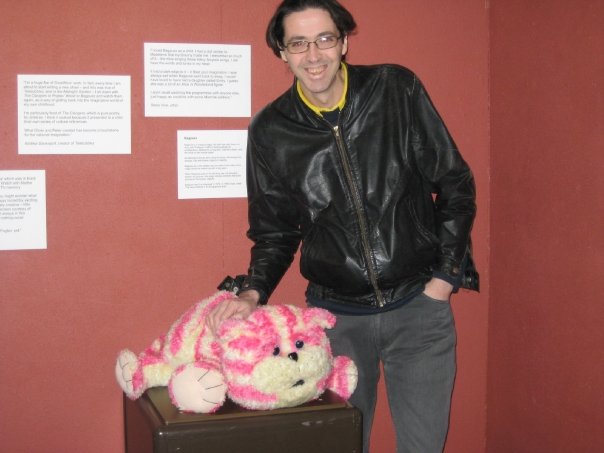
I actually met Bagpuss once when he came to Canterbury. As you can tell from the picture below my inner child was delighted!
Where would you go on a shopping spree?
This year I am on a serious spending curb as I am no longer working full time. So, any spending spree is definitely in the realm of fantasy, but if and when I win some money or some vouchers, I would definitely put it towards a book buying bonanza! I am a member of Waterstone’s Plus so I get 1 token for every full £10 I spend. That won’t go far on a spending spree, but every so often they have a wishlist competition that asks Plus Members to choose £300 worth of books to potentially win. I love choosing my books for the competition because they tend to be books I would otherwise see as too expensive. That is like a spending spree in my mind and my list changes for every competition.
If I won book tokens or Amazon vouchers I would take the same wishlist based approach and buy lots of books. The book pile at home is being reduced by increments and I am happy with regular trips to the library to get books that are a bit of a punt. However, if and when I do have the opportunity to spend a fair amount of money I will focus completely on books as they bring me so much pleasure and so much learning.
 David Pearce - Popular Culture and Personal Passions