
What is good about having a pet?
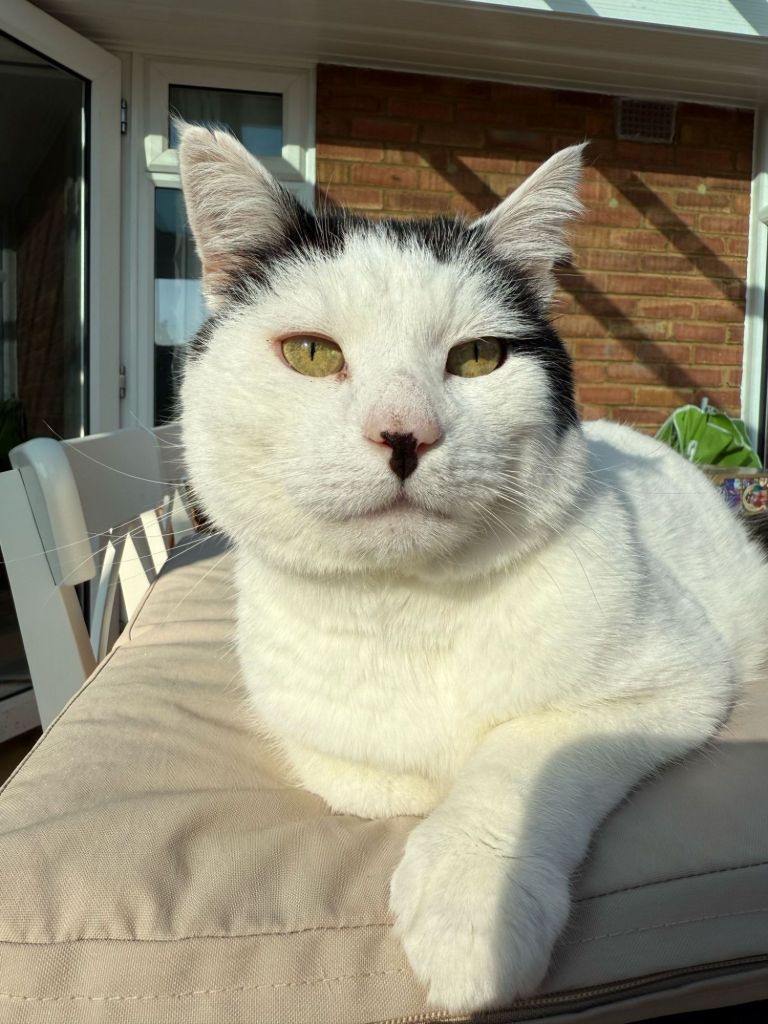
Albus has been with us 8 years now and is proof positive that cats are not these aloof creatures of popular imagining. Pretty much from the time we adopted him from Cats Protection he has been my companion, silent sounding board and occasional guest teaching assistant! He wants to be where people are, well people he knows anyway, and he is the most affectionate soul you could imagine.
Now that I am no longer commuting to London I spend far more time with him and he isn’t bored of my company yet! My daughter works from home most of the time, and my wife has a hybrid working pattern that means she doesn’t go in until later, but every so often it’s just me and Albus and you will find him either on my lap or near me most of the day. He has me as his personal butler, feeding and watering him on demand. When he wants to go out at night he scratches at the carpet which nearly always wakes me up, but I don’t mind. It’s an endearing trait as far as I am concerned, but my wife and daughter don’t agree!
My life has been so much richer for Albus being here. It’s more fun, filled with affection and I would recommend it to anyone.
Name the most expensive personal item you’ve ever purchased (not your home or car).
In terms of the proportion of an item’s cost compared to my wages at the time, the most expensive item I ever bought was a ZX Spectrum 48k computer back in 1984. Clive Sinclair’s company was at the forefront of the early home computer industry.
At the time, the way to access computer games was through a connected cassette player which made a lot of high pitched beeping noises! I remember a few of the games, pool, golf and an early version of a combat game where you were flying a plane to attack an enemy which bore some resemblance to the Falklands War about 18 months earlier. I was absolutely hopeless at all of the games, as I have been ever since! The coordination needed to play anything like that was beyond me with my dyspraxia, but I think it was a good way to practice my fine motor skills and I did notice some improvements.
The Computer lasted about 9 months or so until I went into the RAF. I am not sure what happened to it. In those days it would probably just have been binned, maybe when I left home. It was, by the standards of the time, a hugely expensive purchase. It was close to £200 at a time when I was earning £300 a month before tax! I have never spent a bigger proportion of my salary on one item before or since. On balance it was a complete waste of money! I would love to say it was lesson learned, but I have to admit it took a long time to be more careful in my spending!
What podcasts are you listening to?
One habit I can’t get into is listening to podcasts. I have tried with a couple of them recently, the first I have ever listened to, but I found them quite difficult to concentrate on, even when I was interested in the subject of the podcast.
As I explained the other day, I am trying to control my screen time and one way I do that is to read. Every morning commuting into London I read rather than scrolled or listened. The printed word is, to me, far preferable to the spoken word. I tried Audible and I like the full cast editions of books on occasions, but I can’t take a story being read to me because it takes so long and I am a fast reader. I know about the speeding up options, but to me it just sounds unnatural when you do that. Also, as a reader I am in control of the pictures in my head and the sounds of the characters voices and I much prefer that.
OK, so if you are still reading this I would like you to suggest a podcast for someone like me who doesn’t really get on with the format. It could be about music, Christmas, books or any of the other things I have written about recently. I will try to give some of your suggestions a go, but no promises.
What was your favorite subject in school?
At St Andrew’s Rochester, the one school I loved, I found real joy in learning. My favourite subject at the time was probably History. I was an avid collector of Ladybird Books but only the history ones. I remember, particularly, a fascination with Horatio Nelson and the Battle of Trafalgar. As I mentioned in a recent blog I produced a 4 page newspaper about the event complete with adverts for a school project! One of the benefits at that time was that the Tudors were not taught every other year as they seemed to be during my children’s school days. I did very early on develop a dislike for Henry VIII and that has hardened since those days. He was one of the most unpleasant people ever to be in charge of the country and the way he became a folk hero never sat well with me. Instead of him, we learnt about Victoria, the Romans and Boadecia as she was then referred to and Explorers across the ages.
Geography was another subject that I enjoyed because it was focused on facts about countries. We had a slide show once in class that showed the journey from cocoa bean to chocolate and I was absolutely fascinated by the journey from primary source to end product and the work of the women (almost exclusively) who picked, sorted and began processing the cocoa beans. It gave me a whole new appreciation of the bars of chocolate I ate, an appreciation that has continued to this day.
Looking back, I remember Arithmetic as we called it in those days. I was interested in numbers and I proved to be a natural at mental arithmetic. We used to have very long times table tests which I loved and did very well at, and to this day I can calculate numbers in my head for fun!
I have written about Singing Together at length in three blog posts and if you want to take a look at them I have linked to the main one above. In addition there are two Christmas themed entries that you can take a look at with the second link reflecting my St Andrew’s experience.
All of these subjects were taught in an engaging way, by excellent teachers in a supportive environment. My enthusiasm for these areas of learning did not, however, survive my move to Secondary school where anything other than surviving the day intact was the furthest thing from my mind. I wonder how common that was and still is?
How do you manage screen time for yourself?
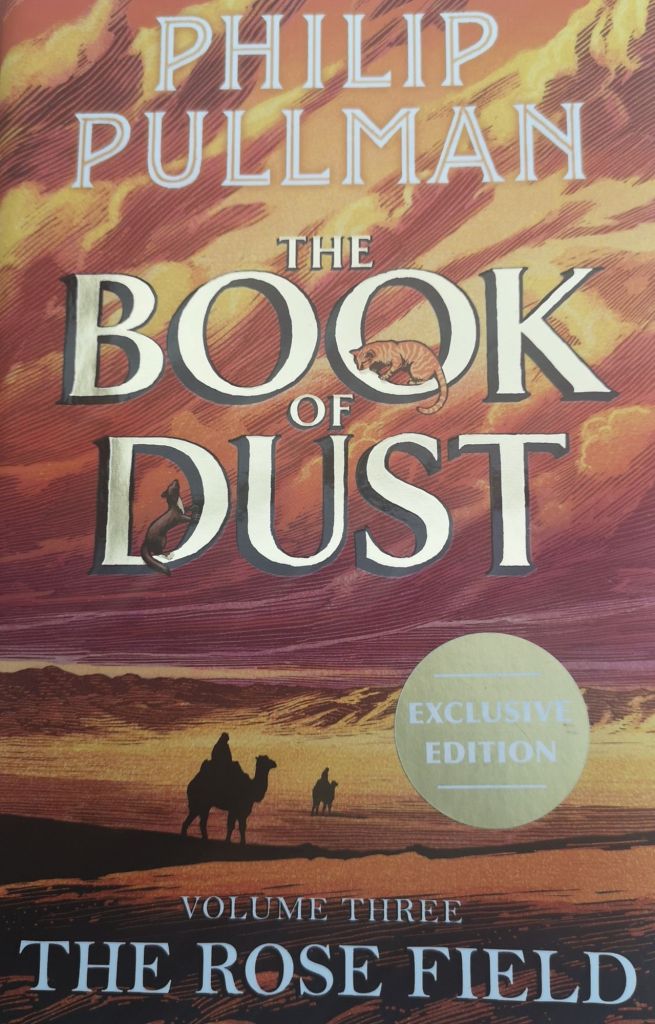
I manage screen time by reading paperback books and, very occasionally, hardback books if they are very special. One such book is the final story from Lyra’s universe. The first three books that make up the His Dark Materials trilogy were ones I read to my children. We followed the adventures of Lyra and Will to the surprisingly bittersweet end. The Book of Dust trilogy started with La Belle Sauvage, continued with The Secret Commonwealth and ends with The Rose Field.
The Story
We pick up the story with Lyra and Pantalaimon, her daemon, separated and searching for answers both inward and outward. Lyra is trying to get to the Red Building and Pan is trying to find her imagination. The story brings in The Magisterium, the organised religion of Pullman’s story, under the subtle influence of Marcus Delamere who has found a way to reshape the organisation so that it acts to his will. He is looking for Lyra but he isn’t the only one. Malcolm, the young hero of La Belle Sauvage is searching for her so that he can once again be her protector, but with the desperate hope that he can be more despite the 11 year age gap. Olivier Bonneville, the son of the man killed by Malcolm 20 years earlier is tracking both of them to exact revenge for the killing of his father and the theft of his alethiometer, which he uses to search for answers to benefit himself and others, as long as those others are useful to him. The cast of human characters also include Alice, Malcolm’s companion through the dangers of two decades earlier, Abel Ionidies, the fixer and guide who is so much more than he seems on the surface and Leila Pervani, his old colleague who works for the Magisterium. As well as the human characters, the Witches from the North return and we meet the Gryphons, a race of immensely proud winged creatures who value only gold and those who can supply it and work with it.
It is a world of shifting alliances with people who are loyal to no one apart from themselves, people who are loyal only to those in power and those who are caught up in the games that everyone else is playing. I realised after about a hundred pages that Pullman was in fact writing one of those spy stories that were so popular in the past. At so many points in the story, you are suspicious of the people who say they have Lyra’s best interests at heart. We see her being threatened with death, imprisonment and the worst kind of assault and without Pantalaimon by her side she is literally half the person she used to be. To be separated from your daemon is against the nature of the world and she is looked on with fear, anger, and despised by those who see her as being against nature. She is, however, protected by a loose confederation of allies who often step in when everything seems to be lost. The Magisterium has found out about the doors between the Worlds that Will opened and they are desperate to close them as the very existence of them and of Dust itself disproves the entire basis of their religious beliefs. All of the characters are trying to get to the Red Building, some to get through the door within, some to destroy that door and others to see if they can control what is on the other side. What awaits them if they do get there?
My Thoughts
I wanted to race through this book, but at the same time I wanted to savour it. The final story of any series is the one you want to read but do so with the bittersweet knowledge that this is it. The world and the story will finally be at an end, and you know that Pullman will not make the ending a nice neat one tied up in a bow. I am very happy to say that the ending is both satisfying and open ended. It is one that you could never see coming but one that is also absolutely true to everything that preceded it.
Pullman has made no secret of his distaste for organised religion or of his anger at what human beings are doing to the Earth in the name of profit and power. To him, all those at the head of these organisations are deeply flawed, deeply unpleasant and deeply wrong. What he has done here is to make that viewpoint it an integral part of his world. Like Terry Pratchett he uses the world he has created to reflect our own world back to us. The way that no one in power can be trusted and the way that allegiances shift for all but the most fanatical rings so true and roots his spy story and his fantastic world in the reality of our own. However, in this last of his six books, written over a span of 30 years, he occasionally allows a few chinks of light to shine through showing that even in the darkness there is still hope even it is far away and very faint.
I read the first two books of the trilogy, which were published eight and six years ago respectively, recently to prepare myself for The Rose Field and I strongly recommend that you do the same. To plunge straight into this book would be too overwhelming in terms of the story otherwise. Philip Pullman has written one of the greatest series of books ever published and I will return to them again sometime and definitely understand them in a slightly different way.
 David Pearce - Popular Culture and Personal Passions