
What activities do you lose yourself in?
There are a few activities that really relax me, and they have one thing in common. They are activities that are carried out quietly but which require me to think about what I am doing. Let’s start with reading. Nothing takes me away from daily life like a good book. If I enjoy a book I can read for anything from 20 minutes as a kind of mind cleanser to hours on end. When I was commuting to London I never noticed the journey go past until I got to Rochester and sometimes not even then if the book was good enough. Jigsaws are another engrossing activity that will often take an entire afternoon out of a weekend and sometimes two. You are constantly concentrating but unlike concentrating on work it is utterly relaxing. That being said, I always loved marking essays for the same reason. Yes, I was one of those weird teachers who felt that marking was a very pleasurable part of the job. I can occasionally lose myself in a film or TV show but I am trying to find non screen activity where possible and I am definitely doing well with that. Obviously, if I am writing a full length blog post it can use up two hours very easily, but that is productive activity so I can use it to relax and feel like I am doing something worthwhile.
I mentioned in a previous post that I am not very good at making myself do something that I see as self indulgent, but I am getting better. As long as I can see an end product or I feel like I am learning something I am happy to sit down and let the world drift away.
What movies or TV series have you watched more than 5 times?
I have posted at Christmas with reviews of the films and TV shows I love from the festive season. Of those, Love Actually, which I have watched every year since 2004, is my most viewed film and The Good Life episode It’s Silly but It’s Fun is my most watched comedy episode. In terms of cartoons I have seen both The Snowman and the 1971 version of A Christmas Carol over a dozen times. Other Christmas films I have seen over and over again include at least 4 films of A Christmas Carol with the George C Scott version being the best and the 1970 Scrooge The Musical being the most fun.
What about outside the festive season? Well, I am a big Richard Curtis fan and have definitely seen Four Weddings and a Funeral and Notting Hill more than five times each. They hit the spot every time and I love the soundtrack of both films. I have almost certainly seen The Sound of Music five times but not for a long time. I am not really a James Bond fan, but I have seen The Spy Who Loved Me a number of times because it has always been my favourite. For me it has the best theme song ever and it’s just great fun. I saw it three times at the cinema watching it twice back to back, back in the days when you bought a ticket and could stay in the screen for as long as you liked. The only film I watched more than 5 times in the cinema was the original Star Wars in 1977, which I sat down to watch on the big screen 6 times. Surprisingly, however, I have only watched it once since then, when my youngest son rented it from a video store back in 2004 when we were in Australia, but I have it on DVD so perhaps I should sit down and give it another go.
Full TV series don’t get numerous rewatches because I just don’t have the time or the inclination. That being said, I am currently watching some children’s TV classics and I will definitely have seen the episodes of Bagpuss and Camberwick Green more than 5 times each. So, it’s not unknown for me to watch TV shows more than once, but at the moment I can’t imagine sitting through a whole run of a programme more than twice. I will be rewatching some TV shows and blogging about them very soon so watch this space!
Are you superstitious?
Initially, I said to myself, ‘Of course not’. Superstition is something I grew out of ages ago. When I thought about it, however, that isn’t true. My superstition is beneath the surface and comes out in actions, words and decisions often without me realising. A good example is the phrase in the title, which is part of our common experience growing up in the UK. I read somewhere that the derivation of the phrase comes from both Pre-Christian and Christian religions. Pagans believed that trees had powerful spirits who could intercede on your behalf so the idea of touching wood was that if you connected to the spirit directly it may listen to your request. Christians, as they commonly did, took the tradition and gave it a more gospel based focus by saying that the wood they were referring to was the true cross of Jesus. Of course, like the bones of popes and saints the pieces of the ‘true cross’ were anything but. However, if I am aware that I am trusting to luck, I still have the automatic response of ‘touch wood’ straight after.
As anyone who has read my blog over the last few months and years will know, I am obsessed with Christmas, a time of the year riven with superstition. For example, you must make sure you take all of your decorations down by Twelfth Night. It’s connected, again, to religious ideas. Twelfth Night coincided with the end of Candlemas, the final day of the section of the liturgical calendar encompassing Advent and Christmas. Taking the decorations down was initially done to show that you were ready for Epiphany which market the start of the next phase. After all, you couldn’t be focused on important matters if you still had your Christmas decorations in place. Even in our modern world, it is a useful end point at the time of the year when people are returning to work in the UK. It says that the fun is over and it’s time to focus on earning money!
Finally I will look at things happening in threes. Even at my most resistant to superstition I held to this idea. Apparently it’s rooted in our brain’s tendency to look at things in groups of three. When we are speaking to an audience or writing for an audience we try to increase the effectiveness of what we are trying to say by putting ideas together in groups of three. My latest set of posts about the A to Z of Classic Children’s TV (a fascinating set of articles you really should check out 🤔😂) include reflections on three episodes of the shows chosen, with the exception of The Adventures of Robinson Crusoe which I split into three articles! We notice things good and bad which happen in threes and if two fortunate or, more commonly, unfortunate events are detected by our brains we immediately start looking for the third.
So, all these and many others are hard wired into us by tradition, upbringing and the way our brains work. Whether we try to avoid them or not, they are part of us. Now, I am off to walk under a ladder! 🤣🤣😉😉
Here is a Box, a Musical Box
Wound up and ready to play
But this box can hide a secret inside
Can you guess what is in it today?
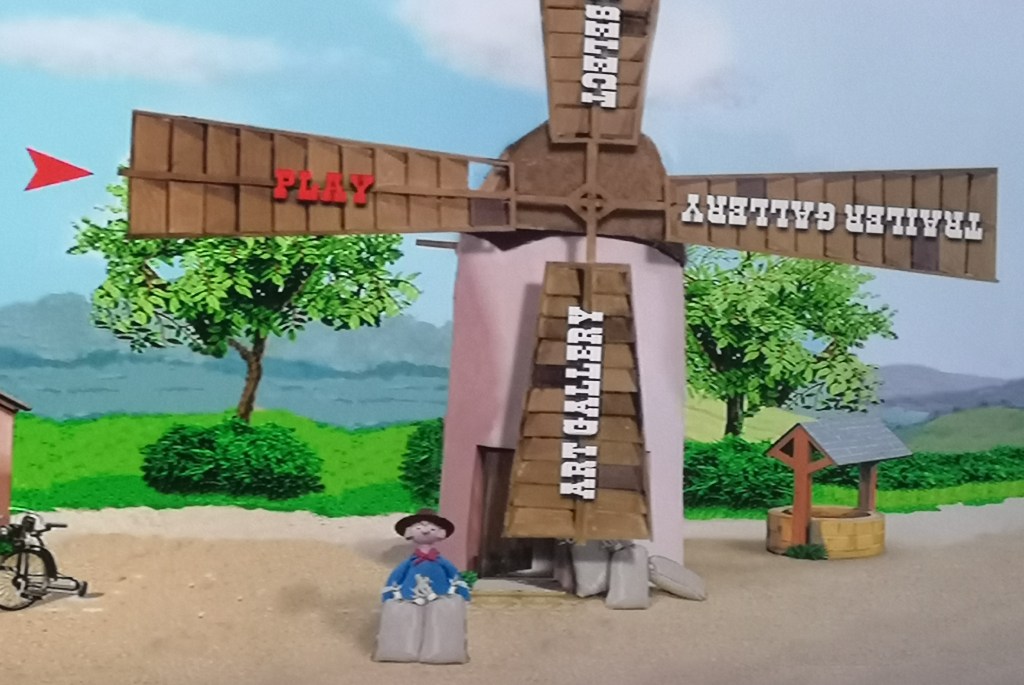
Camberwick Green was made in 1966 and was the first of the Trumptonshire Trilogy, followed by Trumpton in 1967 and Chigley in 1969. To my mind, it is the children’s TV equivalent of the first three albums by The Police. Outlandos D’Amour was a great start, Regatta De Blanc was the standout and Zenyatta Mondatta had great moments but did not hit the height of the first two. That is why you will see Trumpton in this series of posts but not Chigley. Why not put them together as a trilogy? Well, I did think of that, but all three series were self contained and very different from each other in tone and characters. Also, it would have made the blogpost too long. So, what makes Camberwick Green so special? Well, the elements I remember most vividly, before rewatching some of the episodes, are the opening and closing credits and Windy Miller.
If I may digress for a minute, I was interested by a poll I saw in my research for this post. Neither Camberwick Green nor Chigley were able to earn a place in the Channel 4 100 Greatest Kid’s TV Shows poll from 2001, which saw Trumpton at Number 22, and it would be unlikely to be remembered at all by many voters if they re-ran the poll now. It is a fascinating list, but the top spot was taken by The Simpsons showing that the voters had no clear idea what a Kid’s TV show really was. The Simpsons definitely isn’t my idea of a kids show, and I think it was only the fact that it was a cartoon that led voters to that conclusion.
Getting back to Camberwick Green, the programme was, like almost all Watch With Mother programmes, a series of 13 episodes, allowing for 4 different programmes in each daily slot throughout the year, first shown between January 3 and March 28 1966. It was repeated until 1985 and has been released in a number of versions on VHS, DVD and Blu-Ray. The latest, and presumably last, of these releases includes the original master tapes found in writer and producer Gordon Murray’s attic. It is however for the purists given it is over £40 for the DVD and £50 for the Blu-Ray at full price!
Episode 1 Peter Hazell The Postman
The lovely tune, the clown that rotates the opening credits, the music box that opens to reveal the central character of the story, and the unmistakable voice of Brian Cant are instant nostalgia for any child brought up in the UK in the 60s, 70s or 80s. The first story centres around Peter Hazell, the postman for Camberwick Green. Like all the characters, Peter has a song of his own which starts with a strong whistle, a sound that you used to hear from many postmen or milkmen on their rounds, and indeed many men in a range of jobs. He has a song for emptying the post boxes and a variation of the song to tell him who to deliver the letters to. Once he has got the letters sorted he starts dancing with Mrs Dingle, for no adequately explored reason! He goes first to Mickey Murphy the baker, then to Dr Mopp whose beard and top hat made him instantly recognisable to many children of the era. Poor Dr Mopp finds himself being talked at by Mrs Honeyman the village busybody. Then it’s on to Windy Miller with that iconic windmill, the sails turning making a sound I recognised instantly. Windy has the smock and hat that mill workers probably stopped wearing over a century ago. Then, it’s off to Pippin Fort under the command of Captain Snort. Peter gets into trouble for calling the men to collect their letters while they are on parade. As Brian Cant observes, ‘You must never do that’! That is it for the story in Episode 1. Back goes Peter Hazell into the music box and the closing credits are turned by the clown. The lack of action or storyline would almost certainly baffle children these days, but the appeal to those of us of a certain age is more about the characters and the village, which was very similar to the villages you could see in the UK in the 60s and 70s in particular. My grandparents lived in one such village, Felsted in Essex, with many characters who were identifiable chiefly by their professions. It is a throwback to quieter and more socially structured times that is now so far away from our modern lives as to be unfathomable to many.
Episode 2 Windy Miller
We meet Windy at his mill, preparing to grind some corn. We learn that many farmers now take their corn to the large modern mills rather than to the old windmill. Farmer Jonathan Bell brings his corn to Windy and suggests that he get himself a modern mill so he can increase his business. Windy is adamant, saying that the mill was good enough for his father and grandfather and is therefore good enough for him. In any case, as Windy points out, the modern mills don’t make such a nice sound! In a very interesting detail, given that this was made in 1965 before it became socially unacceptable, Jonathan refuses Windy’s offer of home brewed cider as he is driving. Maybe the subtle message influenced a generation of drivers without them knowing it, as I remember that in my generation drinking and driving was definitely frowned upon, whereas for my parents’ generation it was not really a big deal even when it became illegal. Windy, however, has a drink as he likes cider but as it is very strong it sends him to sleep! While he is sleeping the sails stop turning. Mickey Murphy, whose tune is an Irish jig, requires a lot of flour for a flood of orders from Captain Snort and Mrs Honeyman. So, Mickey and his children drive to Colley’s Mill to pick up some flour. They wake Windy up, but there is no wind to power the sails. Windy says that all you need to do is whistle for the wind so he, Mickey and the children try to do this. We then go to Pippin Fort where the soldiers are off to Camberwick Common to play tracking games! They are all roped in by Windy to whistle for the wind and this time it works! Mickey Murphy gets his flour and we wave goodbye to Windy.
Episode 4 Dr Mopp
The family Doctor who visited patients is very much a thing of the past, but Dr Mopp is one such Doctor in his car that requires a handle to start it. This would have been old fashioned even in the 60s, so he is very much a throwback. First of all, Dr Mopp visits the bakery to tend to Mickey Murphy’s children who have bad colds. Luckily Dr Mopp has pink medicine for that, so that’s a relief! Mrs Honeyman sees him go into the bakery and sees the chance for a good gossip. She leaves her baby under the watchful eye of Peter Hazell, but when she looks at her baby in the pram she sees that there are red spots all over its face. What she doesn’t see is one of the soldiers from Pippin Fort on a ladder right above the baby using red paint! Dr Mopp goes to Windy Miller’s mill in a hurry, because, it turns out, he is a keen photographer and Windy has spotted two thrushes building a nest. The doctor remembers that he needs to be at Pippin Fort for a medical inspection of the men, helped by Sgt Major Grout who gives the order to the men to stick their tongues out! Then it’s off to Jonathan Bell whose wife is unwell. He hears a very deep cough which Farmer Bell tells him has been going on for two days. It turns out not to be his wife who has the cough. As Farmer Bell says, ‘Oh no, it’s not my wife, it’s the old cow’!! Definitely a joke for the adults watching 🤣🤣 His final job of a busy episode is to tell Mrs Honeyman that the baby’s red spots are paint.
Final Thoughts
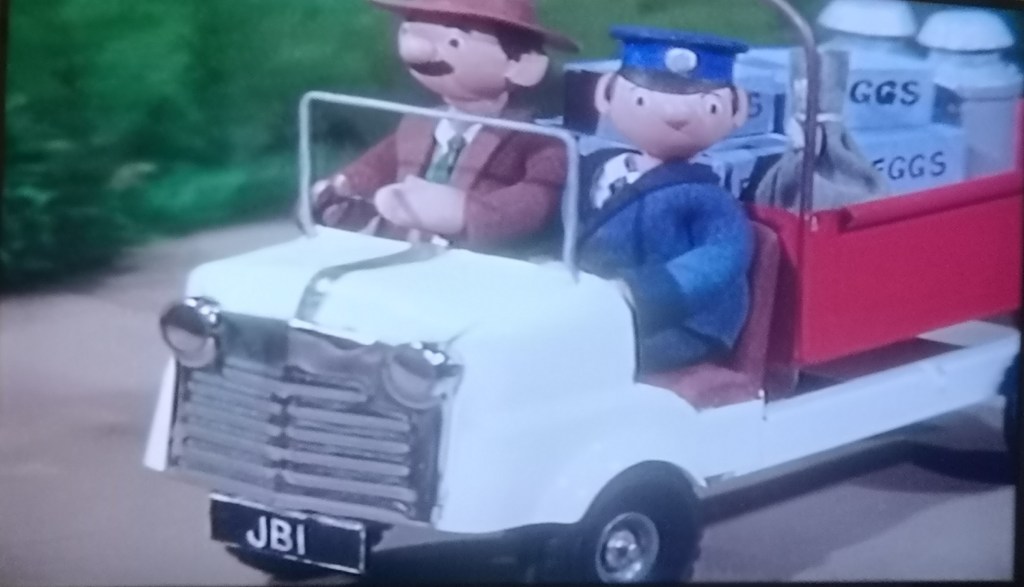
This is an absolute joy of a programme, that looks at old fashioned ways with a wry humour, while indicating that more modern approaches may not always be an improvement. There is real care taken with the stop motion animation and the detailed buildings and backgrounds. People are kind to each other, help each other out whenever needed and are even patient with the gossipy Mrs Honeyman. This vision of a Britain that might only have existed in Trumptonshire is still one that has a power to draw us in. It is an analogue world with community life at its centre and a clear expectation of each person according to their position and profession. Tolerance is the watchword in Camberwick Green, and although very little of any real importance seems to happen, you know that everything is helping to keep their small village in perfect equilibrium. You are safe in Camberwick Green, safe with Brian Cant’s gentle and humorous narration and safe in the little music box which only gives you pleasant secrets.
It’s abiding cultural impact can be shown most clearly by TV series Life On Mars and the rock band Radiohead. Enjoy the two links below, which are dangerous in a way Camberwick Green could never be, but dangerous in a way that would certainly have given Brian Cant a chuckle.
Which animal would you compare yourself to and why?
I would compare myself to a cat, because I think I share some characteristics with my own cat Albus. First of all I am a home lover and I am never happier than when I can be safely inside my four walls. Yes, I do go out, but I always look forward to getting back to what is familiar. Second, I am loyal to, and comfortable with, a small number of people. Albus is incredibly affectionate with people he knows and trusts but he steers clear of those he doesn’t. There are occasions when I think that diving for cover or heading to the foot of the garden is far preferable to being sociable 🤣🤣! Third, I am always looking out for those I care about, checking in from time to time and making sure all is as it should be.
I am aware that Albus is not your typical cat but if I channel any animal it’s definitely him. We are very similar in personality and approach to life and I can’t imagine anyone else from the animal kingdom I would rather be. After all, humans, animals themselves with no spiritual characteristics lifting above any other life form, would be so much better if they actually learned from other animals rather than believing they were better than them! This is why I like the approach of Buddhists who live in harmony with animals and see themselves as part of the same world.
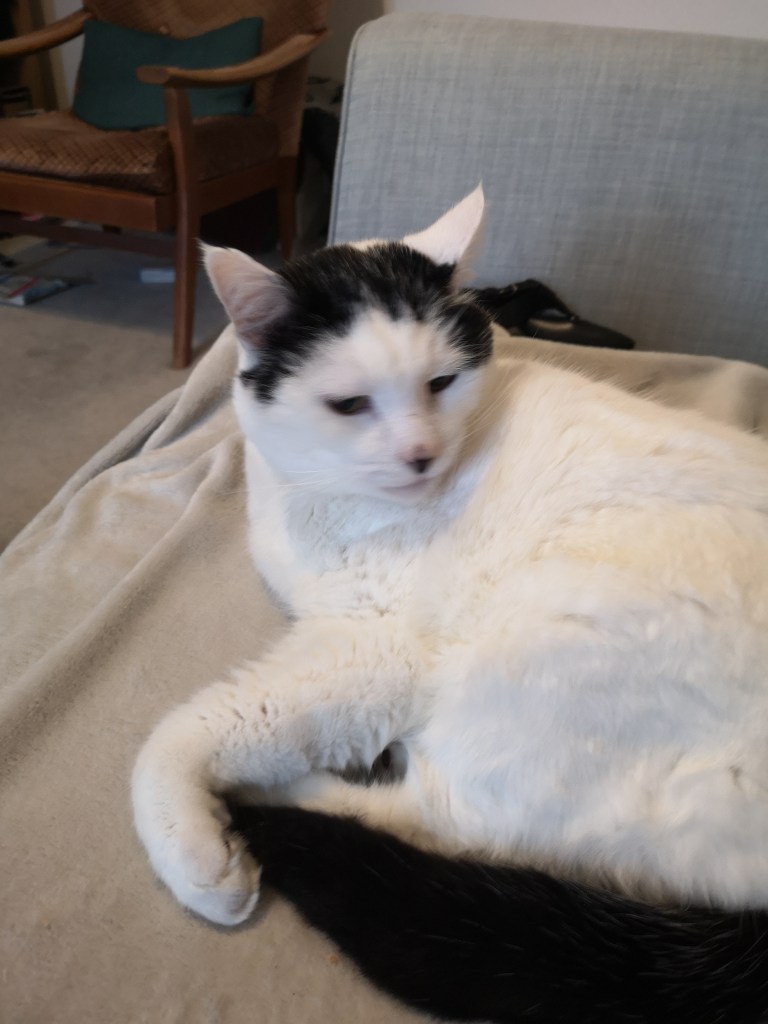
My Spiritual Guru, Albus
 David Pearce - Popular Culture and Personal Passions