
What is something others do that sparks your admiration?
I have always been envious of people with a clear sense of purpose and destiny. That becomes admiration when these people use that sense to make the lives of others better. Philanthropy in its Victorian incarnation has all but disappeared in our modern world where people in power, political or financial, only wish to make their own lives better. Only a few of those with influence use that influence for good. Nowadays it is much more common for powerful people to deliberately make the world worse for the vast majority in order to make it better for themselves. We are in the age I have seen described as the ‘Broligarchy’ where those who have made countless billions through their ability to use technology for their own ends now bow down to the very worst leaders humanity has to offer.
What a contrast to the Victorian philanthropists who were extremely well off and who lived in luxury that was unimaginable to their workforce, but who did what they could to make life better for them. The Cadbury company built the Bournville Village for their employees in the late 18th century, with relatively spacious houses to alleviate the many problems caused by overcrowded accommodation. They also built schools, parks and facilities for further education of the workers. George and Richard Cadbury were Quakers so they refused to have pubs in the village, removing a source of both social and personal problems that they saw as inhibiting effective work in their factories. Were they completely altruistic? Of course not, because the village tied the workers to the company in perpetuity as their home was utterly dependent on remaining employed by the company. In that sense it worked as a kind of benevolent dictatorship because what the Cadburys expected of you was socially enforced in all areas of life, not just work. However, they realised something that nearly all modern employers have completely forgotten, namely that a workforce that is valued will produce much better work than a workforce that is threatened and overworked, the situation for so many people today. It is very sad to think that employers are worse now than they were 200 years ago, but it’s the truth and I can only see them doubling down on their poor treatment as it is profitable for them and keeps them in the manner to which they have become accustomed. It is unimportant to them that they have more money than they can spend in a hundred lifetimes. All they care about is power to do bad things to people below them.

What was 1996 like?
Queen Elizabeth II had been monarch for 44 years, but it’s fair to say that the past four had been some of the most difficult of her reign. From the annus horibilis of 1992 through the seemingly daily revelations of marital strife and infidelity and the finalising of divorce proceedings for both Charles and Diana, and Andrew and Sarah, she could be forgiven by thinking that it could get no worse. Of course, the following year it did, and it looked as though it could bring down the monarchy – but no spoilers! The government under John Major saw a Conservative Party limping towards an election they already expected to lose, riven by infighting and unable to command a majority in the House of Commons by the end of the year. The Labour Party under the telegenic Tony Blair energised as they saw government was within their reach, but they were kept under tight discipline by a Labour hierarchy scarred by 1992 and the triumphalist Sheffield Rally, which was seen as a contributory factor explaining why Neil Kinnock’s chance to get the keys to Number 10 did not succeed.
There were a number of shocking events in 1996, the worst being the Dunblane Massacre in Scotland where 16 children and their teacher were killed at a Scottish Primary School. Following this tragedy the government brought in legislation to make the possession of handguns illegal, saving future generations of children, to date, a similar situation to that in America where school shootings are a fact of life. There were attacks by the Provisional IRA which ended a ceasefire that had stood since late 1994. Three took place in England and one in Northern Ireland. It was a troubling return of the conflict that had claimed thousands of lives in the decades before.
In sport, football ‘came home’ when the 1996 European Championships took place in the UK. It completed the final rehabilitation of the sport internationally after the hooligan problems of the 1970s and 1980s made it inconceivable that England in particular could ever host such an event. England had a tournament to remember getting through to the semi-final before losing to the German team on penalties. It was a summer when football was taken to the heart of the nation in a way that had not happened since 1966, and it led to Baddiel, Skinner and the Lightning Seeds recording perhaps the finest football song ever, the brilliantly mordant but uplifting Three Lions. After that tournament, Alan Shearer set a new British transfer record by leaving Blackburn Rovers and joining Newcastle United for £15 million.
An interesting situation becomes clear when you read the data for average wages in the UK for 1996. In the rush for job creation in the service and tertiary industries from 1979 onwards, the manufacturing sector was all but destroyed. You might think that those left in that sector would be valued for their disappearing skills that were still needed. However, the average wages for manual workers came in at a shade under £300 per week whilst non-manual workers earned, on average, £460 per week, half as much again. It spoke of a complete lack of value, monetary now as well as social, ascribed by society as a whole towards those who worked with their hands. Apprenticeships were virtually non-existent in some industries and with the drive towards university, they were seen as almost valueless. The interesting thing is that we still do not value apprenticeships despite bemoaning the lack of practical skills demonstrated by workers in this country. I think you can trace back that line from today to 1979, and now it seems to be accepted by all parties, something that was arguably starting to happen in the mid 1990s.
Country Life Christmas Number 1996
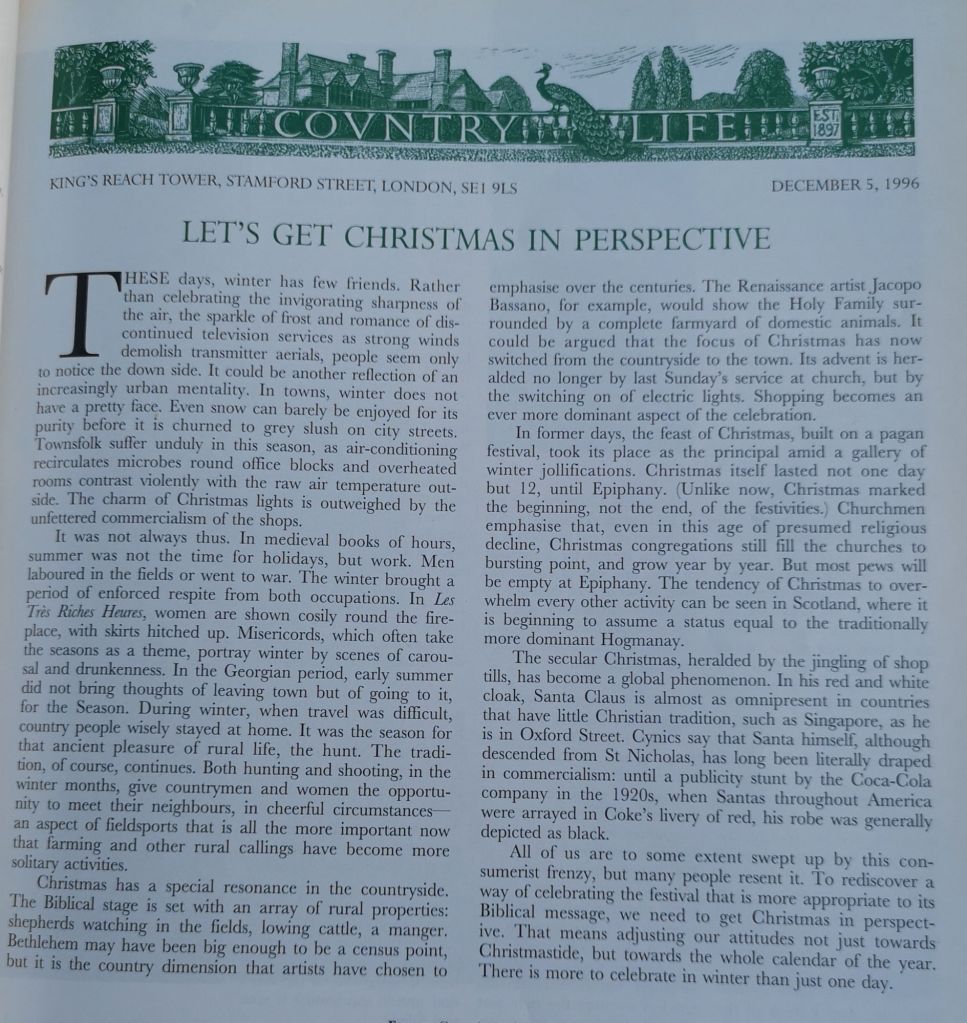
The cover is a clear indication of the approach this magazine takes to the season. The snow, the idyllic village and the smiling children on sleds show an idealised vision of an old fashioned Christmas, and this harking back to earlier, arguably better, times is definitely a theme of the contents throughout. The thought provoking editorial asks us to reflect on Winter as a whole not just Christmas itself. It points out that Winter in past times was a season of rest and celebration, where labourers and farmhands stayed at home or were found engaging in social activities such as the hunt. The piece reminds us that the Nativity was set in the countryside with shepherds, livestock and rural properties to the forefront. All of the above is compared to the situation, now even more entrenched, where the town is the centre of everything and the switching on of Christmas lights has superseded the first service of Advent as the start of the festive season. It is worth reading the editorial in full as it makes some interesting and, still, pertinent observations.
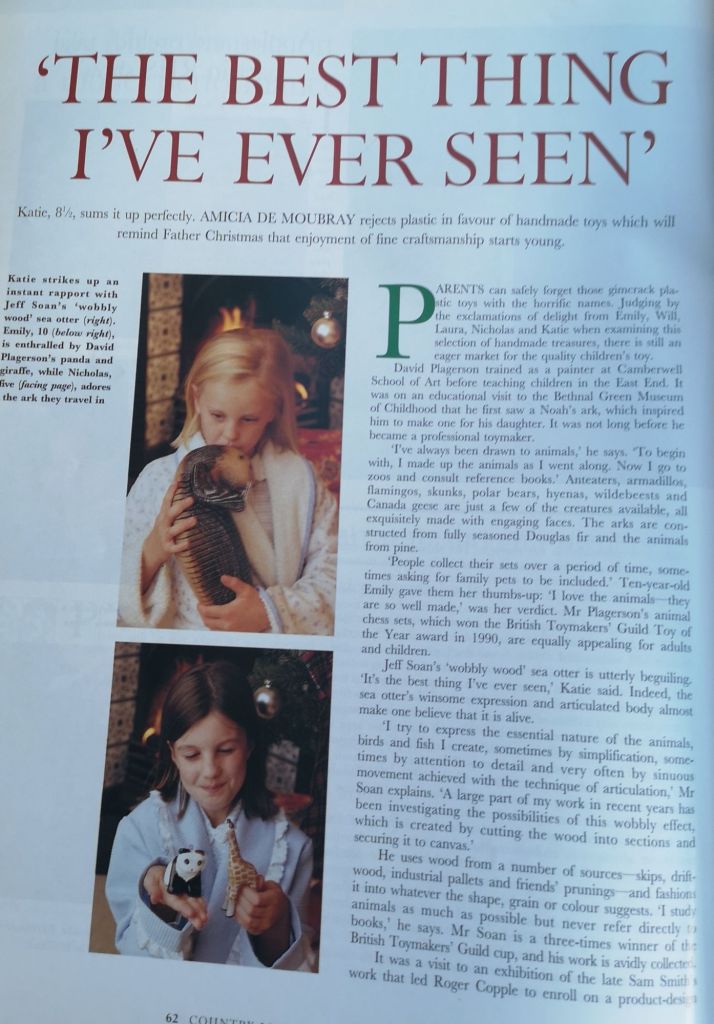
The idea of tradition is front and centre in the article ‘The Best Thing I’ve Ever Seen’ where children are introduced to the delights of traditional wooden toys to enable them to reject plastic alternatives. When you see the backgrounds of the houses, you realise that, like everything else in the magazine, it is aimed squarely at high end consumers of all ages. Carved animal chess sets, hobby horses and traditional farm sets are also more likely to reflect the lives of the children involved, thus increasing the interest level. Don’t get me wrong, I think that the appeal of a long lasting handmade toy is timeless, but it is very much a niche product that would be less likely to appeal to children in the towns and cities that lie outside the rural heartland of the readership.
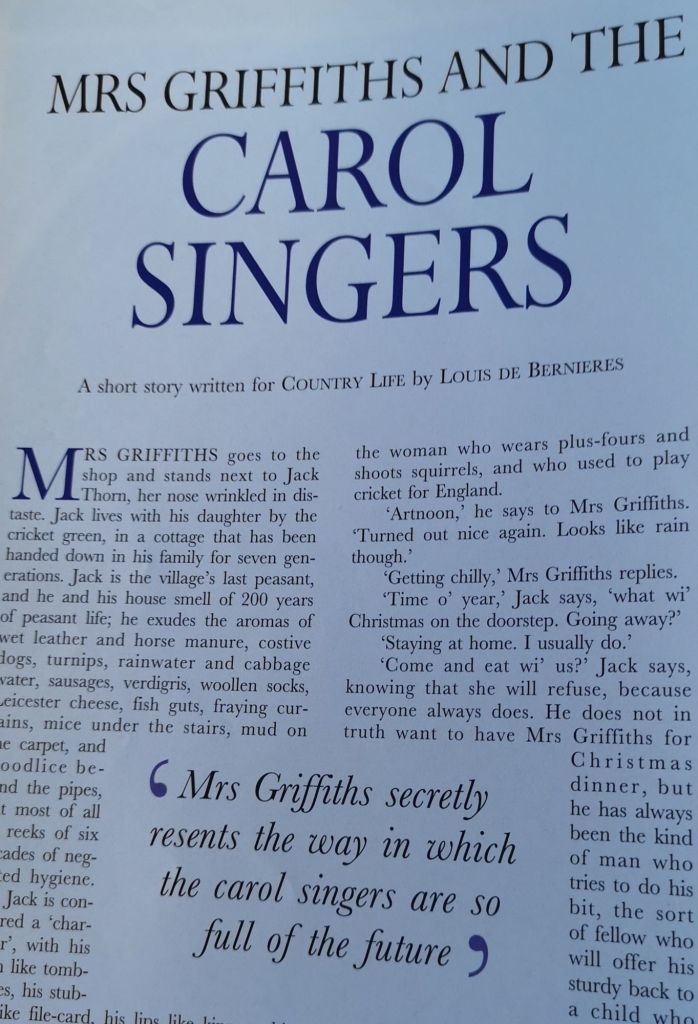
The story Mrs Griffiths and the Carol Singers is a lovely, nuanced piece of writing that perhaps invites the reader to sympathise with the views of Mrs Griffiths at the start, before delving into the reasons behind her behaviour. We see someone who wants to change but is not sure how to, and the events that occur when the carol singers do their rounds of the village are very sad. The story does end on a note of hope, and it earns that with its understanding of human nature.
The letters page is very interesting. In amongst the horror expressed about security lights and plastic windows, there is a letter that calls magpies avian hooligans! There is also an article about traditional skills focusing on the Skills Olympics which took place in 1993 and 1995, where the UK were mid-table, unlike the sporting Olympics where the Atlanta games saw the team take home just one gold in its worst ever performance. However, two letters at the foot of the second page are quite unsettling. Both bemoan the banning of handguns, which they see as criminalising their way of life, accusing politicians of lacking the courage to ignore public outcry following Dunblane. One writer actually predicts that it will have no success in preventing future massacres, but Nigel Kerner of Niden Manor has been proved comprehensively mistaken in the 29 years since he wrote this letter.
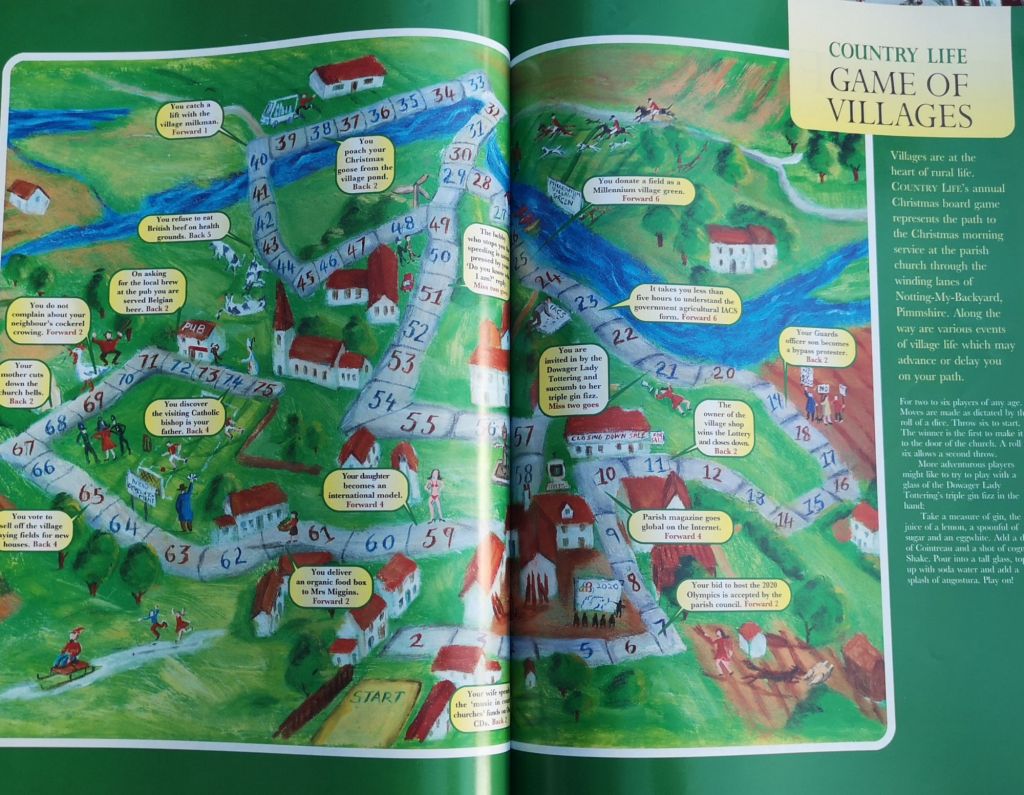
The final thing I wanted to share is the ‘board game for all the family’ on Pages 68 – 69 which follows the journey to church on Christmas morning! Let’s just say, it’s a game you wouldn’t find anywhere else!
Advertisements
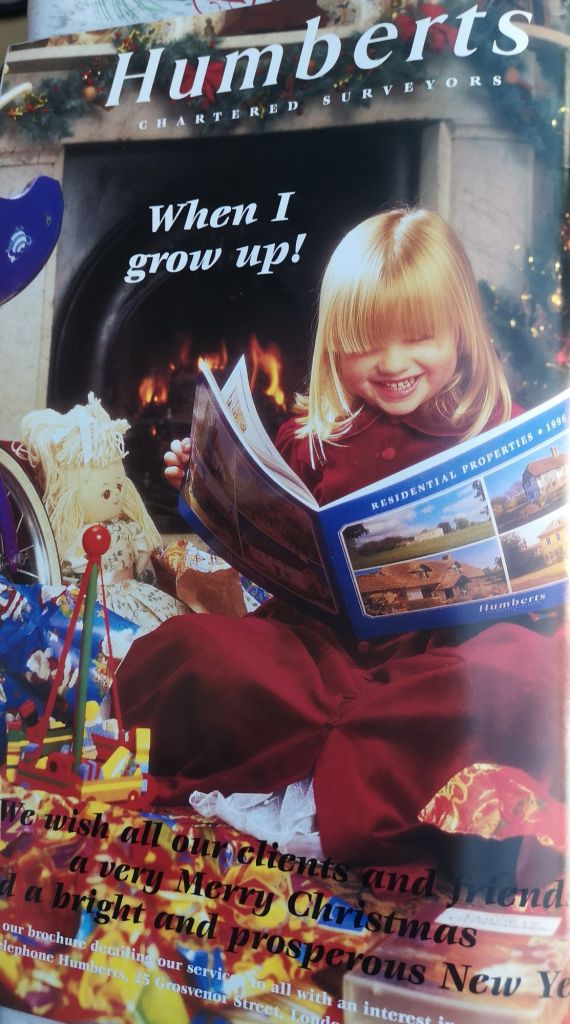
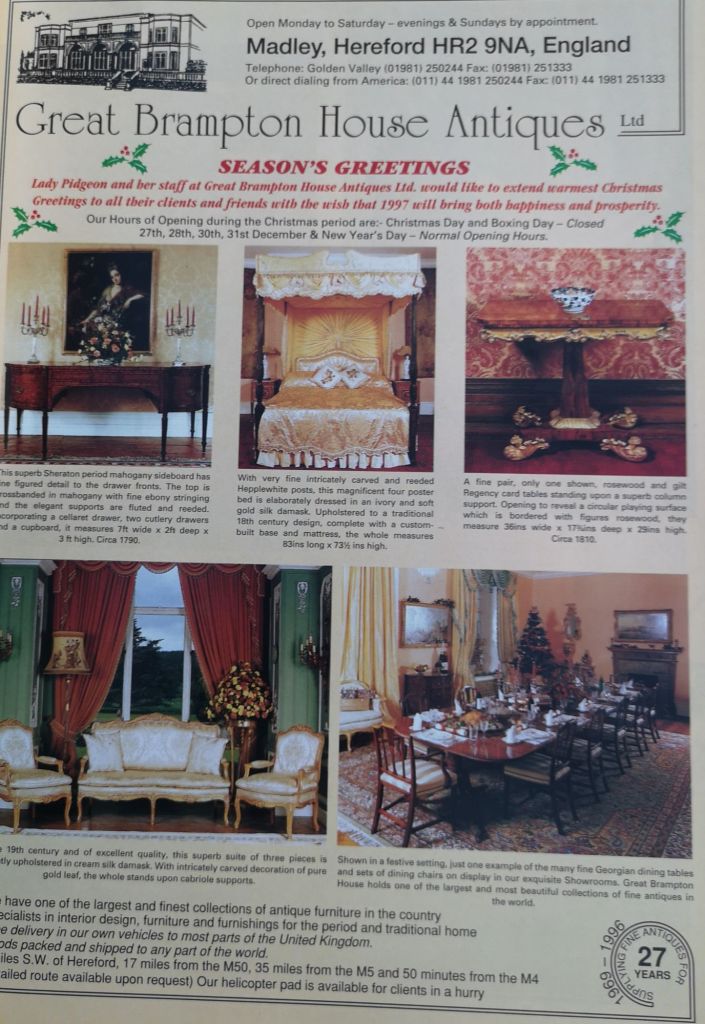

Even compared to the high end advertising of 1975’s Illustrated London News and 1986’s The Field, the 1996 Country Life is a riot of conspicuous consumption. The back cover is advertising the Bvlgari jewellers, whilst the bulk of the first 54 pages are dedicated to property, antiques and paintings, all with an eye to their investment potential. The top advertisement even acts as a career pointer for the average rural infant school pupil! Beyond this section there are advertisements for all things luxurious, the Concorde to Barbados holiday definitely caught my eye, and articles about fashion, wine and cigars!
Final Reflections
This magazine is from 29 years ago, but content wise it harks back to much earlier times, where the countryside was king and people were clearly placed within certain stations in life. The readership probably harked back to the awful verse in that hideous piece of music and lyrics that make up ‘All Things Bright and Beautiful’ where it proclaims that
‘The rich man at the castle, the poor man at his gate. God made them high and lowly and ordered their estate’!
To the majority of readers of this magazine, they were almost certainly there through divine plan, rather than generations of accumulated wealth. However, these people were clearly also driven by a sense of purpose, that of protecting the countryside and the traditions that were so important to them. In that respect, they have proven to be more in tune with the generations that followed than perhaps even they would have suspected. We may have our views about them, based on stereotypes and magazines like this, but when it comes down to it, they were people doing what they thought was important and doing it with determination and innovation as they faced rather than hid away from a modern world that didn’t really understand them.
What’s your favorite cartoon?
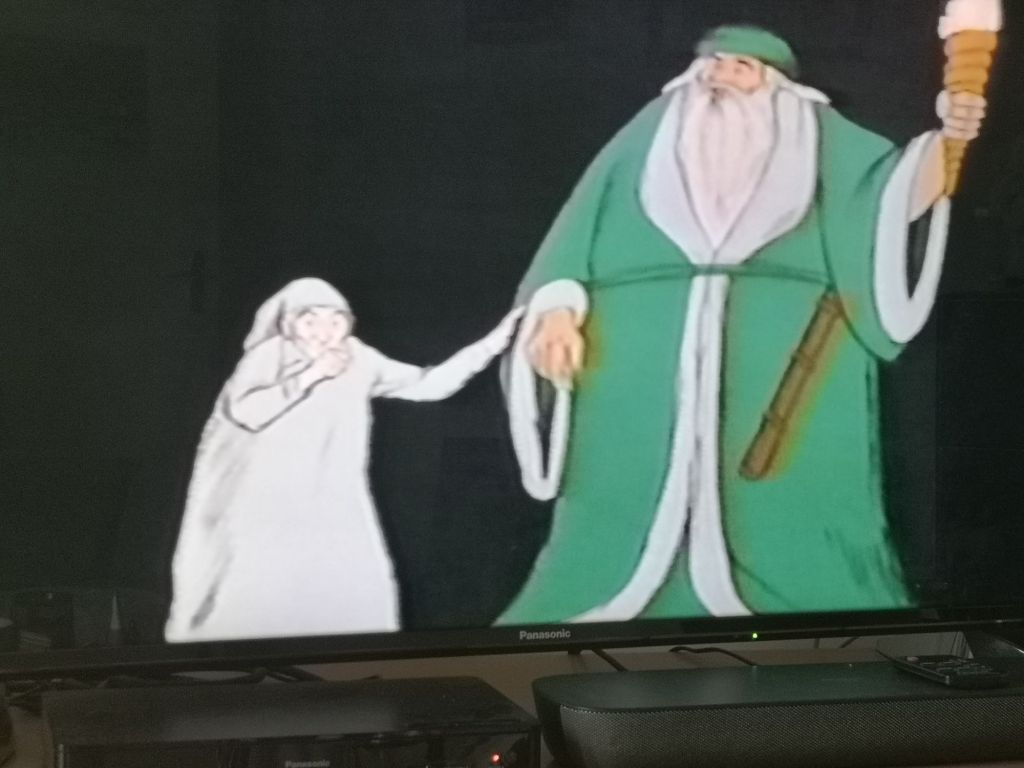
Over 50 years ago, one of the most accomplished cartoon films ever made was released. Initially it was a made for television presentation but it was given a small scale cinema release to make it eligible for an Oscar nomination. Not only did it get nominated, it very deservedly won. The film industry was angry that a mere television cartoon had beaten the best that they had to offer. Accordingly, they changed the rules so that it could never happen again. I think that this history has a huge bearing on the fact that it has never received an official Dvd release. The film industry wanted everyone to forget about one of the finest cartoons ever made and have effectively buried it. Luckily for you, it’s on the Internet via YouTube and I will put the link at the bottom of the article. I have a bootleg release that is of very good quality, but that is no longer available. So why is it the finest cartoon ever made?
It starts with a bird’s eye view of London as the scene pans down to Scrooge’s office. We see that a lot nowadays, but at the time it was highly unusual. The characters leap off the page fully formed and the attention to detail is amazing. The words from the novel are used directly on the screen and the faithfulness to the book continues throughout. The voice cast includes the 1951 Scrooge Alastair Sim and the 1951 Marley Michael Hordern. They bring real gravitas to their roles, treating this cartoon version with real reverence. The Ghost of Christmas Past is usually shown as one fixed form, but this cartoon allows her to have a variety of forms as the book mentions. The Ghost of Christmas Present takes Scrooge to a mining village, a lighthouse and a ship at sea, a part of the story almost always left out. The flying scenes are simply stunning and the ascerbic nature of Christmas Present is very much in evidence. The Ghost of Christmas Yet to Come is frightening and the scene where Scrooge’s belongings are being sold is extremely unsettling, and Old Joe is a fantastic piece of drawing, a perfect rendering of Miles Malleson, once again from the 1951 film. Not a scene is wasted and the 25 minutes cover every beat of the original story in a way that many much longer films fail to do.
With the drawing skills of the great Chuck Jones this is a tour de force of animation and you really must see it.
What was 1986 like?
Queen Elizabeth II was in the 34th year of her reign and Margaret Thatcher was in the seventh year of hers. As with most of the preceding years of the 1980s, politics appeared to be on fast forward, though looking back it seems like a decade of relatively slow, thoughtful politics in comparison to the 2010s and 2020s.
(24 hour news had not started yet and neither had social media. As a result, politicians were not chasing the next headline or curating 30 second sound bites. In banking, however, the Big Bang was in progress throughout 1986, a precursor to the effects that computerisation was going to have on everything. Enough crystal ball gazing in a Tomorrow’s World style, let’s get back to what actually was happening!)
Unemployment reached a record high of over 3.2 million in June, just under 15% of the workforce, and the Labour Party were then 9% ahead of the Conservatives. The Channel Tunnel was given the go ahead, and this time it would be built. In other European news, the UK signed up to the Single European Act which promised a single market for goods, services, people and jobs across the European Union by 1992. British Gas was privatised and the shares offered to individual members of the public in a heavily oversubscribed flotation of the previously nationalised industry. Part of the interest was engendered by the brilliant ‘Tell Sid’ campaign, a series of adverts that communicated the flotation with real imagination. Here’s the second advert in the series.
Despite the deregulation and privatisation, the one change that Thatcher wanted to force through was defeated as 72 Conservative backbenchers defied a three line whip and voted against the Shops Bill 1986 which would have introduced largely unregulated Sunday Trading. It was the only time in 11 years that she would see an entire bill defeated in Parliament. Meanwhile, the education sector steeled itself for two huge changes. The GCE O Levels and CSE Qualifications were done away with after the final cohort took the examinations in June and the two exams were combined to form the new GCSE. It was a change designed to introduce more fairness into the system. The CSE qualifications were taken by students who were deemed ‘likely to fail’ their O Levels, and even though a Grade 1 in CSE was ‘equivalent’ to a Grade C O Level, nearly every employer in the country dismissed any qualification other than the O Level. The new system was seen as a level playing field because everyone took the same exam and it was also criterion referenced not norm referenced. Under the previous O Levels only a specific number of students could achieve each grade, whereas under the GCSE you could theoretically get 100% A Grades or 100% Fails. The ‘pass’ was still set at C by all schools and employers, so in practice the less academic students were still disadvantaged, and the perception of easier exams meant that for a good few years afterwards those who took O Levels were seen to have an advantage over those taking the GCSEs. The other much more welcome change for many was the outlawing of Corporal Punishment in schools, consigning the cane and the slipper to well deserved oblivion.
In 1986, a struggling Manchester United sacked Ron Atkinson and brought in an abrasive Scot called Alex Ferguson. His first season was anything but stellar, although he took from second from bottom in November to mid table safety in May 1987. Players were starting to command ever higher fees with Gary Lineker moving to Barcelona for £2.75 million and Ian Rush moving to Juventus for £3.2 million before immediately being loaned back to Liverpool for the whole of the 1986/7 season. On the pitch, Liverpool became only the second club in the 20th Century to achieve the League and F A Cup double under the leadership of player/manager Kenny Dalglish. Joe Johnson, a 150/1 outsider beat the favourite Steve Davis to win the World Snooker Championship.
Two comedies that have stood the test of time like few others started in January, and they were both sequels. Blackadder II was the sequel to a poorly received original so it had an easier ride in terms of expectations, but even if those expectations had been sky high it would have met them. Yes, Prime Minister gave itself a massive act to follow and ended up outdoing even the brilliant Yes, Minster. Grange Hill, no stranger to controversy, shocked viewers with the Zammo McGuire drug addiction storyline, which produced the unforgettable image of the character comatose in a toilet stall after overdosing on drugs. Also controversial at the time was Eastenders introduction of Colin Russell, played by Michael Cashman, the soap’s first gay character. Despite this, the soap reached new heights on Christmas Day when that night’s episode attracted an audience of 30 million, a record for a British drama that will never be approached let alone beaten.
The Field Christmas Number 1986
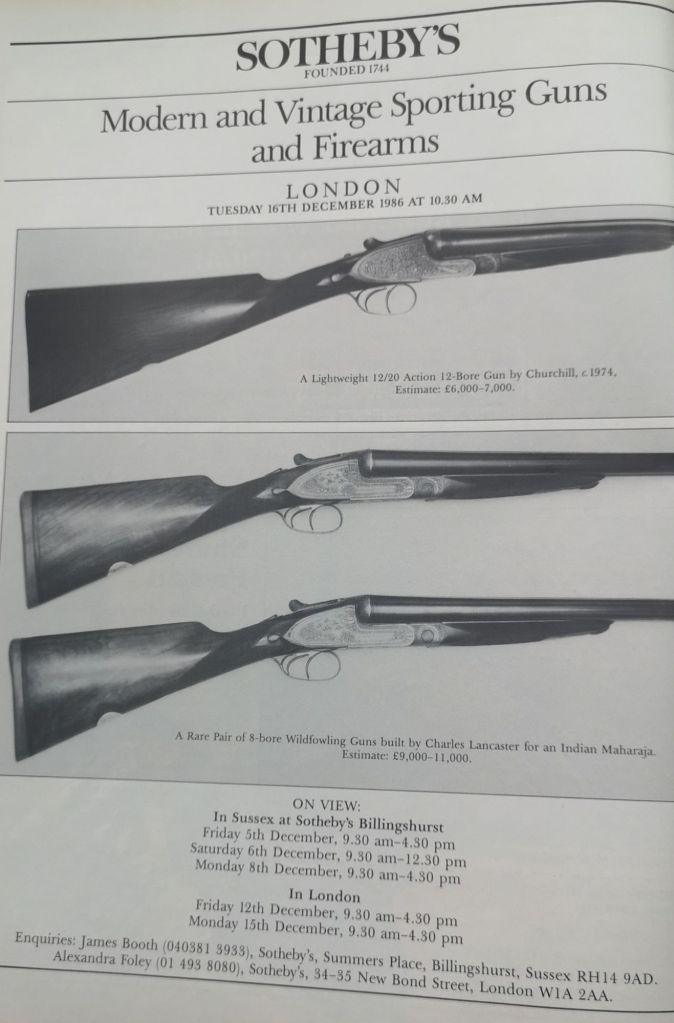

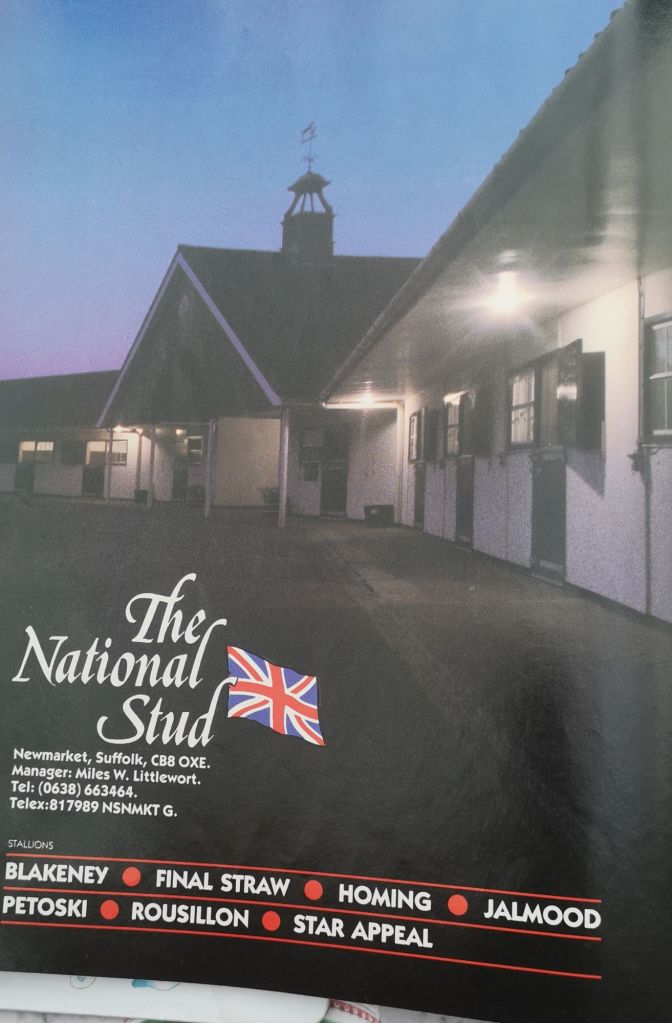
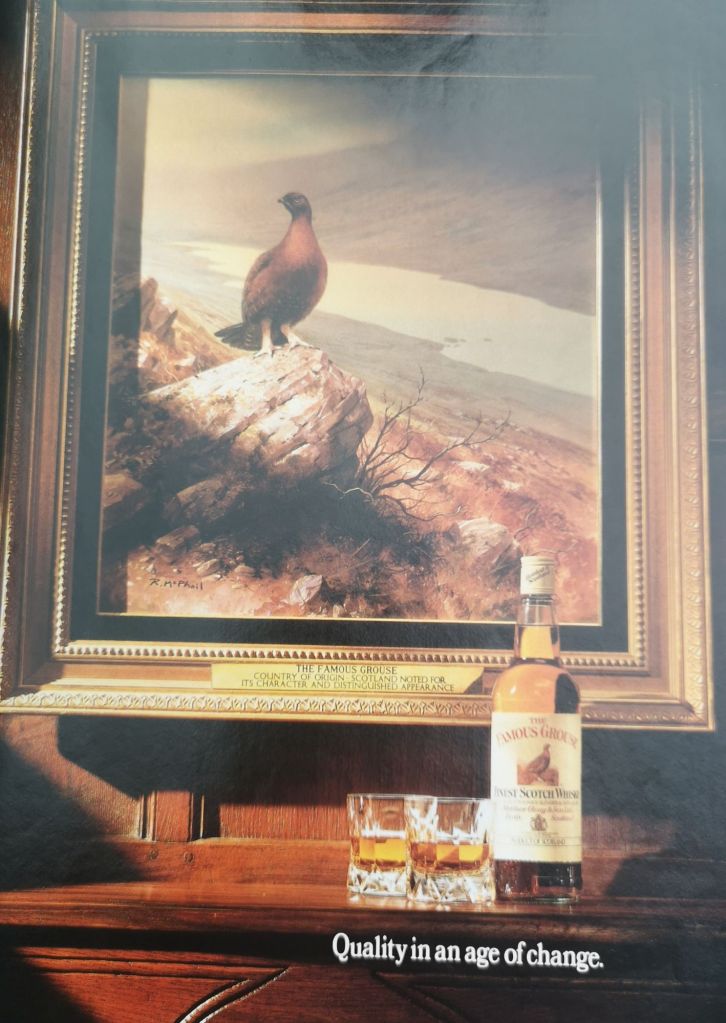
Advertisements
I am starting with advertisements this time because it is in those that you see the real flavour of the magazine. The title of the magazine is, of course, a clear indication of the demographic, but the firms who advertise their goods and services in this issue are clear as to their approach. The items are, in the vast majority of cases, only for the very rich. We start with Sotheby’s, one of the most prestigious auction houses in the world. For a start, the advertisement is for guns which have a guide price of between £7000 – £11000 at a time when a Sales Executive, who would have been comfortably off, earnt on average around £27500 a year. This advertisement would not have appeared in Good Housekeeping, which would have catered to the relatively comfortable middle classes, for example! It also tells you that it is not aimed at struggling farmers with limited acreage, but landowners with large estates. If you wanted a new gun for your hunting, Veteran Gunmakers of Spain would provide the ‘ideal game gun’ for a mere £9000. Moving up the social and income scale you could avail yourself of the services of the National Stud, whose covering fees would no doubt be well known to trainers and owners. Even Famous Grouse, a company who probably would have advertised in Good Housekeeping, have aimed their advertisement fairly and squarely at the traditional ‘huntin’ shootin’ and fishin” types with their tagline ‘Quality in an age of change’. As we will see when we look at the articles, the sense of the traditional custodians of the country protecting the things that really matter is clear throughout. All of the advertisements are targeted in a way that is very unusual in the magazines I have looked at during this research.
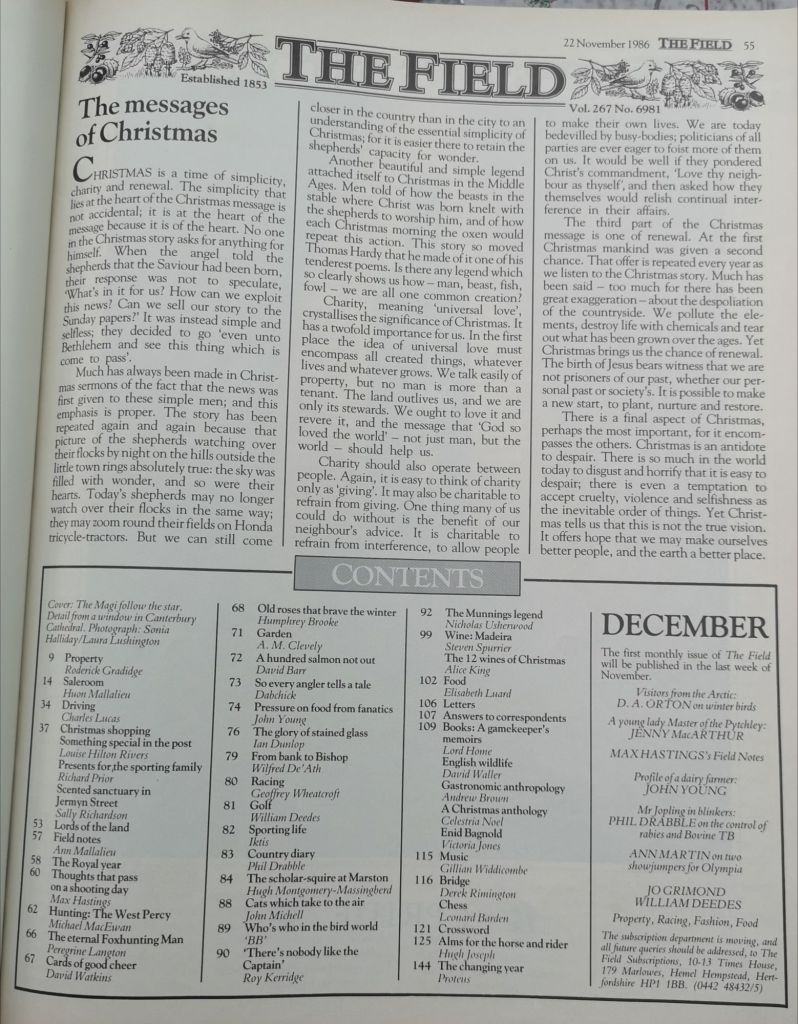
Contents
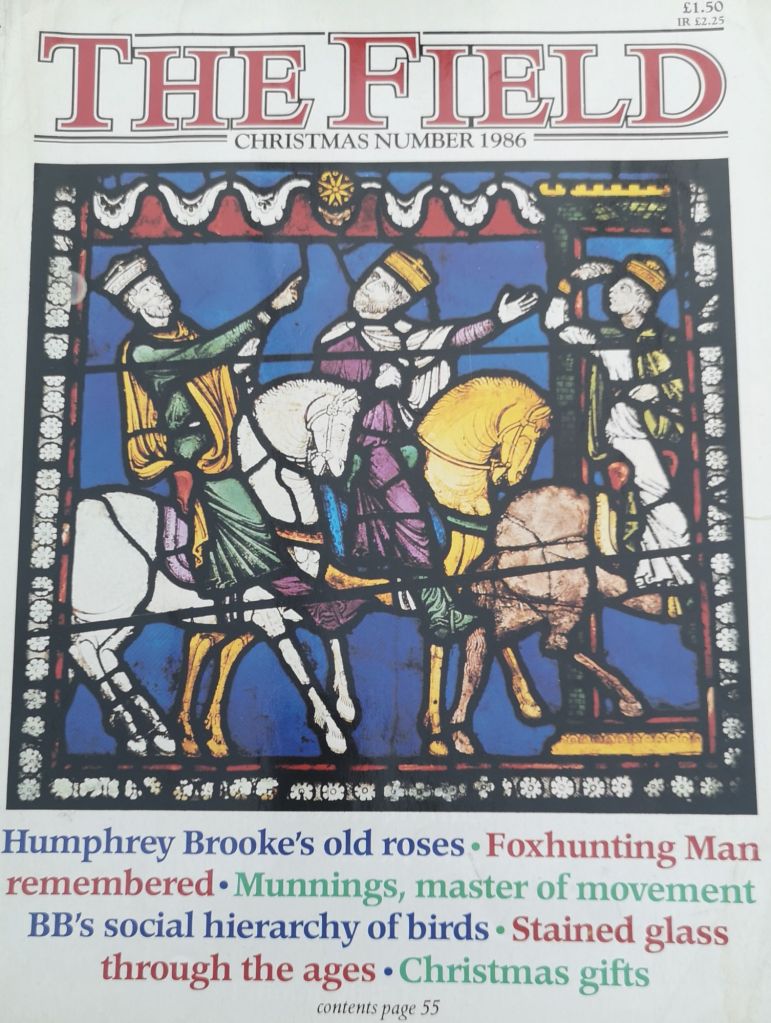
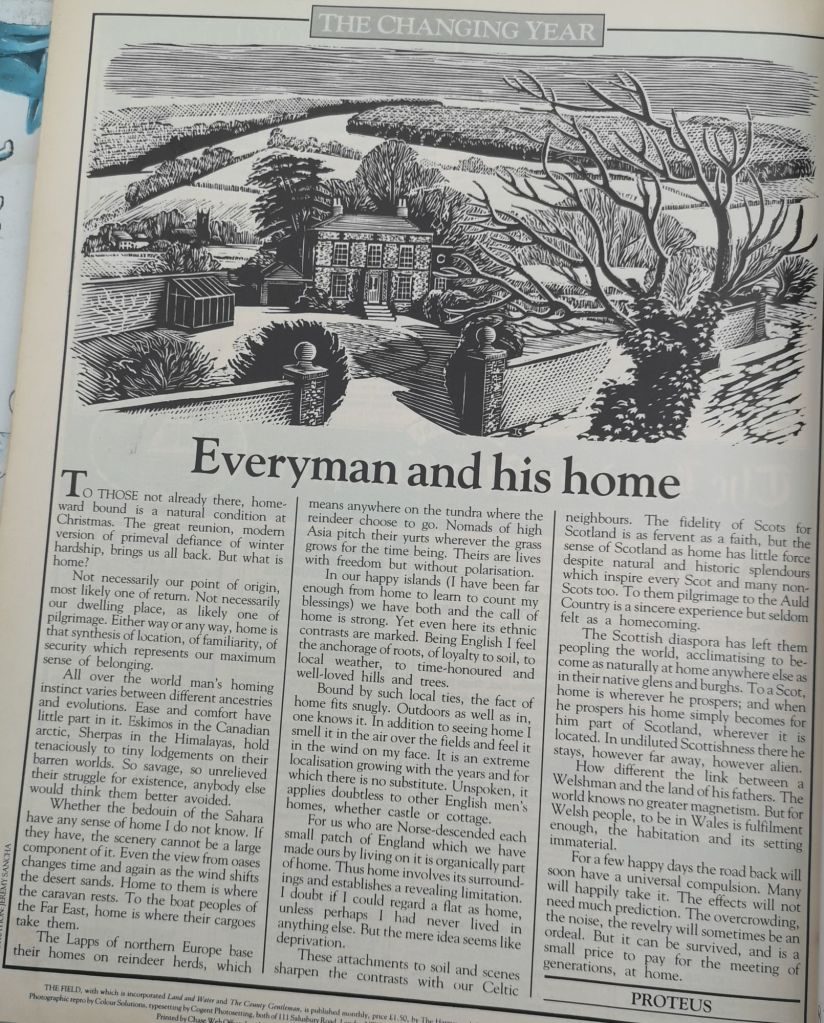
The cover of this magazine, the traditional stained glass window, comes from a window at Canterbury Cathedral, the oldest continuous seat of the Christian religion in the British Isles. It is the Magi following the star, but look more closely at what they are riding. They are on horses, not camels. It is a very Anglo centric portrayal not only in terms of their transport, but also in terms of their looks, with the full beards favoured by nobles in the middle ages and beyond. It is similar to the hymn Jerusalem in that sense, with the unspoken idea that ‘God is an Englishman’ an idea humorously outlined in the quote by E M Delafield who said; ‘Most Englishmen are convinced that God is an Englishman, probably educated at Eton.’ The editorial ‘The Messages of Christmas’ focuses on simplicity, charity and renewal. It observes that no one involved in the Nativity wanted to know what was in it for them or what they could get out of it. The assertion is made that farmers and those who live in the countryside are closer to understanding the message of Christianity than those in the towns as they can keep a sense of simple wonder in close proximity to nature. It is arguable in some ways, but the idea that it is easier to live a life of simplicity seems to have merit. When the editor gets to charity he takes a handbrake turn into politics saying that ‘it is charitable to refrain from interference’, something that politicians of all parties should remember! He stays in the political sphere with a message to those who refer with ‘great exaggeration’ to the despoiling of the countryside. The Field’s readers are actually the agents of renewal as people who know the land. The final paragraph warns against despair, proving that 39 years ago there was unwarranted pessimism about the future similar to that found in 2025. The final page of the magazine contains a lovely reflection about the importance of home at Christmas. However, it echoes the idea of the editorial by saying that it is in the scenery and land of a country that we find our true home, not in a specific plot of land with a building. As he observes ‘I doubt if I could ever regard a flat as home’! Once again the magazine raises its readership above the herd by giving them a greater insight into life than city and town dwellers.
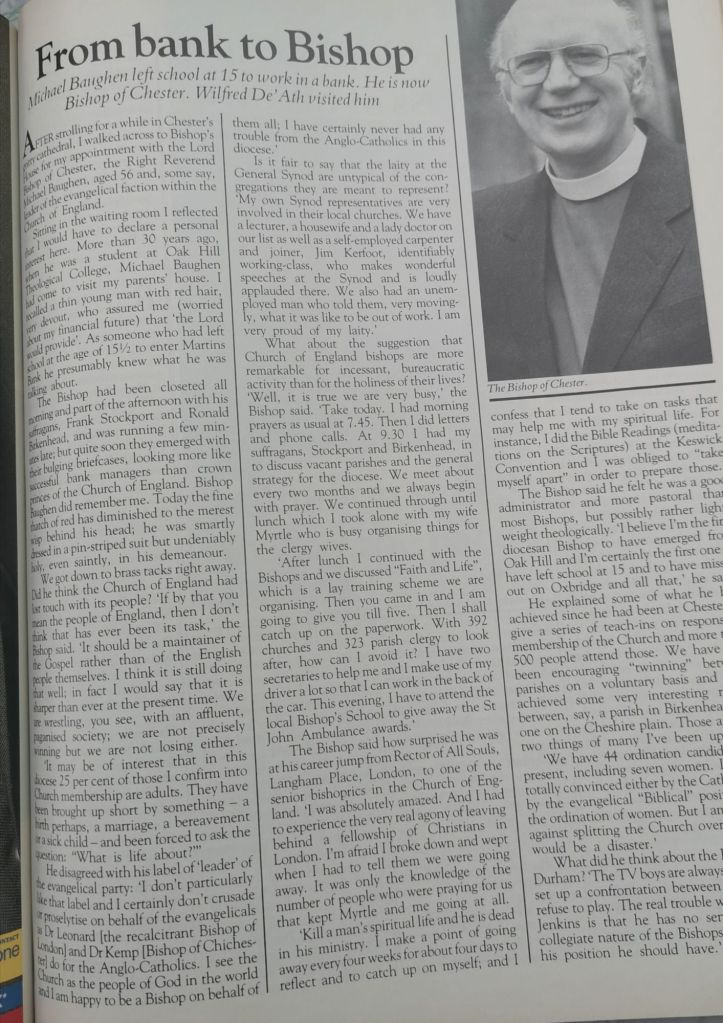
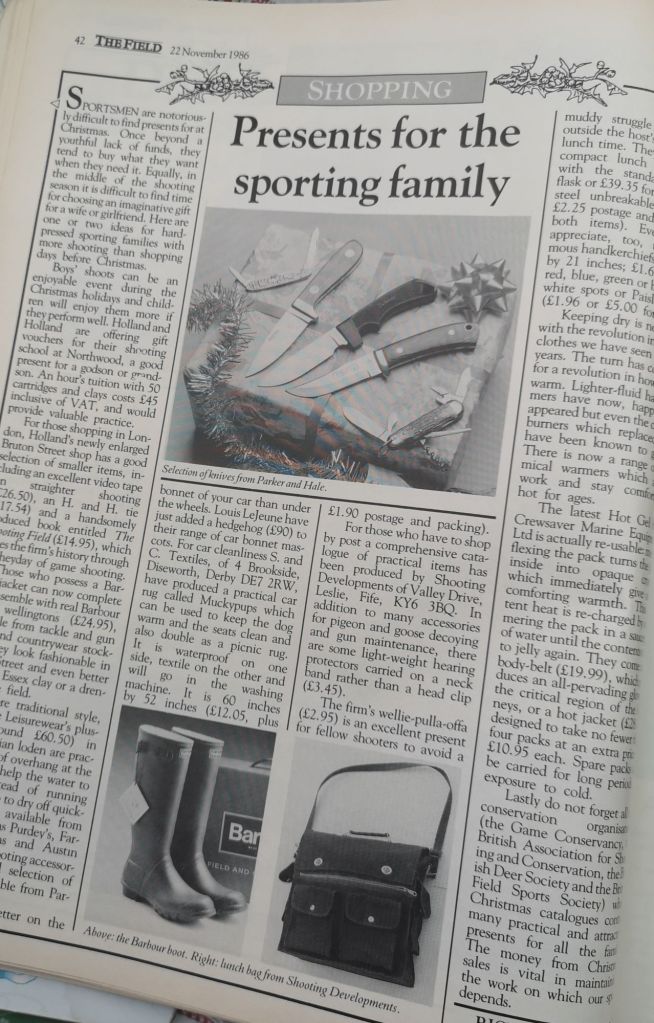
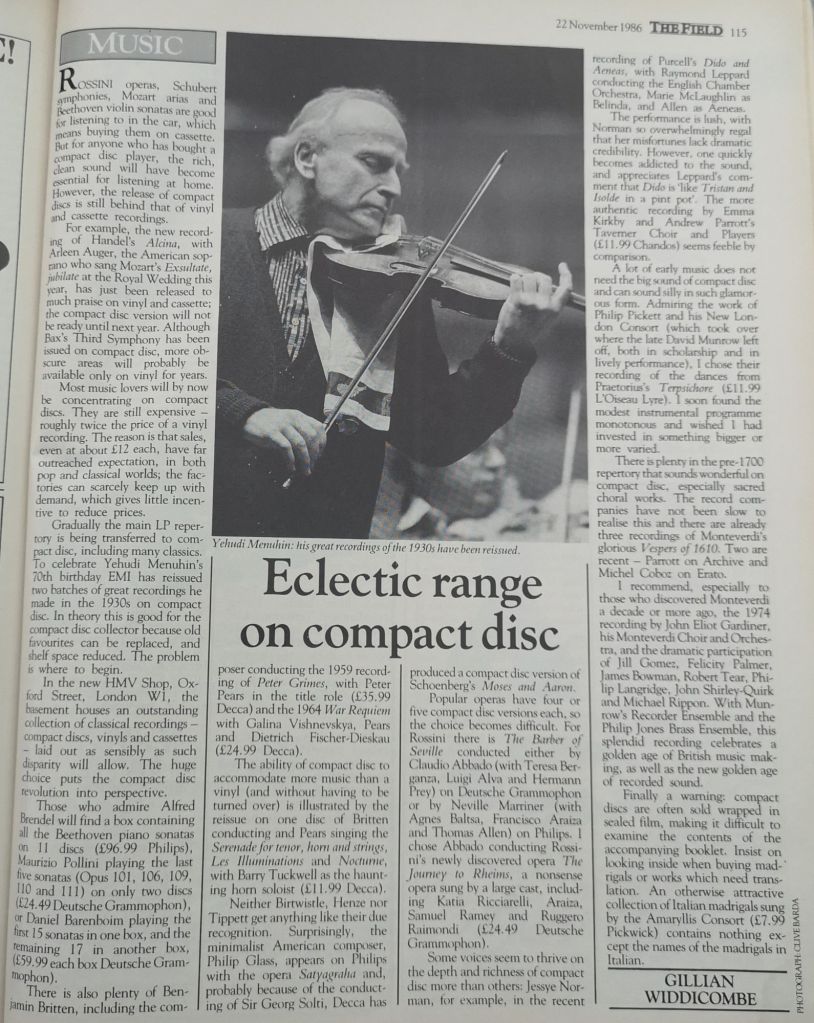
The three articles I have picked out are very good at illuminating the preoccupations of the readers. First of all, you have an interview with Bishop of Chester, Michael Baughen, who left school at 15, worked in a bank and then studied at theological college. He comes across as a light touch churchman, which no doubt the readers will approve of, and he plays a dead bat to the more controversial questions, although he does mention the then famous David Jenkins, Bishop of Durham, who ‘has no sense of the collegiate nature of bishops’. It is 19th century style ‘muscular Christianity’ of the type that would definitely find favour with the traditional readers of the magazine. The gifts for a sporting family article is interesting in the insight it gives us to the way of life in the upper echelons of the country classes. You can buy Boys’ shooting tuition for £45 an hour, as presumably girls don’t need to know about things like that! However, for our no doubt fashion conscious younger female recipients, Burberry wellington boots apparently look fashionable in Sloane Street! Knives are very useful, no doubt for skinning the game you kill. It is a world closed to all but those in the know and with the money to access it, a network of landowners who have access to an influence up to and including the Royal Family in some cases. Finally, the Compact Discs reviewed on the music page are all classical, all reassuringly expensive and of the required cultural level for its readership.
Final Reflections
This has definitely been the most targeted magazine of those I have read, and because of that it has a continuity of approach that I haven’t found anywhere else. The readers are not being encouraged to experiment, either as consumers or thinkers. Everything in the magazine is designed to reinforce their certainties and the correctness of their position in the life of the country. That said, even for those who share nothing of the background, the writing is accessible, of a high standard and full of insight. It is an incredibly masculine world laid out in front of us, but I don’t think that is because of the era. My guess is that 39 years later Girls’ shoots still don’t exist and the same gripes about politicians and town and city dwellers are still very much in evidence. Perhaps they are, as a group, less religious but I would venture to suggest that they are still Christians with at least a small c who are found in the pews at this time of year.
 David Pearce - Popular Culture and Personal Passions