
What was 1970 like?
The 18th year of Queen Elizabeth II’s reign featured a general election in June that neatly split the political year into two halves. For the first half of the year Harold Wilson led his Labour Government with a very thin majority. Despite this, they were able to pass the bill reducing the Age of Majority, the legal definition of adulthood in effect, from 21 to 18 for the most purposes. The election was almost impossible to predict with the Conservatives coming into 1970 with a 20 point lead in the opinion polls and Labour calling the election with an apparently healthy 5 to 8 point lead themselves. In the end, the Conservative and Unionist Party which included the Northern Irish Ulster Unionist Party at the time, won by a surprisingly comfortable 30 seats. Some tongue in cheek commentators suggested that England losing their 1970 World Cup Quarter Final to West Germany just before the election was what swung it back to the Conservatives! Even more surprisingly for anyone brought up in today’s political environment was the fact that Harold Wilson did not instantly resign, but stayed on largely unopposed to fight and win two elections in 1974.
A number of events from 1970 caught my eye because of their offbeat nature. On 31 July the Royal Navy issued its last ration of grog to all sailors. Usually, consisting of rum and water, grog was distributed to all sailors from 21 August 1740! It’s amazing to think that this tradition continued unbroken for very nearly 230 years. Glastonbury Farm held its first festival, headlined by Tyrannosaurus Rex (soon to become T Rex), with an attendance of 1500! It would become somewhat more popular over the next half century! Finally, I must mention a staple of many teenage years in the 70s and beyond which debuted on November 17, the Sun Page Three Girl, an almost perfect microcosm of the permissive society of the late 60s and the saucy postcard from the UK’s beach resorts. It made stars out of some of its topless models and gave writers free rein for innuendo for decades to come!
Musically speaking it was the end of one era and the dawn of at least two others. The Beatles released their last single and album as a group and on 31 December Paul McCartney filed a lawsuit against the rest of the band to dissolve their partnership. In February, Black Sabbath released their eponymous debut album which was the acknowledged start of the heavy metal genre. T Rex were already experimenting with what would become Glam Rock, a genre that became the predominant chart music of the first half of the 1970s.
The start of the 70s was a watershed for the UK’s younger viewers. The first colour episodes of Doctor Who were shown as Jon Pertwee took over the role and gave an iconic portrayal of the Doctor. Three programmes from the US that were to become staples of children’s viewing were all shown in the UK for the first time. Scooby Doo, Where Are You?, The Banana Splits and Dastardly and Muttley all burst onto our screens with a verve and humour unknown in their more restrained UK counterparts. That said, the UK always had the edge when it came to quality drama, and Timeslip also debuted this year.
Woman’s Realm 1970
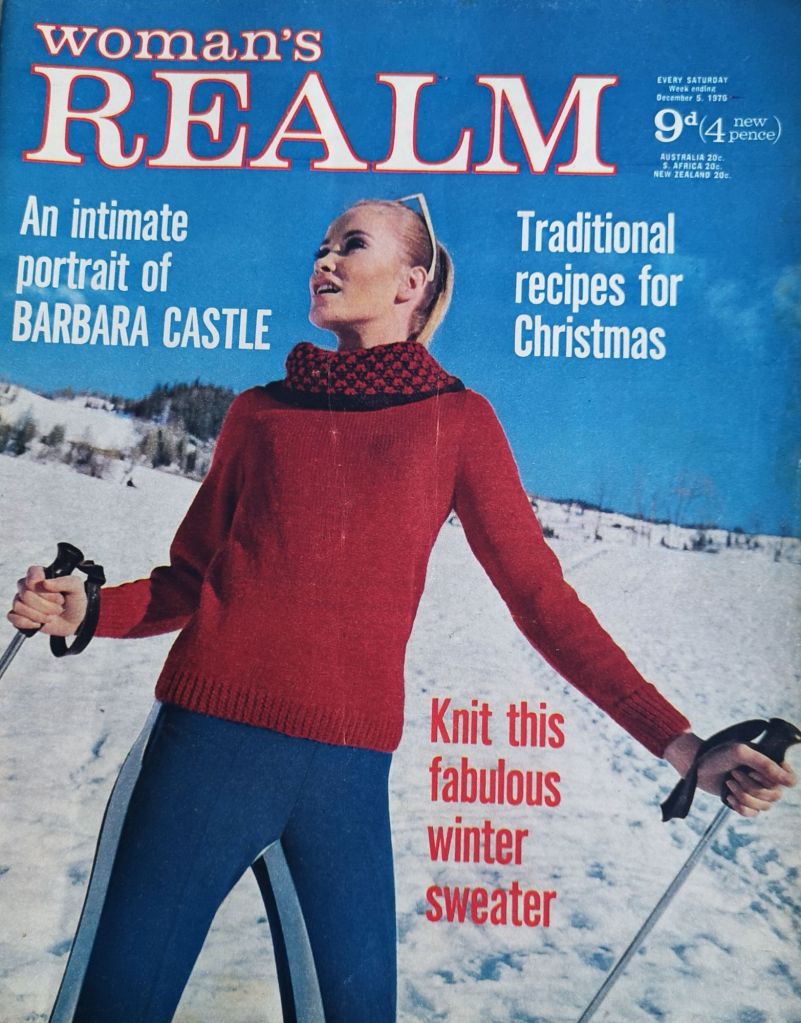
The first thing I want to reflect on is the completely atypical cover. The woman in skiing gear on a mountain reflects the anticipation of a new decade and a new more dynamic female approach to life. For most women, this vision would have remained just that, as everyday lives carried on for most in a typically low key fashion. However, it indicated a new aspirational image that would see in the decade of the Women’s Liberation movement that pushed for women to be independent and equal participants in UK society. Remember, that in 1970, women could not open their own bank accounts or apply for credit without a male guarantor! It’s incredible to think that it was 1973 before women were allowed to be financially independent. At the time, they would have had to rely on a husband or father to buy that skiing gear. Looked at from our modern perspective they really were the dark ages! However, there is a nod to the everyday reader as they are going to have to knit the sweater themselves before they hit the slopes!
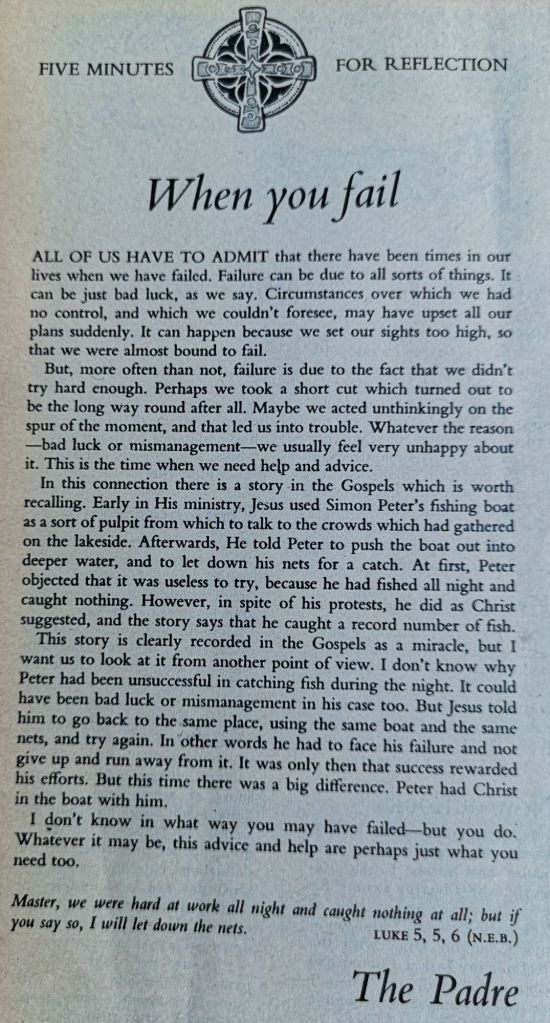
On Page 5, there is a reflection on the gospels from The Padre who talks about failure and how to deal with it. This is interesting from two perspectives. Firstly, you have the fact that it puts a religious element right at the start of the magazine, something that would be unthinkable today in our more secular times. Secondly, the acknowledgement of failure as a likelihood would be incredibly unlikely in today’s magazines where everything is seemingly rosy and life is there for the taking. Actually, if you read it, the advice is as pertinent to 2025 as it is to 1970, pointing out that very often you are just tired and that’s what leads to failure. A companion article appears later on in the magazine, entitled ‘So Depressed!’ which focuses on recognising the difference between sadness and depression and some strategies for dealing with the situation. Once again, the advice is timeless although the final paragraph betrays its origins in a different medical time by mentioning ‘… skilled care either with drugs or with electrical treatment’.
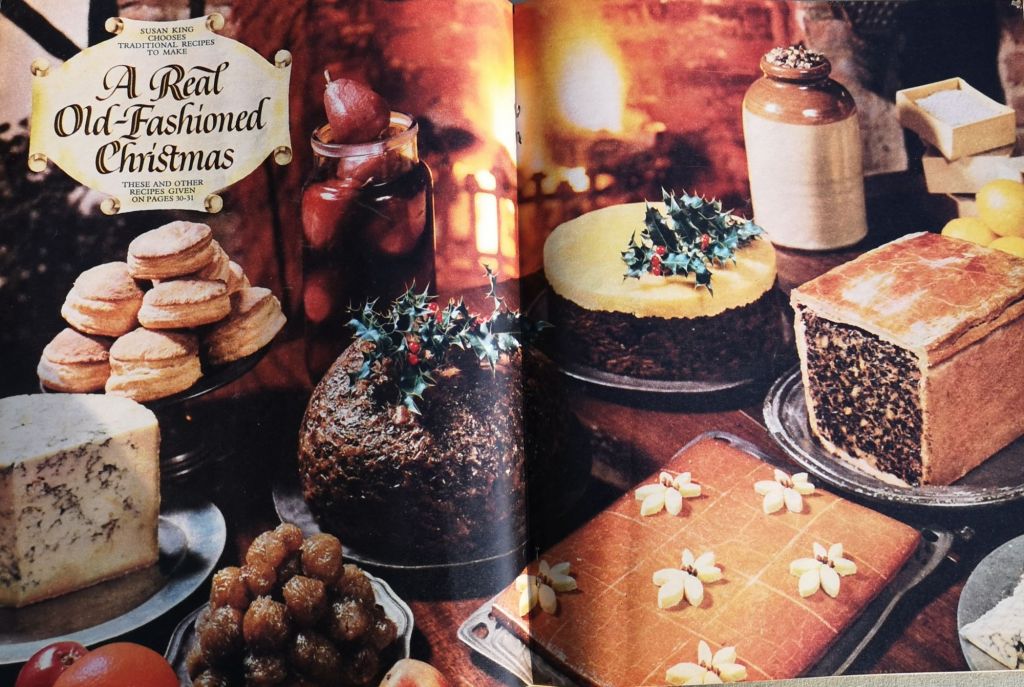
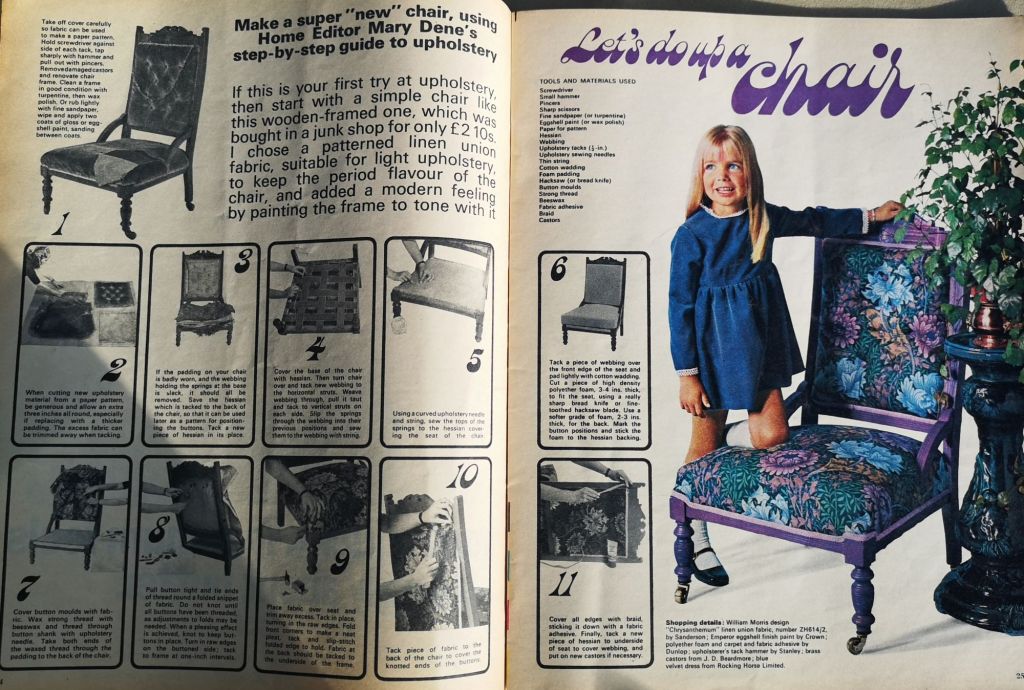
For the average woman in her own realm, she could cook Christmas Dinner courtesy of the recipes in the four page section ‘A Real Old-Fashioned Christmas’. We would still recognise Mincemeat, Puff Pastry for Mince Pies, Christmas Cake and Gingerbread. Plum Pudding, Candied Chestnuts and Spiced Pears would be less familiar, and probably only read about in old novels, while Black Bun and Drunken Prunes would be absolutely baffling! For the record, Black Bun is a Scottish cake encased in pastry, which you don’t eat and Drunken Prunes are soaked in sherry for four days, which might do it! She could knit the aforementioned jumper, girls’ dresses and a cuddly Lennie the Lion. With the time she would probably have left (!) she could also upholster a chair! This definitely reflects the ‘make do and mend’ approach required of so many families in those days. Yes, you could afford the occasional treat but only if you saved money where you could.
What interested me on flicking through the magazine was the fact that the family are referred to only in passing. Children and husband are there, but they are not necessarily the centre of these women’s lives. The different slant on the life of the average reader is quite clear when you compare it to the previous two decades. No longer do women have to clean the house, prepare the dinner and still look desirable when their hard working husband comes home!
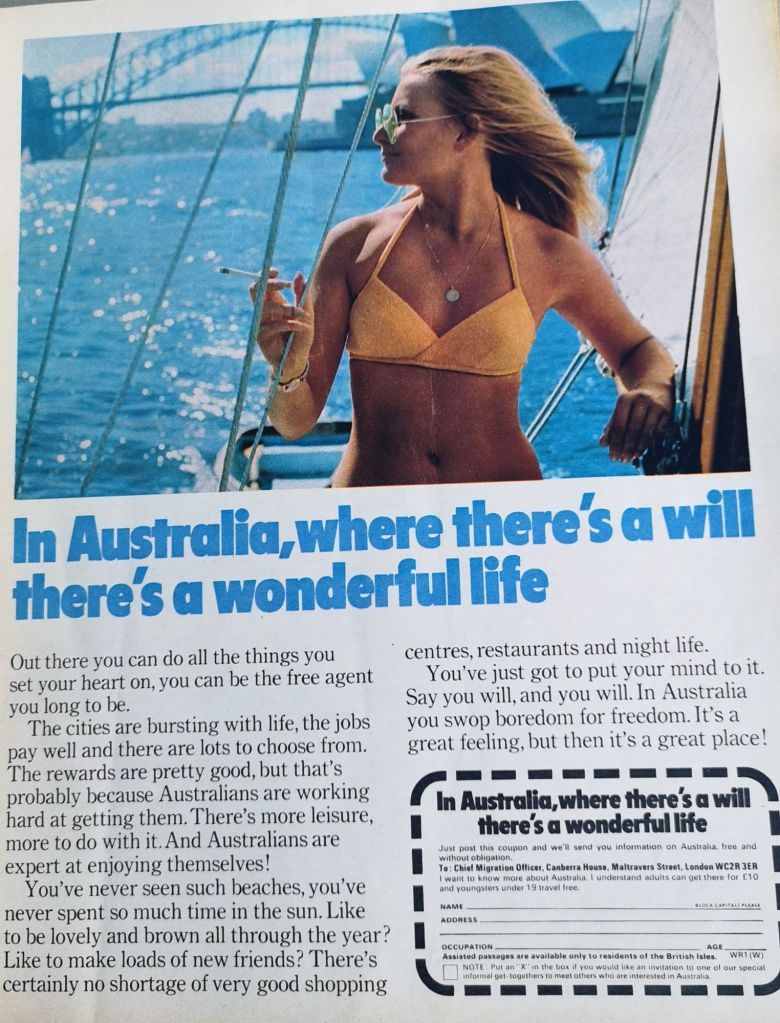
In terms of the adverts, significantly fewer than would be the case in years to come, they were again very focused on the woman herself. It is very much a practical set of products that would enhance their lives quite easily and relatively cheaply. If all else failed and you had had enough of the cold British Winter, which actually gave us a rare White Christmas in the South of the UK, then Australia was interested in you! Assisted Passages, known to everyone else as the Ten Pound Pom scheme, are advertised with the ultimate in aspirational lifestyle style for a British woman. As you can see, they could transform themselves into bikini clad Australians smoking a cigarette on a boat with Sydney Opera House in the background!
Final Reflections
This is, perhaps more than any of the others I have read, a most fascinating time capsule. We are on the cusp of a new era for women, and it is an era that Woman’s Realm are very much at the forefront of. They tread a very fine line between what was possible at the time and what may be possible in the future. Their vision of a more independent lifestyle is at odds with a time when women wouldn’t be trusted with their own money, but change was in the air and Woman’s Realm could sense it. They seem to be saying the future is here, and it could be female.
Do you ever see wild animals?
I see wild animals all the time as the news is always about the wildest ones. Humans are wild animals, not a favoured creation. Humans are the wild animals, because they are the only ones to deliberately destroy their environment. Humans are the only species, as far as we know, who have evolved beyond the point of stability, both environmental and psychological. The most powerful don’t care about anyone else apart from themselves or anything else apart from the hoarding of more wealth than they could spend in a thousand lifetimes. The least powerful vote in those who promise to inflict as much damage as possible on the world as long as they say that they hate the other side.
The so called wild animals, a phrase that belongs in the 19th century along with savages, are actually far kinder and far less damaging than we are. Lions, Tigers and Leopards kill for food and only kill humans because humans have moved into their territory. Humans kill these magnificent creatures because they are selfish, vain and money hungry. A poacher is far more of a wild animal than the rhinoceros or elephant they are hunting. All they will do is bring down the animal, cut off their ivory and leave them to die in agony. How can you think of that and not see who the true wild animals are?
All other animal species contribute to their environment whereas human beings damage theirs. Sooner or later we will become extinct and the planet will recover without us.
What was 1967 like?
It was the 15th year of Queen Elizabeth II’s reign and her Prime Minister was Harold Wilson. There were two pieces of legislation with far reaching consequences passed in this year, both in October. Male Homosexuality was decriminalised, but only for those over 21 and only for consensual acts in private. Despite the less favourable treatment, when compared to heterosexual acts which were legal at 16, and the fact that it was still illegal in the Armed Forces, it was an incredibly brave piece of legislation for the 1960s which, despite the exaggerated prevalence of the ‘permissive society’, was still very traditional at its heart. The decriminalisation of abortion, which was a Private Members Bill introduced by David Steel, later leader of the Liberal Party, was a social and healthcare issue that was costing the lives of women forced into having illegal abortions. The fact that both pieces of legislation continue to be controversial nearly 60 years on shows the seismic effect it must have had on society at the time. One thing Harold Wilson did not get through was his application for membership of the EEC. General de Gaulle who hated the British that had, after all, given him protection during the war years once again said ‘Non’!
In the New Year’s Honours List, one name stood out, that of Alf Ramsey. Still the only England manager to lead the country to World Cup glory, he became Sir Alf Ramsey following their success the previous year. The captain, Bobby Moore, never received a knighthood but he was honoured with an OBE at the same time. Geoff Hurst, who scored a hattrick in the final had to wait 13 years before he also received an OBE while the final five were honoured for their part in the final 33 years later in 1999!
In TV one of the main events was the transmission of the first episode of Trumpton on January 3. 20 years later it was still entertaining a whole new generation of children. The models, the songs and, above all, Brian Cant’s marvellous voice made this a show that has been referred to in popular culture multiple times. On July 1 the BBC started to experiment with the new medium of colour, even though very few colour sets yet existed. News at Ten was shown for the first time on ITV on 3 July.
In music, one event stood above all others in 1967, the release of Sgt Pepper’s Lonely Hearts Club Band by The Beatles, an album that ended up defining the 1960s for many people. After missing out on the Christmas Number 1 the previous year, the Fab Four were once again at the top of the charts on December 25 with ‘Hello, Goodbye’.
Woman’s Own Christmas Annual 1967
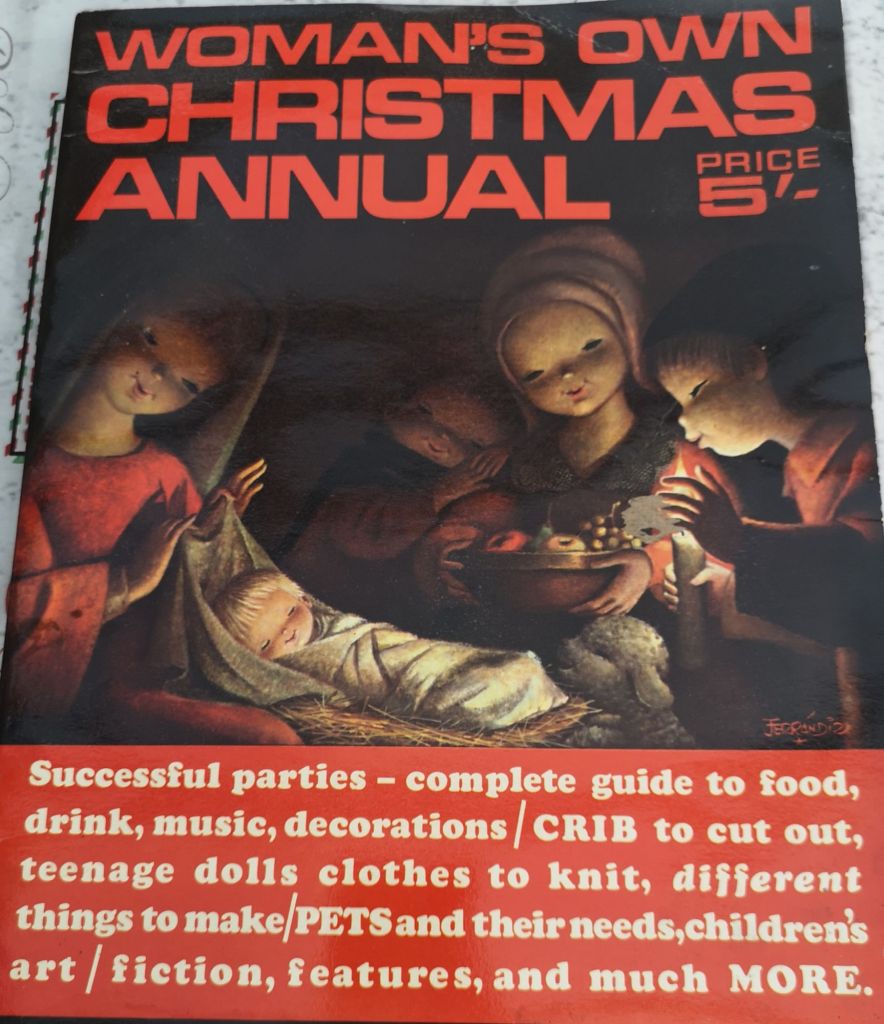
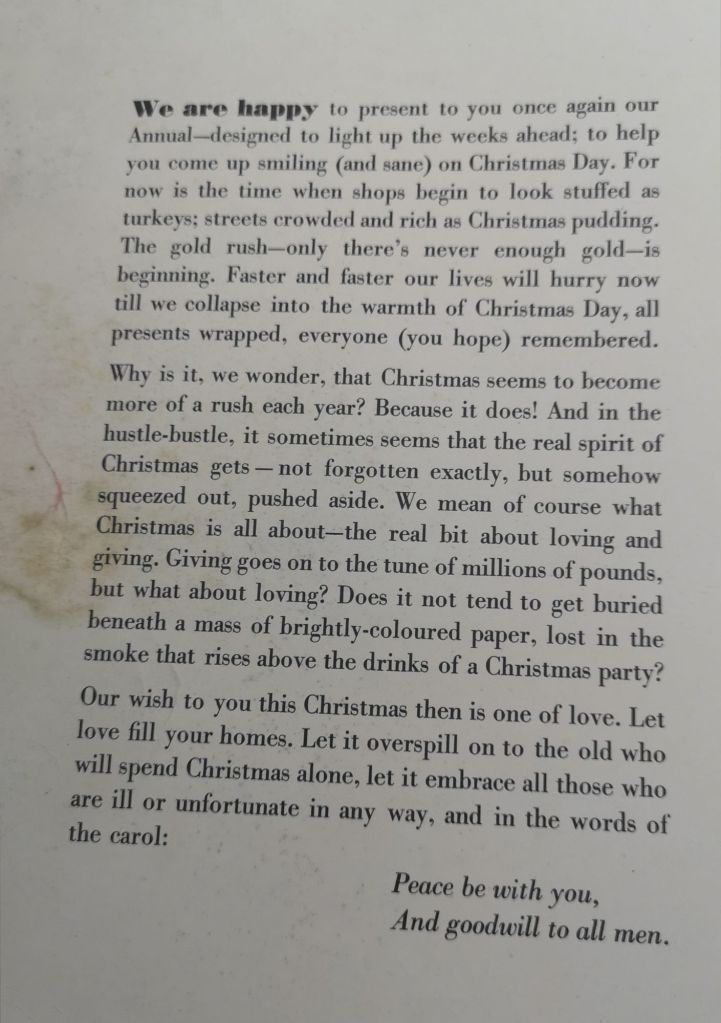
The first thing to notice on the cover is the quite significant price rise on the issue just two years earlier. It had risen from 3s 6d to 5s. It equates to a price rise of well over a third, and indicates, perhaps, a large increase in costs, as inflation was between 1 and 2% that year. In terms of the content, the magazine was maybe even more traditional than the 1965 version. If you look at the editorial below, the readers are strongly encouraged to get away from the trappings of the consumerist Christmas and to concentrate on the real meaning behind it. It’s interesting, and amusing, to see that the complaint of Christmas becoming too frantic was just as much in evidence in 1967 as it is in 2025. The reminder of the real meaning of Christmas is just as pertinent then as it is now. There is a feeling of Woman’s Own trying to reshape Christmas into one its older readers might recognise. This feeling is enhanced by the first main article ‘The Magic of Christmas’ which takes the reader back to simpler times and older traditions with the comfort of repetition. The author does wistfully reflect upon the fact that more people listen to the Nine Lessons and Carols on the radio than actually go to church, but she excuses them because of how busy the day is! Finally, as with the magazine two years earlier, the magazine looks towards Europe for some traditions that really reflect the season on the continent.
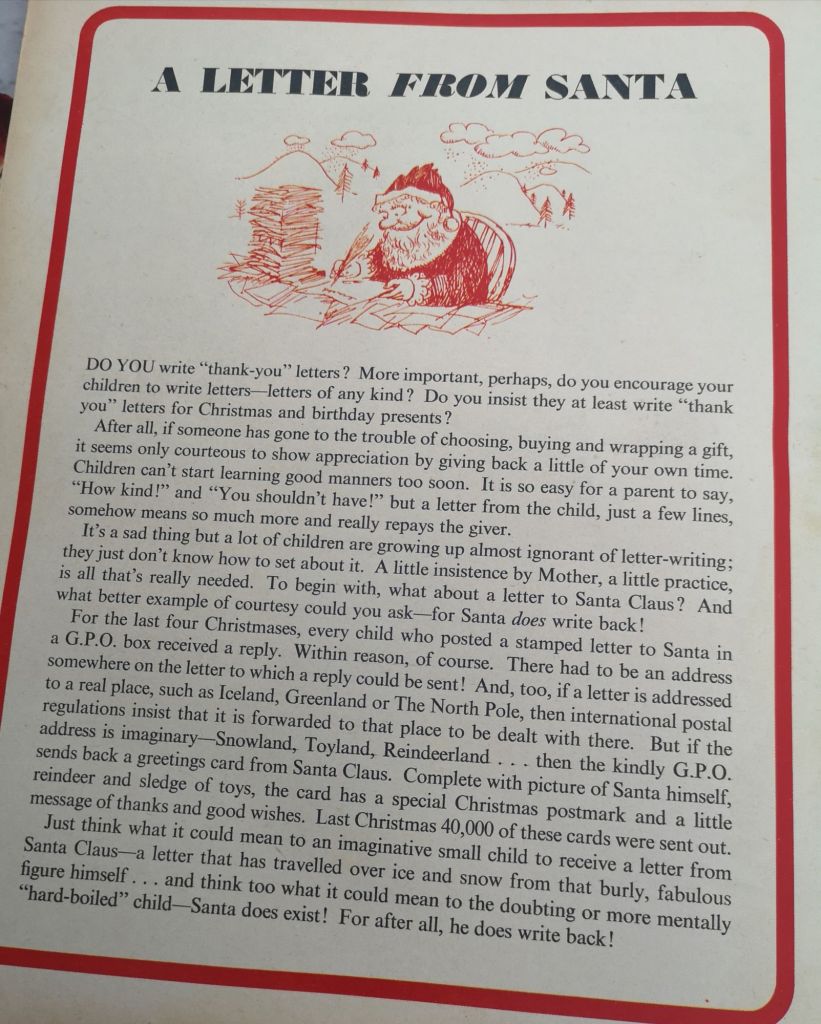
There is a tentative acknowledgement that children are maybe less likely to truly appreciate their gifts and that they are growing up more quickly than they used to. The Letter from Santa bemoans the younger generation and their reluctance to write thank you letters or indeed many letters at all! He suggests getting your children to write to him because they are guaranteed an answer. There is no indication that reinforcing the belief in Santa Claus himself is in any way a bad thing. In fact it is to be encouraged among the ‘doubting or … mentally had boiled child’! The benefits of keeping the wonder are extolled while the more modern concern of ‘lying’ to your child does not even come into it, an approach I wholeheartedly agree with.
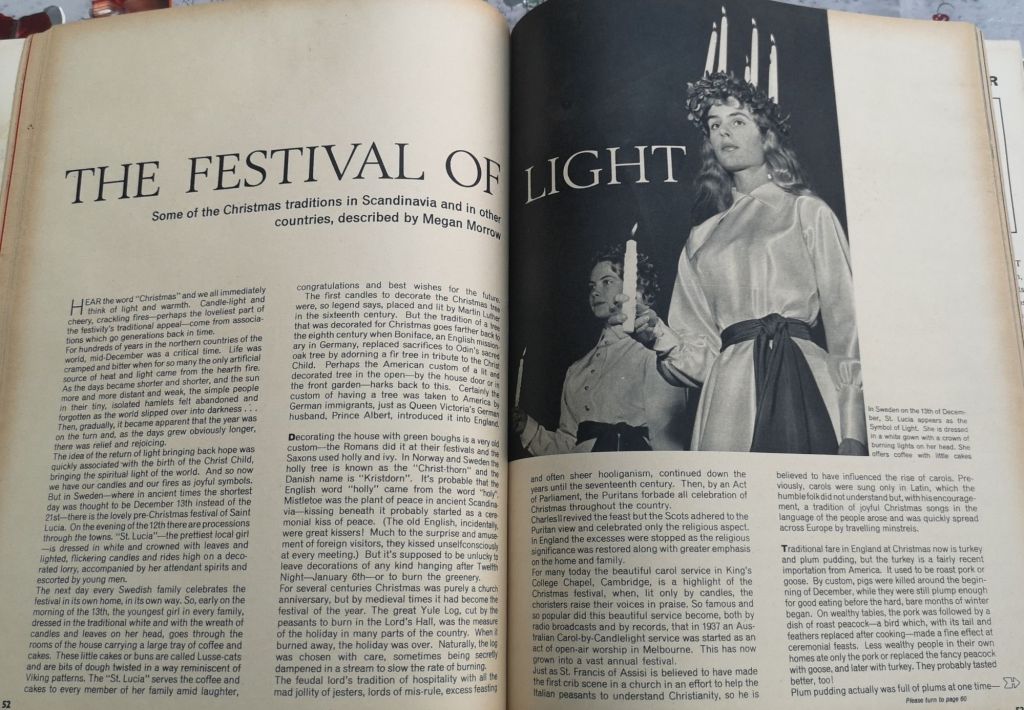
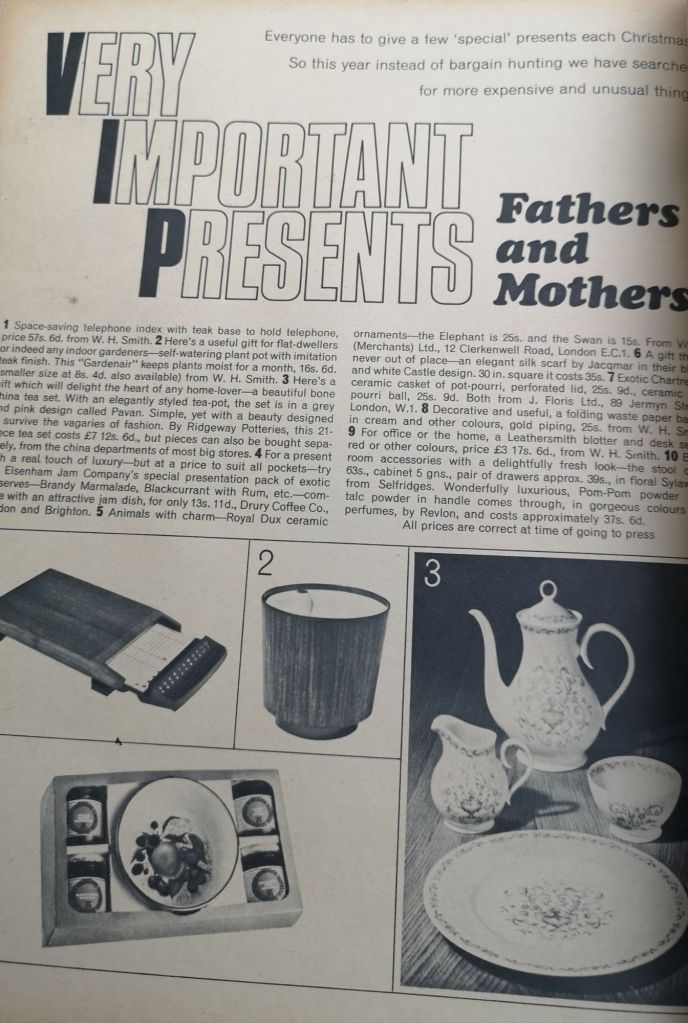
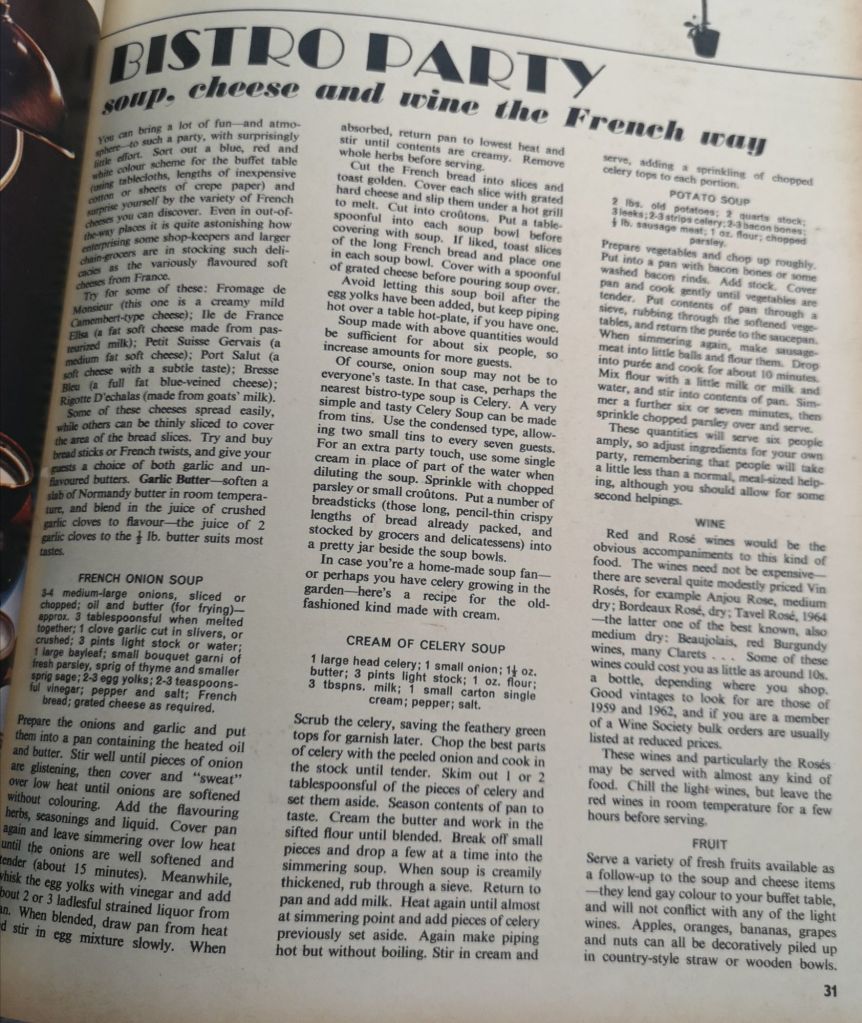
However, even the most determined magazine has to accept reality in some ways. Their readership will be from diverse backgrounds with struggling manual workers at one end to the very well off, relatively speaking, professional class at the other. Hence, two articles are pitched quite clearly at the more affluent or more aspirational of their readers. First of all, there are suggestions for presents that will bring some luxury into Christmas for the pockets that can stretch to it. With prices from 25s to over £7, these would not be within the reach of many. However, even those people may find some inspiration from those ideas. If you wanted to impress your guests at a Christmas party, why not turn it into a Bistro party! Absolutely certain that nothing could impress more easily than French food, delicacies like garlic butter, three different types of soup, wine and fresh fruit! Failing that you could go Danish with Shrimp sandwiches, lots of different meats and beer! It would seem that even Woman’s Own would not go too far away from the familiar for fear of frightening the meat and two veg brigade of whatever income bracket!
Final Reflections
This is an interesting magazine in that it is fighting the potentially huge effect of societal changes by doubling down on tradition. This approach would no doubt have chimed with many around the country who were worried about the speed of change. However, these changes would not be stopped and eventually magazines like Woman’s Own would be forced to change themselves or become irrelevant. Despite the way that consumerism has altered the world of the sixties so markedly, there are still echoes of the wish to have a traditional Christmas, however we perceive that term, and return in some way to the magic of our childhood Christmases.
Next time it’s the turn of Woman’s Realm 1970.
Do you have a favorite place you have visited? Where is it?
I think favourite places are attached to a time rather than a geographical location. My immediate answer was Sydney, but on thinking about it more carefully I would say Sydney 2004 would be more accurate. That year was anything but straightforward but as a family we lived in the suburbs of Sydney as locals would. The indelible memories of that time were connected to the children being young and the degree I was taking being so enjoyable. When we returned last year I realised that it was a very different place because we were only there for three weeks and we were at full speed for most of the time. It was a very different place because I was older and we only had one of our children with us. It was a very different place because I was a very different person.
So, there you have it. I can’t say that I have a favourite place but I can say I have a place that coincided with a favourite time. There is a big difference between the two and unless you recognise that you may be in for disappointment if and when you do return.
What was 1965 like?
It was the 13th year of Queen Elizabeth II’s reign, and the year she saw the death of her first Prime Minister, the legendary Winston Churchill, in January. A third of a million people filed past his coffin when he lay in state for three days. Her Prime Minister throughout the year was Harold Wilson, the first Labour Prime Minister since Clement Atlee. Politically, there were two main events. First was the Abolition of the Death Penalty, a long overdue move towards a truly civilised society. However, it was initially a five year suspension allowing for a change of mind, which thankfully never came. Second was the Race Relations Act which made it an offence to discriminate against people based on their colour in a public space. It also introduced a crime of Incitement to Racial Hatred. The Beatles played live for the last time in Britain at the Capitol, Cardiff as the screaming from the audiences was drowning out their singing. However, in the rest of the year they filmed Help!, recorded and released the soundtrack, recorded Rubber Soul and released a Double A Side of Day Tripper/We Can Work It Out which was their third Christmas Number 1 in a row! Despite all this success, the biggest selling record of the year was Tears by Ken Dodd! The 1965 film year was dominated by The Sound of Music which was released in March and became a seemingly permanent fixture in cinemas across the country. The soundtrack also dominated the album charts even with all the huge acts around.
When looking at television in 1965, there was one big surprise. This was the year that cigarette adverts were banned, although cigar and pipe tobacco ads were allowed to continue! Given the prevalence of cigarette adverts in print media, it is interesting to speculate why ITV was relatively quick off the mark on this. My guess would be that in the position of relative power ITV found itself in – there were only two channels at the time – meant that it could be perceived to be encouraging a potentially extremely harmful pursuit, which may have led to legal action down the track. As with so many other dangers, from global warming to the effect of radiation, the evidence already existed in the scientific journals long before it became common knowledge in public circles.
Debuts made in this year included Till Death do us Part, Tomorrow’s World, Man Alive, Thunderbirds, one off play The War Game and The Magic Roundabout. Culturally, all of these have remained in the public imagination with the exception of Man Alive, but social history has much to thank that documentary strand for. Two Christmas Day events of note were the first ever Christmas Top of the Pops and The Feast of Steven, a Christmas themed Doctor Who episode, where William Hartnell as the Doctor broke the fourth wall to wish viewers compliments of the season.
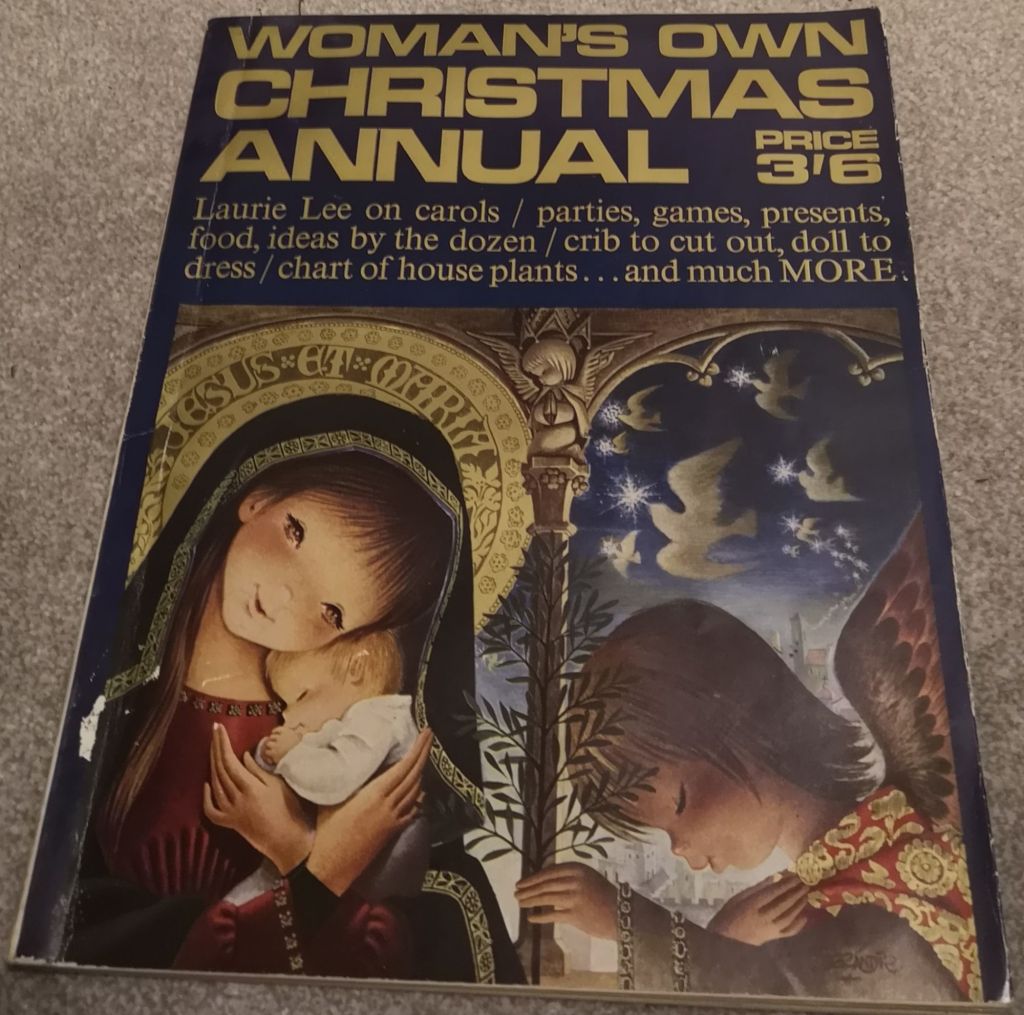
Woman’s Own Christmas Annual 1965
The cover at the top of this article is more effective at creating the mood for this magazine than almost any other. Although the use of children as Mary and an angel can seem a little cloying to modern readers, it reflects the children’s place right at the centre of the festival. It would have brought to mind the school Nativity play which was a staple at, almost certainly, every Infant and Junior school in the country at the time. The only element that might be called into question in that sense was the brunette Mary replacing the blonde Mary that was seemingly essential to almost every play I have ever watched!
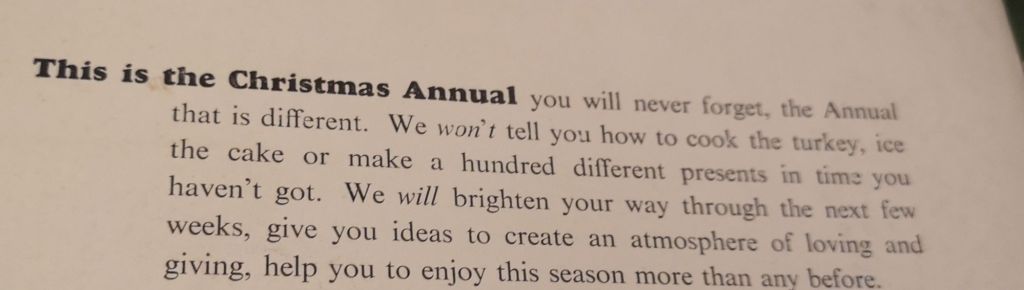
It’s interesting how this short paragraph sets out the stall for this magazine so succinctly. The intention seems to be to separate it from the ‘old fashioned’ magazines of the past and to attract a readership accordingly. It is probably one that would be more recognisable to a modern audience than the four that have preceded it in this series, which, given it is 60 years old, may indicate that the past is not so different a country as we might believe it to be. I certainly found it familiar in many ways and, of all the magazines I have read for this project it is probably my favourite.
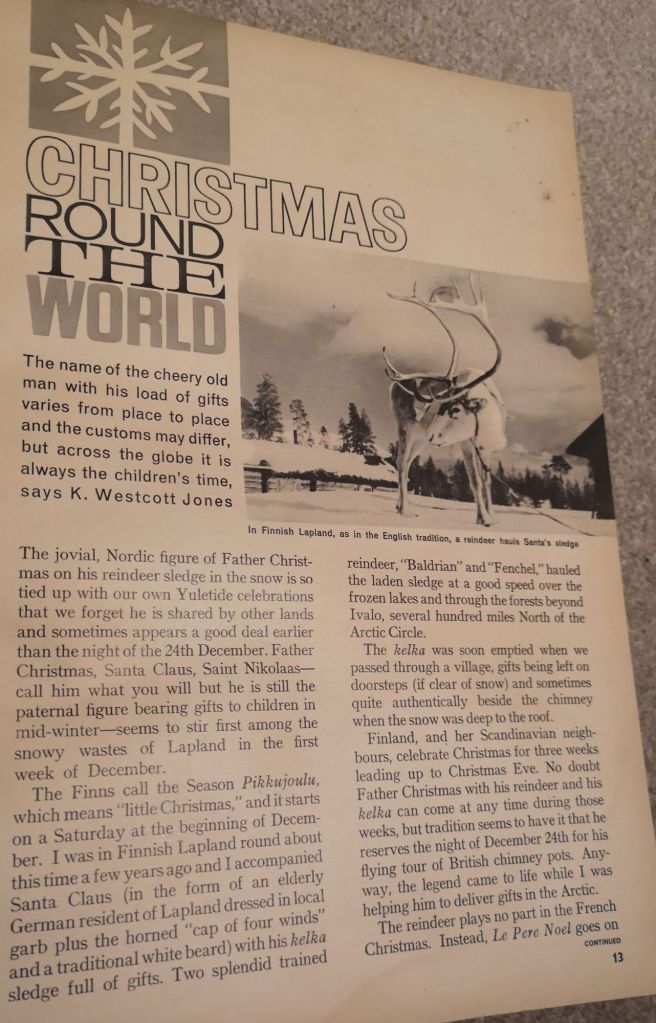
The first section I have picked out is the Christmas Round the World item that broadens the view from a British Christmas to a much more European festival, in keeping with the derivation of Father Christmas/Santa Claus/Sinterklass/Le Pere Noel. This type of article would have been as interesting to many children as it was to the Mothers whose magazine it was. Don’t forget that in those days this information was not readily available outside of heavy encyclopaedias or academic texts, so to have it in a well written and accessible form would have been very useful to all concerned.
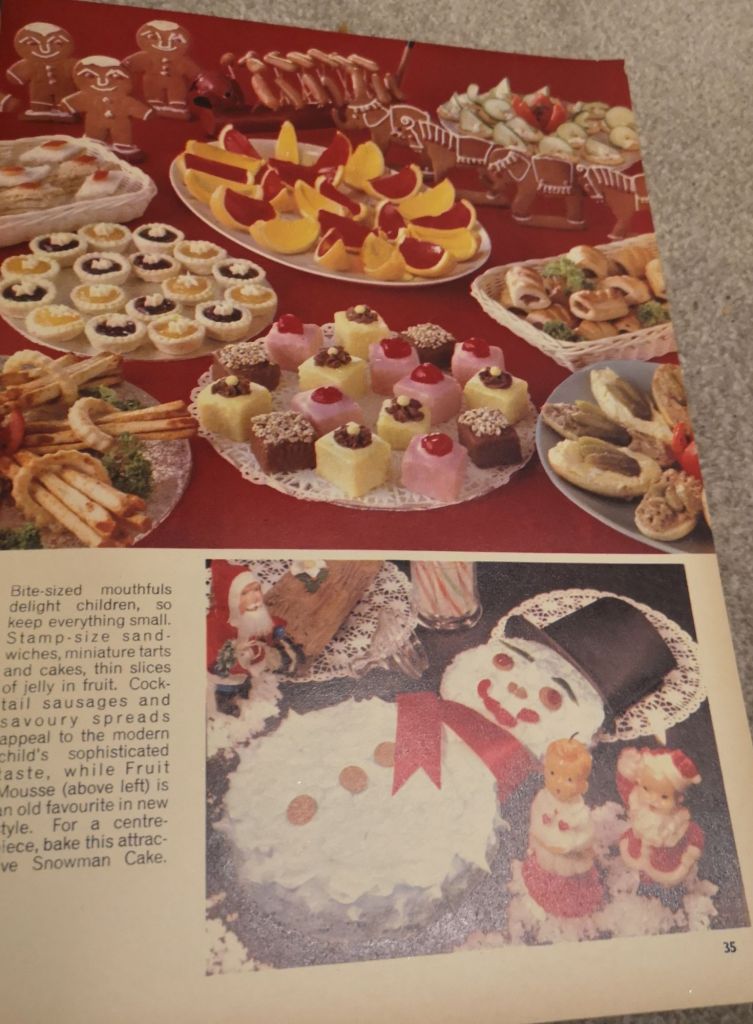
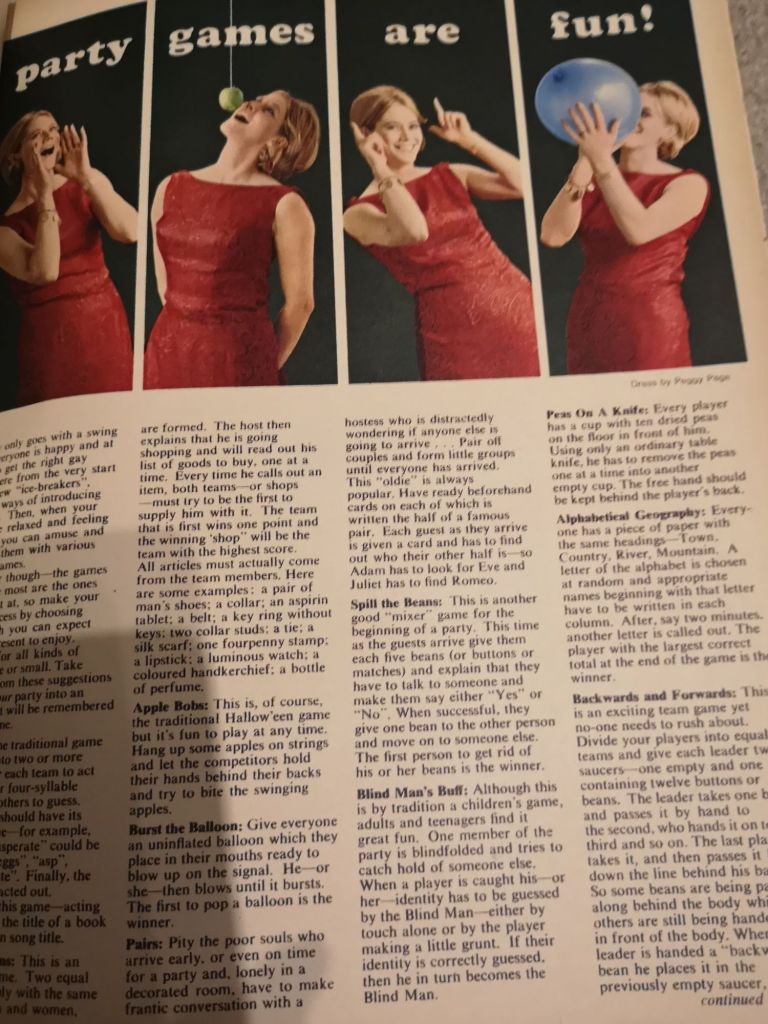
In the interest of brightening the way through the season there is an eight week Christmas Countdown that contains advice that is still very useful today. Of course, some advice like postage times to Ceylon and Rhodesia would be out of date, while references to ‘gay’ wrapping paper and tying a bow round pussy’s neck might raise eyebrows! However, timings for baking, early food buying, presents for all the family and party planning are still very good. As you flick through, there are four pages of lyrics for carols and using an ordinary pack of cards to tell fortunes as a fun party activity. Party food for children range from the now unfamiliar canapes, which are even rare at parties for grown ups, citrus segments with jellies replacing the orange and grapefruit and the show stopper, a Snowman Cake which does actually look like it would be very popular even with today’s children. Once the children have gone to bed then adults can play party games – no not those party games! As the magazine suggests you can create whatever atmosphere you choose with your choice of these games.
Finally, I want to pick out Laurie Lee’s short reflection on carol singing in his childhood. It is an extract from his incredibly successful memoir Cider with Rosie and is beautifully written. It is someone from our grandparents or great grandparents generation telling us about a world that no longer exists but which, through so many period dramas we can picture perfectly.
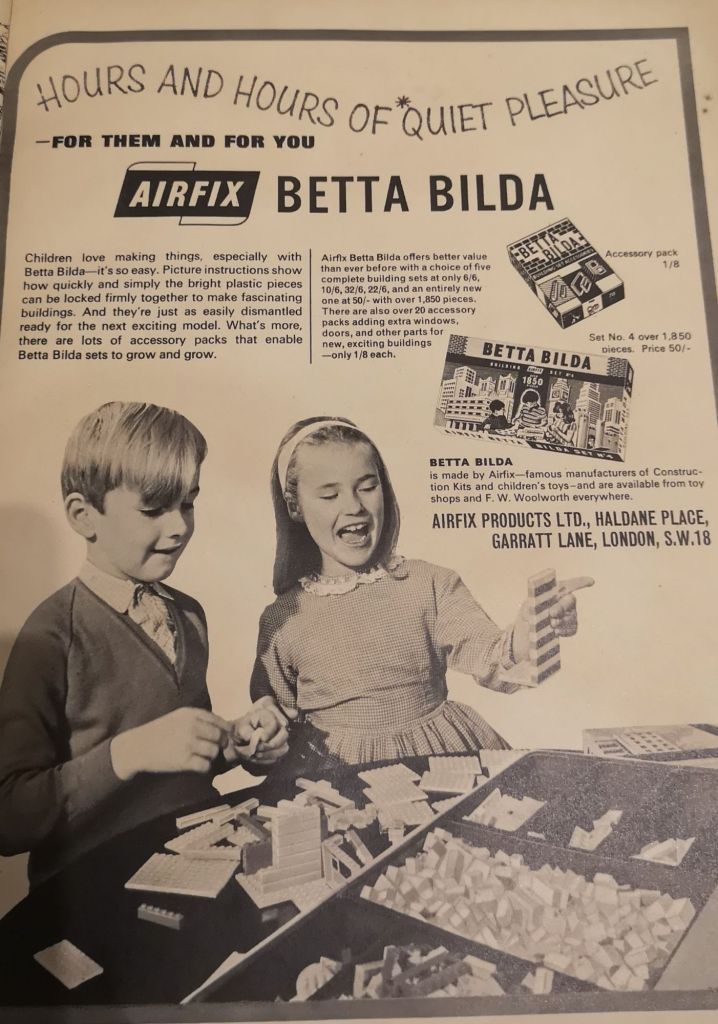
The adverts in the magazine include Lea and Perrins once again, Basildon Bond offering a whole year’s supply of stationery consisting of 220 sheets of writing paper, 148 envelopes, 25 correspondence cards, 20 brieflets and a jotter! That would last most people today a lifetime and more, sad to say. I think that of all the things that have disappeared in the last 60 years, it is letter writing I miss the most. There are Raleigh Bikes, familiar to any child of the 70s and Lindt Chocolate, probably more popular now than ever before. The advert I have featured is from Airfix and, to my surprise, is entirely gender neutral. It shows a boy and a girl using Airfix Betta Builda to construct their own towns. Who knows how many young women would have been encouraged into STEM if this kind of approach had remained the model for every construction toy in my 70s childhood. By then, Airfix and Meccano, neither of which suited me at all, were marketed almost exclusively to boys.
Final Reflections
If this magazine appeared on our supermarket shelves now, it would certainly not look out of place amongst the massed ranks of festive offerings except for the fact that it is very largely in black and white with colour used to create a ‘wow’ factor. The standard of writing and range of subjects could teach something to today’s celebrity obsessed Christmas issues, and I for one would probably find more of interest in it than in any of its modern competitors.
Next time, we look at the Woman’s Own magazine two years later.
 David Pearce - Popular Culture and Personal Passions