
What are your favorite physical activities or exercises?
When I look back on my journey through exercise, I realise that there has never been a type of activity that has been consistent apart from walking.
As a child, I found physical activities like sports very challenging due to my dyspraxia. I was forced to think about every movement and for that reason nothing was natural and easy. Once I learnt how to run and ride a bike I still found myself having to think about every movement. Football was a game I loved playing but I couldn’t get my movements sorted out so I played just one half of one game for my junior school, mainly, I think, because I was a trier. I played in defence and when I was substituted we were 3-0 down but in the second half the defence shipped another 7 goals and we lost 10-0. I felt like it indicated that I was a better defender than my replacement, but the football coach didn’t seem to agree!
I played a variety of games at senior school but if you weren’t a natural player you were not given any opportunity to improve. You were put in the lowest group and given up on. This happened with rugby and cricket in my first two years and I proved to be very bad at the time at cross country running. Basically, those seven years were a real trial but, looking back, the 90 minutes of games plus the 90 minutes of PE gave me a baseline fitness level that stood me in really good stead. Along with the hiking it gave me a strong core of activity throughout my teens.
As I have recounted before I ended up becoming extremely fit when I was in the Royal Air Force. I had to rebuild that fitness after my injury and in Polytechnic I tried Kendo, which I thoroughly enjoyed but which, with its prescribed foot movements was a trial for my dyspraxic brain. I played badminton at various points but was enthusiastic rather than able. I played friendly 5 a sides in Hong Kong with my fellow teachers and enjoyed it but looked like I was completely out of my depth, which I was!
I did some weight training for a couple of years along with cycling, rowing and running machines so by the time I finished at INTO St George’s I was very fit. We have equipment at home which was bought for me to restart this training but which I haven’t used for a few years! I know I must start again and I will in 2026. Along with that I will definitely be walking more as I look to move to another level of fitness at this point in my life. Please wish me luck, as I could need it!
What was 2007 like?
Queen Elizabeth saw in the 55th year of her reign in a much stronger position than she had been in 10 years previously. She was seen as a valued stateswoman by the majority of the UK public and was very much the favourite member of ‘The Firm’. In politics, however, the previously very popular Labour Party was split at the very top with Gordon Brown insisting that Tony Blair should make good on his promise, apparently made at the time of the Labour leadership election that took place after the tragic death of John Smith, that Brown step aside to avoid splitting the vote and Blair would hand the leadership over after 10 years. Whether the promise was made in those very definite terms, only the two protagonists would know, but after years of acrimony Blair resigned as Prime Minister in June and handed over the poisoned chalice to Brown. Then came one of those ‘Sliding Doors’ moments, where Brown had the opportunity to go to the country in October, buoyed by a 20% poll lead. Rumours were so strong within the party and the press that it was considered a foregone conclusion. Brown never wanted to go, because it was not in the national interest as he saw it, but when he announced that there would be no election, the press jumped all over the story and accused him of bottling it. The following year, the Banking Crisis sank the World economy, and although he used all his economic judgement to navigate a path through it, he was fatally compromised by it in political terms. Brown himself admits that Labour would have won the election and he would have had extra time to recover politically from the 2008 Crash.
Away from politics, it was a year that saw the new Wembley Stadium open, but the England team that graced the new stadium were less a new era and more a throwback to the 1970s with their failure to qualify for the 2008 European Championships. Their lack of success was matched by the England Cricket Team who were whitewashed in the 2006/7 Ashes series by an Australian team looking for revenge after England had regained the Ashes in 2005. A sporting icon made its last appearance on BBC1 after nearly half a century of bringing the best of sport to TV viewers. Sadly, it was a shadow of its former self as the BBC lost sport left right and centre to Sky and Channel 4.
Television was in the grip of reality shows and one of them, Celebrity Big Brother became highly controversial when Jade Goody, Danielle Lloyd and Jo O’Meara were accused of directing racial abuse at Shilpa Shetty, a Bollywood actress. Leon Jackson won X Factor and became the third show winner in a row to achieve the once coveted Christmas Number 1 slot. In more positive news, The Sarah Jane Adventures starring Elisabeth Sladen as former Doctor Who companion Sarah Jane Smith, debuted on New Year’s Day and at times was even better than the parent series. However, David Tennant had a notable success in the role of the Doctor, as the Doctor Who Christmas Special, Voyage of the Damned, co-starring Kylie Minogue achieved a 13 million audience, the programme’s highest on Christmas Day.
The music charts in the summer were dominated by the juggernaut of Umbrella by Rihanna and the latter part of the year by the highest selling single of the year, Bleeding Love by the previous year’s X Factor winner Leona Lewis. Now that downloads as well as physical sales counted, the opportunity for records to stay in the upper reaches of the chart for longer meant less movement up and down. Whether that was a good or bad thing depended upon your age and view as to the importance of chart positions, but for now the charts were still to some extent the true measure of success.
Two films released this year used books that had been a massive success with a young audience. Harry Potter and the Order of the Phoenix was the fifth book in the series and a guaranteed blockbuster. The other was The Golden Compass, the first book of the His Dark Materials trilogy. It had a top cast with Daniel Craig and Nicole Kidman and a fantastic central performance by Dakota Blue Richards as Lyra. However, the source material with its anti religious storyline was diluted, too much for supporters and not enough for detractors. The result was that the second book, The Subtle Knife was left unfilmed until a much more faithful BBC adaptation many years later.
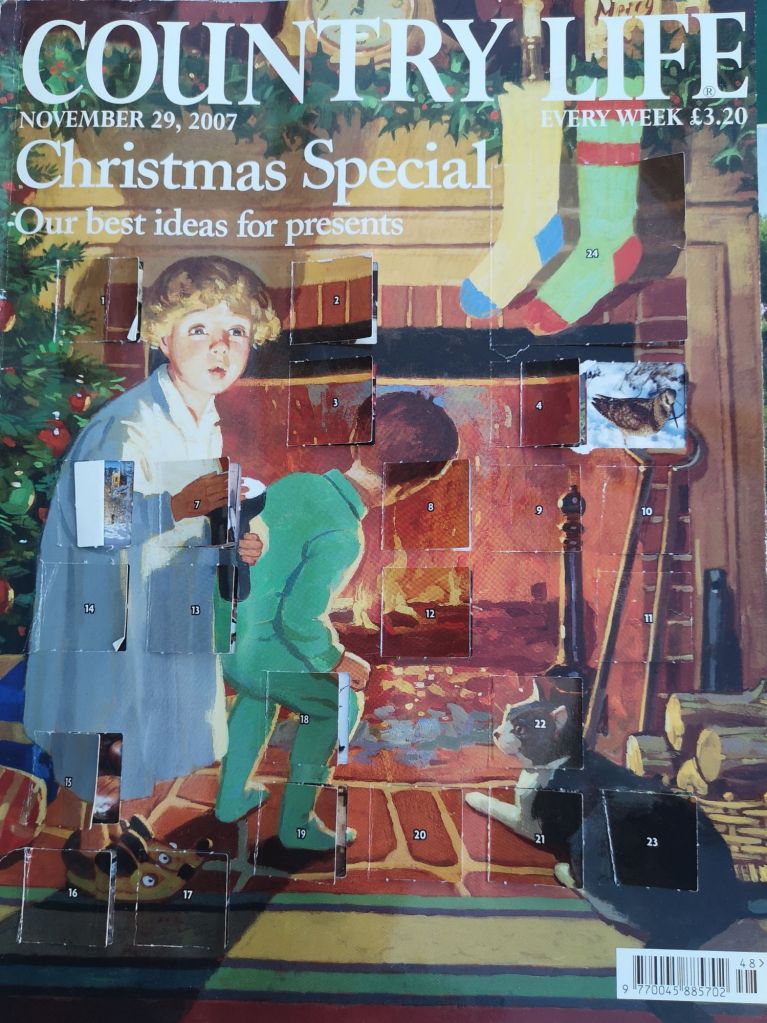
Country Life Christmas Special 2007
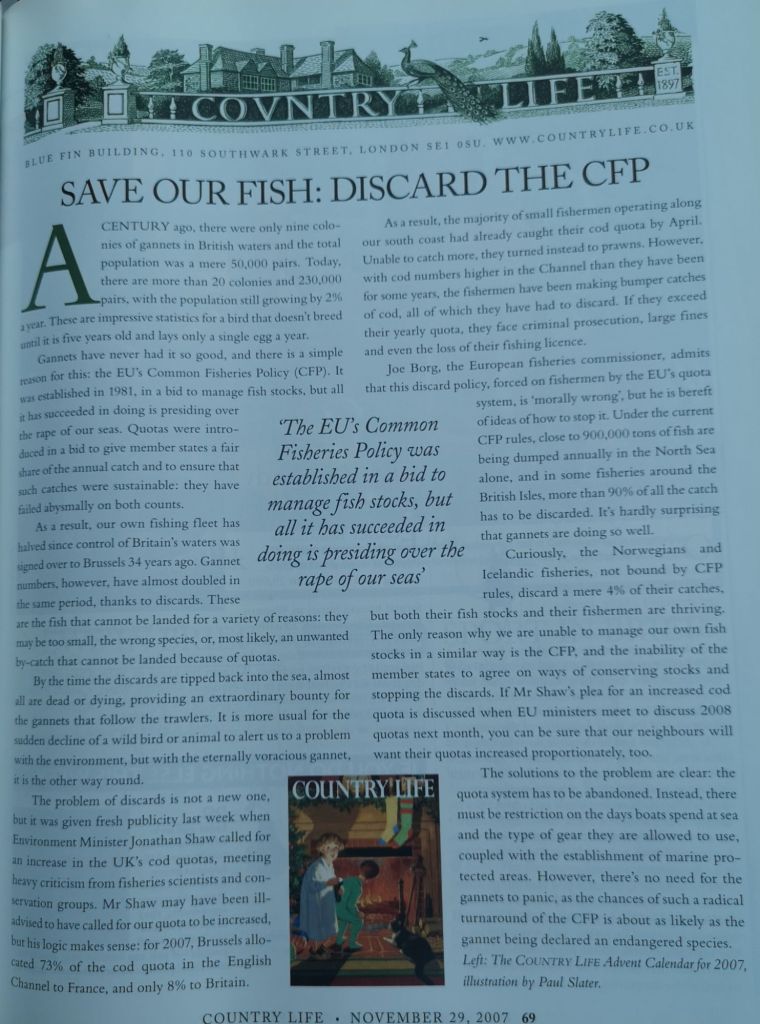

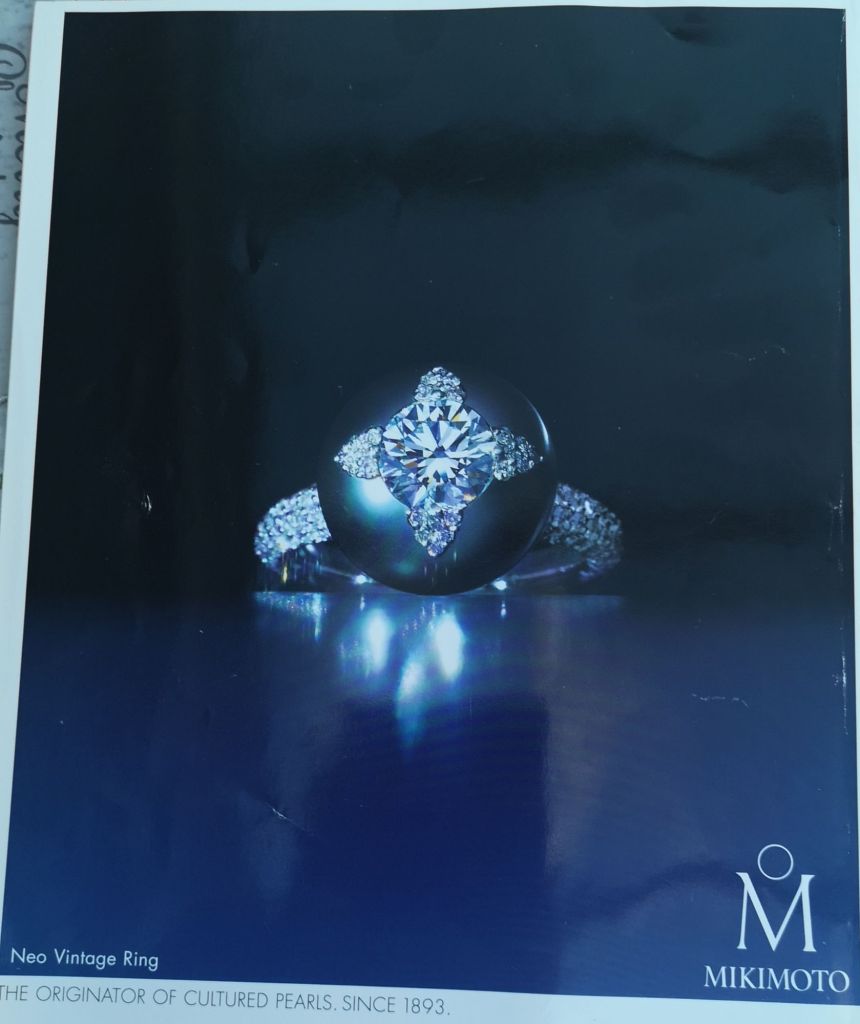
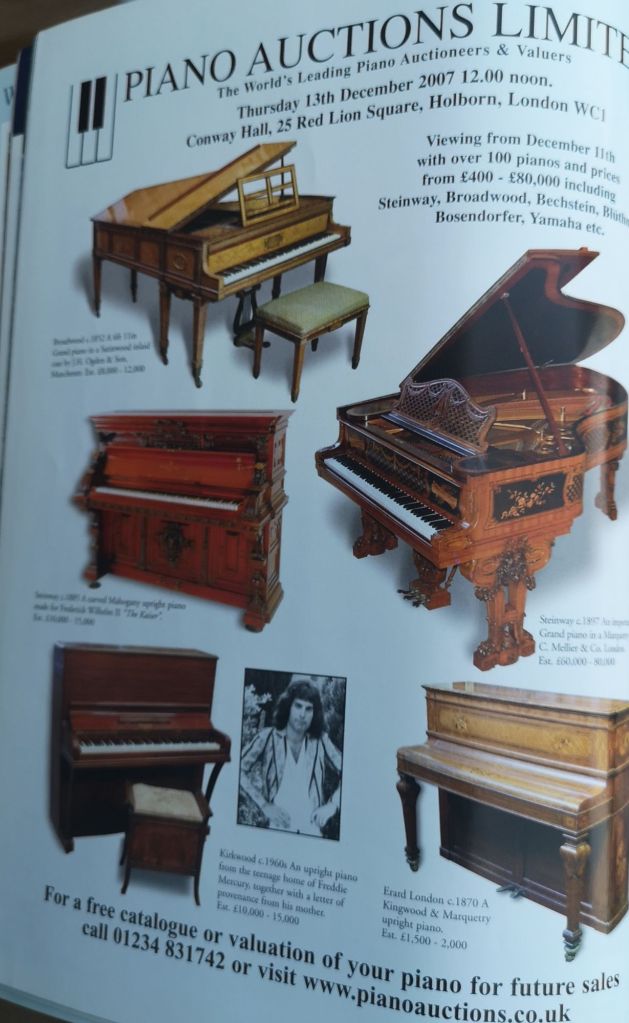
The cover promises magic and reflection, but it turns out to be a very misleading one. In 11 years, this magazine had undergone a massive change in tone. Gone were 1996’s reflections on the social and religious meaning of Christmas. In its place there is a political activism that sits very uneasily with a festival of peace and love. The editorial is nothing to do with Christmas and instead concentrates on a campaign to get rid of the European Union’s Common Fisheries Policy. No peace and love there, that’s for sure! This sour tone continues into the letters page with no one seeming to wish anyone else the compliments of the season. I found it very disappointing, and I can only imagine that at least a readers at the time found it left a similarly sour taste. Looking at the advertisements the readership hadn’t changed in social and financial status, but they were clearly more militant having a Labour Party in power that they saw as antagonistic to their way of life. With Avian Flu being an immediate threat to their birds, things were bad enough, but when the smoking ban in enclosed places including pubs was brought in, the landowners must have felt like they were living through the end days!
Final Reflections
I suppose there is no golden rule that you can run to decide whether a Christmas issue is meeting the needs of its audience. It has become clear that the magazines throughout the years are meeting the needs of the audience at the time and in a way that the audience appreciate. However, the lack of Christmas spirit in evidence has made this the least enjoyable read so far. My next magazine is a Country Life from the following decade so did the Christmas spirit so absent here reappear? You will have to find out tomorrow!
What is something others do that sparks your admiration?
I have always been envious of people with a clear sense of purpose and destiny. That becomes admiration when these people use that sense to make the lives of others better. Philanthropy in its Victorian incarnation has all but disappeared in our modern world where people in power, political or financial, only wish to make their own lives better. Only a few of those with influence use that influence for good. Nowadays it is much more common for powerful people to deliberately make the world worse for the vast majority in order to make it better for themselves. We are in the age I have seen described as the ‘Broligarchy’ where those who have made countless billions through their ability to use technology for their own ends now bow down to the very worst leaders humanity has to offer.
What a contrast to the Victorian philanthropists who were extremely well off and who lived in luxury that was unimaginable to their workforce, but who did what they could to make life better for them. The Cadbury company built the Bournville Village for their employees in the late 18th century, with relatively spacious houses to alleviate the many problems caused by overcrowded accommodation. They also built schools, parks and facilities for further education of the workers. George and Richard Cadbury were Quakers so they refused to have pubs in the village, removing a source of both social and personal problems that they saw as inhibiting effective work in their factories. Were they completely altruistic? Of course not, because the village tied the workers to the company in perpetuity as their home was utterly dependent on remaining employed by the company. In that sense it worked as a kind of benevolent dictatorship because what the Cadburys expected of you was socially enforced in all areas of life, not just work. However, they realised something that nearly all modern employers have completely forgotten, namely that a workforce that is valued will produce much better work than a workforce that is threatened and overworked, the situation for so many people today. It is very sad to think that employers are worse now than they were 200 years ago, but it’s the truth and I can only see them doubling down on their poor treatment as it is profitable for them and keeps them in the manner to which they have become accustomed. It is unimportant to them that they have more money than they can spend in a hundred lifetimes. All they care about is power to do bad things to people below them.
What was 1996 like?
Queen Elizabeth II had been monarch for 44 years, but it’s fair to say that the past four had been some of the most difficult of her reign. From the annus horibilis of 1992 through the seemingly daily revelations of marital strife and infidelity and the finalising of divorce proceedings for both Charles and Diana, and Andrew and Sarah, she could be forgiven by thinking that it could get no worse. Of course, the following year it did, and it looked as though it could bring down the monarchy – but no spoilers! The government under John Major saw a Conservative Party limping towards an election they already expected to lose, riven by infighting and unable to command a majority in the House of Commons by the end of the year. The Labour Party under the telegenic Tony Blair energised as they saw government was within their reach, but they were kept under tight discipline by a Labour hierarchy scarred by 1992 and the triumphalist Sheffield Rally, which was seen as a contributory factor explaining why Neil Kinnock’s chance to get the keys to Number 10 did not succeed.
There were a number of shocking events in 1996, the worst being the Dunblane Massacre in Scotland where 16 children and their teacher were killed at a Scottish Primary School. Following this tragedy the government brought in legislation to make the possession of handguns illegal, saving future generations of children, to date, a similar situation to that in America where school shootings are a fact of life. There were attacks by the Provisional IRA which ended a ceasefire that had stood since late 1994. Three took place in England and one in Northern Ireland. It was a troubling return of the conflict that had claimed thousands of lives in the decades before.
In sport, football ‘came home’ when the 1996 European Championships took place in the UK. It completed the final rehabilitation of the sport internationally after the hooligan problems of the 1970s and 1980s made it inconceivable that England in particular could ever host such an event. England had a tournament to remember getting through to the semi-final before losing to the German team on penalties. It was a summer when football was taken to the heart of the nation in a way that had not happened since 1966, and it led to Baddiel, Skinner and the Lightning Seeds recording perhaps the finest football song ever, the brilliantly mordant but uplifting Three Lions. After that tournament, Alan Shearer set a new British transfer record by leaving Blackburn Rovers and joining Newcastle United for £15 million.
An interesting situation becomes clear when you read the data for average wages in the UK for 1996. In the rush for job creation in the service and tertiary industries from 1979 onwards, the manufacturing sector was all but destroyed. You might think that those left in that sector would be valued for their disappearing skills that were still needed. However, the average wages for manual workers came in at a shade under £300 per week whilst non-manual workers earned, on average, £460 per week, half as much again. It spoke of a complete lack of value, monetary now as well as social, ascribed by society as a whole towards those who worked with their hands. Apprenticeships were virtually non-existent in some industries and with the drive towards university, they were seen as almost valueless. The interesting thing is that we still do not value apprenticeships despite bemoaning the lack of practical skills demonstrated by workers in this country. I think you can trace back that line from today to 1979, and now it seems to be accepted by all parties, something that was arguably starting to happen in the mid 1990s.
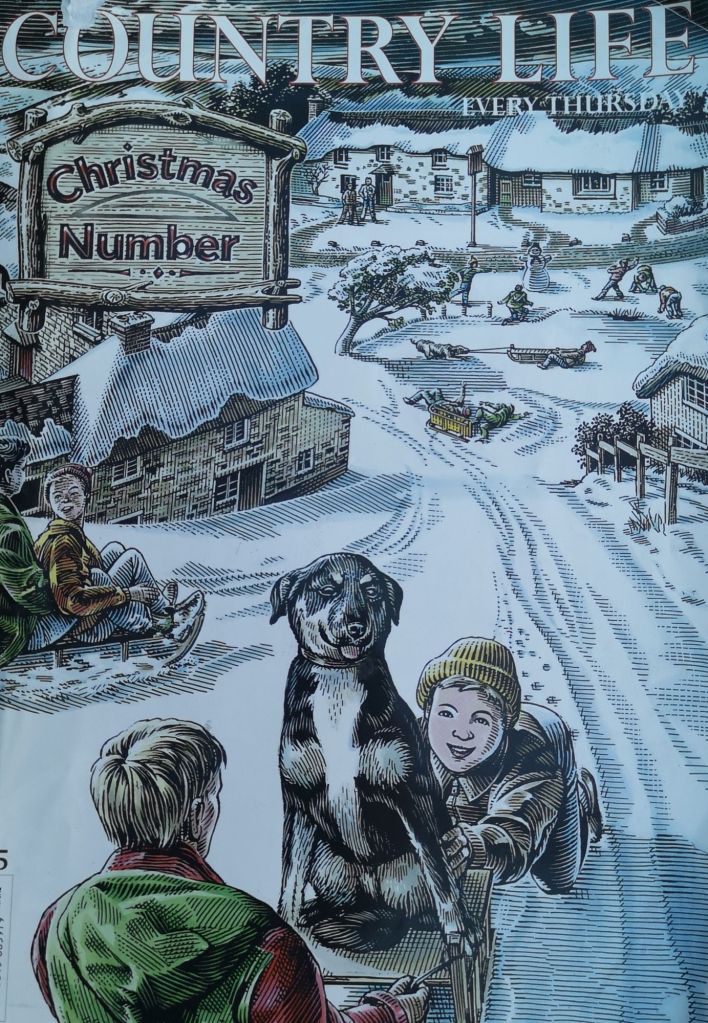
Country Life Christmas Number 1996
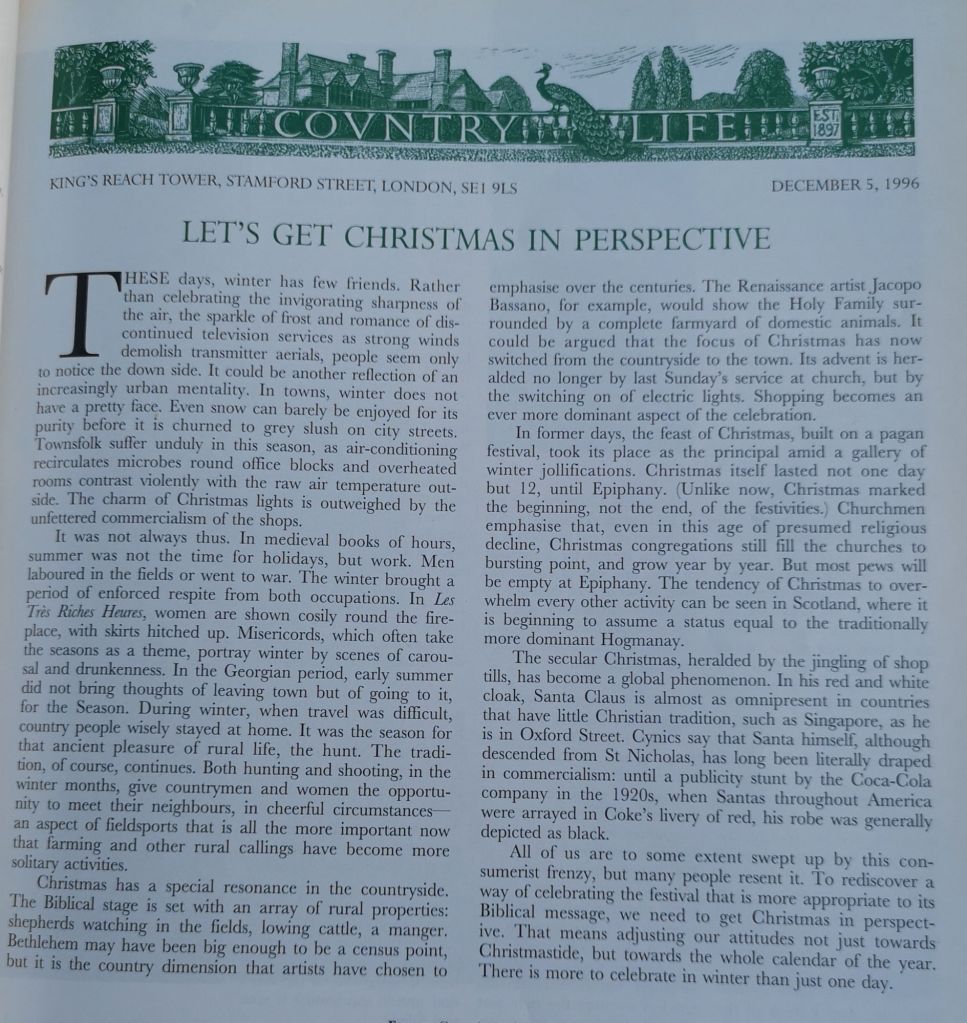
The cover is a clear indication of the approach this magazine takes to the season. The snow, the idyllic village and the smiling children on sleds show an idealised vision of an old fashioned Christmas, and this harking back to earlier, arguably better, times is definitely a theme of the contents throughout. The thought provoking editorial asks us to reflect on Winter as a whole not just Christmas itself. It points out that Winter in past times was a season of rest and celebration, where labourers and farmhands stayed at home or were found engaging in social activities such as the hunt. The piece reminds us that the Nativity was set in the countryside with shepherds, livestock and rural properties to the forefront. All of the above is compared to the situation, now even more entrenched, where the town is the centre of everything and the switching on of Christmas lights has superseded the first service of Advent as the start of the festive season. It is worth reading the editorial in full as it makes some interesting and, still, pertinent observations.
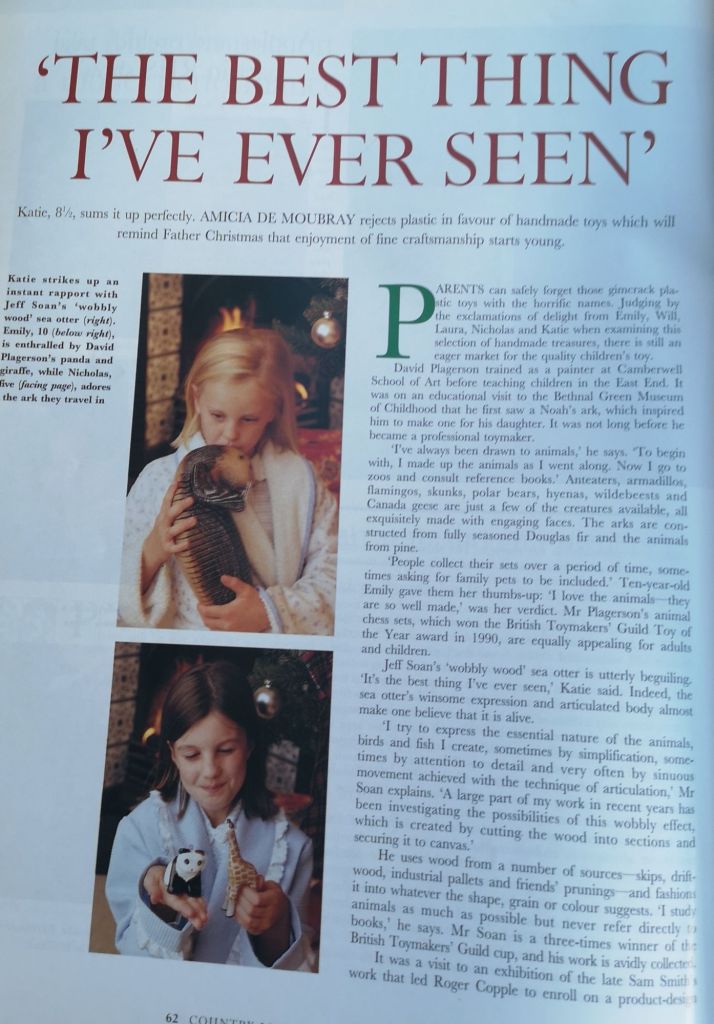
The idea of tradition is front and centre in the article ‘The Best Thing I’ve Ever Seen’ where children are introduced to the delights of traditional wooden toys to enable them to reject plastic alternatives. When you see the backgrounds of the houses, you realise that, like everything else in the magazine, it is aimed squarely at high end consumers of all ages. Carved animal chess sets, hobby horses and traditional farm sets are also more likely to reflect the lives of the children involved, thus increasing the interest level. Don’t get me wrong, I think that the appeal of a long lasting handmade toy is timeless, but it is very much a niche product that would be less likely to appeal to children in the towns and cities that lie outside the rural heartland of the readership.
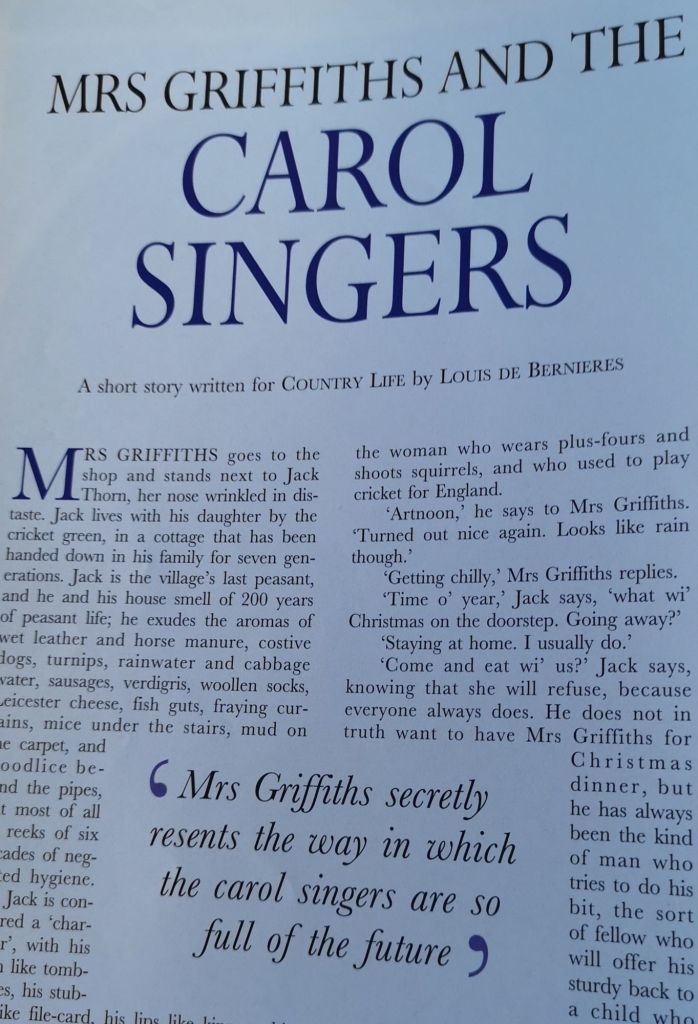
The story Mrs Griffiths and the Carol Singers is a lovely, nuanced piece of writing that perhaps invites the reader to sympathise with the views of Mrs Griffiths at the start, before delving into the reasons behind her behaviour. We see someone who wants to change but is not sure how to, and the events that occur when the carol singers do their rounds of the village are very sad. The story does end on a note of hope, and it earns that with its understanding of human nature.
The letters page is very interesting. In amongst the horror expressed about security lights and plastic windows, there is a letter that calls magpies avian hooligans! There is also an article about traditional skills focusing on the Skills Olympics which took place in 1993 and 1995, where the UK were mid-table, unlike the sporting Olympics where the Atlanta games saw the team take home just one gold in its worst ever performance. However, two letters at the foot of the second page are quite unsettling. Both bemoan the banning of handguns, which they see as criminalising their way of life, accusing politicians of lacking the courage to ignore public outcry following Dunblane. One writer actually predicts that it will have no success in preventing future massacres, but Nigel Kerner of Niden Manor has been proved comprehensively mistaken in the 29 years since he wrote this letter.
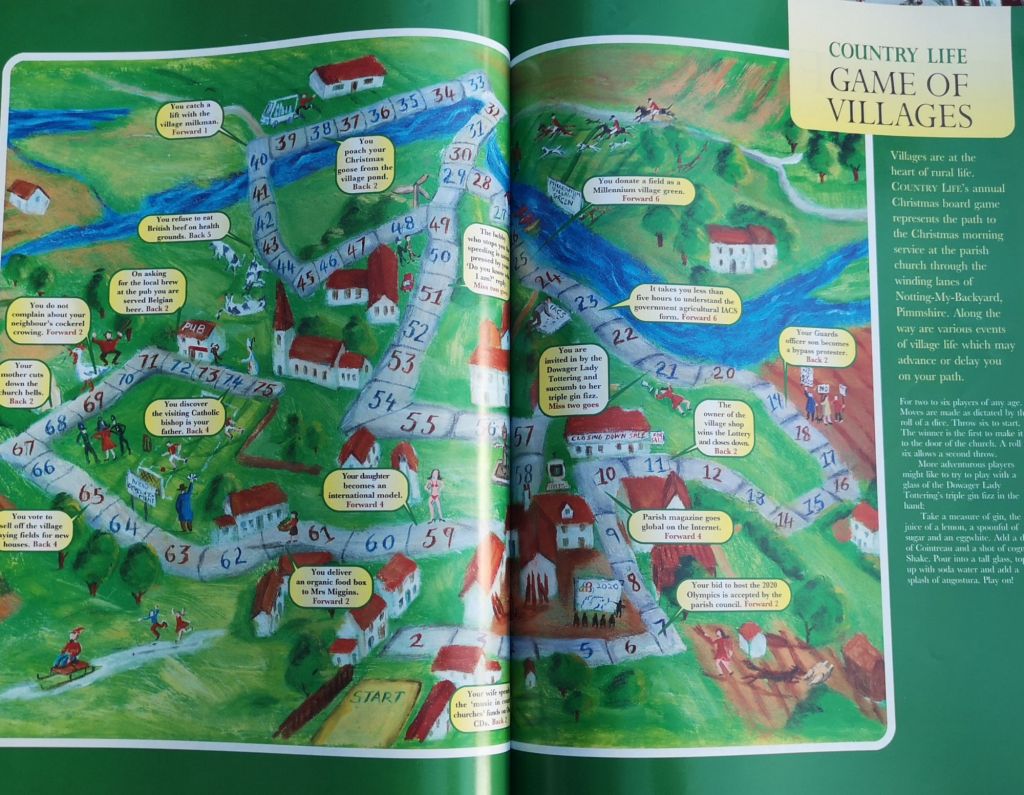
The final thing I wanted to share is the ‘board game for all the family’ on Pages 68 – 69 which follows the journey to church on Christmas morning! Let’s just say, it’s a game you wouldn’t find anywhere else!
Advertisements
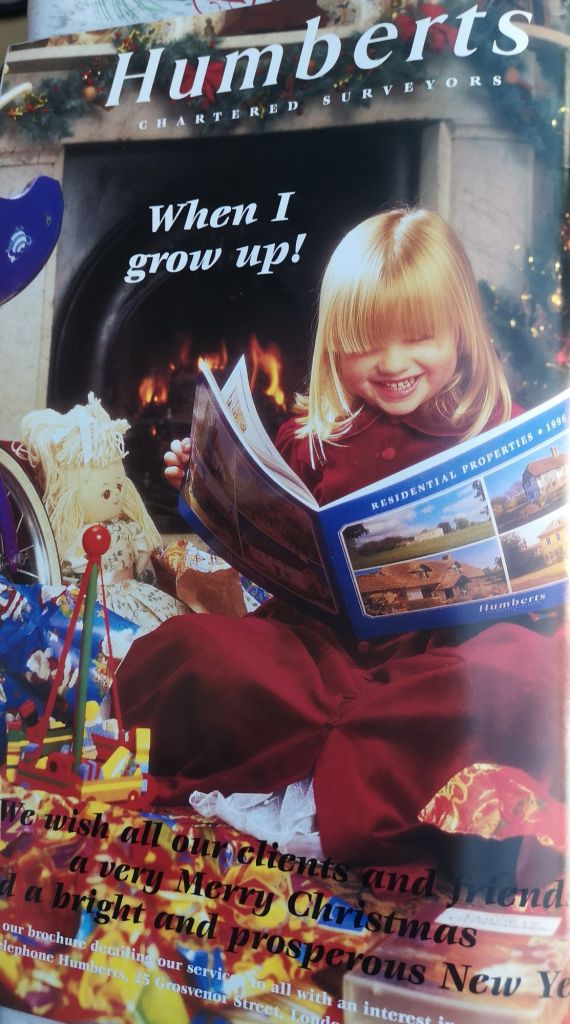
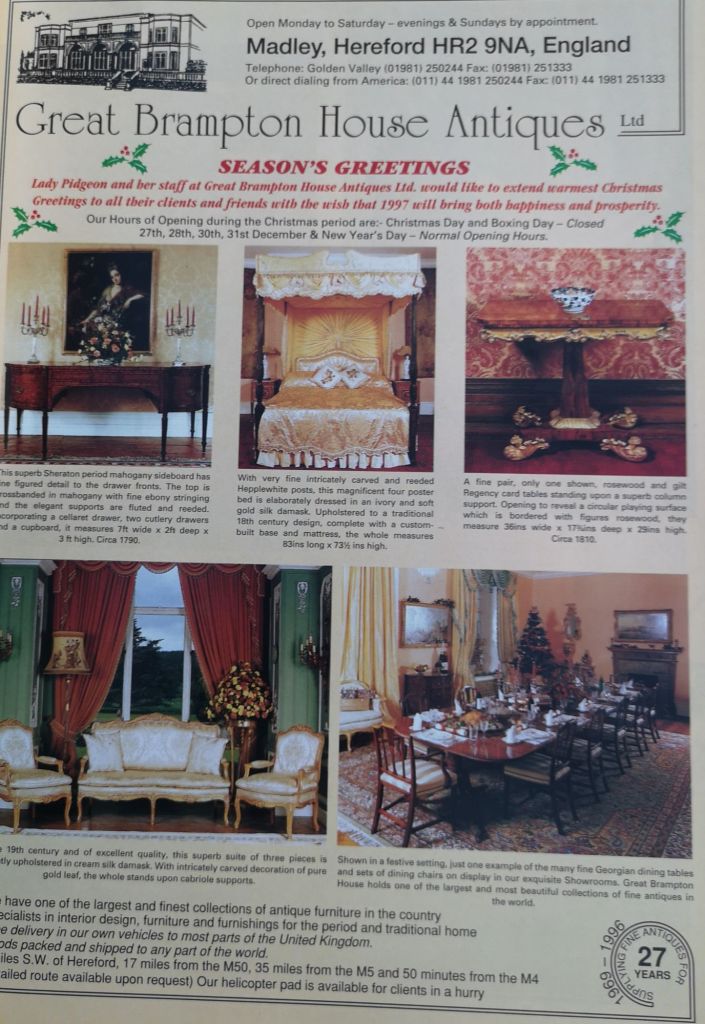
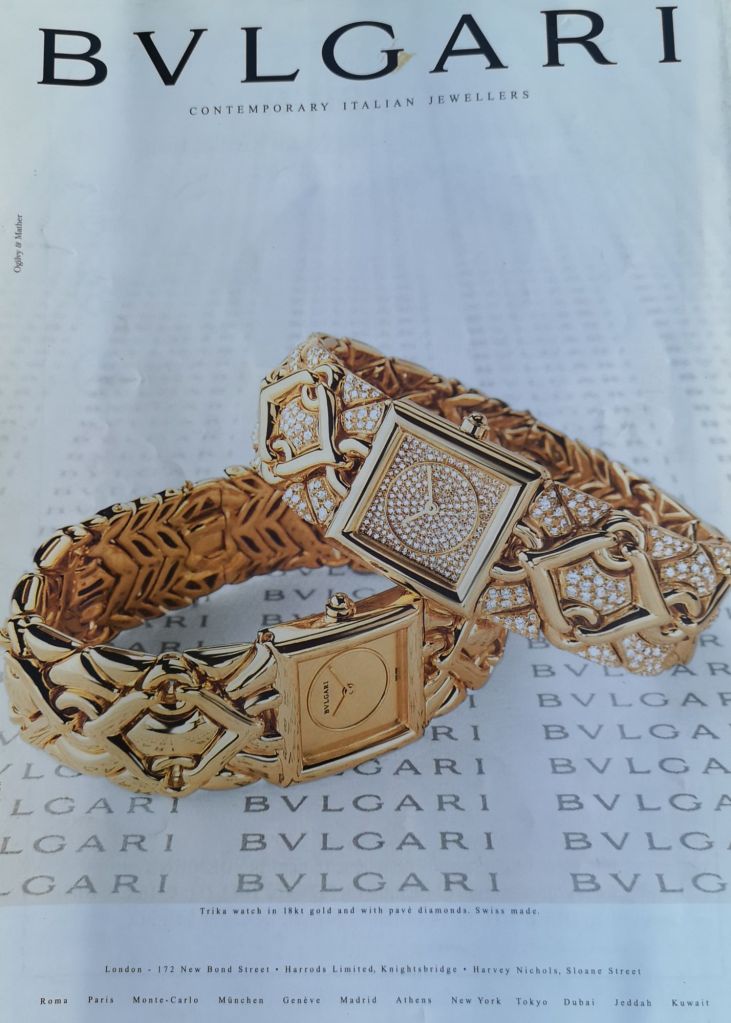
Even compared to the high end advertising of 1975’s Illustrated London News and 1986’s The Field, the 1996 Country Life is a riot of conspicuous consumption. The back cover is advertising the Bvlgari jewellers, whilst the bulk of the first 54 pages are dedicated to property, antiques and paintings, all with an eye to their investment potential. The top advertisement even acts as a career pointer for the average rural infant school pupil! Beyond this section there are advertisements for all things luxurious, the Concorde to Barbados holiday definitely caught my eye, and articles about fashion, wine and cigars!
Final Reflections
This magazine is from 29 years ago, but content wise it harks back to much earlier times, where the countryside was king and people were clearly placed within certain stations in life. The readership probably harked back to the awful verse in that hideous piece of music and lyrics that make up ‘All Things Bright and Beautiful’ where it proclaims that
‘The rich man at the castle, the poor man at his gate. God made them high and lowly and ordered their estate’!
To the majority of readers of this magazine, they were almost certainly there through divine plan, rather than generations of accumulated wealth. However, these people were clearly also driven by a sense of purpose, that of protecting the countryside and the traditions that were so important to them. In that respect, they have proven to be more in tune with the generations that followed than perhaps even they would have suspected. We may have our views about them, based on stereotypes and magazines like this, but when it comes down to it, they were people doing what they thought was important and doing it with determination and innovation as they faced rather than hid away from a modern world that didn’t really understand them.
What’s your favorite cartoon?
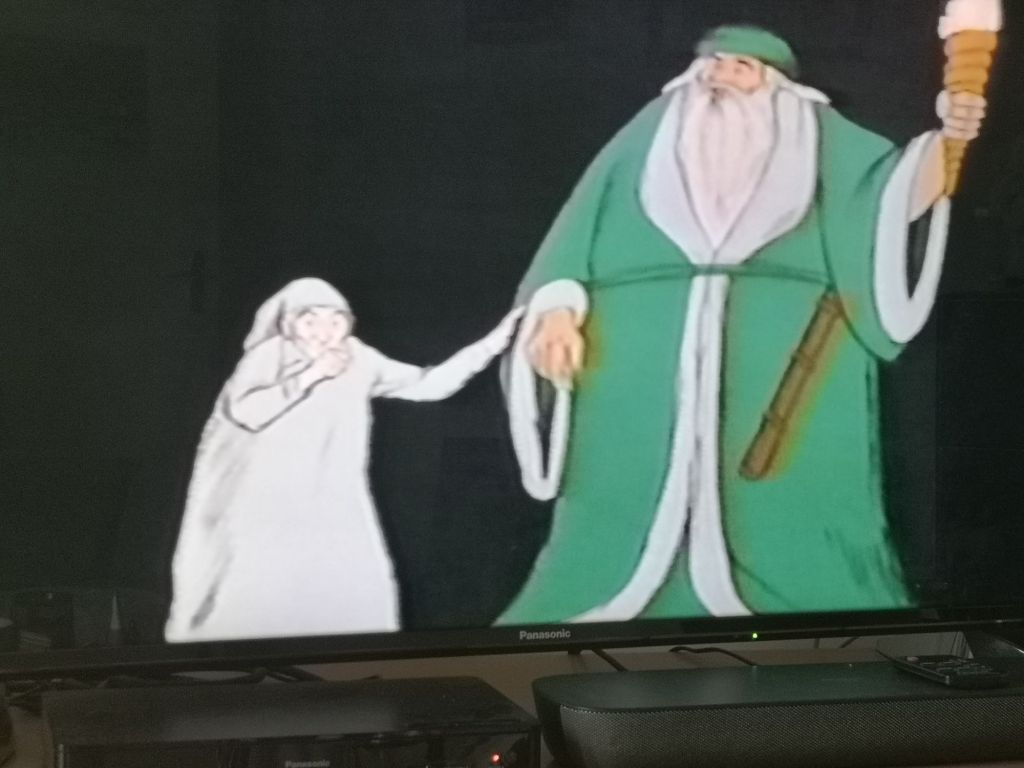
Over 50 years ago, one of the most accomplished cartoon films ever made was released. Initially it was a made for television presentation but it was given a small scale cinema release to make it eligible for an Oscar nomination. Not only did it get nominated, it very deservedly won. The film industry was angry that a mere television cartoon had beaten the best that they had to offer. Accordingly, they changed the rules so that it could never happen again. I think that this history has a huge bearing on the fact that it has never received an official Dvd release. The film industry wanted everyone to forget about one of the finest cartoons ever made and have effectively buried it. Luckily for you, it’s on the Internet via YouTube and I will put the link at the bottom of the article. I have a bootleg release that is of very good quality, but that is no longer available. So why is it the finest cartoon ever made?
It starts with a bird’s eye view of London as the scene pans down to Scrooge’s office. We see that a lot nowadays, but at the time it was highly unusual. The characters leap off the page fully formed and the attention to detail is amazing. The words from the novel are used directly on the screen and the faithfulness to the book continues throughout. The voice cast includes the 1951 Scrooge Alastair Sim and the 1951 Marley Michael Hordern. They bring real gravitas to their roles, treating this cartoon version with real reverence. The Ghost of Christmas Past is usually shown as one fixed form, but this cartoon allows her to have a variety of forms as the book mentions. The Ghost of Christmas Present takes Scrooge to a mining village, a lighthouse and a ship at sea, a part of the story almost always left out. The flying scenes are simply stunning and the ascerbic nature of Christmas Present is very much in evidence. The Ghost of Christmas Yet to Come is frightening and the scene where Scrooge’s belongings are being sold is extremely unsettling, and Old Joe is a fantastic piece of drawing, a perfect rendering of Miles Malleson, once again from the 1951 film. Not a scene is wasted and the 25 minutes cover every beat of the original story in a way that many much longer films fail to do.
With the drawing skills of the great Chuck Jones this is a tour de force of animation and you really must see it.
 David Pearce - Popular Culture and Personal Passions