
Christmas Magazines Through The Years The Illustrated London News Christmas Number 1975
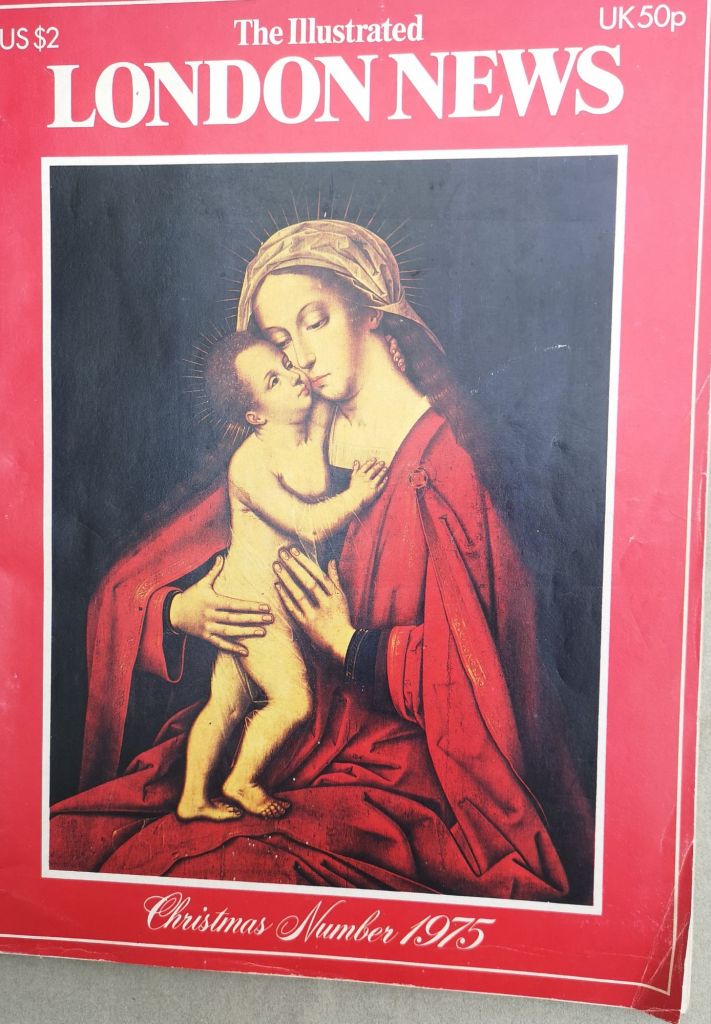
What was 1975 like?
In the 23rd year of Queen Elizabeth II’s reign her Prime Minister was Harold Wilson. On the Conservative side, Ted Heath, who Wilson had beaten twice in February and October 1974 was forced from the leadership of the party after a challenge by Margaret Thatcher. The ‘big beasts’ were much in evidence in the second round of the contest, expecting Thatcher’s tilt at the crown to run out of steam, but she reaped the benefit from her performance in the first round to secure the party leadership and become the first female leader of a major UK political party. It was, as it turned out, a pivotal moment in British political history. The other, seemingly pivotal moment was the referendum on EEC membership which was overwhelmingly rubber stamped by the British public. Sadly, it wasn’t the final word on the matter.
The Troubles in Ireland were brought shockingly into focus for my ten year old self, as they were for so many children at the time. Ross McWhirter, along with brother Norris were household names as co-presenters of the BBC show Record Breakers, based on the Guinness Book of Records which they co-edited. In November, he was assassinated by the Provisional IRA, leaving the many fans of the programme deeply upset. What we didn’t know at the time, of course, were that Ross McWhirter was very involved in politics and, in particular, Irish Politics. He wanted the death penalty for terrorists, not that this was a fringe view at the time, but he also wanted the Irish Community in the UK to face compulsory registration with the police and restrictions of their daily activities, for example renting flats or booking hotel rooms. He also put up a reward of £50,000 for information leading to capture and conviction of IRA terrorists. He freely accepted that this made him a target and so it proved.
1975 saw the release of one of the most significant pieces of music in popular culture history. Bohemian Rhapsody by Queen is 50 years old as I write, but it has never lost its place as one of the crown jewels of music in that time. There are, of course, many who dislike it but its position at the pinnacle of music can’t really be argued against. Nine weeks as Number 1 in 1975/76 keeping Greg Lake’s I Believe in Father Christmas from the top spot on December 25, and another five weeks, including uniquely at the time its second appearance as the festive chart topper following Freddie Mercury’s death in 1991.
In other cultural news, The History Man by Malcolm Bradbury was published. One of the great modern novels it features a brilliant antihero in Howard Kirk the self centred sociology lecturer. It is a fantastic satire of university life that is as recognisable today as it was then, but perhaps is even more relevant as a critique of organisations in general.
Average wages in 1975 were about £54 a week, slightly less for male manual workers who were paid an average of £48 a week. However, if you were a female manual worker you were paid just £27 a week, half the National average! The Equal Pay Act of 1970 had been ignored under the previous government, and not properly enforced by the Labour government either. In an effort to ensure that this no longer happened, the Sex Discrimination Act of 1975, and the introduction of ACAS with a remit to rule on disputes between companies and workers, sought to strengthen the legal framework. The fact that we still don’t have equal pay 50 years on shows the difficulties faced by anyone trying to get fairness in the workplace.
The Illustrated London News Christmas Number 1975
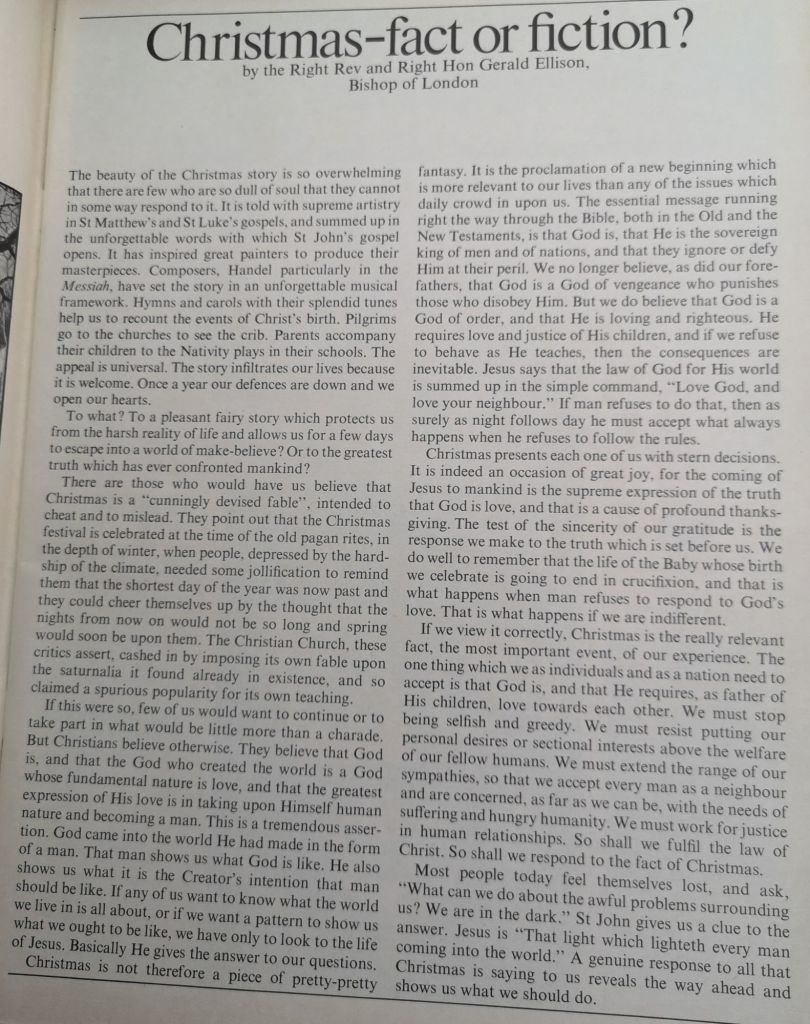
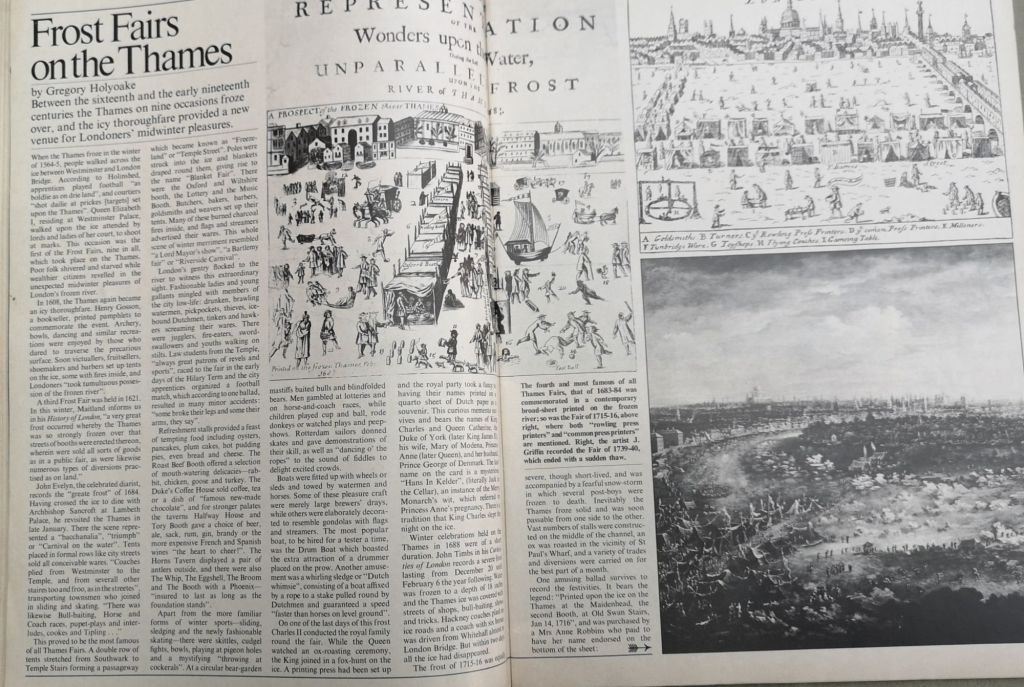
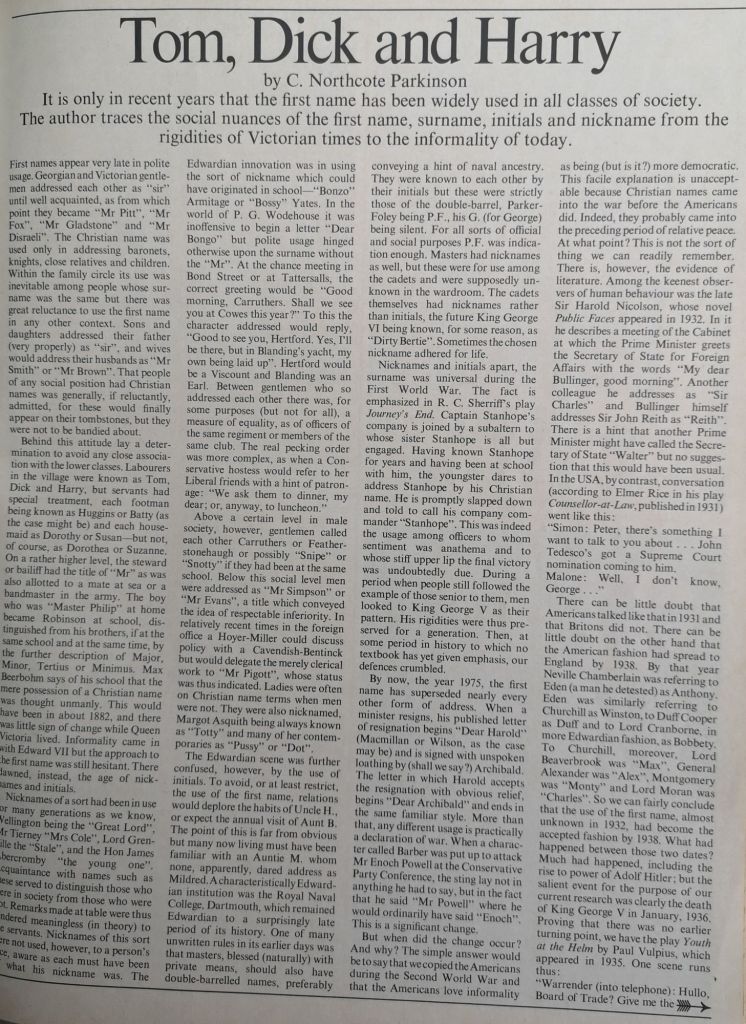
The cover of this magazine is absolutely gorgeous and definitely my favourite of those I have been working with. It is ‘The Madonna and Child’ by Ambrosius Benson, painted in the 16th century and sold by Bonham’s that year. It is a cover that hints at the traditional viewpoint of the magazine as we shall see. The first article I want to concentrate on is the Bishop of London’s piece, Christmas – fact or fiction? Unsurprisingly, this piece of writing comes down firmly on the side of fact, but it is not totally dismissive of those who hold the opposite viewpoint. It is an unequivocally ecclesiastical take on the season and, in 1975, there was no requirement for someone to put the opposite view forward. The traditional and historical approach that this magazine takes is present in the marvellous four page history of Frost Fairs on the Thames. There are marvellous details from letters and diaries of the time and it is a fascinating read. It expresses sadness that the Thames has never frozen over so completely since then, although 1947 and 1963 came close. The same view is echoed nowadays as we realise that due to climate change those of us in the South of the UK are unlikely ever to have a White Christmas again as warm, wet conditions are now the rule for Winter.
I was greatly amused by the irritated tone taken by the writer of Tom, Dick or Harry. It is a masterpiece of upper class parochialism bemoaning the use of forenames instead of surnames when people address each other. They, according to the article, ‘appear very late in polite usage’, sons addressed their fathers ‘very properly as sir’ and the fact that people had forenames was something that ‘would finally appear on tombstones’! The article continues in this vein and could not possibly be taken seriously today. It reads as if it is a parody, but in this magazine, when it was first published, it was very likely to have seen readers nodding furiously in agreement!
Advertisements
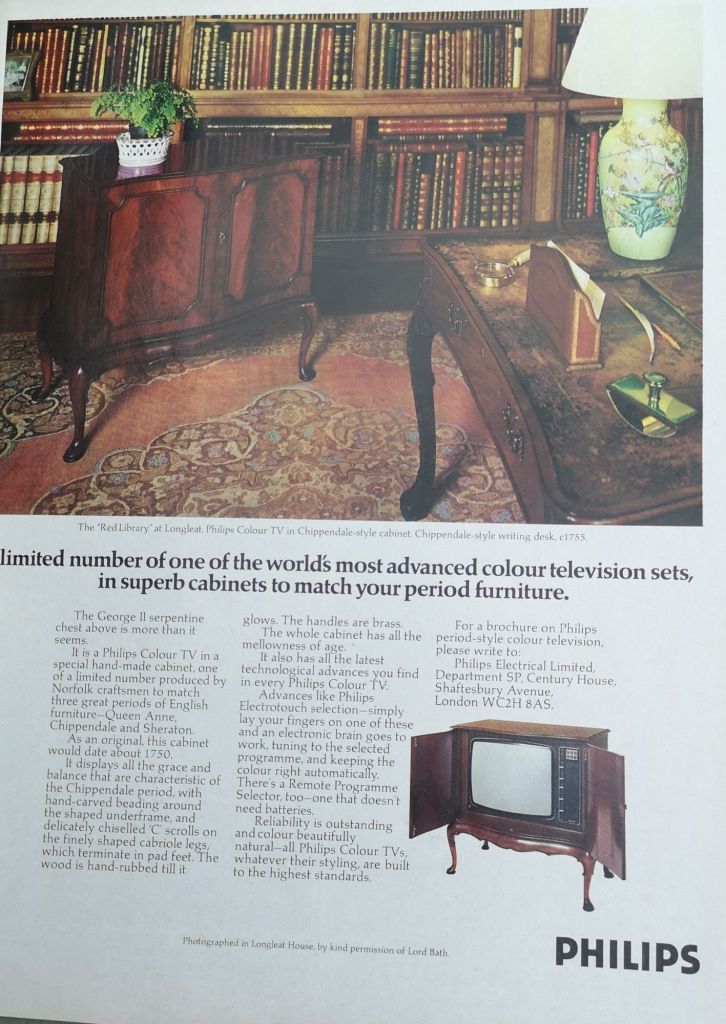
The advertisements (they would never have been referred to as adverts!) in this magazine definitely require closer examination, because they illuminate the class structure of the time very effectively. Dotted throughout the magazine are advertisements for high end products such as fine arts, Jaguar XJS cars and Burberry scarves and coats. These were clear markers of the social and financial standing of the readership of The Illustrated London News, but nothing epitomises the viewpoint of the Upper Middle and Upper classes better than our first advertisement below. Philips Televisions genuinely came encased in a mock George II Serpentine cabinet to hide the fact that you had anything as ‘non-U’ as a television! It is worth remembering that this was a time when many people still refused to watch ITV because it was lowest common denominator programming for the working classes whereas the BBC was still the gold standard of world broadcasting. Philips are at pains to point out that the set inside is state of the art, even including a remote control which was very unusual at the time. (Perhaps it was there in case the butler was on holiday!!) The snobbishness on display is simply jaw dropping, but it was snobbishness shared even by those who had neither the background nor the money to gain admittance to even the middle echelons of society.
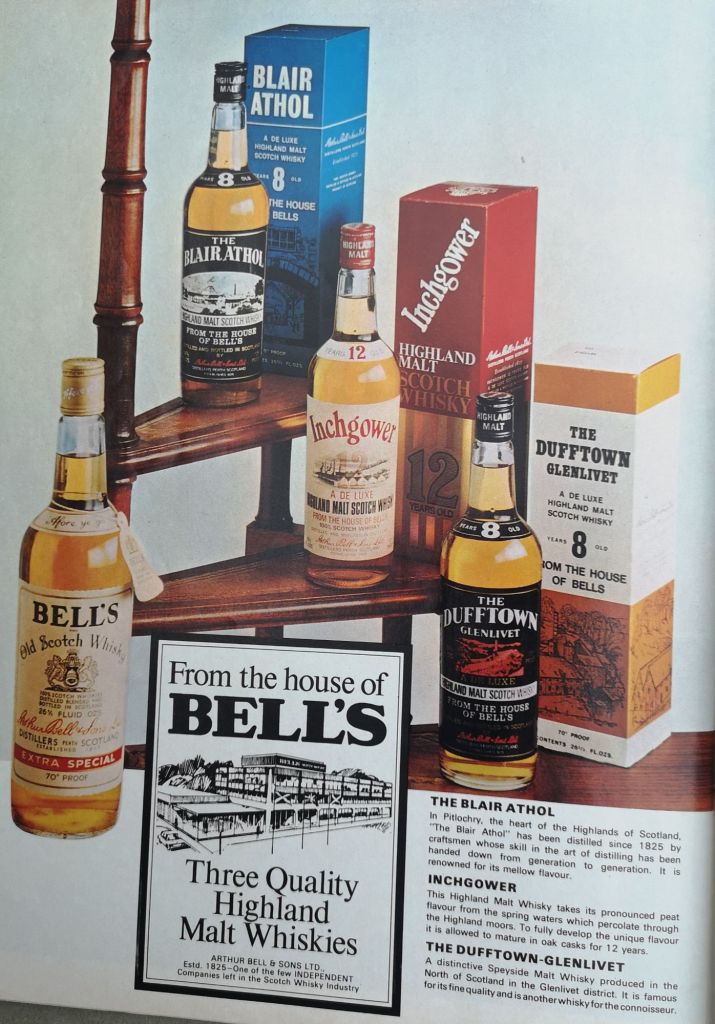
The number of advertisements for smoking and drinking is quite surprising even for the time, but they were restrained and, in terms of the alcohol particularly, skewed to the higher end of the market. Havana Cigars and high priced single malt whisky and top quality brandy was definitely the order of the day for the upper class table.

Final Reflections
This, in purely social and cultural terms is the most fascinating of the magazines I will be looking at. It captures a moment in time when the upper classes were still very much about keeping the barriers up. This magazine represented their world view in all its shades and gives us an invaluable insight into how the other half lived 50 years ago. To read it is to be taken back to drawing rooms virtually unchanged in a century. For better or for worse it is a world that has completely vanished from our lives, but which stays alive in our popular culture and our stately homes.
Discover more from David Pearce - Popular Culture and Personal Passions
Subscribe to get the latest posts sent to your email.


Thank you for including the excellent texts from the adverts and opinion pieces, which really bring home the kind of magazine this was. Well worth straining the eyes to read the small print on the photographed pages. The article on surnames even briefly acknowledges the thirties as being important for the rise of Hitler. However, this is only insofar as it provides a backdrop for the seemingly more important matter of the changes going on in England with surnames at the time.
LikeLike