
New Year in history, culture and around the world


We are close to the end of 2022, and, as always, our thoughts turn to what the next year might hold. Why do many people decide to use this time of year to reflect on what they have done and how they might want to change in the following twelve months? Has January 1 historically been the date of New Year? Why is New Year more important in some cultures? Why do we make resolutions? I decided to look at this phenomenon because I have researched Christmas exhaustively but never even looked at New Year in any depth. Follow me as I make my own voyage of discovery and find some answers to the questions above and some others that will arise.
The development of New Year celebrations
As with many things that have their origins in the era before recorded history, we can only guess at how people millennia ago even marked the year. Take Stonehenge, for example. We know that at the Summer Solstice and Winter Solstice, the large central stones frame the rising sun. In that sense it was like a giant calendar, but we don’t know if the Summer Solstice or the Winter Solstice marked the start of their year, if they even had a concept of the rolling year outside of the two Solstice days. Did the Solstice come as a surprise to them every year when it arrived, or did the priests have some way of tracking the course of the sun? It seems likely from the rituals passed down, presumably in the oral tradition, that the Winter Solstice marked the rebirth of the Sun god, but who knows if that was the way that druidic cultures viewed that time of the year? The rituals in cultures who adopted a calendar based on the sun focused their festivals on the Winter Solstice with decorations, feasting, social bonding and fire. By contrast, the Babylonian calendar set New Year’s Day in March, sometime around the Spring Equinox, whilst the Romans, who initially had a year consisting of 10 months, set March 1 as their New Year’s Day. That changed when Ianarius (January) and Februarius (February) were added to the calendar and, despite initially being considered to be the last two months of the year, they became the start of the year and January 1 became the ‘New Year’ as this was when Consuls were elected. Most European nations accepted January 1 as the New Year in the 16th and 17th Centuries. The UK, who had previously designated March 25 as New Year’s Day, held out against this until 1752, when they finally accepted it for business reasons. With everyone else on holiday, trade could not effectively take place on that day! Why was March 25 originally set as New Year’s Day? Well, the church set March 25 as the date of the Feast of the Annunciation when the Angel Gabriel appeared to the Virgin Mary, because 9 months later was the date set as Christmas Day. As such, this was the start of the religious year for many people. New Year’s Day in Georgian and Victorian times, long since set as January 1, was the time when presents were most likely to be exchanged. It was 1974 when the final step was taken and New Year’s Day, like Christmas Day and Boxing Day became a public holiday.
In a number of countries, New Year is based on the lunar calendar rather than a solar one. For example, the Chinese New Year can occur on any date between January 12 to February 20. In Hong Kong, both the lunar and solar New Years are celebrated, but January 1 is definitely the minor festival. The Islamic tradition has an even more mobile New Year, given that the lunar year is 12 days shorter than the Gregorian Calendar used in setting the solar New Year. As a result, the date typically moves back 11 or 12 days each year, so the 2023 date is 19 July and the 2024 date is set as 7 July. However, for the purposes of this entry, I will concentrate on the celebration of New Year on January 1.
New Year in England
The celebration of New Year’s Eve in England is a relatively recent phenomenon that has become increasingly popular since 1974 when the newly instituted public holiday allowed a day of recovery from the previous night’s excesses! In general, New Year’s Eve is seen as a time for people to see their friends, having spent Christmas Day with their family. The parties that see the New Year in, tend to be alcohol and dance filled as people take a final chance to let their hair down before returning to work. In my teens and early 20s, prior to having a family, I never missed a New Year’s Eve party, but since having a family the events we have gone to, if indeed I have gone anywhere, have been in child friendly situations and at child friendly times. When I was in the RAF, Christmas Day leave was generally given to those with children whilst New Year’s Day leave was generally given to those without. I remember thinking at the time that this was absolutely right despite my love for Christmas. Where institutions are required to give a service covering every day of the year, that is often the model still used by those planning leave.
It wasn’t completely unheard of for some people to celebrate New Year’s Day with fireworks at midnight. However, it was the advent of the year 2000 which was perhaps the first one that had a fireworks display at its centre in England. Fireworks were more common in warmer climes, for example Australia, but since then the idea of a big fireworks display has gained traction. Many people welcome this development, but a large number do not, for the same reasons as they do not welcome fireworks on Guy Fawkes Night, but it seems as though they are here to stay. For my part, I feel that the sounding of horns by all the boats on a river, a New Year’s tradition my wife, who lived near to the River Medway, loved, is a far more evocative and pleasant way to usher in another 12 months.
New Year in Scotland
Hogmanay is the celebration that takes pride of place in Scotland, over and above Christmas Day as it is of far longer standing. There are a number of festivals that have contributed to the development of Hogmanay, including the Pagan Winter Solstice, the Gaelic festival of Samhain and the Viking Yule. There are various Hogmanay celebrations across Scotland with the most internationally recognised being that in the city of Edinburgh.
There are some Scottish traditions that add a lot of flavour to the Hogmanay celebrations. My favourite custom is that of first footing. This involves the first person from outside your family unit to cross the threshold on New Year’s Day. They should carry items such as coal, shortbread, whisky and a rich fruit cake, often a Clootie dumpling. Good luck will visit the household if your first footer carries some or all of these items, and if that person is tall and dark haired. Why dark haired? Well, the explanation I heard is that if the person appearing on your threshold in the days of Yule was fair haired they would probably be a Viking raider whose appearance at your door would be the worst possible start to what could be a very short New Year for you!
New Year in Japan
The New Year is an incredibly important time in Japan, in a cultural, religious, and social sense. Christmas is seen as a fun festival for young children, but has no importance in anything other than a commercial sense. New Year, on the other hand, is based around visits to Buddhist Temples, family meals and a series of rituals designed to clean the house and its inhabitants both externally and internally. It is called Omisoka, and up until 1873 was a lunar New Year which occurred at different times based on the phases of the moon. However, at the start of the Meiji era, the Gregorian calendar was adopted to set the date of New Year’s Day as January 1. People clean their houses, bathe and pay their debts on December 31 in order to start the New Year completely fresh. Families eat soba noodles, typically about an hour before New Year arrives, which are long and associated with good health and longeivity. Temples ring their bells 108 times to represent the 108 ways in which people can fall short of the model behaviour required by Buddhist teaching. Japanese families will go to the temples together to see in the New Year in the most auspicious place possible. The Grand Shrine at Ise, the central shrine of Buddhism in Japan, is crowded with thousands of worshippers, as are the temples throughout Japan. I found the Japanese New Year meaningful, fascinating and thought provoking, everything the Western New Year lacked.
New Year in Australia
This was the most fun I have ever had as one year ticked over into the next. On three occasions I watched the fireworks over the Sydney Harbour Bridge and the Opera House, and on each occasion I loved it, which may surprise people who think of me as a curmudgeon when it comes to pyrotechnics! The atmosphere, like the Australian Christmas I described for Blogmas is completely different because it is the summer. We would head down to a viewing point, or stay in the parks where we could see the display unfold amongst people, like us, in shorts, t-shirts and hats. There was a real carnival atmosphere in the air and very little trouble despite the amount of drink being imbibed. If you were worried about your younger children’s bedtime, there was a slightly truncated display at 8.30 in the evening, allowing you to get them home for a slightly later, rather than a much later, bedtime. When I think of New Year’s Eve, this is the country I think of.
New Year’s Resolutions
These have a religious origin, and appear in many religions, most commonly around New Year. They used to be focused on avoiding sins, becoming more chivalrous or charitable or reaffirming their commitment to God. Nowadays, they focus, especially in the West, on becoming a more complete person. It is a very clear move from an outward looking process to an inward looking process, which makes resolutions accessible to those who have no religious belief. Many of us will try to give up bad habits and adopt good ones, but these resolutions often last for only a short time! A 2007 study carried out by the University of Bristol suggested that 88% of people fail to keep their resolutions, which is actually lower than I expected! What about me? Well, I still make resolutions but they tend to be open ended aims which might make them easier to keep. Mine are below so I might keep you posted as to my progress in 2023!
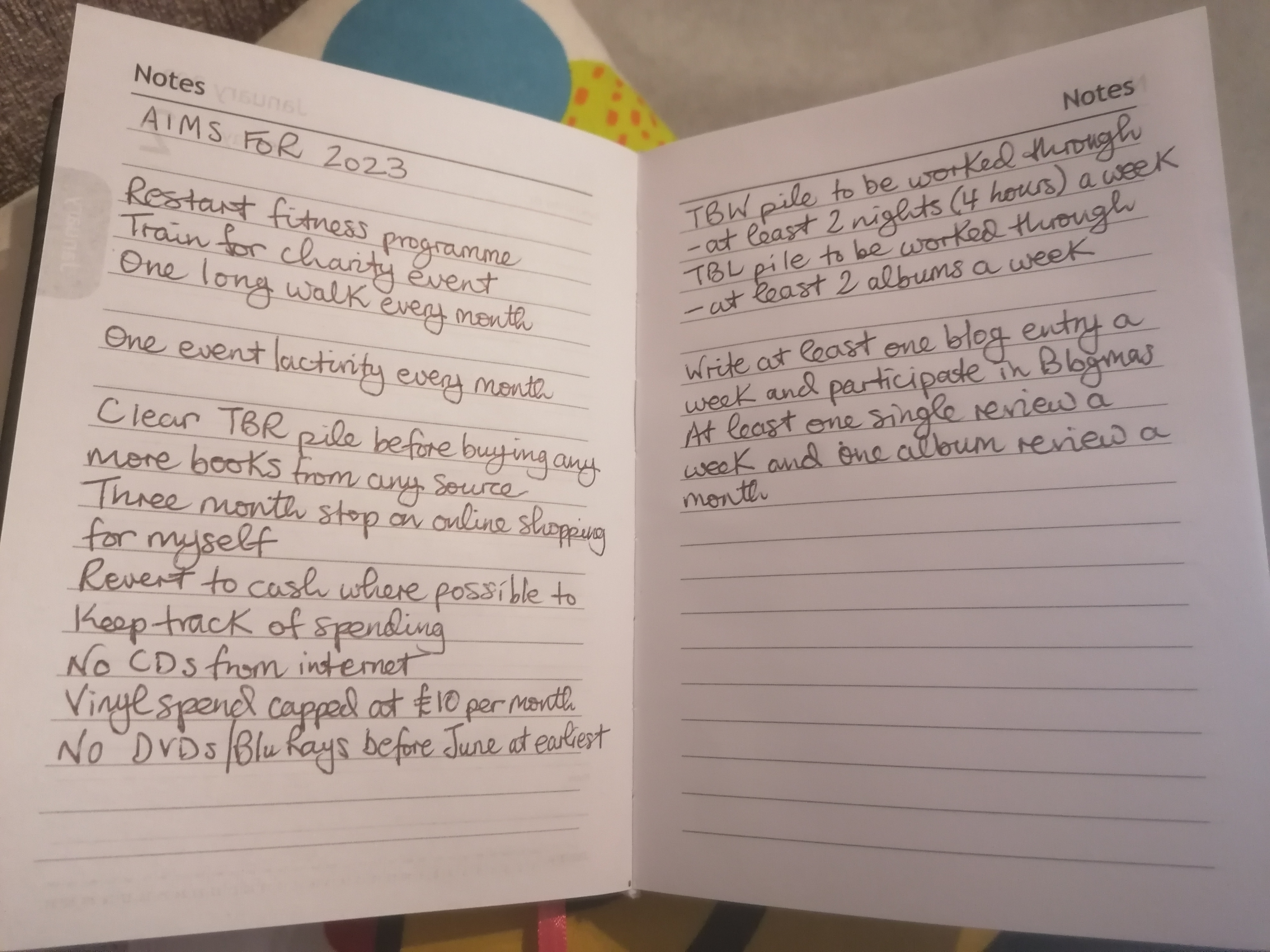
Happy New Year to all of you and may 2023 be full of fortune, love and success.
Discover more from David Pearce - Popular Culture and Personal Passions
Subscribe to get the latest posts sent to your email.
 David Pearce - Popular Culture and Personal Passions
An enjoyable and fascinating read! New Years Eve hasn’t held much importance for me since i was about 25 – the last time i went out was the millenium NYE – and now i prefer to stay in, play music and watch the celebrations on telly.
LikeLike
Likewise, and I was that irritating person pointing out that it wasn’t the real millennium as the calendar actually started at Year 1 not Year 0! Mind you, the Queen agreed in her 2000 Christmas Day Message so I felt vindicated! A very happy 2023 to you.
LikeLiked by 1 person