

Although our Christmas seasons share many common features, what makes a Christmas ‘our Christmas’ is the family traditions that we build up over many years. Some of us may decide to keep many of our parents’ traditions, whilst others may decide to create an entirely new Christmas for themselves as they move away and set up their own lives. I am very much in the latter camp, so let me introduce you to our family traditions.
Christmas music and films
An interesting question, because different aspects start at different times. Christmas music starts on December 1 and goes through to December 31. I have a ton of music on various formats and never enough time to play it all, but that’s OK as I look forward to the Christmas tunes and never get bored of them. My own Christmas DVDs and Blu-rays also get their first outings around December 1. There are certain films we watch most years, but only one that has become a true family tradition. The film is Love Actually, and this year will be the 19th year in a row my wife and I will have watched it. The children started watching it when they were still young enough to be appalled by the naughty scenes! Once we get them together, on goes Love Actually and we laugh at the same scenes, cry at one scene in particular and feel thoroughly festive. It wouldn’t be December without it. Other films that get regular plays include at least 2 or 3 versions of my favourite story, (See Day 2 of Blogmas, A Christmas Carol and Me) and invariably The Polar Express, a particular favourite of my wife and daughters.
Christmas Decorations
In this category, we have the carefully treated decorations that have come back from school over the years from all of our children. They never fail to give me a warm glow, although the glow they give the children is sometimes mixed with a helping of embarrassment! Still, I know they appreciate the fact that their creativity still means a lot to us. Our nativity scene is housed in a stable made by my two daughters one year when they were much younger, and it makes me smile every time I look at it. Many of the decorations are now 15 years old or more, but they will continue to be put on the tree for many, many years yet.
Advent and cake toppers
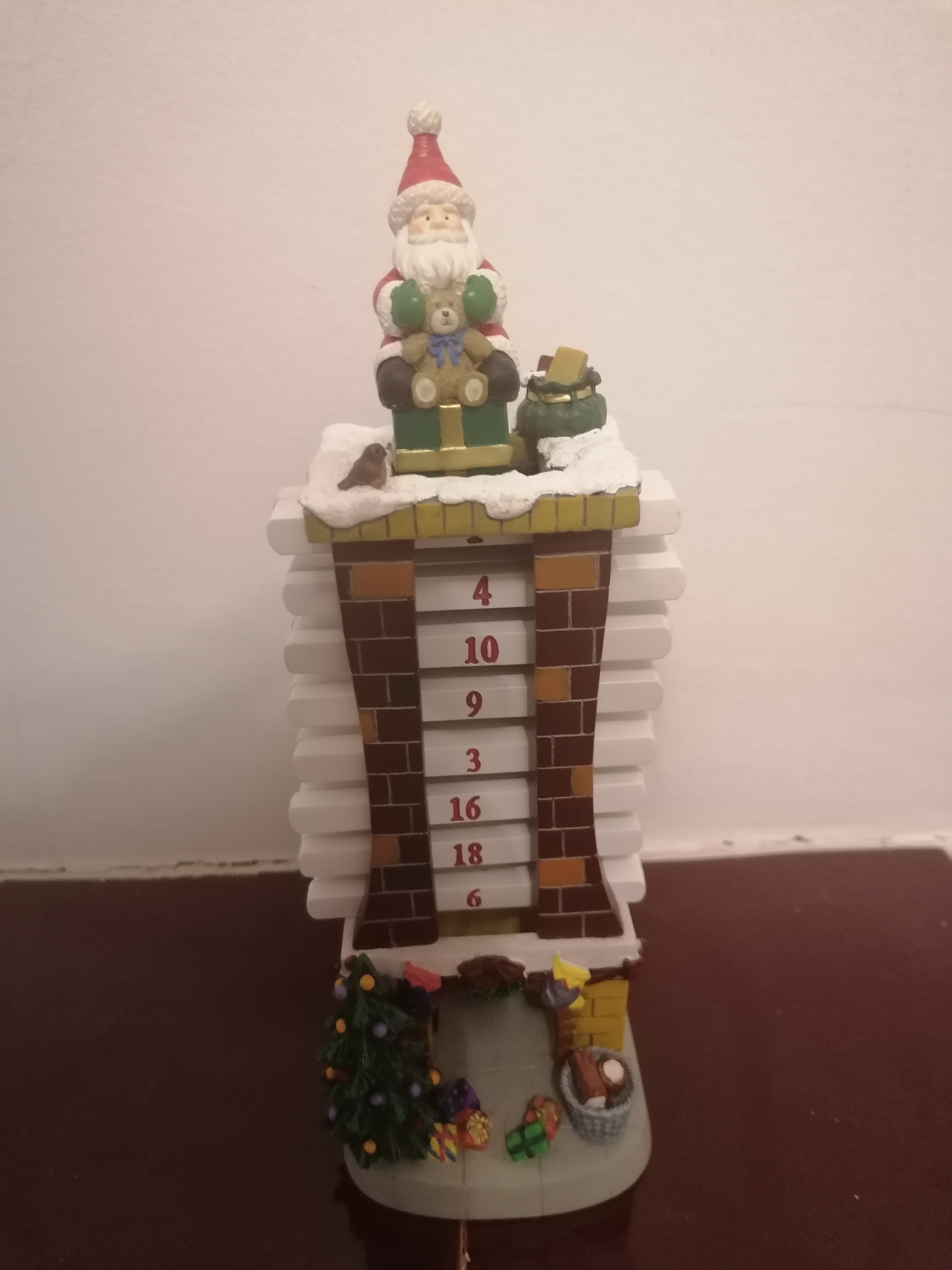
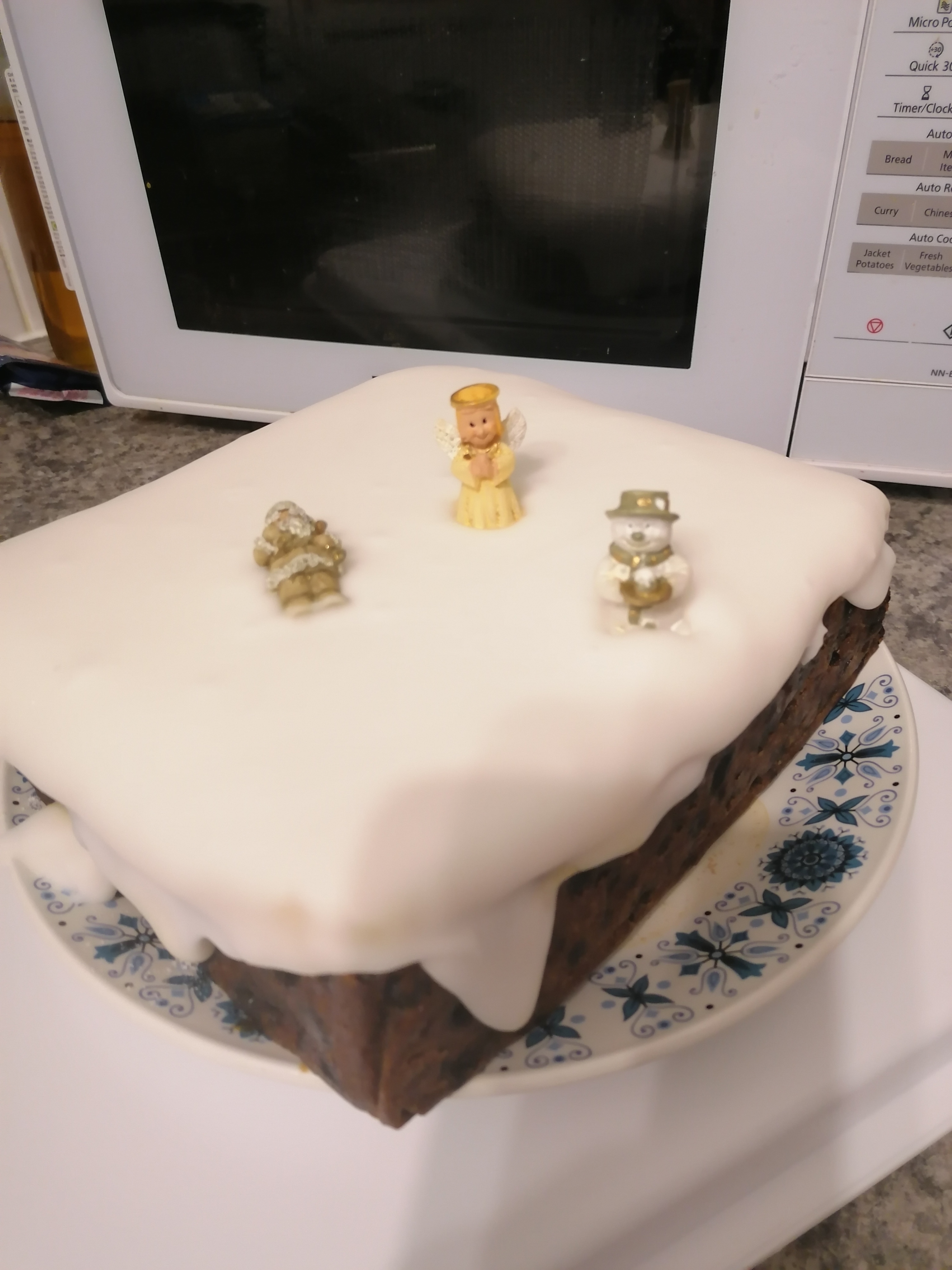
OK, odd category, but they are a reminder of harder times, financially, that led to two of my favourite bargains. Probably 15 years ago, I walked into our local Sense charity shop and saw an Advent calendar of Santa coming down the chimney and I bought it on the spot for £2. It’s a very simple idea. Under Santa are a series of 24 numbered rods that are removed one at a time. At various stages, Santa will move down the chimney, reaching the bottom on Christmas Eve itself. We always made sure that each of the children moved Santa down the chimney twice each Advent, and it was a highlight of the season. 16 years later, it is still our main family Advent calendar, and we still love watching his journey down the chimney! The other bargain was a pack of 3 Christmas Cake toppers which I picked up in our local supermarket for 13p in January one year. As they will be on the Christmas cake for the 16th or 17th year in a row soon, I think I can say I got my money’s worth out of them! When I see those reminders of the poorer times that many still face, I reflect on the fact that I should be grateful for what I now have and never forget those who still struggle more than we once did.
Stockings and Presents
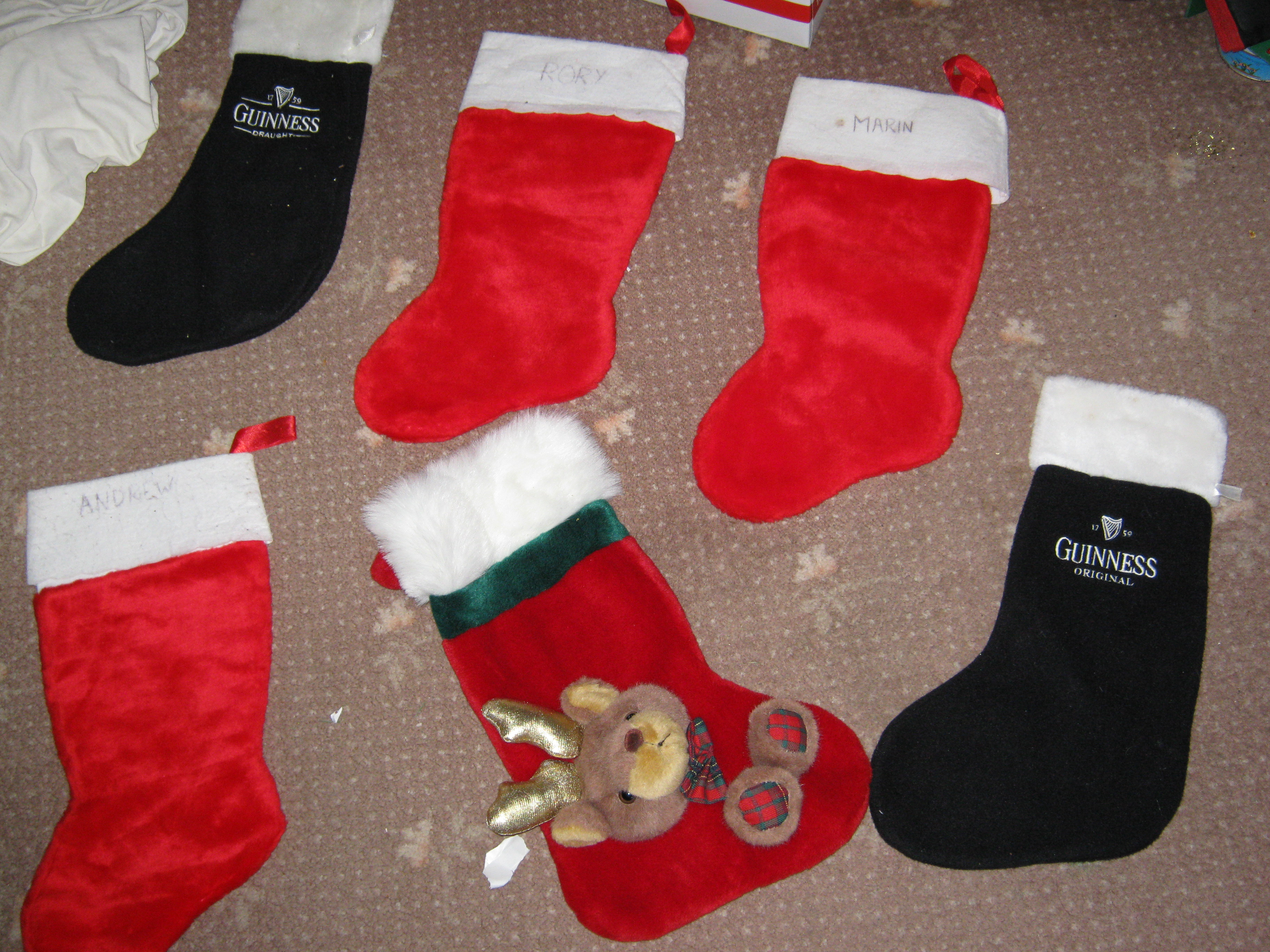
When did we stop putting out stockings for the children? The answer is that we didn’t! Our youngest daughter will be 22 this year, and she still has her stocking to wake up to every Christmas morning! Even our children who no longer live with us find their stockings when they come over for Christmas lunch, due to a mix up that caused Santa Claus to leave their gifts with us! Even now, if they ask about stocking presents, I remind them that it’s not up to me, it’s up to Santa what they get! To make it even more special, the children still have their original stockings – from 1998 for the oldest 3, and 2001 for our youngest. One year, one of the stockings went AWOL and we had to buy a replacement, something that upset our younger son more than he would let on. Luckily, we found it in the wrong box, and he still has his original stocking 24 years later! One thing that always amused me and made my heart grow three sizes was the insistence by our youngest daughter that her beloved teddy bear, Barnaby, have his own Christmas stocking. Well Santa couldn’t disappoint her, could he?
Presents are not put in a pile and opened before Christmas Day is a few minutes old! One thing we were very strict on from the start, was making sure that the children finished breakfast before opening their first present. After that they opened one present each at regular intervals until Boxing Day, or even the 27th depending on how many presents they had. That remains the rule to this day for the children. My wife and I realised after our first few Christmas Days with a growing family that our presents for each other were not being appreciated enough, so we moved our own present opening, first to the very start of Christmas Day once we had seen Santa delivering the stockings, and then to Christmas Day night after the children had gone to bed. It’s still our time together to appreciate the gifts we have given to each other
What does it all add up to?
As I said before, every family has their own traditions, and I am sure that yours are different to ours in many respects. What all these traditions add up to is the feeling that December 25th is more than a simple date on a calendar. It is everything that makes us a family, however near or far from each other we may be. I know that our children will have their own traditions when they settle down in homes of their own, but they will know that it’s a special day, because for our family it always has been.
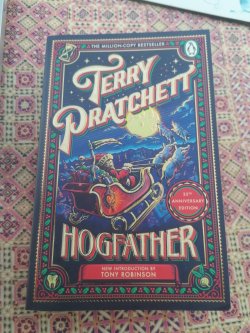

From the ever-fertile imagination of Terry Pratchett comes his Discworld take on Christmas, but with our familiar seasonal traditions seen through a distinctly unusual lens. Now, for those of you who have never come across Discworld, I had better give you an introduction to a world quite like our own, but at the same time very different.
Discworld
Floating through space, supported by four elephants perched on top of the turtle, the great A’Tuin is Discworld, a flat planet with a variety of species co-existing, albeit uneasily. There are wizards, dwarves, trolls, vampires, zombies and, for want of a better word, human beings. As well as all of these there are supernatural beings who keep a not always benevolent eye on the goings on in the world. By far the most benevolent of these beings is Death who has become very fond of people. He and his Granddaughter are central to what happens in this novel.
The Plot
The story starts with a visit from a group of shadowy beings called Auditors. They are much like all managers in that they cannot deal with anything that diverges from their plans. One of the things that diverges from their idea of a smooth-running universe is superstition. They appear in the Assassins Guild one night and ask to have the Hogfather removed from existence. Like Father Christmas, the Hogfather travels to every child in Discworld dispensing presents in a sleigh pulled by four massive hogs. Children write to the Hogfather and leave out pork pies and sherry as well as root vegetables for the pigs. Like Father Christmas, the Hogfather depends on belief, without which he is unable to function. When the Hogfather disappears, it is up to Death to stand in for him to make sure that belief does not vanish. Whilst Death is delivering presents, his granddaughter Susan is given the task of finding the Hogfather. It turns out that his disappearance has something to do with the Tooth Fairy so Susan has to visit the Tooth Fairy’s realm. While all this is happening there is extra belief floating about in the world that leads to the creation of other supernatural beings like Bilius, the Oh God of Hangovers!
A commentary on our own world
In amongst the very strange cast of characters and the even stranger plot, there is a satirical eye cast over the behaviour of human beings here on Earth. Christmas is clearly the main target with its commercialism, excess and mash-up of traditions under fire from the occasionally sharp pen of Pratchett. There are superb set-pieces with the different gods, many of whom seem to be as bemused as the inhabitants of Discworld by their roles and their places in the scheme of things. Death delivering presents is utilised brilliantly as a vehicle for examining the logic, or otherwise, of Christmas. In one particularly funny scene, which riffs on Miracle on 34th Street, Death takes over as a department store Hogfather, and things start getting quite confusing for everyone. You see, Death assumes that the Hogfather will give children the presents they ask for, no matter how dangerous or impractical they are. There is a computer created by one of the wizards run using the power of an anthill leading to an ‘Anthill Inside’ joke that will mean more to those of us who remember early laptops than those who have grown up with the newer versions! In the final pages (no spoilers from me I promise), there is a quite scathing view of the nature of belief outlined by Death that never fails to hit home.
Why should I read The Hogfather?
Even if you are not a fan of fantasy, I really urge you to give this book a try. The use of Christmas as the basis for Pratchett’s humour makes this the most accessible place to start in my opinion. He will make you think, and he may make you question your ideas on a range of topics, especially if you read other Discworld books. Above all, however, he will make you laugh, often out loud and in today’s world who can pass up a chance for laughter?
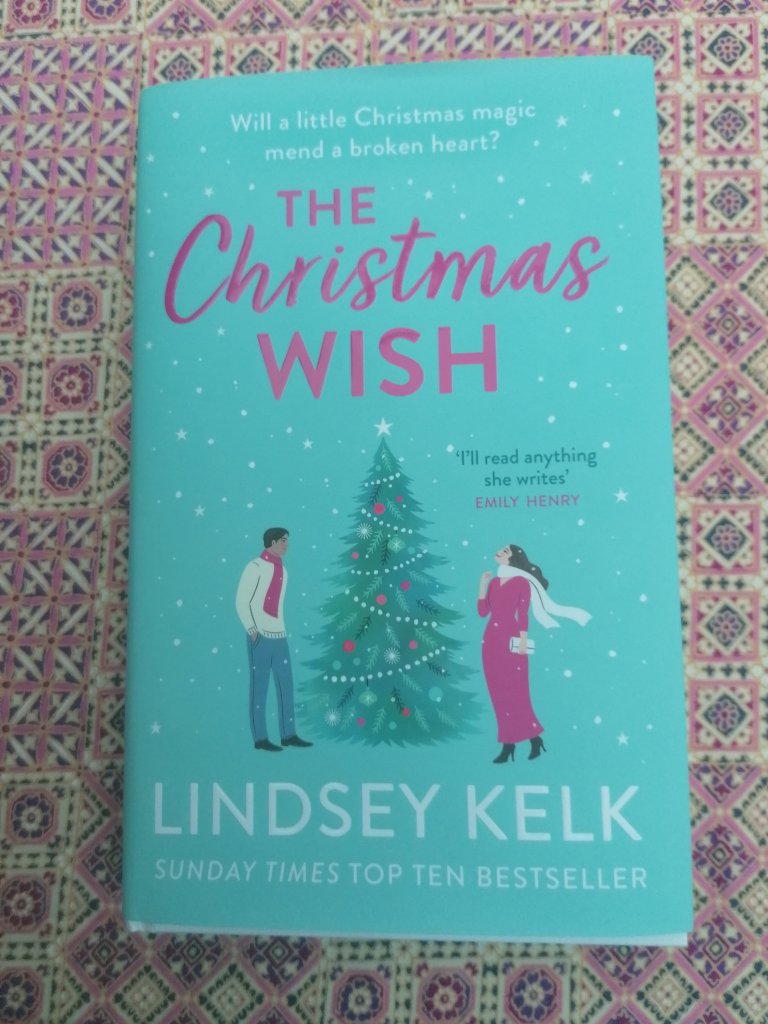
I have been a fan of Lindsey Kelk since I first picked up I Heart Christmas, the sixth of her I Heart series featuring the character of Angela Clark. It was clear that Lindsey was a Christmas fanatic like me, and I smiled and laughed throughout as Angela’s Christmas mania reflected my own but exaggerated of course! I went back through the series, not always in order, and absolutely loved them. Once I saw that her new book was called The Christmas Wish I instantly ordered it and waited impatiently for publication day. Was it worth the wait? Well, read on!
The Plot
The book features Gwen Baker, a lawyer at a crossroads, whose professional and personal lives seem to be heading in one direction only, downwards. As usual, she is heading for her childhood home in Derbyshire to spend Christmas with her parents. The family know that she has finished with her boyfriend, a dentist who has, rather unimaginatively as the family point out, finished with Gwen and moved in with his receptionist! What they don’t know is that she is faced with losing her job at a prestigious law firm after attacking a client. It is a job she hates, but she has never told her family, especially her father whose dream it was for her to become a top lawyer. Gwen is hoping to get through the visit without admitting to this, but unfortunately her boorish brother-in-law has found out about the situation and told Cerys, Gwen’s sister. It’s like a ticking time bomb, and when it goes off, on Christmas Day itself, there are literal and metaphorical fireworks. Gwen goes to sleep that night, wondering how to fix things with her dad. The following day, however, isn’t the following day, it’s Christmas Day again. In an inversion of Wizzard’s classic song, Gwen must find a way to make sure that she escapes whatever is causing this, because she really wishes it wouldn’t be Christmas every day!
The story, the characters and the feelings
One of the cleverest things that Lindsey Kelk does is to get Groundhog Day out of the way very early on, when her adoptive brother and best friend, Manny, mentions it. Obviously, Groundhog Day itself is in a long line of events repeating themselves, but it is definitely the cultural touchstone that would otherwise remain in the back of our minds. Next, the spectre of repetition is also dealt with early on as Gwen decides that to get out of this situation, she must need to solve the problems of someone in the family. Once the idea of repeated Christmas Days is out of the way, every Christmas Day is different to the extent that common events are only mentioned in passing as the story takes hold.
Gwen is a thoroughly sympathetic heroine, albeit one with significant faults and failings which have put her in this position. She is grounded in reality but has that clear air of a Hallmark movie protagonist! Her increasingly desperate attempts to find the key to her problem show up a number of less positive elements of her character, but these are more than outweighed by the positive. Her family are very well drawn, moving from the surface characters we see in that first Christmas Day to complex individuals whose behaviour is often grounded in fear, regret and social expectations. Cerys in particular becomes far more understandable as we dig beneath the surface of her behaviour, and by the end she is a person I really warmed to. The central trio are Gwen, Manny and childhood friend Dev, now a very successful surgeon. Gwen learns more about them as every Christmas Day goes past, but they of course don’t remember the previous meetings and conversations. Interestingly, Gwen uses the things she’s learnt sparingly and, generally, as carefully as possible. She learns that Dev, who she always had a massive crush on, reciprocated that crush but neither of them admitted it to each other. The way that their relationship fizzled out over e-mail is true to life and will cause some people to think of their own failed friendships. The walk to Chatsworth House is one of the comic high points of the novel as the two friends revert to daredevil teenagers without really intending to. One more Christmas Day that was really well handled was the one where she tries to talk to Michael, her former boyfriend. It cleverly dissects a relationship break up that is not as clear cut as it seems.
This book just fills you with Christmas spirit when you read it. However, that Christmas spirit doesn’t have the overpowering, cloying sweetness of Bailey’s, more the sometimes-bitter edge of a mulled wine. It reflects family Christmases as they are with all their frustrations and irritations, but also with all the warmth, friendliness and togetherness that they contain. This is such a skilfully written book with brilliant comic set pieces, warmth and sympathy for all the characters and steeped in the traditions and feelings of Christmas. I loved every minute of the book and raced through it. Very unusually I am intending to read it again during December this year. It is the Last Christmas or Merry Christmas Everybody of Christmas novels – an instant classic!
As a kind of primer for the big day I wanted to share some of the most interesting facts about the Festive Season that I have come across in my fairly extensive reading about Christmas. Some you will know, others you may not. If you are familiar with all 20 then you are as much of a Christmas addict as I am!
Here goes, and if your next pub quiz has a Christmas round you are set for full marks!
- The date of Christmas Day may have been tied to the Winter Solstice celebrations associated with the pagans. Under the Julian calendar the Solstice took place on December 25 until the Leap Year was instituted. This change required the movement of the Solstice to December 21, separating the two festivals.
- Saturnalia, a Roman celebration for the god Saturn took place from December 17 to December 23 and involved eating, drinking and gambling. This was followed by Kalends, the secular New Year, a three-day holiday from January 1where people put evergreens up in their houses and exchanged New Year gifts. Parts of each festival survived to become elements of our modern Christmas.
- The Norse people called this time of the year Jul (which became Yule in English) and marked the ‘dying’ of the old year. Perhaps this festival contains the origin of Santa Claus and his reindeer, following the example of Odin who rode his eight-legged horse Sleipnir across the sky. Children would put out straw and sugar for Sleipnir on the night of Odin’s annual hunt.
- In the Middle Ages, the churches celebrated in December with a Feast for Fools. The festival, which started on St. Nicholas’ Day included cross dressing, masters becoming servants and vice versa and the election of a Boy Bishop. This topsy turvy festival took elements of the old Kalends festival.
- Boxing Day, December 26, developed from the tradition of landowners giving each of their tenants a Christmas ‘Box’ on the day after Christmas consisting of either food or money.
- Parliament banned the celebration of Christmas in 1643, but it only really took hold in 1649 once Oliver Cromwell became Lord Protector and started to enforce the law vigorously. Fortunately, Charles II reinstated Christmas celebrations upon his restoration to the throne in 1660.
- There are records of Christmas Trees being put up by George III at Windsor Castle in the 1790s. However, it was only popularised amongst the wider population in 1848 when Illustrated London News published a picture of Victoria and Albert next to a tabletop Christmas Tree.
- A Visit from St Nicholas, the 1823 poem by Clement Clarke Moore introduced and named the eight reindeer.
- A Christmas Carol by Charles Dickens was published in 1843, and was followed by four other Christmas Books, The Chimes, The Cricket on the Hearth, The Battle of Life and The Haunted Man.
- A Christmas Carol was originally a pamphlet that Dickens was writing called ‘On Behalf of the Poor Man’s Child’. He turned it into a story which he thought would have more effect and used the Ghost of Christmas Present to voice the ideas contained in the pamphlet.
- Dickens himself set A Christmas Carol in a snowy Christmas because he had seen a number of White Christmases in his childhood and thought it integral to the perfect Christmas Day.
- The first Christmas Card was sent in 1843 and Christmas Crackers appeared in 1846 thanks to Thomas Smith, a London sweet maker.
- Christmas Presents were not routinely exchanged until the 1860s. Prior to this, they were exchanged on New Year’s Day.
- The Christmas pantomime took elements of the Kalends festival, with the Dame, played by a man, and the Principal Boy, played by a woman.
- The Coca-Cola company wasn’t responsible for putting Father Christmas in a red and white outfit. The colours had become popular in Victorian times with Christmas cards showing him in these colours.
- Rudolph the Red Nosed Reindeer was a poem written by Robert May in 1939, but only became widely popular when Gene Autry set the words to music in 1949. Since then, there have been various versions by many different singers which, between them, have sold over 80 million records.
- The first official Christmas Number One was Al Martino’s Here in my Heart in 1952. Dickie Valentine had the first Christmas themed Number One with Christmas Alphabet in 1955.
- The first Christmas chart battle is generally accepted to be that between Slade and Wizzard in 1973. Slade won the battle with Merry Christmas Everybody getting to Number One for six weeks. They were still in the Top 40 in February!
- In 1984 Band Aid sold over 3 million copies of Do They Know It’s Christmas. It completed a unique treble for Paul McCartney who appeared on the best-selling single of the 1960s, She Loves You by The Beatles, the 1970s, Mull of Kintyre by Wings and the 1980s with Band Aid.
- In 1985, Shakin’ Stevens reached Number One with Merry Christmas Everyone, a record he’d recorded for release the previous year, but quietly shelved when he saw the competition from Band Aid and Wham!
Hope you enjoyed that rundown of my favourite Christmas Facts!
I have taken my facts from a range of different places, but special mention must be made of Judith Flanders Christmas: A Biography which is a very interesting read and highly recommended.

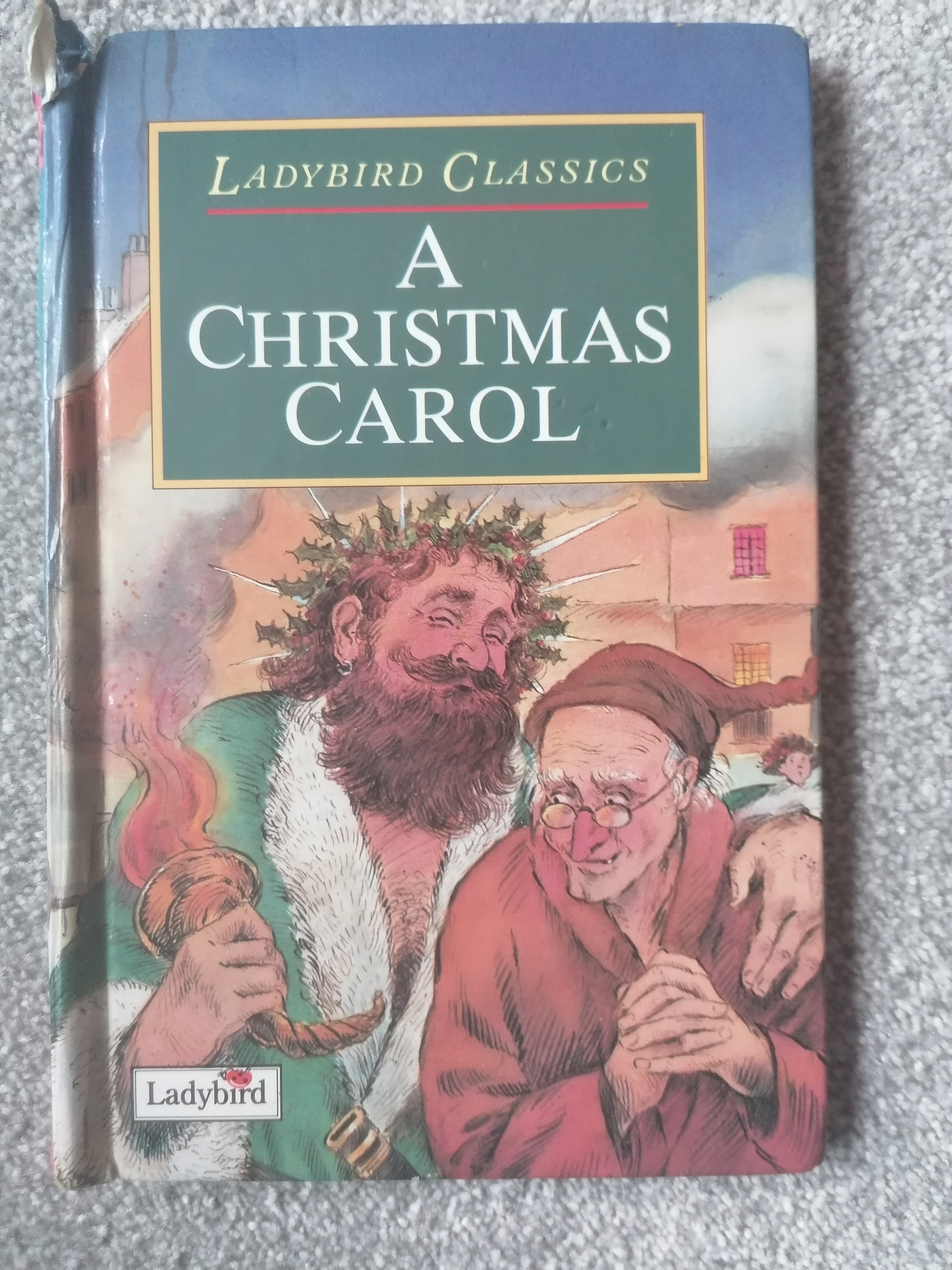
I think perhaps we all have that one book, film, TV show or piece of music. It’s a piece of art that, for whatever reason, had a huge impact on us when we first read it, saw it or listened to it, and a piece of art whose influence on our world view and our very character is an influence that continues to grow throughout our lives. For me, that piece of art is Charles Dickens’ A Christmas Carol and I wanted to take the opportunity to explore the reasons why I love it, and the reasons why it continues to resonate with me 50 years after the story came into my life.
The First Time
I have always had this vague memory of sitting in my lounge, watching Richard Williams outstanding version of A Christmas Carol as a young child. When was it, though? I narrowed it down to 1972 or 1973, but until about two months ago I had no way of checking where and when it was. Luckily, I came across the BBC Genome project during a web search. They have digitised every issue of the Radio Times and their listings page is no less than our personal histories kept safe in the corner of the Web. I clicked on the double issue covering December 16 to December 29, and there, on Christmas Eve 1972 was this!
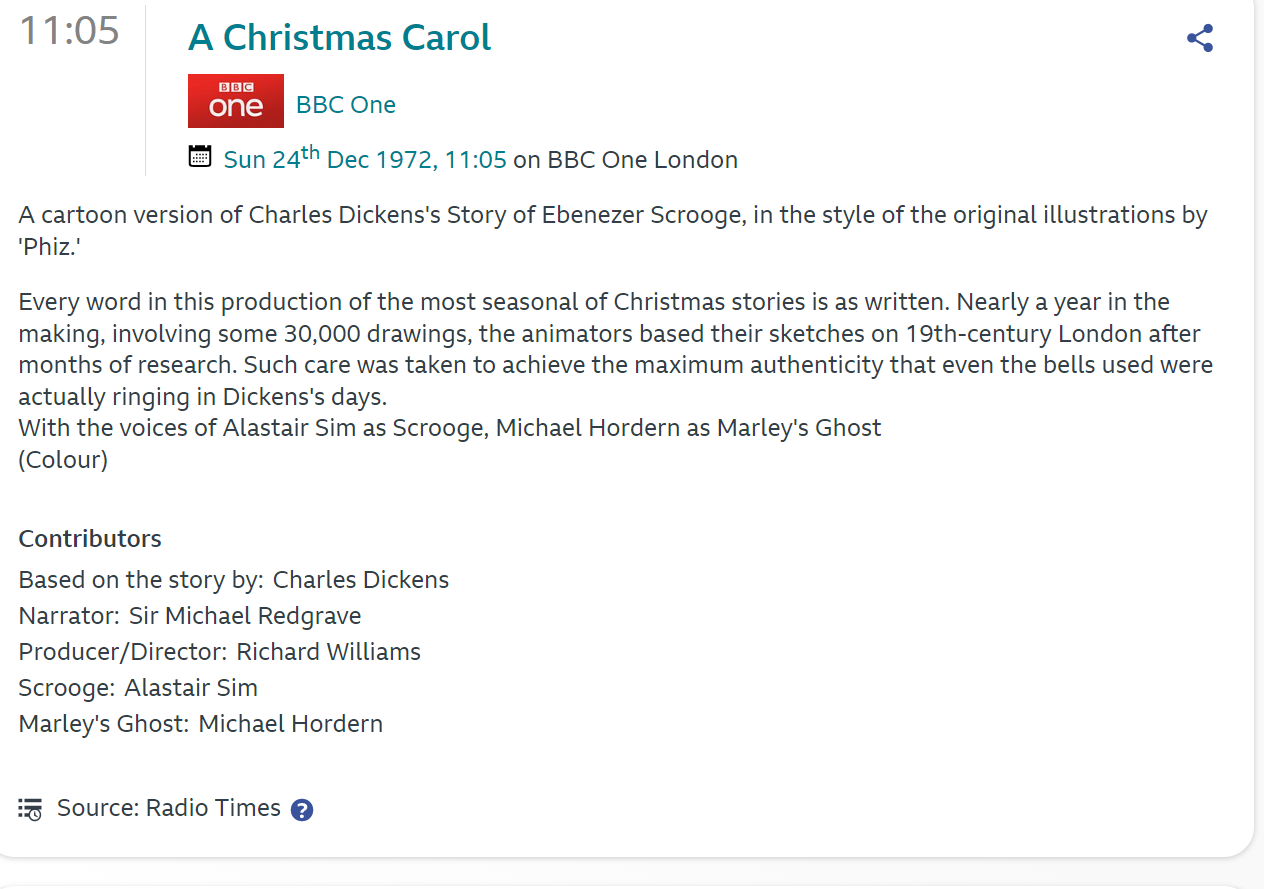
The moment that I first encountered it now had not only a day, but a time to go with it. At 11:05 on Christmas Eve, 1972, I sat down in front of A Christmas Carol for the first time. Even if I didn’t have a copy of the film to rewatch, there would be scenes that would be burned into my mind to this day. Marley’s Ghost, the flight of Scrooge and the Ghost of Christmas Present from a mining village to a lighthouse and from there onto the deck of a ship. Looking at the animation today, it did not ignore the poverty and sorrow at the heart of Dickens’ original vision, but that, of course, didn’t resonate as much with me then as it does now. However, I always had a social conscience as a child, and I wonder if it could be traced back to that first viewing? I think it’s likely that it can.
Scrooge at school
One of the few times I actually enjoyed being at my secondary school was when they treated us to a Christmas film. There was a film club at the school which I was a member of. A few times a term, the organiser would hire a film projector and show us old films of varying quality on a big screen. In my second year there a Christmas film was shown, and much to my delight it was Scrooge, the 1970 musical version with Albert Finney. It was the first time I’d seen it, because in those days there were only three channels, so films tended to come around far more infrequently than they do now! Most of the pupils around me were bored but I was gripped by the film, and from that first viewing it became a firm favourite. With superb songs like ‘December the Twenty Fifth’ and ‘Christmas Children’ it was a delight, but the highlight was the brilliant Anton Rodgers as Tom Jenkins with the showstopping ‘Thank You Very Much’. Yes, it took liberties with the story, but it had a verve and a heart that made it irresistible. There was some darkness along with the songs and in many ways, it was a victim of fashion as filmgoers moved away from the big Oliver style musicals. However, Leslie Bricusse, the writer, felt that there was unfinished business and just over two decades later, he revived it as a musical play. We’ll return to that later.
The book itself
I first tried reading the book when I was about 14, and I do remember finding it quite hard going in places. It seemed to be a mass of description that had little to do with the story at times. When he described the food and drink at Fezziwig’s party and the room in which the Ghost of Christmas Present sat, he seemed to a teenager to go into almost absurd detail. I found myself flicking through those parts, but when it came to Jacob Marley and the Ghost of Christmas Present in particular, I was gripped. Marley was a fascinating combination of vengeful spirit and friend to Scrooge, whilst Christmas Present was a jolly giant with an angry and sarcastic side to him. This mixture of dark and light really appealed to me and gave me my entry to the novel. Although I was somewhat older before I really understood the intricacies of the novel, I knew that it was a story about complex characters. Scrooge himself was clearly damaged, although we only get hints as to why that is, but he never seemed to be a fully rounded character. It was Bob Cratchit who I really identified with. He was the ultimate underdog who did his best but never got much out of life. The Cratchit family Christmas was deeply affecting because he was surrounded by love, and this was his protection from a harsh world. The trouble was that his family time was only fleeting in a time when people worked 6 days a week. He was a good man who made the most of a bad hand. He is the everyman character that Dickens identified with on a personal level given his own experiences of poverty. All these elements would keep me coming back to the book again and again until it became my favourite novel.

The Book at Bedtime
I always enjoy sharing my discoveries with other people, be they books, TV shows, films or music. You might have noticed that! It is probably the reason why I became a reviewer. One of my favourite versions of A Christmas Carol comes from the long-running BBC Book at Bedtime series. Read by Martin Jarvis and Denise Briars, this is a fantastic version of the story with well-chosen abridgements and an extra dimension that all the others lack. Every other version is read by a man on his own, who has to provide all the voices including those of women and children. Here, Denise Briars is an equal partner in the reading, giving more authentic life to the voices of those who had previously been impersonated with varying degrees of success, by which I mean very little in most cases! From the start of every episode, which begins and ends with the music famously used by Box of Delights – Hely-Hutchinson’s Carol Symphony – the quality never falters, and all 8 episodes keep me gripped whenever I listen to it. My wife’s first introduction to the story was with the tape, which I took away with us on holiday one early autumn, at her request I might add, to listen to over 4 nights. Although she has never quite taken to the story with quite the fervour I have, which is probably nigh on impossible given my obsession with it (!), she is now also A Christmas Carol lover herself.

Scrooge The Stage Musical
When I found out that the musical Scrooge was heading for the stage I was determined to get tickets for it. That was before I found out that my first Doctor Who, Jon Pertwee was playing Jacob Marley! Alongside him in a high powered cast were Anthony Newley as Scrooge, Tom Watt as Bob Cratchit and Stratford Johns as The Ghost of Christmas Present. All four were perfect for their roles and the extra songs that Newley and Leslie Bricusse had written gave the musical a real boost. It was a real privilege to see those four and the uniformly excellent supporting cast breathe new life into the story. However, my real Christmas present was still to come. I wrote to Jon asking if I could meet him after the performance and got a reply pretty much return of post saying he would be happy to meet me in his dressing room. To say that he was imposing under states the fact. I immediately became as nervous as the kid I was when I first saw him. He may have been in his seventies but he just exuded power and a star quality I have never experienced before or since. He was the one person I have met who genuinely overawed me and I would not have missed it for the world. That was definitely the highlight of my year and one of the highlights of my life.
The collection and the gaps
It’s been a long time since I first fell under Scrooge’s spell, but over the years, that spell has become stronger and stronger. My collection of Christmas Carol based films and other it shows no sign of stopping. I have the famous versions mentioned here, and some much less familiar versions such as the Ross Kemp modern day version which was genuinely good. What am I still on the look out for? Many years ago I saw the brilliant A Christmas Carol ballet, performed by the Northern Ballet, a couple of times, but it has not been revived in decades. I would love to find a Dvd of the ballet, or better still, go to see it in a theatre once more. I would love a Dvd copy of the Guy Pearce Christmas Carol from a few years back, but that is only available as a stream or download as far as I can tell. Finally, the crowning glory of my collection would be one of the earliest copies of the book from 1843, but miracles only happen on Christmas Eve after 4 ghosts have visited you! I hope you have enjoyed this trip through time with the ghost of Christmas Past and that you may be inspired to read, watch or listen to the book that set the template for the Christmas season.
 David Pearce - Popular Culture and Personal Passions