

When you sit down to a new book, especially an autobiography of someone whose public persona you are familiar with, you have pre-set ideas of what the subject will be like. Accordingly, I sat down with Baroness Floella Benjamin’s autobiography expecting a funny and warm read. Now I certainly got those emotions in places, but I got other emotions I definitely wasn’t expecting, like anger, shock, disbelief and passages that affected me so deeply that I had to put the book down to compose myself before I was able to carry on. In every way, this autobiography gave me deeper feelings than I had ever felt from any other life story. Is that because of Play School, Play Away and her other appearances during my later childhood? Well, that’s why I put the book on my Christmas list, but no not really. I got these feelings because of the power of the writing and the absolute honesty Floella put into every line. It is no exaggeration to say that I have never been so moved by any other book in years.
The Story
Floella’s early years on the island of Trinidad were days of fun and laughter with her beloved Marmie and Dardie and her five siblings. When her parents moved to Britain, leaving the four older children in the care of family and friends, what had been idyllic became a nightmare. She eventually moved to England to join her parents and settled in to her new life with positive expectations and a heart full of love for those around her. This was met with anger, racism and daily discrimination from neighbours, fellow pupils at school, racist gangs and the police. When you read how this young girl and her family were treated it makes you burn with anger, but from her adult perspective Floella shows the most incredible forgiveness to those who treated her so appallingly. It wasn’t always that way, as she admits, and unsurprisingly so.
That Question
The title reflects the question that Floella and every other non-white person gets asked when they are in a place where they aren’t expected to be. It’s a question that has dogged her throughout her life in England, and it hasn’t been asked only by people you might be expecting, but also by the ‘great and the good’ of politics, media and even the august members of the House of Lords itself. The way that Floella brings it to life and its horrible effect on her and many many others, makes what can, too often, be an abstract idea for those who have never been affected by racism and the questioning of your very self, deeply and shockingly powerful.
Love and Loss
The whole autobiography is full of love. Love for her parents, her siblings, husband Keith, her children, her Play School babies, her students and her fellow actors and performers. The fact that her love is so present at all times is the reason why people have loved her in return all through her life and career. Her overwhelming goodness and compassion is at the centre of this book, and it is this that makes the losses that she faces so upsetting. On a number of occasions in this book my eyes filled with tears and I had to put the book down to process what I had just read.
Final Thoughts
Baroness Benjamin of Beckenham, to give her her full title is quite simply one of the most important figures in this country. Her work for children, charities and equality has been indefatigable for half a century and more. She has given herself fully to everyone who has needed her help throughout her life and she is incredibly inspiring. She is full of Consideration, Contentment and Contentment. If you only read one autobiography this year you must make it this one.
Those of you who follow me on twitter or read my blogs will know that I do not care about fashion or ‘credibility’ when it comes to my music choices. If I like something I like something and that’s that. I will review and champion music of any genre. That wasn’t always the case when I was a child and a teenager, because saying you liked the ‘wrong’ band could be socially disastrous! I got a huge amount of stick for my abiding affection for Showaddywaddy, which I didn’t hide, so with groups or artists that were even more socially unacceptable for a boy, I learnt to keep things very quiet. From quite early on, I had a huge affection for the music of artists whose pictures were to be found in Jackie or, occasionally, Look-In. I am talking about the boybands and teen heart throbs that girls used to become obsessed by. If there had been the opportunity to join that obsession I would have done, but that area of fandom was clearly marked as out of bounds for boys! Well, many years later I can finally give full vent to my early music loves and not care whether I am being judged or not!
The Osmonds were a family of talented performers from the United States, whose wholesome appearance and polished ballad singing gave them the key to the hearts of girls across the world. I was a fan of their later songs, especially Love Me For A Reason, but their first hit couldn’t have been more different. It was a loud and uncompromising song of environmental activism that was, I realised in retrospect, one of the chief reasons for my eventual love of rock and metal. In 1972, however, it was an atypical choice of chart entry for me to become excited by, with glam very much on the periphery for me until the following year. When you listen to Crazy Horses, it is the sound of five young men being let off the leash and given creative control, a creative control they were not allowed to exercise again. When I went to see The Osmonds Musical in the theatre last year, which I thoroughly recommend, this was the first song in their encore. Even 50 years on, it raised the roof and pointed to a very different direction for these teen heart throbs to explore if only they had been allowed to.
Moving on to the other huge teen favourites of the decade, we find ourselves draped in tartan as a group of good looking – I was reliably informed by girls I chatted to! – Scottish performers called the Bay City Rollers dominated the conversation of girls from primary school upwards. I was an early fan of theirs, although I only admitted that to girls I could trust not to say anything, from Shang A Lang onwards. That was the name of their own show on ITV which I never missed, because they would have lots of other bands and artists on who I enjoyed listening to. I can’t have been the only boy to fall under their spell either, as worldwide sales of 120 million records would be hard to do on a narrow fanbase of the type they were supposed to appeal to. They were actually an influence on early punk rock in the US – no hear me out! Saturday Night was a US chart topper, originally released in 1973, but sinking without trace everywhere, that featured a chanted chorus with the letters Saturday being shouted out. It was re-released in the US at the end of 1975 before hitting the top in January 1976. The Ramones heard this track and decided to use a similar idea for their first hit, Blitzkrieg Bop. Pop on to YouTube if you don’t believe me, but the similarities are clear, and confirmed by The Ramones themselves. My favourite Rollers track hit the top of the charts in the UK earlier that year. No, it wasn’t Bye Bye Baby, much though I liked the song. It was the follow-up, the frankly quite brilliant Give A Little Love, sung superbly by the excellent Les McKeown and backed up by some top notch musical support from the rest of the band. It remains to this day one of my favourite ballads and the opening lines are simply lovely.
Now, the next entry on my 70s heart throbs list had a much more ambivalent position, because he was a male singer who had a huge appreciative following of male fans as well as female fans. However, those fans were not looking for the same thing in their idol. The artist in question was one of the most famous actors of the time, and a fixture of Saturday night television, but he also wanted to return to his early singing career. The decision of David Soul, aka Ken Hutchinson of legendary police show Starsky and Hutch, to release a series of gorgeous ballads came out of the blue because the only ‘singing’ policeman we had come across previously was Telly Savalas, who played Theo Kojak. His frankly terrible rendition of If was notable for the fact that he spoke all the way through it, because he could not hit a single note! Honestly, he made Lee Marvin, whose tuneless growling version of Wanderin’ Star from the musical Paint Your Wagon was a similarly inexplicable Number 1, sound good! (Both tracks are on YouTube but if you decide to look for them, on your own head be it!) David Soul, by contrast was genuinely talented. His early gimmick was to sing in a ski mask on US TV as The Covered Man because he wanted to be judged on his voice not his looks. When he revisited his music career he did so with the song Don’t Give Up On Us which charted on the week before Christmas 1976 and sped to Number 1 in January where it stayed for four weeks. It was the first of a trio of hits in 1977 with Going In With My Eyes Open making Number 2 and Silver Lady getting to Number 1. A true singing talent he may have been, but his music was seen by most boys as something to be avoided at all costs, because ballads were for girls! Following Starsky and Hutch Soul returned to his career as a regular guest star in US shows before becoming a regular on the West End stage in shows like Blood Brothers. Here is that first hit, the gorgeous Don’t Give Up On Us.
The 1970s came and went, and with it, arguably, the high point of the boy band. Certainly, it was a long time before any other band managed to work its way into the affections of the, largely, female record buying public. The 90s saw that band recreate Osmondmania and Rollermania as five young men grew up on camera from teens who were a little rough round the edges to a polished and supremely successful chart topping act. I refer of course to Take That, who were big enough in 1995 to feature on collectable boxes of cereal! The first track of theirs that made me sit up and take notice was their excellent cover of Could It Be Magic with a first lead vocal for a young Robbie Williams. After that, it was the lovely ballad Babe, which would have been the 1993 Christmas Number 1 if it wasn’t for Mr Blobby! In 1995, after a run of chart toppers, they produced a song that even their detractors had to grudgingly admit was ‘pretty good’. For me, it was perhaps the best single of the entire decade. From the first few bars of Back For Good, it was clear that this was something incredibly special. Gary Barlow’s vocals were on typically good form, but it was the tune that set this track apart. As a ballad, it is absolutely from the top drawer and stands comparison with any of the other great love songs across pop music history. After the inevitable break-up, Robbie Williams matched it with his own classic Angels, and the reformed ‘man band’ as they called themselves pretty much matched it a decade later with the outstanding Rule The World. It’s a trio of tracks that all feature highly in my all time favourites, and it’s incredibly difficult to choose the best of the three, so I’m not going to!
The 1990s finished with one more boyband who became, in chart terms at least, the most successful of all. Westlife were managed by boyband veteran Ronan Keating of Boyzone, and they exploded on to the scene in the era of SMTV Live and CD:UK where Top of the Pops was on its way down and Ant and Dec were on their way up. For the second half of 1999 they seemed to be on Saturday morning television every single week. Their first single, Swear It Again went straight in at Number 1, as did the next 6 releases! There were four chart toppers between May 1999 and December 1999, but it was their third that captured my imagination. The sublime Flying Without Wings is, to this day, one of the songs that will make me stop what I’m doing and just listen. As with all boybands, there was a lead singer, Shane Filan, but in Flying Without Wings, every member of the group took lead vocal duties, and the effect was to give Westlife a unity that a lot of their predecessors didn’t have.
So, there you have it. I am a fan of teen heart throbs, always have been, always will be. I hope that the choices above have proved that each one had songs that stand comparison with any music by any artist you care to mention. You just need to listen without prejudice.

On a cold and bright Sunday at the end of January I finally saw a childhood favourite on the big screen. Willy Wonka and the Chocolate Factory is one of those films that has continued to grow in popularity since its original release. It was my first trip to the big screen since New Year’s Day 2020 so it was well overdue. Now, I have to be honest that one reason alone encouraged me to go to the BFI last Sunday. As well as the film, the lovely Julie Dawn Cole was doing a Q&A after the film, and she was a childhood crush of mine, of which more later!
My first memory of Willy Wonka was on the small screen as a clip on the Screen Test programme. Thanks to the magic of the Radio Times Archive (with which I am becoming obsessed for its ability to take me back to my childhood days) I have pinpointed it to an episode that aired in 1972.

I remember that even in black and white, the world of Willy Wonka looked absolutely amazing. Then I saw another episode in December of that year with (I’m sure, although memory does play tricks on you!) an interview with Julie Dawn Cole and some behind the scenes clips.

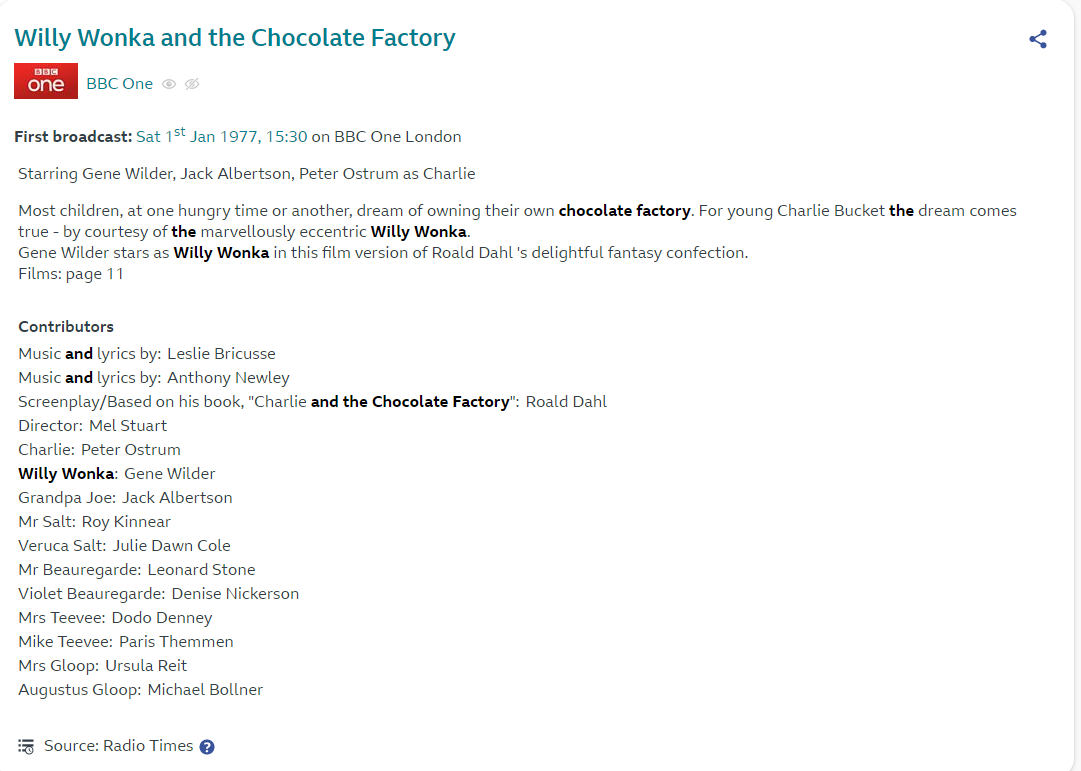
Now, remember that the film itself was released in 1971 and it was 1972 before it left the cinemas. Once that happened, TV stations had to wait five years before showing it. BBC1 picked it up for showing at what was almost certainly the first opportunity as you can see below. That meant that it was 1977 before I saw the film in its entirety, but by that time colour television had arrived in my household and I was able to enjoy the film as it was originally intended.
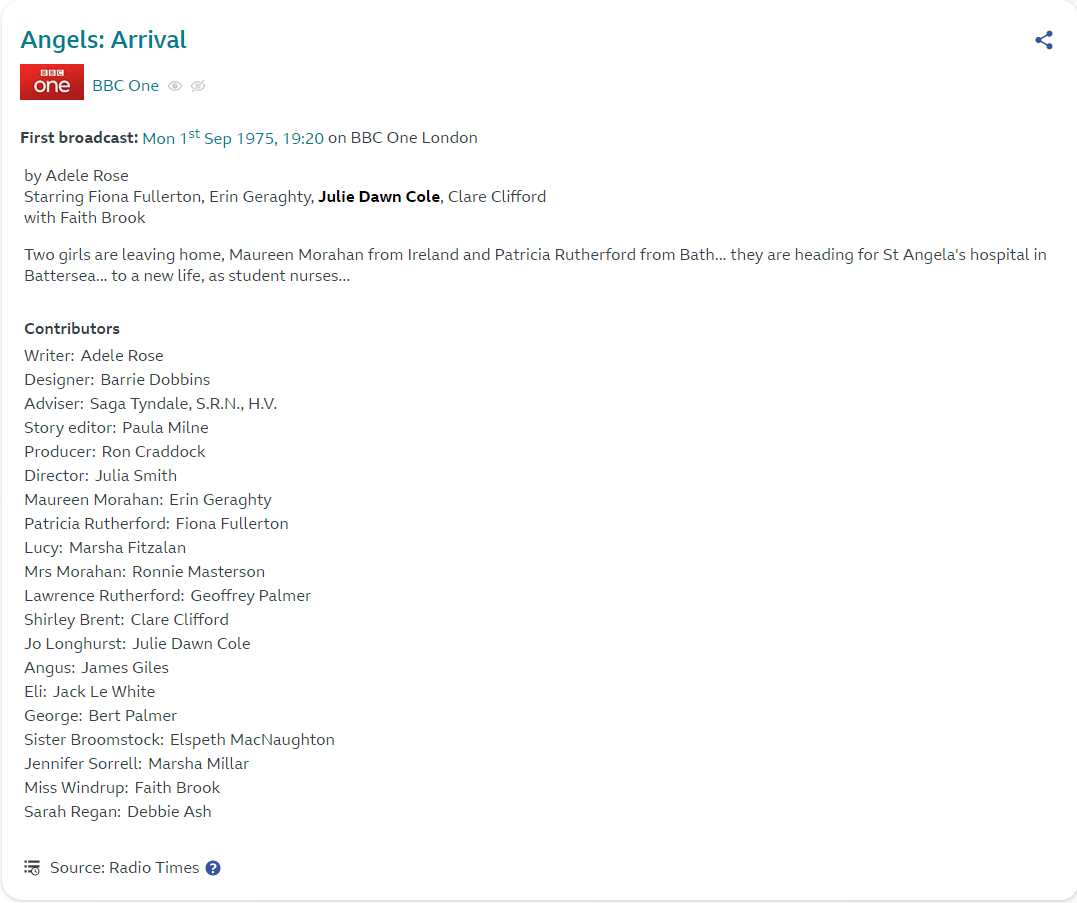
By this time, Julie Dawn Cole had become one of my early heart throbs and I nursed (pun intended) a huge crush on her when she appeared as Jo Longhurst in the hospital drama, Angels, which started in 1975. Julie’s were the first pictures I had up on my wall and when I watched Angels, any part of the story that didn’t include Jo saw my attention wandering!
When I saw Julie as Veruca Salt, I was captivated anew by her younger self, closer in age to me at that time, and my crush on her intensified. It was a very odd experience watching the film, because, not knowing the story very well, I wanted Veruca to win the Chocolate Factory even if she was a bad egg! I remember being very disappointed when she disappeared down that chute!
So, how did the film appear to my adult self. Well, first of all, the relative novelty of the big screen made it a far more immersive experience than the biggest of home TVs, so it was easy to lose myself in the story. I liked the way that Charlie Bucket and his family’s poverty was portrayed in a surprisingly direct and honest manner. Yes, it was exaggerated, but at its heart was a clear eyed portrayal of his life that was rare in children’s films at the time. The songs by Leslie Bricusse and Anthony Newley were fun with Pure Imagination and I Want it Now the obvious standouts as indeed they were when I first watched. This time, though, I also appreciated the melancholy Cheer Up, Charlie sung by Diana Sowle as Charlie’s mother. The pacing of the film was very good, with the search for the golden tickets and the introduction of the main protagonists being handled well. This is due to the excellence of the uncredited screenwriter – more later in the Q&A section! The reveal of the Chocolate Factory itself was just as impressive to my adult eyes, as I soaked up all the details and marvelled at the amount of pure imagination that went into creating it. As with all Roald Dahl’s work, there was a streak of nastiness running through it, albeit for unpleasant characters, but the screenplay did soft pedal it and play it for laughs somewhat more. Suffice to say, the 1 hour 40 minutes went by very quickly as Willy Wonka and the Chocolate Factory proved that it is a film for all ages as it held the full attention of three generations.

The Q&A was the third time I saw Julie Dawn Cole on Sunday. First of all, I saw her walk through the foyer to meet the staff at the BFI who were organising the showing. She looked very youthful given the time that had passed between the filming and this showing, and I was aware that a combination of my younger self and older self were absolutely overjoyed to finally see her close up! Then she helped present some prizes to children who had done some drawings before the film, and gave us a couple of moments to look out for in the film that we might otherwise have missed. When the film ended, she came out for the Q&A and spoke with real affection for the film, her co-stars and the whole team behind the scenes. There were three snippets of behind the scenes information that I was really fascinated by.
Firstly, she fibbed about her acting experience when attending the final audition as she realised that her inexperience was costing her roles that she was otherwise a great fit for. She invented her film history, in the days before an IMDB search would have revealed the truth, and secured the part. Well, it’s what Veruca herself would have done isn’t it? Secondly, a large part of the screenplay was written by David Seltzer, who also wrote The Omen. However, he had to agree to be uncredited because the studio were under the impression that Roald Dahl was still attached to the production. Thirdly, Julie was the only child on set not to be accompanied by a family member so Gene Wilder asked all the older members of the crew to keep a special look out for her. It was a warm and lovely half hour with the most delightful of actresses.
I did actually see Julie walking out, and I toyed with the idea of saying hello, but my younger self , which seemed to take the reins, was too shy to do so! It was probably for the best, and it gives me a reason to go to her next signing when, I trust, I won’t be tongue tied! They say you should never meet your heroes, but you should definitely go to see your childhood crush!
Song 3 – Rite de la Terre
Never heard of it? Well neither had I until this morning, or at least I had no idea what the tune was called. Quite by chance I found it on Spotify and a huge piece of my musical history fell into place finally. Now, strictly speaking this is a tune, not a song, as are the four following it in this trawl through my musical upbringing, but they belong to a fairly neglected area of musical creation nowadays, namely the television theme tune.
Without sounding too much of an ‘in my day’ bore – I hope! – I put the decline in their overall quality down to the way that people started to fast forward through them on VHS and now ignore them altogether on streaming services. Of course, there are still good examples of the genre in the TV programmes nowadays, but the sheer number of memorable theme tunes from my childhood pointed to the early 70s in particular as a golden era.
Anyway, back to Edward Michael’s Rite De La Terre. It introduced one of the most original and challenging children’s programmes of all time, Timeslip. When it was shown on ITV, I was 6 or 7 years old, and I can’t remember if or when it was repeated. The content of the programme was way above my head at the time, but that theme tune was the reason I tuned in week after week. It is a foreboding, scary theme tune that unsettled me as a child and still does now. When I got the series on VHS many years ago, it was that theme tune which sent the hairs on the back of my neck rising. The programme itself was as accurate a picture of the future as was scientifically possible at the time, with episodes involving Virtual Reality, global warming and cloning turning out to be pretty much on the money as those scientific concepts hardened into everyday reality. Have a trawl through YouTube and eBay or elsewhere on the internet for artefacts of this marvellous, forgotten series. Just to whet your appetite, here is that theme tune that finally has a name!
Next, we have a theme tune from 1972 that is instantly recognisable as the sound of Sunday afternoons, at least in the Southern Television region. I give that little caveat, because the regional variations at the time were sometimes very large indeed. For others of my age it may have been the sound of a Saturday or Sunday evening, but whenever you heard it during the weekend, the fantastic Galloping Home will bring memories flooding back. Although I knew the tune, and in this case the title, I had no idea of the identity of the composer behind it until today. Denis King has had a varied career to say the least. A member of the King Brothers, Britain’s first ‘boy band’, whose tunes would be familiar to those with memories of the late 50s and early 60s. He studied orchestration at the Guildhall School of Music from 1970 after the group disbanded. It’s fair to say that he hit the jackpot pretty much straight away when he composed the exhilarating theme to children’s equestrian drama Black Beauty! His musical expression of the freedom of a horse at full speed is 50 years old now, but still instantly recognisable to those of a certain age and, almost certainly, their children. Here is a tune that is simply iconic.
Moving back into the realm of sci-fi, it’s the third ITV theme tune in a row in an era when the BBC tended to dominate children’s viewing. If I say the words SuperMarionation to you, you might look at me blankly or nod your head as you remember the incredible theme tunes from the Barry Gray Orchestra. The partnership between Barry Gray and Gerry Anderson began with the very first puppet series from 1956, the largely forgotten The Adventures of Twizzle, and stretched throughout the 1960s with Stingray, Thunderbirds, Captain Scarlet and the Mysterons and, my favourite of all, Joe 90. The adventures of a bespectacled nine year old, employed by WIN as a very special agent who could enter places fully grown agents couldn’t, and who could be given the brainwaves of any person when he sat in the machine BIGRAT, captured my imagination from the start, quite literally. Gray’s psychedelic theme tune was an outstanding theme tune that sits with the classics of any genre. Many of you will have other favourites from the Gerry Anderson stable, but for me, it’s another taste of childhood weekends that is imprinted on my mind.
Changing channels now, I move onto a programme that shaped my childhood love for the cinema. Screen Test was, in my childhood, one of the few ways you could see film clips outside of Disney Time. Four children answered questions about the film clips they had just seen in a game of visual and aural memory. I used to love playing along although I was not particularly brilliant at the visual questions if memory serves. As well as the questions, it had Michael Rodd who was one of the best TV presenters of the time. He also appeared on Tomorrow’s World which I became a regular viewer of because of Rodd’s presence, and he was one of the great communicators in a TV era packed with them. Syd Dale’s Marching There and Back was the military style theme that introduced the programme and contributed so much to it. There were lots of great BBC theme tunes in the 1970s, but this is my pick of the lot.
For my final theme tune, I am changing the channel again to ITV. They really did have a run of excellent theme tunes in those days and they held me in their thrall from that day to this. My final choice comes from composing legend Dudley Simpson. His incidental music was heard in pretty much every iconic Doctor Who story from Planet of the Giants in 1964 to the somewhat less iconic Horns of Nimon in 1980. Alongside his Doctor Who work, he was responsible for two of the most readily identifiable pieces of science fiction music from the 1970s. In 1978 he composed the music for Blakes 7. Despite never liking the series itself, I always liked listening to the theme tune before turning over to another programme. However, in The Tomorrow People it hit the spot both as a theme tune and a genuinely intelligent science fiction series. Whilst the theme tune itself was extremely good, it was the incredibly unsettling visuals that went with it that really stick in my mind. All that is left is to ask, were you the blue or the green?
I hope that, for those of you who remember this era, I have brought back some memories and singled out some of your favourite theme tunes. If I have missed any, let me know in the comments. See you for Part 4 very soon.
Song 2: Womble of the Universe by The Wombles
I have written about my discovery of this song here and mentioned it regularly on twitter as part of my fan worship of the amazing Mike Batt. Why did it affect me so much on a musical and personal level? Well, I had been a huge fan of The Wombles from the start, but this was definitely a game changer as far as I was concerned. It mesmerised me from the first few notes with its space vibe and it referenced, though I didn’t know it at the time, Space Oddity in places. The storyline was captivating as we followed Orinoco into space on his clockwork rocket ship and wondered, along with his family and friends, whether he would come down to Earth again. It tapped into my feeling of wanting to escape from everything I knew to have an adventure, although it reflected just wanting to escape from everything whether I had an adventure or not, when I listened to it when I was older. As with many of Mike Batt’s songs it has a wistful, almost melancholy edge to it. The whole album showcased a musical genius at work in its use of 11 different genres, but it was Womble of the Universe that was the track which led me to different songs as I developed a fascination with space and the universe around me.
The next song, chronologically in my discovery of music, was a small film called Star Wars! I saw it 6 times in the cinema and, although I enjoyed the main tune, it was the scene in the Cantina Bar which really hit the spot musically. Why that one? Well, I suppose that it was different, kind of quirky and great fun. At 12 you don’t necessarily look for the same songs as you do when you are an adult, but I still love this track. It reflects a bit of Mike Batt’s sense of fun and musicality, and the use of clarinet style instruments in the original film was great. The track that charted was by Meco and it was a combination of the main theme and the Cantina Band tune and it was a single that was hardly off of my record player in 1977/78! As you can probably hear, it is very much a 70s disco track, but it’s great for all that.
In 1980 my favourite TV series was Cosmos, the history of pretty much everything presented by the visionary Carl Sagan. The breadth and depth of the programme as it tackled philosophy, discovery and space exploration set it apart from anything else at the time, or indeed since. There were brilliant uses of music throughout, but the piece of music that left me awestruck was the track Alpha by Vangelis which sound tracked a journey through space. It is a synthesiser track that starts slowly and builds up momentum gradually throughout until, by the end, it is an exhilarating dizzying ride that just leaves you breathless – well me at least – and just staring at the TV in stunned admiration at the combination of special effects and that simply incredible music. Remember, this is in 1980, when UK TV sci-fi was innovative in terms of storylines, but had the budget of the average caravan holiday in Norfolk! Cosmos was in all ways on a different planet. When I saw the ‘Cosmos’ single of Heaven and Hell in the record shop I picked it up eagerly. I turned it over and saw Alpha on the B Side, although at the time I bought it, the title meant nothing to me. When I put it on the record player and realised which song it was I was overjoyed. It is a record that also put me in touch with the world of exciting synthesiser music, but that’s another story!
Time for a little bit of fun now, with a song that is one of the most educational songs ever recorded. In the excellent Meaning of Life from the Monty Python team, there were some really good songs, but one of them was an all time classic. Written and sung by the multi-talented Eric Idle, it is the tour de force that is The Galaxy Song. For my money, it is better than the more heralded Always Look on the Bright Side of Life, as he uses entirely accurate information about space and time to encourage a woman to donate her organs! It skips along with a sense of mischief, but never loses sight of scientific accuracy as it wears its knowledge so lightly. Eric Idle is on great form as he sings it with the air of a game show host and a travelling salesman combined. If you’ve never heard the song before, you are in for a rare treat I promise you.
The final track is from the artist that recorded Space Oddity, so in a sense it completes a nice circular journey as we move through space to the Red Planet. The song Life on Mars is definitely my favourite Bowie track with its mix of captivating piano playing by Rick Wakeman and the lyrics that are open to multiple interpretations. In December 2016 I went to the Kings Cross Theatre to see Lazarus, the Musical. The part of the girl in the production was played by Sophia Ann Caruso on Broadway and in London. However, on that night, her understudy, Hannah Rose Thompson played the part and delivered the performance of the night. She sang Life on Mars with a beauty and power that left me covered in goose bumps and with tears in my eyes. Ever since then I have been looking for a copy of her version of the song on Youtube or Spotify, but without any luck. If anyone can track it down I’d be incredibly grateful, and if by a very small chance Hannah reads this, thank you for my favourite musical memory from any stage production. Given the impossibility of tracking down that version, I shall stick with the gorgeous original that I discovered many years after it was first recorded.
I hope you enjoyed reading my space themed collection and I hope that you will join me for song three of my musical journey very soon.
 David Pearce - Popular Culture and Personal Passions