
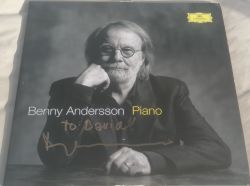
Back in 2017 Benny Andersson of ABBA revisited some of the songs from his career with the Swedish icons and beyond, taking in his work for the musical Chess, perhaps his most famous non-ABBA work, amongst others. He did this on the album Piano where, as the title suggests, he played them unaccompanied on his grand piano. You can hear his classical background in every single tune, so how do they stand on their own as pieces of music?
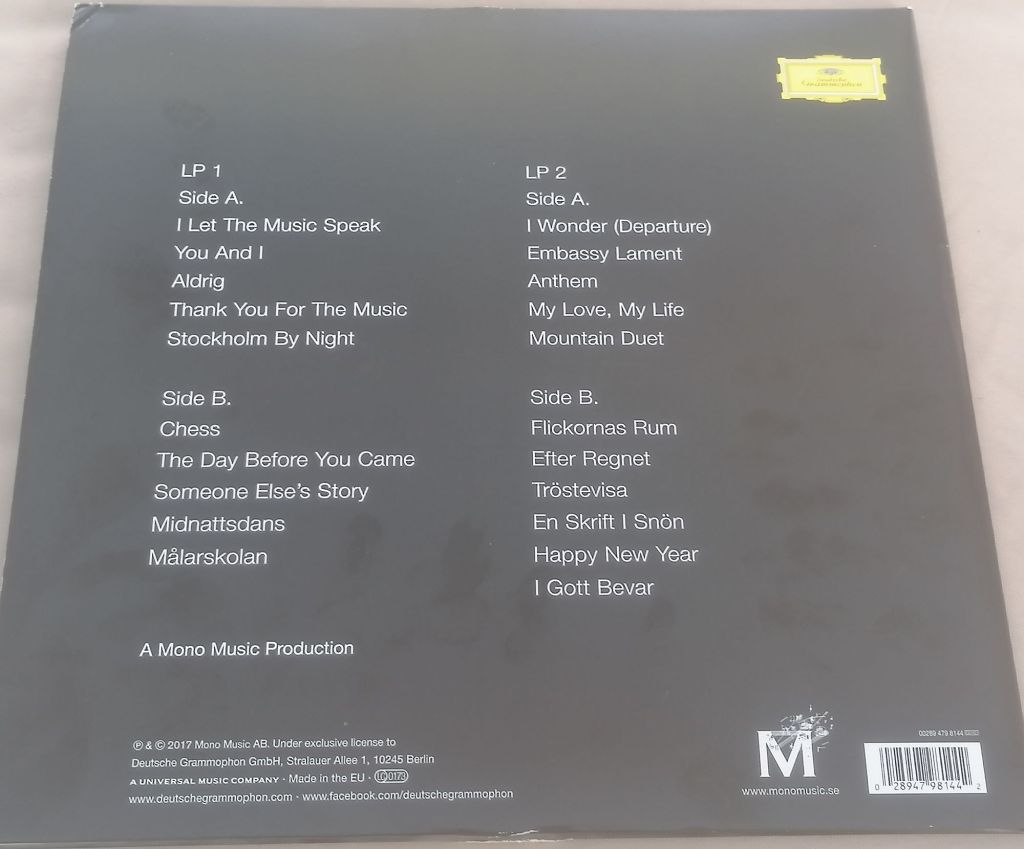
Disc One
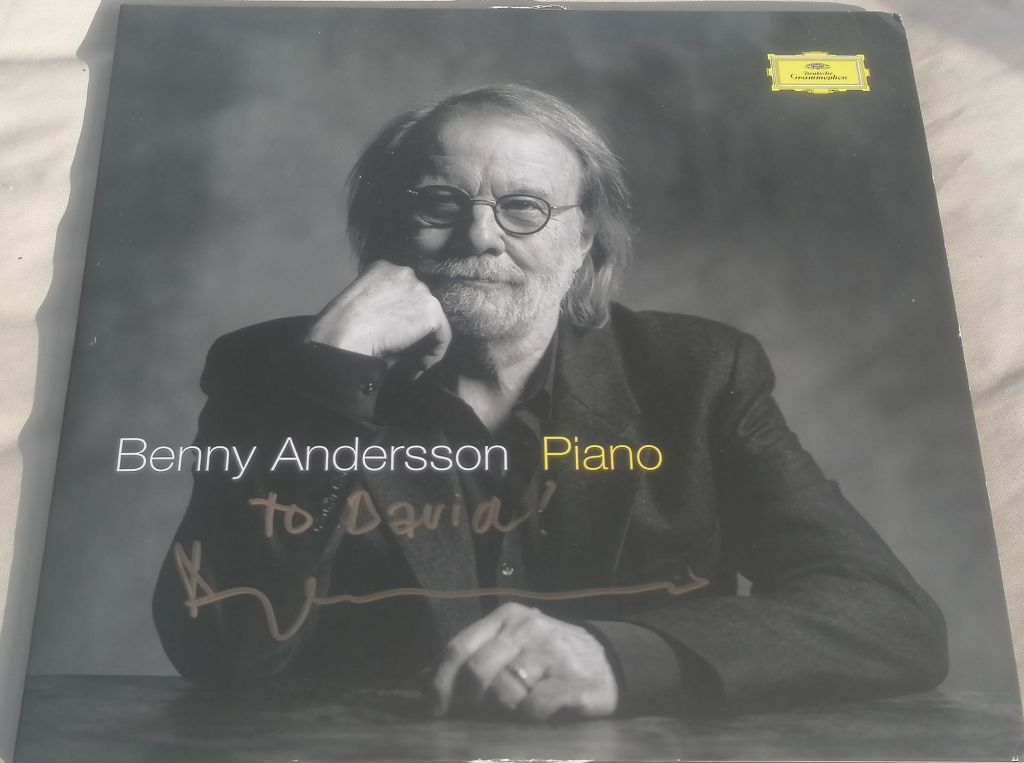
Benny starts off the album with the appropriately titled Let the Music Speak. It was originally on The Visitors in 1981, and it is reworked very cleverly. There are elements of this tune that sound familiar to someone who knows the album, but the arrangement and the playing give it depths that the original treatment was not able to do much more than hint at. There was often a classical underpinning to ABBA’s tunes, and this opener brings that out very effectively. Next, you have the Bach influenced You and I which was written for Chess. It’s the kind of tune that you can imagine being played at a classical concert and not sounding out of place. The same goes for Aldrig, a stately romantic tune from the Swedish musical Kristina fran Duvemala which was completely new to me. Thank You for The Music, on the other hand, could not be more familiar. Here, it is given a mix of Gershwin style jazz inflections and traditionally classical music from the era of the great composers. It is an absolute treat to hear it without the words, proving beyond doubt how good the musical underpinning to all of their songs were. The whole basis of ABBA’s success was the interplay between four individual artists who combined to lift their songs to the level of genius, but without the musical understanding of the writers, the singers could not have demonstrated their own abilities so effectively. The final track on Side A of the first disc is the lovely Stockholm by Night, originally written for his album, November 1989.
Side B begins with Chess, an instrumental track from the musical that plays during the chess match itself. As before, you can hear echoes of Bach, a composer who Andersson has an abiding love for. It’s not a musical I’ve ever seen or heard in its entirety. The only tunes I know were singles in the UK charts, Murray Head’s One Night in Bangkok and Barbara Dickson and Elaine Paige’s smash hit I Know Him So Well. It is a lovely tune, and if Chess is revived I would like to see it in its entirety. The Day Before You Came has long been one of my favourite ABBA songs, and the version on this LP really reaches down to the longing and sorrow that underpin the track. The feeling of a wasted life, stuck in the meaningless pursuit of money is superbly captured in the original lyrics, but the sadness inherent in that life is beautifully realised here and gives this an emotional charge that the original lacked to some extent. Someone Else’s Story is another track from Chess that makes me wonder why I have never sought it out either on vinyl, CD or Spotify. It is a gorgeous tune that stands comparison with any of the ballads from the musical genre. I was taken away by it in a way I never expected, and I can just imagine Agnetha singing it, even without knowing the lyrics, as it suits her voice so well. Midnattsdans was written for the Benny Andersson Orchestra in 2004 and represents his love for Swedish folk music. Once again, it is a track that is timeless, in the sense that you would not have been surprised if it had been written in the 1800s or early 1900s. His ear for music from any era, and his ability to reshape it, is what helped propel ABBA to greatness. Malarskolan is the final track on Disc One and it is a tune written for the November 1989 album. It has the air of a gavotte and you can feel yourself moving in time to the music almost as soon as it starts. It is two minutes and twelve seconds of musical delight.
Disc Two
The gorgeous I Wonder (Departure) is from ABBA’s 1977 album, simply called The Album, and despite not being a single is instantly recognisable. As the start of Side A of Disc Two, it couldn’t be bettered. The classical motifs are very much in evidence with a touch of Beethoven most apparent. It is gorgeous. Embassy Lament from Chess is a short but effective interlude, just under one and a half minutes long, but packing in a huge amount of musical virtuosity. Anthem, once again from Chess, is, paradoxically, played very subtly and effectively in a very non-anthemic style. My Love, My Life is from the 1976 ABBA album, Arrival, and epitomises how much Benny brings out of the album tracks that would have passed all but the most committed fans by. It seems only right to reflect on what a gifted classical pianist he is, especially at this point because he turns a piece of pop music into a composition to sit alongside any of the most renowned pieces within the classical repertoire. We were used to hearing his genius put to good use on synthesisers, but the purity of his grand piano shows what a great musician he really is. It seems strange to say that when ABBA’s songs are so popular, but it is incredibly difficult to break down the barriers between pop and classical and Benny Andersson is one of the few who can do it. The final track on Side One of Disc Two is Mountain Duet, the last selection from Chess. It is another song that recognisably belongs in the musical theatre genre given its construction, but which is given a very different feel when played on the grand piano.
Side B of Disc Two, with one exception, showcases Benny’s Swedish output with Flickornas Rum, the first track, coming from 2011 and originally contained on the Benny Andersson Orchestra’s album O Klang Och Jubeltid. It is a lovely light track that takes the listener away on a gentle wave of music. The second track Efter Regnet from his first post ABBA solo album Klinga Mina Klockor is one of the most effective of the unfamiliar tunes showcased here. It is quite simply beautiful and gives you a feeling of happiness. Trostevisa from the November 1989 album is much requested at Swedish funerals apparently, and I can quite understand that, given its gentle evocation of melancholy and deep sadness. It is a counterpoint to Efter Regnet that shows his ability to affect the emotions in a way few other modern composers could hope to do. En Skrift I Snon was written as part of an inauguration for an organ in Pitea. Sweden. Naturally, it doesn’t sound like a piece of organ music here, played as it is on the grand piano, but it has a lightness of touch that is quite enchanting. The final ABBA song on this collection is next, and it’s an absolute treat. Happy New Year is one of their best songs, in my opinion, but it came right at the end of their career when their star was on the wane. I am sure that if it had been recorded two or three years earlier, at the height of their success, it would have become a festive standard. It still deserves to be by the way! To listen to it on piano is to have your breath taken away by its reflective, regretful beauty and to really understand what a masterpiece of writing it is. Of all the ABBA tracks on this album, this is the one that just captures your heart and refuses to let it go. The final track, I Gott Bevar, comes from his musical Kristina Fran Duvemala and it brings the album to a peaceful, reflective close.
Final Thoughts
I got this album in 2017 and, although I played it a couple of times, I never really sat down properly and listened to it. Having had the opportunity to do so now, I can only say that I waited far too long before giving it another chance. It demonstrates the sheer brilliance of Benny Andersson the composer and Benny Andersson the pianist. To some extent the first always overshadowed the second. This album gives us the chance to appreciate both in perfect harmony. Oh, incidentally, if you are wondering about the inscription on the front, yes it is personally signed by Benny from a competition I won when the album first came out!

One thing I am not very good at is relaxing. I was brought up with the words of If by Rudyard Kipling, my Dad’s favourite poem. The final verse mentions filling the ‘unforgiving minute with 60 seconds worth of distance run’ and any time I was guilty of not doing that it was considered an indication of a lack of moral fibre, as the forces might say!
This week I have been forced to relax having gone down with a nasty flu type offshoot and I have hated it. Relaxing takes so much effort that I find it exhausting! 😂😂 For the last couple of days, being unable to do much more than get between rooms slowly(!) I have written two blog posts and am now writing a third. Old habits die hard obviously! So how does someone like me try to change tack after a lifetime of seeing relaxation as a great evil?
Albus
Albus is our cat, and his presence is perhaps the most relaxing constant in my home. When he is on my lap or sitting next to me purring, or demanding food, it puts a lot of other worries out of my head or at least in perspective. Having any type of pet can be incredibly good for your mental health, but a totally chilled out cat like Albus takes relaxation to the next level! 😻😻

My Go to app
The last couple of years have seen me use one app more than any other when I am on the phone and trying to relax. Happy Colour is a simple colour by numbers app that I am pretty obsessed with. Colour by numbers wasn’t something I really enjoyed as a child, because my dyspraxia meant that my fine motor skills – in fact all motor skills – were a weakness of mine. Accordingly, I was guilty of literally going outside the lines. For the Happy Colour app, this is not an issue and I have found it the most useful way to destress. As you may have noticed, a number of the pictures are seen at the top of my blog posts, especially at Christmas. This year, to reflect the app’s effectiveness at relaxing me, I have set myself the target of colouring all 366 daily pictures in 2024.

The magic of the printed word
Reading is a constant in my life, and with really good books I can completely lose myself and all track of time. I wonder if I take it for granted sometimes, because it is part of the tapestry of my life and has been since childhood. On the way to and from work I invariably take my book out and don’t really consider the other option. However, last week I forgot to take a reading book with me, and a one hour journey stretched out in front of me interminably. I hate being on my phone on the train so all I had was The Metro and my own thoughts – the latter always a dangerous road to go down! Suffice to say I was really pleased to find that I had a novel at work for the way home, and I now have a fresh appreciation of the importance of reading for my mental health. I am a fast reader so my TBR pile below is about 3 weeks worth of commuting at most!

Cooking
Sadly, I don’t have anything like enough energy to cook at the moment, but when I do, nothing takes me away from my stresses like preparing a meal from scratch in the kitchen. Now, I know it’s a little bit of the 70s style upbringing coming to the fore again because it’s relaxation with a very clear end product and one that often takes a lot of effort, but it’s the best feeling to cook, or very occasionally bake, from scratch. Below is a rare attempt at baking, since Janet is so much better. It’s a twelfth night cake from Spain called Roscon de Reyes. Though I say it myself, it was pretty good!

Jigsaw Puzzles
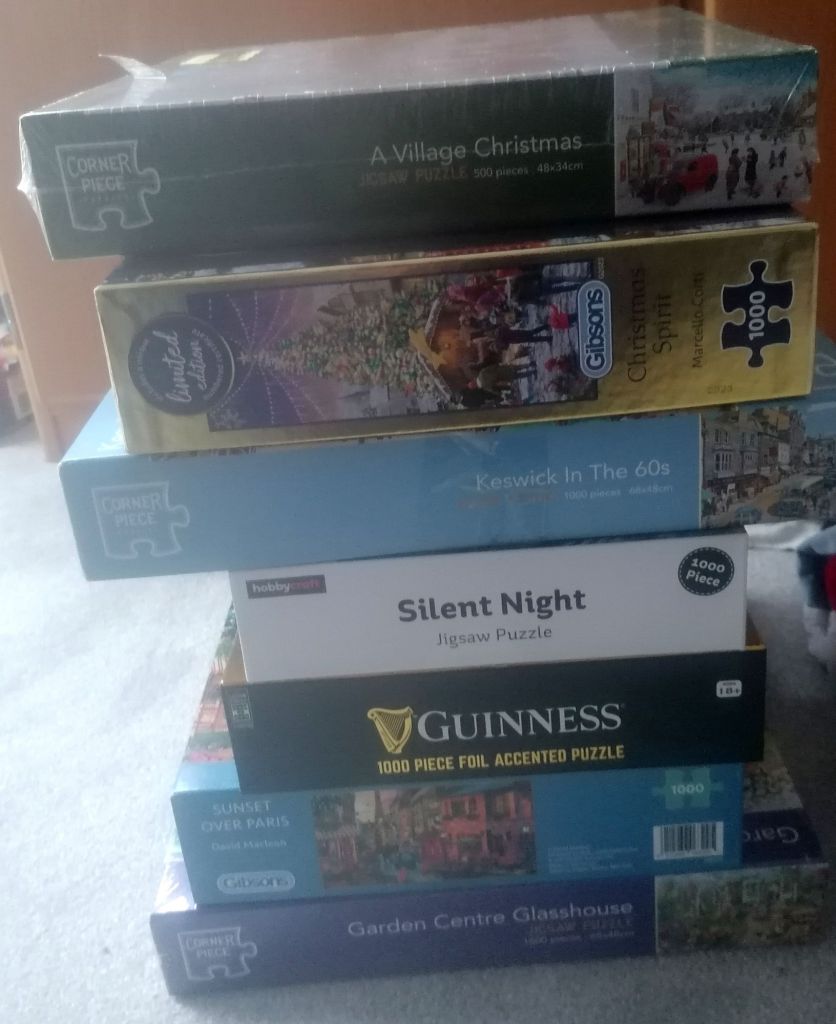
Anyone who follows me on Instagram will know that puzzles were something I picked up during Lockdown and never got bored with. Most weekends Janet and I tackle a puzzle of some kind and once it is finished, I post a picture of it on Instagram! It’s something I never enjoyed as a kid, because I couldn’t really see the pictures. Now, however I am a dab hand at people, writing and animals! Sky, sea and buildings are Janet’s forte so we have very well matched skill sets. This year we got no fewer than 7 new puzzles to go with the 5 we still haven’t started, so weekends look quite well catered for, for the foreseeable future!
Final Thoughts
So, there you have it. My five main ways to relax and all but Albus involve an end product of some sort, so you could argue that I am cheating a little, but without them I would have far more trouble with calming my racing brain than I do. Do any of these make their way onto your own list? If not, what do you like to do to relax? Let me know in the comments and I hope you enjoyed this article. Maybe you even found it a relaxing read!

Part 10 starts with a Double A Side single from Don Mclean with one of my all time favourites, Vincent, being the reason for buying it, but American Pie making it even more of a treat. I had heard American Pie before, but having the single enabled me to properly listen to it, and it is truly exceptional. However, Vincent will always be my favourite. I have blogged about it here if you are interested in finding out why. Freddie McGregor is one of those artists who has become somewhat obscure, but this Jamaican singer was well known in the second half of the eighties for his smooth reggae covers. Just Don’t Want to be Lonely was his only UK Top 10, but its infectious rhythm and smooth vocals make it a good listen all these years later.
Meatloaf was a massive part of my mid to late teens musically speaking. I was blown away by the visceral excitement of Dead Ringer for Love when I first heard it, and the Saturday after it first burst on to my consciousness, I was down at the Strood Record Centre to pick it up. Within a couple of months, I had the Dead Ringer album on cassette and Bat Out of Hell on vinyl, which I listened to endlessly. Midnight at the Lost and Found was the next album, released in 1983, and whilst not his best, being a contractual obligation album, there were some good tracks on there, including the title track, which I picked up as a double single, mainly for the live version of Bat Out of Hell. Bad Attitude was an album that has pretty much sunk without trace, but it contained my favourite single of his, the fantastic Modern Girl. It is a song that shows off his excellent vocals to good effect and is backed with a really good tune. It’s well worth a listen.
The Star Wars/Cantina Band record by Meco reminds me of the days when I was an absolute fanatic for everything connected to the film. It’s an excellent record that is basically a disco remake of the main theme and the tune played by the band in the bar where Luke meets Han Solo for the first time. Even now, it’s as catchy as anything. Next we have Glenn Medeiros with the smoochy ballad Nothing’s Gonna Change My Love for You. I know it was derided at the time and since, but it was Number One when Janet and I announced our engagement so it will always have fantastic memories associated with it. Finally, Aussie Rock from Mental as Anything with their massive hit from the Crocodile Dundee soundtrack, the ridiculously catchy, Live It Up. When we went to Australia in 1998, we saw them perform live at an open air New Year’s Eve concert in a park in Sydney. They were excellent throughout, but when this was played, the entire audience, young and old, Australian and non-Australian went crazy. It’s what I always think of when I hear this song and it always makes me smile.

This is a very useful set of Ms as they capture in one picture two legends and ‘novelty’ records that stand the test of time. Useful, because I know what’s coming up in the next picture! We start with the marvellously catchy and danceable Men Without Hats, a favourite at discos in the 80s. The Safety Dance does have the label of ‘novelty’ hit, but if it is, it is one of the absolute best. I still love it, and as soon as I hear that instantly recognisable intro I get a smile on my face. Now, are you ready for Freddie? I always was, and always will be. It may be that his solo records didn’t really reach the heights of his Queen output, but very little did at the time. Love Kills had a brilliant video, featuring Metropolis, the same film as Queen used for Radio Gaga, and it’s a really well structured song. Of the two we have here, however, I prefer the disco hit of I Was Born to Love You with it’s instantly recognisable intro and singalong chorus. It is perhaps the most joyous Freddie moment outside of Queen. Next, George Michael, another all time legend, with three singles covering my three favourite solo moments of his. Careless Whisper is one of the all time great ballads, mainly because of that voice and his ear for a song. However, what really sets it apart is the fact that, like All Out of Love and I’m Not in Love, it’s actually a song about love gone wrong. This sub-genre of the ballad has always interested me because it subverts the usual message whilst using the same approaches, musically speaking. It is, for me anyway, his finest solo moment, although I know many of you will disagree. Faith is a marvellous rock and roll inflected tune that gives George Michael the chance to spread his wings beyond his Wham days, although I still think Wham were his finest years, again a view many would not hold. Finally we have his amazing duet with Elton John for Don’t Let the Sun Go Down on Me. Both singers are on top form and the partnership definitely lifts them to new heights, and it is my favourite duet ever between two solo artists. Finally, we have the Noel Edmonds inspired chart hit, Captain Beaky, a record that I was obsessed by at the time. Keith Michell is perfect as the narrator with the right balance of seriousness and twinkle in his eye. He treats the material as if it is a soliloquy from a classic play and this is what lifts it above the usual run of novelty singles. Now, not many people have the follow up, The Trial of Hissing Sid, but I do because I bought it as soon as it was released! It didn’t have the same success, failing to chart, but it’s well worth tracking down if you can.

This octet starts off with The Divine Miss M, or Bette Midler, with the fantastic ballad Wind Beneath My Wings from Beaches. It’s a film both Janet and myself absolutely love. A well written, brilliantly acted and deeply affecting exploration of a female friendship from childhood to adulthood. Wind Beneath My Wings is obviously the song everyone remembers from the film, but can I put in a word for the Soundtrack Album which includes the timeless ‘Otto Titsling’?! Two songs from Mike and the Mechanics next with the unsung pop genius that is Paul Carrack. Of the two, I think that I prefer Silent Running (On Dangerous Ground). The movie it comes from, in brackets on the title, has been lost in the mists of time, but the song itself is an absolute cracker. A dystopian society is brilliantly captured in a song. You can feel the claustrophobia of the threatened family and you can hear the regret in Carrack’s voice as he sketches in the details of an oppressive regime striking fear into the citizens of a state that was futuristic then, but contemporary now! Living Years is, of course, a song that resonates with fathers and sons across the years, and for that reason, it’s a very difficult listen. It’s one that always catches me out, however many times I hear it. The Banner Man by Blue Mink will be instantly familiar to pretty much all of us who grew up in the 70s, and almost completely unfamiliar to everyone else. It was one of those songs that just leapt out at us because of the chorus. It is a song with a quasi religious feel, and you can imagine it being sung by a congregation as well as by a Top of the Pops audience.
Now, we come to perhaps the worst single in my entire collection. This abomination by Danny Mirror, a tribute to Elvis Presley called The King is Dead, got to Number 4 in the charts thanks to people like me buying it! In my defence, I was 12 years old and not yet in full possession of my critical faculties, but even so, it’s pretty unforgiveable. I can’t even bring myself to listen to it, but I remember that the ‘heartfelt ballad’ of the time was actually a dirge to cynically cash in on a celebrity death. Mea Culpa, mea culpa, mea maxima culpa!
Back on safer ground with the next two, as the Modern Romance belter is followed by a piece of synth genius from two giants of 80s popular music. Best Years of our Lives is quite simply a party on a seven inch disc with a tune that is amazing, party sound effects that are brilliant and a reminder that when you’re young there’s no time or place better. When I hear it again, it reminds me of fun, friendship and parties. It is my teens distilled into 3 minutes. Together in Electric Dreams by Giorgio Moroder with Phil Oakey on vocals still sounds modern all these years later. Like On Dangerous Ground, the main song has remained in the public consciousness far longer than the film it came from. Oakey was never better and Moroder’s legendary ear for a tune never more in evidence. One of the songs of the decade. Finally, another song from a film. OK, so the film is appalling. I watched it again a few months back and lasted no further than 15 minutes of utter drivel. So, is the single bad? Oddly, it isn’t, because Mel Smith and Griff Rhys Jones could deliver a song, as they proved time and again during Not The Nine O Clock News, and of course at Christmas when Mel teamed up with Kim Wilde on Rockin’ Around the Christmas Tree. The song itself is incredibly catchy and often funny, and it has a pre-popstar Jimmy Nail on backing vocals! Is it a classic? Absolutely not. It’s simply fun and there’s nothing wrong with that.

WE come to the end of the Ms with this set of eight singles which includes a whole set of favourites. First of all, Alison Moyet, whose voice is up there with the all time greats of British music. The four singles I have of hers start with the second single from Alf, her debut solo album, All Cried Out. What a song, and what a vocal performance this is. I loved the album from beginning to end and played it endlessly on cassette back in 1984. That Ole Devil Called Love, a Number 2 hit from March 1985, is a fantastic smoky jazz number, and Moyet’s vocal style is pitch perfect for a song that was already forty years old by the time she recorded it. It was one of those tracks that I became totally obsessed with for quite a few months after I bought it, regularly putting it on the turntable on repeat as I tried to pick up ever beat and every inflection. Is This Love? was the lead single from Raindancing, the album released in 1986, and a strong enough track to break the Top 3 in the UK charts, giving Moyet another big hit after a year away from the charts after That Ole Devil Called Love. In 1987, her version of Love Letters was yet another Top 5 for this marvellous singer. It was, once again, a cover of an old classic given that unique Alison Moyet treatment. One of the best voices of any era, Alison Moyet is a singer to discover or rediscover and I certainly intend to do so.
Mr Mister were an American rock band who released two brilliant singles in 1985 from the Welcome to the Real World album. Broken Wings and Kyrie were both US chart toppers, with the former reaching Number 4 in the UK and the latter a surprisingly lowly Number 11. Broken Wings was a moody, atmospheric slice of AOR, but my favourite was always Kyrie with its fantastic chorus that I belted out every time I heard out. In fact, it’s not unknown for me to do so nowadays if I hear it! Mud were glam rock royalty in the 1970s with a string of big hits, none bigger than Tiger Feet, an irresistible slice of rock and roll music that became iconic due to the roadies dance featured on Top of the Pops and even 50 years on, it could start a party in an empty room! For the final M we have The Muppets, more specifically Kermit’s Little Nephew Robin, with the most unlikely Top 10 hit of 1977. Halfway Down the Stairs. Based on an A A Milne poem, it is a gorgeous, brief piece of music that brings a smile to the face of all but the most curmudgeonly. On the B Side, however, is the track I played most. It’s the Muppet version of Mah Na Mah Na. I bet you are already singing along with it in your head! Both tracks are also on The Muppet Show album, a very well played Christmas present that year.
Well, that’s the Ms finished, and it was a set of singles that truly went the whole journey from sublime to ridiculous before taking a day trip to utterly unforgiveable! If you enjoyed it and want to hear a selection of these songs on my latest playlist, click on this link See you next time as I start the Ns.

Ages ago, I bought myself the complete DVD set of The Wonder Years but I never got round to watching it. Why? To be honest, I just have so many on my TBW pile, I have been paralysed by indecision! In order to encourage myself to finally do so, I decided to make it the subject of a series of blog posts, and here’s the first one! As this seems to be working already, I will look for other big collections to blog about. I have written about The Wonder Years at quite some length for h2g2 so if you’re new to the programme, I definitely suggest starting there, mainly to keep this article to a readable length. So, without further ado, let’s look at The Wonder Years Season 1.
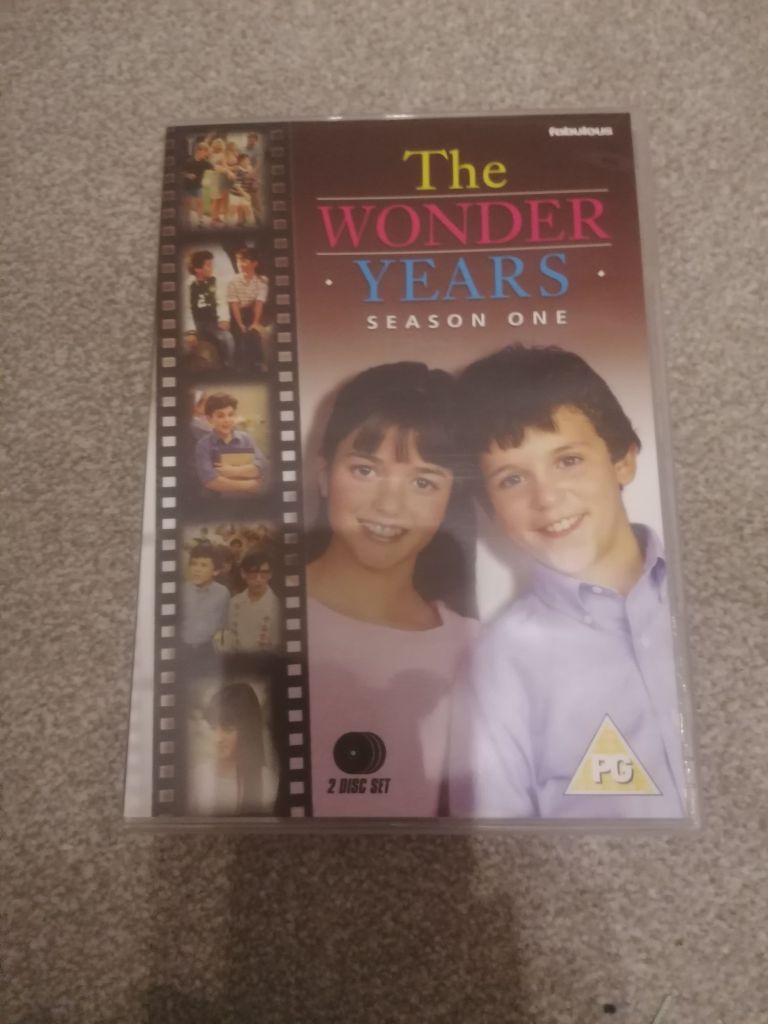
Season 1 Episode 1 Pilot
Few programmes have made such a strong start in their first 25 minutes. Pretty much everything that made The Wonder Years one of the best TV programmes of all time is on display here. Fred Savage plays Kevin Arnold with a freshness and truthfulness that shines through as something incredibly special, and never really matched, over 30 years later. His onscreen family are believable from the first few frames as the story sketches in their characters with a minimum of fuss. Wayne, Kevin’s older brother, played by Jason Hervey, is every inch the obnoxious sibling that many people will have experienced growing up. His efforts to get under Kevin’s skin are all too successful, especially when Winnie Cooper is concerned. Winnie herself, played by Danica McKellar, is every boyhood crush brought to life. In the pilot episode, she goes from gawky neighbourhood playmate and elementary school classmate to the object of Kevin’s affections. That this is only brought about by a change from glasses to contacts and pigtails to long hair flowing down Winnie’s back, reflects the superficial nature of young boys. She is still the same person she ever was, and she is still the friend and confidante he needs. Kevin’s sister Karen, the excellent Olivia D’Abo simply exemplifies the hippy tendency of the time. What is great, however, is that it isn’t a caricature of the movement, but a reflection of the times that she lived in and played with absolute sincerity. Kevin’s parents, Norma and Jack are experienced stage and screen actors, Alley Mills and Dan Lauria. The stressed out Jack is constantly on edge, but Norma is always there to keep the peace, though she does so subtly enough to influence his mood, and the family dynamic, to its best advantage. The final member of the regular cast is Kevin’s best friend Paul Pfeiffer, Josh Saviano, who has complete loyalty to Kevin, and who, despite being allergic to pretty much everything, has an inner strength and insight that is often crucial. Finally, the narration of Daniel Stern has the right balance of perception, humour and emotion as he reflects on his 12 year old self.
The first episode evokes the suburban surroundings, their safety, familiarity and restrictive nature effectively sketched out in the opening few minutes via the narration and the sheer ordinariness of the times. One of the strengths of The Wonder Years was its sense of time, and in the pilot episode, this is tied to two things, one central to the story and the other incidental but very effective. The first is Vietnam, the war famously fought on television, which invades their kitchen diners and living rooms every night. This is a faraway war at the start, but it comes much closer to home when Winnie’s brother, Brian, is sent to Vietnam. The second is the name of Kevin’s new Junior High School, renamed Robert F Kennedy Junior High School. Kennedy had been assassinated in June 1968, his death coming when he was in with an excellent chance of becoming the Democrat nominee for that year’s Presidential Election. Like his brother’s assassination it led to thoughts of the different path that America could have taken, and the renaming of the school seems completely in keeping with the prevailing mood in 1968. The way that the seemingly disparate storylines of Kevin’s crush, his school, his brother’s bullying and the Vietnam War converge is an early sign of the way that this series would refuse to pull its punches. Suffice to say, that the final scene with Kevin and Winnie is quite simply the perfect end to a fantastic first episode.
Season 1 Episode 2 Swingers
Still struggling with the events of the previous episode, Kevin is uncertain how to act around Winnie although he gets advice from an unexpected source. The main focus of the episode is, as the title alludes to, the forbidden pleasures of sex. Although Kevin and Paul are excited by their first sex education lesson, taught by Coach Cutlip, it turns out to be a complete let down. For fans of the series, Robert Picardo’s hilarious portrayal of the borderline insane Coach Cutlip seemed absolutely integral to the goings on at Robert F Kennedy Junior High, so it comes as a surprise that he only appears in 15 episodes across the entire series. The sex education talk is one of his absolute highlights as he draws female reproductive organs, and then a whole woman, in his own inimitable style! Feeling unsatisfied by this introduction, Kevin and Paul decide to buy a copy of Everything You Ever Wanted to Know About Sex. Unfortunately for them, their intended reading session is interrupted by Wayne and then Norma, leading to an unexpected revelation!
Season 1 Episode 3 My Father’s Office
This episode is absolutely pivotal to the series, as it’s the first step in making Jack the fully rounded character he was rather than the remote, somewhat frightening, head of the family of Kevin’s memories. It was also pivotal to me starting to understand my own father, as it was the episode that really cemented the programme in the affections of both of us. From this episode onwards, my Dad and I used to ring one another without fail every Sunday after the episodes were transmitted to discuss what we thought of them. Kevin realises that he doesn’t have a clue what Jack’s job is, and what he does all day at work, so Jack tells him to come to work with him the next day, instead of going to school, so he can see for himself. To see Jack in his work surroundings was to give Kevin and myself a fresh insight into the way that a job can influence everything else whether we like it or not. Kevin learns what his Dad’s dream was when he was Kevin’s age, and we see the way that his and Jack’s feelings are changed in an instant by an appalling piece of management from Jack’s superior. It’s no wonder Jack is always in such a bad mood after work. It is a beautifully written character study that lifts an already excellent first season to an entirely new level.
Season 1 Episode 4 Angel
Karen takes centre stage for this episode which looks at the relationship between her and her parents, particularly Jack. From being his angel, she is now a source of confusion and irritation as he tries to keep up with the way that the new generation are turning away from the certainties of his generation. The catalyst for the conflict that occurs is a fellow student called Louis, played by John Corbett, later Aidan in Sex and the City and the sequel Just Like That, who is older and more experienced than her. Kevin doesn’t like him because he has the suspicion that he is heavily involved with another female student. There is a fantasy scene, something that would become something of a series trademark, of Kevin beating Louis in a fight, but given the difference in age and physique, Kevin has to content himself with glaring at his sister’s boyfriend! The real fireworks occur at dinner that night when Louis challenges all of Jack’s views and mentions the futility of the Vietnam War. This is too much for Jack, a Korean veteran. When you watch this scene it’s important to realise that Dan Lauria was a Vietnam veteran himself, and I wonder if like me you’ll decide that Jack the character has given way to Dan the actor?
Season 1 Episode 5 The Phone Call
This episode is a fantastically observed reflection on the rite of passage of the first phone call to someone you really like. Kevin suddenly realises that he fancies Lisa Berlini when they are in class watching the launch of Apollo 8, an event that happened on December 21, 1968. Now, if the timeline is correct from then on, school doesn’t break up until December 23, which seems rather late, but that’s a minor point. He wants to find out if he has a chance with Lisa so he asks Paul to ask one of Lisa’s friends in the dining hall. The chain of events from then on is very funny and absolutely believable. Kevin eventually realises that there’s only one way to find out for sure, but does he have the nerve to make that phone call?
Season 1 Episode 6 Dance With Me
The final episode of this shortened season revolves around that other rite of passage, the school dance. Kevin, now firmly settled in as Lisa’s admirer, decides to strike while the iron is hot and ask her to the school dance. She says yes, then changes her mind almost immediately as Brad Gaines, a more sought after date than Kevin, asks her. It is an episode that sets up Season 2 very well, as the scales finally fall from Kevin’s eyes and he realises that his feelings for Winnie run far deeper than he realised. He then decides to ask Winnie out instead. The trouble is that Winnie has been asked out by an eighth grader, a whole year older than Kevin himself, and she has already said yes. Unlike Lisa, she is not going to let down her original date. Will Kevin find another date for himself? Will Paul ask out Carla Healy, even if the very mention of her name triggers his allergies and makes him sneeze?! It’s an episode that answers some questions and leaves others for later, and the perfect ending to this extremely effective first season.
Final Thoughts
Given that I haven’t seen these episodes in over 30 years, it’s amazing how well I remembered them. They were an extremely strong start to a programme that would become better and better as Kevin, Winnie and Paul made their way through Junior High. It’s a programme that reminds you of your own childhood, however long ago it was, and it never fails to hit the right note emotionally speaking. Speaking of the right notes, the music never fails to evoke that sense of time and place. It is a character in its own right and from songs of the counter culture like Turn, Turn, Turn and For What It’s Worth to The Monkees I’m a Believer and Born to be Wild by Steppenwolf. For those who were around at the time, the different pieces of music will remind them of their own childhood like nothing else. I hope you enjoyed this first post about my favourite television series. Look out for more from The Wonder Years very soon.
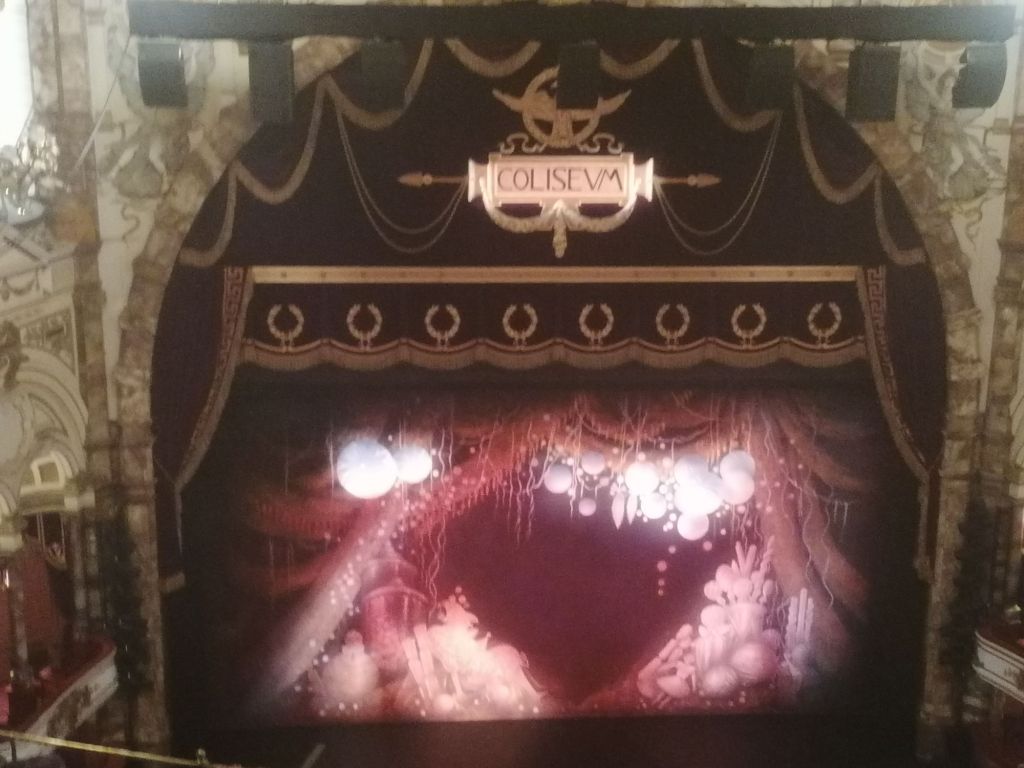
It had been the best part of a decade since I last went to a performance of The Nutcracker, and it was with an air of expectation that I went, with my wife, daughter and my daughter’s boyfriend, to the Coliseum on a windy Tuesday evening. The Nutcracker is the ballet equivalent of a pantomime, in that it is a guaranteed seat filler, and the first time many children are introduced to the magic of the theatre. However, unlike the pantomimes, The Nutcracker also introduces them to classical music, and, particularly on hearing Tchaikovsky’s marvellous score for the first time, the love for this form of music can take hold at an impressionable age. So, what will the younger theatre goers be treated to when they see The Nutcracker at The Coliseum.
The Theatre
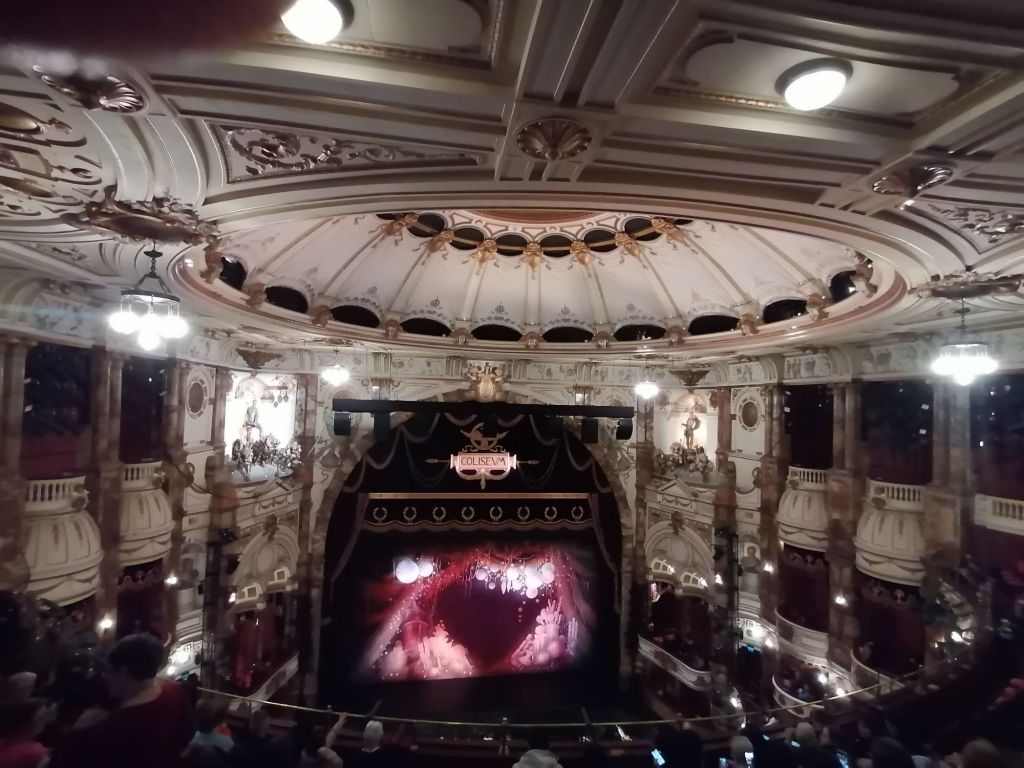
It is important to have the best possible setting for The Nutcracker, and in the London Coliseum it has just that. The Edwardian grandeur of Frank Matcham’s original design was matched by the acoustic qualities for which older theatres are justly famous. In the 120 years since it opened in 1904, as a variety theatre, it has been used for a number of purposes, but today it is most famous as the home of the English National Opera and the English National Ballet. With nearly 2500 seats, it is the biggest theatre in London, and The Nutcracker regularly fills all of them. We were up in the balcony, a couple of rows from the back but we still had a fantastic view of the stage and the music was crystal clear throughout. Given the situation in many other theatres where you have at least a slightly restricted view, this is something I always value when I come to the Coliseum. The ability to watch the action unfold with no barriers in your line of sight is another element of this production that makes it perfect as an introduction to live theatre.
The Staging
The ballet was simply sumptuous to look at with a staging that made use of every inch of London’s biggest stage. From a skating rink in the opening scenes to a huge ballroom it awed the audience at every turn. Smaller sets like Clara’s bedroom were masterpieces of space utilisation and they provided an intimacy that drew the audience into the scenes. The snowy effects were magical and the lighting faultless. Sometimes, we take the staging for granted in a theatre production, but the behind the scenes work made the overall look of the ballet a character in its own right. I have never seen a production so full of magic before.
The Music
Many writers have examined Tchaikovsky’s score in great depth and in exhaustive detail. If you want to know more about the score in technical terms there are far better guides than me. However, as a music lover, I can say that it has every single element you could wish for in an evening’s music. For a start, even though it had been so long since I saw it, I was amazed at how much of the score I recognised within a few notes in the first act. It is from memory my sixth or seventh visit to this ballet, but the way I could recall the less instantly familiar parts of the score was still a very nice surprise. The second act has the familiar show stoppers, with the Trepak Russian Dance, Waltz of the Flowers and Dance of the Sugar Plum Fairy being the most recognisable. However, for people of a certain age, the Danse des Mirlitons is the one apt to take us back to our childhoods. I can guarantee that it isn’t just me who was hearing Frank Muir’s voice in my head as he told us that ‘Everyone’s a Fruit and Nut Case’!
The English National Ballet Philharmonic orchestra were incredible, and underlined the importance of live music in a production such as this. These consummate professionals were a huge part in making the show as successful as it was. The harps in The Waltz of the Flowers were almost otherworldly in their beauty, as were the flutes in the Danse des Mirlitons. Although these two passages were fine examples of the orchestral excellence on display, each section shone in their individual parts and gave others the chance to shine in theirs. The enthusiasm and the freshness they brought to the score made me feel like I was hearing it for the first time, familiar though it was.
The Cast

As with any ballet, or indeed any stage production, the success of the evening lies with the cast. However great the source material is, a cast who don’t quite hit the heights can reduce the enjoyment of any play, musical or ballet. Fortunately, in the case of The Nutcracker, the cast did indeed hit the heights. The dancing was uniformly excellent throughout. The company were faultless, at least to my largely untrained eye, with crowd scenes showing an amazing tightness of choreography as they navigated the stage area with absolute precision. The principals and soloists were fantastic, with Shiori Kase as Clara and Erik Woolhouse as Drosselmeyer’s Nephew bringing an energy to the Pas de Deux that made it electrifying. Alexander Nuttall made the Mouse King very scary at times with the energy of his dancing and the force of his personality. Victor Prigent’s Nutcracker was a worthy adversary and an excellent foil for Nuttall in their demanding dances together, and you could see why Clara would fall for this uniformed paragon. Precious Adams was superb as the Mirliton with her solo particularly entrancing the audience. Henry Dowden’s Drosselmeyer was bursting with energy and magic throughout, as he brought a flair to the part that made it his own.
For me, however, it was one of the younger members of the cast who stole the show. The Tring Park School for the Performing Arts provided the young members of the company who excelled in technical terms as they brought real verve to their dances. The young Clara, played by Beatrice Lewis-Verebelyi gave the young girls in the audience a glimpse into what is possible on the ballet stage, even at such a young age. As well as being a superb dancer, as you would expect, her acting skills gave Clara a personality and a presence that I don’t recall having seen before in that part. She really showed every sign of being a star of the future. Her fellow Tring Park dancer, Ethan Galeotti, was the perfect foil, bringing a rumbustiousness to Clara’s brother, Freddie, that made him instantly stand out, but also showing a more sensitive side as well.
Final Thoughts
My daughter’s boyfriend came to The Nutcracker, having never been to a ballet before. I was a similar age to him when I saw my first ballet, A Christmas Carol by the Northern Ballet. It was my abiding affection for the Dickens classic which was instrumental in introducing me to ballet as an art form and a spectacle. Now, looking around me last night, I did not see more than a handful of boys in the Coliseum, but I saw a large number of girls eagerly awaiting their introduction to the magic of dance. I would love to see ballet as an art form for both boys and girls to watch and participate in. However, socially there is a lot of work to do while boys are seen as ‘weird’ by friends, and occasionally family, for wanting to dance. The male dancers of all ages in the production confirmed that ballet is a career open to everyone, but until we accept that boys can dance just as much as girls can play football, cricket or rugby, it will remain a cultural outlet that is closed to boys. In the last 20 years or so, we have accepted the idea of girls playing football to such an extent that they are now just as encouraged to aim for the top as any boy. Wouldn’t it be marvellous if we could turn our attention to ballet and aim for the same situation in reverse? There are obviously examples of good practice in terms of this equality across the country, but it is far from widespread as far as I can tell. It would be fantastic to see dance classes in years to come having a good mix of boys and girls, providing ballet and other forms with a far deeper and wider pool of talent for the future.
 David Pearce - Popular Culture and Personal Passions