
What are you most excited about for the future?
For me, the future started on June 20 2025. That was the day I packed away my last few items from my desk, took a bag of presents and left my job of seven and a half years. It was the longest time I had spent in any job, it was the 34th year of teaching and the end of year round full time teaching. A week later I started a 9 week Pre-Sessional course so I definitely haven’t finished with the profession, but I have finished with commuting day after day. So, as I said in the title, what’s next? Well, to find out who I am as David and not to define myself by my job. I want to explore my fascination with the academic discipline of Popular Culture. I would love to do a PhD in the future but I am aware that it might not be possible. I will be putting together family history in various media and hopefully rekindling memories for all concerned. I will be blogging much more. I will also be fulfilling two long term dreams, walking in the stone circle of Stonehenge and going to Salzburg for the Christmas Market.
A year ago I was worrying about what was next, but now I can’t wait!


What is your favorite genre of music?
This is today’s prompt on Jetpack and I thought that it was time I answered one of these!
One of the things I have always done is ignored genres in favour of music I like, but I have found a number of common threads in my music.
My formative years
I look at my musical heartland as the 10 years from 1975 to 1984 the ages of 9 to 19. Favourite acts ranged from ABBA to The Wombles, via The Carpenters, Queen and Helen Reddy! The interesting thing was that those groups never really stuck to one genre, so perhaps that’s the reason why I didn’t. In that time Glam was on its way out, although Slade and Mud still had the odd hit, rock n roll revival courtesy of first Showaddywaddy and then Shakin Stevens brought the 50s back to the upper reaches of the charts. Punk was too early for me in 1977 (although I was a big fan of The Undertones) but I enjoy it now.
However, New Wave came in when I was 14 and hit the sweet spot. The Police were my favourite group of the early 80s and the interplay between the three members on guitar, drums and bass was astounding at least for the first three albums. Other groups in a similar genre I enjoyed were The Jam and The Boomtown Rats
The next big movement was Synth Pop. Now if I have a musical style that appeals above all else, it’s that. OMD, Depeche Mode, The Eurythmics, Heaven 17, Ultravox, Bronski Beat, the list goes on and on! Even now, there are some newer synth artists that I really enjoy like Paul K and Lines of Flight who are able to give me that same sense of enjoyment.
Around that time I also discovered rock music in all its forms. Meatloaf absolutely mesmerised me at 15. I really liked the New Wave of British Heavy Metal with groups like Judas Priest, Rainbow and Iron Maiden. The 80s bands like Europe, Def Leppard and Bon Jovi were lumped together under the disparaging title of Hair Metal by the critics but they were often hogging my turntable.
Bringing things up to date I love the female artists of today like Taylor Swift, Sabrina Carpenter, Zoe Wees, The Last Dinner Party and Wet Leg. They are lyrically brilliant, engaging, frequently very funny and they put their feelings on show with no hesitation. I think that last quality in particular so important for their fan base who have so many messages and distractions and sometimes find it so difficult to deal with the barrage. These young women are the role models of today and music fans of any age are lucky to have them.
So there you have it, there are so many different musical genres and influences running through my head and I can listen to any of them, and any that don’t appear in those genres. Just as one final indicator of what I love and have loved over the years here is the choice I made for my decade of 1975 to 1984.
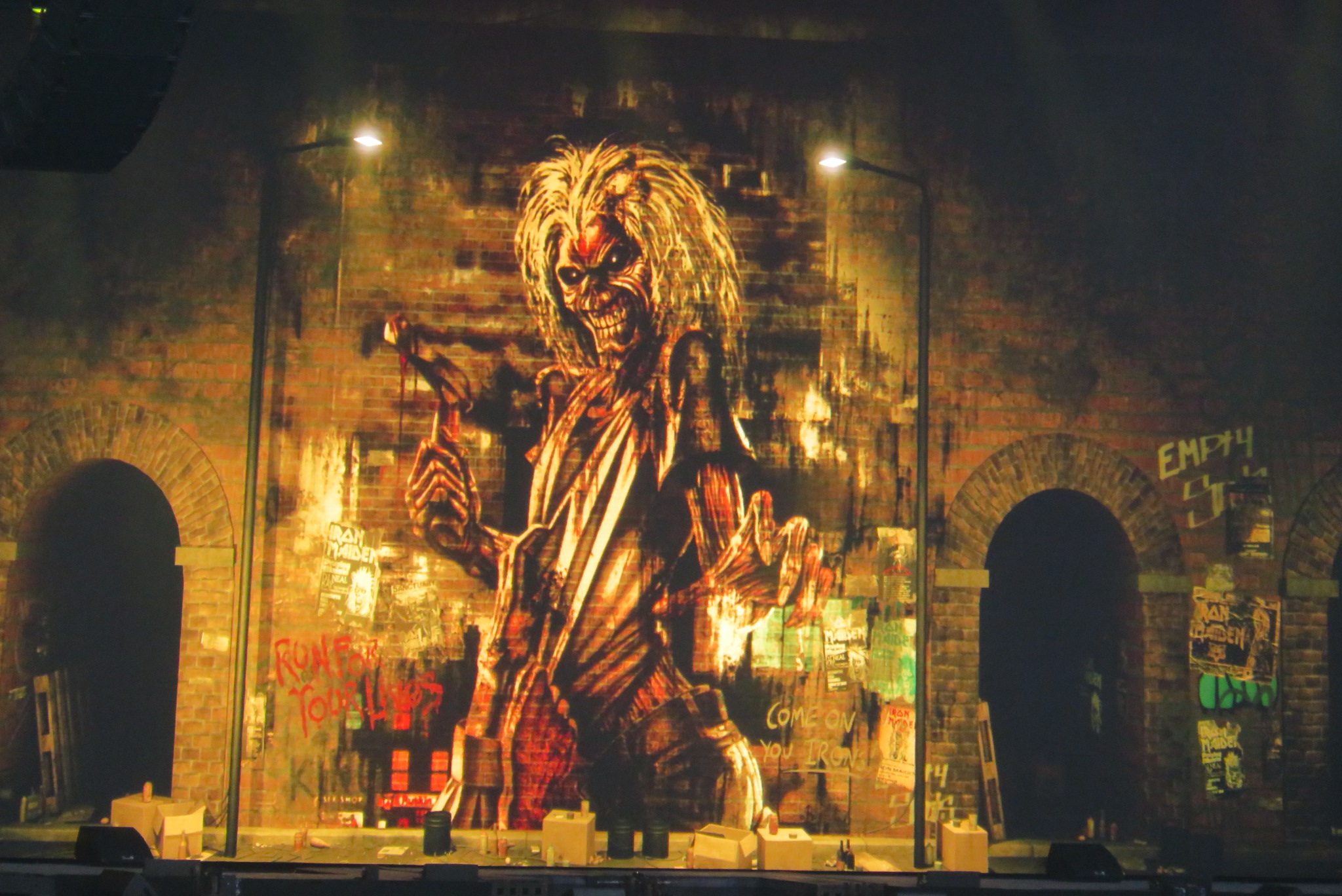
Iron Maiden, Halestorm and The Raven Age at London Stadium June 28 2025
One thing was sure, even before any music was played. This would be the hottest gig I had ever attended, temperature wise! Whether it would live up to that billing in terms of music, well that remained to be seen. Before I start the review I just have to give a shout out to the brilliant security and gate staff who were just as warm as anyone else, but did their jobs quickly, efficiently and with smiles on their faces. They made what could have been a difficult time in the excess heat far easier. Now, the gig itself started at 5.45 and lasted until 10.20 so it was a long haul, but the quality of music kept us so enthralled that it was only during the breaks that we realised we were actually melting!
The Raven Age

When The Raven Age started their set I would say that the stadium was half full, but those who decided to turn up later in the day missed a cracking set. I had listened to them before the concert to get familiar with their style, but, as with a number of bands particularly in the rock or metal genre, to really understand how good they are you have to see them live. The Raven Age are Matt James, the lead singer, George Harris and Robbie Gentry, the guitarists, Matt Cox on bass and Jai Patel on drums. Their seven song set was really high quality throughout, showing the tightness that the band, who have been going since 2009, have developed. James’ vocals soared and swooped throughout, especially on the tracks Hangman, Serpents Tongue and Fleur De Lis, which were standouts in a really good set. They were no doubt familiar to many of the standing audience, with The Raven Age having supported Iron Maiden before, which added to the atmosphere as they were already very well disposed to them. For someone completely unfamiliar with them, the set made me want to hear more of them especially live. They had a huge sound that was heavier than the records and I really enjoyed the guitar solos and the interplay between Harris and Gentry who have a fantastic understanding that gives their sound a real quality. The engine room of any rock band are the bass and drums who lay the foundations for the rest of the group to build on and Cox and Patel were absolutely top class. The audience had really warmed up, metaphorically and figuratively speaking by the end of their excellent set. The Raven Age are definitely good enough to be headliners in their own right, so if you have a chance to see them touring I urge you to take it.
Halestorm

I turned out to be the only person in our quintet of metal fans who hadn’t really listened to much Halestorm. My daughter in particular was a huge fan of theirs during her teens and was really looking forward to seeing them. Halestorm are a four piece band with vocalist and guitarist Lzzy Hale, drummer and younger brother Arejay Hale, guitarist Joe Hottinger and bassist Josh Smith. They have been touring together for 20 years and it really shows. The music just explodes out of the speakers with Arejay Hale leading the way. He is one of the finest drummers I have ever seen live and his drum solo was so epic it left everyone in awe. He had a massive drumkit that he pounded into submission for five exhilarating minutes and towards the end he swapped his normal sized drumsticks for two that resembled baseball bats in size and then proceeded to play the drums just as intricately. It was an absolute tour de force. Smith was the perfect foil to his showier counterpart, giving his bass a real workout and laying the basis for the tracks. Hottinger and Lzzy Hale matched each other on the guitars as they ramped up the sound and the pace and showed the fruits of playing around 200 shows a year, according to the internet. This leaves one question. How the hell does Lzzy Hale do it?! Her voice is the most astonishing instrument you can imagine. It has an upper register that few can match, a growl that shakes the stadium and a scream that has to be experienced to be believed. What an incredible singer! I have never heard anyone like her in 4 decades of gig going, and I sat there in awe for 45 minutes just thinking how lucky I was to hear her live in a venue like the London Stadium. I can only wonder at the strength, stamina and vocal training that goes into maintaining her voice at that level. All the songs were top class, but the standouts were the opener Fallen Star, Love Bites (So Do I!), I Get Off and the finale from August’s new album, the title track Everest. I have become an instant fan and I know at least three of our party are now looking at the possibility of going to the O2 in November to see them as headliners, and a whole 90 minutes plus of Lzzy Hale and Halestorm will be worth it for any self respecting rock fan.
Iron Maiden
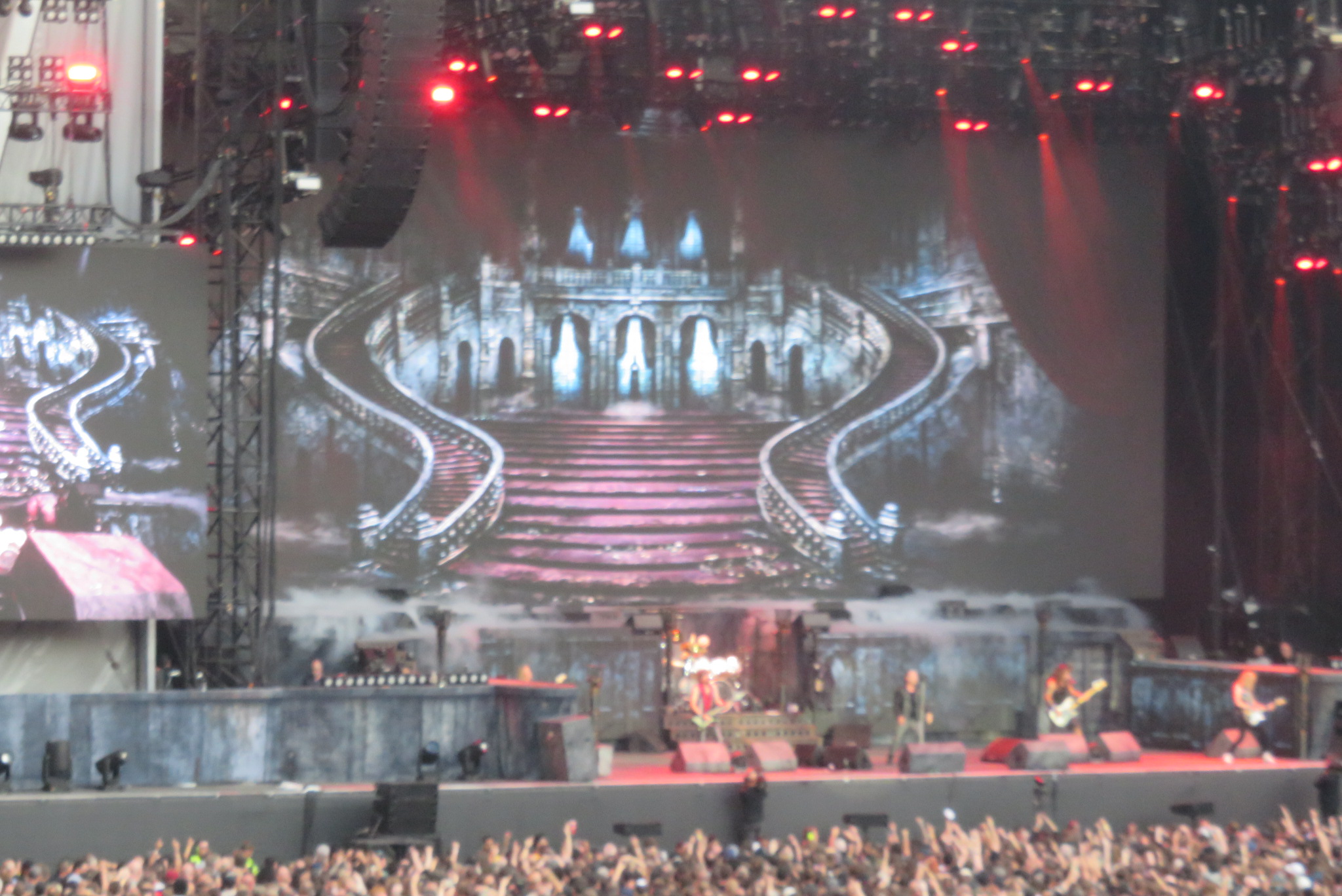
Now for the main event after two amazing support acts it was the turn of Iron Maiden. They have been top of the bill for five decades and I was about to find out why. What was really interesting looking back at the setlist was the number of album tracks that there were. Probably two thirds of the set would have been unfamiliar to the more casual fan, and I would have to include myself on that list in terms of these songs, but what an education it was. The opening four tracks, if you include the recorded instrumental version of The Ides of March, came from Killers, their second album, which I had not listened to. That didn’t matter because I was instantly won over by Murders in the Rue Morgue, Wrathchild and Killers, the latter of those which I did actually recognise. One of the hardcore fans in front of me was in increasing disbelief as they played those three tracks, but given that the first and last were getting their first airing on tour for 26 years and 20 years respectively and even Wrathchild hadn’t been played since 2017. I have some catching up to do!
The line up for tonight was Bruce Dickinson, their vocalist since 1982, one of the most legendary performers in British musical history. Bass player Steve Harris was the founder of the group in 1975, and on Saturday he realised one of his few remaining ambitions, playing at the home of his beloved West Ham. Their three guitarists Dave Murray, Adrian Smith and Janick Gers have been playing together for the whole second half of the band’s history. The drummer, Simon Dawson, was the one new boy in the six piece line up, having taken over as tour drummer from Nicko McBrain after the last tour. It was clearly a good replacement because he fitted in as if he had been there for years and gave the band a fantastic base to work from.
My favourite Iron Maiden album is Number of the Beast and there were three tracks from it, the title track, Hallowed Be Thy Name and Run to the Hills. The latter is my favourite single of theirs and my favourite heavy metal track of all. The performance just took me back to the first time I ever heard it. Dickinson’s voice was powerful throughout the night and had a real depth to it and on Run to the Hills in particular he gave a performance that was awe inspiring. After hearing the four tracks from Powerslave I realised that this was a close second with two great singles, the title track itself and the incredible 13 plus minute epic of Rime of the Ancient Mariner. That track was perhaps the best showcase for the way that Dickinson’s voice has matured like a fine claret as he completely inhabited the story and gave such an intense reading of it that it almost certainly won’t be another 15 years before it is revived. Funnily enough, a number of clues in the Telegraph Cryptic Crossword on Saturday morning referenced Rime of the Ancient Mariner, so I wonder if he or she might have been in the crowd! There were two tracks from Seventh Son of a Seventh Son, the title track, another mesmerising epic clocking in at ten minutes, and The Clairvoyant. Can I Play With Madness comes from that album, and is one of their most recognisable singles, having reached Number 3 in the UK charts, but it didn’t make the cut, which is testament to the embarrassment of riches that they had in their first decade. Their only Number 1 Bring Your Daughter to the Slaughter was on Prayer for the Dying, the only album from their first nine that did not feature at all. Mind you, the British public have not always been the best arbiters of quality have they? The quality throughout the night, both of the performances and the songs themselves, never dipped as they confirmed that they have the finest discography of any group from the metal genre. The final four tracks were probably the encapsulation of this.
The final track before the encore was Iron Maiden, their second song from their self titled debut album, and it hits just as hard 45 years on. The encore itself started with Churchill’s Fight Them on the Beaches speech which of course led straight into Aces High, my son’s favourite Iron Maiden track. It is a tour de force that really shows the quality of their writing as it replicates the timing of a dogfight in the way that it is structured. I don’t think any other group would even think about trying it, let alone nailing it. Next is the haunting Fear of the Dark which has the crowd chanting along in one of the most effective moments of the entire night. The beauty and the darkness of the song is truly magical and I thought that was going to be the last song of the night, but they had one final treat in store. Wasted Years from Somewhere in Time brought the night to a close with a wall of sound from a group not in the first flush of youth, but one that seems to have made a pact with the devil to display youthful energy every time they step on the stage. Dickinson then promises the crowd that ‘Like James Bond we will return’! They aren’t done yet, and with what they showed on Saturday night, why the hell would they stop doing what they are so good at? Their performance didn’t just live up to my expectations, it left those expectations in the dust as I watched live geniuses at work. Thank you Iron Maiden, Halestorm and The Raven Age for one of the best gigs ever.
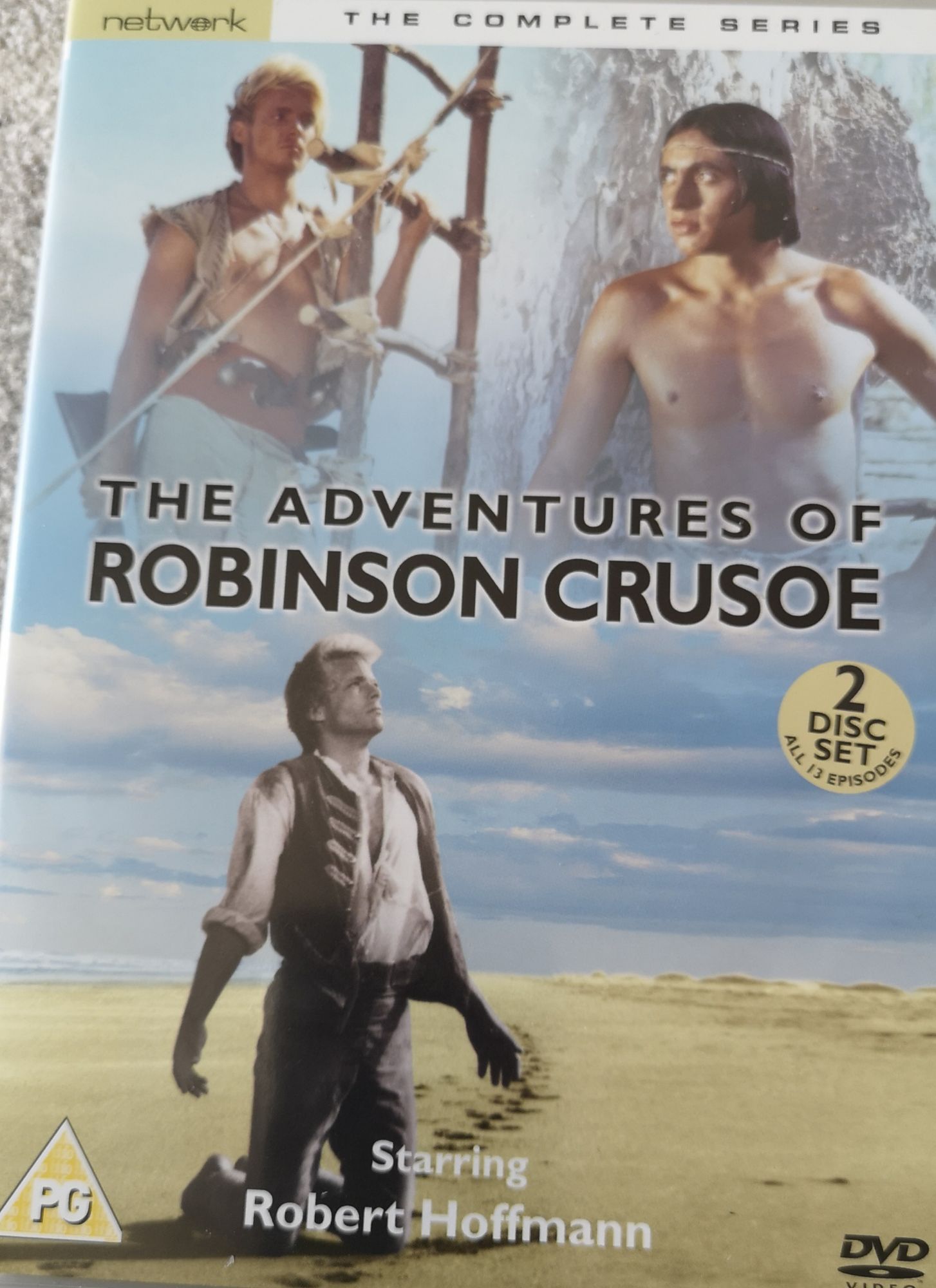
So here are the final five parts but I will start this final section with my favourite Robinson Crusoe joke.
Why did Robinson Crusoe have every weekend off? Because his work was always done by Friday!
Now, you may have noticed that this particular character has not appeared yet. It turns out that he was very much a latecomer to the scene. I can guarantee he plays a significant part in the rest of the story.
Episode Nine opens up with the aftermath of the shipwreck of what turned out to be a pirate ship as Robinson Crusoe has brought a lot of the supplies onto the island. Suddenly, it’s three years since he was shipwrecked and he has a party for himself and his companions after thanking God for his blessings. It’s really interesting to hear that being a central plot point, but with it being so faithful to the original early 18th Century novel, that probably shouldn’t be surprising. I love the different animals and the parrot sitting around the table all being on their best behaviour! After having finished off two flasks of rum, Crusoe bemoans the fact that they left him so little, so he runs down to the beach and sets off for the pirate ship in search of more. He is drunk and the voiceover makes this very clear! Back on the pirate ship he falls asleep in a drunken stupor, waking up to the sound of singing sea shanties, which he presumes is in his imagination, before finding more rum and having a hair of the dog! He playfully spins the wheel of the ship and then falls asleep again. When he comes to he realises that he is drifting out to sea and he can no longer see the island. The ship’s wheel is now stuck and there is nothing left on board the ship as he has taken it all off and transported it to the island. Is he ever going to get back? What will happen to the dog, the parrot and the goats? I can imagine being really worried as a child, as I am concerned as an adult! It’s a measure of how well the story and the adaptation have drawn me in. His ship runs aground on an unfamiliar stretch of coastline and he decides to take his chances with the land. The first living thing he sees is his dog! He turns out to be back on his island much to his, and my, relief. However, he finds unfamiliar footprints which tempers his joy at being back. Who is the intruder? Is he still on the island? It has taken a very unsettling turn as Crusoe starts to fear his own shadow. To keep the parrot quiet, because he is afraid that the bird will bring the intruder to his cave, he throws a sheet over it which seems to work. He finds himself nursing his first illness in three years and decides that inhaling the fumes from a bowl of tobacco will be the perfect cure! His goats are bleating with pain from not being milked and he has succumbed to exhaustion. When he wakes up he has got rid of the fever, no doubt because of the tobacco. Suddenly he sees a skull and realises that there are cannibals on his island!
The next episode sees Crusoe on guard and he sees the cannibals leaving, whereupon he makes plans to frighten them so much that they will never come back. So, he invents a weapon that means a number of muskets can be fired at once and booby traps the place where he has seen the fire they have lit with a barrel of gunpowder. The cannibals will believe that there are supernatural forces at play because, of course, all non English races are superstitious. When they do return it is surprisingly tense. The cannibals see a lone prisoner escape and two follow them. Crusoe kills one, terrifies the other and then the fire explodes accompanied by a volley of gunfire. The savages turn tail and run to their boats apart from two cannibals, including the one who he terrified earlier. One is shot but the other attacks Crusoe and starts to strangle him. Luckily, the grateful prisoner kills the assailant and Crusoe uses the knife to cut the binds around his wrist. The two then set about burying them. Robinson Crusoe calls his new companion Friday, and calls himself Master, because of course he would having been born an Englishman! His dog does not like Friday initially, but is calmed somewhat with food. Crusoe makes Friday sleep outside the cave and binds his wrists once again in case he ‘wakes up feeling hungry’ as he is a cannibal! There is a real feel of the slavery storyline coming back with Crusoe as the slave owner this time, with his added role of civilising this savage, which to modern audiences may be somewhat troubling, but which to 60s and 70s kids was quite natural. The story has suddenly gone into overdrive in Episode Ten after meandering through nine episodes!
Episode 11, and it isn’t clear where the story is going to go yet in these last three instalments. So lets settle in for the ride during this last hour of the story. Now, it’s clear that Friday has to be civilised to enable Crusoe to feel like he has done his job, but how is he going to do this? Well, Friday learns to bring him his breakfast on his first morning, although it’s not explained how. Crusoe tells us that he is showing Friday how the gun works so he can be impressed by how powerful and superior his Master is. He then starts to teach Friday to count and how to say specific words like milk. It’s a fascinating glimpse into the way that people thought about those from different countries, especially those with different skin tones, as people with no sense or intelligence. The whole section dealing with his education makes it clear what was at the heart of slavery, as the trade in people could not be acceptable unless those being traded were inferior. He teaches Friday to use a gun as that is civilised and a bow and arrow are not! Naturally, the use of birds as target practice is a clear indicator of civilisation. Friday then runs amok with the rifle and proves very civilised! Friday suddenly seems to learn the intricacies of English to the extent that they can have philosophical discussions. Robinson Crusoe then introduces Friday to God. It is quite a leap from where they started the episode, that’s for sure!
The penultimate episode starts with Crusoe searching for Friday who he fears has left him after an argument. Apparently he has been living on the island for five years, four years on his own and one year with Friday. Friday has gone to ground but not left the island, as a series of gifts for Crusoe proves, but why is he continuing to hide? Then we find out that his faithful dog is dying in scenes that will have upset even the most hardy of 60s and 70s children. It’s upsetting even now. Friday returns and the two men simply look at each other, and they go together to bury his faithful canine companion. Now, Crusoe sees him as an equal rather than a slave although the reason isn’t exactly made clear. Later in this episode Crusoe has lost track of time, grown a beard and become a joint ruler of his domain. He doesn’t ever want to leave. Suddenly he sees a ship and he is ready to leave with Friday, but when the men come ashore in a small boat he keeps out of sight just in case. It turns out that the men are murderers and pirates, so it’s just as well. Then, his parrot starts talking and the pirate draws his gun. Is the parrot about to squawk his last? Crusoe rescues his bird by tripping up the head pirate, but he and Friday’s days seem to be numbered. Another boat comes ashore. Surely this is it for our heroes?
The final episode opens with a game of hunter and hunted, but which is which? The pirate captain creeps up behind Robinson Crusoe and knocks him out with the butt of his pistol. Friday finds the canoe the latest set of pirates came ashore in and hides in it. Crusoe is a captive at the whim of the pirate captain but he tries to lead him on a wild goose chase in search of water. Friday is found by a pirate but pretends not to understand him so that he can find out what is happening with the pirates. It’s all very confusing! Then, all seems lost as the pirates find his cave and his treasure. Luckily, greed makes them fight and under cover of the confusion Friday escapes. Crusoe tells the captain that he knows of a native village on the other side of the island with even more treasure and luckily the captain is foolish enough to fall for it. Friday then picks the pirates off one by one from hiding. When the captain is killed things become more confusing still for the pirates as they have no leader, no plan and no sense of companionship. Robinson Crusoe and Friday now have the upper hand. It’s quite the body count in this last episode! Crusoe captures a pirate who agrees to help in return for his life. The last two pirates try to escape with the treasure chest in their canoe but Friday sinks the canoe by making holes in the bottom with his knife. The treasure has gone but so have the pirates. Friday makes his way to the pirate ship, ambushes those left on board and raises the White Ensign! They are on their way back to freedom, but Robinson Crusoe reflects on his luck at being changed for the better by his captivity on the island. We now see the two of them back in England with Friday now speaking RP and writing the story in front of a roaring fire.
Well there you go. They certainly don’t make them like that anymore. Yes, there were elements that are jarring to modern eyes, but the way that the story gripped me proves that good television is good television from whatever era it comes. Tales of shipwrecks and desert islands have been replaced for now, but if you ever want to go back to them they will always be there. I hope you enjoyed this revisit and that you will join me for more blasts from the past in the months ahead.
So, after the first four episodes saw our hero settle in to life on his desert island, we see what the next four have in store from him. Here is the TV listing for the morning of Tuesday August 19, 1975 when Episode 5 was broadcast.

I don’t think I would have moved from 10:00 – 1:45!
Episodes 5 – 8
The fifth episode opens up with Crusoe having been on the island for over a month, and now constructing a wall and a terrace for his cave. He even makes his own furniture, though not with great success as he reflects. Yet again, the slow pace and regular silences show how different programmes for children were all those years ago. There is a very interesting insight into his thoughts at his enforced isolation, and the viewer is invited to empathise with his situation without it being made into a big emotional set piece. I wonder how that would go with younger generations. The scenes when he is at sea are fascinating as you watch an old sailing ship being made ready to sail and then his increasing fascination with the way that the sextant and other navigational aids. He has several run ins with the second mate, Blake who dislikes him on sight and revels in his ability to bully him. When Crusoe and some of the sailors row ashore for fresh water they find slave traders in wait and he and another sailor are captured. He tries to escape but his efforts are in vain. There is a large scale action sequence as the slavers rush to try to capture more sailors. The others escape and decide to tell the others on board that Crusoe had been killed. Blake can’t hide his satisfaction at the ‘death’ of his disliked crewmate, and Crusoe has to endure the cruelty of the ‘barbarians’ who act in a way that they are expected to at least in terms of the storytelling of the time. There are Bedouin tents, Emirs with evil expressions, concubines and camels! Back on the island he constructs a goat trap to ensure a regular supply of milk and he keeps a fire going to advertise his existence on the island.
At the start of episode six our castaway is starting to find life ever more difficult as a result of the isolation. He is certain he sees a ship, but it turns out to be an hallucination. He wonders if he is succumbing to madness, and sets about yet more work to try to keep it at bay. He is determined to keep a track of the days by carving a notch for each day on a post (and a cross for Sunday) and wonders how many posts he will have by the end. Then, disaster strikes as his cave catches fire and all his furniture destroyed. Fortunately his dog and his parrot are both safe so he resolves to start again, reflecting how much worse the situation was when he was in slavery. He finds himself being exchanged by the Emir for a camel due to being so useless as a slave, then his second owner gets rid of him in exchange for a donkey and so on until after half a dozen trades he is worth just two baskets of fish! He finds himself working for a fishmonger and he plans his escape. He throws his latest cruel master into the sea and makes his escape in a small boat with very little food but a lot of his master’s gold! However, he has very little food and water and finds himself heading out to sea praying for a ship to find him. Luckily for Robinson Crusoe, and the story, he is finally discovered by a ship, who rescue him. A Portuguese ship finds him in his little rowing boat in a state of complete exhaustion and he is finally rescued. Once again attired as an Englishman should be, he uses the gold to buy a small plot of gold in Brazil, which he then exchanges for a banana plantation, and finds himself making money hand over fist. Back on the island he is rebuilding his cave and constructing a canoe to escape in.
We reach the halfway point and it’s interesting how little has actually happened to take the story forward. There has been a lot of backstory, but he has not really done anything to move on with his plans to get off of the island. Well, in this episode he has finished his massive canoe and he is preparing to leave his island. The trouble is that it is far too big and far too heavy. He cannot even get it to the water and when he realises this he despairs. He reflects once again on Brazil and his good fortune that he never really appreciated properly. He has become bored in Brazil so when he is told that there is a voyage to the coast of Guinea needed to obtain more slaves ‘at source’ he is tempted by the new adventure and accepts, leaving his plantation in the hands of three other businessmen. It is there that he first boards the Esmerelda, the boat that he would eventually be shipwrecked in. The Captain of the ship disappears without trace and there are no rats on board, a sure sign of bad luck in maritime superstition. Hit by a storm very soon after Crusoe must rally the crew to ensure their survival. Men plunge overboard or are crushed by huge spars of wood in yet another seaborne disaster. You are left wondering why he won’t take the hint! It turns out that this is the very voyage that has brought him to his island and left him a castaway. From now on the story can only move forward. However, he ensures that all the adventures are written down in the Esmerelda’s log book which has mysteriously appeared at this point in the story! He is bored and decides to get rid of a piece of rock that he keeps banging his head on. The parrot seems to realise it’s a bad idea and warns him loudly, but it’s no use, Robinson Crusoe is buried under tons of rubble.
The final episode of this quartet opens on a cliff hanger with a Doctor Who style reprise. Crusoe is buried but his dog tries to dig him out. Soon enough he is safe and he has even created a second door for the cave, so that’s fine. He discovers previously unsuspected skills for pottery, cheese making, farming and bread making. This is something of a holding episode of the types that longer series of this style used to have but none the worse for all that. By bringing the focus back completely onto the island and his increasing confidence in his own skills to thrive, not just survive. He even starts to catch fish and as a slave he learnt how to salt them, so he can build up a store of food. He has a day of rest on Sunday to respect the day of the lord, something that would have been completely understood by the children of the day. They would also, no doubt, have been expected to have understood words like idiosyncrasy from primary school onwards. What different times they were. Suddenly he hears a cannon, sees a boat, and realises that possible rescue is close at hand. He can hear a bell but no longer see the boat. Suddenly he remembers that the cannon and the bell means a ship that has the plague aboard. Undaunted, he decides to take his chances with the ship.
Next time, it’s the final five episodes, so join me to see what happens next.
 David Pearce - Popular Culture and Personal Passions