
What do you love about where you live?
Where I live is just 15 minutes away from Rochester in Kent. For any lovers of the works of Charles Dickens, it is a must visit. The shops of the old High Street are obviously different from what the great author would have been used to, but there are still some similarities in the fact that the buildings have largely survived from those days. The Royal Victoria and Bull Hotel is over 400 years old and looks little different on the outside from the time when Dickens stayed there. It was featured in the Pickwick Papers and Great Expectations. Just off of the High Street is Restoration House, the model for Satis House in Great Expectations. Dickens would also have been very familiar with the magnificent Rochester Cathedral which features in Pickwick Papers and his final unfinished novel The Mystery of Edwin Drood.
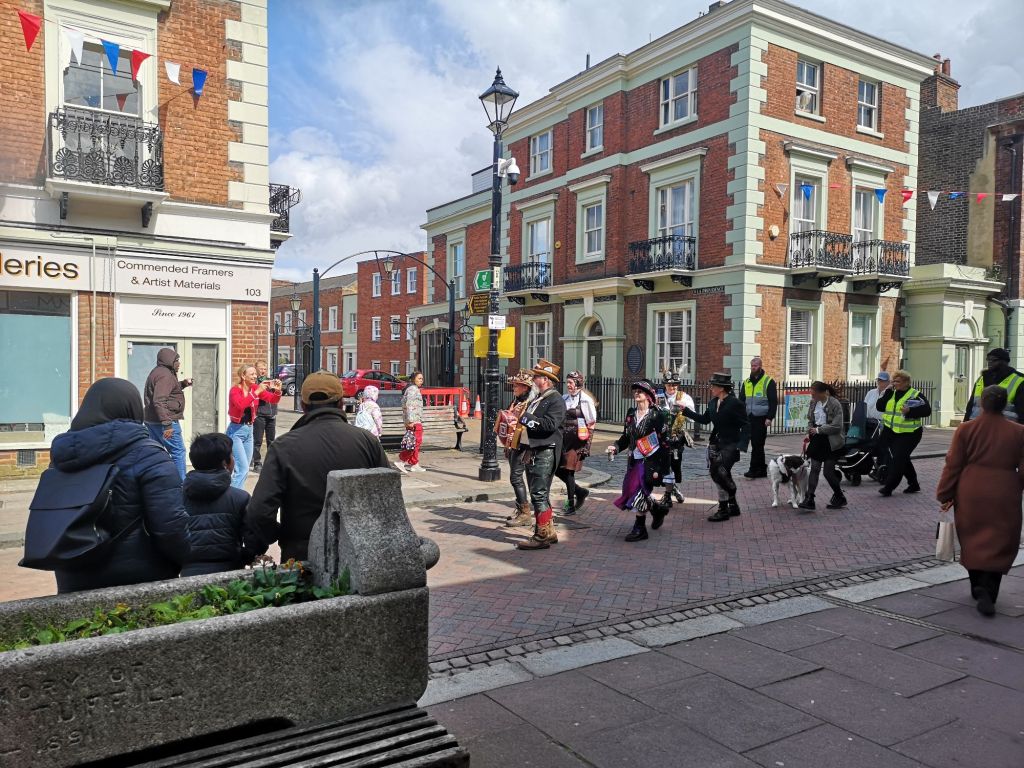
All of this history is a huge draw for tourists and locals alike, but the high point of the entire year for me is the Dickens Christmas Festival which I wrote about in the linked article back in 2022. It is scheduled to take place on the first weekend of December, whenever that is (December 6 – 7 in 2025), and I fervently hope it goes ahead as it was cancelled in 2020 due to Covid and again in 2024 due to adverse weather conditions which never materialised, and it was a massive loss to my Christmas build up each time. For me, that weekend is the start of my festive season, and if you are anywhere near Rochester on the first weekend of December this or any other year it is an absolute treat. Singing Christmas songs with the Cathedral behind you and Rochester Castle in front of you is just seasonal magic. I will be there on the Sunday and I would recommend it to anyone nearby who loves Christmas.

A Landmark Post
This is my 250th post since I restarted this blog. It was mothballed in 2011 after 6 posts where I tried, very unsuccessfully as it turn out, to publicise a book I had written and self published. I restarted it in 2021 and I have been slowly building it up ever since. A few of my posts have achieved some good numbers with Memories of Singing Together from 2023 having over 800 views, but others are stuck on two or three. David Pearce – Popular Culture and Personal Passions 2023 Highlights and Hidden Gems was written at the end of 2023 to give a push to some of my blogs from that year. Maybe I should try this again. What do you think? Although the figures will have changed the quality of the blogs haven’t so I’d love a few more reads on these posts.
What positive emotion do you feel most often?
The positive emotion I feel most often is that of pride. I have never understood why it is supposed to be a sin, whatever form it takes. I think it’s perhaps something of the hairshirt tendency of certain early religions where everything was to do with God because everything was pre-ordained. Anyway, my pride tends to be in other people’s achievements, especially where I have had a certain input.
As a teacher it is really nice to see your former students doing well. For 5 years I was teaching English to prospective Doctors at St George’s University. After that I taught students from a number of different disciplines. I follow a number of them on Instagram and they have, without exception, done incredibly well in their careers in the years since I taught them. One of my real pleasures is seeing their progress as they do so much good in their different fields. Some of them are kind enough to attribute a small measure of their success to my teaching. I definitely helped in the early days as they were getting to grips with Academic English and Academic life in general. Although I know that their success is almost entirely down to their hard work since those days, I feel proud that they have taken some of my influence into the world and worked with it.
The same goes for my children. Their successes and difficulties are theirs but I hope that the influence of myself and my wife has given them a very strong base from which to launch themselves into the world. Every one of them has given me a great feeling of pride at various times over the years and it is one of the real joys of parenthood for me. They still want to come to concerts with me which means so much as I never take it for granted. My daughters and I are going to My Chemical Romance at Wembley Stadium next July and I know it’s going to be an incredible experience.
Very occasionally I allow myself a small measure of pride in myself. I feel that some of my blog posts are as good as anything you will read anywhere. The fact that people read, like and respond in the comments gives me a huge lift, especially the latter, because it tells me that I have struck a chord.
So there you have it. Pride is not a sin to me, deadly or otherwise. It’s one of the most positive emotions you can feel in other people’s achievements.
How do you plan your goals?
I have never really bought into the idea of visualisation. You can’t visualise yourself into success unless you have the circumstances that allow you to succeed, whatever they might be. When I think of my goals they tend to be reactive not proactive. It’s about making the best of what life throws at you. People who don’t reach their goals aren’t, in general, less committed to them, they are less fortunate with the combination of personal qualities and opportunities required. You can have the former but you must have the latter. We have seen so many examples of poor quality people reaching the top to pretty much confirm this, especially in global politics.
So, is there any point in setting goals? Well the phrase God laughs at man’s plans indicates not! However, the verse this is derived from is less clear cut. Proverbs 16:9 says ‘A man’s heart plans his course but the Lord determines his steps.’ If you don’t believe in a higher power you can replace Lord with universe or fate, but the message is the same. We can set our goals to give ourselves direction, but we have to accept what eventually transpires. The most important goals in my life have tended to be reactions to the situations I found myself in. That doesn’t make them any less important, and it makes them more realistic. As a child my goal was to be a sports writer and I ended up writing reports for my son’s baseball team for a season and my daughter’s junior football team for seven years. I didn’t get paid but I took the chance to achieve my goals in a way that meant so much more to me.

I have set myself goals for the next stage of my life after deciding to give up full time year round teaching for a very good reason. I am still determined to do well in whatever form that takes and the focus I have given myself has put me in the right frame of mind to keep growing and learning. Do I expect to achieve everything on my list? No. Will I add to my list with a clear expectation of reaching those goals? Of course! To do anything else would be to live an aimless life, but I fully accept that what transpires may be very different from what is planned.
Good luck with your goals but remember the pleasure lies in aiming for the target even if you don’t hit it.
Create an emergency preparedness plan.
I tend to catastrophise quite a lot as many things tend to activate my fight or flight mechanism. One thing I have learnt over the years through hard won experience is that most things are not the emergencies I imagine them to be.
So, the first item in my emergency preparedness plan is a sense of perspective. I have to step back, look at the situation as objectively as I can and decide how much of a problem it is. The use of Calm – see the post two days ago for a free 30 day trial – has helped where age and experience just seemed to make it worse! I am more able to look at the long view and realise that in a year, for example, I may still remember it but most others won’t. On that basis there have been very few situations that have required an emergency preparedness plan.
If it so happened that I did need to have such a plan, the first thing I would focus on is the safety of my family. If they are OK then everything is just an added extra. When there was an earth tremor in Japan measuring 4 on the Richter scale we simply took the children out of the house and went to a park whilst the after shocks were happening. All our possessions could be replaced if the building collapsed but we couldn’t. As it turned out we had a very nice trip out and when we got back, all was quiet again.
Where we live now, climate change is making suburban wild fires far more likely so that is the main concern. If we were told to evacuate we would take Albus, our cat, and a small bag each with the things we couldn’t bear to lose. I think it’s difficult to say here and now what those things would be because if we wanted to take everything that might come into that category we would need an Uber! When all is said and done though very few things are that central to our lives that we would risk our safety.
I suppose what this says is that the people I love are the centre of any emergency preparedness plan I may have. If they are safe I can survive anything.
What is a word you feel that too many people use?
I don’t have one word that too many people use to take aim at, but a whole language of words! One of the most irritating developments in the last 20 years or so has been the proliferation of management speak. It was, at first, a language used by mediocre people to disguise the fact that they were mediocre.
Yuppies in the 1980s were the forerunners of the trend with their huge ‘brick’ phones and flashy clothes. Many of them succeeded on the basis of image and they developed a communication style that excluded others, a very common tactic. Once you exclude others you feel that you are better than they are.
Then somewhere along the line, probably when LinkedIn became necessary for so many, it became essential for managers to use it. It turned them into, as one of my former colleagues put it, soulless drones. The use of an exclusionary vocabulary excluded the workers they were supposed to mentor and support, and management became their own self congratulatory cadre of ‘talent’ who were somehow better than the rest of us.
If you want to take one example of management speak that has done untold damage to the places we work, it is the change from Personnel, when I started working in 1983, to Human Resources. In an instant those in charge had rebranded us from people, the root of the word obviously being person, to resources that they could use up and throw away with little thought and less guilt. The vast majority of people who worked in Personnel cared about us as fellow human beings, whereas the vast majority of people who work in Human Resources see us as company owned factors of production on a par with computers.
So there you have it, I would get rid of management speak and watch the slow move away from the worst management class I have seen in 40 plus years of working. There are obviously decent managers, but they tend to hit a ceiling of middle management or, as in the case of a very good CEO I worked for, are summarily dismissed when they start talking to employees about what they need. The power of words is that we often fail to recognise their power until it is too late.
 David Pearce - Popular Culture and Personal Passions