
What is your favorite form of physical exercise?
The phrase in the title and many other variations will be used when I am walking with other people! You see, to me the best form of exercise is quick walking and I actually find it way more tiring to walk slowly. There is a certain amount of exaggeration used when describing my walking and it used to be the source of some amusement at work when people saw me ‘speeding’ through the streets from London. I find something between 3 and 4 miles an hour to be the sweet spot, pace wise. I feel nice levels of exertion but I don’t feel uncomfortable. The same is not always true for the people who walk with me and, as my wife and daughter told me last week their fitness trackers actually showed them as running 🤣🤣!!
I know that walking can seem boring to many people, but if you set your targets, stretch your pace at times and constantly challenge yourself it makes it a very satisfying form of exercise. On the walk to work I used to find people who were walking at a similar speed to me and then look to get ahead of them. It was a great way to keep myself focused on intermediate goals. I also looked to beat my previous best times from one place to another and that way shaved about 3 minutes off of my walk to work over the years.
I have done, I think, 6 charity walks over the past few years and one longer term challenge of walking 1 million steps in 3 months in aid of Diabetes Research. That was a brilliant challenge because I needed to average about 12000 steps a day and I explored areas of my town I had never visited before in order to keep my step count up.
Walking keeps me fit for my age, active in a way that doesn’t take too much of a toll on my joints, and makes me content even in times where things are difficult. I will never stop appreciating the fact that I can walk around and keep active in such an uncomplicated way.
How much would you pay to go to the moon?
I would pay absolutely nothing to go to the moon! After all, it’s got no atmosphere 🤣🤣! Sorry, had to get that joke in.
There is so much to see here on Earth, why would you want to go to an arid satellite? I remember as a child being fascinated by the process of space travel but being a little hazy on the reasons. Now I know that the only reason it all started was for either the US or the Soviet Union to have bragging rights.
We developed a lot of scientific breakthroughs as a result of the Apollo missions in particular, but other than that, what did they mean? Nothing, really, apart from proving that we could leave the Earth’s atmosphere. As Shakespeare might have observed, ‘Full of sound and fury signifying nothing’!
Going to space serves no purpose other than to give tech billionaires the aura of explorers. Stay on the Earth and try to fix the planet we are on. There is no Planet B.
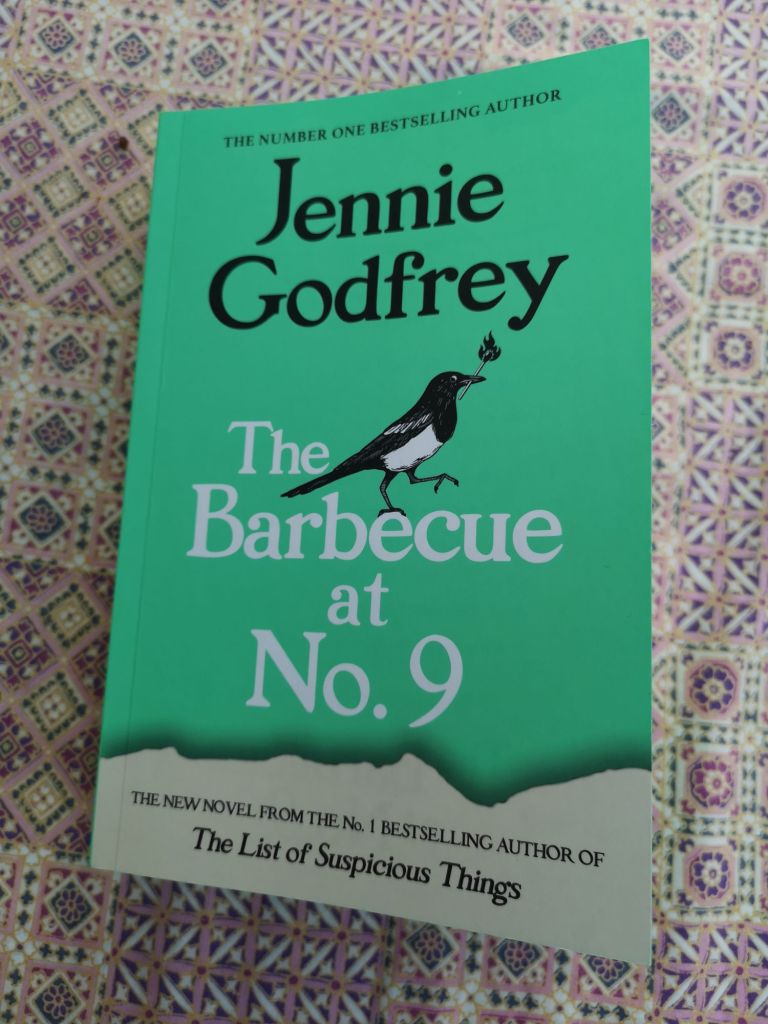
Welcome to my review of my favourite book of 2026! No, that isn’t a typo. I have been lucky enough to be sent a proof copy of Jennie Godfrey’s second novel, The Barbecue at No. 9, which will be released in February 2026, and I find it almost inconceivable that I will read anything better in the whole of next year. I certainly haven’t read anything better this year and I have read some really good books, some of which I have reviewed on here.
The Plot
The residents of Delmont Close, a new build Wimpey housing estate, are in houses arranged in a horseshoe. They all have back gardens and they all know where each other sit in the pecking order, with residents of ‘The Chalmers’ houses having 5 bedrooms, those in ‘The Eldon’ houses having 4 bedrooms and those in ‘The Terrance’ houses having 3. As a separate ranking, the tidiness of the front gardens is useful in differentiating between the houses! No. 9 is the house of the Gordons, Dad Peter, Mum Lydia, 15 year old Hanna and 11 year old David. Lydia sees herself as the leading light of the close, so she decides that in order to impress the neighbours she will invite the whole close to the barbecue of the title to mark Live Aid on July 13 1985. There is pretty much a full turnout on the day, and it turns out to be a day when many of the secrets that are hidden beneath the veneer of suburban respectability are going to be revealed, completely changing the lives of a number of the residents.
The Characters
Hanna is the central character and we see a lot of the events that unfold through her eyes. She is 15 and seems to trust only her best friend Rosie, who has been with her since Primary School, and her dog Prince. Even then, she keeps her counsel and will not tell Rosie exactly what is happening, however much she wants to. We know that she is a goth in the way she dresses, but she has not truly left behind the music of her childhood, still listening to the Top 40. Music is quite central to her story but it often exposes her confusion rather than her certainty. In a very telling aside, we learn that her first record was Under the Moon of Love, (As a Showaddywaddy fan I would say that’s a very solid choice!) but she has rewritten her own story to say it was Blondie. This rewriting is what we often do as teenagers, and it’s perfectly observed.
Lydia is one of those Queen Bees of any community to whom appearance is everything. We learn that she wants as many indicators of success in her home as possible. So there is the state of the art TV, the brand new kitchen appliances, though not a dishwasher as her ever competitive sister-in-law Beverley points out, and the barbecue in the garden. She cannot abide mismatched cutlery, crockery or glassware. She has opinions about everyone else in the close because she sees what is going on in their lives. Events over the course of July 13 will prove that she has missed a lot of what is going on in her own life.
Peter finds that life both in and out of the house is becoming increasingly unfamiliar, confusing and worrying. He has the very traditional breadwinner role that allows Lydia to live in the manner in which she feels she deserves, but Lydia’s spending is starting to reach levels he isn’t comfortable with and he wonders how, or if, he can tell her to rein it in. His relationship with Hanna has changed and he misses the closeness they had before.
Rita is a single woman, no doubt divorced according to Lydia, who has moved to Delmont Close to find suburban anonymity. Her previous relationship was unhappy and she is still looking over her shoulder in case the ghosts of that relationship somehow find her. She is reluctant to mix with the rest of the close, but the barbecue seems to be a way in which she can at least get the measure of everyone. Next door to her are Davina and her three daughters. Davina is a free spirit in the way that Rita can only dream of. She is open about the fact that all three of her daughters have different fathers and that none of them are in the picture. Despite this, they are a loving, happy unit with a positive approach to life and an openness to other people that encourages Rita to take the first step towards becoming part of the community.
Steve is a Falklands veteran who suffers the lasting effects of PTSD following the sights and sounds of conflict. He is sent into fight or flight mode by loud noises of any kind and stays inside the house, mainly in his room, as it is the only place where he feels any measure of safety. He watches the comings and goings in the neighbourhood and takes notes. This is not a voyeuristic pastime, it is an extension of his military training which has taught him to assess danger by knowing exactly what is going on around him. His mother Tina tries to persuade him to leave the house, or at least his room, but with little success. She worries about him constantly but on the outside she tries to keep her worries secret. It turns out that Steve’s notetaking may need to be augmented by contact with the neighbours, but can he really attend the barbecue at No. 9?
My Thoughts
To give you some idea how much of a page turner this book is, I started it at about 3.30 on Thursday afternoon and I had finished it by 7.00 on Friday morning! At the end of every chapter you need to find out what will happen next, not because of a succession of cliff hangers, although they are there and they are very good, but because you genuinely care about the characters. In particular, you will find yourself willing Hanna to work through her problems, Rita to find her confidence and Steve to overcome his demons. The secrets when they are revealed come as a total surprise, but, when you think about it, you realise each one was hinted at or had the seed planted much earlier in the story. It’s a mark of Jennie Godfrey’s confidence in her writing that she doesn’t rush to reveal those secrets, and when they are revealed they have realistic and logical consequences. As with The List of Suspicious Things, these are real people leading real lives in extremis. The use of Live Aid as a framing device is genius because it fixes the action into a day that so many of us remember so well. When Ultravox are singing, when U2 are playing, and when Freddie Mercury and Queen are stealing the show you can instantly place the events going on around it in the context of time, place and culture. This makes the events so much more real and so much more impactful. I have not read many books where I have related to so many characters instantly in the way I did here. As this is a spoiler free review I have not revealed any of the main events, but that will make it better for you as you will have the sheer pleasure of discovering the story as it unfolds. Jennie Godfrey is simply an astonishing writer and she has written two books, both of which have instantly become all time favourites of mine. If you haven’t yet discovered one of the UKs best authors you are in for a real treat.
A huge thank you to Hutchinson Heinmann for their generosity in sending me this proof.
What alternative career paths have you considered or are interested in?
I have loved writing since I was about 8 or 9, and I always dreamed about making my living as a writer. The first idea I had was to get a job on a local paper, in the days when you could get trained up from scratch, but it was a world I knew nothing about, including how to find the apprenticeships that may be available. It was sports writing I really wanted to do, but I found out, after some research, that you would start on general work and I knew instinctively that I wouldn’t be able to deal with the more difficult side of the job. I was very awkward around people so I would have been poor at asking questions in the right way. There was no direct route into sports writing so I knocked that idea on the head.
Later on I set my sights on writing about music, because it was something I was confident I could do. Again, the problem was how to get into the field, because the music magazines were closed shops to most of the population. More so than sports writing as it turned out because there was no way of finding the person to contact and no way of practising by writing for fanzines or similar. When I look back, again I wouldn’t have had the people skills to deal with the more difficult side of the work.
Later, I had the idea of writing books and this time I actually got as far as self publishing electronically on Amazon. The problem there was that I opened myself up to other people’s views and some of their views were aggressively negative. After two attempts to put my work out there I retired from the scene, unable to deal with the critics. Were they good books? Probably not although I like to think they had some merit to them. Could I have improved? Certainly I could have done. Would I have ever have been good enough to get someone to publish me? Very unlikely. It is a time consuming and emotionally draining process, plotting, writing and editing a book, and I didn’t have the time or the thick skin necessary to persue it.
Now, you may have noticed a theme here! The truth is that I have always written and I will always write. I have become, I hope, a decent blogger but, as with every other writing based dream, almost certainly not good enough to make a living at it. I now write for myself and for anyone who might want to read it. This means I can be enthusiastic, true to myself and happy with my writing. Perhaps that is the dream I have always had, but I always wonder, ‘What if?’
What food would you say is your specialty?
This will be my 100th day in a row of answering the daily prompt posting to this blog. It has given me a chance to reflect on many ideas and memories even if, at times, the daily prompt has tended towards repetition. Today is a perfect example as a very similar prompt appeared on 18 July asking what you like to cook.
One of the things I enjoy most about this, perhaps paradoxically, is when I don’t like the daily prompt and I have to work around it to find a way to express my thoughts and feelings.
It’s so important in the kitchen, and in life in general, to balance your traditional approaches with the willingness to experiment. My daughter pointed out a year or so ago that I was constantly making the same meals and she was finding it boring. I realised she was right and since then I have tried to find new recipes at least twice a month to try out. This week I cooked spicy prawn linguine, adding olives to the recipe I found and it worked very well. A previous linguine recipe, lemon linguine, was described as lemon jif for its supposed resemblance to a familiar surface cleaner!! 🤣🤣 Suffice to say it won’t be cooked again, but the spicy prawns with olives will be.
What my daughter did, as well as making me dive into recipes online and from books, was to make me consider how I could incorporate this approach into my everyday life. Leaving full time work has enabled me to look at my usual approach to life and to switch things up. I have given myself permission to experiment and to fail. That’s not to say that I enjoy the process of failing. I hate it when something I try doesn’t go right, but I am slightly nearer to accepting that this is the case and to take what I can from the experience. It is human nature, with the exception of the odd thrill seeker or iconoclast perhaps, to stick with the tried and trusted so you are fighting against yourself when you step away from what you know. It’s very early days for me, but I know that my experiments with the recipes of my life are making me feel more energised and engaged. Long may I continue to leave my comfort zone.
 David Pearce - Popular Culture and Personal Passions