
What was 1896 like?
1896 was the 59th year of Queen Victoria’s reign, with the Queen becoming the longest serving monarch in British history on September 22. Robert Paul demonstrated his film projector, the Theatrograph at the Alhambra in Leicester Square on 20 February. Great Britain and Ireland compete at the first modern Olympics held in Athens from 6 – 15 April. Blackpool opened its pleasure beach on April 23. On August 17 Bridget Driscoll became the first pedestrian to be killed by a car. December 11, around the time that people were buying this magazine, Marconi’s early work on radio was being presented to the scientific community at the Toynbee Hall in London.
In 1896, the average weekly wage for a labourer was 13s 9d, but 20 years earlier it was 14s 1 ½d. Not for the first or the last time, the poorest in society found their spending power lowering by the year as inflation and all powerful employers with a huge pool of labour kept them squeezed. If you were a Post Office Clerk you would be earning, on average £90 per year. A Butler, by contrast would be earning in the region of £42 per year despite the very high level of responsibility he would have had. The Duke of Westminster was, as he would remain for the decades to come, the highest earner with an annual income of £250,000! (Facts and figures courtesy of The Victorian Era website at the link below.)
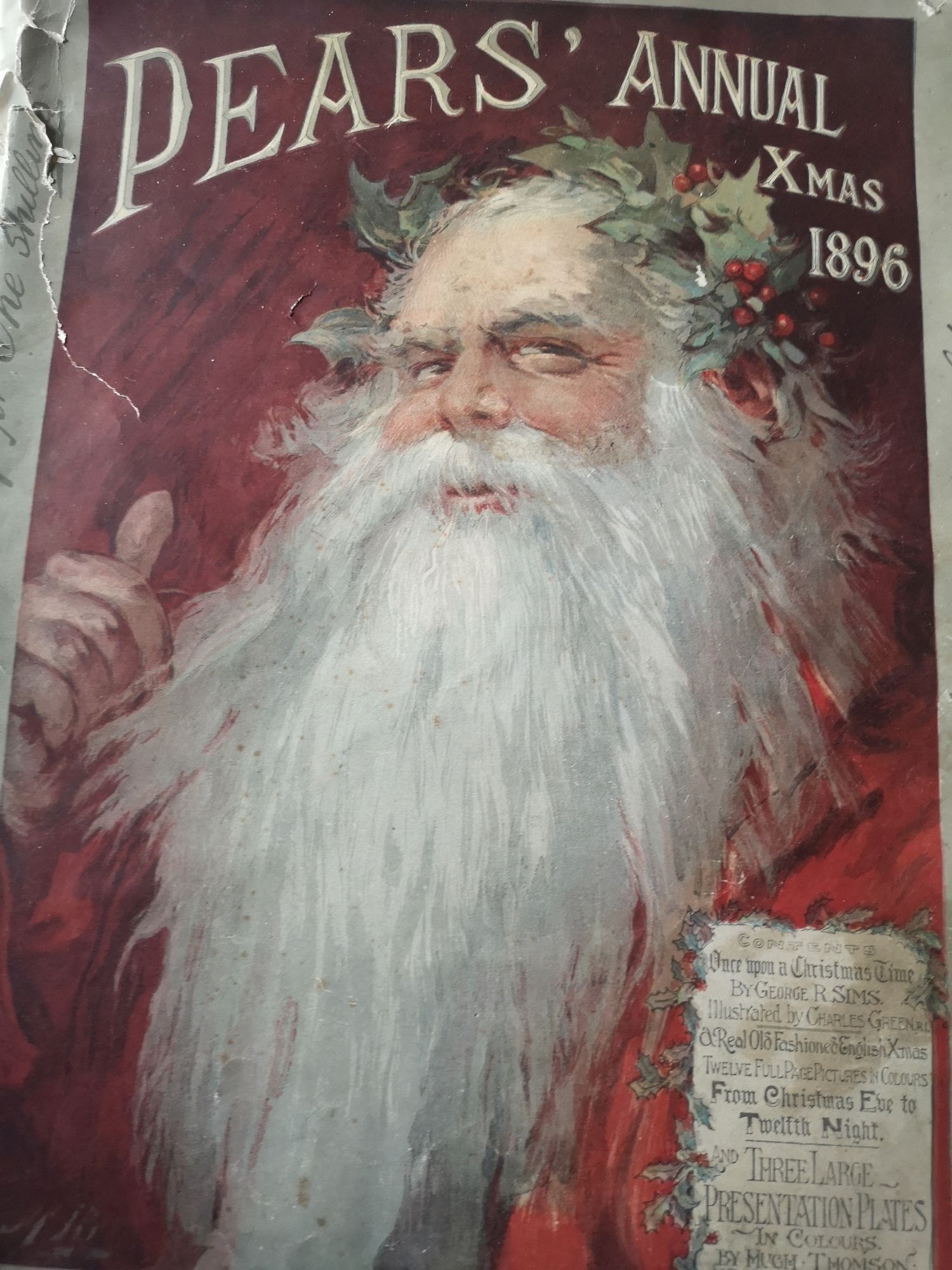
Pears’ Christmas Annual 1896
It really is an amazing piece of history to be able to hold and to read. This magazine was published 129 years ago in a world that, in so many ways, we would not recognise. The overtly moral tone of the magazine would not connect with a majority of the readership today. However, Pears’ soap saw itself as a way of improving the reader by encouraging them to be better both outside, by using Pears’ products, and inside, by reading the uplifting content of the magazine. It’s easy to be dismissive of this approach from our vantage point of 2025, but let’s look at the social and health conditions of the time. Life expectancy was just under 46 for a man and 50 for a woman (Statista.com, 2025). People were living in damp, dirty and overcrowded conditions, causing diseases like cholera to spread extremely quickly. Malnutrition was extremely common as the weekly wages for large families with little money was generally insufficient to buy enough food. Fruit and vegetables were out of the reach of many of the poorest people, as was meat, with potatoes being the only staple that could be counted upon. The average labourer would not be able to read, or would only be able to read at the most basic level so they were restricted to unskilled, often dangerous and frequently backbreaking work.
We only need to look at the cover price of the magazine to know that it was aimed purely at the middle classes or above, as one shilling would have been completely out of reach to our labourers. We should also take notice of the cover. It is clearly Father Christmas of course, but look at his clothing. It is red, a full 30 years and more before Coca Cola put him in red robes. It was nice to be able to bust that long standing myth! The content was pitched at readers with a level of education high enough to be able to read higher level language and comfortable enough both financially and materially to be interested in improving their complexions. Women and children were the target audience for this instruction, as, presumably, it was not something that men would have been interested in. So, in common with some of the other magazines I will be looking at, it was marketed to the woman of the house.
Advertising
To look through adverts from days gone by is to see both the differences and similarities between that time and the present day. As mentioned, this was a magazine aimed at middle class women, but it was also aimed at those who were of a higher social and financial level. The set of adverts at the top of Pages iv and v bear this out.
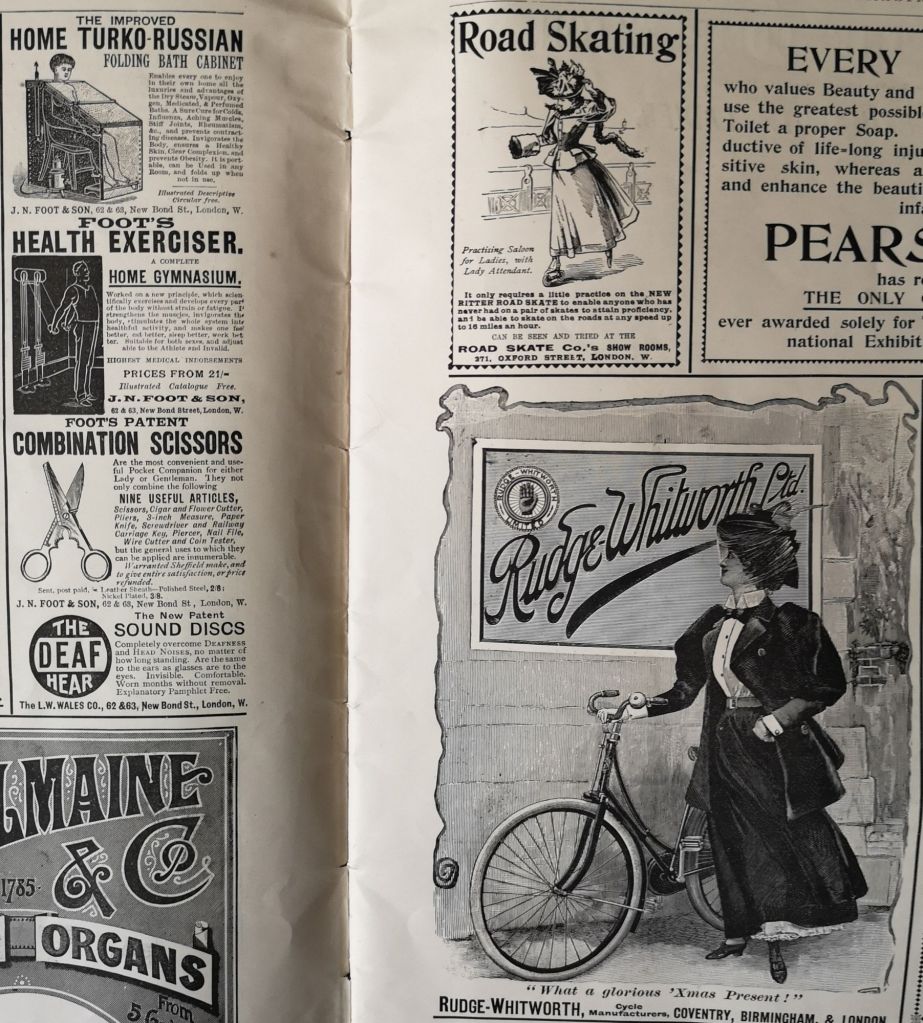
Looking at the variety of mod cons for exercise, bicycles you would expect although the model shown is perhaps more modern looking than I might expect. An early version of Roller skates is more of a surprise. The home bath cabinet is quite similar to what you would see at a modern health spa, and the home gymnasium, though rudimentary by modern standards, would still do the job. Of the three, only the home gymnasium is priced – from 21 shillings – so the idea of ‘if you have to ask how much, you can’t afford it’ was still very much in place for consumers. Also, only the Rudge Whitworth bicycle mentions that it would be a good Christmas present. In fact, a mere handful of the adverts actually mention Christmas. It is interesting that the adverts here are actually, in a sense, lagging behind society at large. Gift giving, which had been traditional at New Year had moved quite substantially, for most in England if not in Scotland, to December 25. Also, it was not, as had hitherto been the case, largely centred around children, as adults had now started giving gift to others. However, the commercialisation of Christmas had been in progress for perhaps 50 years by the time this annual was published, so the advertisers were either unaware of this – very unlikely – or acknowledging to some extent the view that the festival was somehow being cheapened – much more likely, given their professional and still largely church going readership, and more astute as they could present the more acceptable face of commerce.
Familiar Brands
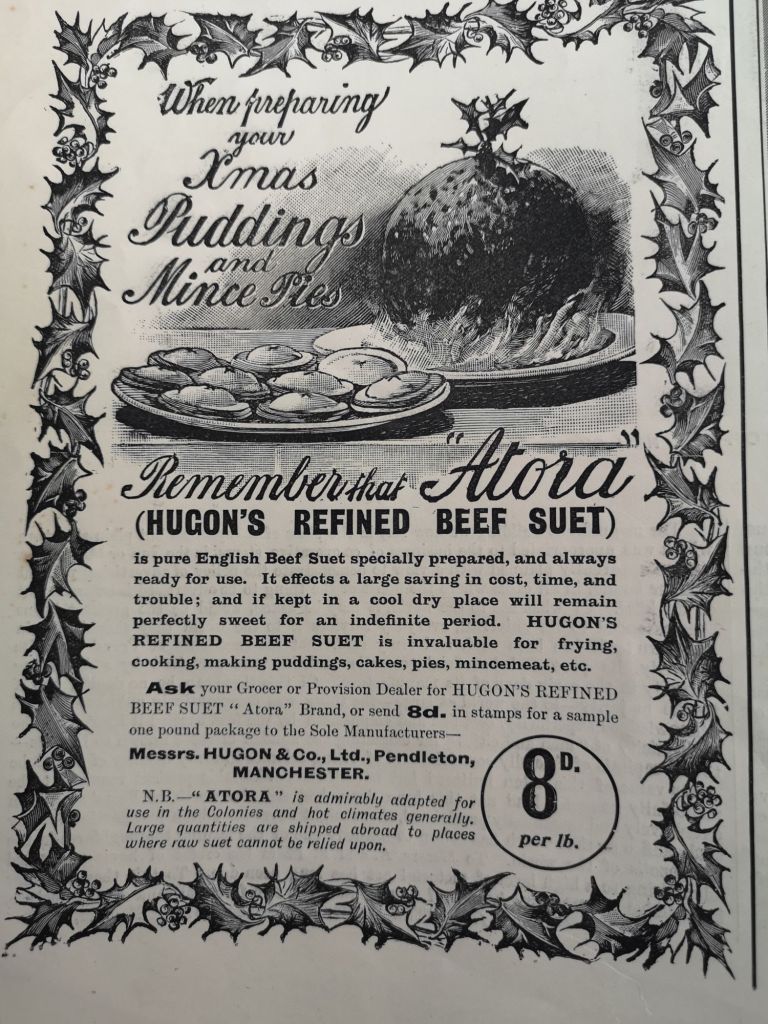
When I was looking through the annual, I counted four brands that you can still find in the shops today, apart from Pears’ itself. Beecham’s were advertising pills instead of powders, but the other three are still famous for the same products. Bearing in mind the economic ups and downs of the past 150 years, that survival is quite amazing.
Atora now has Vegetarian Suet, but still makes the Beef Suet featured here. Notice it markets itself as perfect for the colonies. Given the fact that the middle classes often provided administration and other help to the government outposts, this is clever marketing. What better present than a taste of home after all?
The Cadbury’s advert, from the days when it was manufactured in Birmingham, where the owners built their own village for their employees, thereby creating loyalty through a mixture of philanthropy and the fear of losing the roof over their heads! It positions cocoa as a kind of health drink with claims of nutrition and purity.

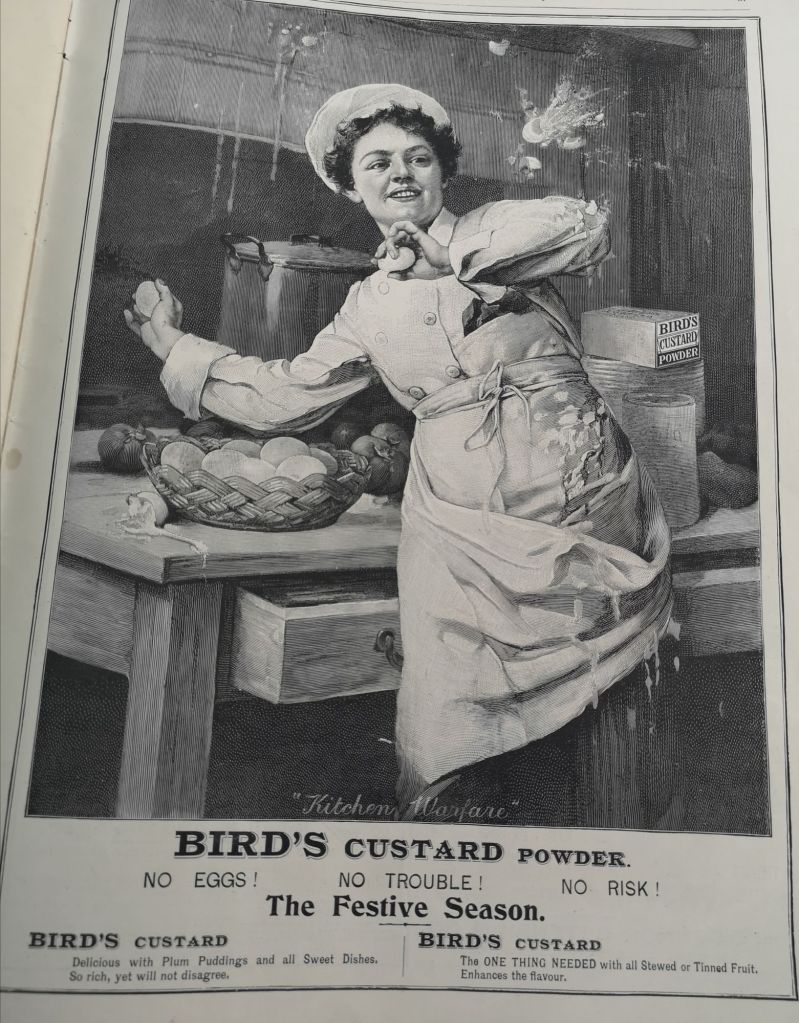
Finally we have Bird’s Custard Powder with an advert that predated the more informal and playful style that was to become much more popular in the decades to follow. Then, as now, it’s irreverent tongue in cheek approach would have made it stand out against its more staid and traditional competitors. That said, you would sack your kitchen staff if they started having egg fights!
The Festival in Stories and Pictures
Very interestingly, this magazine is in two parts. The outside has pages numbered in Roman Numeral style. In the middle we have the real Christmassy part of the publication. The front page is one of 12 coloured plates drawn by artists of the time. Perhaps people could cut out and frame them if they so chose after they had read the story and article contained within. Inside, on Page 2, there is a note to readers expressing a hope that the Pears’ annual, now in it’s sixth year having been first published in 1891, would be a worthy successor to Dickens’ Christmas publications. Along with 12 colour plates, there is a story, ‘Once Upon a Christmas Time: A Story of Yuletide’ by George R Sims, and an article entitled ‘A Real Old Fashioned English Christmas’ by Joseph Gregg. The former can be found from Page 9 ending on Page 31 whilst the latter starts on Page 3 and ends on Page 7. Both of them reflect the seemingly eternal idea that there was a time when Christmas was ‘celebrated properly’! I found the article about Old English Christmas Traditions absolutely fascinating. There are no adverts to interrupt the narratives, hence the necessity for the outer magazine.
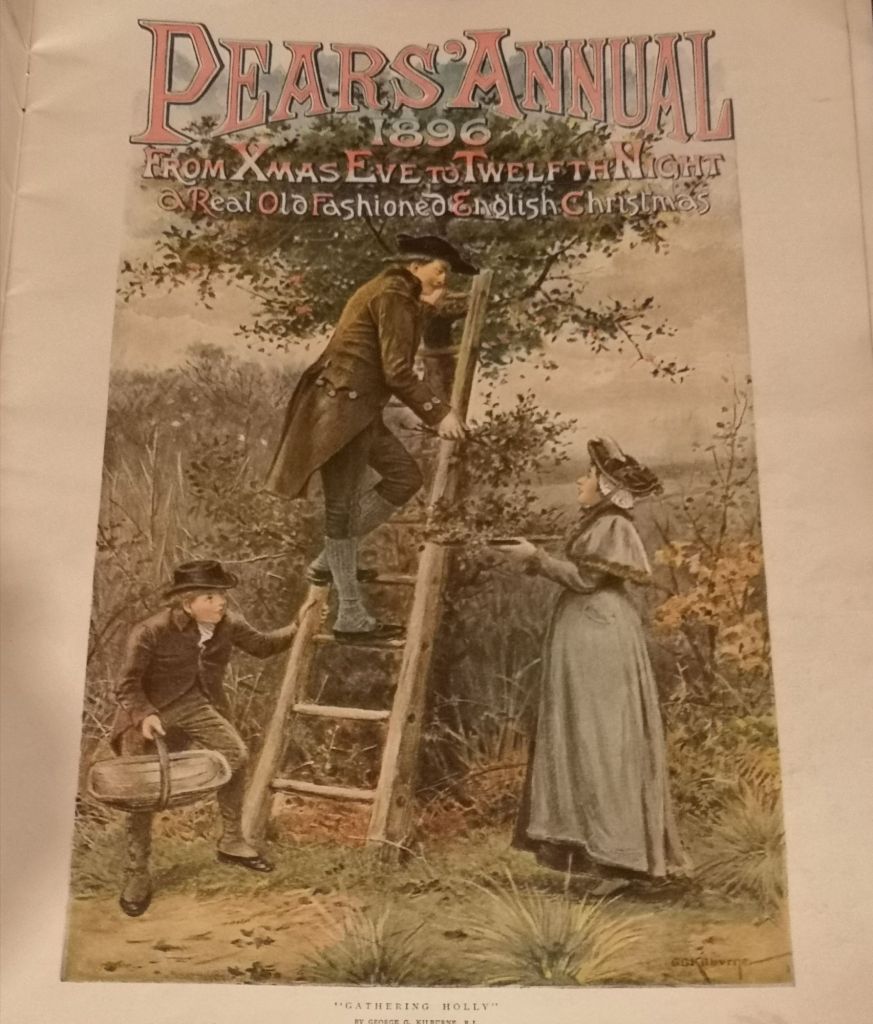
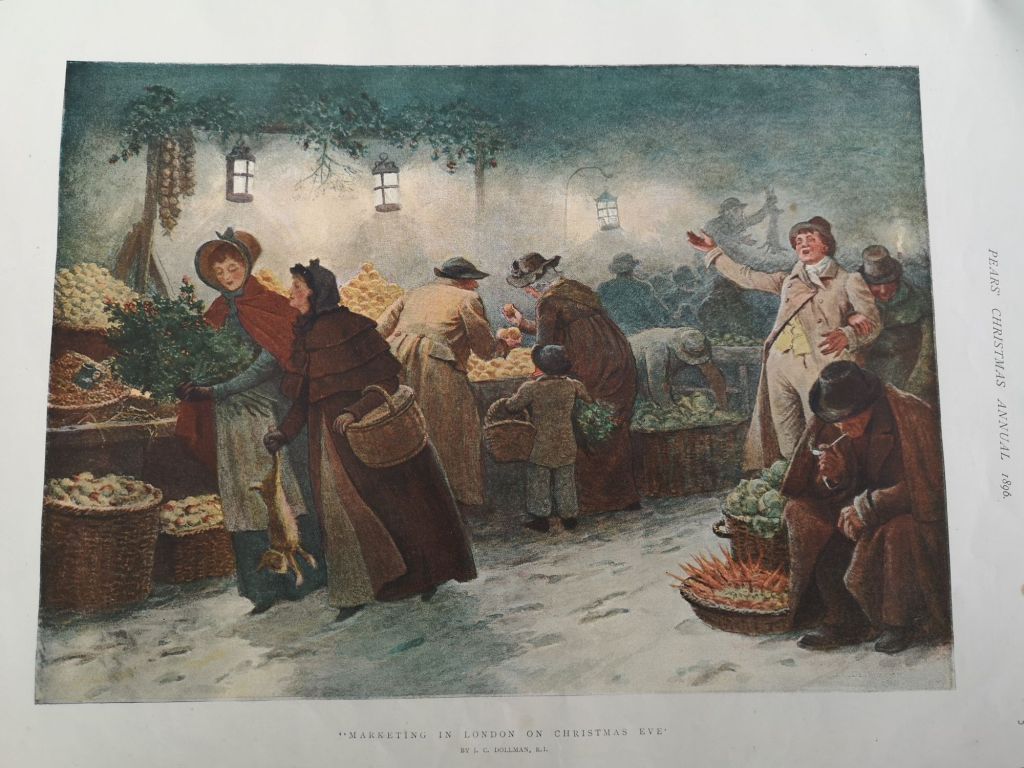
The plates are absolutely lovely throughout and give evocative views of the Christmases of the early Victorian period and before. My favourite plate is the one below, which shows a market on Christmas Eve, and which could have come straight out of the pages of A Christmas Carol.
Final Reflections
So, a late Victorian Christmas was one that we might recognise, if only through different versions of A Christmas Carol. The contents of the outside pages of the Pears’ Annual reflected the then current commercialised Christmas, whilst the inside pull out reflected what Christmas ‘should be like’. It is a contradiction at the heart of the season which has been a central feature for many years, and arguably for a number of centuries. It continues to be so 129 years after this fascinating piece of history was published.
Do you want to entertain/irritate friends and relatives with your Christmas knowledge? Do you have a quiz to set over the next few weeks? If you do, this could prove to be invaluable. 20 facts, well known and obscure, about the Festive season. How many did you know already?
What are your two favorite things to wear?
I always like to wear my learning lightly 🤣🤣! In a more serious vein, I am very likely to be wearing something comfortable rather than something fashionable or sharp. Give me a sweatshirt or a jumper over anything that would be counted as ‘dress to impress’.
At this point in the year I love the fact that I can wear Christmas jumpers for a whole month. They lift my mood and I love their colours and designs. I wore a new Christmas sweatshirt last night when I went with my daughter to watch Love Actually on the big screen in London. It was a Love Actually themed sweatshirt that I love. It’s a quote from the film that anyone who knows it will recognise – Eight is a lot of legs, David!! My daughter got it for me because watching Love Actually is a family tradition that started in 2004 when I took the film out of the video shop in Jannali, New South Wales because I needed something Christmassy. To say I enjoyed it from the first few seconds would not be an exaggeration. The following year, I had bought our own copy, and every year since I have watched the film, initially with Janet and then, as the children started staying up a bit later, with the whole family. I know every joke before it lands but still love them, I know every emotional moment but still get affected by them and I just adore the scene when Sam runs through the airport to tell Joanna that he loves her. Having a sweatshirt is just another example of the way that this one film defines my Christmas.
I say I don’t favour anything smart, but that’s not always the case. I bought a dark green suit back in 1987 for my best friend’s 21st birthday. It cost me a large amount of money at the time, well into three figures, but nearly 40 years on it’s still in my wardrobe and still makes the occasional appearance as I fit into it as well now as I did then! It is a suit that is full of memories of people, places and parties. I love the fact that I still have it.
What technology would you be better off without, why?
I don’t think there is necessarily any technology that I would be better off without but there is definitely technology I could use better. There in a nutshell is the problem that the human race has had through the centuries.
So much technology has been misused, mainly by people who want to hurt or control others. For example, the Internet. It started off as a philanthropic gesture by Tim Berners Lee who shared the code for the World Wide Web with the whole planet despite the fact that he could have made a fortune out of it. Sadly, because of the often mentioned (by me) issue of human nature being basically bad, this gesture has become one of the biggest problems in everyday life.
AI in itself is actually a very good tool, but again, it’s been misused by people with power and control as their aims. They have programmed AI to reflect their own biases and people who consult it often assume that it is in fact unbiased. There is another problem, the fact that it is in the interests of those in power to keep people ignorant. To that end, schools across the world are not allowed to teach children computer literacy and media literacy. We are a dumbed down species and that is essentially down to deliberate choice from those in power across the world. The result is a technology that few understand and that a tiny number of people with knowledge control. This has happened with technology throughout our checkered human history but the power given to the few by this technology is unlike anything ever seen before.
So, the technology is there and it is up to us to use it properly. Get your knowledge base extended by doing your own research and make sure that you are doing everything you can to control technology rather than letting it control you.
What’s the hardest decision you’ve ever had to make? Why?
I got a job teaching English in Dhahran back in 2007. The job was based at a Royal Saudi Air Force base. It was incredibly well paid and extremely straightforward in terms of what I was teaching. The issue was splitting the family up, even temporarily. Now, some of my colleagues just loved being away from their wives and family, and if that suited them then fine! For me it was purgatory. The only light at the end of the tunnel was being told that my wife and children could join me after a year.
I figured that I could just about manage for a year at the type of money they were paying me, but I was in for a nasty shock. When I asked about it I was told that family accommodation was subject to a three year waiting list! This threw me into a tailspin. We were relying on the money to get us straight financially after going into debt when I studied for my Masters degree in Australia. However, there was no way we could cope as a family with a three year separation even with twelve weeks at home every year.
I spent day after day turning it over in my head, but it was only difficult because I hated being a failure at the job. From a personal perspective the decision was 100% cut and dried. I had to come home and stay home. From a financial perspective I was giving up the chance of security and from a career perspective I had already given up a full time job at university and they were rare even then! I was right in that my decision to chase the money made me a less attractive prospect for a good job for a long time and, for two years, I could only get summer work.
Anyway, once I gave in and accepted the inevitable I went to my line manager who understood completely and even helped out by telling me he hadn’t seen my resignation letter. If he had, I would have had to pay for my own flight back! I emailed him from England on Boxing Day, the day I was supposed to go back and told him that I would not be returning, enabling me to leave during the agreed probation period and therefore avoiding any contract issues.
When I had my discussion with the manager he said something that made me realise how badly I had been affected. He told me it was the first time I had smiled in the 6 months I had been over there! A difficult decision but unquestionably the correct one.
 David Pearce - Popular Culture and Personal Passions