
Do you have a favorite place you have visited? Where is it?
I think favourite places are attached to a time rather than a geographical location. My immediate answer was Sydney, but on thinking about it more carefully I would say Sydney 2004 would be more accurate. That year was anything but straightforward but as a family we lived in the suburbs of Sydney as locals would. The indelible memories of that time were connected to the children being young and the degree I was taking being so enjoyable. When we returned last year I realised that it was a very different place because we were only there for three weeks and we were at full speed for most of the time. It was a very different place because I was older and we only had one of our children with us. It was a very different place because I was a very different person.
So, there you have it. I can’t say that I have a favourite place but I can say I have a place that coincided with a favourite time. There is a big difference between the two and unless you recognise that you may be in for disappointment if and when you do return.
What was 1965 like?
It was the 13th year of Queen Elizabeth II’s reign, and the year she saw the death of her first Prime Minister, the legendary Winston Churchill, in January. A third of a million people filed past his coffin when he lay in state for three days. Her Prime Minister throughout the year was Harold Wilson, the first Labour Prime Minister since Clement Atlee. Politically, there were two main events. First was the Abolition of the Death Penalty, a long overdue move towards a truly civilised society. However, it was initially a five year suspension allowing for a change of mind, which thankfully never came. Second was the Race Relations Act which made it an offence to discriminate against people based on their colour in a public space. It also introduced a crime of Incitement to Racial Hatred. The Beatles played live for the last time in Britain at the Capitol, Cardiff as the screaming from the audiences was drowning out their singing. However, in the rest of the year they filmed Help!, recorded and released the soundtrack, recorded Rubber Soul and released a Double A Side of Day Tripper/We Can Work It Out which was their third Christmas Number 1 in a row! Despite all this success, the biggest selling record of the year was Tears by Ken Dodd! The 1965 film year was dominated by The Sound of Music which was released in March and became a seemingly permanent fixture in cinemas across the country. The soundtrack also dominated the album charts even with all the huge acts around.
When looking at television in 1965, there was one big surprise. This was the year that cigarette adverts were banned, although cigar and pipe tobacco ads were allowed to continue! Given the prevalence of cigarette adverts in print media, it is interesting to speculate why ITV was relatively quick off the mark on this. My guess would be that in the position of relative power ITV found itself in – there were only two channels at the time – meant that it could be perceived to be encouraging a potentially extremely harmful pursuit, which may have led to legal action down the track. As with so many other dangers, from global warming to the effect of radiation, the evidence already existed in the scientific journals long before it became common knowledge in public circles.
Debuts made in this year included Till Death do us Part, Tomorrow’s World, Man Alive, Thunderbirds, one off play The War Game and The Magic Roundabout. Culturally, all of these have remained in the public imagination with the exception of Man Alive, but social history has much to thank that documentary strand for. Two Christmas Day events of note were the first ever Christmas Top of the Pops and The Feast of Steven, a Christmas themed Doctor Who episode, where William Hartnell as the Doctor broke the fourth wall to wish viewers compliments of the season.
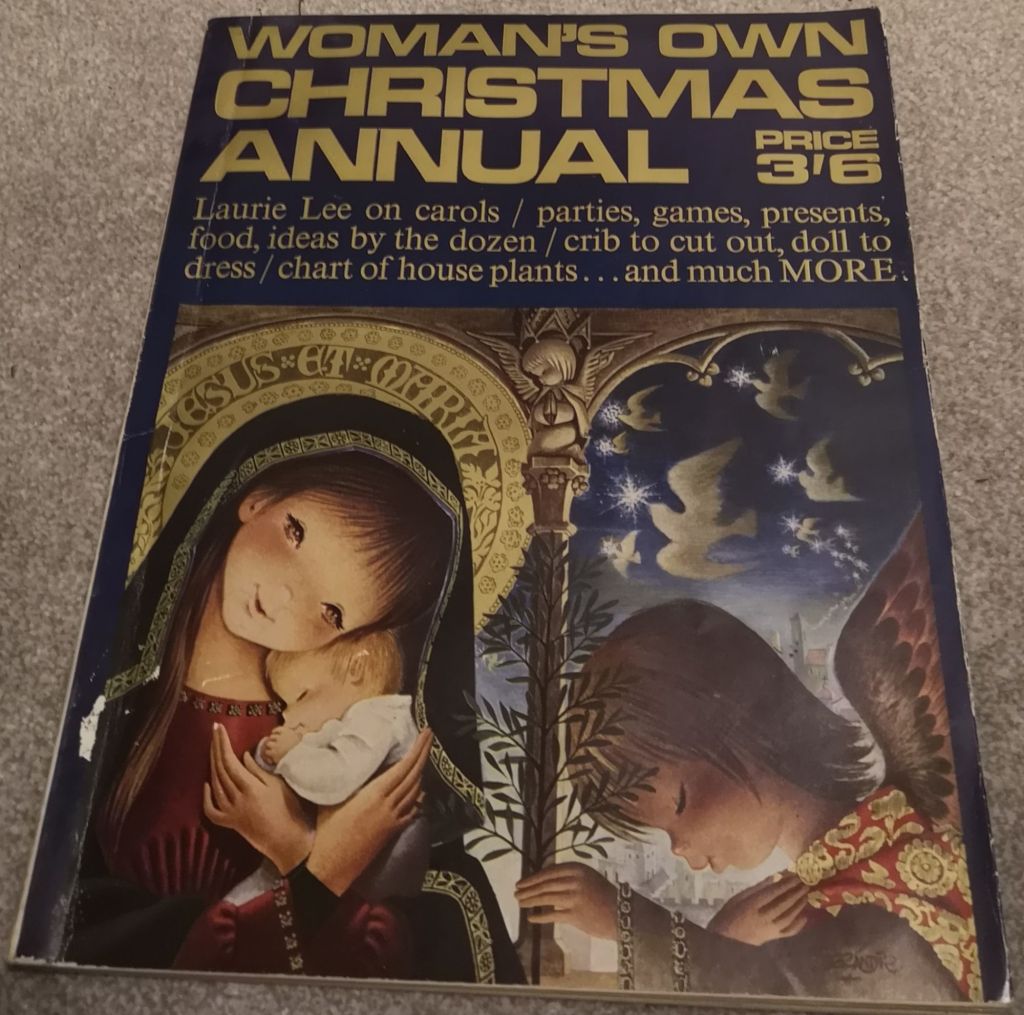
Woman’s Own Christmas Annual 1965
The cover at the top of this article is more effective at creating the mood for this magazine than almost any other. Although the use of children as Mary and an angel can seem a little cloying to modern readers, it reflects the children’s place right at the centre of the festival. It would have brought to mind the school Nativity play which was a staple at, almost certainly, every Infant and Junior school in the country at the time. The only element that might be called into question in that sense was the brunette Mary replacing the blonde Mary that was seemingly essential to almost every play I have ever watched!
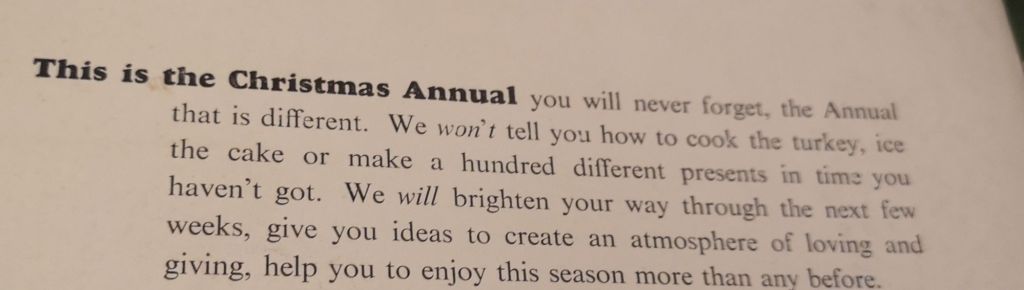
It’s interesting how this short paragraph sets out the stall for this magazine so succinctly. The intention seems to be to separate it from the ‘old fashioned’ magazines of the past and to attract a readership accordingly. It is probably one that would be more recognisable to a modern audience than the four that have preceded it in this series, which, given it is 60 years old, may indicate that the past is not so different a country as we might believe it to be. I certainly found it familiar in many ways and, of all the magazines I have read for this project it is probably my favourite.
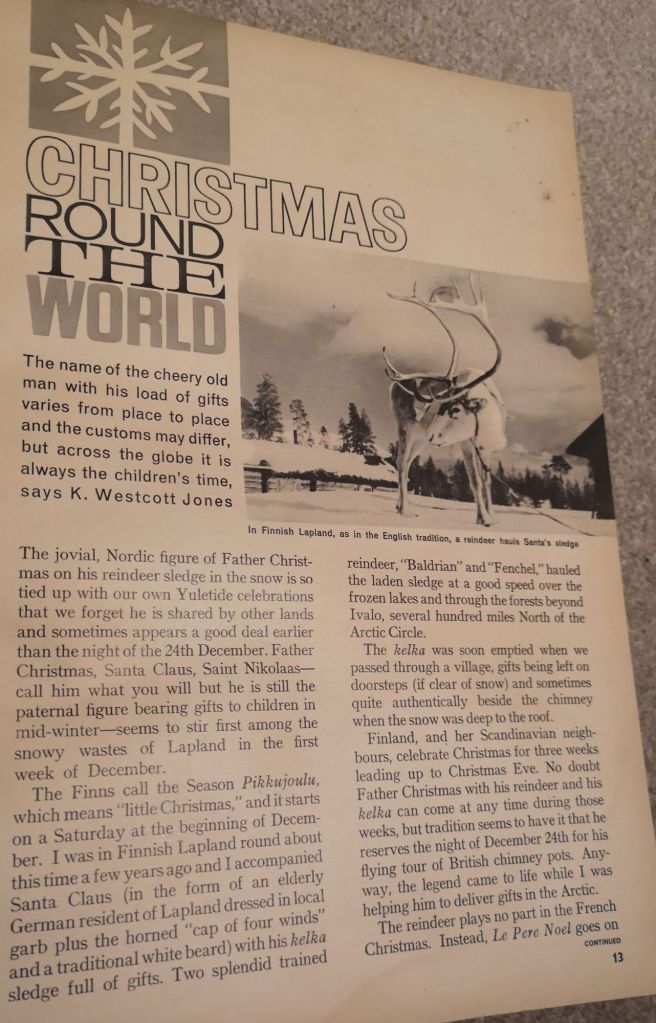
The first section I have picked out is the Christmas Round the World item that broadens the view from a British Christmas to a much more European festival, in keeping with the derivation of Father Christmas/Santa Claus/Sinterklass/Le Pere Noel. This type of article would have been as interesting to many children as it was to the Mothers whose magazine it was. Don’t forget that in those days this information was not readily available outside of heavy encyclopaedias or academic texts, so to have it in a well written and accessible form would have been very useful to all concerned.
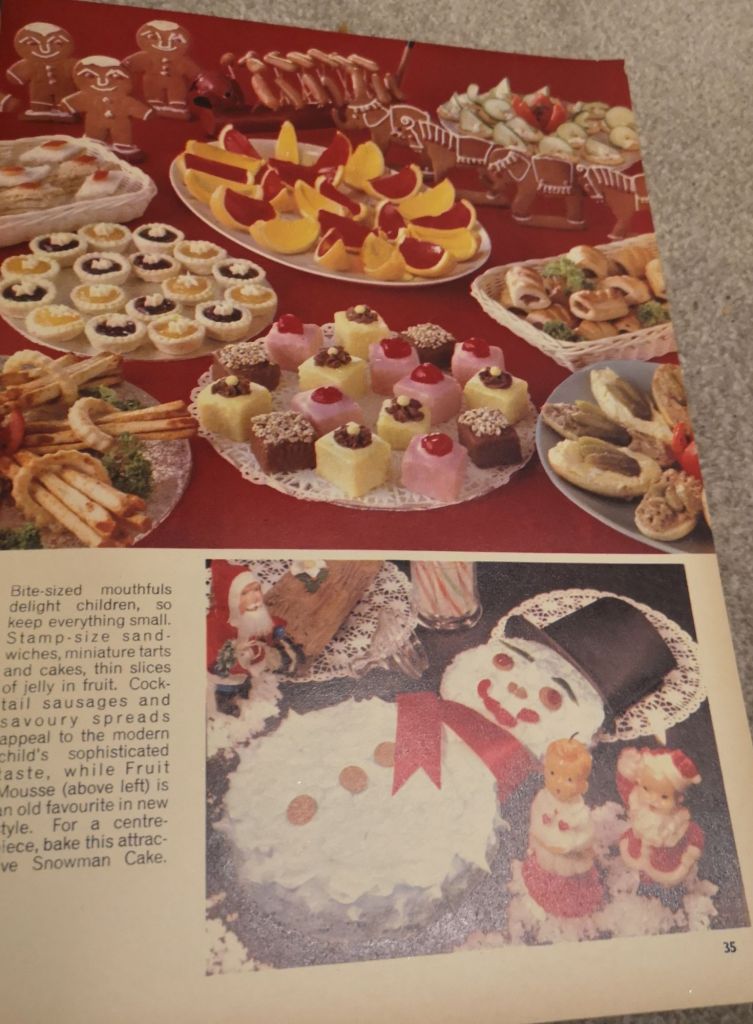
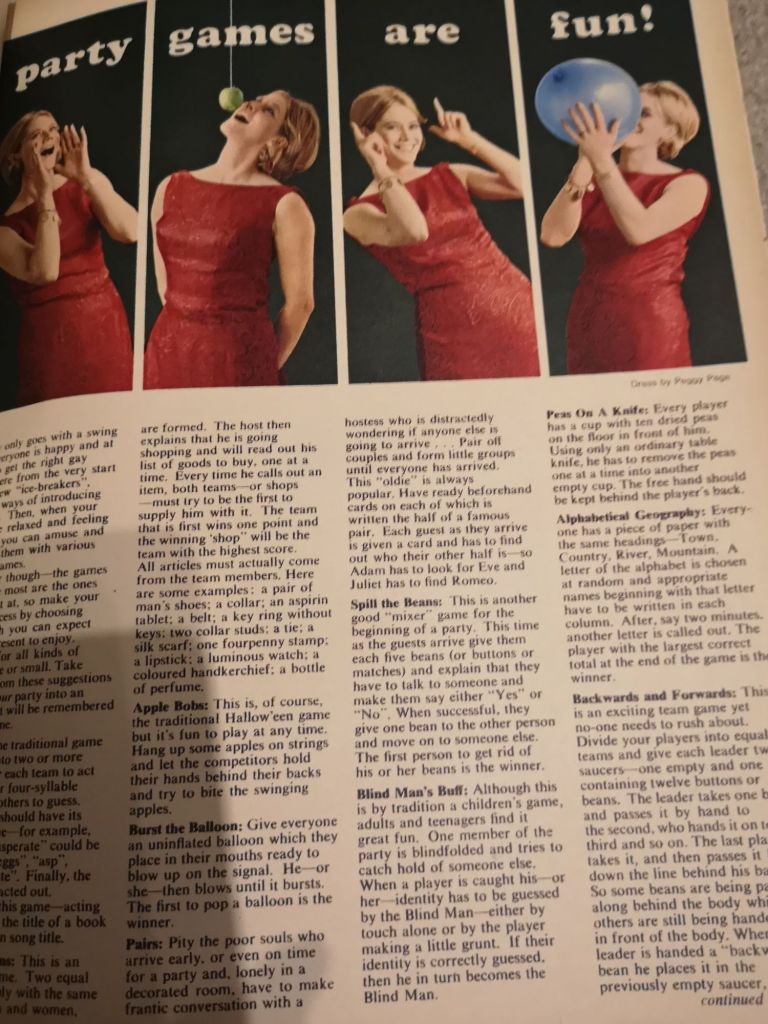
In the interest of brightening the way through the season there is an eight week Christmas Countdown that contains advice that is still very useful today. Of course, some advice like postage times to Ceylon and Rhodesia would be out of date, while references to ‘gay’ wrapping paper and tying a bow round pussy’s neck might raise eyebrows! However, timings for baking, early food buying, presents for all the family and party planning are still very good. As you flick through, there are four pages of lyrics for carols and using an ordinary pack of cards to tell fortunes as a fun party activity. Party food for children range from the now unfamiliar canapes, which are even rare at parties for grown ups, citrus segments with jellies replacing the orange and grapefruit and the show stopper, a Snowman Cake which does actually look like it would be very popular even with today’s children. Once the children have gone to bed then adults can play party games – no not those party games! As the magazine suggests you can create whatever atmosphere you choose with your choice of these games.
Finally, I want to pick out Laurie Lee’s short reflection on carol singing in his childhood. It is an extract from his incredibly successful memoir Cider with Rosie and is beautifully written. It is someone from our grandparents or great grandparents generation telling us about a world that no longer exists but which, through so many period dramas we can picture perfectly.
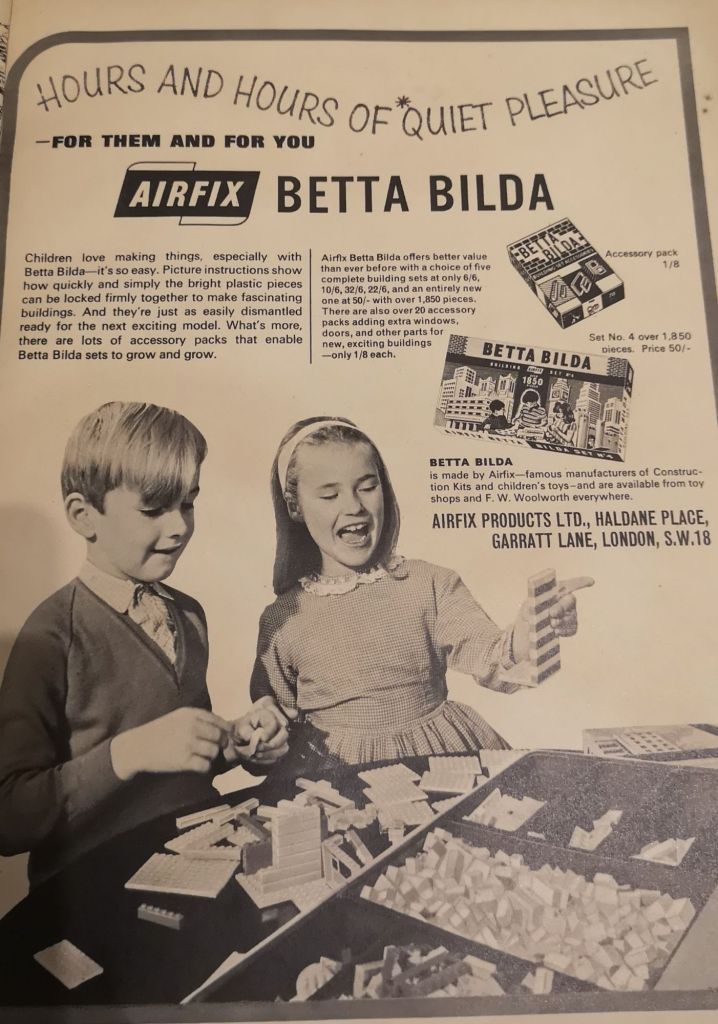
The adverts in the magazine include Lea and Perrins once again, Basildon Bond offering a whole year’s supply of stationery consisting of 220 sheets of writing paper, 148 envelopes, 25 correspondence cards, 20 brieflets and a jotter! That would last most people today a lifetime and more, sad to say. I think that of all the things that have disappeared in the last 60 years, it is letter writing I miss the most. There are Raleigh Bikes, familiar to any child of the 70s and Lindt Chocolate, probably more popular now than ever before. The advert I have featured is from Airfix and, to my surprise, is entirely gender neutral. It shows a boy and a girl using Airfix Betta Builda to construct their own towns. Who knows how many young women would have been encouraged into STEM if this kind of approach had remained the model for every construction toy in my 70s childhood. By then, Airfix and Meccano, neither of which suited me at all, were marketed almost exclusively to boys.
Final Reflections
If this magazine appeared on our supermarket shelves now, it would certainly not look out of place amongst the massed ranks of festive offerings except for the fact that it is very largely in black and white with colour used to create a ‘wow’ factor. The standard of writing and range of subjects could teach something to today’s celebrity obsessed Christmas issues, and I for one would probably find more of interest in it than in any of its modern competitors.
Next time, we look at the Woman’s Own magazine two years later.

Share five things you’re good at.
I tend to be very self critical, but below are five things I believe I am good at.
Writing – I am actually getting better at this because these prompts are encouraging me to be less ‘curated’. By that, I mean that I am being more instinctive with my writing, giving a freedom and a life that seems to be a step up.
Teaching – I may not be a full time teacher anymore, but when I do teach I am pretty good at it. The students have changed so much over the years and I have changed with them. The last couple of years of full time teaching were very difficult and I thought I had lost my ability to connect with a class, but the summer proved that I still have it. My strength as a teacher is that I keep on learning.
Sharing – Whether it’s music, books, TV, Films, Plays or Concerts I love to share my passions with other people. I don’t do it in a ‘you need to do or see X’ but through enthusiasm for the piece of art in front of me. I have always done it and I always will.
Cooking – This is my real life passion in a manner of speaking. Cooking is entirely tactile and it inspires me and challenges me. I am never happier than when I am making food for others. I really look forward to cooking Christmas Dinner because my family enjoy it so much. This year will be the 36th in a row after I promised my wife she would never have to cook on Christmas Day! That very neatly leads me on to
Christmas – I pride myself on knowing about and trying to keep the spirit of Christmas. My enthusiasm and energy for the Christmas period may wax and wane according to what is happening around me, but I love Christmas and want others to love it too. When I was working I was always trying to get people involved in the festive season because it’s such a necessary break from our arduous jobs. I ran Secret Santa at three of my jobs and I know it added to the joy that people took from the festival. I may no longer be Santa at work, but inside my heart I will always keep Christmas and help others to do so.
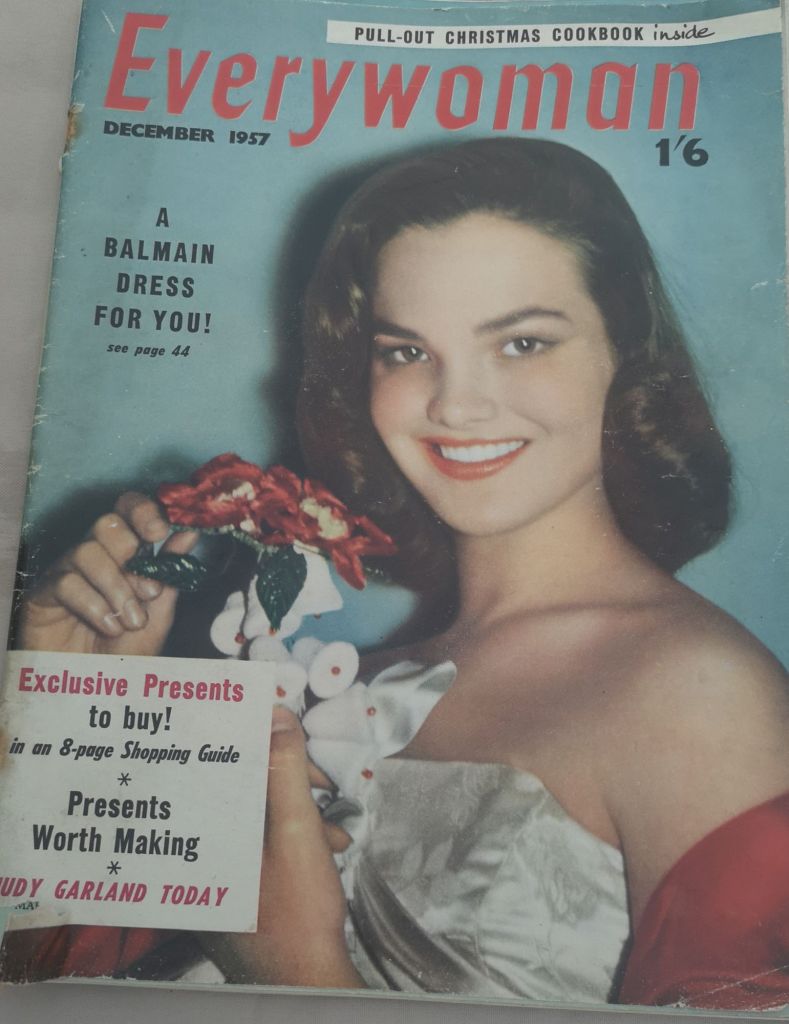
What was 1957 like?
It was the 5th year of the reign of Queen Elizabeth II and on Christmas Day she became the first monarch to deliver the Christmas Message on camera. In politics, Anthony Eden resigned after the previous year’s Suez catastrophe on the grounds of ill health. He was succeeded by Harold Macmillan who, later in the year, commented, ‘most of our people have never had it so good’, instantly paraphrased as ‘You’ve never had it so good’! If nothing else, this strongly suggests that even in the age of deference and respect, truth was as unimportant to the headline writers as it is now.
Until 16 February there had been a ‘Toddler’s Truce’ where the TV channels stopped broadcasting for an hour to allow parents to put young children to bed. The Independent TV channels eventually persuaded the authorities, including the Postmaster General who was in charge of broadcasting policies but who saw the truce as excessive ‘paternalism’ by the BBC, that it was an anachronism. Interestingly enough, in the same month, a future bane of parents’ lives entered UK local government as Norwich City Council became the first authority in the UK to start using a computer! Elvis’ first Number One was All Shook Up which had seven weeks at the top in July and August. The Christmas Number One was Harry Belafonte’s version of Mary’s Boy Child. Perhaps the most significant musical moment of 1957 happened on 6 July when two young men met at St Peter’s Church, Woolton, the two in question being John Lennon and Paul McCartney.
Average wages were significantly higher than in 1950, something reflected in the magazine itself, as we will see. Men were on average earning up to two thirds more than they had been at the start of the decade, with £12 being the average, with women’s wages rising by slightly less in percentage terms, and from a much lower base with an average of £6 6s. Rationing had finished so more was available, and although the teenagers’ increasing affluence was not reality for many in families where the earnings were subsumed within the household income, their spending habits were starting to influence the music that was successful as well as being the key demographic of the very popular coffee shops.
Everywoman 1957
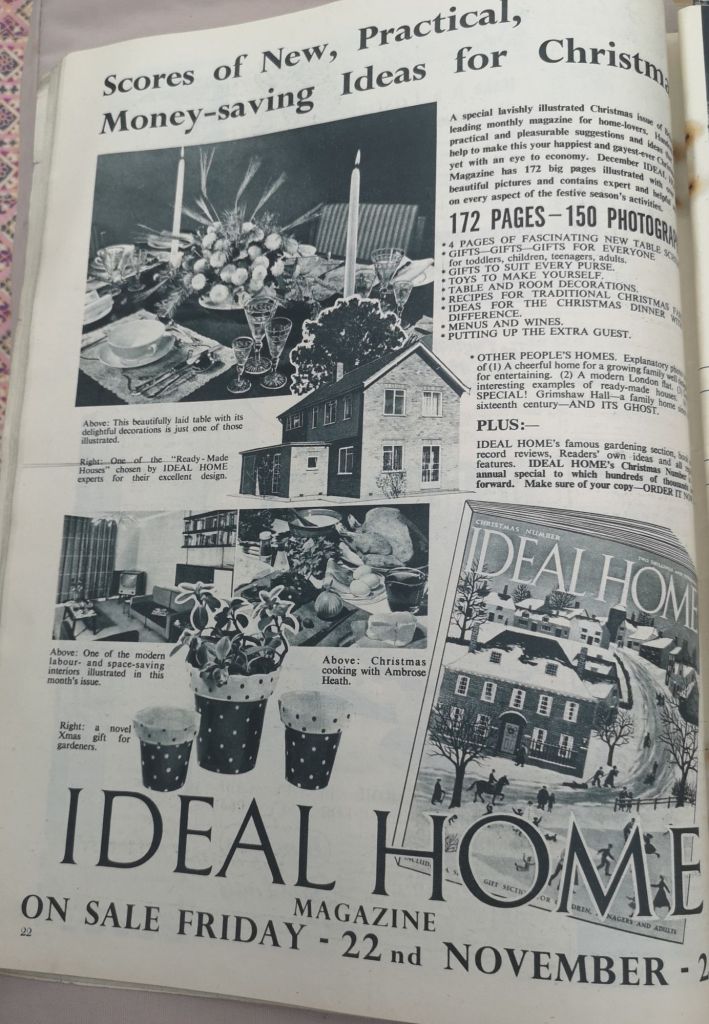
The change in tone and focus between the two Everywoman magazines of 1950 and 1957 is quite astonishing given the reputation of the 1950s as a ‘steady as she goes’ decade. The values of society in 1957 would have been very similar to those in 1950, and even those in 1939, but underneath the surface big changes were happening as this magazine reveals. It is interesting that the Ideal Home magazine, advertised here refers to money-saving ideas for Christmas, much as Everywoman 1950 did. It suggests to me that Ideal Home was perhaps seen as the magazine for the households who needed to be more careful about how much money was spent but who still wanted to have a good Christmas. Everywoman, by contrast appears to have become an aspirational magazine that is concentrating on the ‘must haves’ for Christmas 1957, even if they would not be so uncouth as to use that term!
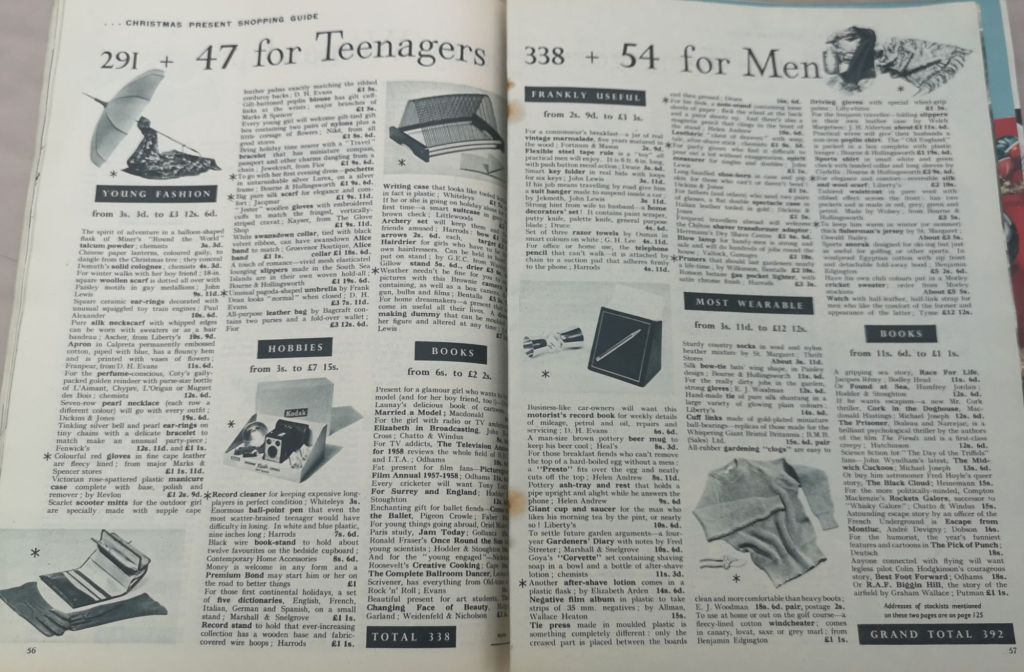
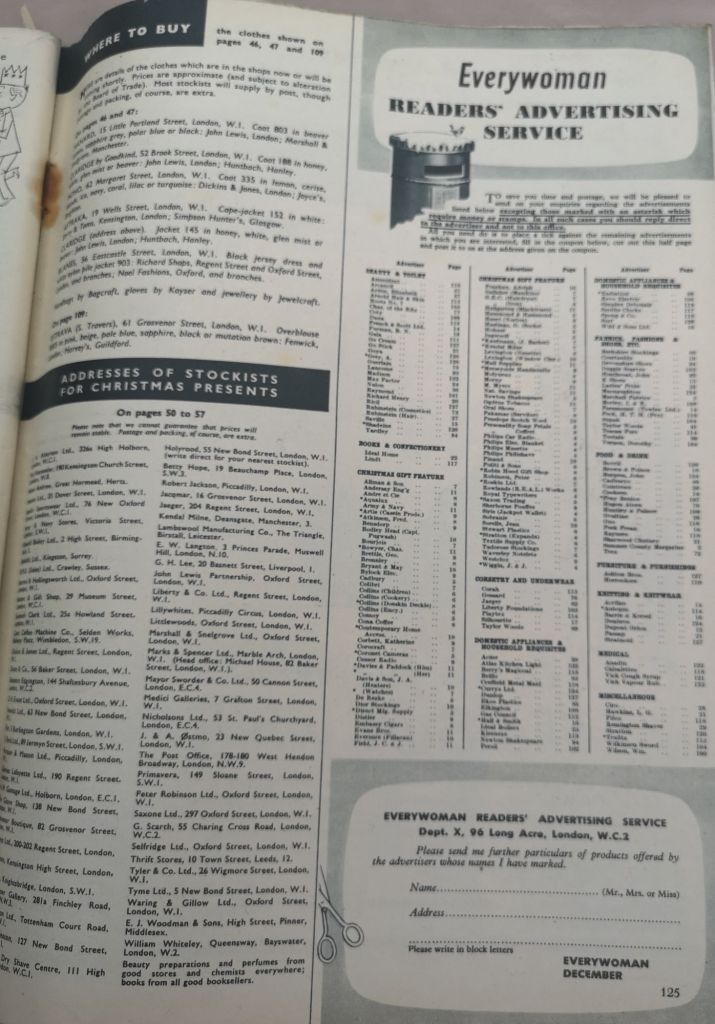
The encouragement for people to observe a traditional Christmas seems to be unnecessary by 1957, so the magazine can head straight into ideas for presents and it does so in no uncertain terms. Its 8 page Christmas shopping guide stretches to nearly 400 gifts. Not quite the Argos or Littlewoods catalogue of my childhood but near enough! Family giving focuses on the practical and useful, the type of gifts you may give to a relative. Then there’s over 100 gifts for children split along gender lines with toys for boys referencing polar and space exploration and for girls flower pots, aprons and a ‘miniature sink unit for the future housewife’! I was going to say that we have left those days behind, but I can imagine some who would happily bring back those dividing lines! Women would have recognised the types of gifts as being useful for the occasional night out, with the more practical items like cleaning appliances no longer suggested as appropriate presents. Teenagers were treated as their own group and some of the ideas like record cleaners and a set of five dictionaries for their first continental holidays certainly hinted at the more adventurous approach of that age group. For men, accessories like a home decorator’s set, motorist’s record book and a gardener’s diary hinted at the traditional pursuits while the clothes were generally about comfort rather than style in a time where the two piece suit was still leisure wear for many who could not stretch to a varied wardrobe. At the end of the magazine, as you will see below, there is a helpful list of all stockists and a coupon to request details for as few or as many advertisers as you wished.
One of the stories is of particular interest as an indicator of slowly shifting social mores. It is the story of Tom, a sailor on leave, and Sarah, a much younger woman who is fleeing the prospect of a loveless marriage. Tom takes her home to a semi-derelict house where he is living, something that would have been unacceptable in the stories just seven years earlier. No surprise that their fling is not consummated – it is 1957 after all – but Sarah tells Tom before they part that if he isn’t at sea or in some distant port next Christmas, she will visit the same house in a year’s time! The idea of the promiscuous sailor was already well known, so to work against expectations like that was very interesting.
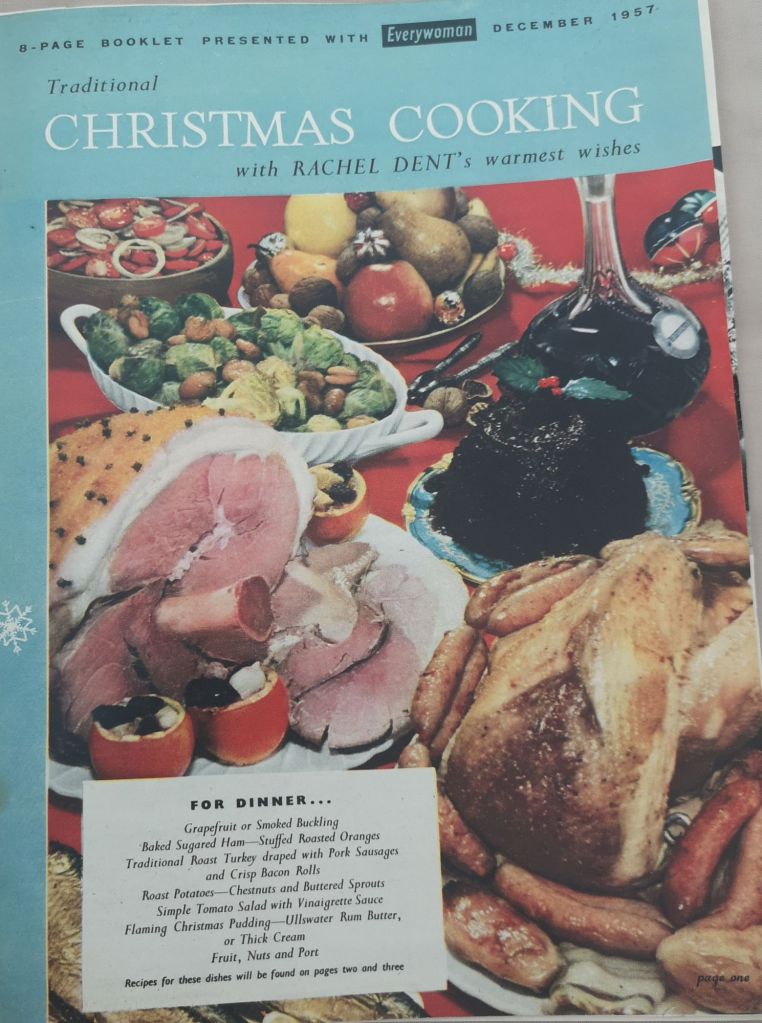
The Christmas Dinner 8 page pull-out was clearly designed to be referred to year after year, and it no doubt was in many households. There is something almost magical about recreating the same recipes every year. It becomes as much part of the Christmas experience as presents, decorations and music. The whole Christmas food needs are covered, Dinner, Buffet, Cakes and Biscuits and Puddings. There are some recipes which would still be worth trying out today. If you’re interested I can share them with you!
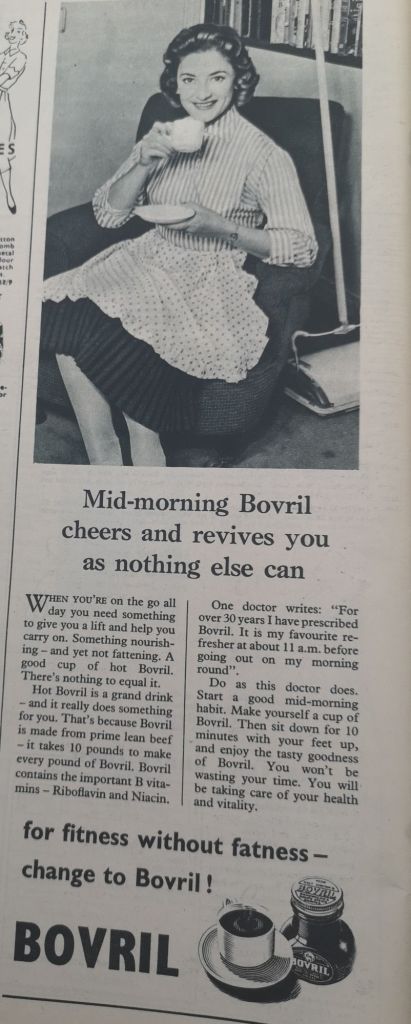
We have already looked at advertisements for presents, but there is one advert from Bovril that shows a very interesting development in the way some women saw themselves. In 1950, Bovril were extolling the virtue of their drink to help keep children strong and healthy. By 1957, they were marketing the drink as a slimming aid. Now that rationing by the government was over, women could choose to ration food for themselves!
Final Thoughts
This is the first of the magazines that is recognisably modern. In its burgeoning consumerist nature, the more realistic characters in their stories and the articles covering celebrities and Christmas hints and tips, it was much more like a magazine of today than its predecessor only seven years earlier. These magazines reflected the society they were writing for, and in 1957 British society was still quite traditional but showing signs of the changes that would be such a huge part of the narrative of the 1960s. How did the magazines of that decade reflect their world? We can find out tomorrow starting in 1965.
What is one thing you would change about yourself?
I have always been a pessimistic person. It is something hard wired into my brain by both genetics and upbringing. My Dad was a very pessimistic person and he always looked at other human beings from the point of view that they were likely to be flawed in many ways. One of my favourite sweatshirts was bought for me by my son and the front reads ‘People Ruin Everything’!! These are traits I have inherited and I have worked on them since. ‘Ah, tis a ponderous chain’ as Jacob Marley might have said!
When something happens, or when I am thinking of doing something new, I tend to catastrophise, playing over in my head all the things that can go wrong, however far fetched they might be! I always assume the worst of both people and situations. I have a couple of pat responses to any comments regarding my approach. Either ‘A pessimist is never disappointed’ or ‘A pessimist is what an optomist calls a realist’. When I first started using these phrases as a teenager I thought I was so clever, but over time I stopped finding them a comfort, particularly when they became a personal cliche. At school, my nickname (one of the nicer ones) was Marvin. For anyone who doesn’t know, that reference comes from Hitchhikers Guide to the Galaxy. It’s a character who is a tremendously intelligent and deeply depressed Android who never expects anything good to happen!
So, what am I doing about it. Well, I have mentioned Calm in these daily prompts a few times and I find it incredibly useful in terms of starting to reset my brain. It’s a long process, and I don’t know if it is possible to reverse a lifetime of pessimism, but I do know that I can see signs of improvement. We are in December, a month that always sees my pessimism diminish somewhat, but in the New Year it just returns. Maybe 2026 will be the year that this return becomes much more muted. We can but hope!
 David Pearce - Popular Culture and Personal Passions