
What Was 1939 Like?
On September 3, of course, Prime Minister Neville Chamberlain announced that a state of war existed between the United Kingdom and Germany. Prior to this, the whole country was switched to a war footing in preparation with the Women’s Auxilliary Air Force and the Women’s Land Army set up and reservists and Civil Defence Workers being called up. These actions were completed by the end of August. It is an event reflected in the pages of the magazine as I will investigate later.
However, World War II wasn’t the only thing that happened during the year. On January 2, 118,557 fans packed into Ibrox to watch Rangers v Celtic in the Old Firm Derby. It’s still the biggest crowd to turn up to a game in Great Britain and, with safety measures being what they are and terraces being a thing of the past, it will never be surpassed. The Sutton Hoo Viking treasure was excavated in the summer of 1939 and donated to the British Museum. Also, Greggs Bakery was founded in Tyneside in this year, and thus the future of sausage rolls and decent priced coffee was secured!
Average weekly wages in 1939 included 38 shillings a week for farmhands who were expected to put in a 50 hour week for 9 months a year, going down to 48 hours during Winter. Members of the Women’s Land Army had their wages set 10 shillings a week below that. Those working in the clerical professions would typically earn between 40 to 70 shillings per week. Shop assistants were low paid by the standards of the time with around 30 shillings a week being their average. Domestic servants would typically receive 15 shillings a week if they were live in and double that if they were not. Miners would typically receive nearer 60 shillings a week to reflect, at least to some extent the danger they faced every day.
Music that was recorded or released in 1939 included Run, Rabbit Run, There’ll Always Be An England, Wish Me Luck as You Wave Me Goodbye and We’ll Meet Again. All four songs became wartime standards that are still familiar to so many people today. One that has been forgotten is I’m Sending a Letter to Santa Claus by Vera Lynn which neatly brings us to the theme underlying this magazine.
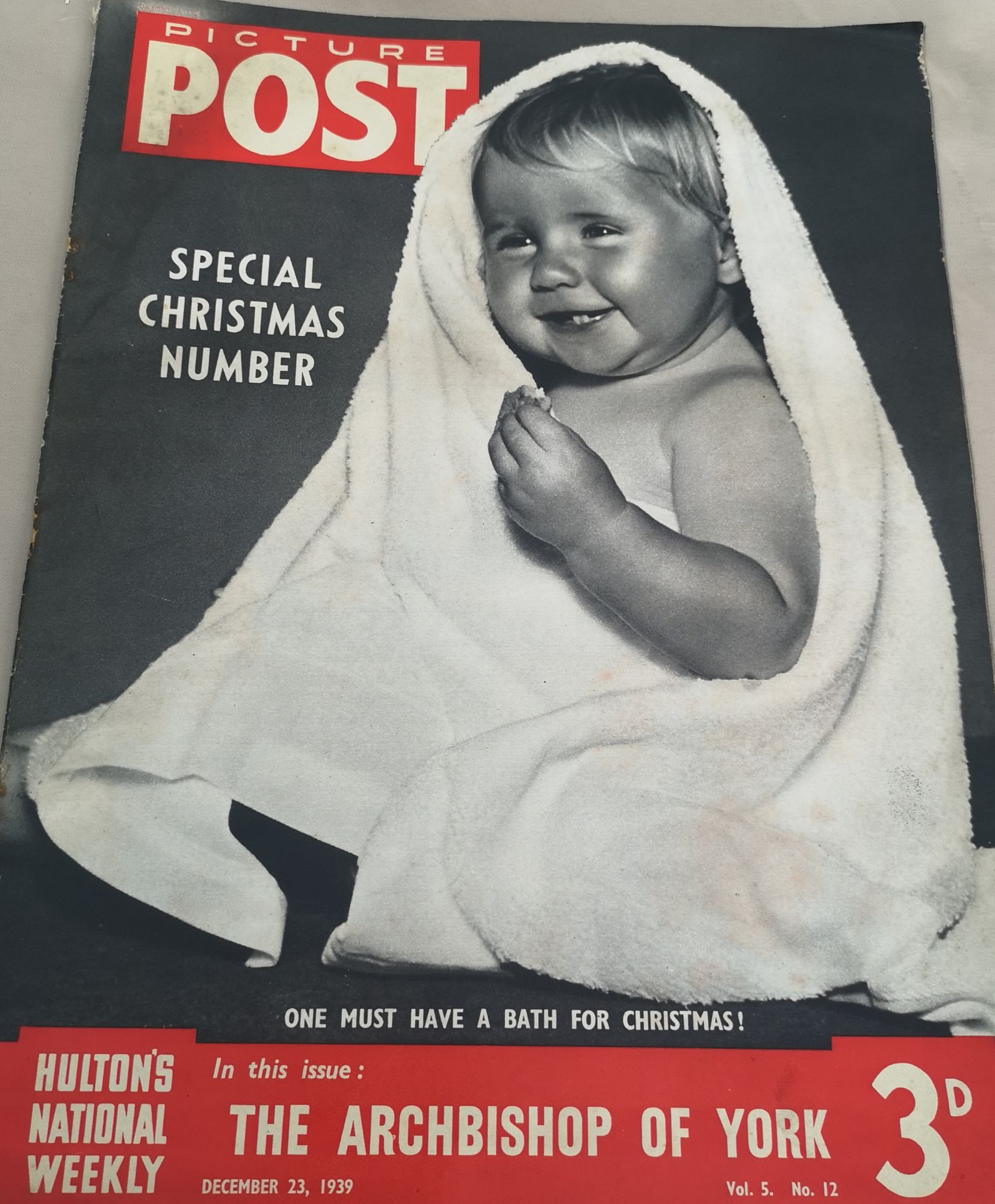
Picture Post 1939
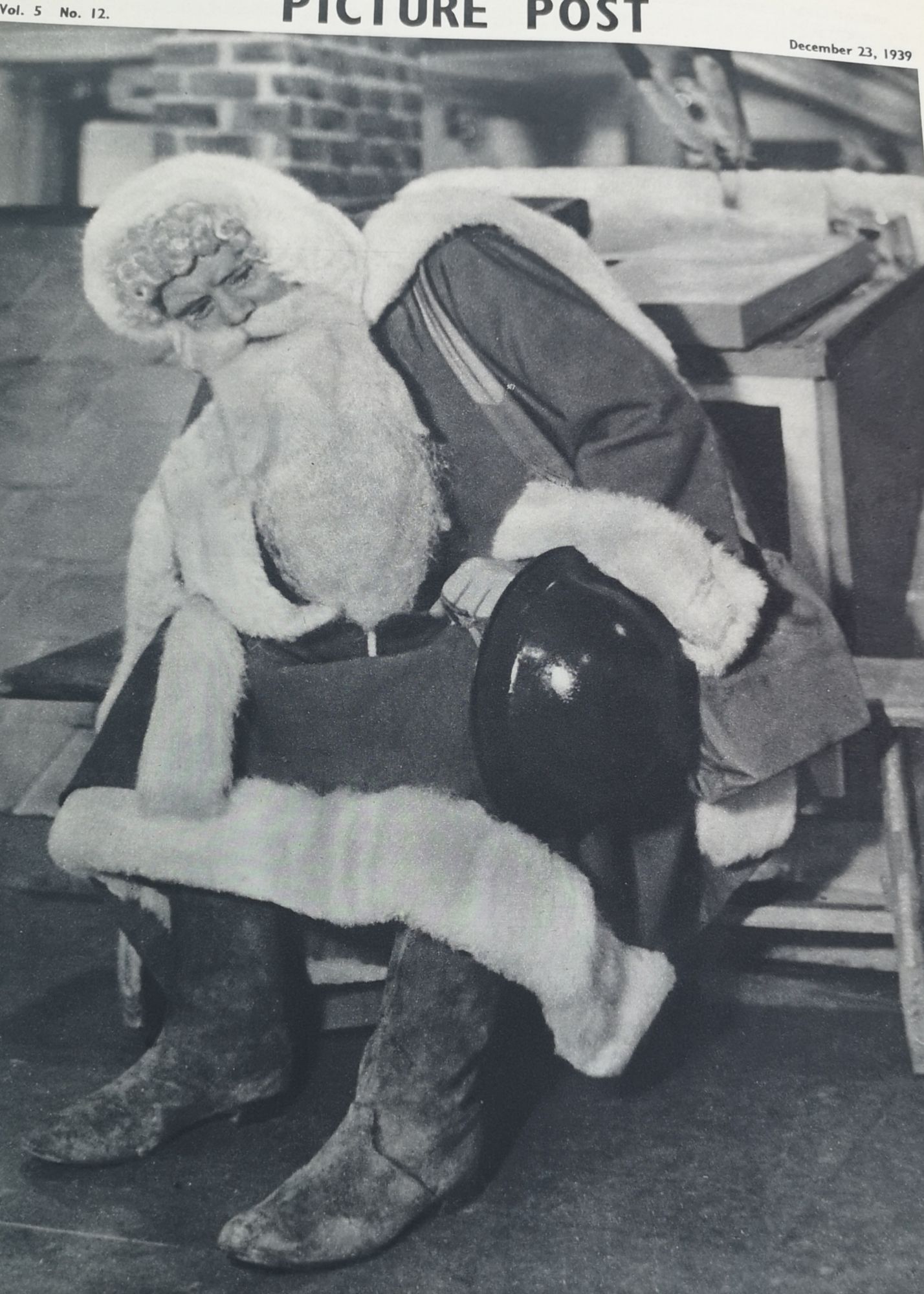
When I saw this on eBay I was really pleased because I was fascinated how the first Christmas of World War II would be treated. It turned out to be far more nuanced in its approach than I was expecting. The imagery of the front cover is, I think, the magazine saying, ‘This is what we are fighting for’. The ideas of innocence and future potential are a message to the readers that the war will be over and we need to protect the future of babies like this. Then, on Page 13 you have the picture of Father Christmas holding a tin helmet. Although war has begun, the festive season must carry on, as it did in World War I. Obviously, no one knew how long the war would continue for, and no one yet foresaw the Blitz which would bring civilians into the new front line. However, that spirit of trying to be as normal as possible shines through in that picture. We then see the Life of Jesus Christ recounted using bible verses and pictures from artists and photographers throughout the centuries. In a far more devout time, this was another way of reminding the readers that there was a higher power that would help and protect the country in its time of trouble.
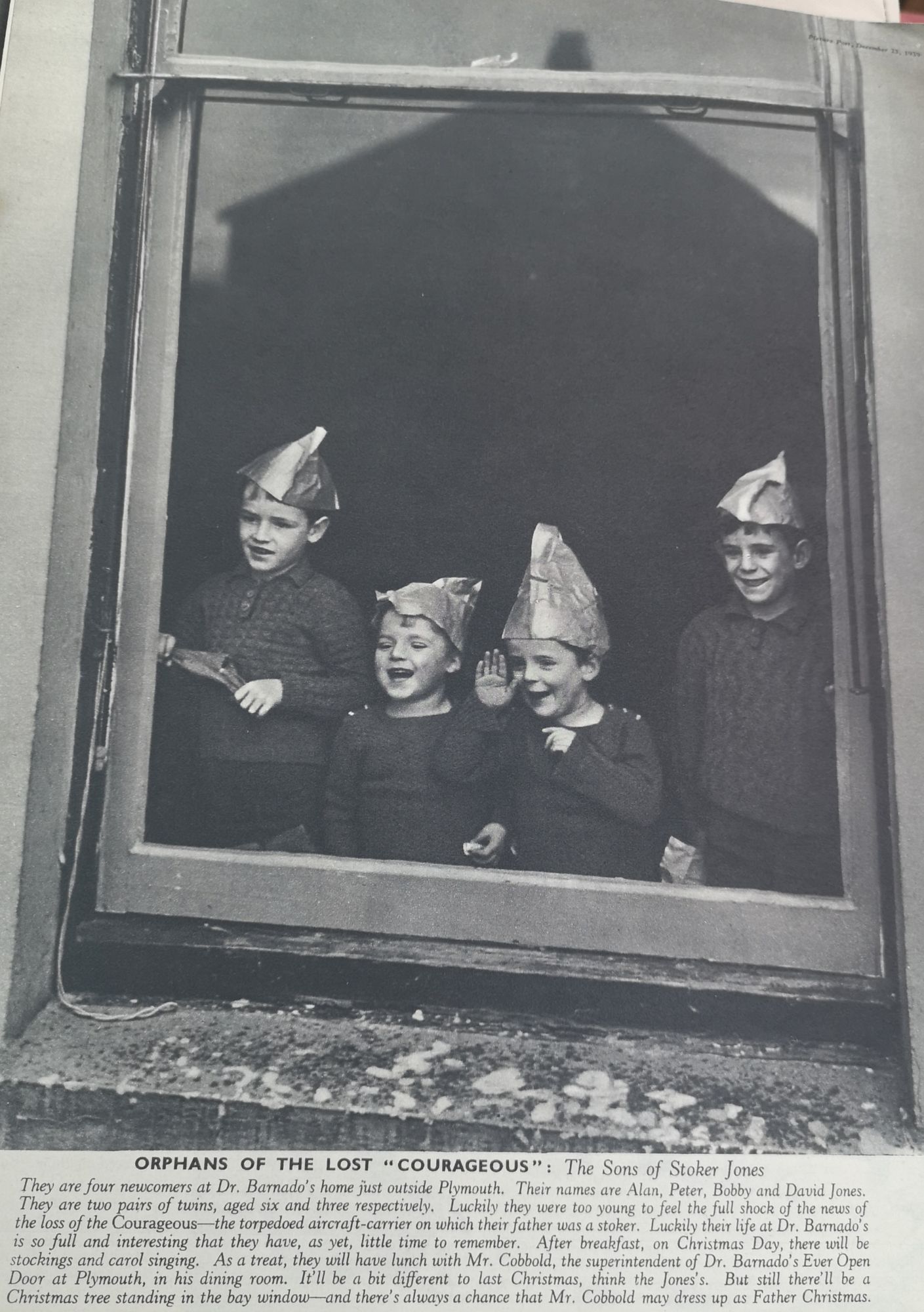
The stories of children in It’s Strange, This Christmas are sobering and upsetting. The picture in the middle of four boys is particularly affecting. They are the four sons of Stoker Jones who was killed when HMS Courageous was torpedoed, and we see them looking through the window of the Barnado’s Orphanage in Plymouth. Maybe the Mother is also dead, maybe she was unable to look after them, but the four Jones boys would be joined by millions of others in the next six years as the war ran its course. At the time, perhaps, they were representative of the way that lives were already being torn apart by Hitler’s evil regime and would have strengthened the desire of those on the frontline and on the Home Front to defeat the enemy at all costs. It is presented in that understated matter of fact way that films of the era tend to have, and is far more impactful as a result. Other stories reflect the Children of men abroad fighting for their country, men who had been injured and men who had lost their jobs as a result of the war. I must confess that I had never considered that people lost their jobs at a time of mass mobilisation.
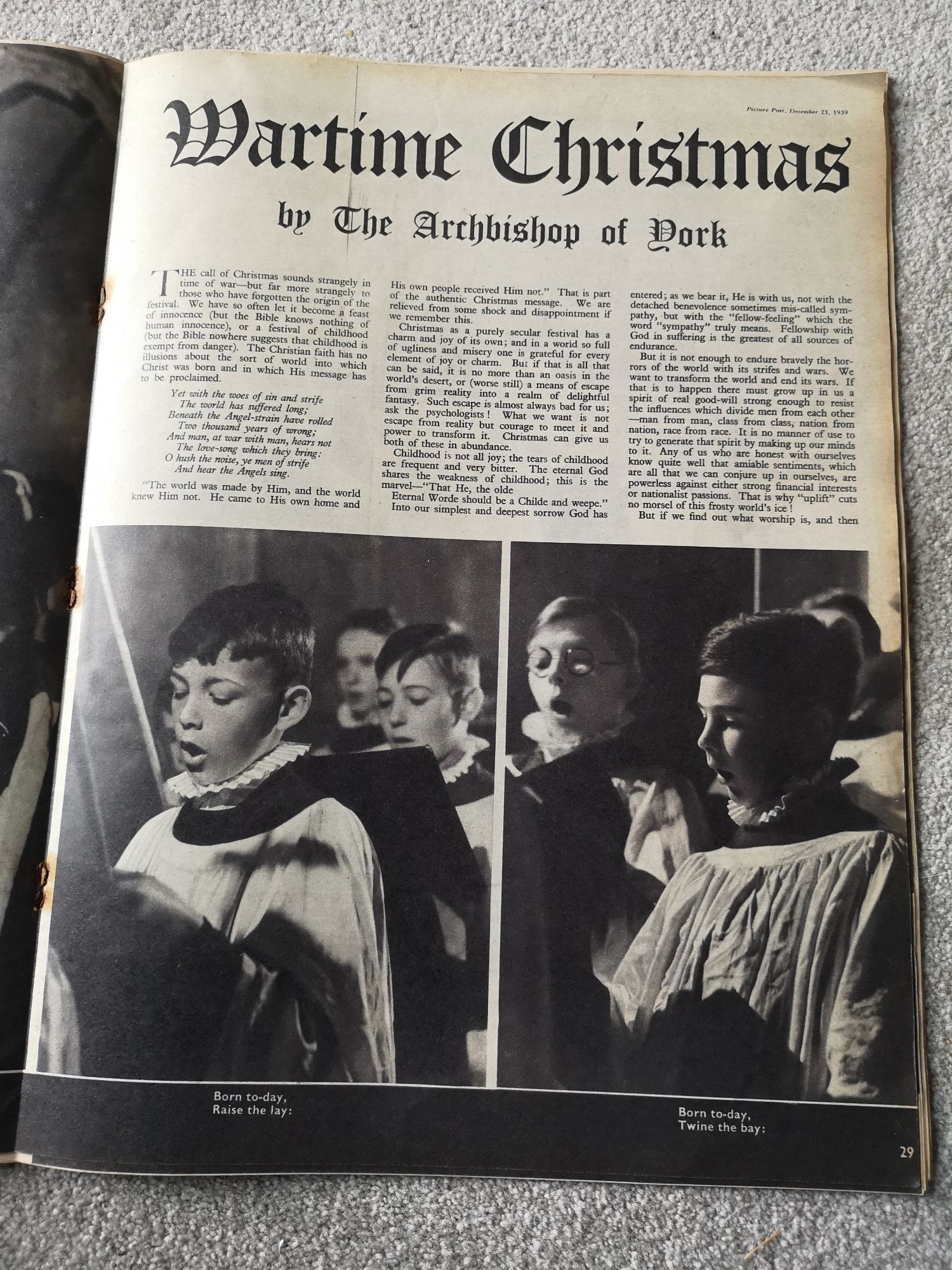
The main reflection in the magazine comes from the Archbishop of York, William Temple who signs himself William Ebor as tradition dictated – Ebor being short for Eboracum, the Roman name for York. It is, once again, very nuanced in its argument, even if, as you would expect, he invokes the shared religion of so many. He refers to the celebration of Christmas, observing that, ‘Christmas as a purely secular festival has a charm and joy of its own’. When you compare that to the language of today, it is very inclusive and tolerant, perhaps because the place of religion is so secure. Later on he treads into even more unexpected territory telling the readers that Christians in every part of the world were part of the same church and who were united by Christmas. He specifically mentioned German, Italian and Japanese Christians, the first two who had already fought against the UK, with the third joining them as a result of the treaty of 1940 that set up the Axis Powers. They were brave words in that context, and it would be interesting to know if they were received with open minds by most of the readership. That readership would have been at the sharp end of the war, the 3d price positioning it as a mass market magazine.
Familiar Brands
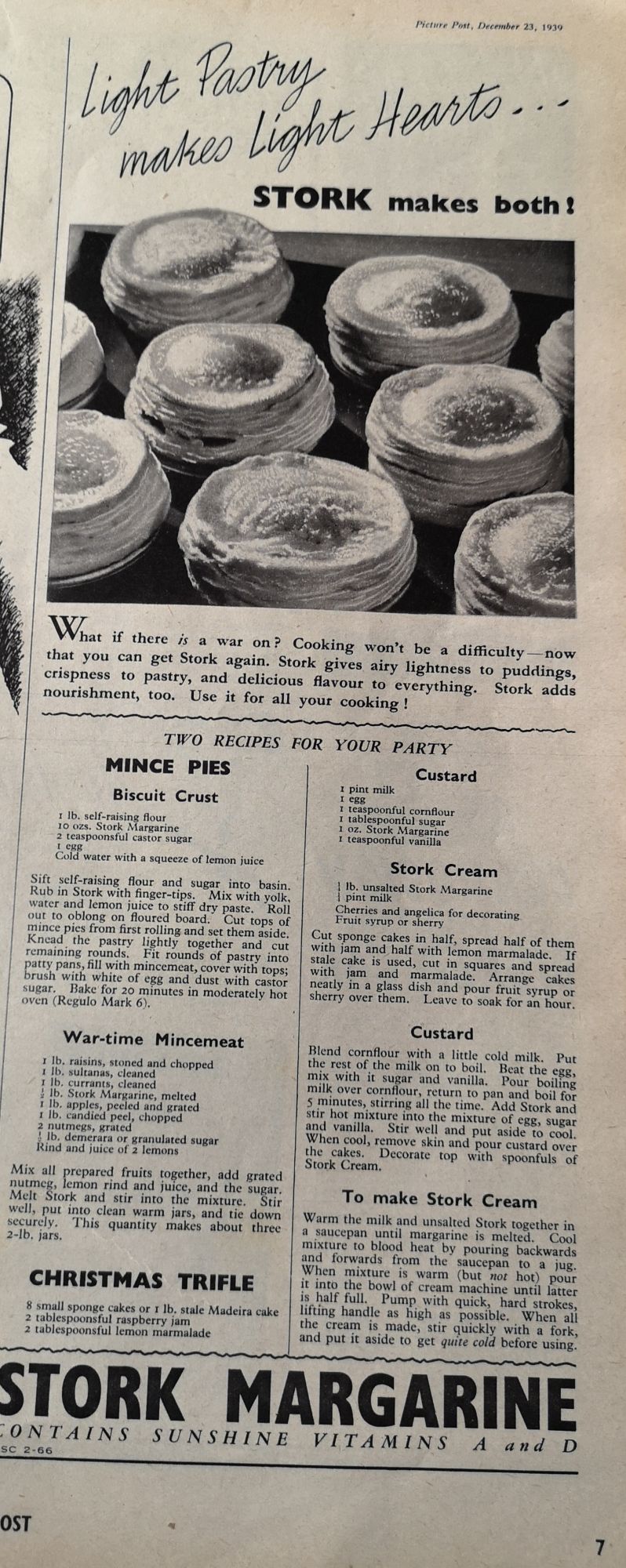
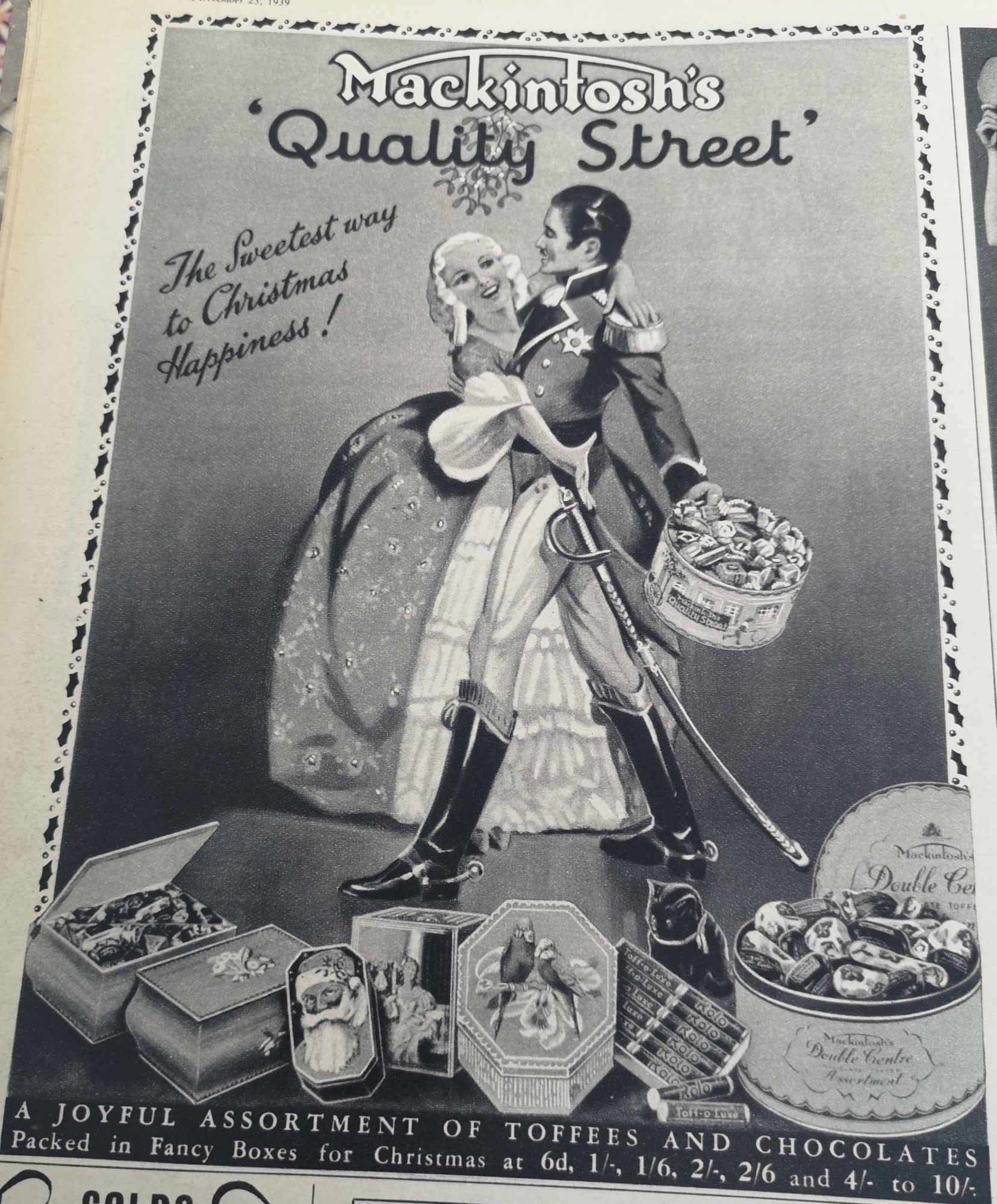
Below you will see four instantly recognisable products being advertised. Stork, Nescafe, Aero and Quality Street are still found in our homes, the latter especially at Christmas time. Stork provides recipes for Mince Pies and Christmas Trifle, Nescafe positions itself as a great tasting instant coffee, Aero as the chocolate that is good for your teeth (!) and Quality Street as the perfect sweet for Christmas. With the exception of Aero, the brand positioning hasn’t changed. The products themselves have of course changed, arguably for the worse in the case of Aero and Quality Street, but the fact that they are still around indicates that despite our complaints they are clearly doing something right.

Final Reflections
The Picture Post of 1939 was as fascinating and evocative as I hoped it would be, but the tone of the articles and the way that British life was portrayed was quite surprising. It wasn’t jingoistic – perhaps that tone came later in the war – and it didn’t seek to use emotion to strengthen its case as I might have expected. However, the restraint and the reportage style make this far more effective than any over the top journalism could ever do. There is a clear lesson for today’s journalists and writers both online and offline.
What are your feelings about eating meat?
I am an omnivore and always will be. However, there are two distinct caveats I now apply to the meat I do eat. First, how much have I been eating recently and second, where does it come from.
When I was brought up, most people had meat with nearly every meal. The Sunday roast was a British staple in virtually every household. Meat for sandwiches, again something I ate virtually every day, was of the highly processed variety. The result was a very unhealthy diet that led to problems with the digestive system at best and high levels of cancer at worst. For me, when I was in charge of my own kitchen I initially followed that pattern. However, I was lucky enough to go to Japan and find a completely different and much healthier vegetable based diet. Once I had got used to it, and I had three years over there to do so, I couldn’t go back to the meat heavy diet of my childhood and early adulthood ever again. Nowadays, we keep our meat intake as low as possible with, in an average week, meat featuring two or three times in our meals.
When times were tougher, money wise, we bought the cheapest meat, which contained poor quality ingredients and which were not manufactured with any interest in animal welfare at any level. The first thing I was able to change was to get free range eggs rather than caged eggs. Even when I did that, and I was an early adopter, I felt like I was taking advantage of poor practices and eating meat that wasn’t produced according to the principles I wanted to follow. So we cut back on meat until we could start to adhere to those principles. Now, every meat product we buy has to have minimum levels of animal welfare. What if we couldn’t afford it? We left the poor animal welfare product on the shelf and looked for a meat free alternative. I would love for everyone who is in a similar situation to me to do so as well.
Just a quick advert if I may! It is now December 1 and I am writing a series of posts for Blogmas featuring a number of Christmas Magazines from 1896 to 2025. If you love popular culture or social and cultural history I really think you will enjoy these articles. Today we go back to 1896.
https://davidgpearce205.blog/2025/12/01/christmas-magazines-through-the-years-pears-annual-1896/
What was 1896 like?
1896 was the 59th year of Queen Victoria’s reign, with the Queen becoming the longest serving monarch in British history on September 22. Robert Paul demonstrated his film projector, the Theatrograph at the Alhambra in Leicester Square on 20 February. Great Britain and Ireland compete at the first modern Olympics held in Athens from 6 – 15 April. Blackpool opened its pleasure beach on April 23. On August 17 Bridget Driscoll became the first pedestrian to be killed by a car. December 11, around the time that people were buying this magazine, Marconi’s early work on radio was being presented to the scientific community at the Toynbee Hall in London.
In 1896, the average weekly wage for a labourer was 13s 9d, but 20 years earlier it was 14s 1 ½d. Not for the first or the last time, the poorest in society found their spending power lowering by the year as inflation and all powerful employers with a huge pool of labour kept them squeezed. If you were a Post Office Clerk you would be earning, on average £90 per year. A Butler, by contrast would be earning in the region of £42 per year despite the very high level of responsibility he would have had. The Duke of Westminster was, as he would remain for the decades to come, the highest earner with an annual income of £250,000! (Facts and figures courtesy of The Victorian Era website at the link below.)
Pears’ Christmas Annual 1896
It really is an amazing piece of history to be able to hold and to read. This magazine was published 129 years ago in a world that, in so many ways, we would not recognise. The overtly moral tone of the magazine would not connect with a majority of the readership today. However, Pears’ soap saw itself as a way of improving the reader by encouraging them to be better both outside, by using Pears’ products, and inside, by reading the uplifting content of the magazine. It’s easy to be dismissive of this approach from our vantage point of 2025, but let’s look at the social and health conditions of the time. Life expectancy was just under 46 for a man and 50 for a woman (Statista.com, 2025). People were living in damp, dirty and overcrowded conditions, causing diseases like cholera to spread extremely quickly. Malnutrition was extremely common as the weekly wages for large families with little money was generally insufficient to buy enough food. Fruit and vegetables were out of the reach of many of the poorest people, as was meat, with potatoes being the only staple that could be counted upon. The average labourer would not be able to read, or would only be able to read at the most basic level so they were restricted to unskilled, often dangerous and frequently backbreaking work.
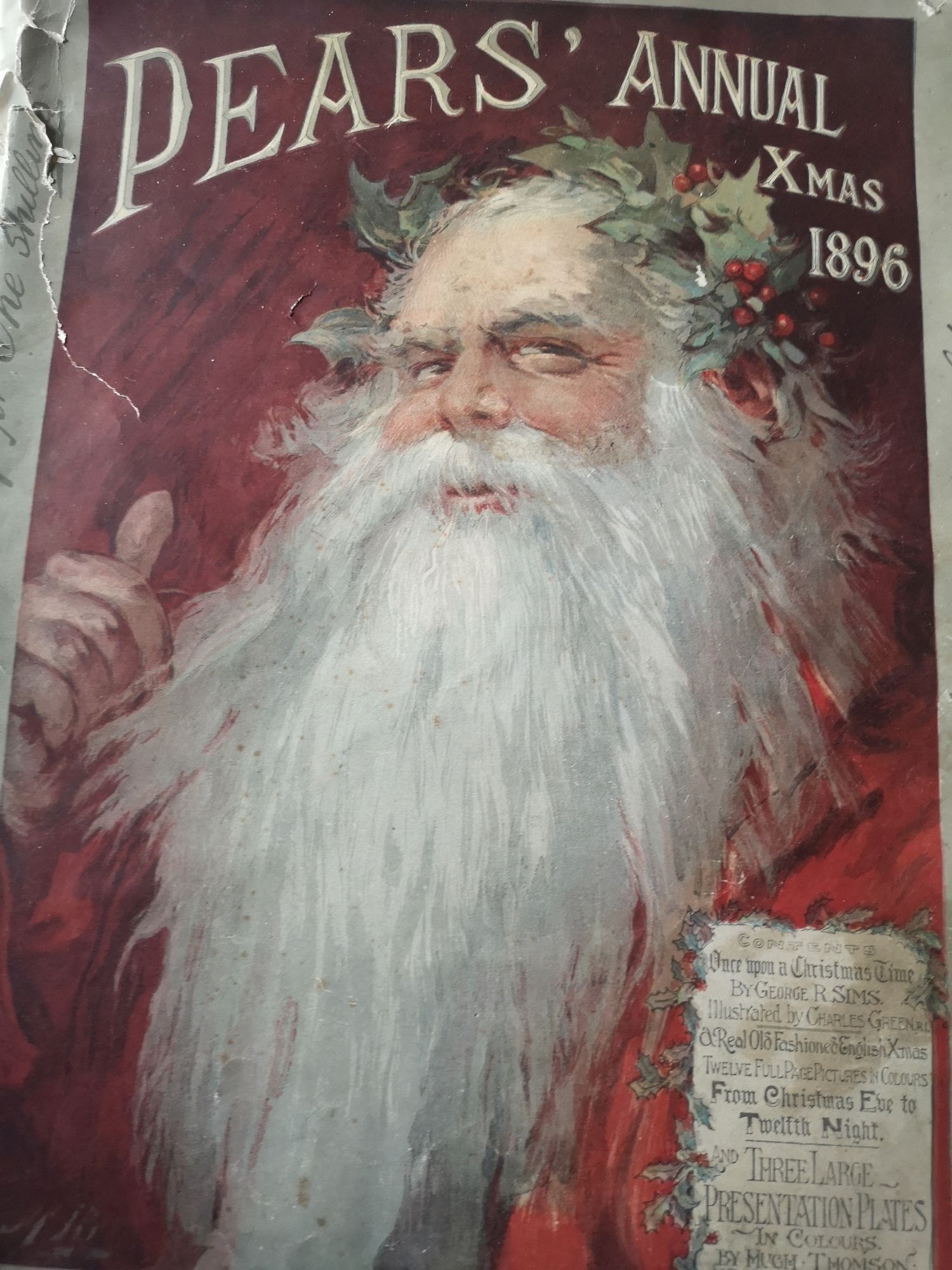
We only need to look at the cover price of the magazine to know that it was aimed purely at the middle classes or above, as one shilling would have been completely out of reach to our labourers. We should also take notice of the cover. It is clearly Father Christmas of course, but look at his clothing. It is red, a full 30 years and more before Coca Cola put him in red robes. It was nice to be able to bust that long standing myth! The content was pitched at readers with a level of education high enough to be able to read higher level language and comfortable enough both financially and materially to be interested in improving their complexions. Women and children were the target audience for this instruction, as, presumably, it was not something that men would have been interested in. So, in common with some of the other magazines I will be looking at, it was marketed to the woman of the house.
Advertising
To look through adverts from days gone by is to see both the differences and similarities between that time and the present day. As mentioned, this was a magazine aimed at middle class women, but it was also aimed at those who were of a higher social and financial level. The set of adverts at the top of Pages iv and v bear this out.
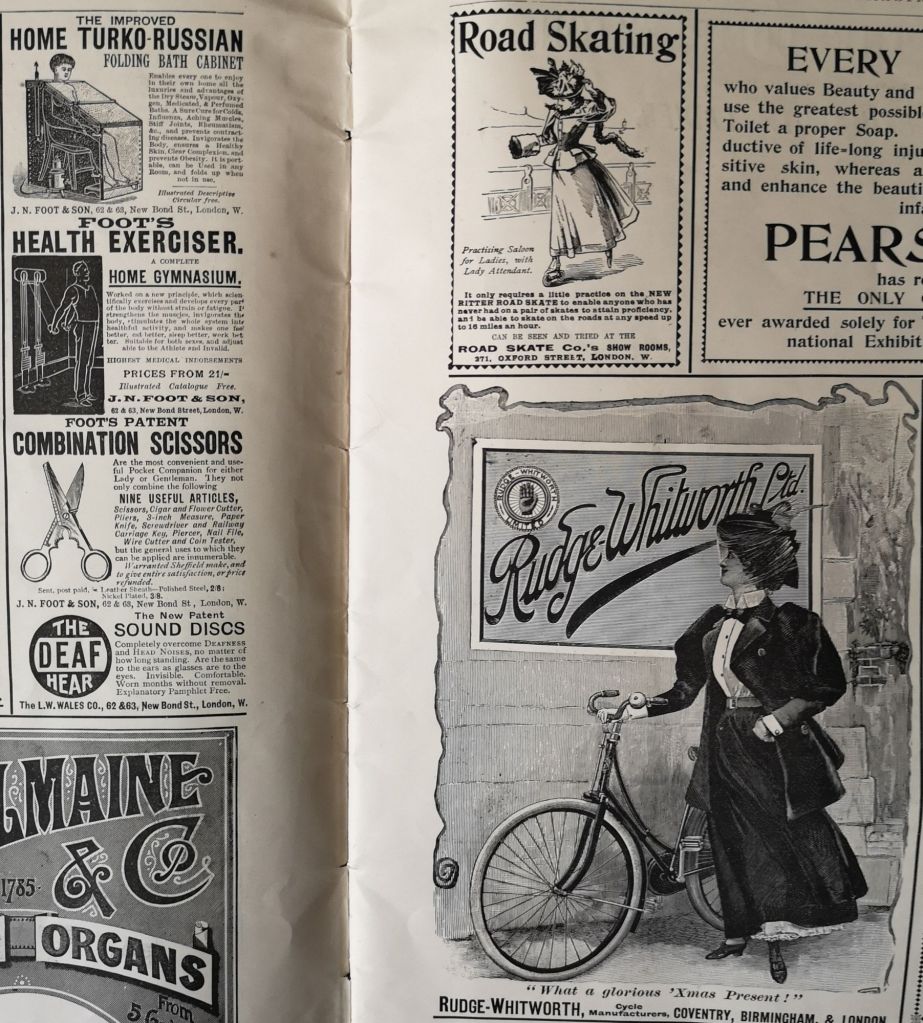
Looking at the variety of mod cons for exercise, bicycles you would expect although the model shown is perhaps more modern looking than I might expect. An early version of Roller skates is more of a surprise. The home bath cabinet is quite similar to what you would see at a modern health spa, and the home gymnasium, though rudimentary by modern standards, would still do the job. Of the three, only the home gymnasium is priced – from 21 shillings – so the idea of ‘if you have to ask how much, you can’t afford it’ was still very much in place for consumers. Also, only the Rudge Whitworth bicycle mentions that it would be a good Christmas present. In fact, a mere handful of the adverts actually mention Christmas. It is interesting that the adverts here are actually, in a sense, lagging behind society at large. Gift giving, which had been traditional at New Year had moved quite substantially, for most in England if not in Scotland, to December 25. Also, it was not, as had hitherto been the case, largely centred around children, as adults had now started giving gift to others. However, the commercialisation of Christmas had been in progress for perhaps 50 years by the time this annual was published, so the advertisers were either unaware of this – very unlikely – or acknowledging to some extent the view that the festival was somehow being cheapened – much more likely, given their professional and still largely church going readership, and more astute as they could present the more acceptable face of commerce.
Familiar Brands
When I was looking through the annual, I counted four brands that you can still find in the shops today, apart from Pears’ itself. Beecham’s were advertising pills instead of powders, but the other three are still famous for the same products. Bearing in mind the economic ups and downs of the past 150 years, that survival is quite amazing.
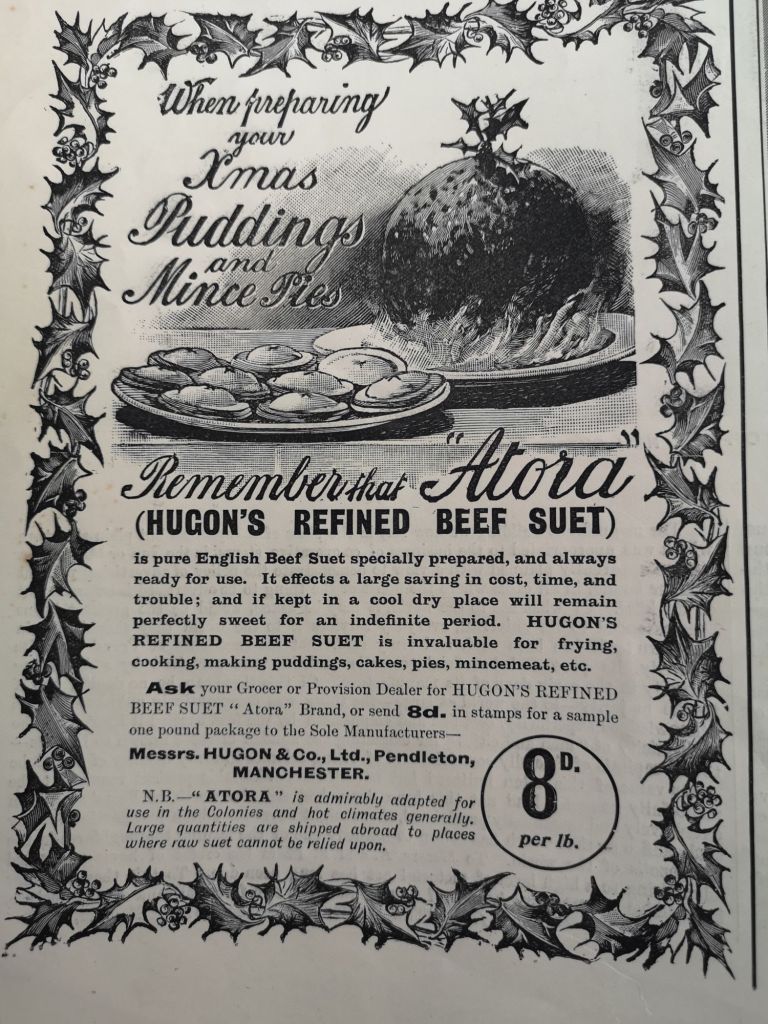
Atora now has Vegetarian Suet, but still makes the Beef Suet featured here. Notice it markets itself as perfect for the colonies. Given the fact that the middle classes often provided administration and other help to the government outposts, this is clever marketing. What better present than a taste of home after all?
The Cadbury’s advert, from the days when it was manufactured in Birmingham, where the owners built their own village for their employees, thereby creating loyalty through a mixture of philanthropy and the fear of losing the roof over their heads! It positions cocoa as a kind of health drink with claims of nutrition and purity.

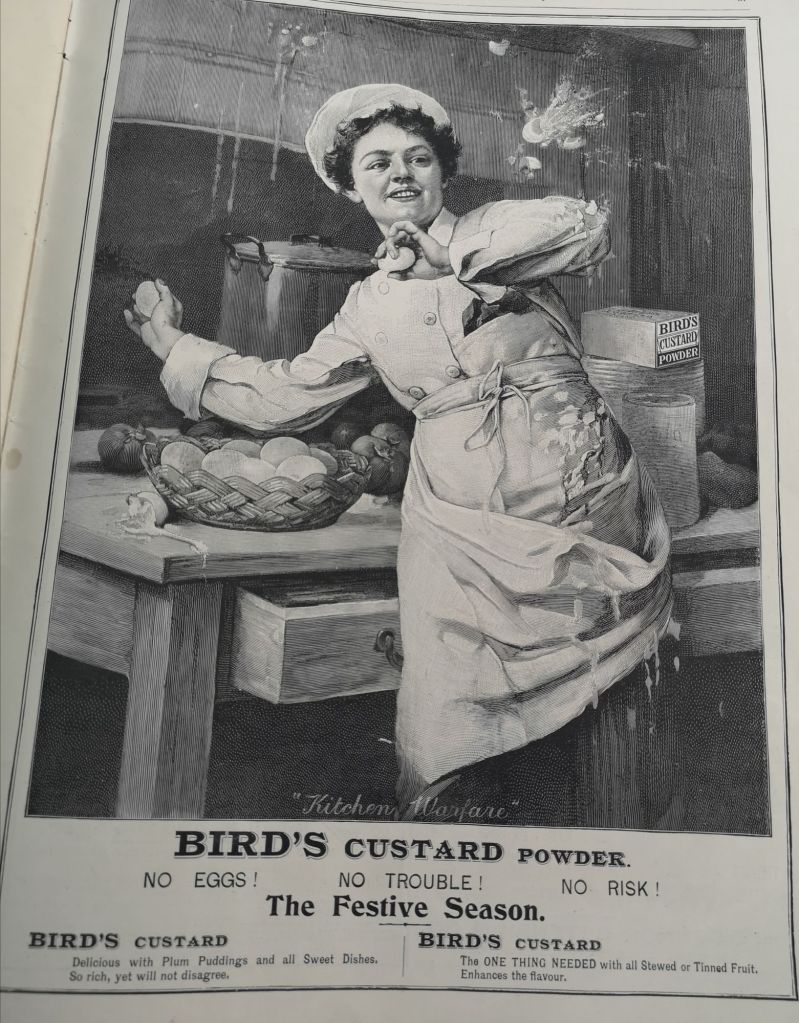
Finally we have Bird’s Custard Powder with an advert that predated the more informal and playful style that was to become much more popular in the decades to follow. Then, as now, it’s irreverent tongue in cheek approach would have made it stand out against its more staid and traditional competitors. That said, you would sack your kitchen staff if they started having egg fights!
The Festival in Stories and Pictures
Very interestingly, this magazine is in two parts. The outside has pages numbered in Roman Numeral style. In the middle we have the real Christmassy part of the publication. The front page is one of 12 coloured plates drawn by artists of the time. Perhaps people could cut out and frame them if they so chose after they had read the story and article contained within. Inside, on Page 2, there is a note to readers expressing a hope that the Pears’ annual, now in it’s sixth year having been first published in 1891, would be a worthy successor to Dickens’ Christmas publications. Along with 12 colour plates, there is a story, ‘Once Upon a Christmas Time: A Story of Yuletide’ by George R Sims, and an article entitled ‘A Real Old Fashioned English Christmas’ by Joseph Gregg. The former can be found from Page 9 ending on Page 31 whilst the latter starts on Page 3 and ends on Page 7. Both of them reflect the seemingly eternal idea that there was a time when Christmas was ‘celebrated properly’! I found the article about Old English Christmas Traditions absolutely fascinating. There are no adverts to interrupt the narratives, hence the necessity for the outer magazine.
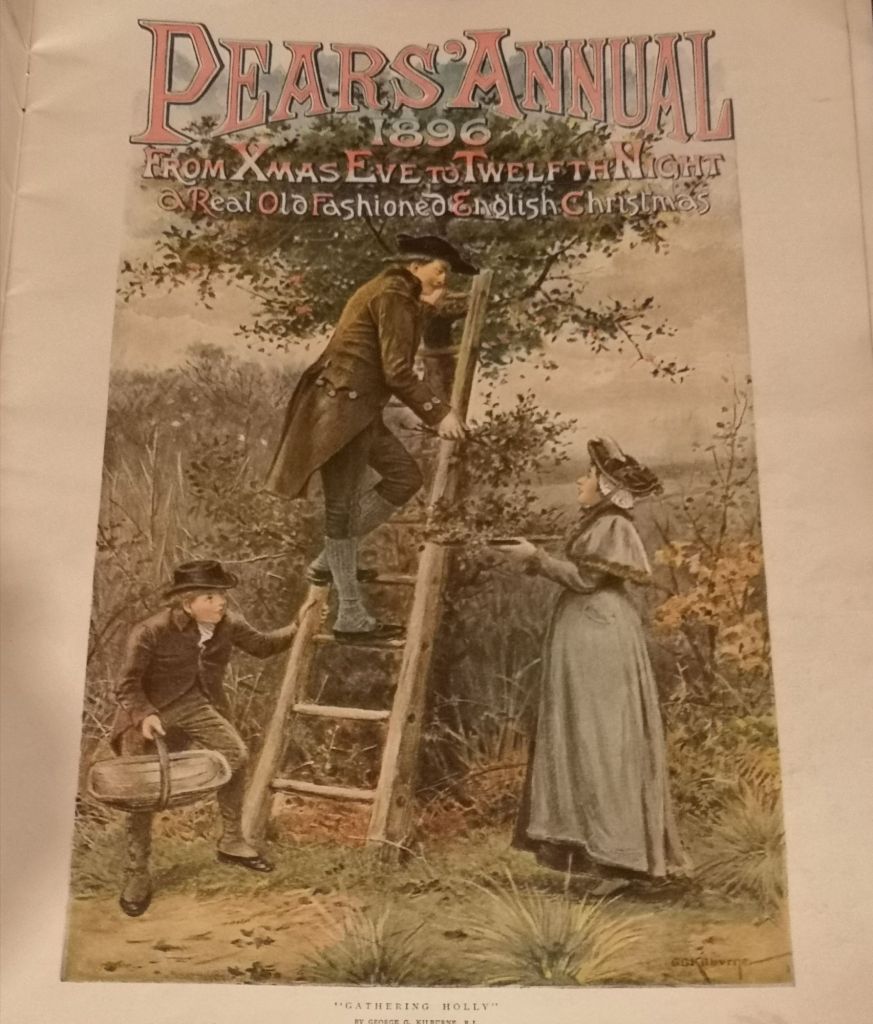
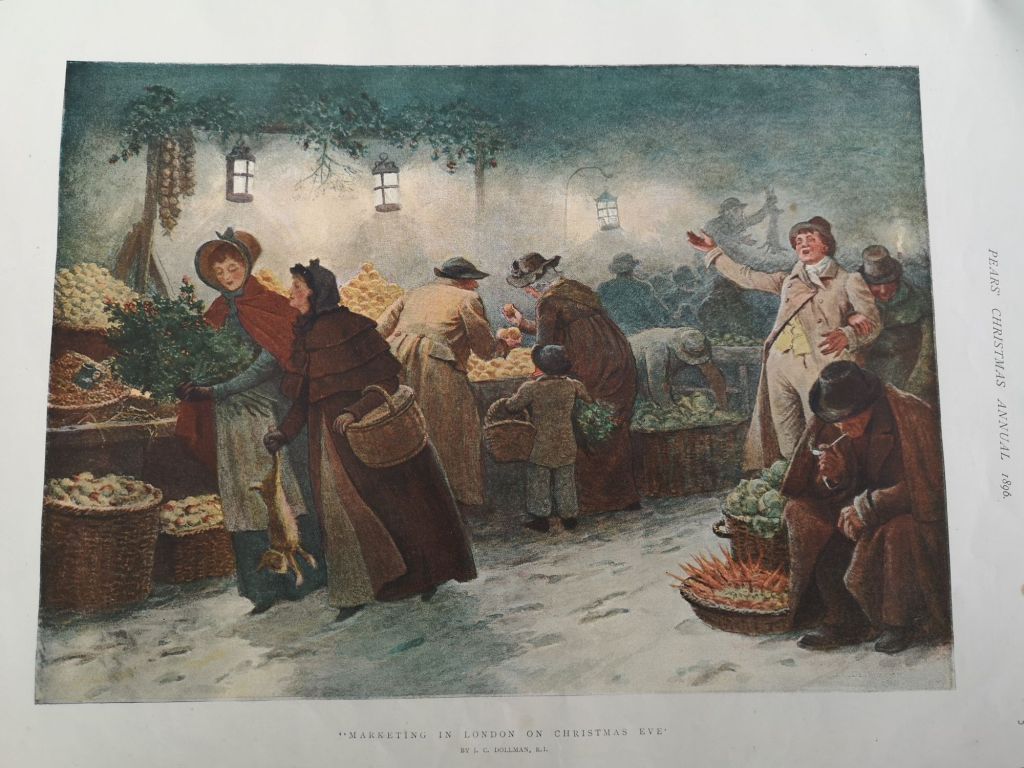
The plates are absolutely lovely throughout and give evocative views of the Christmases of the early Victorian period and before. My favourite plate is the one below, which shows a market on Christmas Eve, and which could have come straight out of the pages of A Christmas Carol.
Final Reflections
So, a late Victorian Christmas was one that we might recognise, if only through different versions of A Christmas Carol. The contents of the outside pages of the Pears’ Annual reflected the then current commercialised Christmas, whilst the inside pull out reflected what Christmas ‘should be like’. It is a contradiction at the heart of the season which has been a central feature for many years, and arguably for a number of centuries. It continues to be so 129 years after this fascinating piece of history was published.
Do you want to entertain/irritate friends and relatives with your Christmas knowledge? Do you have a quiz to set over the next few weeks? If you do, this could prove to be invaluable. 20 facts, well known and obscure, about the Festive season. How many did you know already?
What are your two favorite things to wear?
I always like to wear my learning lightly 🤣🤣! In a more serious vein, I am very likely to be wearing something comfortable rather than something fashionable or sharp. Give me a sweatshirt or a jumper over anything that would be counted as ‘dress to impress’.
At this point in the year I love the fact that I can wear Christmas jumpers for a whole month. They lift my mood and I love their colours and designs. I wore a new Christmas sweatshirt last night when I went with my daughter to watch Love Actually on the big screen in London. It was a Love Actually themed sweatshirt that I love. It’s a quote from the film that anyone who knows it will recognise – Eight is a lot of legs, David!! My daughter got it for me because watching Love Actually is a family tradition that started in 2004 when I took the film out of the video shop in Jannali, New South Wales because I needed something Christmassy. To say I enjoyed it from the first few seconds would not be an exaggeration. The following year, I had bought our own copy, and every year since I have watched the film, initially with Janet and then, as the children started staying up a bit later, with the whole family. I know every joke before it lands but still love them, I know every emotional moment but still get affected by them and I just adore the scene when Sam runs through the airport to tell Joanna that he loves her. Having a sweatshirt is just another example of the way that this one film defines my Christmas.
I say I don’t favour anything smart, but that’s not always the case. I bought a dark green suit back in 1987 for my best friend’s 21st birthday. It cost me a large amount of money at the time, well into three figures, but nearly 40 years on it’s still in my wardrobe and still makes the occasional appearance as I fit into it as well now as I did then! It is a suit that is full of memories of people, places and parties. I love the fact that I still have it.
 David Pearce - Popular Culture and Personal Passions