
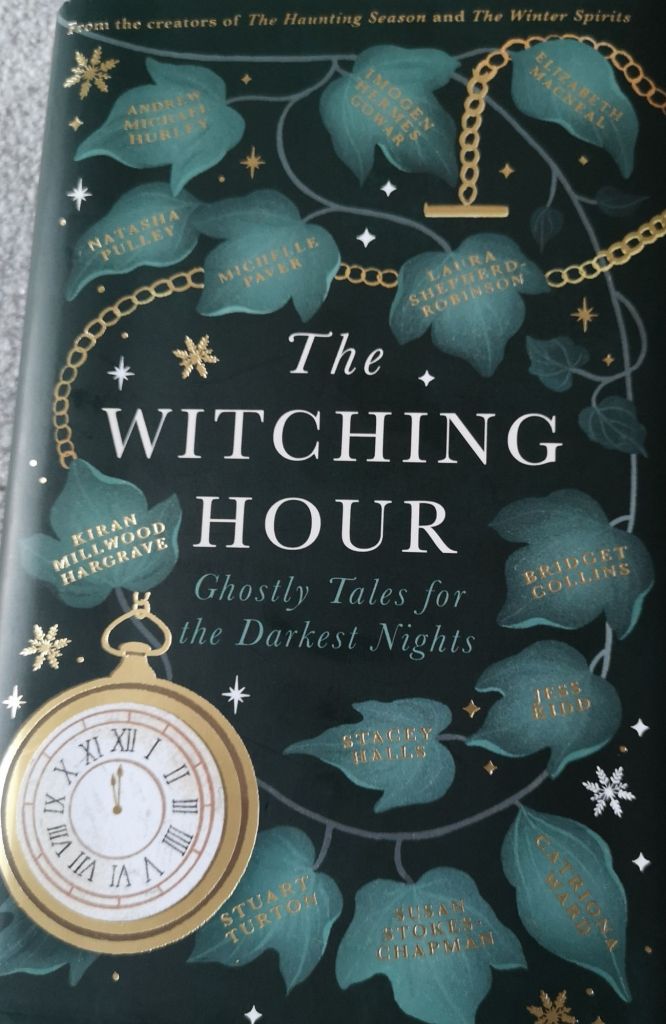
Anthologies by their very nature can be hit or miss. You are meeting authors for the first time in many cases and you will find some to your taste and others will just not engage you. You could read a story, or an anthology as a whole, that you absolutely love, recommend it to someone else and find them ambivalent or worse. However, with those caveats out of the way, I can say that The Witching Hour is probably the best anthology I have read. There are 13 stories, 9 of which I loved, 2 of which I really enjoyed and 2 that were good but, for various reasons weren’t of the extremely high standard set by the other authors. That is an incredibly good result from 13 authors, only one of which I had read before.
The Theme
The theme here is the hour after midnight when, some people believe, the veil between the natural and the supernatural is at its thinnest. All of these tales are ghost stories or stories of other supernatural phenomena. Sometimes the supernatural element is front and centre, sometimes implied and, in one case, a twist that you definitely won’t see coming! With such a broad topic, all thirteen of these tales are completely different from each other, but they all share one thing, a sense of creeping unease that builds throughout the story. Some of the settings are familiar, some not, but each one is fully realised and used in nearly every case as another character. I haven’t been awake at the Witching Hour, apart from when I have been travelling back from a play or a concert, for many years but I remember when I was younger that it was an hour when parties changed tone, conversations became deeper and fears and secrets were often revealed.

My Favourite Stories
I am going to choose three, although it was a very difficult decision. These were the three that left the biggest impact in the days after I read them. They are in the order in which they appear in the book.
The Doll’s House by Elizabeth Macneal
In this story, a young girl called Verity is given the doll’s house of the title by her father who has left on an expedition to the Antarctic. The doll’s house is a near perfect replica of the house they live in, with dolls representing everyone in the house and a tiny leather bound book, representing the diary that he will write in as the expedition makes its voyage towards the Antarctic. In a clever piece of storytelling, Macneal makes it clear that Verity has no wish to play with the doll’s house as she is angry with her father for leaving. We pick up the story a year later, where her only connection to her father has been the letters that have been written to her mother, one of which Verity has taken and put under her pillow. The night she decides to finally take the cover off of the doll’s house, she does so at midnight. As she is investigating the house, she sees that the leather bound book has been written in. It is a diary entry from her father recounting their stay in South Georgia. As well as this diary entry, the map on the wall of her father’s study shows the position of the ship he is travelling upon. On a whim, she pinches the cheek of the Verity doll very hard. The following morning her mother notices a bruise on Verity’s cheek, but when Verity opens the doll’s house the diary is blank and the ship is no longer shown on the map. As the expedition progresses, the diary entries become increasingly concerning as the ship becomes trapped in the ice. Verity is a helpless onlooker until something happens that persuades her she may not be. Is she prepared for what will happen to her though?
This is a story of mounting dread as both Verity and the reader try to find out what is really happening in the doll’s house and what it means for Verity and her family. It is superbly written with little clues sprinkled throughout the story about things that Verity doesn’t understand. There are hints about issues between husband and wife and an odd closeness between the governess and Verity’s mother. What was really skilfully handled was the midnight hour itself when the doll’s house comes to life. At no point did I question the fact that it was happening, and at no point did I suspect Verity of inventing it. I really enjoyed the story and I loved the atmosphere that Macneal conjured with well chosen words.
23 Bridge Street by Stacey Halls
Nelly and Winnie live at 21 and 23 Bridge Street respectively. They are more like sisters than best friends and are as likely to be found in each other’s house as they are to be found in their own. They even have their own signal of knocks to communicate with each other through the thin walls of their adjoining bedrooms. Both sets of parents accept and encourage their closeness and the expectation is that they in turn will raise their own families at 21 and 23 Bridge Street. The two girls do everything together and are absolutely inseparable, until one day when Winnie and her whole family disappear. No one will tell Nelly what has happened, but just after midnight on the day after the disappearance, Winnie’s mother bursts into Nelly’s bedroom asking where her children are. Although this is put down to a very vivid dream by Nelly’s parents, she is sure it happened. She goes next door the following night, intending on using the spare key her parents have, only to find the door is open. She goes upstairs to find the bedrooms empty apart from the cat Clarence who she frees and installs next door. While she is there she hears a loud sobbing coming from Winnie’s parents bedroon, but when she opens the door no one is there. Events become ever more inexplicable including the night loud music plays from a gramophone that isn’t plugged in. Finally there are knocks from Winnie’s bedroom using their secret code, but when she goes round, no one is there.
This was my favourite of the thirteen stories. Beautifully written with a perfectly judged combination of fear and love, I instantly felt that I knew Nelly and Winnie. Their relationship reminded me of Miv and Sharon from The List of Suspicious Things by Jennie Godfrey and is so skilfully drawn that Winnie’s disappearance hits the reader straight away. The ghostly goings on are tied to the love between the two girls, although not in the way I thought. The reveal was a complete shock to me, but looking back at the story it made perfect sense. I will definitely be reading Stacey Halls’ novels having been introduced to her in this collection and I hope that somewhere in one of them we may meet the wonderful Nelly again.
Two Go Together by Imogen Hermes Gowar
This story is centred around Mr Peachment, a coffin maker who is asked to attend a house where a young child named Snow has died. The mother has been ostracised for having the child out of wedlock and not named the father. She is determined to have her daughter buried in a proper coffin so she called Mr Peachment rather than have a pauper’s coffin. As Peachment is setting to work on the coffin he reflects upon the invariable rule that his father, also a coffin maker, brought him up with, ‘Two go together’. This says that the first person who dies will wait until they can be accompanied to the next life by another who will follow quickly afterwards. Mr Peachment starts to see Snow’s ghost in town and becomes ever more troubled. Who will accompany Snow on that journey? Will the injustice of the treatment the town gave her in life be assuaged after death, and what will happen if the identity of the father becomes clear?
This was a superb piece of writing, full of pain and compassion alongside a genuinely unsettling story with an excellent denouement. I felt deeply sorry for Snow and saw the truth of human nature through the ages with small acts of compassion surrounded by judgement and discrimination. It saddened me that I could still imagine something similar happening today even if the catalyst would be different. The issues were both central to the story but incidental to the power of the concept. Two go together could have been effective with any initial death, but it would not have achieved such a deep impact if it had been anyone other than Snow.
Final Thoughts
If, like me, you want to read an anthology but have always been somewhat disappointed by their unevenness, you can rest assured that these 13 stories, all written in 2025, will contain far more hits than misses. You may not react to my three stories in the same way and you will almost certainly have other favourites, but as a collection this is as strong as it gets. Happy reading.
The link below is from bookshop.org which champions independent bookshops but, of course, other stockists are available
In what ways do you communicate online?
I first started using the Internet back in the early 2000s. At that point it was still very much a niche pursuit and in the very early days I just used it to buy online invariably from Amazon. When I moved to Hong Kong I used it to keep in touch with people in the UK and the US mainly via Facebook. After a while I started using it to take a DELTA course which really helped my EAP teaching, but because it was online was never accepted by any organisation, even though the content was excellent. Once I discovered Friends Reunited I added it to my communication repertoire. That and Facebook enabled me to keep in touch and get back in touch with people. Along with that I enjoyed using chat boards to talk about books and films.
Looking back to 20 years ago, communication online was there for the purpose of sharing ideas with people you often didn’t know and for reminiscing on a shared past with people you did. The anger, controversy and rage bait approach that we have nowadays was practically unheard of. Of course it existed but it was very occasional in nature whereas now you end up seeing it everywhere. I think I first noticed it when I put a couple of books on Kindle and some of the comments were very unpleasant. I would not write negative reviews for other people and I couldn’t understand the obvious delight that others took in trashing other people’s efforts. If you don’t like it, just move on, especially when it is fiction writing as something that you don’t like will be something someone else does and every writer puts heart, soul and effort into every book. It stopped me from writing fiction and moved me on to writing reviews and reflections which actually suit me much better.
Sadly, human nature being what it is, anger, spite and abuse was always going to rear its ugly head. The people in charge of huge tech companies became more and more unpleasant, attaching themselves to ever more authoritarian politicians who hated those who disagreed with them. It’s now reflective of the worst of human nature and I do miss the old days of the Internet where nice people were the majority of users. I do still value little areas of the Internet like this but they are few and far between. As the sweatshirt I am wearing today says ‘People Ruin Everything’! The Internet was always going to be ruined and the only surprise was that it stayed nice for so long.
Think back on your most memorable road trip.
I don’t take road trips for one simple reason. Being in a car is never an enjoyable part of the holiday particularly given the extreme congestion and increasingly aggressive behaviour of other road users. However, it’s not just cars. My family will treat travel to a destination as part of the holiday, whether that be by train or plane. For me, it’s a necessary evil. The holiday never starts until I get to the destination, and not fully until I get to where I am staying. I dislike travelling to and from a destination because I see it as completely wasted time.
Airport terminals, quite apart from the concerning double meaning (!) are awful places. People are generally eating and drinking to stave off boredom, the shops are over priced and lacking in quality for the most part. I just look to get through the process because it’s never enjoyable for me.
So, you can keep car drives, plane flights or train rides. If I could invent one thing it would be a teleporter that would get me to my destination immediately so I could avoid the tiring and tiresome process of travelling to somewhere I would like to go.
What snack would you eat right now?
As I am writing this at 7.44, I would not eat anything at all. I can never eat before 8am and breakfast is often later. When I was commuting I would not eat breakfast at all. I would have a Breakfast Bar at work either between 9 and 10 if I wasn’t teaching or at the break in the lesson if I was. That would be it until lunch, although if I had a packet of crisps or cheddars I might dig into them at about 11. If someone bought in sweets, chocolates or fruit they would be put on the table by the staff room door I would generally grab something on my way past every time I had to use it! Work tends to be a snack filled space because the environment is often stressful and sometimes unpleasant and workers need something to make them feel valued at least temporarily.
Home can be a very snack filled environment, but I have a rule which I stick to very closely which is not to have a snack before midday. This is helped by the fact that I don’t have breakfast until around 9am, because I never feel like a full meal before that time. After lunch, I may have a handful of raisins or some biscuits, but I usually manage to keep to what I ate at lunch. By the evening I have had a full dinner and after dessert I don’t generally want anything else.
I have one big weakness, my wife’s baking! If there is a bun or similar in the tin I am very likely to grab one on a whim, but I know that as far as baking goes these are incredibly healthy. There is half the suggested amount of sugar and no preservatives. When I tell people that Janet only uses a relatively small amount of sugar they wonder if it just tastes bland. I can assure them that it doesn’t because there are sweet spices in the buns to give them a real hit of flavour. Today I am going to snack at least once because Janet has just baked a batch of mince pies which are my absolute favourites!!
The writing of a sequel to a well loved novel is fraught with danger for the author who takes a chance on imagining where the characters will be after the end of the original, where their motivation lies in dealing with different situations and how to deepen those characters whilst remaining true to the originals.
I started my reading year by reading a sequel to my favourite novel. It was quite frankly appalling. The characters bore no resemblance to the originals, their situation a decade on from the original novel was so at odds with the way they had ended the story and they might as well have been a completely different set of people, as indeed they were. By tying them to a much loved original, the author guaranteed sales but it was a badly plotted travesty of a novel. I lasted two chapters and it went straight to the charity pile where some poor unfortunate may pick it up!
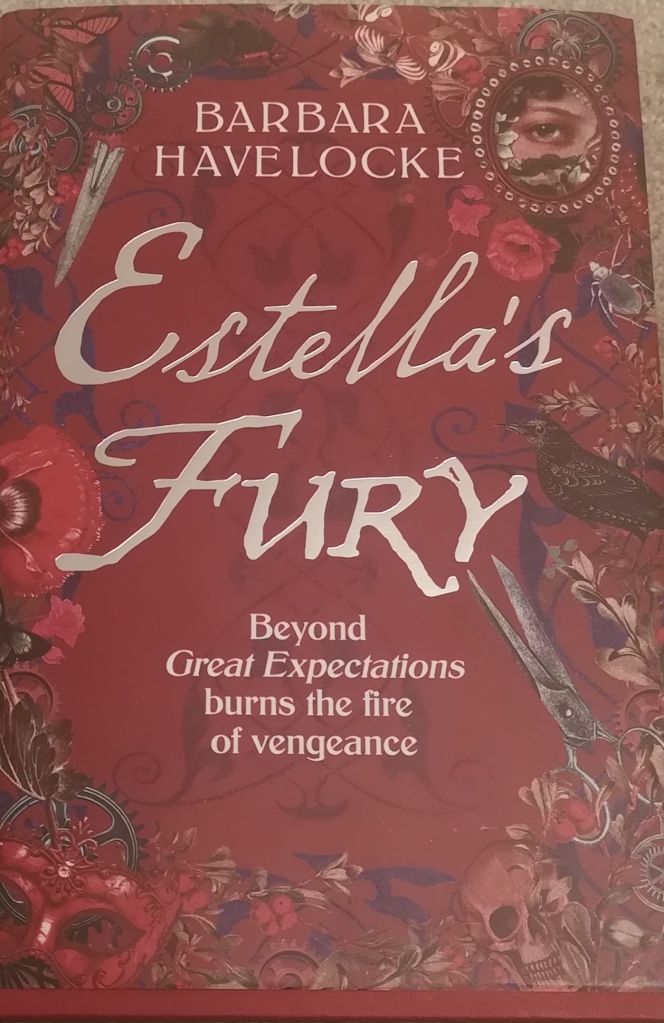
Luckily, my second novel, based on a story by the same author was Estella’s Fury, featuring Estella Drummle (Havisham) from Great Expectations. This is the sequel to Estella’s Revenge, which you should read first if you haven’t already. I went to an evening with Barbara Havelocke where she explained her deep love for the novel and its characters and the reason why she wanted to revisit the story of Estella as she moves away from her adoptive mother and into marriage. In the Q&A I asked if she had changed her view on any of the characters and she mentioned Jaggers, the very complex lawyer whose motivations and loyalties appeared to be unfathomable to everyone around him. We meet Jaggers again in this novel, and he plays a very important role in moving the story along.
The Story
Estella has been taught from a very early age that the male of the species is not to be trusted. Indeed, Mrs Havisham shaped her as a weapon against them, instructing her how best to hurt them and giving her Pip to practice upon. As she enters higher society through her unhappy marriage to the vicious Bentley Drummle, she realises that the higher the society the worse the men become, because they have no one with the power to rein in their behaviour. She decides that she will become the weapon that her mother always wanted her to be but perhaps even more deadly than her mother can possibly have imagined. After the events of Estella’s Revenge, she decides that she needs to move away from the extreme vengeance she has dished out, and to fit her behaviour more to the expectations of society. She goes to visit Lady Elizabeth Taykall, one of her closest friends and the wife of the much older Sir John Taykall. When she gets to Wynterton Manor, their home, she finds a place of dark secrets that frighten everyone both above and below stairs. She is assigned a young girl called Nora as her lady’s maid and she builds a very quick bond with her. Nora, however, is frightened by a threat that she cannot bring herself to talk about. When she disappears and that threat becomes all too real, Estella starts to investigate, not knowing that this investigation will lead her into danger and reach the very highest echelons of society. As well as this, she will have to face her own past in the most shocking way imaginable as she realises that someone else knows her own most dangerous secret.
My thoughts
I have been going through a lull in my reading, but Estella’s Fury has completely overcome it. The novel has short, sharp chapters that do not waste a word and the action moves on quickly and keeps the reader on the edge of their seat. It is almost certainly the style of novel Dickens himself would be writing if he was a modern day author. He wrote as he did because that was what Victorian readers wanted, and he would have been just as great today because he would have adjusted his style to the market. The story is different from Dickens only in the lack of humorous characters like Wemmick’s Aged P, but this is not that type of novel. Other than that, all the characters have stepped straight from the pages of Great Expectations or, as in one particular well judged scene, Oliver Twist. The ability to deepen these characters so effectively is quite amazing at times, with Jaggers in particular having the hidden past and present, to which Dickens alluded, developed in a way that makes the reader say, ‘Of course! That’s what happened.’
I cannot recommend the Estella novels too highly. The third one, which I hope will not be too long in arriving has a number of threads left loose from Estella’s Fury, but with Barbara Havelocke’s incredible knowledge and feeling for the original characters she could easily leave those threads to a later novel. I hope we see Pip again, but if we do it will only be because it serves the story and that assurance is rare indeed in the writing of sequels to original novels of the past, and indeed in the wider literary world. Here’s to Estella, a thoroughly modern character in a thoroughly realised past.
 David Pearce - Popular Culture and Personal Passions