
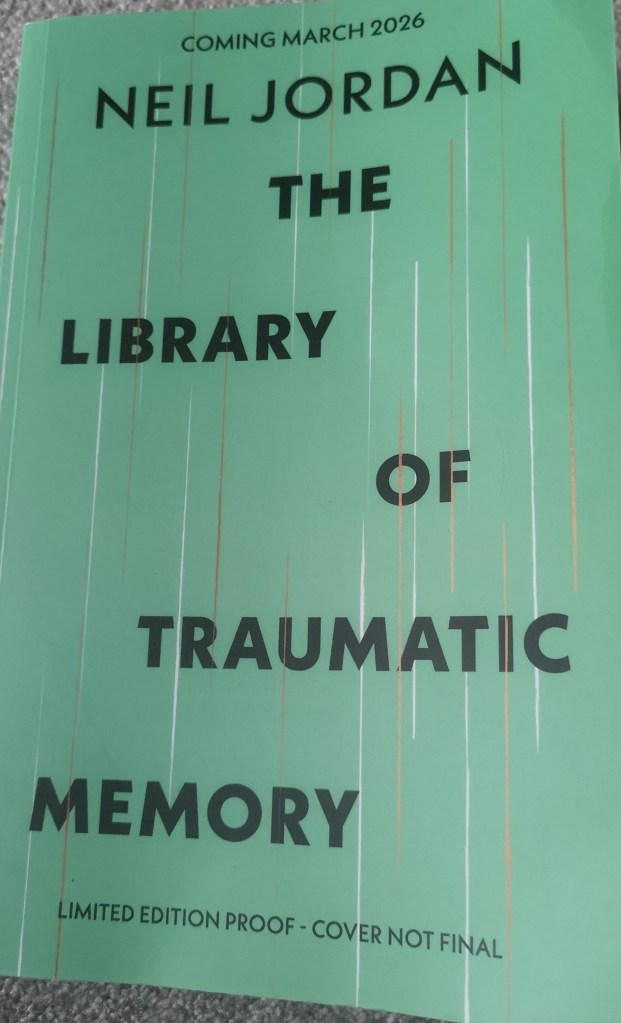
Often, when you read a book written by someone who has become famous in another area of sport or culture, you are left feeling, at best, underwhelmed. Your abiding impression is one of a person stretching their abilities just a little too far. This is emphatically not the case with film director Neil Jordan, famous for films like The Crying Game, Interview with the Vampire and my personal favourite of his, Michael Collins. The Library of Traumatic Memory, which I was lucky enough to receive a proof copy of, is released on March 6, and deserves to be a critical and popular hit.
The Plot
The book starts in 2084 where Christian Cartwright works for the Huxley Institute. He is a librarian in the titular Library of Traumatic Memory, where memories have been stored since the technology advanced far enough for it to happen. His job allows him the time and the technology to ‘resurrect’ his lover, Isolde, who died in a car crash, as a form of digital avatar. Isolde was married to Jan, but the two are drawn together after Christian creates an ‘eardrop’ for Jan to try to cure his deafness, but which the husband is unable to use. However, Christian discovers that the invention allows him and Isolde to have conversations with each other when they are each wearing the devices. He finds that he can put in his eardrop, speak to her, and have her reply. He realises that she has no independent consciousness but he feels comforted being able to hear her voice and have those conversations once again. His ancestor, Montagu Cartwright was an architect who, 200 years earlier, designed two churches, one for Castletown, Ireland and one for Carlsbad, Bohemia. The former was a church with Gaelic decorations, whilst the latter was a Gothic church, each designed with the local culture and architecture in mind. However, due to an administrative mix up the plans for the two churches were sent to the wrong locations and they were built according to those plans. He too is carrying on an affair, with Camilla Huxley, the wife of Admiral John Huxley who has commissioned a mansion for himself and his wife, to be designed by Montagu Cartwright. He creates it using a mirror and a copper model and is left wondering how the process works, knowing only that it is in some sense magical. As the reader learns more about each of their lives it becomes clear that there is a strong, and perhaps deliberate, link between the Huxley Mansion and the Huxley Institute. What it is will completely change Christian’s understanding of the world and his place in it.
My Thoughts
I was absolutely enthralled by this novel from the first page and I read its 300 pages in two days. The appeal, first and foremost, is that it is a novel unlike any I have read before. The dual timeline approach is so familiar now that it has almost become a writing trope of its own. Neil Jordan breathes new life into it by refusing to make things easy for the reader. You know there’s a connection there, but it is an opaque one, which requires the building of scattered clues into a piece of coherent guesswork. As I went through the book I was constantly rethinking my hypothesis and it turned out I was completely wrong all along! The way I engaged with the novel reminded me of the way I read an Agatha Christie mystery, with the clues being there and the misdirection being wholly the responsibility of the reader. The connection of old beliefs and new technology is fascinating and the world that is created by the connection and conflict between the two is fully realised in the reader’s mind’s eye.
Characters initially seem quite indistinct, but this is another aspect of the way that memories and relationships interact. Some people in your life remain unknowable and even though some of them may have a large effect on you, the process by which that happens is occasionally beyond your understanding. The links between some characters remain hazy throughout, but in that haze the reader’s imagination can go to work. It is the sign of a really good novel that since I finished it, I have continued to think about it and I have made a connection between two characters that may be wide of the mark, but which makes total sense to me! The technology is a character in and of itself, and here you get more clues in terms of appearance, but once again it is little details, from which your mind can construct the whole picture.
My final observation is that, because it is Neil Jordan, readers may be expecting a kind of screenplay inside a novel. That definitely isn’t how it came across to me, because so much was left up to the imagination. There are few descriptions of the main protagonists that give the full picture of what the character looks like, and I created versions of Christian, Isolde, Montagu and Camilla that would probably bear little resemblance to those that you see when reading the book. This isn’t to say that The Library of Traumatic Memory would not make a great film, because it certainly has that potential, but whoever films it, whether it is Jordan himself or another director, would use the book as a rough guide to the look of the characters, the technology and even the landscape and create something wholly unique in the same way a reader does.
The Library of Traumatic Memory is a novel that will reward rereading, but even if you only read it once, I would be extremely surprised if you do not spend the days and weeks afterwards thinking about it.
If you could be someone else for a day, who would you be, and why?
My initial thoughts when reading this prompt was to be someone with power who could influence whole systems. Then I considered the fact that I would run the risk of being as bad as those in power. Next I thought of being a singer or an actor but that was too much like wish fulfilment. Then the answer hit me. Whether I chose politics or popular culture I would be most interested in finding out how things work.
For that reason I would choose to be an adviser or a member of a think tank in politics, a roadie in the music business or an assistant director on a set. In all three cases you would be on the periphery of the action with a ringside seat to how things are done. I may have some minor input but that input would be within my area of knowledge and it would be useful. For that day I would be making notes, either handwritten or mental and when I returned to myself I would then reflect upon the experience to enable me to either get involved in the field as myself or simply to write about it with more knowledge.
A couple of thoughts though. First of all, would this be a Freaky Friday type of swap? If so, what might be the effect of that other person stepping into my life? Second, what would the self imposed rules be in terms of what I could do? When stepping into a new experience or a new job, you keep a watching brief for a little while, but it’s possible that I could end up making an impact in a way I wouldn’t anticipate. Maybe an off the cuff and seemingly minor comment could end up setting things into a different direction. It might be fun to see how it works out, but I am happy on balance to leave it to the realms of fantasy!
Describe the most ambitious DIY project you’ve ever taken on.
My role in DIY is to find screwdrivers, hammers or paintbrushes. It is also to hold things in place while other people are using the tools I have located! At no point is it to get involved with the project as a direct participant. For those of you of a certain vintage I wouldn’t quite be Frank Spencer but I wouldn’t be far off! In childhood, my lack of practical ability in the area of DIY had been the despair of pretty much everyone. My Dad was the most practical man I have ever met and he rebuilt parts of the house we lived in for my teenage years as well as installing the electrics. There was nothing he couldn’t do and there was nothing I could do. I couldn’t measure accurately, I certainly couldn’t cut accurately and I was fully aware of my shortcomings. At school my dislike for DIY became more entrenched due to the bullying I was subjected to by the woodwork and metalwork teachers. The latter, in particular, was evil. That’s the only way to describe him. I never hated a teacher more because he delighted in drawing attention to my inability to draw a three dimensional figure or making fun of my dreadful efforts in front of a class of children who already delighted in bullying me. After three years of Mr Vokes I had had enough of anything practical.
As an adult I had the greatest of fortune in meeting and marrying Janet, an intensely practical person with a flair for DIY. She had been put into the position where she needed to do a lot of the practical work around the house as a child because her father was significantly older than most. She was able to check her car, paint and wallpaper rooms and make things out of wood. It was so good to watch her improve the places we lived in and she was quite happy that I could cook so well. Funnily enough I was saying the other day that I wished we could have had cookery lessons at school because of my hatred for woodwork and metalwork. She replied that she would have loved metalwork and woodwork lessons because she hated cookery lessons! It turned out that in terms of our skills we were the perfect dovetail joint, with each of us making the most of our expertise.
Our younger son has luckily followed in Janet’s footsteps and is very practical himself. Just last weekend he came round and put up two curtain rails in the bedrooms and made an excellent job of it. It means that we have two people who make up the DIY taskforce in our homes and I will be very happy to continue looking for tools and other items whilst not getting involved, knowing that if I did it would be disastrous!!
If you could permanently ban a word from general usage, which one would it be? Why?
I would happily ban many words for many different reasons. They annoy me in their misuse or imprecise use or their desperation to sound more important than they are. I am referring, of course, to management speak.
The managers pretty much everywhere are worse than they were 40 plus years ago when I started work. They have, in the main, degrees, arrogance or at least a huge measure of self confidence, and absolutely no ability to communicate with the people they are supposed to lead. This is because they have, in the vast majority of cases, never done the same job themselves. In education and healthcare in particular, they only look at their pay and bonuses and as long as they come in at a good rate they shrug off problems for their staff as a price worth paying.
The worst examples of management speak are those that no actual human beings use. Words like synergy or phrases like circle back are nonsense that they lap up when talking to each other. What they don’t realise is that it makes them sound ridiculous to the non management staff, but as they earn much more money they don’t care. They sit in their offices and try to give off the energy of a CBBC presenter but ultimately achieve nothing. So, from all the rubbish they spout, which is the phrase that I would ban? Going Forward is like squeaky chalk on a blackboard to me as it’s a way of trying to get people to imagine that they are making progress when none is apparent. The phrase would be replaced by ‘in the future’.
What is the biggest challenge you will face in the next six months?
This year I am in the process of changing in a number of ways. I am trying to improve my fitness, start volunteering for a couple of organisations and reducing my spending drastically to take into account my new status as a non earning member of society. The first one only started at the beginning of February following a January during which I was down with a constant series of colds. The second and third got under way at the start of the year. At present, all three appear to be on track, but you would expect that in the early part of the year. In six months, however, I have no idea how things may look. I know that life has a habit of throwing curve balls at me, so I am never complacent, but I appear to be much more nervous about things this year.
It is easily explained, I suppose, by the massive change in lifestyle that I have undergone and the urge to feel useful and relevant as I navigate a totally new way of being. However, at the moment there’s more to it than that, as I have my six month check up with the urologist in two days time as I write. I was referred after my PSA level spiked, but on retesting I was back to a much lower level. If I am lucky, that lower level will be maintained and I can get on with planning everything above and more. If not, it will throw a big spanner in the works, and I will have to reassess. There is nothing that is telling me that I could have a higher level and nothing to suggest that it is more likely than not. However, I have more time at home and alone with my thoughts, which seem to be more extensive and intrusive.
Maybe that’s why so many people, men in particular, seem to be uncomfortable in retirement, especially early on. I think you have to adapt physically, mentally, emotionally and existentially to the new normal and it’s not easy. I can imagine that if I let it take me down rabbit holes, which can be my natural habitats (!) it will mean I run the risk of letting my current early progress stall or even go into reverse. That’s why, whatever happens, whatever challenges I face, mentally or physically, I must keep my focus on progress. The better that focus is now, the better the years ahead can be.
 David Pearce - Popular Culture and Personal Passions