
The A – Z of Classic Children’s TV: Bagpuss
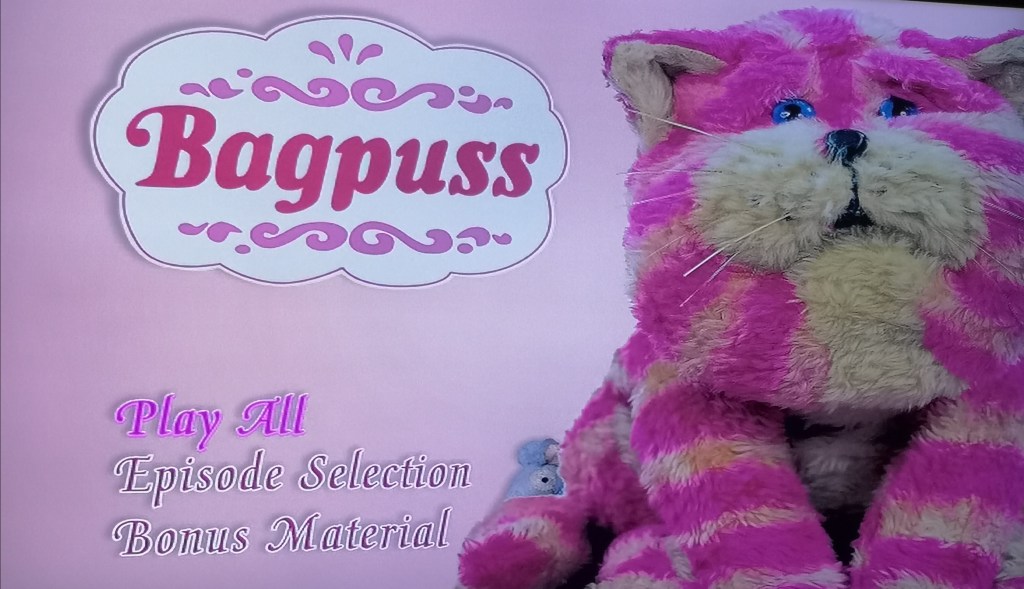
If there is one programme that instantly transports me back to my childhood, Bagpuss would be it. It was first broadcast on 12 February 1974, with the final one of the 13 episodes being transmitted on 7 May 1974. The first episode would almost certainly have been shown during the half term in my first year at St Andrew’s, so my clear memories of seeing it are probably not a trick that my mind is playing on me. I was just over a month away from my ninth birthday and I was still a big fan of Watch with Mother. Watching it now, I think it’s quite clear that, although it appeared in a slot for pre-school children, it was aimed at primary school children in general. The language and the ideas were quite advanced for five year olds, although the repeated introduction and ending would have appealed to the youngest viewers who could learn from the repetition and start to identify words and pictures. Occasionally, I would mention IT at school if I was talking to someone I knew wouldn’t say anything, but I tended to steer clear of anything that could be used against me. It’s not that this happened at St Andrew’s, but after two years of bad treatment from classmates and teachers I definitely played safe.
The opening of each episode was the same. Emily, a Victorian girl in a long dress with long dark hair, played by Emily Firmin, daughter of Peter Firmin who made the series along with Oliver Postgate, would be introduced as Bagpuss’ owner. I remember being absolutely enchanted by Emily who was about the same age as me and looked really pretty, and I doubt I was the only one! Let’s just say that even if I hadn’t enjoyed the programme, I would have tuned in at 1.45 just to see Emily!
The narrator, as he was for so many of the series they made together was Oliver Postgate, whose voice just exuded comfort and security to the young viewer. He created all the voices, except for the singing duo, Madeleine and Gabriel, whose folk songs are sung by Sandra Kerr and Peter Faulkner. Their songs became a very important part of the memories I have of the programme.
Episode 1 Ship in a Bottle
We are introduced to Bagpuss, The MIce on the Mouse Organ, Madeline the Rag Doll, Gabriel the Toad and Professor Yaffle, a bookend in the shape of a distinguished old woodpecker. The item turns out to be a ship in a bottle. Gabriel sings a folk song about mice who sail a very small ship, which the Mice enjoy very much, but which Professor Yaffle describes as very silly. The mice disagree with him and find a music roll to put into the ‘Marvellous, Mechanical, Mouse Organ’! This enables them to hear the song again accompanied by pictures that appear on the screen of the mouse organ. Professor Yaffle decides that Bagpuss needs to tell a magical story to reassemble the pieces of the broken ship. He puts on his Captain’s Thinking Cap from when he was a Sea Captain and tells a story of a voyage that he took. The ship is becalmed so he goes fishing and catches a topless mermaid! Now, that was one bit that I really thought my memory was misleading me on, but no! Let’s just say that the 70s were a different time shall we? If your parents read The Sun, then you will have seen your fair share of topless females before you got to the age where you might appreciate them, so perhaps this was considered completely innocuous. It certainly wouldn’t be these days! However, the fact that there ended up being at least a dozen, similarly unclad mermaids putting the ship back together was something I hadn’t remembered! Anyway, the story works and the mouse under the instructions of Professor Yaffle put the ship looking like new in the bottle and push it to the front of the shop window.
Episode 5 The Hamish
This is the episode I remember most fondly from the series. It is a piece of tartan material that Professor Yaffle says is a soggy bag with legs. They realise it is from Scotland so Bagpuss is given a Tam O’Shanter and then proceeds to weave the beautiful tale of a Small Soft Hamish. It was a creature that lived alone because it was very shy and frightened of people. It didn’t even have a name because it was completely unknown to mankind. Then Tavish McTavish (!) who played the bagpipes so badly that he was forced to live far away from other people (!) hears the call of the creature which sounds like someone else playing the bagpipes very badly. He decides it can only be his long lost brother Hamish McTavish as Hamish is the only other person in Scotland who plays the bagpipes as badly as he does. He introduces himself to Hamish and takes him into the small house he lives in. As it is very dark outside, it is only when he sees Hamish in the light that he realises it isn’t his brother. They decide that they like each other and they live together for many years until the Hamish hears the sound of many other Hamishes and Tavish tells him he must go to his own family. They are both very sad that they have to part and over 50 years on, so was I all over again. Tavish does not want to live on his own without the company of the Hamish, so he goes to live with his sister Mavis McTavish who hates the sound of bagpipes and he never plays them again.
Professor Yaffle is totally unimpressed by the Hamish explanation and decides it is a porcupine. Madeleine and Gabriel sing a song about a porcupine who travels around the world in a hot air balloon which is eventually brought down to earth by an errant spike. Finally Madeleine realises it is a porcupine pin cushion, so the mice find lots of pins to stick into the porcupin cushion, as Professor Yaffle calls it, and it is restored to its former glory. I beg leave to differ here as, to nine year old me it was a Hamish and all these years later, a Hamish it remains!
Episode 11 The Fiddle
My final choice takes me to Ireland, or rather the Bagpuss version of Ireland, which bears as much resemblance to the real Emerald Isle as the Hamish episode represented Scotland! Professor Yaffle says the old bucket that Emily has brought in is Irish. Gabriel hears a fiddle playing from inside the bucket and he and and Bagpuss recognise the playing as coming from a Leprechaun called Seamus O’ Hoolihan! Bagpuss met O’ Hoolihan in a peat bog in the far West of Ireland and he refuses the option of getting a pot of gold from him, much to the leprechaun’s delight. The leprechaun and Bagpuss then tell the story of when O’ Hoolihan was last caught by a cabbage farmer called Michael O’ Sullivan, and it’s a confusing tale of fiddle playing, dancing spades and axes and 40 acres of cabbages all cut in half! The fiddle was then played by the leprechaun to mend all the cabbages, as you might or might not expect. The mice find the fiddle in the bucket that Emily bought them and it starts playing on its own before joining in with a very strange song about Brian O’ Lim and his use of various animal skins to clothe himself. Perhaps exhausted by all the strangeness, Bagpuss goes pretty much straight to sleep at the end of the song. It is a genuinely bizarre episode!
Final Thoughts
From the first notes of the introduction and the first sight of Emily the years fell away. It was much more off the wall than I remembered, but in a lovely way that is absolutely enchanting. I remembered so many of the musical cues and the way that the characters spoke, sang and interacted. It’s amazing how fresh it seemed though. Some of the best children’s television of the 60s and 70s was given the kind of care that seems amazing nowadays, and Bagpuss was the gold standard. If your memory has been jogged and you want to see Bagpuss again, you can view all the episodes on YouTube or buy the Blu-ray version released last year, which I am tempted to upgrade to.
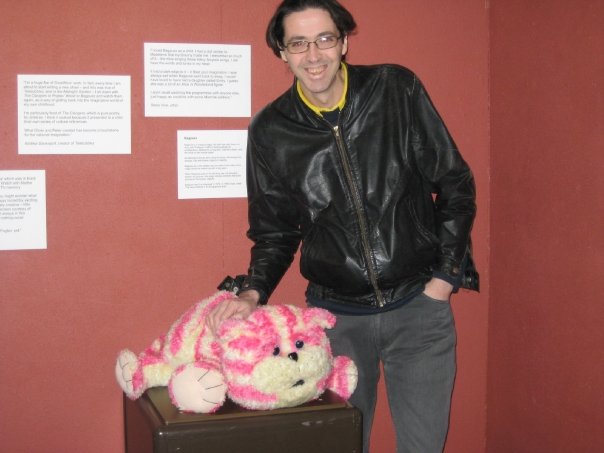
I actually met Bagpuss once when he came to Canterbury. As you can tell from the picture below my inner child was delighted!
Discover more from David Pearce - Popular Culture and Personal Passions
Subscribe to get the latest posts sent to your email.
 David Pearce - Popular Culture and Personal Passions