
The Library of Traumatic Memory by Neil Jordan
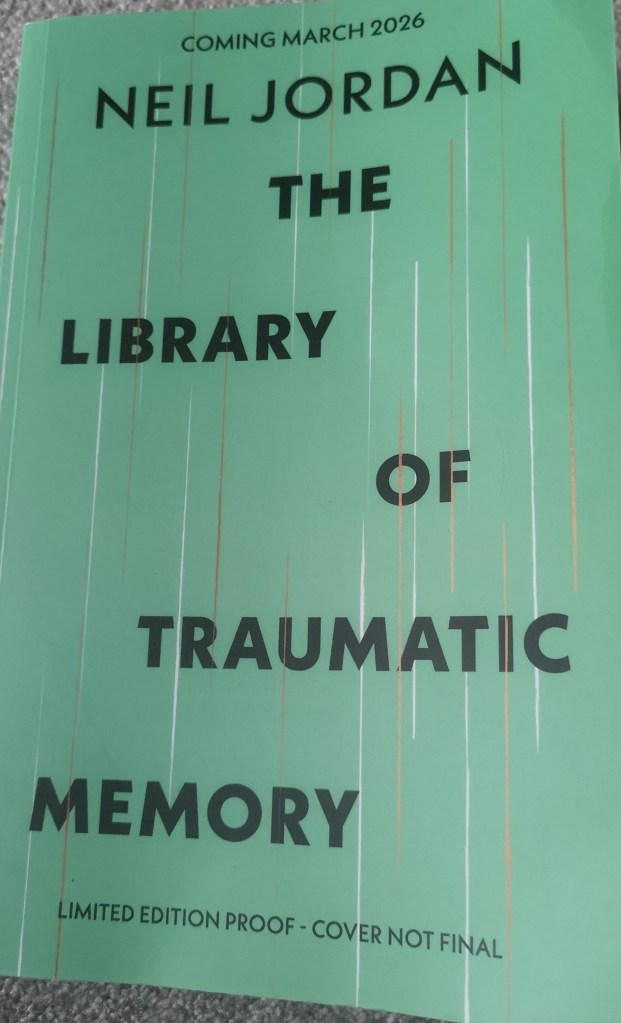
Often, when you read a book written by someone who has become famous in another area of sport or culture, you are left feeling, at best, underwhelmed. Your abiding impression is one of a person stretching their abilities just a little too far. This is emphatically not the case with film director Neil Jordan, famous for films like The Crying Game, Interview with the Vampire and my personal favourite of his, Michael Collins. The Library of Traumatic Memory, which I was lucky enough to receive a proof copy of, is released on March 6, and deserves to be a critical and popular hit.
The Plot
The book starts in 2084 where Christian Cartwright works for the Huxley Institute. He is a librarian in the titular Library of Traumatic Memory, where memories have been stored since the technology advanced far enough for it to happen. His job allows him the time and the technology to ‘resurrect’ his lover, Isolde, who died in a car crash, as a form of digital avatar. Isolde was married to Jan, but the two are drawn together after Christian creates an ‘eardrop’ for Jan to try to cure his deafness, but which the husband is unable to use. However, Christian discovers that the invention allows him and Isolde to have conversations with each other when they are each wearing the devices. He finds that he can put in his eardrop, speak to her, and have her reply. He realises that she has no independent consciousness but he feels comforted being able to hear her voice and have those conversations once again. His ancestor, Montagu Cartwright was an architect who, 200 years earlier, designed two churches, one for Castletown, Ireland and one for Carlsbad, Bohemia. The former was a church with Gaelic decorations, whilst the latter was a Gothic church, each designed with the local culture and architecture in mind. However, due to an administrative mix up the plans for the two churches were sent to the wrong locations and they were built according to those plans. He too is carrying on an affair, with Camilla Huxley, the wife of Admiral John Huxley who has commissioned a mansion for himself and his wife, to be designed by Montagu Cartwright. He creates it using a mirror and a copper model and is left wondering how the process works, knowing only that it is in some sense magical. As the reader learns more about each of their lives it becomes clear that there is a strong, and perhaps deliberate, link between the Huxley Mansion and the Huxley Institute. What it is will completely change Christian’s understanding of the world and his place in it.
My Thoughts
I was absolutely enthralled by this novel from the first page and I read its 300 pages in two days. The appeal, first and foremost, is that it is a novel unlike any I have read before. The dual timeline approach is so familiar now that it has almost become a writing trope of its own. Neil Jordan breathes new life into it by refusing to make things easy for the reader. You know there’s a connection there, but it is an opaque one, which requires the building of scattered clues into a piece of coherent guesswork. As I went through the book I was constantly rethinking my hypothesis and it turned out I was completely wrong all along! The way I engaged with the novel reminded me of the way I read an Agatha Christie mystery, with the clues being there and the misdirection being wholly the responsibility of the reader. The connection of old beliefs and new technology is fascinating and the world that is created by the connection and conflict between the two is fully realised in the reader’s mind’s eye.
Characters initially seem quite indistinct, but this is another aspect of the way that memories and relationships interact. Some people in your life remain unknowable and even though some of them may have a large effect on you, the process by which that happens is occasionally beyond your understanding. The links between some characters remain hazy throughout, but in that haze the reader’s imagination can go to work. It is the sign of a really good novel that since I finished it, I have continued to think about it and I have made a connection between two characters that may be wide of the mark, but which makes total sense to me! The technology is a character in and of itself, and here you get more clues in terms of appearance, but once again it is little details, from which your mind can construct the whole picture.
My final observation is that, because it is Neil Jordan, readers may be expecting a kind of screenplay inside a novel. That definitely isn’t how it came across to me, because so much was left up to the imagination. There are few descriptions of the main protagonists that give the full picture of what the character looks like, and I created versions of Christian, Isolde, Montagu and Camilla that would probably bear little resemblance to those that you see when reading the book. This isn’t to say that The Library of Traumatic Memory would not make a great film, because it certainly has that potential, but whoever films it, whether it is Jordan himself or another director, would use the book as a rough guide to the look of the characters, the technology and even the landscape and create something wholly unique in the same way a reader does.
The Library of Traumatic Memory is a novel that will reward rereading, but even if you only read it once, I would be extremely surprised if you do not spend the days and weeks afterwards thinking about it.
Discover more from David Pearce - Popular Culture and Personal Passions
Subscribe to get the latest posts sent to your email.
 David Pearce - Popular Culture and Personal Passions
I couldn’t help but wonder how far we are from this tech. AI already has the ability to clone faces and voices, as well as put together data from different sources to work things out (for example what happened at a given point in time from emails/messages). It does not seem far fetched for a technology to be able to look through messages and photos and then have enough data to construct some synthetic “memories” that one could talk about with the cloned voice/face avatar.
LikeLike
I think we are very close. There was a programme about AI this week which showed a fairly rudimentary form of this. It’s basically an offshoot of the Chat GPT technology except a computer programmer has managed to get it speaking to him with his mother’s voice!! It was extremely creepy.
LikeLiked by 1 person