
The Witching Hour Ghostly Tales for the Darkest Nights
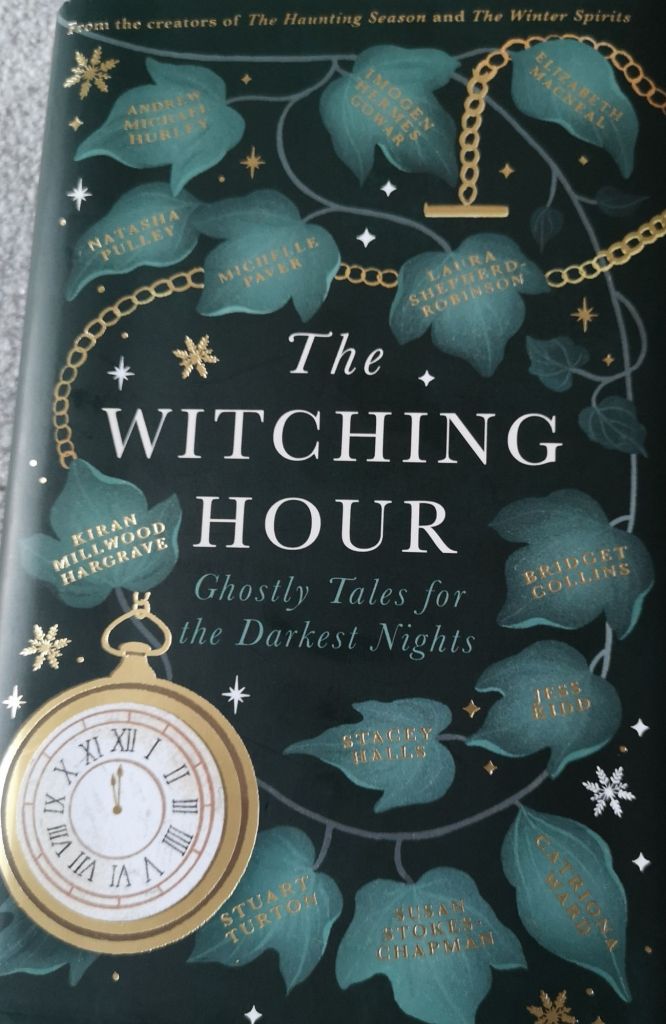
Anthologies by their very nature can be hit or miss. You are meeting authors for the first time in many cases and you will find some to your taste and others will just not engage you. You could read a story, or an anthology as a whole, that you absolutely love, recommend it to someone else and find them ambivalent or worse. However, with those caveats out of the way, I can say that The Witching Hour is probably the best anthology I have read. There are 13 stories, 9 of which I loved, 2 of which I really enjoyed and 2 that were good but, for various reasons weren’t of the extremely high standard set by the other authors. That is an incredibly good result from 13 authors, only one of which I had read before.
The Theme
The theme here is the hour after midnight when, some people believe, the veil between the natural and the supernatural is at its thinnest. All of these tales are ghost stories or stories of other supernatural phenomena. Sometimes the supernatural element is front and centre, sometimes implied and, in one case, a twist that you definitely won’t see coming! With such a broad topic, all thirteen of these tales are completely different from each other, but they all share one thing, a sense of creeping unease that builds throughout the story. Some of the settings are familiar, some not, but each one is fully realised and used in nearly every case as another character. I haven’t been awake at the Witching Hour, apart from when I have been travelling back from a play or a concert, for many years but I remember when I was younger that it was an hour when parties changed tone, conversations became deeper and fears and secrets were often revealed.

My Favourite Stories
I am going to choose three, although it was a very difficult decision. These were the three that left the biggest impact in the days after I read them. They are in the order in which they appear in the book.
The Doll’s House by Elizabeth Macneal
In this story, a young girl called Verity is given the doll’s house of the title by her father who has left on an expedition to the Antarctic. The doll’s house is a near perfect replica of the house they live in, with dolls representing everyone in the house and a tiny leather bound book, representing the diary that he will write in as the expedition makes its voyage towards the Antarctic. In a clever piece of storytelling, Macneal makes it clear that Verity has no wish to play with the doll’s house as she is angry with her father for leaving. We pick up the story a year later, where her only connection to her father has been the letters that have been written to her mother, one of which Verity has taken and put under her pillow. The night she decides to finally take the cover off of the doll’s house, she does so at midnight. As she is investigating the house, she sees that the leather bound book has been written in. It is a diary entry from her father recounting their stay in South Georgia. As well as this diary entry, the map on the wall of her father’s study shows the position of the ship he is travelling upon. On a whim, she pinches the cheek of the Verity doll very hard. The following morning her mother notices a bruise on Verity’s cheek, but when Verity opens the doll’s house the diary is blank and the ship is no longer shown on the map. As the expedition progresses, the diary entries become increasingly concerning as the ship becomes trapped in the ice. Verity is a helpless onlooker until something happens that persuades her she may not be. Is she prepared for what will happen to her though?
This is a story of mounting dread as both Verity and the reader try to find out what is really happening in the doll’s house and what it means for Verity and her family. It is superbly written with little clues sprinkled throughout the story about things that Verity doesn’t understand. There are hints about issues between husband and wife and an odd closeness between the governess and Verity’s mother. What was really skilfully handled was the midnight hour itself when the doll’s house comes to life. At no point did I question the fact that it was happening, and at no point did I suspect Verity of inventing it. I really enjoyed the story and I loved the atmosphere that Macneal conjured with well chosen words.
23 Bridge Street by Stacey Halls
Nelly and Winnie live at 21 and 23 Bridge Street respectively. They are more like sisters than best friends and are as likely to be found in each other’s house as they are to be found in their own. They even have their own signal of knocks to communicate with each other through the thin walls of their adjoining bedrooms. Both sets of parents accept and encourage their closeness and the expectation is that they in turn will raise their own families at 21 and 23 Bridge Street. The two girls do everything together and are absolutely inseparable, until one day when Winnie and her whole family disappear. No one will tell Nelly what has happened, but just after midnight on the day after the disappearance, Winnie’s mother bursts into Nelly’s bedroom asking where her children are. Although this is put down to a very vivid dream by Nelly’s parents, she is sure it happened. She goes next door the following night, intending on using the spare key her parents have, only to find the door is open. She goes upstairs to find the bedrooms empty apart from the cat Clarence who she frees and installs next door. While she is there she hears a loud sobbing coming from Winnie’s parents bedroon, but when she opens the door no one is there. Events become ever more inexplicable including the night loud music plays from a gramophone that isn’t plugged in. Finally there are knocks from Winnie’s bedroom using their secret code, but when she goes round, no one is there.
This was my favourite of the thirteen stories. Beautifully written with a perfectly judged combination of fear and love, I instantly felt that I knew Nelly and Winnie. Their relationship reminded me of Miv and Sharon from The List of Suspicious Things by Jennie Godfrey and is so skilfully drawn that Winnie’s disappearance hits the reader straight away. The ghostly goings on are tied to the love between the two girls, although not in the way I thought. The reveal was a complete shock to me, but looking back at the story it made perfect sense. I will definitely be reading Stacey Halls’ novels having been introduced to her in this collection and I hope that somewhere in one of them we may meet the wonderful Nelly again.
Two Go Together by Imogen Hermes Gowar
This story is centred around Mr Peachment, a coffin maker who is asked to attend a house where a young child named Snow has died. The mother has been ostracised for having the child out of wedlock and not named the father. She is determined to have her daughter buried in a proper coffin so she called Mr Peachment rather than have a pauper’s coffin. As Peachment is setting to work on the coffin he reflects upon the invariable rule that his father, also a coffin maker, brought him up with, ‘Two go together’. This says that the first person who dies will wait until they can be accompanied to the next life by another who will follow quickly afterwards. Mr Peachment starts to see Snow’s ghost in town and becomes ever more troubled. Who will accompany Snow on that journey? Will the injustice of the treatment the town gave her in life be assuaged after death, and what will happen if the identity of the father becomes clear?
This was a superb piece of writing, full of pain and compassion alongside a genuinely unsettling story with an excellent denouement. I felt deeply sorry for Snow and saw the truth of human nature through the ages with small acts of compassion surrounded by judgement and discrimination. It saddened me that I could still imagine something similar happening today even if the catalyst would be different. The issues were both central to the story but incidental to the power of the concept. Two go together could have been effective with any initial death, but it would not have achieved such a deep impact if it had been anyone other than Snow.
Final Thoughts
If, like me, you want to read an anthology but have always been somewhat disappointed by their unevenness, you can rest assured that these 13 stories, all written in 2025, will contain far more hits than misses. You may not react to my three stories in the same way and you will almost certainly have other favourites, but as a collection this is as strong as it gets. Happy reading.
The link below is from bookshop.org which champions independent bookshops but, of course, other stockists are available
The Witching Hour Bookshop.Org
Discover more from David Pearce - Popular Culture and Personal Passions
Subscribe to get the latest posts sent to your email.
 David Pearce - Popular Culture and Personal Passions
After reading the synopsis of the books theme i decided not to read the details of the stories, as i went and ordered the book! I love a good ghost story – in the run up to Christmas i watched the 1970s Ghost Stories For Christmas on youtube, plus the more recent ones. Winter really is the best time for them.
LikeLiked by 1 person
You are definitely in for a treat. I will be very interested to know which your favourite stories are.
LikeLiked by 1 person