
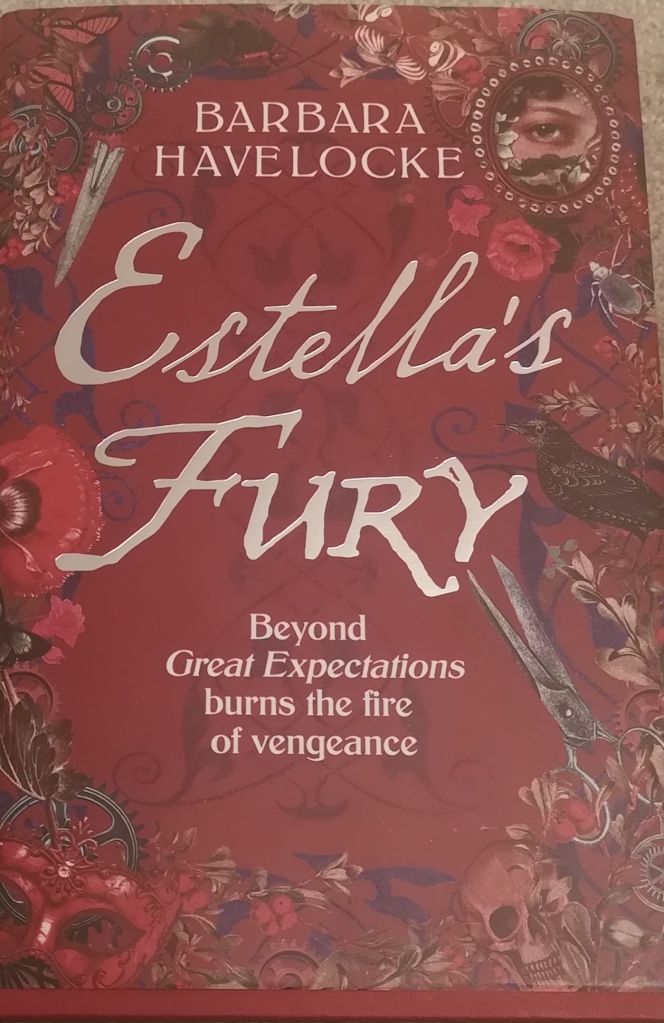
Estella’s Fury by Barbara Havelocke
The writing of a sequel to a well loved novel is fraught with danger for the author who takes a chance on imagining where the characters will be after the end of the original, where their motivation lies in dealing with different situations and how to deepen those characters whilst remaining true to the originals.
I started my reading year by reading a sequel to my favourite novel. It was quite frankly appalling. The characters bore no resemblance to the originals, their situation a decade on from the original novel was so at odds with the way they had ended the story and they might as well have been a completely different set of people, as indeed they were. By tying them to a much loved original, the author guaranteed sales but it was a badly plotted travesty of a novel. I lasted two chapters and it went straight to the charity pile where some poor unfortunate may pick it up!
Luckily, my second novel, based on a story by the same author was Estella’s Fury, featuring Estella Drummle (Havisham) from Great Expectations. This is the sequel to Estella’s Revenge, which you should read first if you haven’t already. I went to an evening with Barbara Havelocke where she explained her deep love for the novel and its characters and the reason why she wanted to revisit the story of Estella as she moves away from her adoptive mother and into marriage. In the Q&A I asked if she had changed her view on any of the characters and she mentioned Jaggers, the very complex lawyer whose motivations and loyalties appeared to be unfathomable to everyone around him. We meet Jaggers again in this novel, and he plays a very important role in moving the story along.
The Story
Estella has been taught from a very early age that the male of the species is not to be trusted. Indeed, Mrs Havisham shaped her as a weapon against them, instructing her how best to hurt them and giving her Pip to practice upon. As she enters higher society through her unhappy marriage to the vicious Bentley Drummle, she realises that the higher the society the worse the men become, because they have no one with the power to rein in their behaviour. She decides that she will become the weapon that her mother always wanted her to be but perhaps even more deadly than her mother can possibly have imagined. After the events of Estella’s Revenge, she decides that she needs to move away from the extreme vengeance she has dished out, and to fit her behaviour more to the expectations of society. She goes to visit Lady Elizabeth Taykall, one of her closest friends and the wife of the much older Sir John Taykall. When she gets to Wynterton Manor, their home, she finds a place of dark secrets that frighten everyone both above and below stairs. She is assigned a young girl called Nora as her lady’s maid and she builds a very quick bond with her. Nora, however, is frightened by a threat that she cannot bring herself to talk about. When she disappears and that threat becomes all too real, Estella starts to investigate, not knowing that this investigation will lead her into danger and reach the very highest echelons of society. As well as this, she will have to face her own past in the most shocking way imaginable as she realises that someone else knows her own most dangerous secret.
My thoughts
I have been going through a lull in my reading, but Estella’s Fury has completely overcome it. The novel has short, sharp chapters that do not waste a word and the action moves on quickly and keeps the reader on the edge of their seat. It is almost certainly the style of novel Dickens himself would be writing if he was a modern day author. He wrote as he did because that was what Victorian readers wanted, and he would have been just as great today because he would have adjusted his style to the market. The story is different from Dickens only in the lack of humorous characters like Wemmick’s Aged P, but this is not that type of novel. Other than that, all the characters have stepped straight from the pages of Great Expectations or, as in one particular well judged scene, Oliver Twist. The ability to deepen these characters so effectively is quite amazing at times, with Jaggers in particular having the hidden past and present, to which Dickens alluded, developed in a way that makes the reader say, ‘Of course! That’s what happened.’
I cannot recommend the Estella novels too highly. The third one, which I hope will not be too long in arriving has a number of threads left loose from Estella’s Fury, but with Barbara Havelocke’s incredible knowledge and feeling for the original characters she could easily leave those threads to a later novel. I hope we see Pip again, but if we do it will only be because it serves the story and that assurance is rare indeed in the writing of sequels to original novels of the past, and indeed in the wider literary world. Here’s to Estella, a thoroughly modern character in a thoroughly realised past.
Discover more from David Pearce - Popular Culture and Personal Passions
Subscribe to get the latest posts sent to your email.
 David Pearce - Popular Culture and Personal Passions
Trackbacks & Pingbacks