
A Reflection on Advertising
If you had a freeway billboard, what would it say?
I would not want to have anything as ostentatious as a billboard. It certainly wouldn’t be on a freeway unless I moved country as we have motorways in the UK! Also, how could you guarantee that the advertisement would reach the correct people? If it did, would it have the correct style?
A famous, though perhaps apocryphal quote, attributed to both John Wanamaker and William Hesketh Lever states, ‘I am convinced that one half the money I spend for advertising is wasted, but I have never been able to decide which half.’ There in a nutshell is the problem with traditional advertising. In practice, way more than half is wasted, whatever medium you choose. Surely, then, the ability to specifically target your advertisements to each individual on the Internet based on their searches and site visits has dealt with that problem? In all likelihood it has simply made it easier for some adverts to succeed while making others less likely to do so. I recently bought a shaver and for two weeks my feed was inundated with more adverts with links for shavers. Now, if it was a human being rather than an algorithm, the adverts would be for something like trimmers or haircare or skincare because a consumer is much more likely to buy a complementary item rather than the same item. I mean, how many people would buy multiple shavers?!
Over the last few months of 2025 I threw myself into a project based around Christmas Magazines Through The Years and I found the development of advertising absolutely fascinating. In the 1890s the advertisements were factual in the main and concentrated on giving the necessary information only, namely product specifications and price. There were two interesting exceptions, however, which both pointed the way forward. Cadbury, back in the day when the company was owned by a Quaker family and produced decent chocolate at a decent price, focused on the provenance of the chocolate and the way that the company followed its values through from the countries that supplied the cocoa to the way that the bars were made in Birmingham. Nowadays, of course, they have no guiding principles apart from profit above all else, and the chocolate is becoming more expensive and of worse quality. Still, at least they are not producing American standard chocolate which is unquestionably the worst in the world!

The other advert was Bird’s Custard Powder which used a humorous advert featuring a playful cook. It set in place the innovative humour that characterised British adverts for at least a century on from that 1896 magazine.
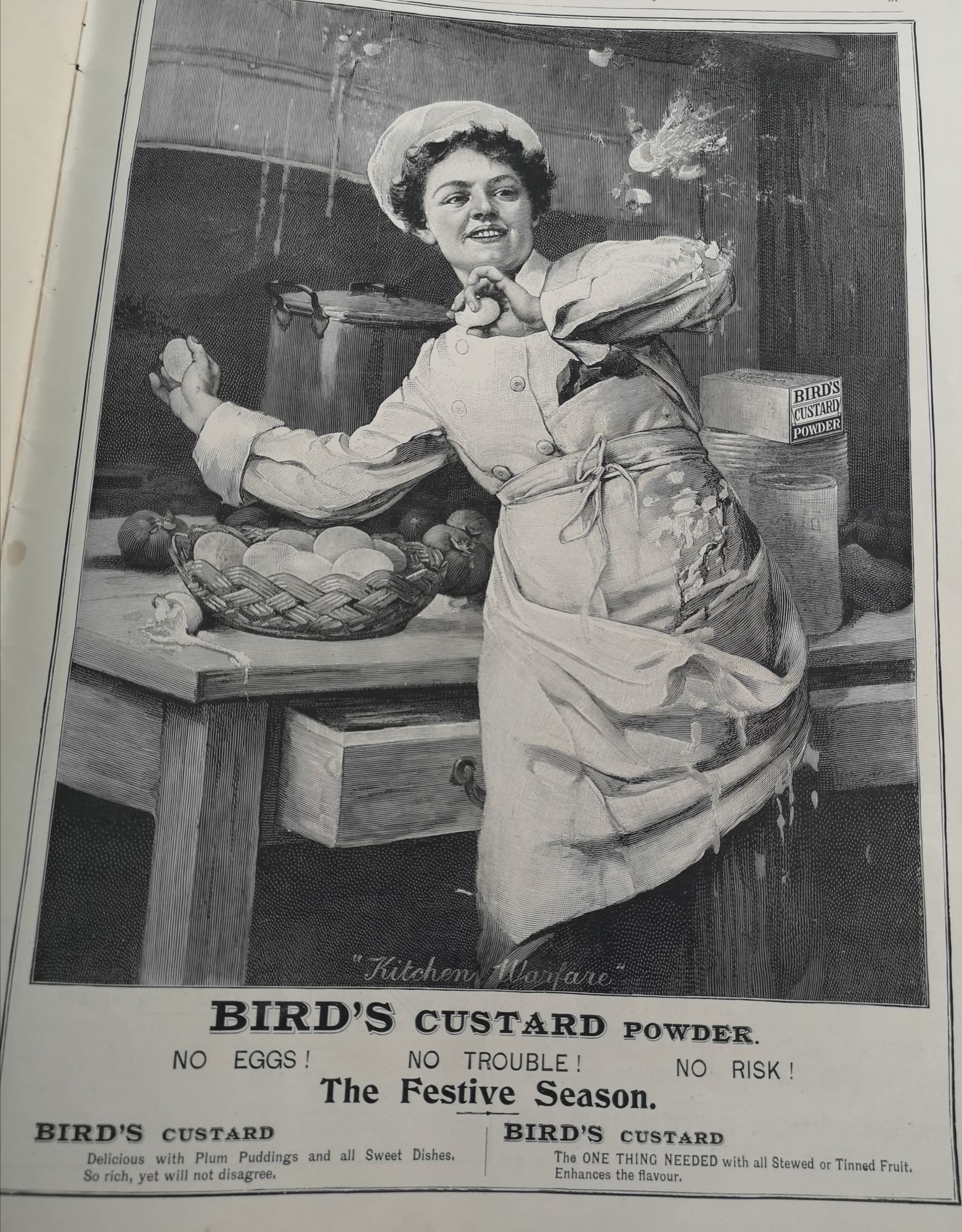
Nowadays, the humour has been largely lost with a few exceptions and replaced by a cynical ’emotion’ that is designed as if by computer to wring tears out of consumers. The problem is that consumers are wiser to the manipulation of their feelings than they were and those advertisements are suffering diminishing returns or being parodied.
The heyday of the UK TV advert was probably the 70s and 80s where humour and innovation were at the forefront of the industry. You had adverts that used chimpanzees, robots, straws and classical music! It was aimed at making the customer remember the brand when they were shopping. It worked with the Smash Robots which advertised a particularly awful powdered mashed potato which tasted entirely of powder and never of potato! Without the robots I doubt it would ever have become a favourite with households up and down the country.
So, although the advertising industry has evolved in terms of the technology it is using, it has significantly regressed in terms of the content it is producing. The only time you might see innovation, humour and true emotion is at Christmas where so many adverts are now events. However, even they are simply becoming repetitive and the innovations are starting to get fewer and further between as AI and algorithms take over. Will we see another golden age? Never say never, but it completely depends on the advertising agencies taking human control of the products and not outsourcing it to computer systems. It certainly seems unlikely at least in the next few years.
Discover more from David Pearce - Popular Culture and Personal Passions
Subscribe to get the latest posts sent to your email.
 David Pearce - Popular Culture and Personal Passions
Be good to one another.
LikeLiked by 1 person