
Christmas Magazines Through The Years The Field Christmas Number 1986
What was 1986 like?
Queen Elizabeth II was in the 34th year of her reign and Margaret Thatcher was in the seventh year of hers. As with most of the preceding years of the 1980s, politics appeared to be on fast forward, though looking back it seems like a decade of relatively slow, thoughtful politics in comparison to the 2010s and 2020s.
(24 hour news had not started yet and neither had social media. As a result, politicians were not chasing the next headline or curating 30 second sound bites. In banking, however, the Big Bang was in progress throughout 1986, a precursor to the effects that computerisation was going to have on everything. Enough crystal ball gazing in a Tomorrow’s World style, let’s get back to what actually was happening!)
Unemployment reached a record high of over 3.2 million in June, just under 15% of the workforce, and the Labour Party were then 9% ahead of the Conservatives. The Channel Tunnel was given the go ahead, and this time it would be built. In other European news, the UK signed up to the Single European Act which promised a single market for goods, services, people and jobs across the European Union by 1992. British Gas was privatised and the shares offered to individual members of the public in a heavily oversubscribed flotation of the previously nationalised industry. Part of the interest was engendered by the brilliant ‘Tell Sid’ campaign, a series of adverts that communicated the flotation with real imagination. Here’s the second advert in the series.
Despite the deregulation and privatisation, the one change that Thatcher wanted to force through was defeated as 72 Conservative backbenchers defied a three line whip and voted against the Shops Bill 1986 which would have introduced largely unregulated Sunday Trading. It was the only time in 11 years that she would see an entire bill defeated in Parliament. Meanwhile, the education sector steeled itself for two huge changes. The GCE O Levels and CSE Qualifications were done away with after the final cohort took the examinations in June and the two exams were combined to form the new GCSE. It was a change designed to introduce more fairness into the system. The CSE qualifications were taken by students who were deemed ‘likely to fail’ their O Levels, and even though a Grade 1 in CSE was ‘equivalent’ to a Grade C O Level, nearly every employer in the country dismissed any qualification other than the O Level. The new system was seen as a level playing field because everyone took the same exam and it was also criterion referenced not norm referenced. Under the previous O Levels only a specific number of students could achieve each grade, whereas under the GCSE you could theoretically get 100% A Grades or 100% Fails. The ‘pass’ was still set at C by all schools and employers, so in practice the less academic students were still disadvantaged, and the perception of easier exams meant that for a good few years afterwards those who took O Levels were seen to have an advantage over those taking the GCSEs. The other much more welcome change for many was the outlawing of Corporal Punishment in schools, consigning the cane and the slipper to well deserved oblivion.
In 1986, a struggling Manchester United sacked Ron Atkinson and brought in an abrasive Scot called Alex Ferguson. His first season was anything but stellar, although he took from second from bottom in November to mid table safety in May 1987. Players were starting to command ever higher fees with Gary Lineker moving to Barcelona for £2.75 million and Ian Rush moving to Juventus for £3.2 million before immediately being loaned back to Liverpool for the whole of the 1986/7 season. On the pitch, Liverpool became only the second club in the 20th Century to achieve the League and F A Cup double under the leadership of player/manager Kenny Dalglish. Joe Johnson, a 150/1 outsider beat the favourite Steve Davis to win the World Snooker Championship.
Two comedies that have stood the test of time like few others started in January, and they were both sequels. Blackadder II was the sequel to a poorly received original so it had an easier ride in terms of expectations, but even if those expectations had been sky high it would have met them. Yes, Prime Minister gave itself a massive act to follow and ended up outdoing even the brilliant Yes, Minster. Grange Hill, no stranger to controversy, shocked viewers with the Zammo McGuire drug addiction storyline, which produced the unforgettable image of the character comatose in a toilet stall after overdosing on drugs. Also controversial at the time was Eastenders introduction of Colin Russell, played by Michael Cashman, the soap’s first gay character. Despite this, the soap reached new heights on Christmas Day when that night’s episode attracted an audience of 30 million, a record for a British drama that will never be approached let alone beaten.
The Field Christmas Number 1986


Advertisements
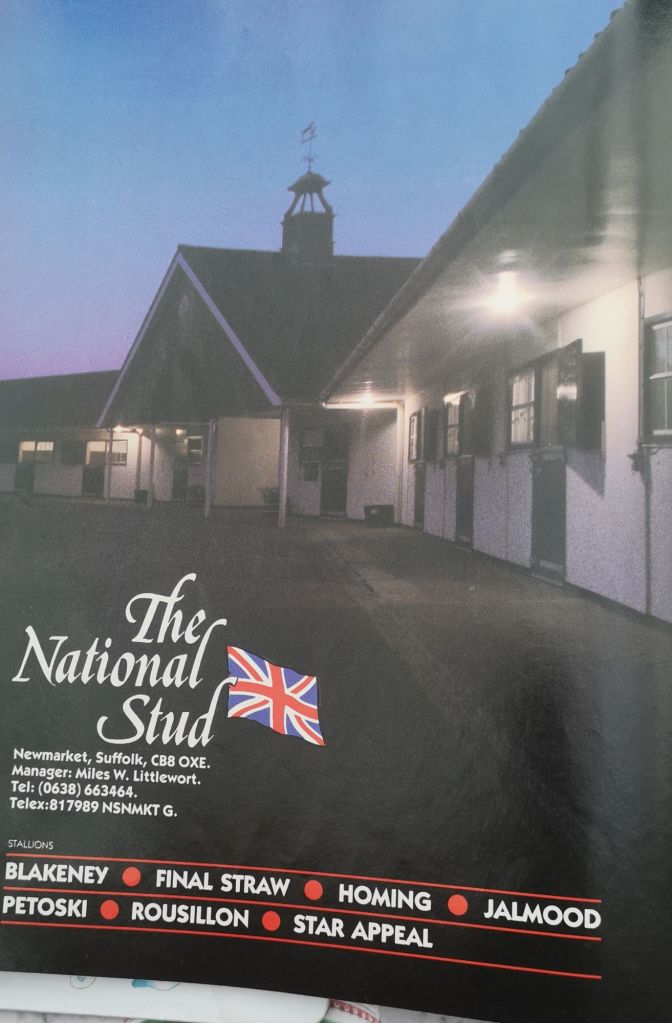
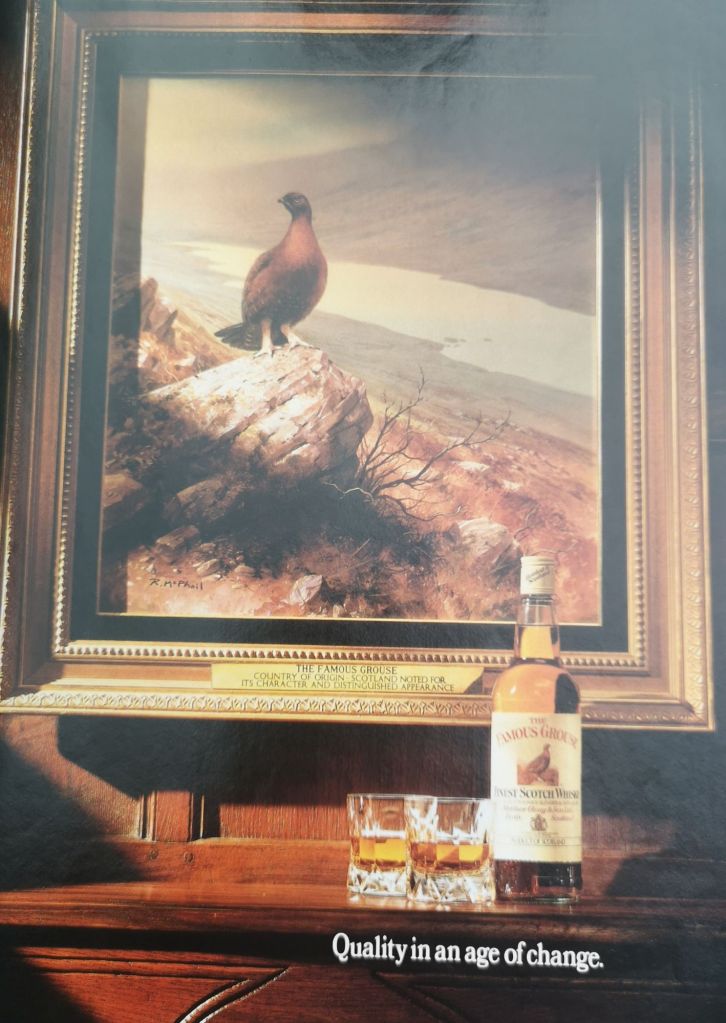
I am starting with advertisements this time because it is in those that you see the real flavour of the magazine. The title of the magazine is, of course, a clear indication of the demographic, but the firms who advertise their goods and services in this issue are clear as to their approach. The items are, in the vast majority of cases, only for the very rich. We start with Sotheby’s, one of the most prestigious auction houses in the world. For a start, the advertisement is for guns which have a guide price of between £7000 – £11000 at a time when a Sales Executive, who would have been comfortably off, earnt on average around £27500 a year. This advertisement would not have appeared in Good Housekeeping, which would have catered to the relatively comfortable middle classes, for example! It also tells you that it is not aimed at struggling farmers with limited acreage, but landowners with large estates. If you wanted a new gun for your hunting, Veteran Gunmakers of Spain would provide the ‘ideal game gun’ for a mere £9000. Moving up the social and income scale you could avail yourself of the services of the National Stud, whose covering fees would no doubt be well known to trainers and owners. Even Famous Grouse, a company who probably would have advertised in Good Housekeeping, have aimed their advertisement fairly and squarely at the traditional ‘huntin’ shootin’ and fishin” types with their tagline ‘Quality in an age of change’. As we will see when we look at the articles, the sense of the traditional custodians of the country protecting the things that really matter is clear throughout. All of the advertisements are targeted in a way that is very unusual in the magazines I have looked at during this research.
Contents
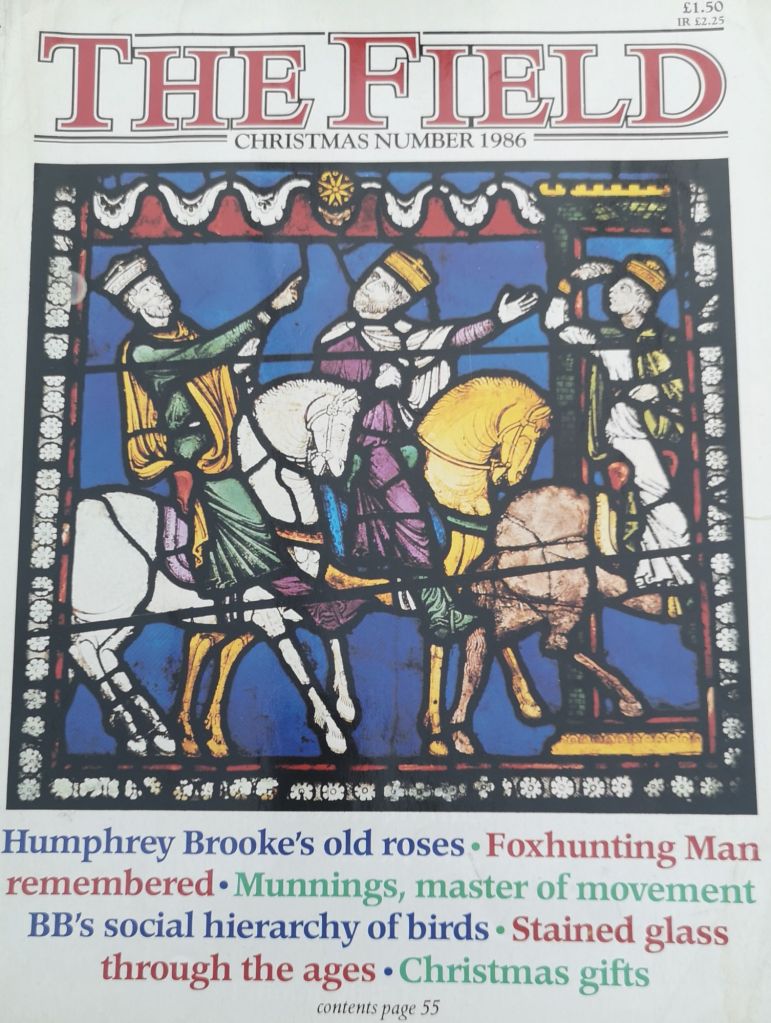
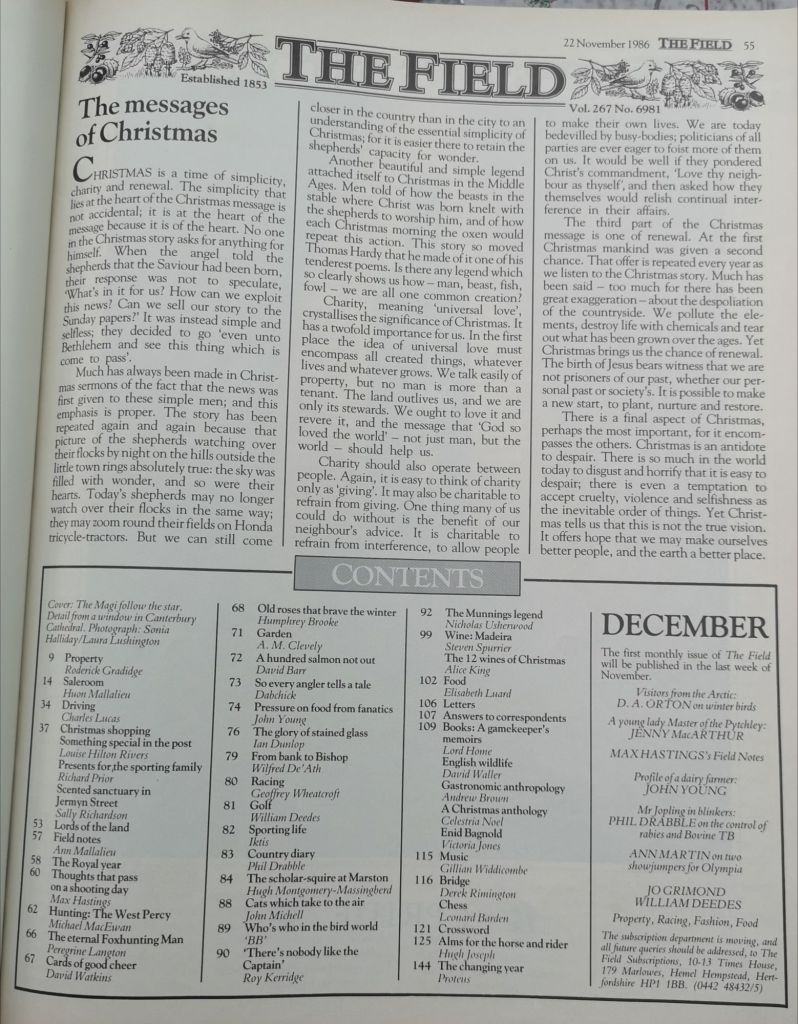
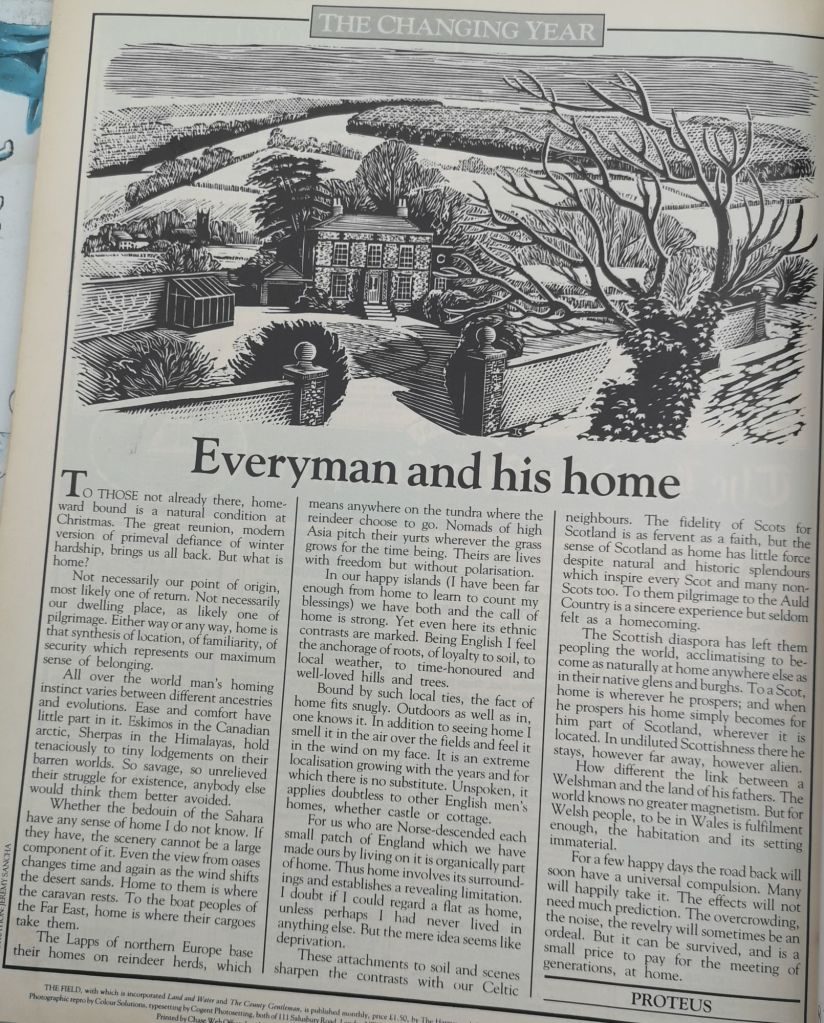
The cover of this magazine, the traditional stained glass window, comes from a window at Canterbury Cathedral, the oldest continuous seat of the Christian religion in the British Isles. It is the Magi following the star, but look more closely at what they are riding. They are on horses, not camels. It is a very Anglo centric portrayal not only in terms of their transport, but also in terms of their looks, with the full beards favoured by nobles in the middle ages and beyond. It is similar to the hymn Jerusalem in that sense, with the unspoken idea that ‘God is an Englishman’ an idea humorously outlined in the quote by E M Delafield who said; ‘Most Englishmen are convinced that God is an Englishman, probably educated at Eton.’ The editorial ‘The Messages of Christmas’ focuses on simplicity, charity and renewal. It observes that no one involved in the Nativity wanted to know what was in it for them or what they could get out of it. The assertion is made that farmers and those who live in the countryside are closer to understanding the message of Christianity than those in the towns as they can keep a sense of simple wonder in close proximity to nature. It is arguable in some ways, but the idea that it is easier to live a life of simplicity seems to have merit. When the editor gets to charity he takes a handbrake turn into politics saying that ‘it is charitable to refrain from interference’, something that politicians of all parties should remember! He stays in the political sphere with a message to those who refer with ‘great exaggeration’ to the despoiling of the countryside. The Field’s readers are actually the agents of renewal as people who know the land. The final paragraph warns against despair, proving that 39 years ago there was unwarranted pessimism about the future similar to that found in 2025. The final page of the magazine contains a lovely reflection about the importance of home at Christmas. However, it echoes the idea of the editorial by saying that it is in the scenery and land of a country that we find our true home, not in a specific plot of land with a building. As he observes ‘I doubt if I could ever regard a flat as home’! Once again the magazine raises its readership above the herd by giving them a greater insight into life than city and town dwellers.
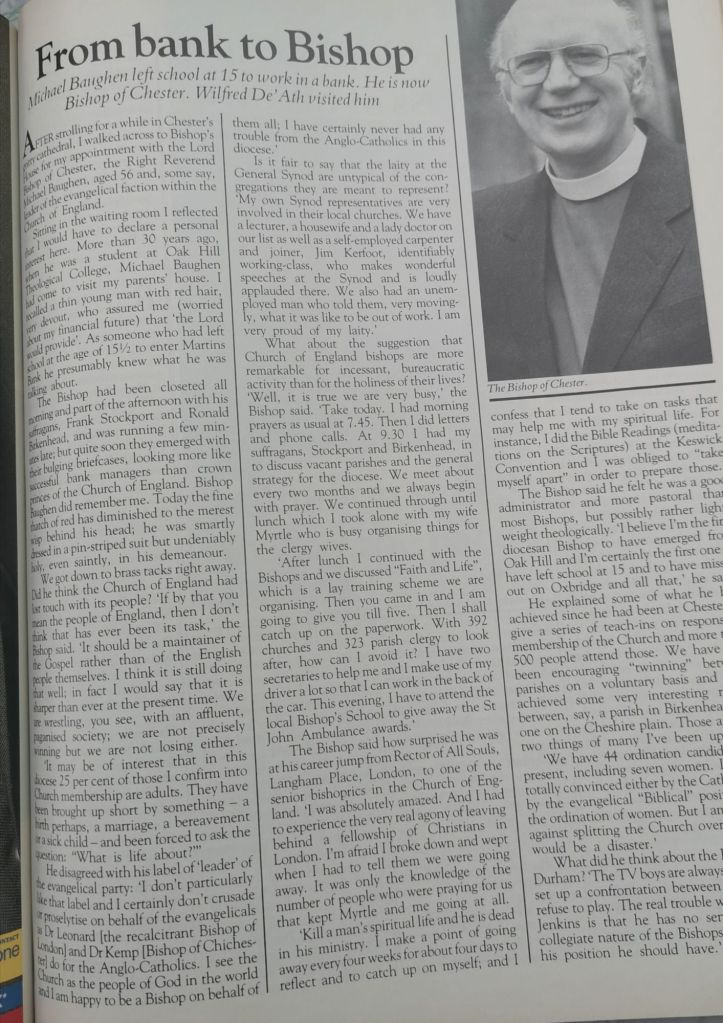
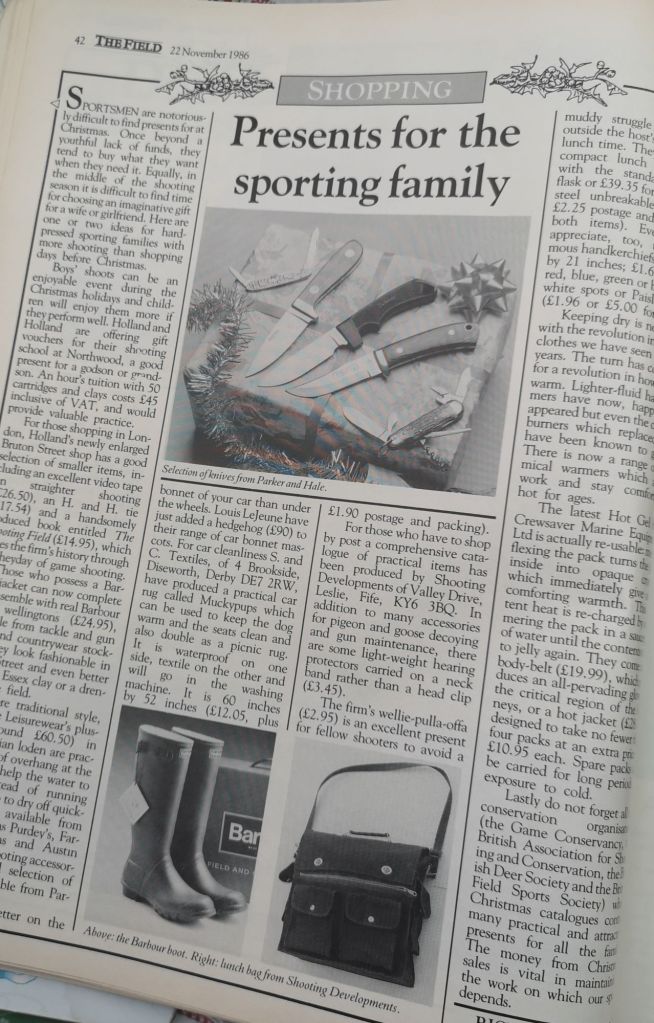
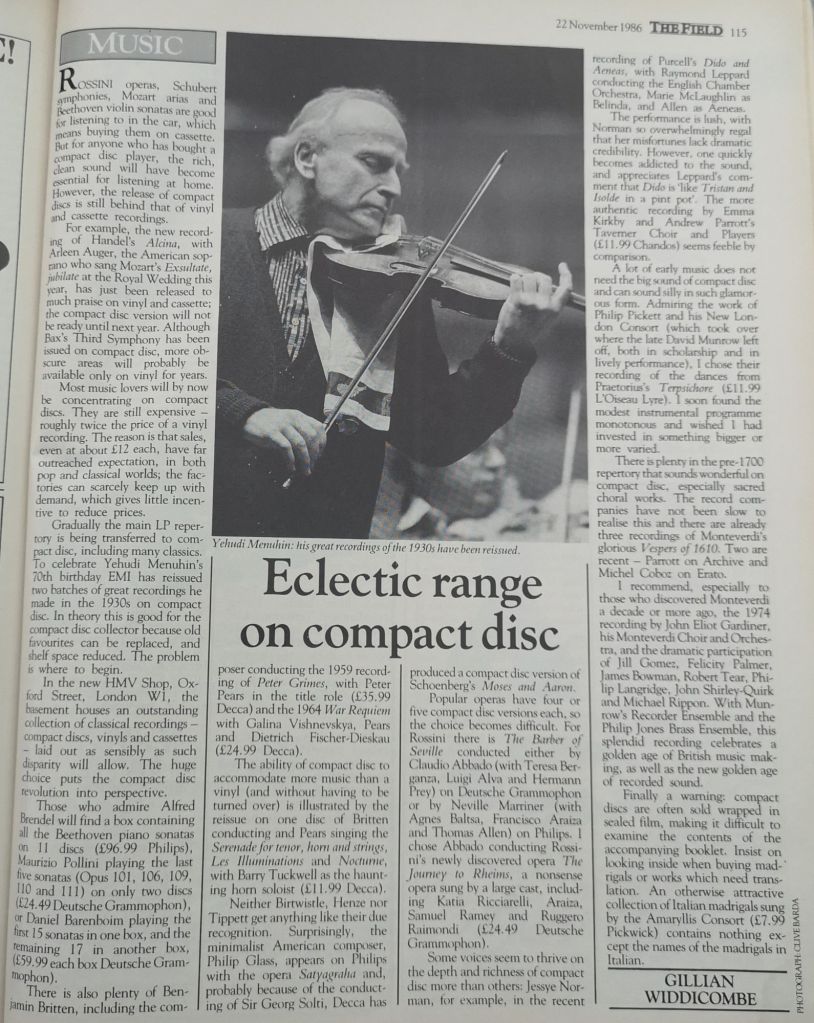
The three articles I have picked out are very good at illuminating the preoccupations of the readers. First of all, you have an interview with Bishop of Chester, Michael Baughen, who left school at 15, worked in a bank and then studied at theological college. He comes across as a light touch churchman, which no doubt the readers will approve of, and he plays a dead bat to the more controversial questions, although he does mention the then famous David Jenkins, Bishop of Durham, who ‘has no sense of the collegiate nature of bishops’. It is 19th century style ‘muscular Christianity’ of the type that would definitely find favour with the traditional readers of the magazine. The gifts for a sporting family article is interesting in the insight it gives us to the way of life in the upper echelons of the country classes. You can buy Boys’ shooting tuition for £45 an hour, as presumably girls don’t need to know about things like that! However, for our no doubt fashion conscious younger female recipients, Burberry wellington boots apparently look fashionable in Sloane Street! Knives are very useful, no doubt for skinning the game you kill. It is a world closed to all but those in the know and with the money to access it, a network of landowners who have access to an influence up to and including the Royal Family in some cases. Finally, the Compact Discs reviewed on the music page are all classical, all reassuringly expensive and of the required cultural level for its readership.
Final Reflections
This has definitely been the most targeted magazine of those I have read, and because of that it has a continuity of approach that I haven’t found anywhere else. The readers are not being encouraged to experiment, either as consumers or thinkers. Everything in the magazine is designed to reinforce their certainties and the correctness of their position in the life of the country. That said, even for those who share nothing of the background, the writing is accessible, of a high standard and full of insight. It is an incredibly masculine world laid out in front of us, but I don’t think that is because of the era. My guess is that 39 years later Girls’ shoots still don’t exist and the same gripes about politicians and town and city dwellers are still very much in evidence. Perhaps they are, as a group, less religious but I would venture to suggest that they are still Christians with at least a small c who are found in the pews at this time of year.
Discover more from David Pearce - Popular Culture and Personal Passions
Subscribe to get the latest posts sent to your email.
 David Pearce - Popular Culture and Personal Passions
These just keep getting better. A real pleasure to read and deserves a far bigger audience. I am only sorry that I have not been able to read most of the series as it is published. That said, reading them when I have the time and space to take in the wonderful curation and insights does make it all the more enjoyable. Thank you again for putting these together.
LikeLiked by 1 person
So glad you are enjoying them. I have had many other posts that have been slow burners but eventually they have found their audience.
LikeLike