
Christmas Magazines Through The Years – Everywoman 1957
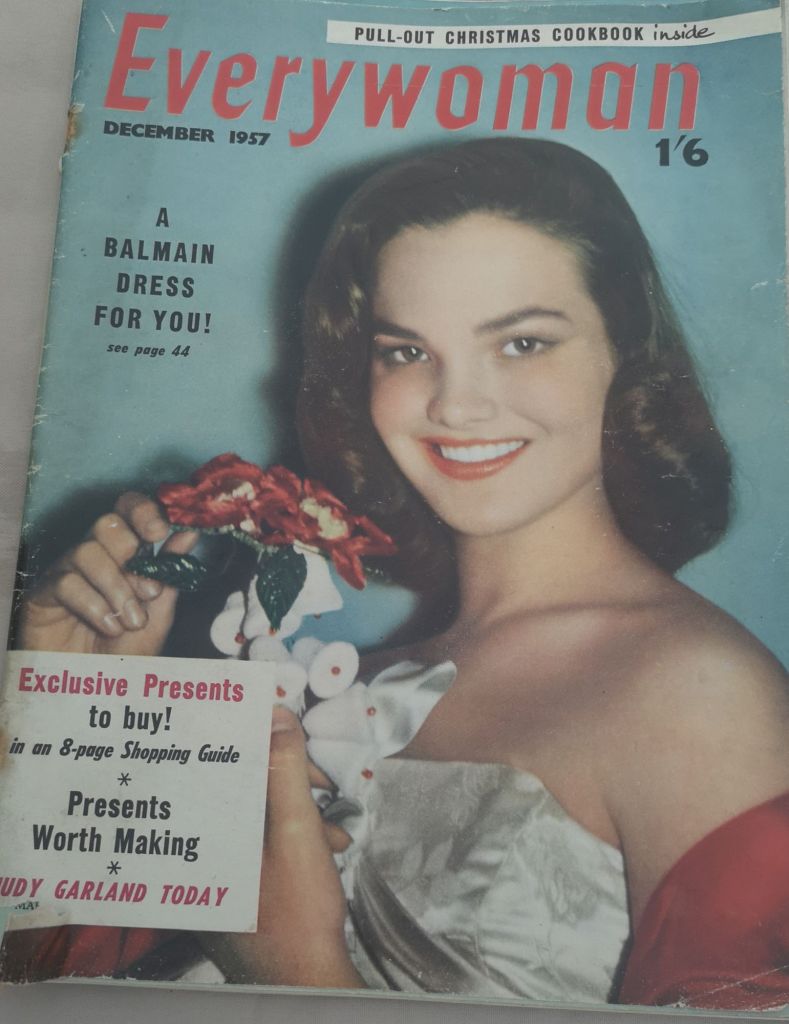
What was 1957 like?
It was the 5th year of the reign of Queen Elizabeth II and on Christmas Day she became the first monarch to deliver the Christmas Message on camera. In politics, Anthony Eden resigned after the previous year’s Suez catastrophe on the grounds of ill health. He was succeeded by Harold Macmillan who, later in the year, commented, ‘most of our people have never had it so good’, instantly paraphrased as ‘You’ve never had it so good’! If nothing else, this strongly suggests that even in the age of deference and respect, truth was as unimportant to the headline writers as it is now.
Until 16 February there had been a ‘Toddler’s Truce’ where the TV channels stopped broadcasting for an hour to allow parents to put young children to bed. The Independent TV channels eventually persuaded the authorities, including the Postmaster General who was in charge of broadcasting policies but who saw the truce as excessive ‘paternalism’ by the BBC, that it was an anachronism. Interestingly enough, in the same month, a future bane of parents’ lives entered UK local government as Norwich City Council became the first authority in the UK to start using a computer! Elvis’ first Number One was All Shook Up which had seven weeks at the top in July and August. The Christmas Number One was Harry Belafonte’s version of Mary’s Boy Child. Perhaps the most significant musical moment of 1957 happened on 6 July when two young men met at St Peter’s Church, Woolton, the two in question being John Lennon and Paul McCartney.
Average wages were significantly higher than in 1950, something reflected in the magazine itself, as we will see. Men were on average earning up to two thirds more than they had been at the start of the decade, with £12 being the average, with women’s wages rising by slightly less in percentage terms, and from a much lower base with an average of £6 6s. Rationing had finished so more was available, and although the teenagers’ increasing affluence was not reality for many in families where the earnings were subsumed within the household income, their spending habits were starting to influence the music that was successful as well as being the key demographic of the very popular coffee shops.
Everywoman 1957
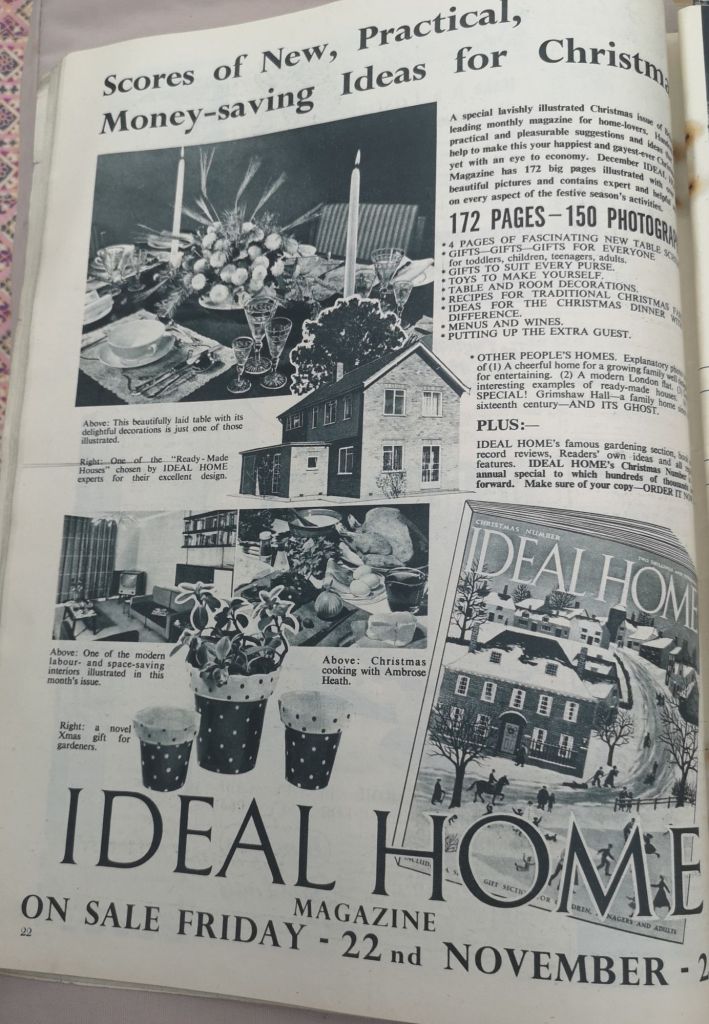
The change in tone and focus between the two Everywoman magazines of 1950 and 1957 is quite astonishing given the reputation of the 1950s as a ‘steady as she goes’ decade. The values of society in 1957 would have been very similar to those in 1950, and even those in 1939, but underneath the surface big changes were happening as this magazine reveals. It is interesting that the Ideal Home magazine, advertised here refers to money-saving ideas for Christmas, much as Everywoman 1950 did. It suggests to me that Ideal Home was perhaps seen as the magazine for the households who needed to be more careful about how much money was spent but who still wanted to have a good Christmas. Everywoman, by contrast appears to have become an aspirational magazine that is concentrating on the ‘must haves’ for Christmas 1957, even if they would not be so uncouth as to use that term!
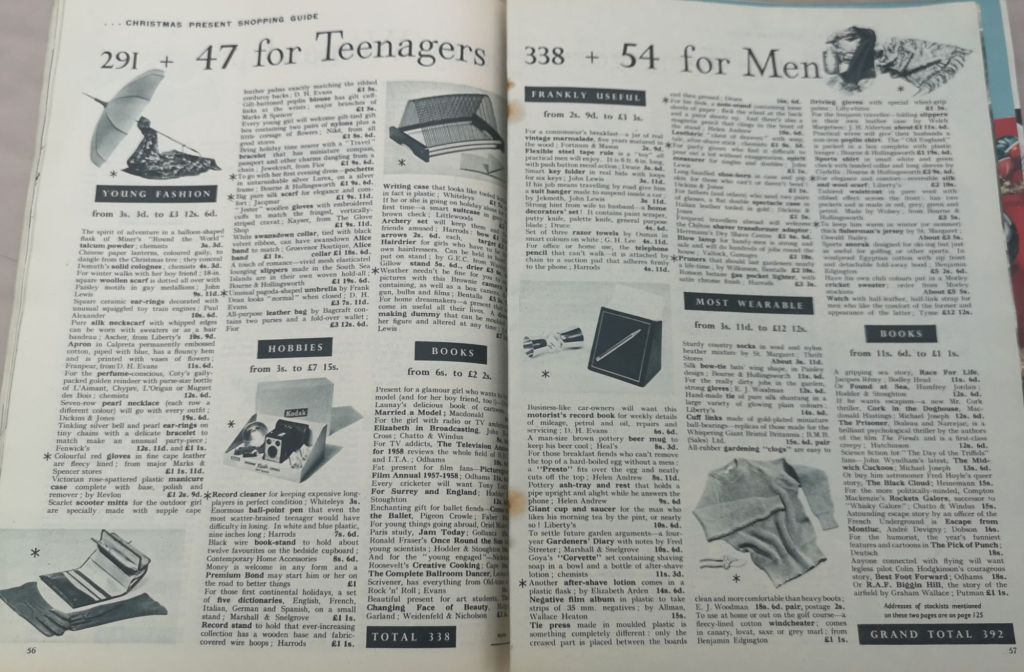
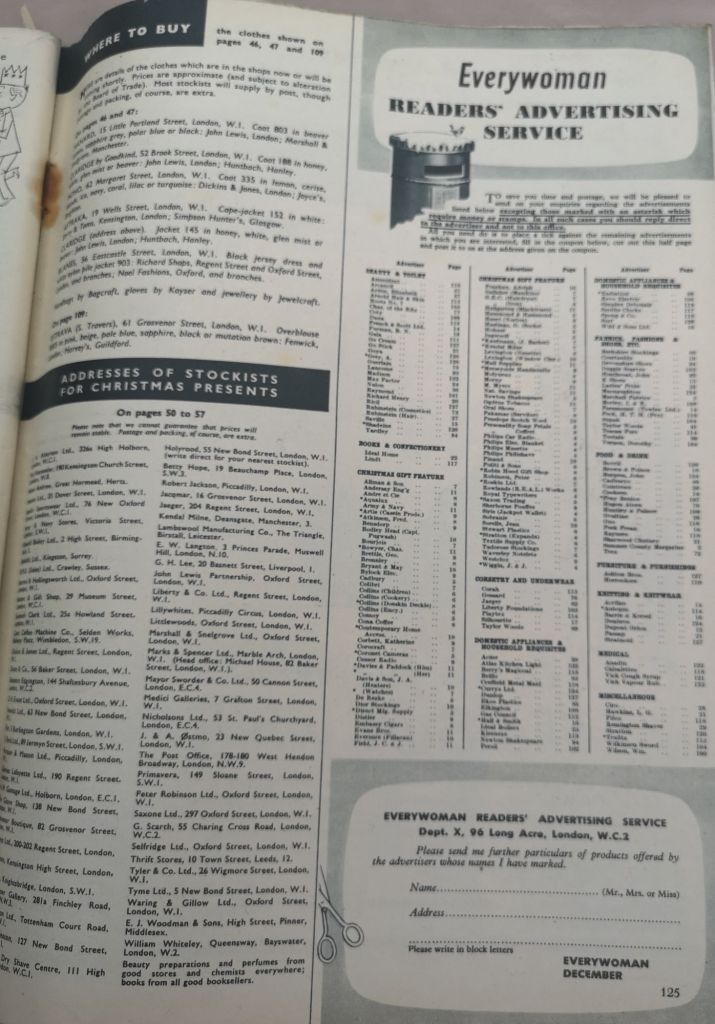
The encouragement for people to observe a traditional Christmas seems to be unnecessary by 1957, so the magazine can head straight into ideas for presents and it does so in no uncertain terms. Its 8 page Christmas shopping guide stretches to nearly 400 gifts. Not quite the Argos or Littlewoods catalogue of my childhood but near enough! Family giving focuses on the practical and useful, the type of gifts you may give to a relative. Then there’s over 100 gifts for children split along gender lines with toys for boys referencing polar and space exploration and for girls flower pots, aprons and a ‘miniature sink unit for the future housewife’! I was going to say that we have left those days behind, but I can imagine some who would happily bring back those dividing lines! Women would have recognised the types of gifts as being useful for the occasional night out, with the more practical items like cleaning appliances no longer suggested as appropriate presents. Teenagers were treated as their own group and some of the ideas like record cleaners and a set of five dictionaries for their first continental holidays certainly hinted at the more adventurous approach of that age group. For men, accessories like a home decorator’s set, motorist’s record book and a gardener’s diary hinted at the traditional pursuits while the clothes were generally about comfort rather than style in a time where the two piece suit was still leisure wear for many who could not stretch to a varied wardrobe. At the end of the magazine, as you will see below, there is a helpful list of all stockists and a coupon to request details for as few or as many advertisers as you wished.
One of the stories is of particular interest as an indicator of slowly shifting social mores. It is the story of Tom, a sailor on leave, and Sarah, a much younger woman who is fleeing the prospect of a loveless marriage. Tom takes her home to a semi-derelict house where he is living, something that would have been unacceptable in the stories just seven years earlier. No surprise that their fling is not consummated – it is 1957 after all – but Sarah tells Tom before they part that if he isn’t at sea or in some distant port next Christmas, she will visit the same house in a year’s time! The idea of the promiscuous sailor was already well known, so to work against expectations like that was very interesting.
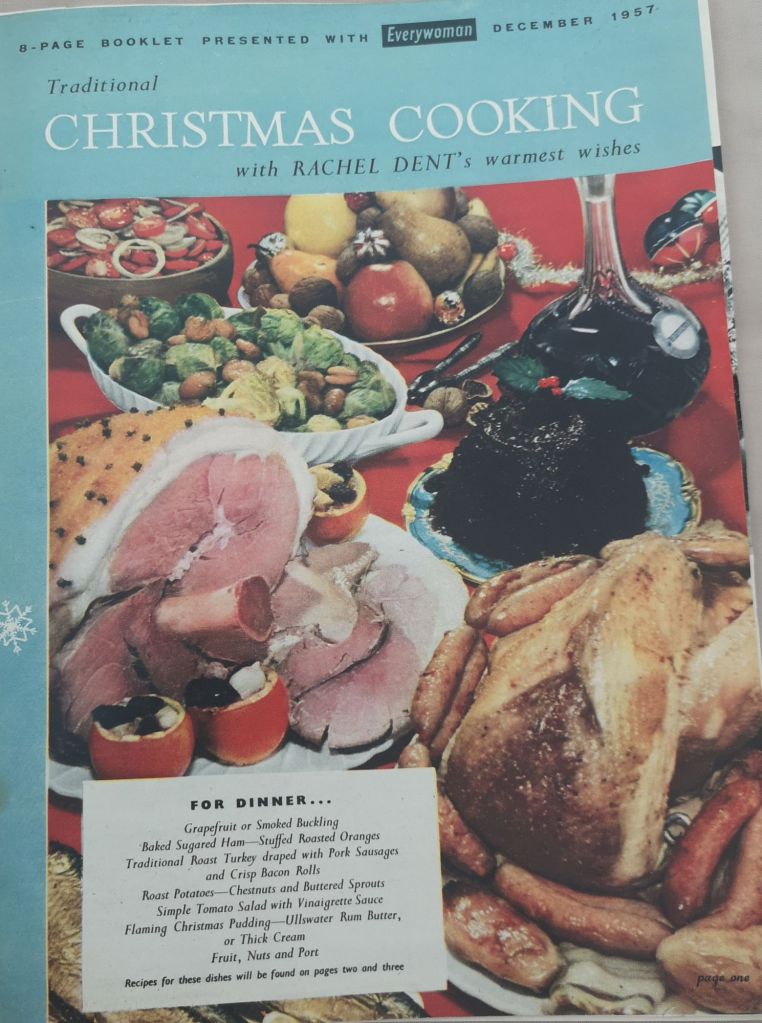
The Christmas Dinner 8 page pull-out was clearly designed to be referred to year after year, and it no doubt was in many households. There is something almost magical about recreating the same recipes every year. It becomes as much part of the Christmas experience as presents, decorations and music. The whole Christmas food needs are covered, Dinner, Buffet, Cakes and Biscuits and Puddings. There are some recipes which would still be worth trying out today. If you’re interested I can share them with you!
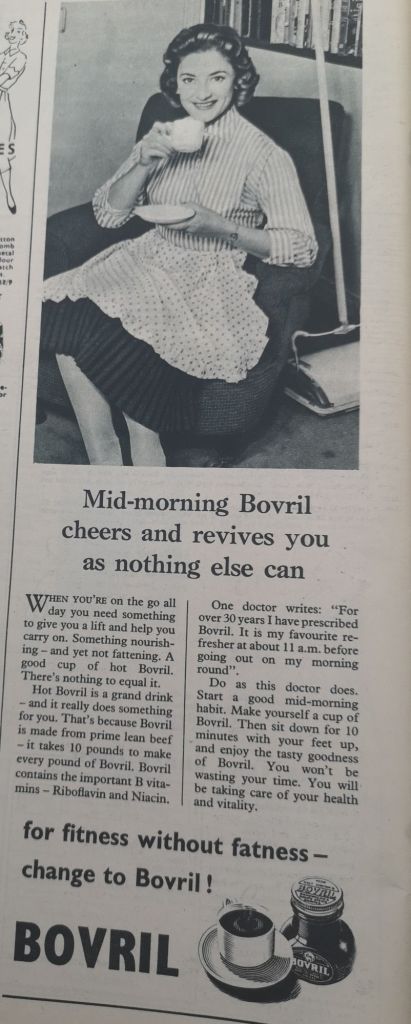
We have already looked at advertisements for presents, but there is one advert from Bovril that shows a very interesting development in the way some women saw themselves. In 1950, Bovril were extolling the virtue of their drink to help keep children strong and healthy. By 1957, they were marketing the drink as a slimming aid. Now that rationing by the government was over, women could choose to ration food for themselves!
Final Thoughts
This is the first of the magazines that is recognisably modern. In its burgeoning consumerist nature, the more realistic characters in their stories and the articles covering celebrities and Christmas hints and tips, it was much more like a magazine of today than its predecessor only seven years earlier. These magazines reflected the society they were writing for, and in 1957 British society was still quite traditional but showing signs of the changes that would be such a huge part of the narrative of the 1960s. How did the magazines of that decade reflect their world? We can find out tomorrow starting in 1965.
Discover more from David Pearce - Popular Culture and Personal Passions
Subscribe to get the latest posts sent to your email.
 David Pearce - Popular Culture and Personal Passions
Such a great idea this. Very much the social history story you had in mind.
LikeLike