
Mary Page Marlowe The Old Vic September 30 2025

This was the first time I had ever been to the Old Vic and I have to say that I was expecting a traditional West End theatre given the name. From the outside it looked like a new state of the art venue and that impression was confirmed when I got into the theatre itself. It’s a venue I will be hoping to visit more often in the future.
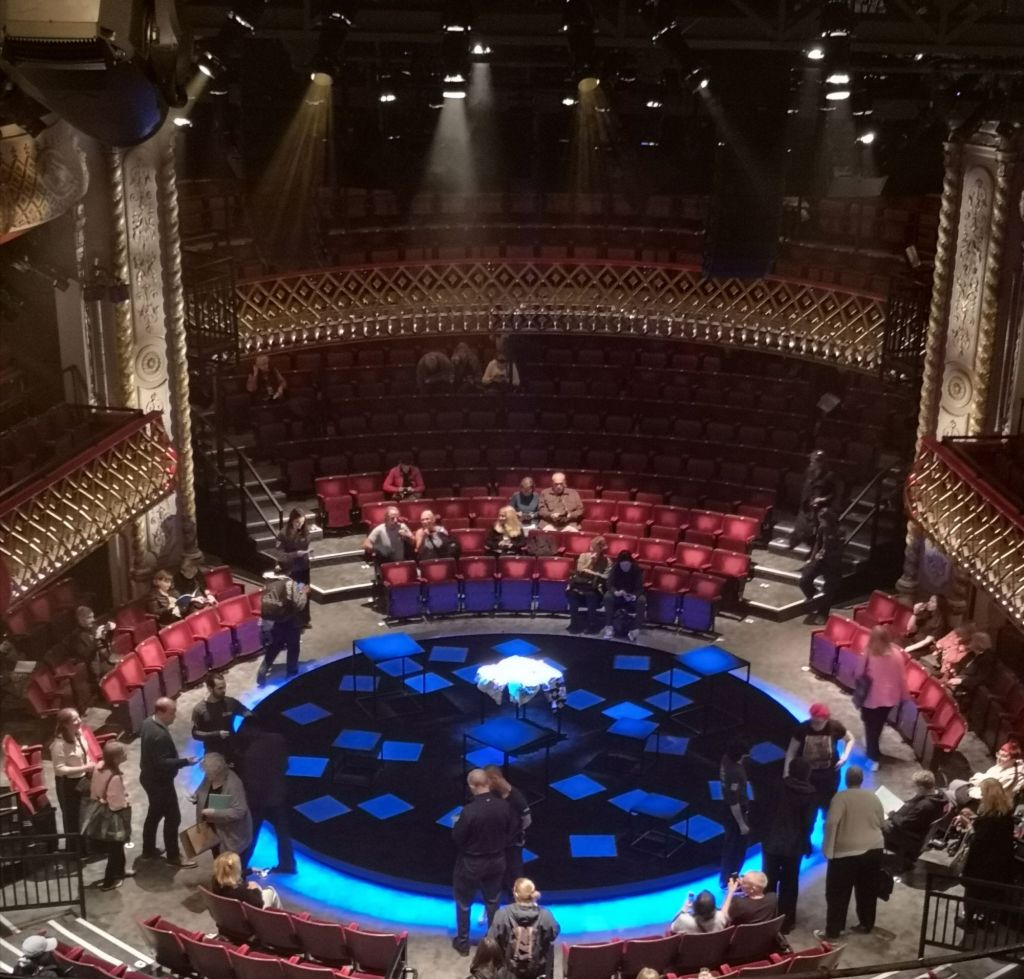
When we got inside the seats had generous legroom when compared to the older theatres, and you could see the stage with no problem. As you can see, the stage was in the round, something that will continue throughout the next year, another innovation for me as I have not seen a play in the round before. Having such a clear focal point really suited this play as it drew your entire attention to one life ‘in the round’.
The Play
I don’t want to give too much away about the play itself, partly because I think it needs to be enjoyed with as little prior knowledge as possible, and partly because it would take too long to explain the different aspects! Suffice it to say that the eleven different scenes are not in chronological order, and that you have to put two and two together to fully understand the story. Even then you probably won’t get the full story, because, as in all our memories, some of the events are almost certainly remembered differently by different people and what we see is the reflections of Mary Page Marlowe herself. Some things are hinted at, some are deduced and some almost certainly exist in my own mind differently from the way they exist in the minds of the other audience members. It reflects hope, fear, love, hate, grief and acceptance in a way that is dizzying in its brilliance. Tracy Letts has created a tour de force of theatre that will have the audience in its spell long after the show has finished.
The Cast
There are five Mary Page Marlowes on stage at various times and I will go from youngest to oldest. Alisha Weir plays Mary at the age of 12. Her scene reflects the path not taken, mostly due to a mother who is using alcohol to numb her psychological pain, sowing the seed for Mary’s own battle with sobriety. Weir very subtly plays the conflict between wanting to be a child and having to look after her parent, and it makes the heart sink to watch it, because by then you have seen the bulk of her future and you want to protect her. It is a performance of sensitivity and skill that shows a young actress who will not only be a fine screen actor, but also an excellent stage actor in the years to come.
Eleanor Worthington Cox is a young actress who I recognised from The Enfield Haunting where she played a teenage girl affected by a poltergeist. She was brilliant in that, but on stage she is even more well known, having been one of the original Matildas in the stage musical, the same part Alisha Weir played in the film version, and having returned to the stage regularly thereafter. She plays the 19 year old Mary Page Marlowe, and she has a brittleness and wariness that sets the scene for the more complicated woman that she becomes. However, at this point she is still able to look forward with a certain amount of positivity to a future that may include creativity and travel. In her portrayal, Mary is still allowing herself to hope for something better while half expecting something worse. It is a very nuanced and clever piece of acting that unbalances the audience because they pick up an undercurrent, the specifics of which only become clear later.
Rosy McEwen is Mary at 27 and 36. Her scenes are powerful and surprising, particularly the one where we find out that she is having affairs outside of her rocky marriage and is sleeping with her boss! Her Mary is still trying to find a way out of her descent into unhappiness and is allowing herself to hope for the best whilst preparing for the worst. We see a Mary who is capable of volcanic anger, a trait that becomes increasingly obvious in her future, but also of vulnerability and a sexuality that allows her to express a different side of herself as she charms and excites her boss. The sadness that hangs over this scene comes from the fact that both of them know that this is doomed to be a fling even though to each of them it clearly means much more. Andrea Riseborough has three scenes, playing Mary at 40, 44 and 50. Her scenes show a series of awful events that littered the decade, a decade that shapes the rest of her life for the worse and which puts Mary and the audience through the emotional wringer. Sometimes pleading for help, often vicious and unkind, occasionally showing a complete disassociation with everything going on around her, Riseborough’s Mary constantly wrongfoots those around her and imposes her faults and issues on everyone else’s lives. However, you retain a sympathy for her because of Riseborough’s incredible ability to make you care for this damaged, self-obsessed person. How she does it, I’m not sure, but it’s the type of alchemy that very few actors are capable of. In many ways her Mary is the central character of the play because it is in her ten years that you see all her chickens come home to roost. It is these chickens that her oldest self will spend the rest of her life trying to deal with.
The oldest Mary, at the ages of 59, 63 and 69 is played by the legendary Susan Sarandon. It’s a really interesting decision for this great actress because it is very much an ensemble piece and she doesn’t try to overpower the other four. She is every inch the older woman with regrets and the reasons for those regrets become clear at various points in the play. The pain of those regrets is palpable at times, but mixed in with the pain is acceptance and flashes of optimism particularly in the company of her final, and best, husband. The idea that she has found a person who makes life better for her is far too superficial for a play of this complexity, but she has clearly been able to accept things that have happened more readily and the support, finally, of someone who she can rely on definitely plays a part in this healing. Sarandon skilfully brings the conflicting emotions and experiences of a life not so well lived together to create a character who we understand by the end, at least on her terms. The final scene, in the play but not chronologically, is sweet and positive and beautifully played by a consummate and generous actress.
The play is introduced and played out by Hymn for Her by The Pretenders, one of my favourite ever songs. The lyrics refer to ‘the maiden, the mother and the crone that’s grown old.’ I think in this play we see the connection between all three stages more completely than in any other piece of work. I really urge you to go to this play if you can, and I wouldn’t be surprised if this will be revived with a new set of Marys every few years. However, this marvellous collection of actresses will be very hard to improve on as they were simply outstanding.
Discover more from David Pearce - Popular Culture and Personal Passions
Subscribe to get the latest posts sent to your email.
 David Pearce - Popular Culture and Personal Passions