
The A – Z of Classic Children’s TV: The Adventures of Robinson Crusoe Episodes 5 – 8
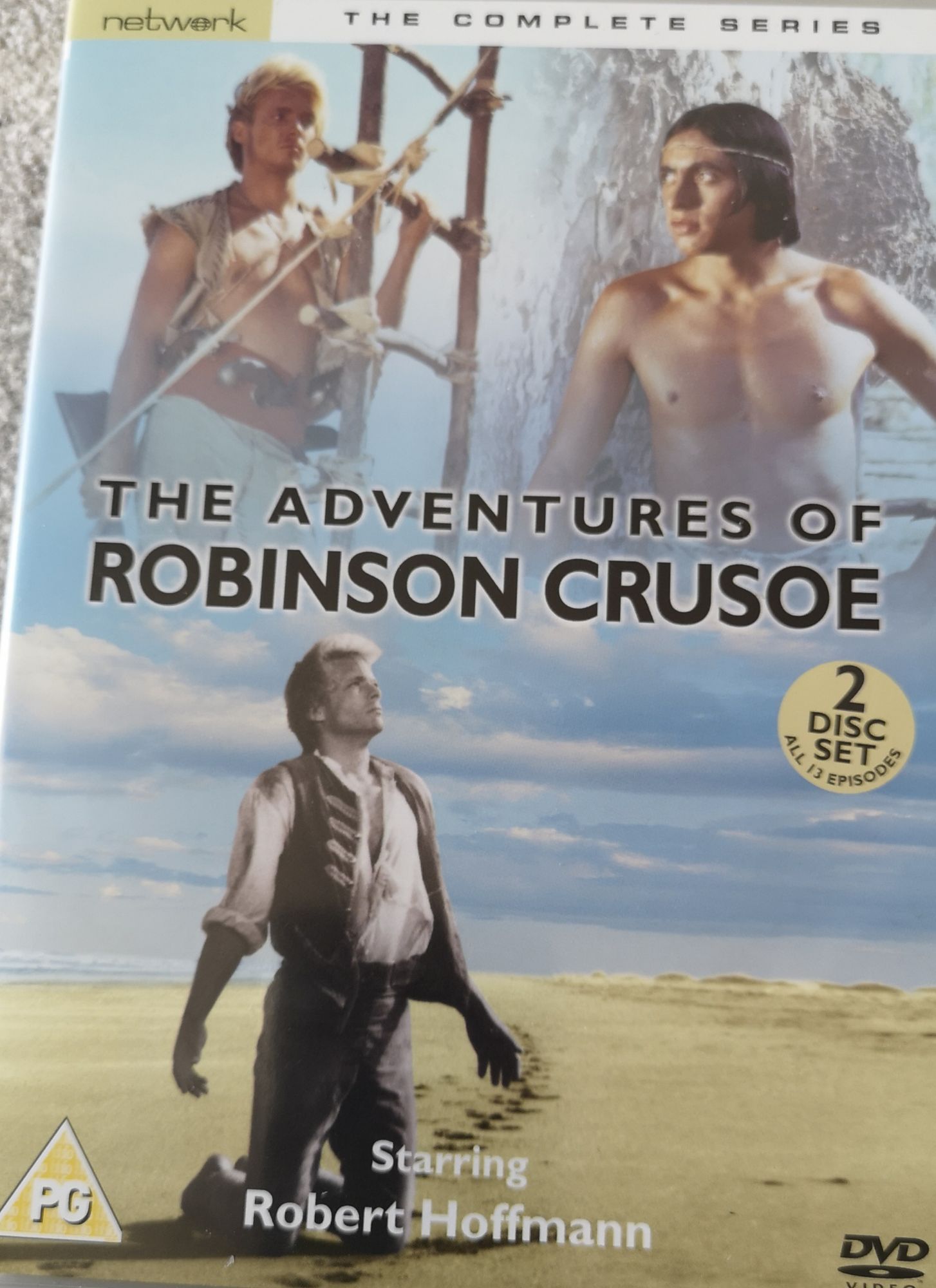
So, after the first four episodes saw our hero settle in to life on his desert island, we see what the next four have in store from him. Here is the TV listing for the morning of Tuesday August 19, 1975 when Episode 5 was broadcast.

I don’t think I would have moved from 10:00 – 1:45!
Episodes 5 – 8
The fifth episode opens up with Crusoe having been on the island for over a month, and now constructing a wall and a terrace for his cave. He even makes his own furniture, though not with great success as he reflects. Yet again, the slow pace and regular silences show how different programmes for children were all those years ago. There is a very interesting insight into his thoughts at his enforced isolation, and the viewer is invited to empathise with his situation without it being made into a big emotional set piece. I wonder how that would go with younger generations. The scenes when he is at sea are fascinating as you watch an old sailing ship being made ready to sail and then his increasing fascination with the way that the sextant and other navigational aids. He has several run ins with the second mate, Blake who dislikes him on sight and revels in his ability to bully him. When Crusoe and some of the sailors row ashore for fresh water they find slave traders in wait and he and another sailor are captured. He tries to escape but his efforts are in vain. There is a large scale action sequence as the slavers rush to try to capture more sailors. The others escape and decide to tell the others on board that Crusoe had been killed. Blake can’t hide his satisfaction at the ‘death’ of his disliked crewmate, and Crusoe has to endure the cruelty of the ‘barbarians’ who act in a way that they are expected to at least in terms of the storytelling of the time. There are Bedouin tents, Emirs with evil expressions, concubines and camels! Back on the island he constructs a goat trap to ensure a regular supply of milk and he keeps a fire going to advertise his existence on the island.
At the start of episode six our castaway is starting to find life ever more difficult as a result of the isolation. He is certain he sees a ship, but it turns out to be an hallucination. He wonders if he is succumbing to madness, and sets about yet more work to try to keep it at bay. He is determined to keep a track of the days by carving a notch for each day on a post (and a cross for Sunday) and wonders how many posts he will have by the end. Then, disaster strikes as his cave catches fire and all his furniture destroyed. Fortunately his dog and his parrot are both safe so he resolves to start again, reflecting how much worse the situation was when he was in slavery. He finds himself being exchanged by the Emir for a camel due to being so useless as a slave, then his second owner gets rid of him in exchange for a donkey and so on until after half a dozen trades he is worth just two baskets of fish! He finds himself working for a fishmonger and he plans his escape. He throws his latest cruel master into the sea and makes his escape in a small boat with very little food but a lot of his master’s gold! However, he has very little food and water and finds himself heading out to sea praying for a ship to find him. Luckily for Robinson Crusoe, and the story, he is finally discovered by a ship, who rescue him. A Portuguese ship finds him in his little rowing boat in a state of complete exhaustion and he is finally rescued. Once again attired as an Englishman should be, he uses the gold to buy a small plot of gold in Brazil, which he then exchanges for a banana plantation, and finds himself making money hand over fist. Back on the island he is rebuilding his cave and constructing a canoe to escape in.
We reach the halfway point and it’s interesting how little has actually happened to take the story forward. There has been a lot of backstory, but he has not really done anything to move on with his plans to get off of the island. Well, in this episode he has finished his massive canoe and he is preparing to leave his island. The trouble is that it is far too big and far too heavy. He cannot even get it to the water and when he realises this he despairs. He reflects once again on Brazil and his good fortune that he never really appreciated properly. He has become bored in Brazil so when he is told that there is a voyage to the coast of Guinea needed to obtain more slaves ‘at source’ he is tempted by the new adventure and accepts, leaving his plantation in the hands of three other businessmen. It is there that he first boards the Esmerelda, the boat that he would eventually be shipwrecked in. The Captain of the ship disappears without trace and there are no rats on board, a sure sign of bad luck in maritime superstition. Hit by a storm very soon after Crusoe must rally the crew to ensure their survival. Men plunge overboard or are crushed by huge spars of wood in yet another seaborne disaster. You are left wondering why he won’t take the hint! It turns out that this is the very voyage that has brought him to his island and left him a castaway. From now on the story can only move forward. However, he ensures that all the adventures are written down in the Esmerelda’s log book which has mysteriously appeared at this point in the story! He is bored and decides to get rid of a piece of rock that he keeps banging his head on. The parrot seems to realise it’s a bad idea and warns him loudly, but it’s no use, Robinson Crusoe is buried under tons of rubble.
The final episode of this quartet opens on a cliff hanger with a Doctor Who style reprise. Crusoe is buried but his dog tries to dig him out. Soon enough he is safe and he has even created a second door for the cave, so that’s fine. He discovers previously unsuspected skills for pottery, cheese making, farming and bread making. This is something of a holding episode of the types that longer series of this style used to have but none the worse for all that. By bringing the focus back completely onto the island and his increasing confidence in his own skills to thrive, not just survive. He even starts to catch fish and as a slave he learnt how to salt them, so he can build up a store of food. He has a day of rest on Sunday to respect the day of the lord, something that would have been completely understood by the children of the day. They would also, no doubt, have been expected to have understood words like idiosyncrasy from primary school onwards. What different times they were. Suddenly he hears a cannon, sees a boat, and realises that possible rescue is close at hand. He can hear a bell but no longer see the boat. Suddenly he remembers that the cannon and the bell means a ship that has the plague aboard. Undaunted, he decides to take his chances with the ship.
Next time, it’s the final five episodes, so join me to see what happens next.
Discover more from David Pearce - Popular Culture and Personal Passions
Subscribe to get the latest posts sent to your email.
 David Pearce - Popular Culture and Personal Passions