
Electric Dreams Review: The 1990s Family Experiment
As the Sullivan-Barnes family reaches the third and final decade of the experiment, we are promised that the gadget count will go through the roof, but it’s the humble television that causes the first hint of friction. There are now three TVs for three bedrooms belonging to Adam and Georgie, Steff and Ellie, and Hamish. The children can’t wait to get their own choice of viewing, but Georgie questions whether they need a television in their room. Adam says he has missed it, which causes him to get a frosty glance in return! Georgie’s worry about the family splitting up looks like it is already coming true in the first year of the new decade. Hamish is looking forward to staying in his room far more, as he did in 2009 (their modern day), whereas Ellie is more uncertain as to whether it’s really a positive thing. This situation gets more acute outside the bedrooms when the Game Boy arrives in 1991 and, as Adam observes, Hamish only needs to communicate for food and drink! Even Adam is ambivalent about the situation as he says he has enjoyed talking to him over the previous two decades.
In 1992, it’s time for satellite TV, and it was very interesting to recall, as the programme does, the snobbery associated with the dishes when they first arrived. It was seen as something almost shameful to have a dish on the side of your house, and certain assumptions were made about you if you did. As Georgie observes, it indicates couch potato, despite only having 5 extra channels! As mobile phones were still too expensive the family are given pagers, which I never saw outside of hospital dramas (!), to help organise a shopping trip for the millennium party they are going to hold at the end of the experiment. The ‘girls team’ found it very easy to use and send messages via the pager, but the ‘boys team’ proved that any technology in the world was only as good as the person using it!
1993 was a year that reflected the disquiet about increasing technology and the use to which it was put. There was a huge moral panic after the murder of James Bulger and technology, particularly the ‘violent’ video games of the time, which were cast in the role of the evil influence. To reflect this, the tech team deliver new consoles with a selection of popular games of the time, together with a note asking Adam and Georgie to look at the games and decide which are suitable for the children. They decide that Mortal Kombat was so poor in terms of the graphics that it was comical rather than disturbing. The main issue was the total incompatibility of the two gaming systems, Nintendo and Sega. Both Ellie and Steph, and Hamish, want the Nintendo to play Super Mario, and Adam decides the only fair way to decide it is to toss a coin. Hamish, perhaps as a result of the 1980s experience sees it as his right to have it and he complains bitterly leading to a battle of wills between Adam and Hamish. The coin is tossed and Steph calls correctly, so the girls get the Nintendo console while he is left with the Sega! That wasn’t happening in the 1980s because the girls found the BBC computer so boring, which indicates that both genders were equally happy to play video games, something I saw with my own children. It begs the question as to why it is still seen as a largely male preserve to this day.
At the end of 1993, Georgie gets a mobile phone, which would have cost the equivalent of £1400 in 2009, to reflect the fact that she has the highest status job in the family. She is amused by Adam’s apparent discomfort at not having one of his own! However, Adam has been given his own digital camera which he will use the following day when the family go to France to celebrate the 1994 opening of the Channel Tunnel. It’s interesting to find out that in 1994, no one could make or receive calls from aboard, so there turns out to be no point to Georgie taking it over there. Adam’s cutting edge technology is little better as the memory holds eight pictures with a resolution of half a megapixel. As there is no preview screen Adam is unaware that the pictures are so dark and grainy. The model he is using would cost the equivalent of £740 in 2009!
By 1995 the prospect of remote working looked to have become more of a reality as laptops and mobile phones now allowed workers to communicate with their offices. In practice, however, they were more likely to work at home after work rather than from home during the day as the internet was not powerful enough or available enough to support full time working. As we have seen recently, businesses are very suspicious of working from home even when it has been proven to raise productivity, probably because it has shown that the majority of workers not only don’t need micro managing bosses but actually perform better when they have proper autonomy and can decide on the structure of their working days.
When an early Sony console arrives, complete with games like Tomb Raider, Adam immediately commandeers the living room for a ‘lad’s night’ leaving Georgie despondent as this was what she had been dreading. She is sitting in the kitchen listening to Adam and his friends enjoying the games and, as she mentions, it feels very exclusive and a pointer to the future. The children, banished from the living room go upstairs to their own rooms as they would have done in 2009 leaving a completely atomised family unit. Although the amount of technology has grown exponentially across the 90s, it’s still not enough. Ellie wants a mobile phone, but is told that she can’t have one because she ‘will look like she’s mugged a yuppie’! Then Steph wants the internet which turns out to be less unlikely than I thought. By 1997, surprisingly, over 6 million UK people were already surfing the ‘World Wide Web’ so it’s time for the Sullivan-Barnes family to find out just how good, or not, the internet was in it’s early days.
It’s quite incredible to think that Tim Berners-Lee and Robert Cailliau, who is interviewed in a fascinating section from CERN, decided to make the World Wide Web completely open and free to anyone to use. They could have made it subscription or payment based and put it in a silo along with all the intranets that were developed from the 1960s onwards. By putting the code in the public domain and allowing anyone to use it they completely changed the world, and arguably the brains of nearly every human being on the planet. It is unarguably the most important scientific and cultural moment in history.
The internet of 1997 was delivered through a phone line with the noise that became so familiar to so many of us, and the websites, just 1.5 million at the time, were much more primitive due to the lack of processing power. Steff comments that the internet is rubbish! Georgie tackles Adam that night about putting a games console in the living room, something they had agreed would not happen during the experiment. Adam tries to protest that it’s a PS1, but the look that Georgie gives him betrays her view of that feeble justification! In 1998, the children finally get their mobile phones amongst a blizzard of technology including smoothie makers, digital cameras and pretty much anything else that could contain a microchip. There are so many deliveries that year that even tech head Adam gets annoyed by the constant churn of gadgets!
There’s a very interesting conversation at the dinner table on the penultimate night. Ellie wants to see the adult only status of the living room in 2009 reversed. Adam is very reluctant to allow that to happen as he regards it as his, but he is outvoted by the rest of the family. In response he makes the condition that the family can come in but that he (and maybe even Georgie!) will decide what they are watching. It’s interesting that with our modern mobiles everyone in a family can once again be in the same room but they can be completely separate in terms of what they are viewing. I think, on balance, I prefer that, because at least there is the opportunity to communicate with each other that doesn’t arise in a house where everyone is in different rooms.
We return to the Sullivan-Barnes family a month after the experiment to see what has changed if anything. Interestingly, while Georgie has come round to the view that technology is absolutely central to the children, Adam has decided that they need to do more things together as a family, so the living room has indeed become a place where the family can come together.
Final Thoughts
I remember really enjoying this when it was first shown back in 2009, and I found it fascinating once again. However, much as you never read the same book twice, because you bring different experiences to bear on each reading and understand and react to it in a different way, so you can never watch the same film or TV programme twice. When I first watched it my oldest child was 16 and my youngest was 8, and we were not able to afford new technology, so we often had gadgets that were a year or two behind, sometimes more. I remember looking at the Sullivan-Barnes’ home and thinking I’d love to have all that tech. Now, all but one of the children has moved out and we have powerful mobile phones, superfast broadband, hundreds of channels on our TV, a bread maker in the kitchen and many other gadgets. However, what I notice now is that the tech is in the background as we have come to terms with its centrality to our lives, and we have seemingly reached a plateau of innovation. All new phones look the same, laptops are pretty much identical and the only reminder of the old incompatibility is Apple with its insistence on tying people into their technology to the exclusion of all other operating systems, the main reason I have never wanted any Apple products. Now, when the children visit we spend time together, generally happy in each other’s company but with phones at the ready to distract us, use IMDB to find out who that actor was(!), or to communicate with people outside the house for a variety of reasons. Technology is both all enveloping and less important as we have found ways to navigate modern life. I wonder how the Sullivan-Barnes family look back on their time on this show? I wonder if they have made changes since then that have stuck? It would be fascinating to find out, and who knows, they might even read this! If they do, I raise a glass to them for being part of this experiment.
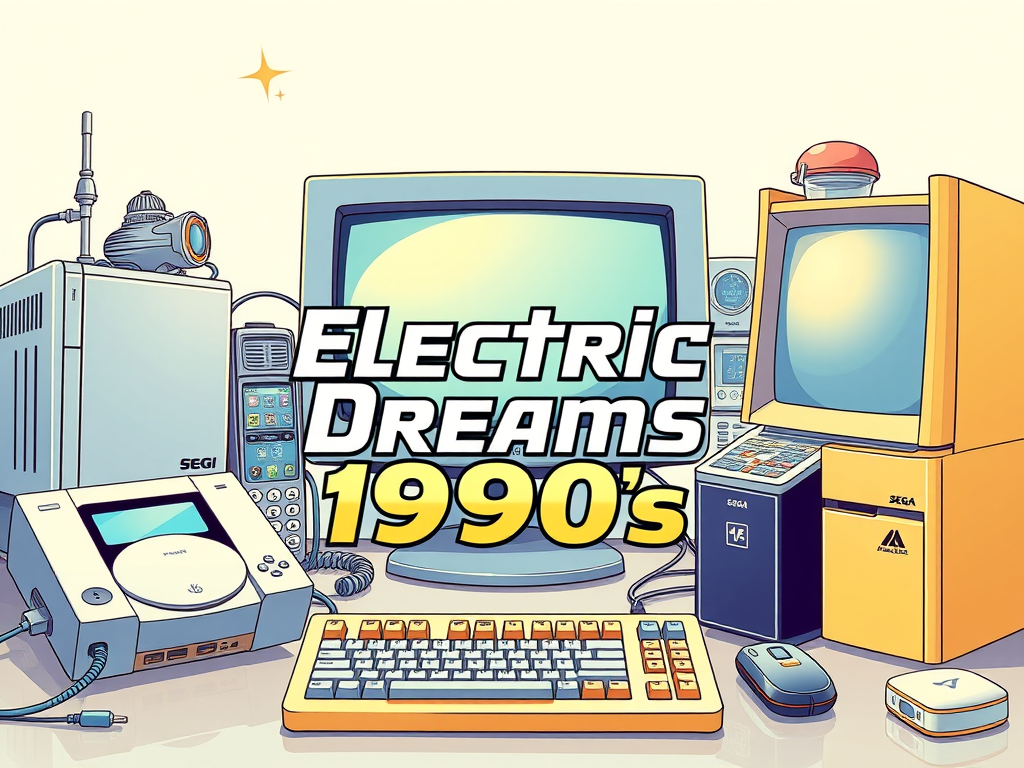
Oh, and one final note. I have created all the pictures to accompany this series using AI in WordPress and I have to say it is probably the most tangible (or non-tangible) form of technological progress I can think of. Even a year ago, AI like this would have to be paid for but now it is available to all of us.
Discover more from David Pearce - Popular Culture and Personal Passions
Subscribe to get the latest posts sent to your email.
 David Pearce - Popular Culture and Personal Passions