
Band Aid Do They Know It’s Christmas 40 Years On
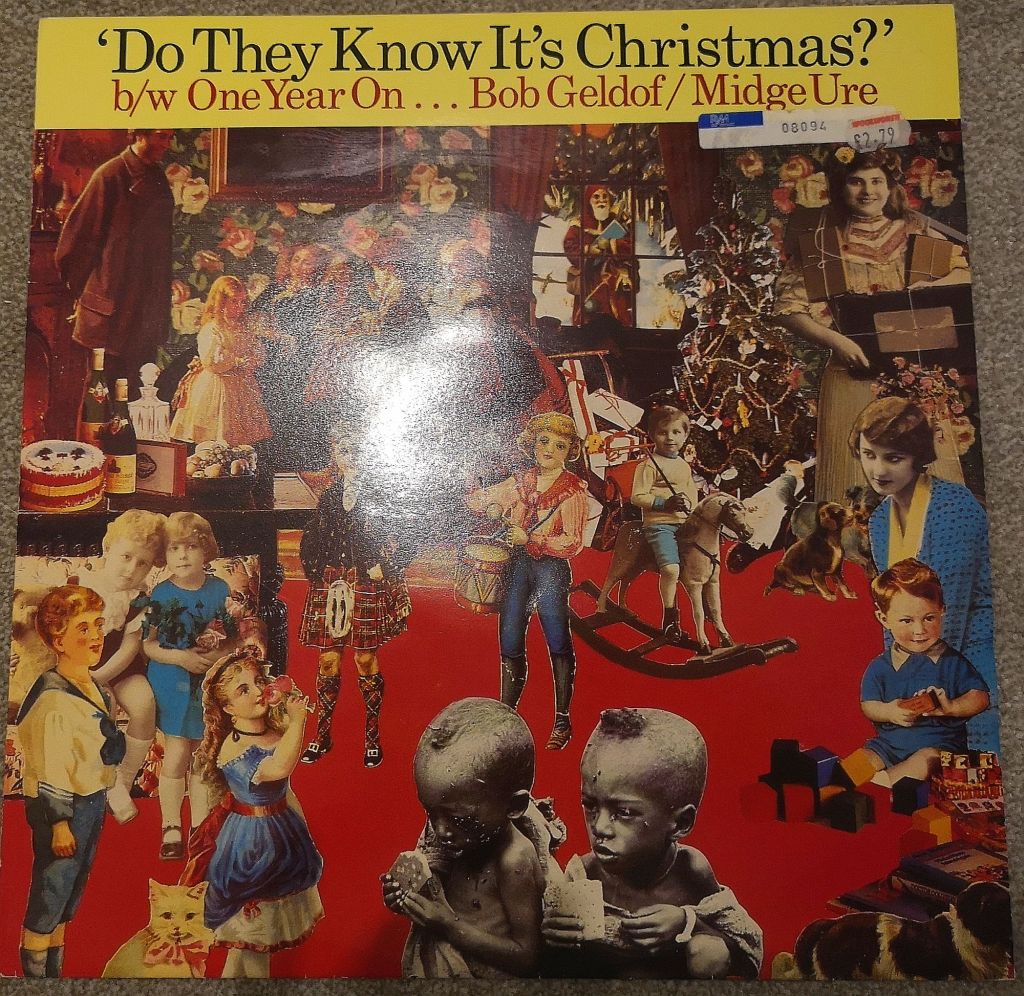
It was the single that became a phenomenon, selling over 3 million copies and becoming a Christmas staple. Band Aid was unlike anything that had been done before. Do They Know It’s Christmas was written, recorded and released within a month to raise funds for famine hit areas, and it raised £8 million pounds within a year. Never entirely without its detractors it has come in for a fresh wave of criticism four decades on, but I feel that it’s critics, despite making some valid points, should take much more account of the cultural and social landscape of the time.
Mass Communication in 1984
Television
When I look back to 1984, I remember an analogue world where BBC1 and ITV each had three news bulletins a day – definitely preferable to 24 hour news, but that’s another argument! There were four channels, the youngest of which had only been around since 1982. Breakfast television was still in its infancy and both channels had a magazine style approach into which news only intruded occasionally. There was still a closedown on all four major channels – again better than the 24 hour a day programming we have – the only exception being for the 1984 Olympics from Los Angeles which were broadcast through the night. News from Asia or Africa very rarely came to public attention, and if it did it was almost always to do with war, famine or an item on ‘And finally …’ on ITV when foreigners did something strange or amusing.
Computers
The computer rooms in major firms were just that, rooms with huge computers. They possessed a memory that was less extensive than the phone, tablet or laptop you are reading this on. Remember that the ZX Spectrum with a ‘massive’ 48k memory was only just over a year old and was still basically cutting edge. It loaded games using a cassette, and the graphics, amazing to an 80s teen, are considered positively prehistoric by today’s computer users! As for the internet, that existed purely in the realms of science fiction for the overwhelming majority of us. The thought of finding out what was happening everywhere and anywhere in the world in real time was fantasy.
Newspapers
This was the way that the majority of our news was delivered. Yes, TV was immediate but on most stories it could not go into the depth that newspapers could. With the luxury of a few hours or a couple of days, newspaper writers could provide a more considered take on the main events. They didn’t always succeed in this, but they certainly did quite well all things considered. The journalists got their own stories through instinct, interviews and simple hard work as they had no social media to rely on for hot takes – yes you’ve guessed it, a far better situation than the one we face today!
The Effect of Band Aid in 1984
Michael Buerk reported from Ethiopia, bringing the famine into the living rooms of the UK. There was shock, of course, at the sights and sounds of the famine, but we had seen these scenes before and we would see them again. I think it is fair to say that there was perhaps a parochialism to the majority of the UK at the time because flights were relatively much more expensive than they are now so we often stayed put, or we went to Europe on one or two week breaks. Obviously there were many people who didn’t fit in to that stereotype, but they tended to be very much the exception. Since most of our considerations were of a domestic nature, the foreign news, even the most horrifying foreign news, had far less impact than it does today. Without Bob Geldof and Midge Ure the famine would have faded from our collective consciousness very quickly. Their decision to do something about it gave an impetus to the fund raising that would never have happened otherwise. They kept the story in the news and actually enabled us to do something to help. We could buy the record and donate to a cause we would have probably walked past if it was the subject of a street collection. Many people, even if they didn’t buy the record, were aware of and remembered the story of the famine for far longer than they would have been in the normal run of things. By keeping the situation in the public eye Band Aid ensured that the famine remained on the front pages. At Christmas time when thoughts more typically strayed to family, friends, food and festivities, we were reminded that not everyone was as fortunate. That effect was intensified the following July when Bob Geldof headed the massive Live Aid concert, raising even more money for those who were still suffering and for those who were trying to rebuild their lives.
So, of course, there were decisions that may have been made under immense time pressure that those involved would change with hindsight. (There are many things I would change from those days, not least my fashion choices!) However, the lyrics, whatever their perceived weaknesses, struck a chord that turned a news report about a distant event into something that so many of us cared about deeply. What Bob Geldof, Midge Ure and the artists and technicians gave freely to the cause created something that we should still marvel at. Oh, and I still love the record, it’s bloody marvellous and absolutely one that stands the test of time.
Discover more from David Pearce - Popular Culture and Personal Passions
Subscribe to get the latest posts sent to your email.
 David Pearce - Popular Culture and Personal Passions
I was 8 when it came out, and whilst i don’t have much recall of the actual song or the hubbub surrounding it, i do remember us having to sing it in final assembly at school, before breaking up for the Christmas holidays.
LikeLiked by 1 person
It is a great song, regardless of nitpickers moaning about the factually incorrect lyrics! It served – and continues to serve – a purpose
LikeLiked by 1 person