
7 Up TV Series Re-view

What was 7 Up?
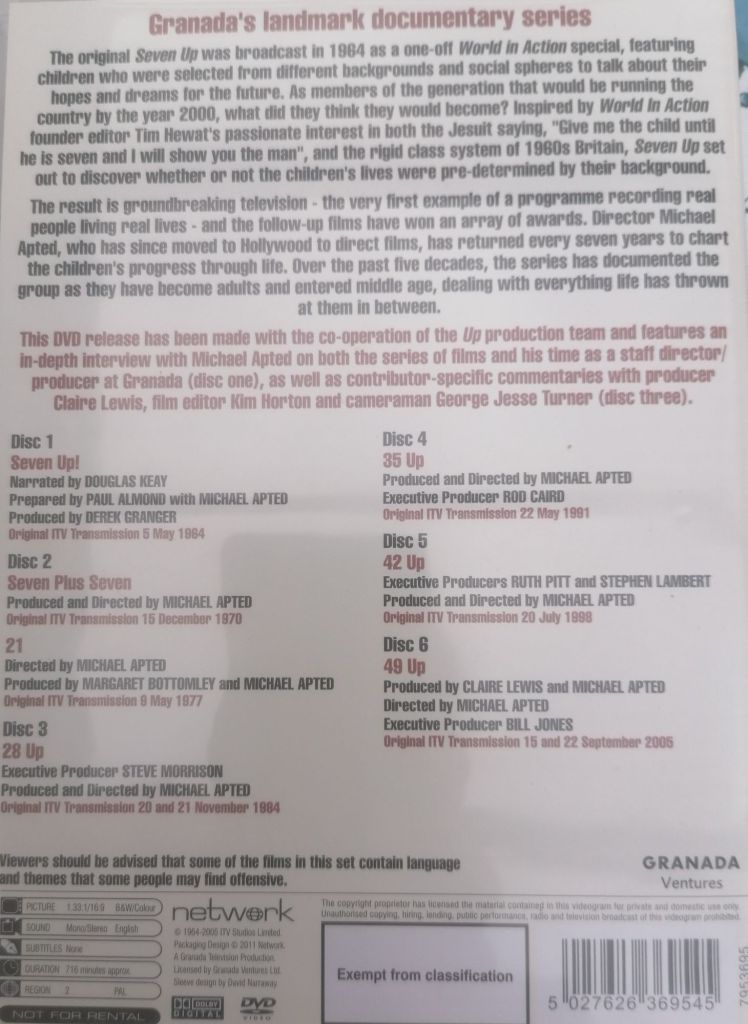
7 Up was a one off show produced by Granada Television as part of their World in Action documentary programme. In essence World in Action was the ITV equivalent of the BBC programme Panorama. However, it had a wider brief and frequently courted controversy in a way that it’s more staid counterpart would not. As well as this controversial edge, it was often much more innovative and took chances on new film makers and new ideas. One idea that made it to the screen was that of finding a group of seven year old children whose cohort would be likely to be running the country in the year 2000. Given that these children were seven in 1963, they would be 44 and at the peak of their careers by the end of that year. Well, that was one reason. The other was the often quoted, and variously attributed, adage ‘Give me a child until he is 7 and I will show you the man’. Although girls were included in the 20 chosen children, it was very likely that the boys were the main focus in the minds of the documentary makers when it came to their future impact on the UK. In the end, 14 of the 20 children were chosen to be interviewed in more depth, 10 boys and 4 girls. Those 14 children were Bruce Balden, Jackie Bassett, Symon Basterfield, Andrew Brackfield, John Brisby, Peter Davies, Susan Davis, Charles Furneaux, Nicholas Hitchon, Neil Hughes, Lynn Johnson, Paul Kligerman, Suzanne Lusk and Tony Walker. They came from a range of backgrounds as the underlying aim was to examine the impact of class on the lives of this new generation. Accordingly, they chose working class boys and girls alongside upper class boys, but only one upper class girl interestingly, to get a snapshot of their lives. By the way, it’s interesting to note that a snapshot is all it was supposed to be, since at the time it was only ever seen as a one off programme. Michael Apted, the film maker involved with the project throughout its run, has gone on record as saying that the lack of girls was a mistake brought about by a lack of foresight regarding the impact of feminism would have. You need to give the documentary makers some leeway of course, as hardly anyone foresaw those societal changes. The UK was a very much less diverse country in 1963, so it’s perhaps reasonable to argue that in including Symon, the only child from a mixed ethnic background, they were being quite forward thinking in their own way. So, how does this programme look six decades on?
7 Up World in Action
I suppose the first thing that strikes you is the way that in London Zoo, where all the participants were treated to a day out, the children are just that, children. By looking at them, you can’t really tell which social background they come from, even if you can make a few educated guesses. There is a brief scene where a boy who doesn’t appear in the rest of the programme is shown throwing stones at one of the animals, and is told off by one of the other children. The telling off is caused by the fact that the boy throwing stones has transgressed against the social norms that we are, or should be, bound by.
The first scene after the day out shots shows the child who had been doing the telling off in his school classroom singing a song whose tune is instantly familiar, but whose words aren’t. It turns out that this is a class in a Pre-preparatory school where the 7 year olds are singing Waltzing Matilda in Latin! These 7 year olds can already conjugate Latin verbs from memory and are clearly expected to do so with ease. The children, all boys, are almost unnaturally well behaved. All of them are paying attention and showing total engagement in a subject I found difficult to master in secondary school at the age of 12. When we see the three chosen boys being interviewed, John, Andrew and Charles, they answer questions with ease, assurance and, to modern ears perhaps, a touch of coaching. For example, when they are asked what newspapers they read, their answers range from The Telegraph to Andrew’s response of the Financial Times! They also have suspiciously adult views about The Beatles who apparently should cut their hair and play less raucous music! Another scene shows a boy acting as a parade ground NCO instilling discipline into his seven year old compatriots as they practice military drill. These boys are clearly very privileged and they have opportunities that the lower class children would never be able to access. The other upper class participant, Suzy, is shown doing ballet and interviewed in her headmistress’ study where she answers questions quietly but with a seeming air of confidence.
The classroom and playground scenes in an East End school which Tony attends show the class and behaviour divide extremely clearly. Even in those days, it’s clear that a lot of the teacher’s job is crowd control as a clearly inattentive Tony has to be told multiple times to turn around. In the playground, tarmac rather than the grass of the pre-prep school, the girls play skipping games while the boys fight with each other to burn off some of their excess energy. Tony is far more comfortable in this environment and when he is asked what he wants to do when he leaves school he answers that he wants to be a jockey. The questions for Tony, Symon and the rest of the working class participants seem far less aspirational than those for the upper class children. This is emphasised when the three East London girls, Jackie, Lynn and Sue are asked how many children they think they are going to have.
The other participant that really stands out at this point is Nick who lives in a remote part of the Yorkshire Dales and walks four miles a day to attend school. His remoteness together with his age, at 6 the youngest participant, seems to give him a different perspective from the others. He is clearly quite isolated from other children and therefore, perhaps, more affected by his family and his surroundings given the lack of socialising cues available to the others.
My reaction
As anyone who follows me will know, I am fascinated by social history and popular culture in all its forms. The number of questions raised by 7 Up in terms of our progress, or otherwise, as a society will no doubt be reflected upon at length as I re-watch the other episodes in the series. Two things occurred to me as I was watching it. Firstly, how children in essence don’t really change that much. Yes, they have technology all around them and access to ideas and materials that the 7 Up cohort could never have dreamed of, but at heart they are no different from seven year olds today. Put the classroom scenes into colour and it would be quite easy to believe that you are watching a modern day classroom. Secondly, I reflected on the small amount of progress we made towards a more equal society in the 1970s and 80s, where social climbing was possible, and how even that progress seems to have been lost as the class system has rediscovered its rigidity. It is no doubt something I will return to before this series of posts finish.
Discover more from David Pearce - Popular Culture and Personal Passions
Subscribe to get the latest posts sent to your email.
 David Pearce - Popular Culture and Personal Passions
I remember being shown this at junior school in the mid 80s, and i did follow it up until the last two installments.
Felt sorry for the guy who had mental issues, but i can’t remember much about it!
LikeLike