
Eternal Peace Gregorian Chant for Christmas CD

Gregorian Chant can split music lovers down the middle. For some, it is restful, profound music, for others it is anything but restful. To quote Ruby from the Butterflies Christmas Special in 1979 when she finds Ben listening to it while she is on her cleaning round,
I’ve switched them moaning fellas off while I’m working!
(Lane, 1979)
Whether you are a Ben Parkinson, who loves it, or a Ruby who can’t stand it, a little bit of background will probably be useful.
Gregorian Chant
Gregorian Chant is named after Pope Gregory I who became the Pontiff in 590 and oversaw the Catholic church until 604. He was the first person to codify it and make it an integral part of worship. However, the music we would recognise as Gregorian Chant nowadays probably dates from a few centuries later when Charlemagne, the King of the Franks, a Germanic people, combined existing Gregorian Chant with Gallican Chant to create a new style of worship. Even allowing for this, which has the recognised version of Gregorian Chant dating from the very start of the 9th Century, it is perhaps remarkable that this style has endured for over 1200 years and, in its original form, for 1500 years.
It is sometimes referred to as plainsong and it consisted of Latin worship set to very simple music and sung in monophonic style. This simply means that there is only a single line of melody which is sung in unison. It is at its most effective in churches and large halls, where the acoustics bring out its full power. There were different chants for different times of day, as they followed the cycle of the eight prayer services, Matins, Lauds, Prime, Terce, Sext, None, Vespers and Compline. In addition the chants varied across the year according to the seasons. As you might expect, then, there are chants which are only heard during Advent and Christmas. They were obviously not Christmas carols as we know them today. Incidentally, the word carol actually referred to a dance performed in a circle in Roman times, and celebrated all kinds of festivals. They only became inextricably linked with the Christmas season much later on, particularly after their revival in Victorian times.
Gregorian Chant has been used in a number of films, especially the ‘Dies Irae’ chant used for funerals, which pops up in films as diverse as Star Wars, The Lion King, The Shining and It’s A Wonderful Life. This is extremely well covered in this YouTube video from Vox if you want to go into more depth. Gregorian Chant even reached the UK Number 1 slot the week before Christmas in 1990 when Sadeness by Enigma used a Gregorian Chant by The Kapelle Antiqua Choir as the background to the track. Unfortunately, Enigma didn’t ask permission to feature the track, so the choir sued the group (!) who settled very swiftly out of court.
So, how does Gregorian Christmas music sound to my modern ears? Let’s find out!
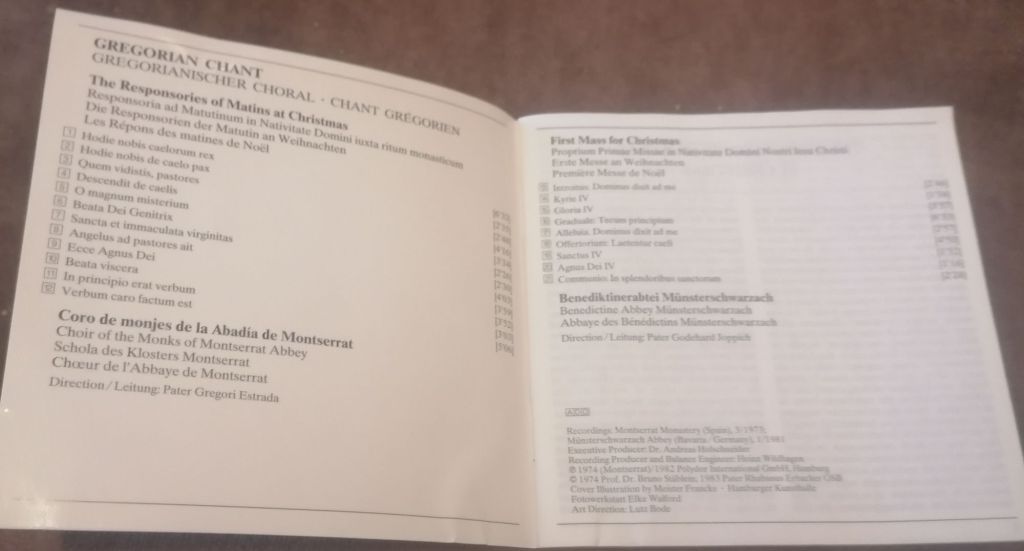
The Music
The Responsories of Matins at Christmas
The first 12 tracks on this disc are titled The Responsories of Matins at Christmas. Matins is the canonical hour sung at midnight and this group of songs are generally used following the reading of lessons, in the same way as King’s College Cambridge have the famous Nine Lessons and Carols, alternating between the two. These are responsories that vary with the seasons but which, by virtue of coming at midnight, must have been incredibly significant in marking Christmas. The haunting refrain is, quite naturally, an acquired taste purely because we are no longer used to hearing music like this any more. However, if you can learn to appreciate as I have been able to, after some effort I must admit, it is uniquely atmospheric. These twelve tracks are sung by the Choir of the Monks of Montserrat Abbey, and the sound of many voices coming together as one is powerful, and the quality of their voices makes the limited musical palette bright and colourful. Though there is nothing, to modern ears, particularly festive, the sleeve notes for the CD includes the full responsories in four languages including English. It includes the familiar bible story of the Virgin Birth and the Angels’ tidings to the shepherds together with the meaning of the birth in spiritual terms. Whether you believe in the story or not, you can sense the importance of these words to the monks in the way they are sung.
I find it to be a piece of social and musical history that is incredibly interesting. These songs whisk you back a millennium or more to times when only the monks themselves and the wealthy, whose family could afford and wanted to give their children an education, could read the words. The rest of the population would have been reliant on listening to the words in songs like these to follow and understand the story of the birth of Jesus. In an oral tradition, they would have been incredibly significant as a way that the clergy could communicate with those outside. Although I am a teacher now, I realise that I would certainly not have been one in those days because I am not from the ruling and monied classes. I too would have been reliant on these responsories to understand what happened that first Christmas. I can picture myself in a monastery in the 12th or 13th Century listening to these words and committing to memory as far as possible. Perhaps I would have been inspired to join the monastery in those days where it was seen as a step up the social ladder that allowed you to access the world of education. These voices and words of the past carry me back to my ancestors and their much harder, more uncertain, and shorter lives, lives that were enriched by a simple belief that, in some ways at least, is still central to the season.
First Mass of Christmas
The tunes and words in this section, sung by the Benedictine Abbey, Munsterschwarzach in Bavaria, are believed to date from around the 9th Century, right at the start of the Gregorian Chant we know today. You can hear differences in this mass, with the words being sung, not by all the monks all the time, but in different sections and perhaps combinations. These songs are also structurally different with longer chants like the Gloria having a very similar purpose to the Collect in the modern church as far as I can tell. In both cases, the congregation are encouraged to reflect on the central message of the religion. There is also a more musical flavour to them, in modern tones, with more variety in the tones you can hear. In its understated way, this is a more expressive piece of choral singing.
It is interesting that the chant seemed more modern and accessible, given its very early derivation, mentioned above, but it is clearly recognisable as the forerunner of choral and religious singing in more modern times. Again, as with the responsories, there is nothing recognisably festive in these tunes, but their overall effect is to invite contemplation that can move in religious or more personal directions. If you are not inclined to think about the former, you can, perhaps, consider your own life and relationships and listen to that still small voice of calm that the reflective music may help you to hear.
Final Reflection
This was a really interesting experience for someone who is fascinated by the development of music through the ages. Did I feel as though I really understood it? No, I didn’t. Quite apart from the content, I couldn’t pick up the variations and intricacies that I am always listening for in modern music. Did I find it an easy listen? Actually, yes, because it is so relaxing and so different from anything else I have ever listened to that I lost myself in it. My thoughts turned to my ancestors, as I remarked above, and by weaving a narrative I was able to immerse myself in the music.
Should you be interested in trying this new field for yourself, you will be able to find this CD from your usual stockists. Read the sleeve notes, because they will help to put things in context, but have an open mind. Who knows, you may find a new appreciation for something incredibly different as I have started to through this aural experiment.
Discover more from David Pearce - Popular Culture and Personal Passions
Subscribe to get the latest posts sent to your email.
 David Pearce - Popular Culture and Personal Passions
Trackbacks & Pingbacks