
Blue Peter Eleventh Book Re-Read
One of the guarantees on a Christmas morning in the 1970s was that somewhere among my presents would be an annual or two. The Beano, The Victor Book for Boys and from the age of 8 a Blue Peter annual were regular treats. The Eleventh Blue Peter book was my first one and I received them every year until my teens. What was so special about them, and how would I react when reading my first annual again? I got the chance to find out when I found it in a charity bookshop earlier this year, so let’s go.
The Year 1973
1973 was the year of strikes and industrial unrest with the unions and the government at loggerheads. It was the year that the three day week started and we did our homework by candlelight. It was the year of the first battle for the Christmas Number One won by Slade with their iconic Merry Xmas Everybody. It was, for me, the year I joined St Andrew’s and finally fitted in somewhere. For all those reasons it was a year I remember with great affection.
The Cover
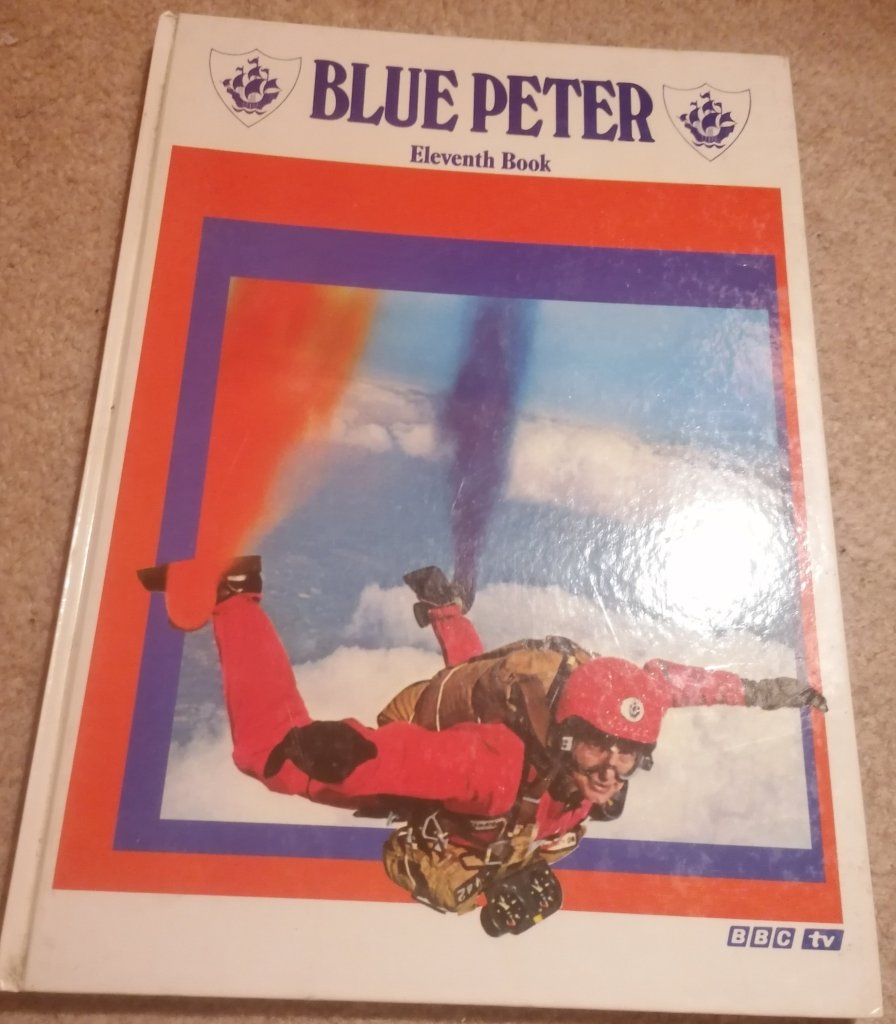
On the front, instead of the year, the title was Blue Peter Eleventh Book, rather than the Blue Peter Annual 1974. I think this gave it an air of an ongoing series and perhaps made it less likely that it would be put to one side before New Year’s Eve as some of the other annuals were. The picture on both the front and back cover is of the daredevil presenter John Noakes skydiving as part of one of the most clearly remembered segments of the show from 1973. I was a massive fan of John Noakes, as were many others, and his picture on the front cover probably attracted many parents, family, friends or Father Christmas himself to buy it!


The Contents
On the two contents pages inside the front cover there are 20 passport style pictures of John Noakes and 20 of Lesley Judd, who joined the team in 1972. They were the presenters who were perhaps seen as more relatable to the audience and, in Judd’s case she was now the third presenter of a trio with Noakes and Peter Purves, having initially presented the programme alongside Valerie Singleton and then taken over from her as Singleton branched out into a series of programmes like Val Meets the VIPs and became a guest presenter for Blue Peter Special Assignments rather than a regular presenter. So, 1973 was Judd’s first full year and the book reflected this in the prominence it gave her. Looking at the bottom of the two pages, the 70p price tag raised a smile! Looking at the contents themselves, three sections jump out straight away. First of all, A Spoonful of Paddington, one of a series of Michael Bond penned stories featuring the famous bear. I got the Armada Lion collection of stories pretty much as soon as it was released in 1978, but this was my opportunity to read a new Michael Bond and I remember it being the first page I turned to. Second was Tolpuddle Martyrs which I remember incredibly well both on screen and in this book. Finally, The Ugly Sisters was a pantomime themed section of the show with Peter Purves and John Noakes gleefully hamming it up aided by Arthur Askey!

A Spoonful of Paddington
One of the elements of the Paddington books that kept them fresh was that there were no references to people or events that could pin the books to a specific time period. After decimalisation, for example, people still referred to coins using their pre-decimal names, and everyone knew what they meant. So, when a character in Paddington referred to sixpence or a shilling it didn’t seem out of place. I read Paddington as a child and was quite convinced that the books were set in the modern day. That was turned on its head in A Spoonful of Paddington which was a story based on Uri Geller. Now, immediately, I have to explain to readers who weren’t around in the 1970s who Uri Geller was. He was an ‘illusionist’ (charlatan) whose stock in trade was bending spoons through ‘the power of the mind’ and he became a sensation in the more credulous days of 1973. Michael Bond incorporated this trick of Geller’s in the story and tied it in to Paddington’s efforts to replicate the feat, his first go at babysitting and the Blue Peter team in a typically funny and well plotted tale. By the end of the story, with it’s knowing pay off, it is clear which side he is on in the Geller debate!

The Tolpuddle Martyrs
This was a story I remember from television and one that had a real impact on me at the time. In the studio, and in this book, Peter Purves introduced this historical tale with union banners behind him to explain the reasons behind unions. Nowadays, of course, the government would be screaming about indoctrination and trying to get Blue Peter banned, but in those days we were trusted to be given that type of historical information. The historical stories were always accompanied by beautifully drawn cartoons, which are reproduced faithfully in this book. The story of the poor workers in Tolpuddle being exploited by their employers resonated with me and the time because of the way it was done. They complained that 8 shillings a week was impossible to live on and asked for 10 shillings. In retaliation for their attempt to feed their families properly, the employers reduced their wages to 6 shillings a week, leaving whole families at the risk of starvation. A group of men got together to form the first union and swore an oath to support each other. Sadly, one of the men was a traitor and he went straight to the employers. I remember being appalled by his actions at the age of 8, and not much has changed in the intervening 50 years. Along with the cartoon version of A Christmas Carol it informed my sympathy for the underdog that has stayed with me all my life.

The Ugliest Sisters
This was an article based on a Blue Peter pantomime that took a scene from Cinderella as its inspiration. Val was Cinderella, Lesley was the Prince, John and Pete were The Ugly Sisters and Arthur Askey was Baron Hardup. It was Askey with his huge experience of the art form who guided them through their rehearsals and gave them the tips they needed to put together a scene that was broadcast. I still remember the ‘somewhere else’ gag that amused me hugely then and still makes me grin now. It is the details of the preparation that give this article a real interest to me, explaining some of the history and conventions behind pantomimes.
Reflections on the book
There is a huge amount to read in this book, even for an avid devourer of the written word as I was at the time. There are behind the scenes stories including the cover story of John’s 25,000 feet freefall with the Flying Falcons which goes into great detail about the training required and the way the actual jump felt. There are historical articles and one of the famous ‘makes’ giving you the instructions to make your own ‘Red Indian’ village! I’m not sure that one would get past the planning stage now! There is a recipe for cooking a Scone Pizza, which sounds intriguing at the very least, and would be easy for any reasonably capable child to do. In those days of latchkey kids, of which I was one, it was useful to be able to put a snack together when you got home from school. Of course, you first needed to remember your key if you were to try out these recipes, something I was not always good at! The overall tone was what might be called didactic today, and it is a tone some people might frown upon. This book shows why they would be completely wrong to do so. All the facts and ideas are presented in an engaging and effective way that is as good as the most technologically advanced of lessons these days. The quality of this book just doesn’t dip from cover to cover, and revisiting it has been an absolute treat.
Discover more from David Pearce - Popular Culture and Personal Passions
Subscribe to get the latest posts sent to your email.
 David Pearce - Popular Culture and Personal Passions
Thank you for posting this. The Tolpuddle Martyrs were mentioned today in comments on a Rural Historia Facebok page post – https://www.facebook.com/permalink.php?story_fbid=pfbid02wJZ6dswzWrDWRudgWG9xHhvtty3gxpZZPwngNrQ4Fn7sxMmTngaQfNfdedKZyrbCl&id=100087855281319
It set me thinking about where I first read about them, and yes it was in my Blue Peter 11th book! My copy is now long gone, but thank you for posting this. Your comments about how it would never now be allowed to be covered by a kid’s programme is exactly what I thought too.
I quoted from your blog in my response to the Facebook page and included a link to this post.
LikeLiked by 1 person
Thank you Susan. So glad you enjoyed it and thank you for linking to the post. I have a couple more Blue Peter books that I am going to blog about so hopefully you will enjoy these. All the best David
LikeLike
Just in case you are interested I have a number of posts covering the 1970s. If you remember Singing Together you might be interested in this https://davidgpearce205.blog/2023/06/10/memories-of-singing-together/ and if you remember Robinson Crusoe I have three posts that you can find in the links at the top of my homepage. Happy Reading!
LikeLike