
Memories of Singing Together

For those of us of a certain age, one of the landmarks of primary school was sitting in the classroom just before 11am on a Monday waiting for the radio to be switched on for Singing Together. Although the programme ran for over 60 years, starting in 1939 and ending in 2001, I am often met with blank looks by anyone who went to primary school after the early 80s. So, if you have never heard of it, or experienced its gentle charms let me introduce you to a programme that literally provided the soundtrack to my primary school years.
Rediscovering Singing Together
When I did a twitter challenge called #Marchthroughtime I reflected on two songs I remembered from Singing Together. It made me wonder if there were any records of the show anywhere, so I went to eBay and found the marvellous Nigel42folk who had digitised decades of Singing Together books including the entire run from my primary school years. So, what did I remember about one of my favourite parts of the week? More than I realised as it turned out.
A potted history
Singing Together was part of the Reithian tradition of the BBC, to inform, educate and entertain. It started on 25 September 1939, just over three weeks after the Second World War started. That is no mere historical detail, it is central to the reason it came into being. With children being evacuated and sent to new communities away from the expected bombing targets, thoughts turned to how these new arrivals might integrate. Community singing was considered to be a very effective vehicle for this integration and so Singing Together was born. For much of the first couple of decades, the song list consisted almost entirely of British folk songs, but gradually songs from cultures around the world began to appear. By the 1970s there were a number of songs from Europe, the US and the Caribbean amongst other areas, making the list more varied and interesting. The Autumn Term saw a range of Christmas songs from a variety of cultures along with the more traditional entries. Some songs were forgettable, but some stayed with those who sang them for decades afterwards.
Singing Together 1970 – 1976
I spent the first five years of my life abroad in India, Pakistan and Singapore as my Dad worked for the Diplomatic Wireless Service. However, in 1970 we returned to the UK and our first port of call was a small village called Potterspury in Northamptonshire where I went to Potterspury Primary School (now renamed John Hellins Primary School) for a year. From the first term of songs, one stands out. See Amid the Winter’s Snow is a lovely carol, but it isn’t one you hear very often. When Annie Lennox sang it on her Christmas Album many years later I knew it from somewhere, but I didn’t know where. As it turned out, it had triggered one of my earliest memories of this country in the Autumn 1970 Singing Together songbook. The other song from that year that came back to me was when I read the list of songs for the Summer 1971 songbook. It was a song called Donkey Riding and I remembered how much I loved singing the chorus! Here it is sung by Fisherman’s Friends
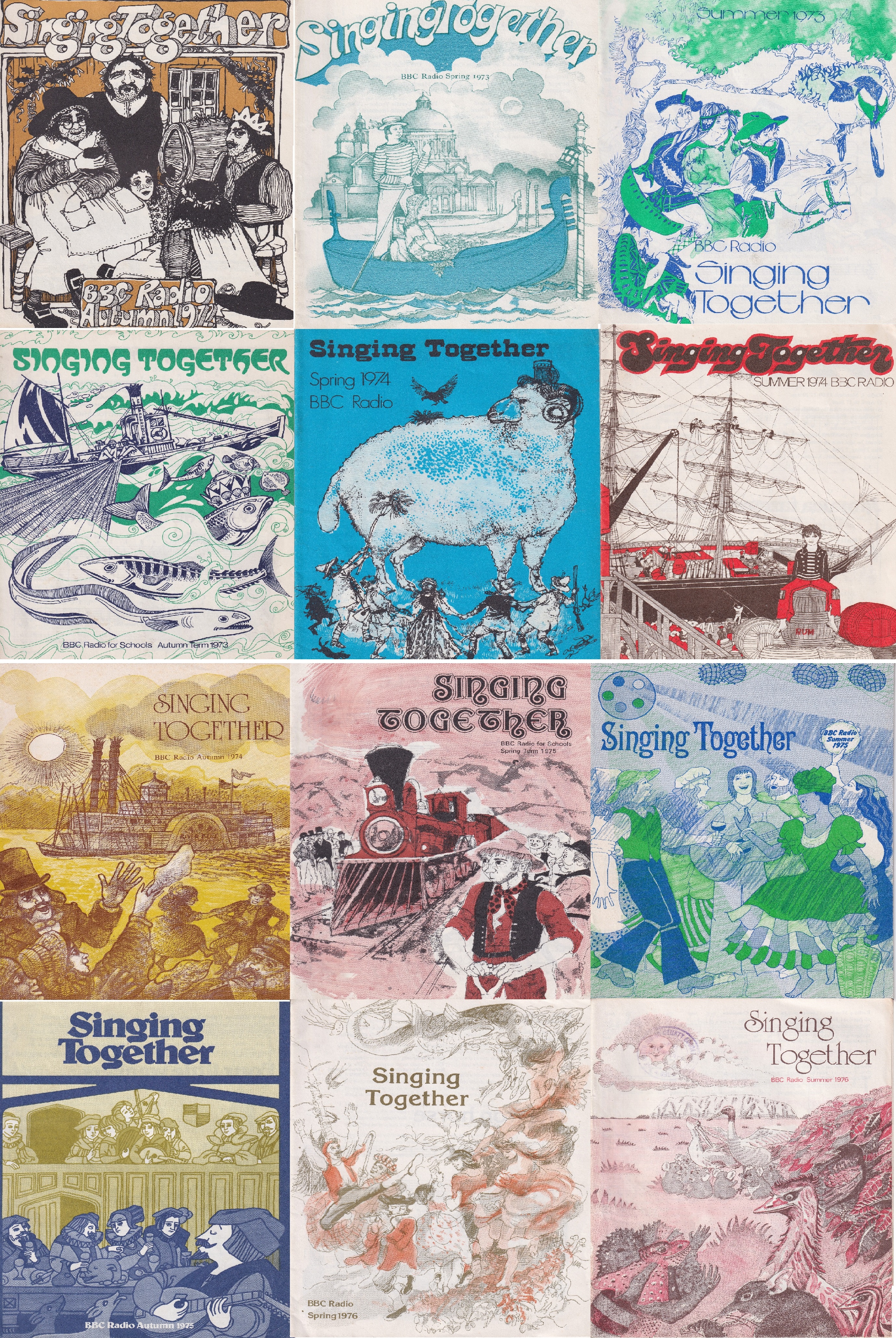
The first few years back in England were quite nomadic, and September 1971 saw me at Bligh Way Primary School in Kent which I remember as the first time I realised I was an outsider. I wasn’t liked by students or staff and I just remember wondering why we had to move there. Monday mornings were one of the few times I could really enjoy and it was nice to know that even in the face of the comments about my lack of coordination (dyspraxia) and general ‘weirdness’ (Asperger’s) I received from everyone including the headmistress there were some positive memories. Two songs immediately stood out from Autumn 1971, and I started singing them in my head as soon as I saw the titles. One was Land of the Silver Birch, a Canadian folk song about the Native culture with a chanted chorus that I found irresistible and the other was the carol from Saint Helena called Mary had a Baby which, once again had a chorus that has stayed with me for over 50 years. I loved the type of song you could ‘belt out’, a musical preference that has stayed with me ever since as my ongoing trawl through my singles collection is testament to! Neither of the other songbooks from that year had any songs that stood out, so onto the next school! My choice from the two mentioned is Land of the Silver Birch.
Cobham Primary School was one of those in the vanguard of the progressive teaching movement, where projects that saw each student ‘playing to their strengths’ made that school more to my liking. Once again, however, it was a one year stopping off point from September 1972 to July 1973! The progressive teaching meant that I could devote myself to reading and finding information for group projects, leaving other people to the writing and the art. There were a couple of obvious highlights in the Autumn 1972 book. The song Four Sisters again had a chorus that I enjoyed and amongst the carols there was Deck the Hall that I’m pretty sure I hadn’t come across before, which, according to the book, is a Welsh carol. There was a Spanish carol in this book called Fum, fum, fum, but it rings absolutely no bells whatsoever! The Spring 1973 book contained the most well remembered tune of all, the wonderful Song of the Western Men, a song of Cornish origin, that is thought to tell the story of either Sir John Trelawny, jailed by King James II in 1688 or his grandfather, of the same name, imprisoned by King Charles I in 1628. As with many folk songs the derivation is a matter of debate, but even if I had been aware of that debate I wouldn’t have cared, because the song is just fantastic. Here are The Fishermen’s Friends once again to show you how it should be sung.
Once again, the Summer Term had no songs I remember, but looking at the lyrics of Here Come the Navies, an Irish song, actually references the potato famine and the prejudice they faced when coming to England. It’s a fascinating insight into history, and quite advanced in a sense for primary school pupils.
It was off to another school in the September of 1973 (!) as my parents were unimpressed with progressive teaching and wanted something more traditional for me. I passed the entrance exam to get into St Andrew’s in Rochester and it became the only school which holds any fond memories for me at all. The three years there were safe because a lot of my fellow pupils seemed to be similar to be in many ways so I no longer really stood out. It was a lovely school and one I wish I could have been at for longer. The Autumn Term 1973 songbook contained more carols including the marvellous Gabriel’s Message which was the B Side of Sting’s single Russians. As with See Amid the Winter’s Snow, I knew it was familiar from somewhere when I first listened to Sting’s version, but it was only when I looked at that term’s Singing Together that I understood why. Perhaps he too heard it in Singing Together when he was training to be a Primary School teacher at the time. It’s an interesting thought isn’t it?

Spring Term 1974 is the cover I remember most clearly. It is based on the Derby Ram which I very dimly recall. It was The Lincolnshire Poacher that I really enjoyed at the time. As with all my other clearer memories, it was one that benefitted from an excellent chorus. The theme that is coming across when I look at these songs is that of folk songs that were pieces of social history, reflecting lives that never made the pages of the history books in a time when all that mattered was Kings, Queens and battles. Summer Term 1974 featured the West Indian song Jamaica Farewell which I loved, although I do remember in those less politically correct days that we were encouraged to sing the song in a Caribbean accent!
Autumn Term 1974 saw me in 3rd Year Juniors and thoroughly settled into the life of the school. The carols that term were not familiar then and not familiar now, but there was the bonus of Cockles and Mussels, a song I remember singing outside of Monday morning’s Singing Together broadcasts, because I enjoyed it so much. Spring Term 1975 had no real highlights for me, although I do remember Kalinka, the Russian song. Summer Term 1975 featured Scarborough Fair, made famous by Simon and Garfunkel, not that I knew it then.
My final year of Singing Together started with the Autumn Term 1975 songbook. The carols this year included the Carol of the Drum. Ringing any Christmas bells? Possibly not, but if I called it The Little Drummer Boy you would probably recognise it instantly. Even the children who didn’t like Singing Together could not help but enjoy that tune. Here’s my favourite version of that song from Charlotte Church
1975 – 6 was my last year of Primary School and Spring Term 1976 had two songs that I actually recognised already. A-Roving was a song sung by The Spinners, a folk group whose album was one of the few my parents owned. As a result I played it quite a lot at home and was very familiar with it already. The chorus of Casey Jones was the theme tune of a black and white TV programme of the same name, that appeared during school holidays if Champion the Wonder Horse wasn’t on (!), which I hadn’t thought about in ages before looking at the songbook. Here it is in all its ‘glory’!
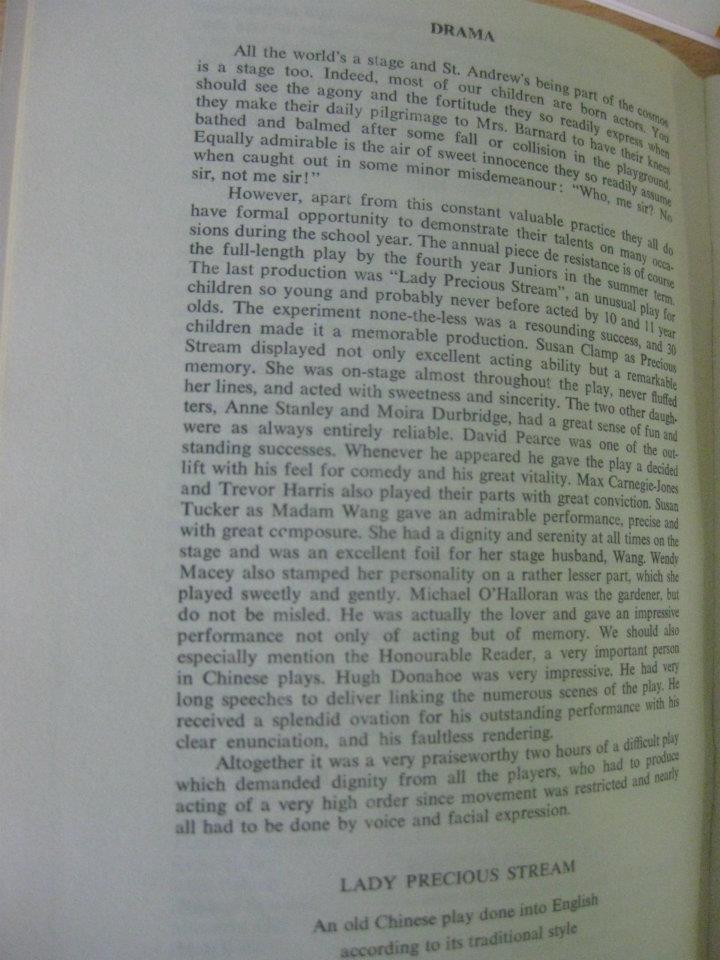
So to my final Singing Together songbook from Summer Term 1976. It was a very low key finish for the series, in terms of the songs, although I am sure that I joined in with my final opportunity to sing at 11am every Monday with my usual enthusiasm. That term saw me concentrating on Lady Precious Stream, the 4th year Juniors leaving play, in which I took one of the main parts, that of the Prime Minister! I loved it and thoroughly enjoyed getting most of the laughs. It is, however, somewhat bittersweet reading the review of the play which I never saw until returning to the school for its 60th anniversary. It reminds me that before the Maths School knocked it out of me I did have some self confidence.
So, there you have it. The part that Singing Together played in my formative years was low key but definitely not unimportant. It gave me a love for music, an appreciation of a good chorus, an early introduction to the music of the world and a smattering of social history. I feel that those of us who grew up in the Singing Together era were very lucky and I wish something similar had been around for my own children.
Discover more from David Pearce - Popular Culture and Personal Passions
Subscribe to get the latest posts sent to your email.
Trackbacks & Pingbacks
- Christmas songs from Singing Together 1970 – 1972 | David Pearce - Popular Culture and Personal Passions
- Revisiting Blogmas Day 13 Christmas Songs from Singing Together 1970 – 1972 | David Pearce - Popular Culture and Personal Passions
- The good and bad time stealers! | David Pearce - Popular Culture and Personal Passions
- What the Dickens? | David Pearce - Popular Culture and Personal Passions
- Primary School Discoveries | David Pearce - Popular Culture and Personal Passions
- A Grateful Blogger: Reflecting on 1000 Page Views | David Pearce - Popular Culture and Personal Passions
 David Pearce - Popular Culture and Personal Passions
I don’t remember the Singing Together show from my time at primary and juniors (1980-87)although i do remember the fun we had singing in assembly and music lessons, which included anything from traditional hymns and carols to Beatles and folk tunes. Some of the songs you’ve mentioned sound familiar though, so maybe we did sing them. Kate Rusby does a wonderfully atmospheric version of See Amid The Winters Snow on one of her Christmas albums – Of Angels And Men i think – that has a touch of Kate Bush about it.
LikeLiked by 1 person
I must take a listen to that, but it will take a lot to beat the Annie Lennox version. For me, Singing Together was something of a safe place every time it was on.
LikeLiked by 1 person
Thanks for the comments. I am ‘nigel42folk’ from Ebay (mentioned above). I also go under my own name, Nigel Parsons, at mudcat.org (a folk & blues site) where there is a contents list for ‘Singing Together’ covering nearly every term (from my collection) from 1950 to the 1990s: mudcat.org: Contents: Singing Together at joe-offer.com
Contents lists for many of the other BBC song books are also at Mudcat.org
LikeLiked by 1 person
Thank you for taking a look at this article. I have loved looking through the Singing Together books and I also did a couple of articles on Christmas songs which I really enjoyed writing. You definitely opened a door to my memories. Thank you.
LikeLike